Name That Neighborhood: Wall Street Blues

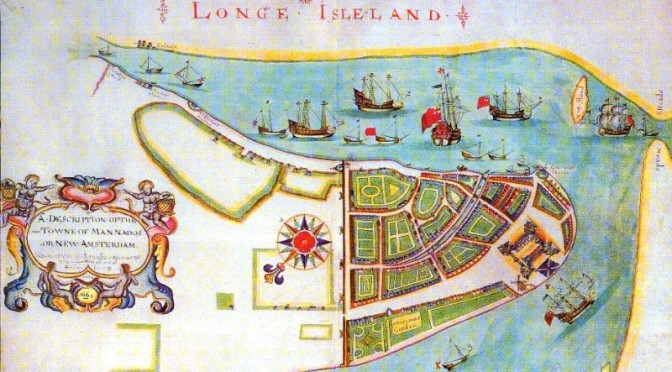
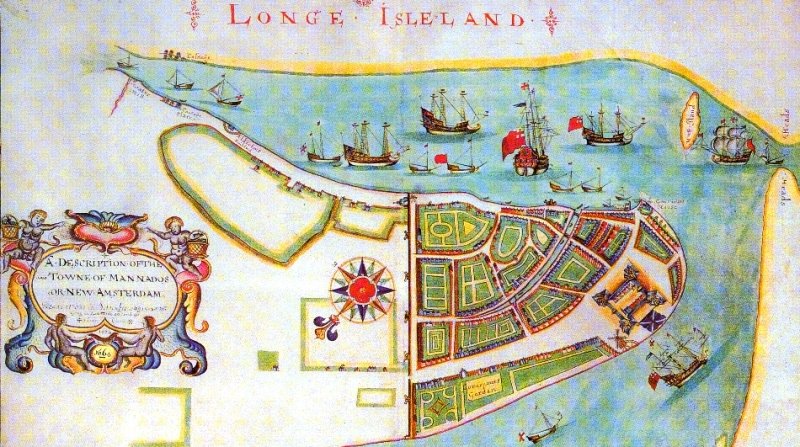
A simplistic but colorful view of “Man Mados” or “New Amsterdam” in 1664 (click in to inspect the detail)

One of the first facts you learn as a student of New York City history is that Wall Street, that canyon of tall buildings and center of the American financial world, is named for an actual wall that once stretched along this very spot during the days of the Dutch. The real story is rather fuzzied by the presence of a small community of French-speaking Belgians known as the Walloons.

The original ‘De Waal Straat’ was the center of a small Walloon community in New Amsterdam. There was most definitely a walled fortification nearby on New Amsterdam’s northern boundary, and it certainly did stretch along about the same area as Wall Street does today.

But the present name seems to be a formation of mixed meanings that only a tangle of languages and hundreds of years of history can create. The Dutch themselves referred to an actual street alongside the wall as the ‘Cingel’ — according to an old history, meaning “exterior, or encircling, street.”

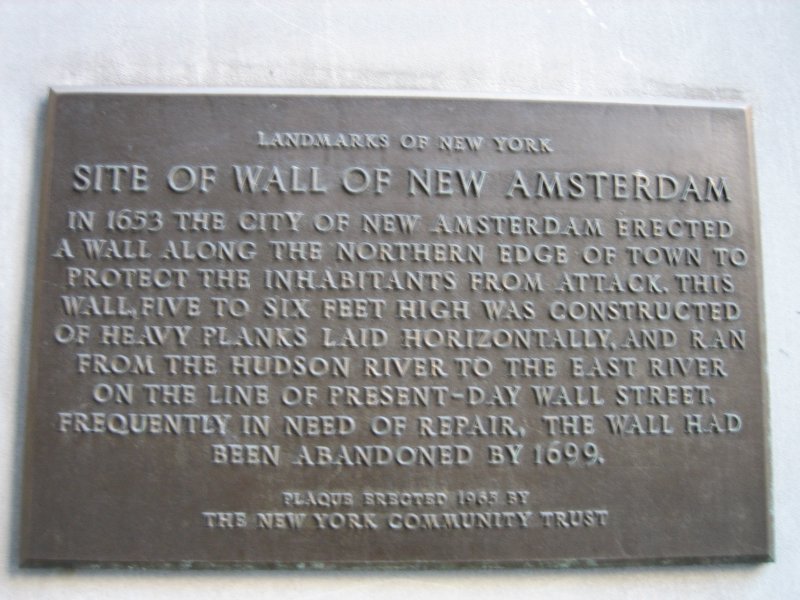
The real reasons for New Amsterdam building its famous wall are also up for grabs. It’s commonly held that the wooden palisade was erected in defense of Indian attacks, and certainly the residents of New Amsterdam did their part to rile the anger of the native landowners. But the Dutch had been living at the tip of Manhattan for over 25 years by the time the wall was built in 1653. In truth, it was commissioned to keep out a different sort of enemy.

You’ll be pleased to know that one-legged director-general Peter Stuyvesant was the man who ordered the construction of the “high stockade and small breastwork” that cleaved the Dutch community from the natural wilds beyond.

This was an incredibly important year for New Amsterdam in two respects. In February 1653, New Amsterdam was chartered as a official Dutch city. Although Stuyvesant was quite against the outpost receiving such official recognition, he eventually took advantage of it, appointing the first town council himself rather than putting it up to such trivial inconveniences as elections.

But in 1653 the tides of the motherland spilled onto their shores, as the war between England and the Netherlands threatened the remote and undefended new city. The Dutch intended to launch ships from New Amsterdam harbor in battle against the English.

As a result, the English colonies up north were sure to retaliate, either by sea or, feared Stuyvesant, over land, possibly teaming with hostile Indian forces, down through undefended Manhattan island. Essentially, the wall that helped give us Wall Street was built because Stuyvesant feared attacks not just from Indian tribes, but from the European colonies of Connecticut, Massachusetts and New Haven!
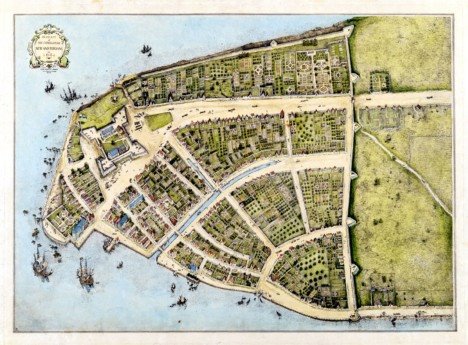
Above: looking at this more well known map of New Amsterdam, once can see the two gates very clearly

Stuyvesant called upon the 43 richest residents of New Amsterdam to provide funding to fix up the ailing Fort Amsterdam and to construct a stockade across the island to prevent attacks from the north, while it took New Amsterdam’s most oppressed inhabitants — slave labor from the Dutch West India Company — to actually build the wall.

The barrier was constructed out of earth, rock, and 15 feet timber planks sold to the Dutch, ironically enough, by the “notorious” Englishman Thomas Baxter. In a turnabout that one would expect from hiring your enemy, Baxter later led a group of “Rhode Island marauders” and pirated Dutch fishing ships.

Early in the 1660s, the Dutch upgraded its wall to include brass cannons and two sturdy gates — one at today’s intersection of Wall and Broadway (for land), the other at Wall and Pearl Street (according to an early account, a water gate and access to a ‘river road’).

The British took over New Amsterdam in 1664 and renamed it New York, but the wall still remained, becoming more a relic than a serious defense.

By the turn of the century, the fear of land attacks had almost completely subsided and the city was beginning to feel crowded. So in 1699 the wall was torn down with some of the material salvaged to help construct a new City Hall at the corner of Nassau Street and the newly cristened Wall Street. When the British were forced out in 1783 by the Americans, the City Hall building was renamed Federal Hall — the first official center of American government.

A plaque honoring the old wall sits today at the corner of Wall and Broadway, where the gate to the city once opened:
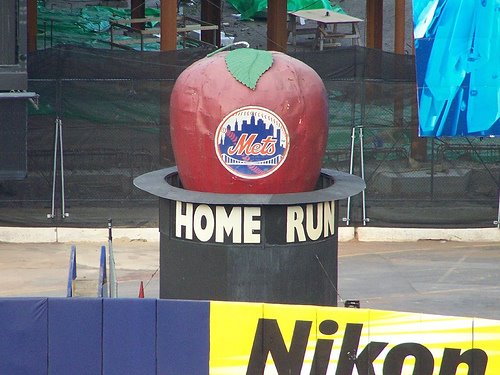
Mets Apple won’t fall far from the tree

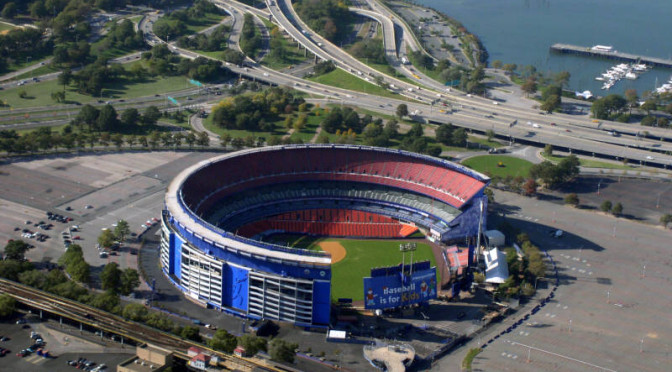
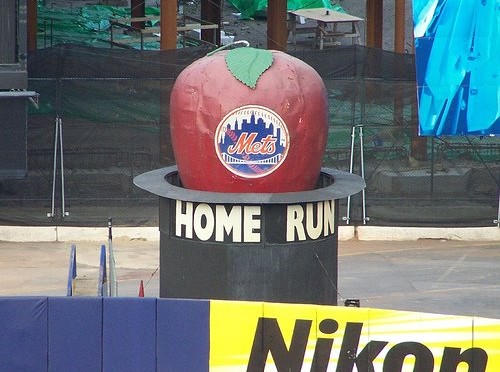
Back in March, we speculated on the fate of Thurman Munson’s locker, which had been preserved at Yankees Stadium since the untimely death of the popular Yankees catcher in 1979. Well, Shea Stadium has a far more irreverent but equally treasured fixture that many have been wondering about — the Mets Apple. Will the frail little thing make the move to Citi Field? The answer: no, and yes.

The Mets nine-feet-long, 582 lb apple, which would not look out of place in a Disney animatronic ride, made its debut during the 1980 season. Hoping a clever slogan could prove prophetic, the Mets advertised that “The Magic Is Back!” that year, literally demonstrating this with a mechanical apple that would emerge from a top hat behind center field every time a Met hit a home run.

Accompanied by a light show and the occasional firework display, it was without question one of the cheesiest things to ever grace an American sports stadium. Because of that, however, it was quickly beloved by Mets fans, derided by Yankees fans, and pretty much confused everybody else.

Silly, of course, but the apple was a colorful and original quirk of Shea Stadium. So when it was announced that the Mets would be moving to Citi Field, fans became concerned about the fate of the fruity apparatus. An impassioned website Save The Apple attempted to convince the team to move the apple, which they concede is “an ugly 80s relic.”

Their mission was only partially accomplished. According to the Daily News, a new replica of the apple will be popping up in center field at the new Citi Field.

It’s been confirmed that the original apple — fairly withered on the vine already — will be saved from the trash heap and will make the transition to the new field in some capacity. But how it will be displayed is undermined. Fans have suggested the apple stand alone on the walkway leading up to the new stadium.

Photo above from Flickr

Categories
Podcasts

PODCAST: Shea Stadium

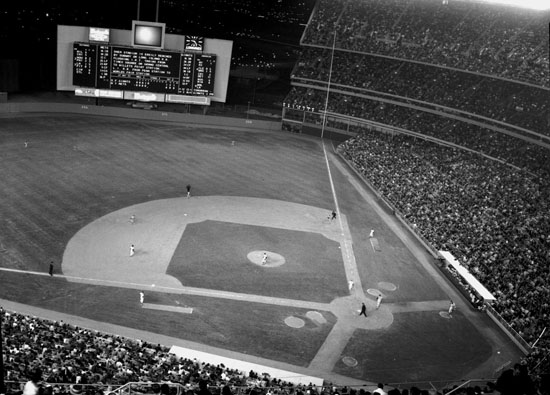
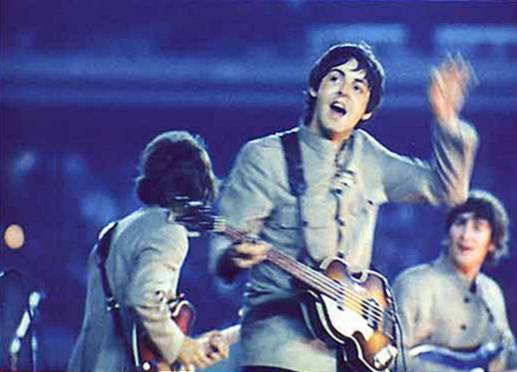
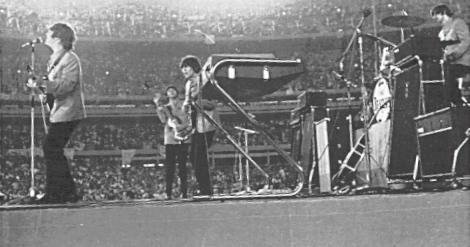
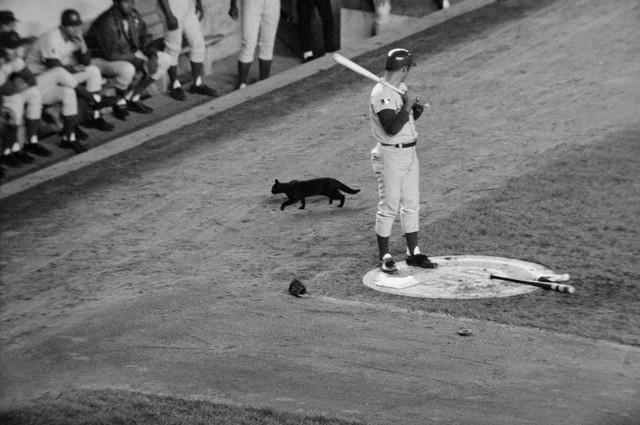
The Mets are movin’ out to Citi Field, but we can’t overlook the great stories contained in their old home, Shea Stadium, a Robert Moses project took years to get off the ground and has been populated with world class ball players, crazed Beatles fans, and one very mysterious black cat.

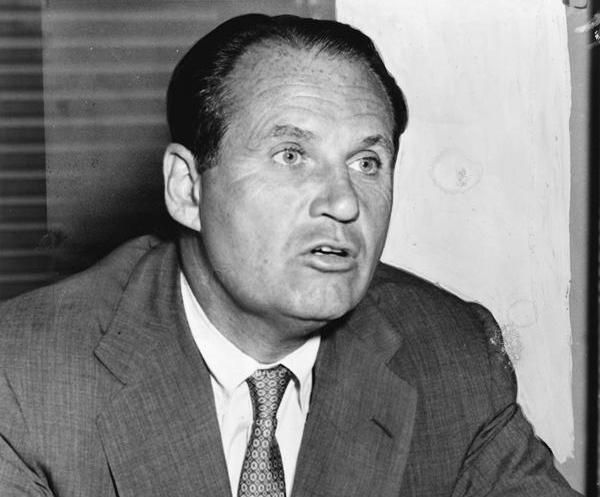
William Shea, who essentially bluffed the National League into creating a new team for the city — the New York Mets

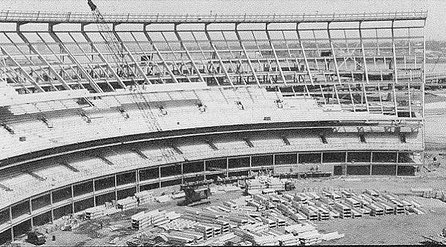
Shea under construction. Plans for a retractable done were abandoned, although many of the features that did make it were revolutionary at the time, including one of sports biggest scoreboards.

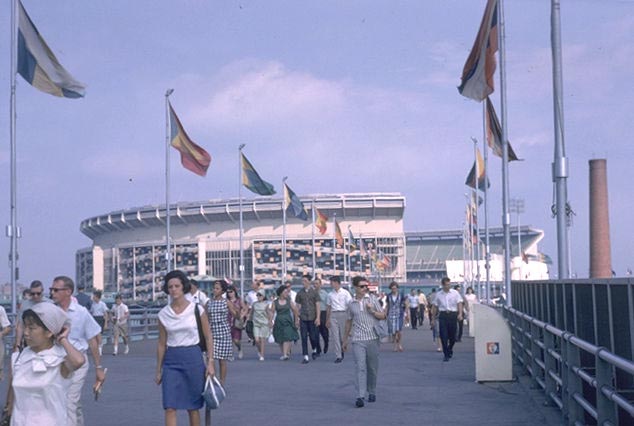
How the exterior of Shea Stadium looked back in 1964. (The photo above is from a great fan website from Carl Abraham, full of great old pictures. Check it out here.)

And inside, the same year.

The biggest stars to play in Shea Stadium in the 1960s weren’t sports figures, but music heartthrobs — the Beatles.

The infamous black cat from that acursed game in September 1969, jettisoning the hopes of the Cubs that year.

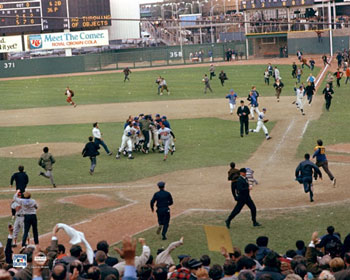
Fans literally stormed the field the moment the Mets clinched their very first Worlds Series title in 1969.

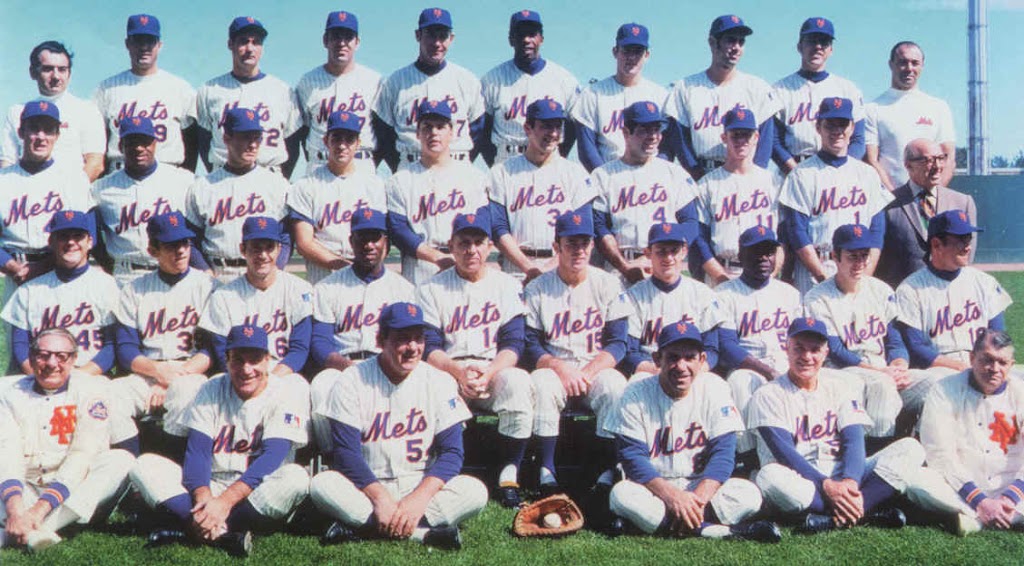
The proud lineup of the Miracle Mets of 1969.

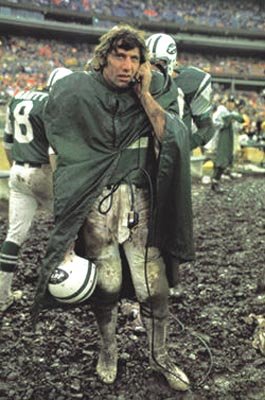
His notable performances and personal theatrics at Shea Stadium with the New York Jets turned quarterback Joe Namath (#12) into a Wheaties-box household name during the 1970s.

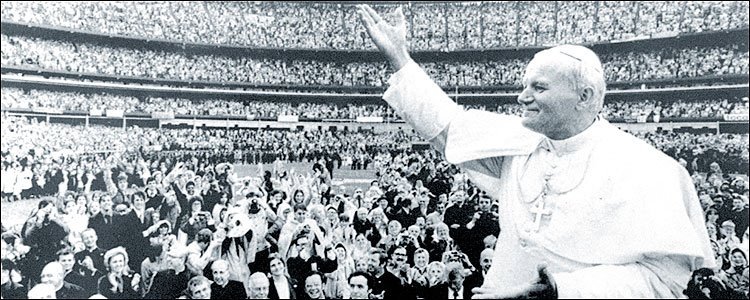
No less a star than Namath, Pope John Paul II finds a warm welcome for him at Shea in 1979.

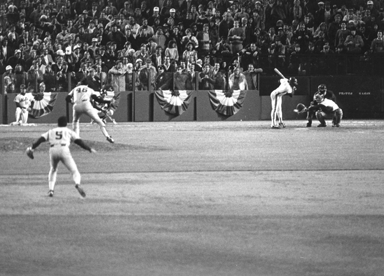
One of the Mets biggest stars of the ’80s, cheerful center fielder Mookie Wilson, was instrumental in the Mets World Series win of 1986 over the Boston Red Sox.

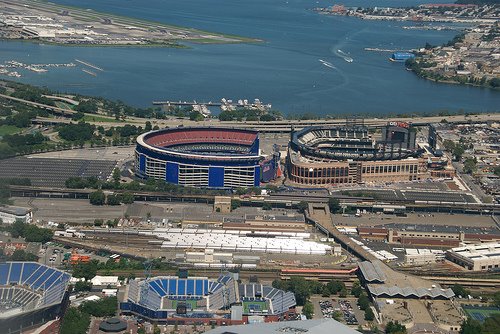
The new Citi Field sits within site of the stadium it will replace

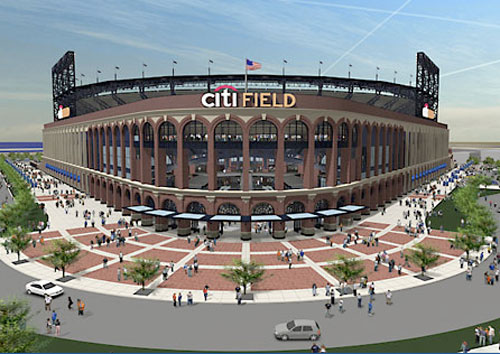
An illustration of what the new Citi Field will look like.

Ever wonder why the Mets team colors are blue and orange? Read one of our very early entries about it here.

However, a commenter below notes that the Mets website actually says: “The Mets’ colors are Dodger blue and Giant orange, symbolic of the return of National League baseball to New York after the Dodgers and Giants moved to California.” Which sounds very plausible — and amazingly coincidental, considering they’re also the official colors of New York. Perhaps the Giants and the Dodgers original sporting colors were based on the official colors, making both explanations correct?

Frankly there’s been no better tribute to Shea Stadium than the New York Post’s current countdown of the top 25 moments that occurred there over the years.

Union Grounds: Baseball history in Williamsburg

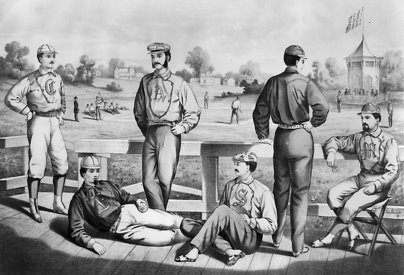
Above: Quite a fancy looking team of baseball players! Note the pavilion in the background. Picture courtesy Brooklyn Ball Parks

I love finding out where very basic, everyday, take-for-granted concepts were invented. For instance, there is some place on the planet I’m sure that heralds as the first place somebody put a straw in a beverage and drank it.

Well, in today’s Williamsburg, in a crowded section inhabited by a mostly Hasidic Jewish population, there once stood a baseball field named the Union Grounds with a unique distinction: it’s the first to regularly charge spectators to watch a game of baseball.

In the mid-19th Century, Williamsburgh was a fairly new independent city, having divested itself from the neighboring town of Bushwick several years earlier to govern itself. The Union Grounds were actually built on the outskirts of the nearby town of Wallabout, but its location on a large patch of land bounded by Marcy Av., Rutledge St., Harrison Ave., and Lynch St. is today in modern Williamsburg.

Believe it or not, baseball had been a recreation for New Yorkers for over 20 years — a New Yorker even invented it — by the time that William Cammeyer built Union Grounds in 1862 from an outdoor skating rink he owned. It would still be used for ice skating during the winter months.

Previously, field owners made profits by charging teams fees to play. Seating was provided at some fields for fans, and spectators were encouraged to stand around and watch, sometimes even around the very baselines.

Baseball was well organized by this time; the first official baseball league incorporated sixteen teams — most of them from New York and Brooklyn. Cammeyer decided to capitalize on the sports popularity in 1869 by fencing in the field and charging the spectators (a reasonable ten cents) for the honor of watching these top-notch squads in action.

Certain teams gravitated to the Union Grounds, loosely giving the field its own home teams. The Eckfords, a team named after a shipbuilder, were league champions that played most of their games here, as did the Mutuals and the Hartford Deep Blues. The field would continue to host teams in the 1870s, when baseball went ‘professional’ and paid players and teams would be associated with particular cities.

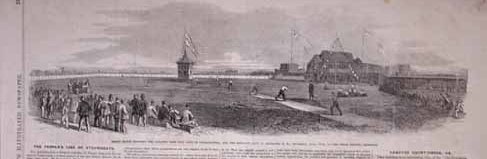
Apparently the field was still making enough money as an ice skating rink that one certain disruptive feature sat in the outfield during baseball season. According to Brooklyn Ball Parks, an elegant three-story pavilion was planted in the middle of outfield, used during the winter to light up the ice at night. (Below is a page from Frank Leslie’s Illustrated Newspaper circa 1865, before the fence went up. However if you click into it, you can see greater detail of the ballfield and this curious feature.)

The field was plowed over on July 1883 and replaced with the 17th Corps Artillery Armory, which still stands there today.

Former location of the Union Grounds:


View Larger Map

Categories
Uncategorized

Name That Neighborhood: Why is Jamaica in Queens?

Some New York neighborhoods are simply named for their location on a map (East Village, Midtown). Others are given prefabricated designations (SoHo, DUMBO). But a few retain names that link them intimately with their pasts. Other entries in this series can be found here.

I have a friend of Jamaican descent that lives in Jamaica, Queens. I used to think that was like a French Parisian moving to Paris, Texas. That’s wrong, actually. Paris, Texas, is actually named for the French capital. Jamaica, Queens, meanwhile, has almost nothing to do with the Carribean nation that shares its name. (Although many of Jamaican island descent do live in the Queens borough today.)

Jamaica is an English distortion of an Algonquin tribe that inhabited this Long Island outpost — the Jameco Indians (also referred to as the Yamecah tribe). They were named after the Algonquin word for beaver.

The Jameco lend their name to various parts of the city, from Jamaica Bay (the body of water in front of JFK airport) to Jamaica Avenue, a prime extension of East New York Avenue through Brooklyn and eastern Queens.

A pathway between Brooklyn and the city of Jamaica, called the Jamaica Pass, was used to the British’s benefit during the war of 1776, sneaking around American forces and chasing them back to Manhattan.

By then, the British were calling the town of Jamaica by its modern name. The Dutch before them, however, had referred to the village there as Rustdorp, settling there in 1656 and officially coined by none other than Peter Stuyvesant. I leave it up to you to determine which of these names sounds like more exciting and vibrant community.

As for the island of Jamaica, it was inhabited by a tribe of Arawak indians, who named their place Xaymaca, which holds the far more flattering translation of “land of wood and water.”

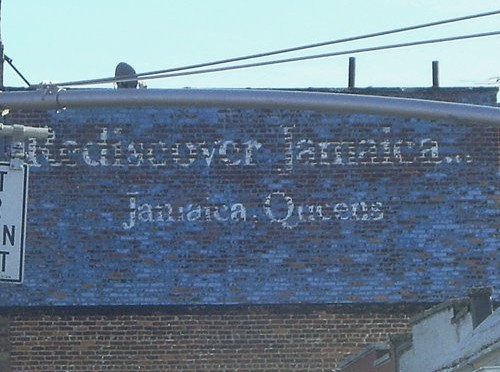
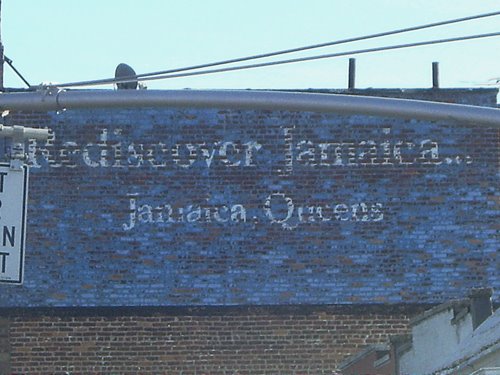
Photograph above is from the Fading Ad Blog.

Categories
Podcasts

PODCAST: The Pan Am Building

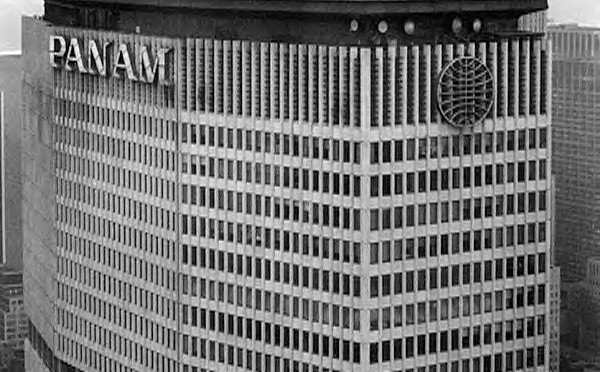
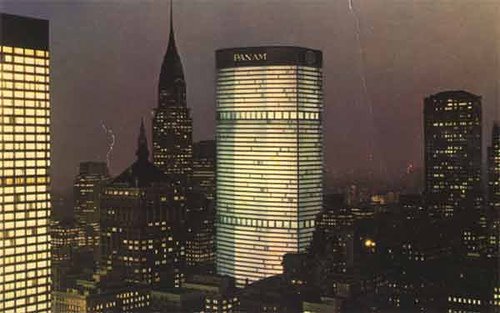
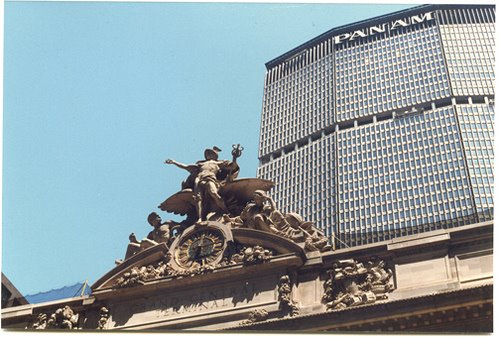
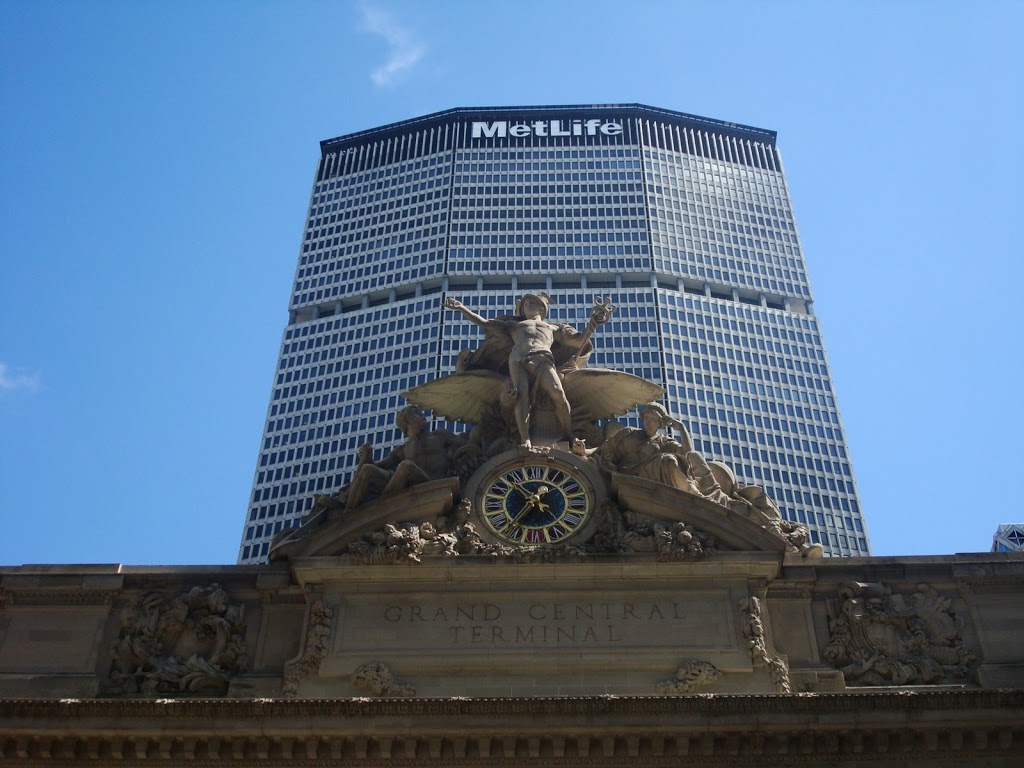
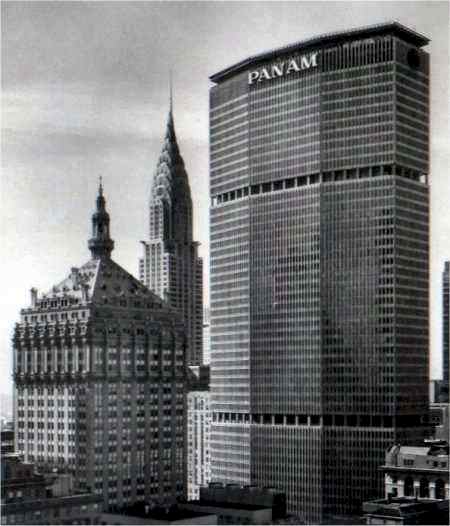
Today it’s the Met Life Building. It’s been called the ugliest building in New York City. It sits like a monolith behind one of the city’s most enduring icons Grand Central Terminal. But it’s got some secrets you may not know about. In this podcast, we scale the heights of this misunderstood marvel of modern architecture.
Listen to it for free on iTunes or other podcasting services. Or you can download or listen to it HERE

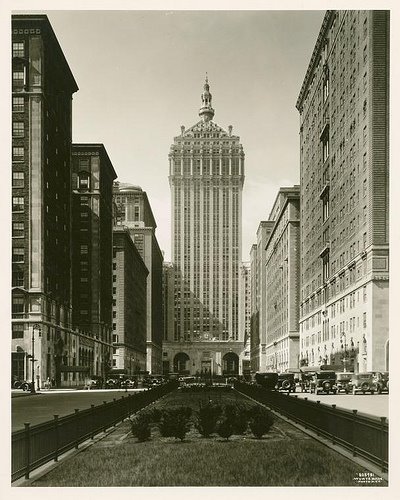
In the days before the Pan Am Building, Park Avenue was lorded over by the ‘dowager queen’ of glamour architecture, the New York Central Building (later the New York General Building, and finally — the Helmsley Building)

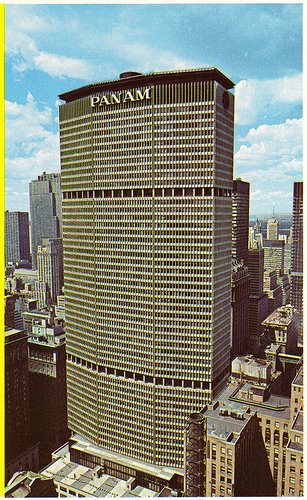
Another angle, year of photograph unknown.

In this picture, taken in 1962, the monolith is almost complete.

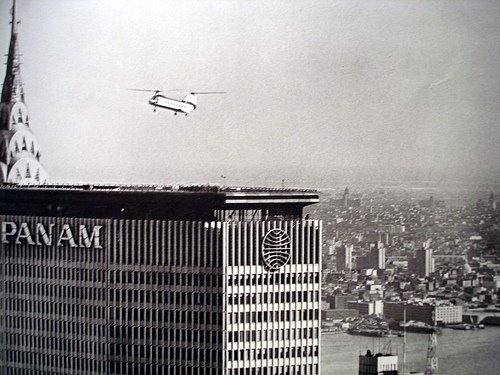
New York Airways once provided helicopter service from the top of the Pan Am in the 1960s. It was briefly revived in 1977, but a tragic accident killing five people ensured it would never be tried again.

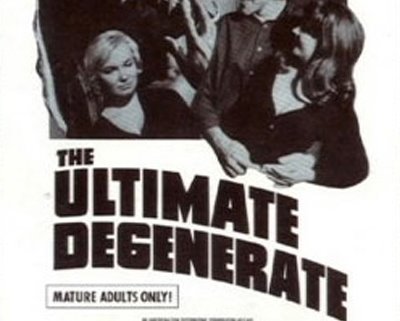
One of those killed in the tragic helicopter blade accident of 1977 was film producer Michael Findlay, creator of such sexploitation classics like the Flesh trilogy and the Ultimate Degenerate. (He also made some films with titles that are bitterly ironic considering his untimely death.)

In 1987

Today

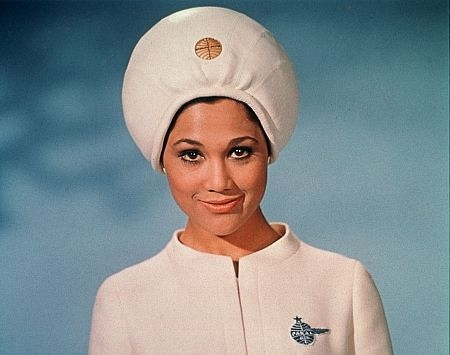
When Pan Am moved into the building in 1962, they were one of the world’s leading airlines, best known for their on-board service and fleet of attentive flight attendants.

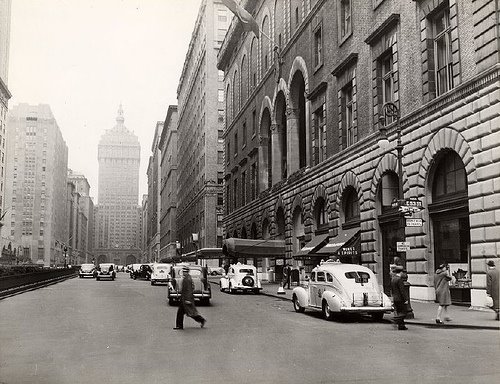
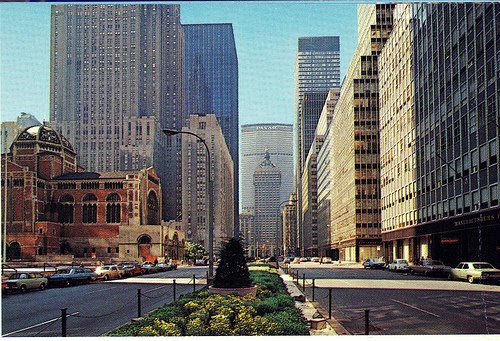
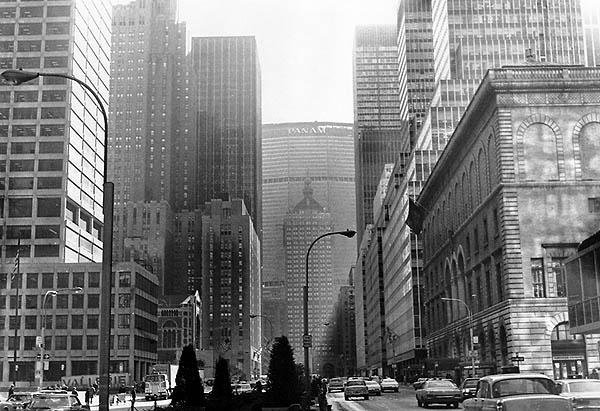
Looking down Park Avenue at the Pan Am in 1970

The same view a few years later

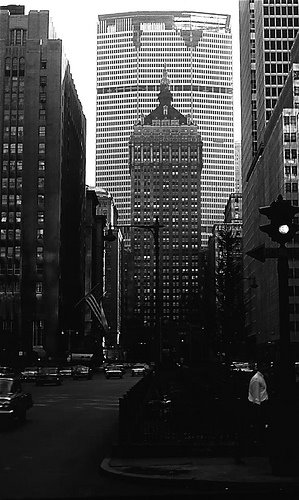
Its relationship to the Helmsley Building has caused great controversy over the years. Some say it’s like hanging a work of art in a cheap frame.

Metropolitan Life replaced the Pan Am logo with its own in 1991

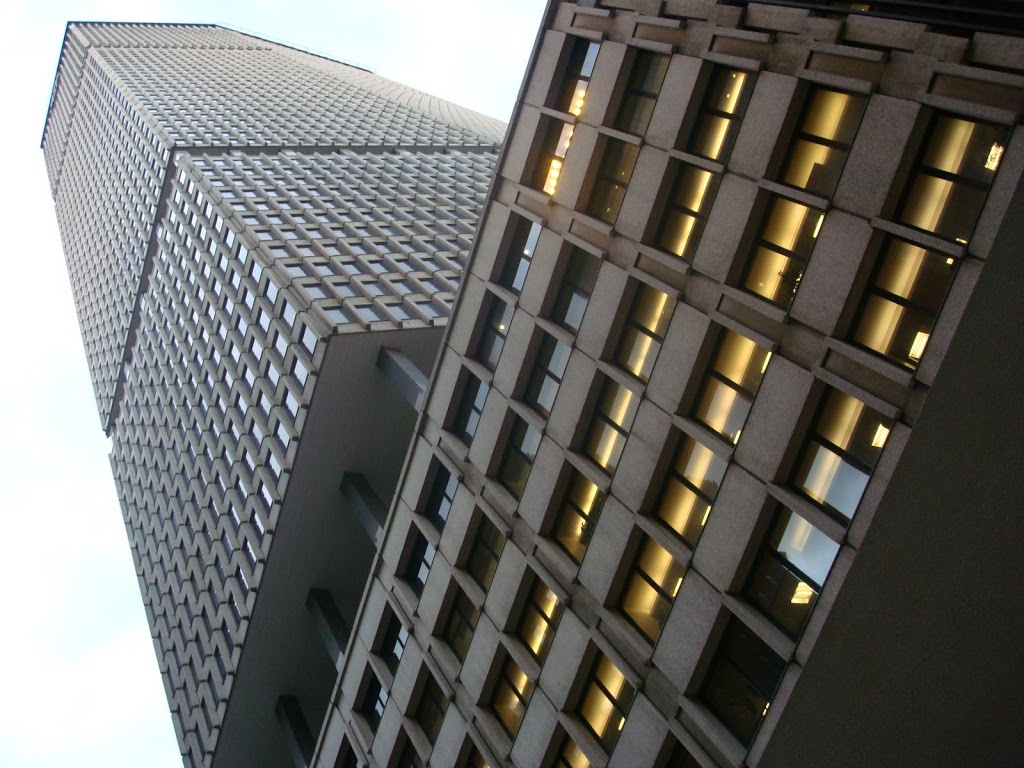
Quite unlike an impressionist painting, the building actually looks more interesting the closer you are to it, revealing some odd angles befitting its imposing proportions and ‘lozenge’ shape

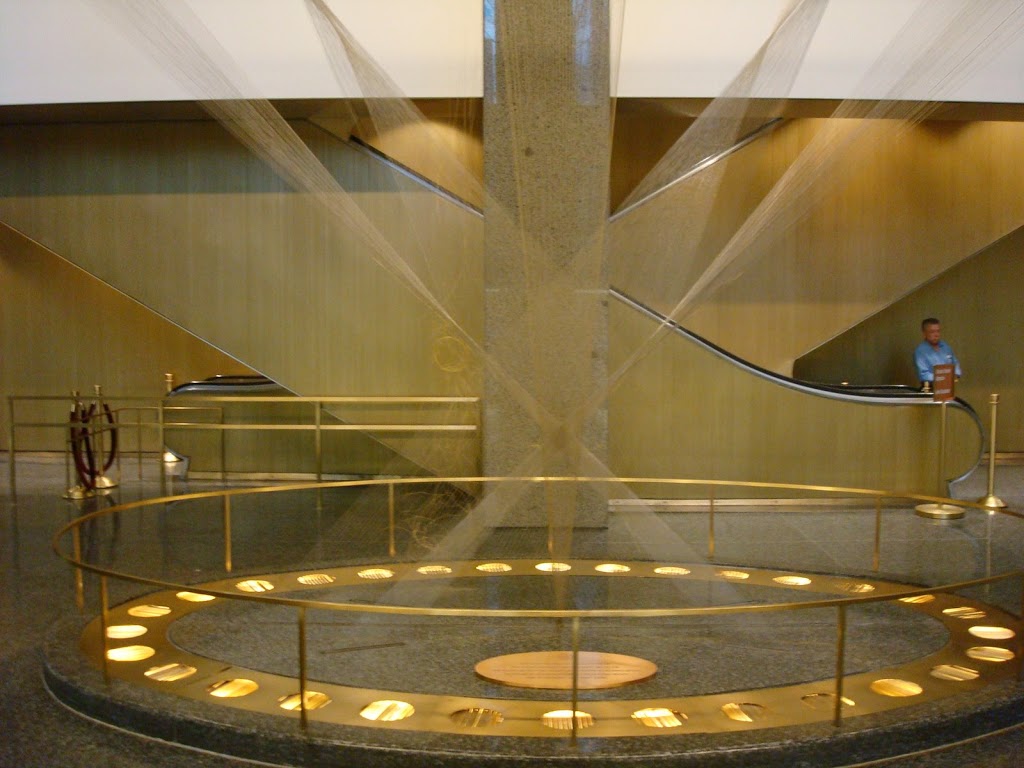
Inside the lobby: Flight, the expressive wire sculpture of Richard Lippold. The lobby once also held a painting by Josef Albers.

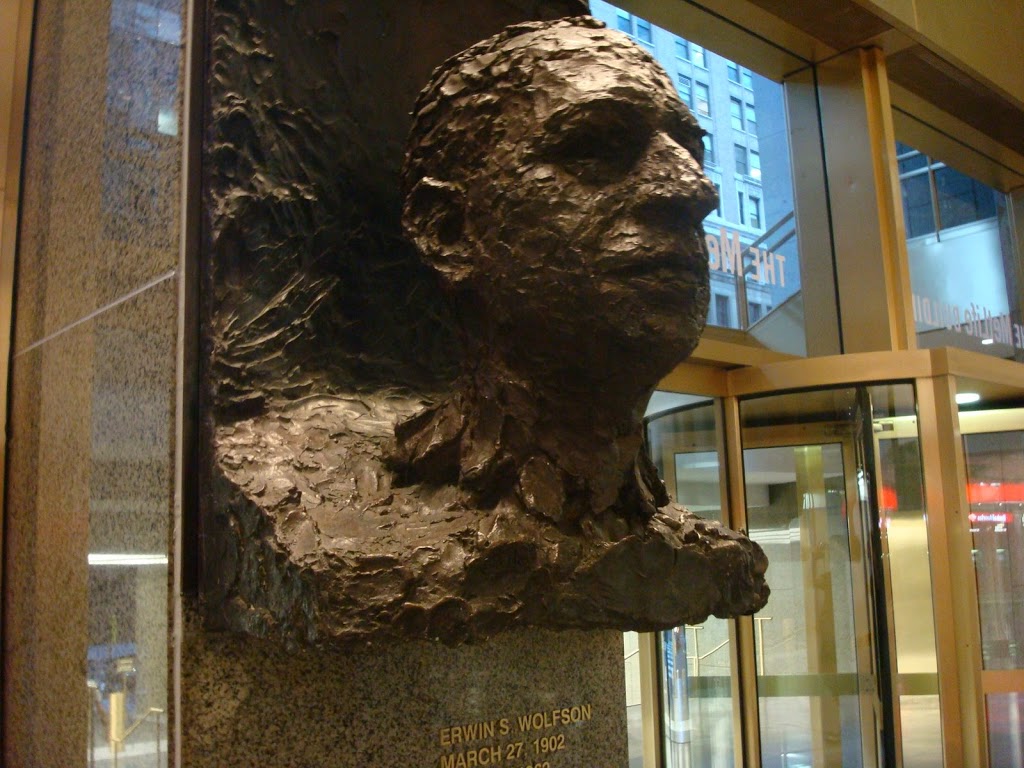
This rather grotesque bronze bust of Erwin Wolfson greets you as you enter the building.

CLARIFICATION: In the podcast, it appears I was a little vague in my description the Metropolitan Life Insurance Tower which is on Madison Square Park. Although the slender clock tower is indeed also topped with gold ornamentation, do not confuse it with Madison Square’s real gold standard — the gilded New York Life Insurance Building

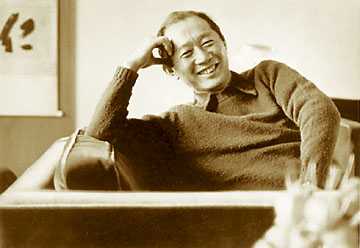
Minoru Yamasaki: The man who made the Twin Towers


In 1962, Minoru Yamasaki was given an improbable, totally ridiculous task.

Yamasaki, a Japanese-American architect best known at the time for his modernist designs of airports, university buildings and synagogues, won the World Trade Center job in 1962 over more internationally famous architects. He was paired with the prolific Emery Roth and Sons, who had marked Park Avenue with a chilling procession of tall concrete monoliths.

Yamasaki and Roth were commissioned by Port Authority, on an inspiration from the Rockefellers, to build a gargantuan office space on a relatively small area of land — 12 million square feet of usable space over a mere 16 acres, all the while with trains rushing beneath it and the Hudson River right next door.

It would take a balancing act worthy of Philippe Petit(the tight-rope walking subject of Man of Wire who later walked between the Twin Towers) to create something both elegant and functional on such absurd dimensions.

One massive tower over the space would tax even the most expert construction teams and cast a large looming shadow over the city. A cluster of buildings would, in the words of Paul Heyer, “[become] too approximate for their size and ‘looked too much like a housing project’.”

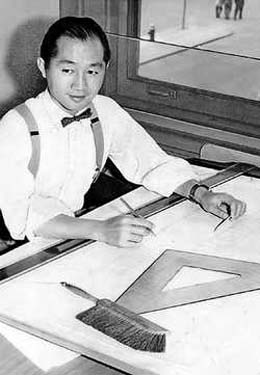
This spacial puzzle, however, proved no match for the exceptional Yamasaki. Born in Seattle in 1912, he worked his way through New York University and into the city architecture scene by sheer genius, during a time in the early 40s when many Japanese American back home were placed in internment camps. He started ambitiously — at Shreve, Lamb and Harmon, who brought New York many great skyscrapers including the Empire State Building — and branched out into his own firm in the 1950s.

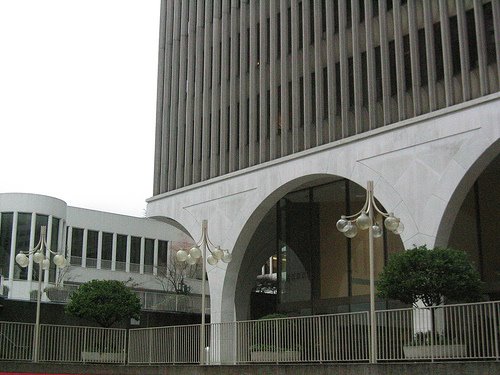
He distinguished himself with fabulous buildings in Seattle (the IBM Building) and throughout the Midwest, with a unique Gothic twist to the modernist aesthetic. In a world possessed by International style — with coarse, hard and lean as code words to a new world of architecture — Yamasaki was still a poet who eschewed pure brutality. Interestingly, for the World Trade Center, he was paired with New York’s main liners of architectural brutalism, Emery Roth, who never saw a slab of concrete he didn’t like.

Below: the IBM Building in Seattle, in many ways a practice run for the Twin Towers in its linear form and simplicity

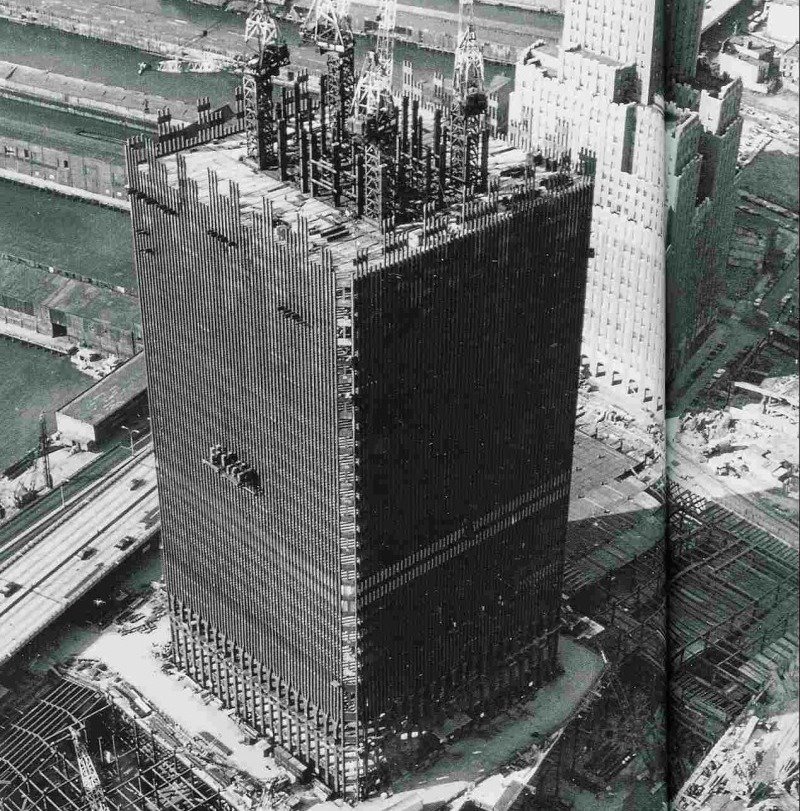
Balancing his own principles with Roth’s, taking an impractical situation presented by Port Authority and the vast budget (eventually $900 million) attached to it, Yamasaki decided that to balance it all meant a physical symmetry — two buildings standing side by side, with an open plaza in between so that the sheer immensity could be admired.

Construction on the towers began in 1966 and the second tower was finally completed in 1973. By then, Yamasaki and his firm would scatter great buildings all over the world, working right up to his death in 1986. But although he would be known as a visionary architect, the World Trade Center was his only building for New York City.

“World Trade Center should, because of its importance, become a representation of man’s belief in humanity, his need for individual dignity, his beliefs in the cooperation of men, and through cooperation, his ability to find greatness.” — Yamasaki

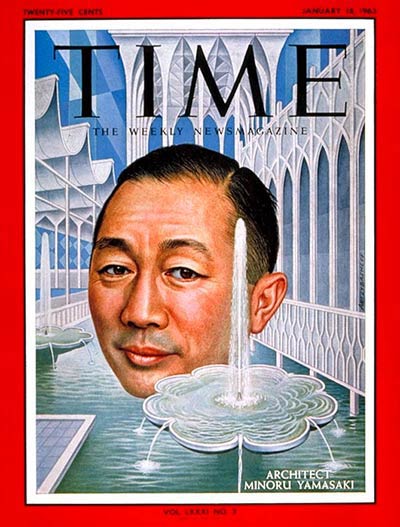
Below: Mere anticipation at the greatness of the World Trade Center planted Yamasaki on the cover of Time Magazine in 1963

Click here for our recollection of September 11, 2001 from last year.

Know Your Mayors: William Lafayette Strong

Our modest little series about some of the greatest, notorious, most important, even most useless, mayors of New York City. Other entrants in our mayoral survey can be found here.

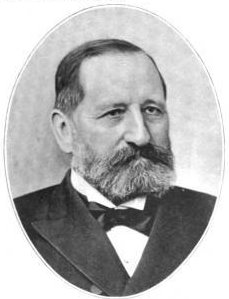
Democrats and Republicans in this year’s election who think they can roll into office on the mantel of “change” may want to look at the example of William Lafayette Strong (mayor 1895-97), a reformer who swept in, cleaned up the city … then watched it all fall apart again.

One of the great narratives of New York City in the late 19th century is the dominance of the Democratic Tammany Hall machine in controlling city politics, often seeped in deep corruption.

At key periods, however, Tammany Hall would be usurped from its perch. In the 1870s came the great reckoning to Boss Tweed and mayor A. Oakley Hall. However by the early 1890s, Tammany had regained control of local government and had installed mayors who exhibited various degrees of independence. (For instance, the topic of our last Know Your Mayors column, Hugh J. Grant, mayor from 1889–1892, was firmly in their pocket.)

By 1894, in the throes of a nationwide fiscal depression, outrage at open corruption in the police department prompted the New York State Senate, Republican-led and frequently at odds with city management, to clamp down. The Lexow Commission, named for its chairman Senator Charles Lexow, exposed deep veins of criminal negligence within the New York police department and issued a now-legendary 10,000 page report outlining the most grievous charges.

Republicans and reform-minded Democrats saw their chance to effectively wipe Tammany from the map. Forming a Committee of Seventy (a Biblical reference, as well as one to the group that helped expose Tweed’s malfeasance), they rallied their support in late 1894 with a fusion ticket backing a political novice, one William Lafayette Strong.

Like another reformer mayor before him (William Russell Grace), Strong was a businessman made good, an Ohio-born dry goods merchant turned banker whose efficiency and clean record (not to mention prominent position on the influential Union League Club) endeared him to those looking for a clean break from Tammany.

Still reeling the Lexow smackdown, Tammany Hall could only watch their ambitions fold. Against Strong they put up Nathan Straus of Macy’s Department Store as their candidate; within two weeks, he resigned, fearing business reprisals. They replaced him with former mayor Grant, but he was no match against the fusion ticket and alliance of German and Jewish voters, which easily swept Strong into office.

Strong went immediately to work, scouring City Hall of bureaucratic buildup and rebooting municipal agencies mired in Tammany cronyism. First on the agenda was a literal cleanup, hiring Civil War vet George Edwin Waring Jr. as the head of street cleaning, an absolutely key element to restoring the city’s psychological health. Within a few months, New York’s streets — clogged with garbage, manure and other detritus — were as clean as they had ever been.

Strong’s most electrifying appointment, however, would put a future president on the road to the Oval Office.

Lexow had exposed the police department’s weaknesses, and Strong sprung on this moment for a radical shakedown, hiring a new police commissioner known for his tenaciousness, an also-ran for mayor with roots in New York City — Theodore Roosevelt.

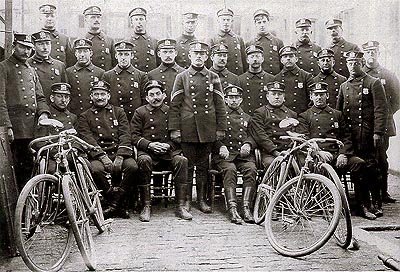
The new commissioner was a dominant force in transforming the city at this time, easily outshining Strong. Roosevelt eliminated anyone associated with prior corruption and installed new programs that would improve efficiency but also confidence among the ranks. Notably he mounted cops on bikes (see below), a quaint notion today, but one that at the time allowed a pervasive presence throughout the city.

Roosevelt’s key ally was not Strong but our old friend Jacob Riis. With Riis’ guidance, loathsome and unsafe police homeless shelters were shut down. It was the influence of Riis, through his close associate Roosevelt, that enabled Strong through recently passed state laws to finally tear down the tenements of Five Points.

The New York school system was also getting a thorough shake. In July 1896, Strong and an emboldened state legislature passed the School Reform Law, which for the first time created a centralized education system in the city. Previously, schools were governed by city wards, a practice allowing for uneven educational opportunities and fertile ground for all manner of dishonesty.

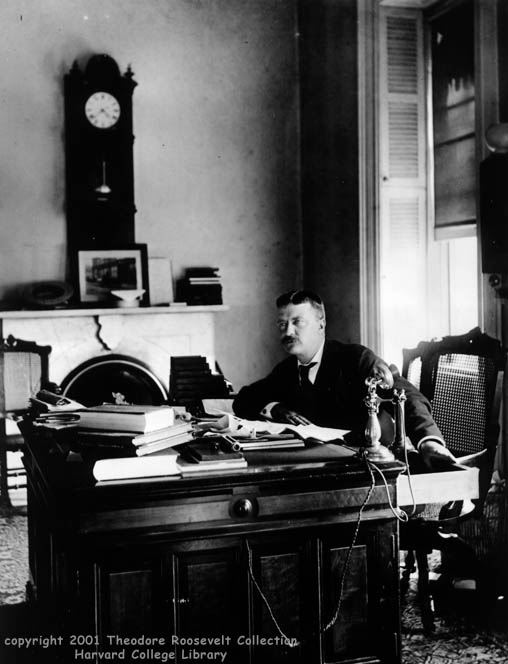
We benefit today from many of the vast reforms initiated under Strong’s administration. The effects on his own political fortunes, however, were far less beneficial. Roosevelt had become unwieldy, shutting down saloons popular with the German New Yorkers who had helped sweep Strong into office. The closures of these working class drinking holes were evidence that Strong spoke only for the rich, claimed activists, whose rallies and protests were harshly dealt with by Roosevelt’s newly determined police force. Above: Commissioner Roosevelt in his office

By the time the backlash began for Strong and Roosevelt, the commissioner had already resigned, on a naval appointment from William McKinley and a few years away from being president of the United States.

Part of the reason for so many pressing reforms through state government is because of the most important event in New York history — the consolidation of the boroughs, slated to take effect on January 1, 1898. William Strong is the last mayor of the unconsolidated borough of Manhattan, passing over the newly created city to new mayor Robert Van Wyck….handpicked and groomed by Tammany Hall.

Strong was vociferously opposed to the consolidation, thinking it a ridiculous burden to the city coffers, vetoing it even up to the very end. By that time, however, Strong was not seeking re-election, but for decidedly personal reasons. In cleaning up the city — getting it ready for the future — his own business had nearly gone bankrupt. He would die just two years later, in 1900.

Strong left a vastly changed city, newly expanded, and now in the hands of the very group whose prior machinations he had tried so very hard to reverse.

That’s politics for you.

‘Rent’ hikes, taking the old East Village with it


A stubborn group of good-looking, well-meaning squatters were finally evicted last night as the hit Broadway musical ‘Rent’ closed after 5,124 performances.

The show had become the most peculiar historical time capture on Broadway, freezing forever a musical variation of late 80s/early 90s, pre-Guiliani East Village underground, recalling a time when Avenue B had far fewer condos and trendy bars. Seen now as a history of pre-development, ‘Rent’ documents a psychic battle most feel the East Village lost — artistic independence in a shrinking bohemian subculture.

‘Rent’ was written as a tangle of contemporary love stories — based loosely on ‘La Boheme’ — by Jonathan Larson, the young playwright who died of an aortic aneurysm the day before the show’s opening night (January 26, 1996) at the New York Theatre Workshop.

‘Rent’ moved to Broadway that spring and won the Best Musical Tony, eventually becoming the seventh longest running show in Broadway history. It fell into a ragtag category of edgy downtown shows made good — inheritor of ‘Hair’-like passions among fans and setting the stage ten years later of ‘Spring Awakening’, another sexy, youthful show based on an older source.

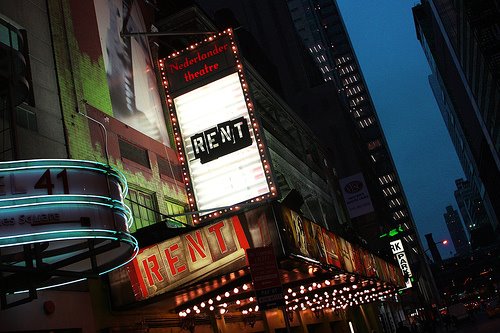
It ignited the career of many of its original cast members, chief among them married stars Taye Diggs and Idina Menzel (securing her Best Actress Tony for ‘Wicked’). From the show’s perch at the Nederlander Theater on 41rd Street, the show literally saw nearby 42nd Street transform from a shiftless boulevard of empty marquees to the most hyper-neon tourist friendly destination on the planet. Slowly, what felt fresh and contemporary turned nostalgic, as the cast’s trendy fashions became more and more costume-y as the years went by.

The Tower of Toys made famous in ‘Rent’s striking scaffolding set has since been demolished. The Life Cafe — scene of Rent’s rousing ‘La Vie Boheme’ — is still around, although when the film version of ‘Rent’ came around, the roomier bar at 7th Street and Ave B was its stand-in.

I fully admit to being a ‘Rent’-head; I saw the show two days after its opening downtown, when the cast was still stunned by Larson’s passing and energized by audience and critical enthusiasm. Once the show moved to Broadway, it offered front-row seats for $20, as long as you were willing to literally camp out all night for them. (I did it. Twice. Okay, three times.)

The show now faces its final test — as a musical standard spreading to local theatre troupes all over the world. A national tour has been on the boards for years. Can a bit of the old East Village survive perpetually in suburbia?

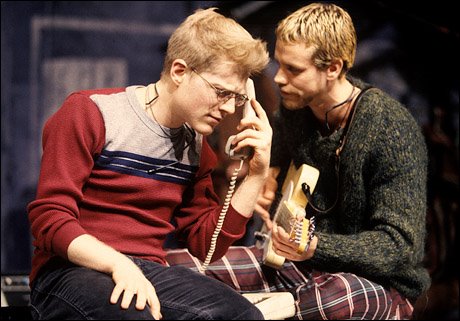
Below: Anthony Rapp and Adam Pascal

Goodbye Astroland (again)

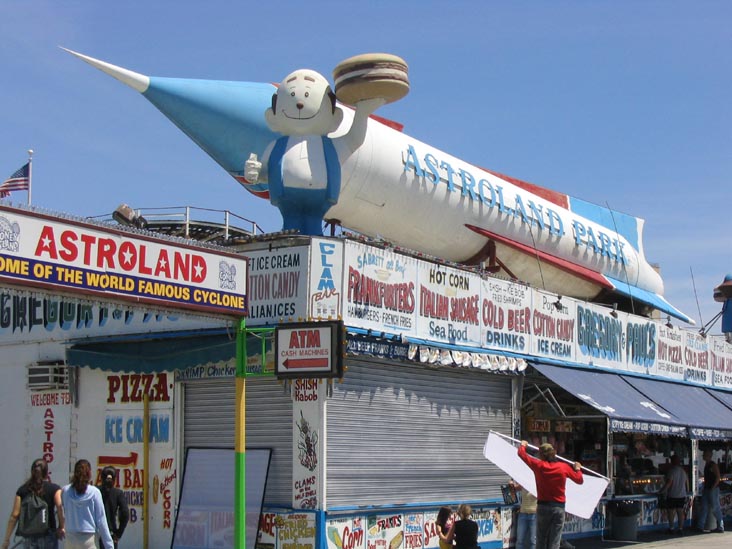
Astroland is once again closing for the final time at the end of this weekend, making way for Thor Equities to begin their new development of the area.

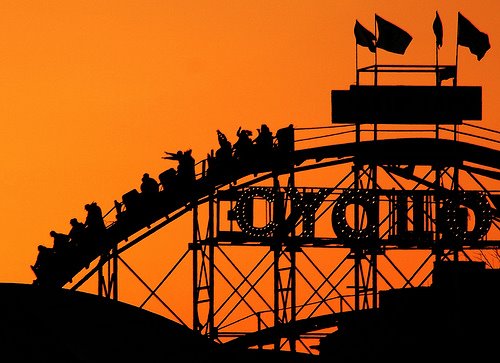
The park’s main attraction, the legendary Cyclone, isn’t going away however. A functioning roller-coaster since 1927 — and built on the spot of the world’s very first roller-coser — the Cyclone is actually owned by New York City parks department. Its been leased to Astroland since the park’s opening in 1975 and will return to the city’s hands with Astroland’s closure.

Less certain is the fate of cheesier rides such as haunted ride Dantes Inferno and the back-pain indusing Break Dancer.

This is a huge dent to the immediate future of Coney Island, but it isn’t the end. Deno’s Wonder Wheel park stays open through October and will be open as usual next year.

You can read official statement of Astroland’s closure at the great Coney Island blog Kinetic Carnival. And relive our podcasts on Coney Island — the golden age and the funspot in the 20th Century including a history of the Cyclone.

Dandies of New York: the dapper Cherry Hill Gang

Above: Another local gang of the Lower East Side, the Shirt Tails of Corlear’s Hook, most likely fought with the Cherry Hill gang, the Batavia Street gang, or maybe even both (circa 1889 pic from courtesy of Irishinnyc)

We’re finally stepping away from the grime of the late 19th century, but not before giving a little shout-out to possibly one of my favorite gangs of the era, the Cherry Hill Gang.

Not much is known about them — street gangs don’t traditionally leave exhaustive archives about themselves — but current descriptions usually use one word to describe them : dandies.

Cherry Hill was the decrepit neighborhood near the waterfront in the Fourth Ward, lined with tenements as awful (and sometimes worse) as the ones in Five Points. Its resident mix of Jewish and Italian suffered the same conditions as those in other poor neighborhoods, and hard times dealt its share of saloons, prostitution, crime and ruffians.

An early variation of the gangs of Cherry Hill included young William ‘Boss’ Tweed as their leader. According to an early bio on Tweed, the Cherry Hills rivals were the boys on Henry Street, just three blocks away. According to author Denis Tilden Lynch, it was important to stay clean on your turf and spar on somebody elses:

“A gang, to survive, must be peaceful in its own neighborhood. Its petty offenses are invariably directed against peaceful citizens of distant streets. Piracy would never have been an honored profession if the black flag flew only in home waters.”

By the 1890s, the “roughs” of Cherry Hill had literally re-tailored themselves. To rob the rich, one must be able to mingle with them convincingly. So the Cherry Hill gang was known for their impeccable dress sense, their stolen funds apparently used to acquire elegant, dressy outfits of the day. Topping these foppish costumes were walking sticks tipped in metal to better thwack an unsuspecting victim.

The Bowery Boys of the 1850s and 1860s were also known as sharp dressers; however their dress sense reflected their well established reputation and political power. The Cherry Hills meanwhile dressed for success merely to infiltrate rich neighborhoods and rob unsuspecting gentlemen. And apparently to intimidate local rivals.

The primary rival of the Cherry Hill gang was the local Batavia Street gang. Batavia Street was a former street in the same area, “in the shadow of the Brooklyn Bridge” and apparently in one account was “the most [Charles] Dickensy street in New York.” (It’s also referred to in some accounts as Batavia Lane, but the Batavia Lane Gang doesn’t sound very menacing, does it?)

Like some Gilded Age variation of West Side Story, the Cherry Hill gang and the Batavia Street gang were set to meet on the dance floor of New Irving Hall (once located on 214 Broome Street). Lower East Side balls in the late 19th century were modeled after their upper class variations, but were far rowdier and certainly more fun.

The Cherry Hill gang were set to dazzle in their finest ensembles, certainly intending to steal the show (if not steal more material things in the process). The Batavias would not be outdone but were desperately broke. After the pawning of a stolen gold watch from Herman Segal’s jewelry shop failed to produce enough cash for fancy new threads, the jealous gang returned to the jewelry store and simply smashed the window in, running off with 44 gold rings “worth from $3 to $45 dollars apiece.

The Batavias were eventually captured — while trying on their newly bought suits, no less, on Division Street — and thrown in the Tombs. Apparently the Cherry Hill gang attended the ball as planned. They would eventually go on to influence the dress sense of other street gangs. New York has changed so drastically in the 110 years since the New Batavia ball, but it’s nice to see that the superficial love of fashion has never been altered.

You can read more about the Batavia’s foiled robbery in the The American Metropolis. The Tweed bio referenced above is called “Boss Tweed: The Story of a Grim Generation.”
Below: The Jacob Riis photograph of the alleyway at Gotham Court in Cherry Hill
Categories
Podcasts

PODCAST: The Fate of Five Points

Part two of our “Five Points” podcast. Join us as we explore the “wicked” neighborhood’s clean up, fall from grace, and eventual destruction.

Listen to it for free on iTunes or other podcasting services. Or you can download or listen to it HERE

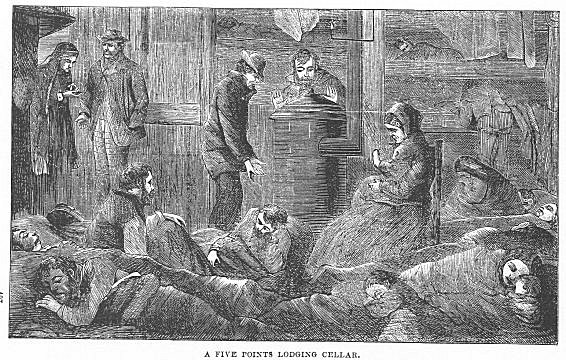
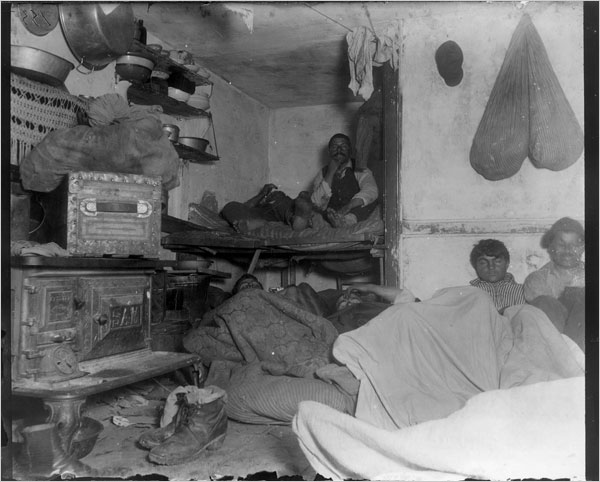
Sleeping quarters

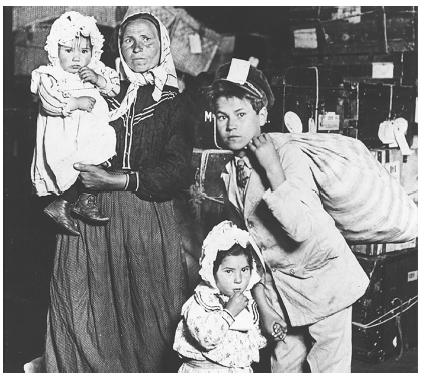
An Italian family newly arrived in New York.

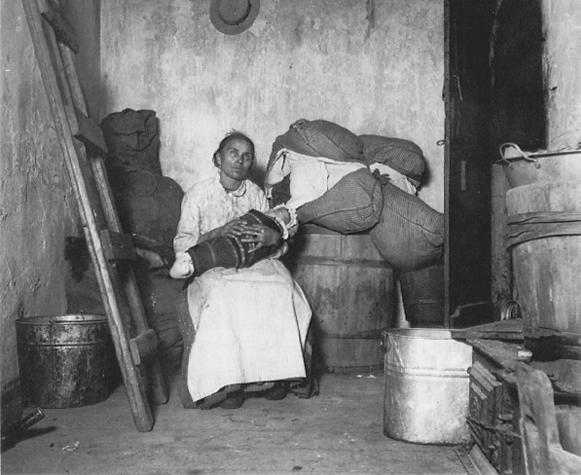
An Italian woman, employed as a ‘rag picker’

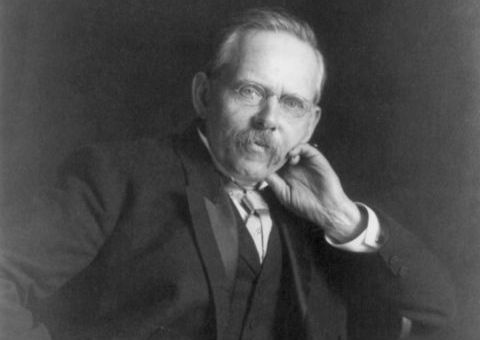
Jacob Riis, who helped define the early days of investigative journalism with his exposes on life in New York City slums

A Riis photograph of a typical residence that would have been found in Five Points

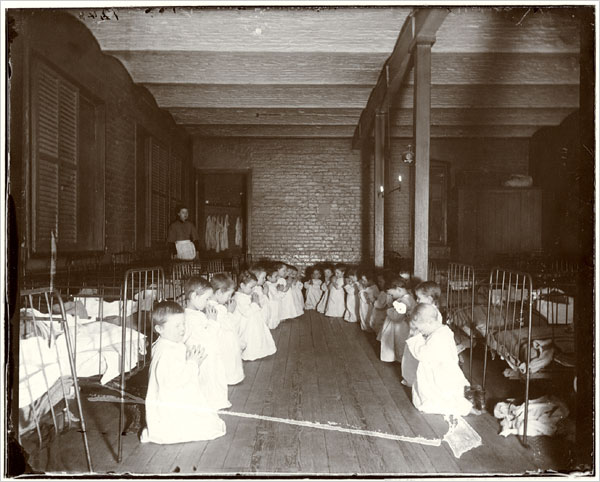
Inside the House of Industry in 1888

A look at the neighborhood after portions of Five Points was cleared away in 1895

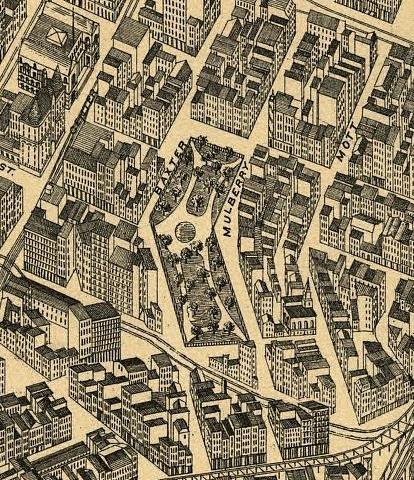
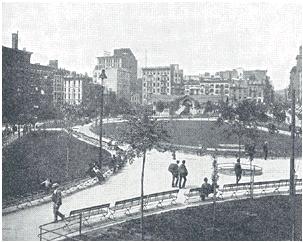
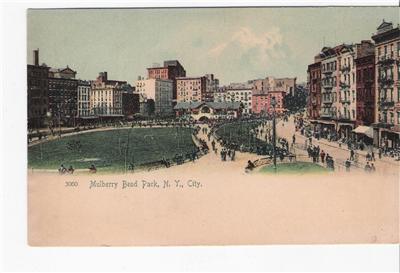
Mulberry Bend Park, designed by Calvert Vaux, and opened in 1897

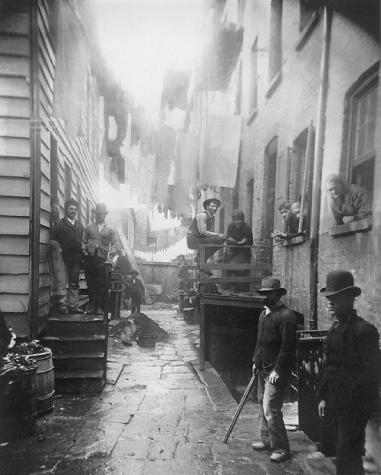
Jacob Riis’ most famous photograph of Bandits Roost. Gang members stare menacingly at the camera. By the stairwell is a stale beer hall.

http://www.blogger.com/img/gl.link.gif
Greetings from Mulberry Bend Park. Who would have ever imagined this area as being perfect for a postcard a few years before this?

Not much remains of the once infamous Five Points intersection

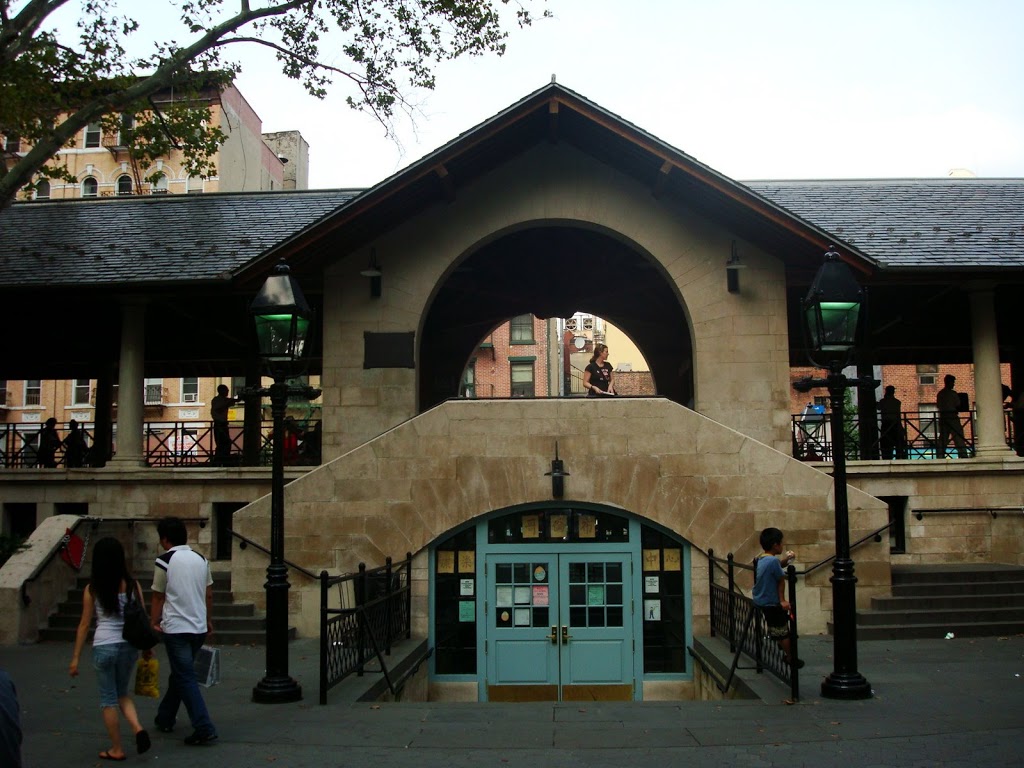
The pavilion in Columbus Park, erected in 1897 when the park was called Mulberry Bend Park

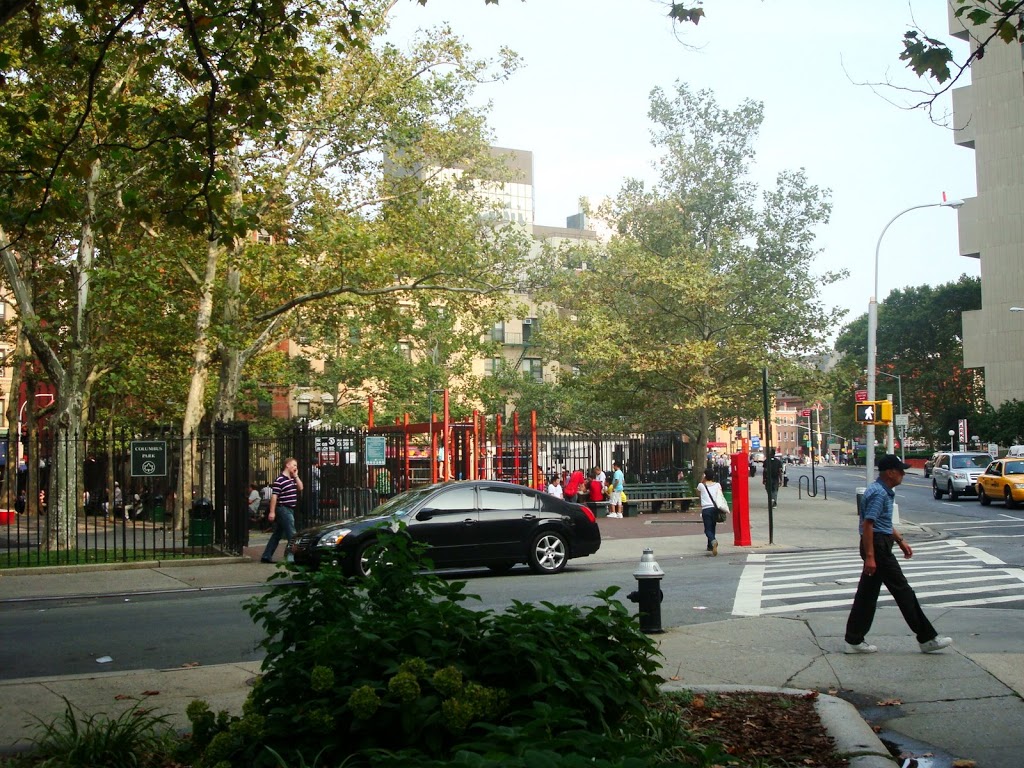
Columbus Park today: the FIve Points tenements replaced with playgrounds

Some other great resources about Five Points: An archaeological look at the area, and “Urbanography” which feature some great original source articles

Categories
Podcasts Uncategorized

The Story of Five Points: Wicked Slum

You’ve heard the legend of New York’s most notorious neighborhood. Now come with us as we hit the streets of Five Points and dig up some of the nitty, gritty details of its birth, its first residents and its most scandalous pastimes.

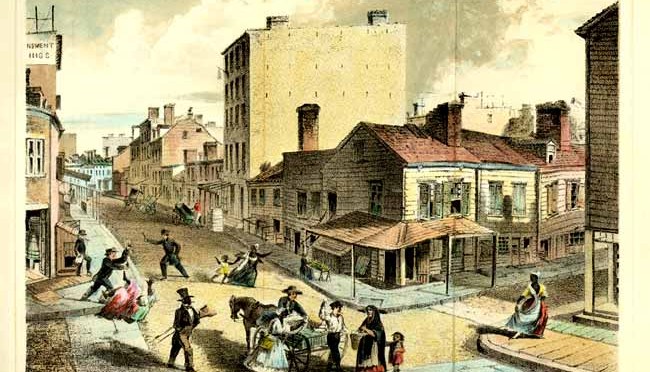
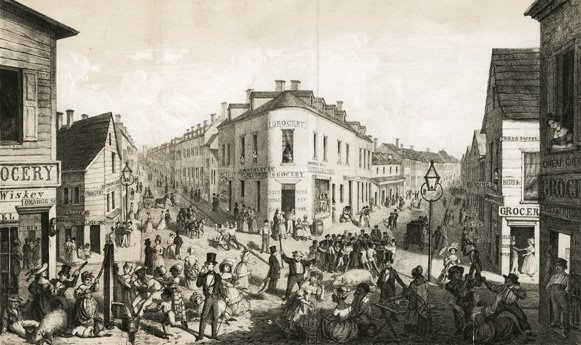
One of the most famous images of Five Points, accentuating its bustle and chaos

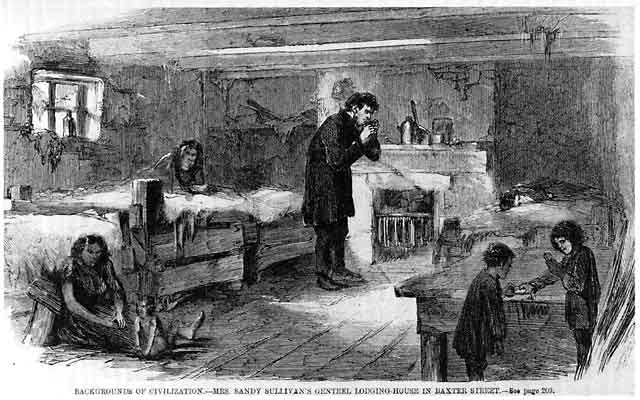
A dour living condition in a Baxter Street tenement

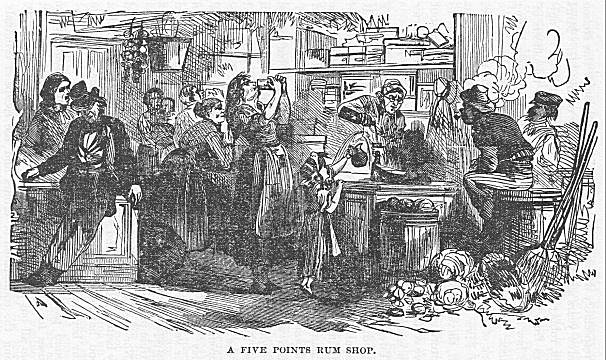
People drank their woes away at one of Five Points’ hundreds of groceries, rum shops and grog houses

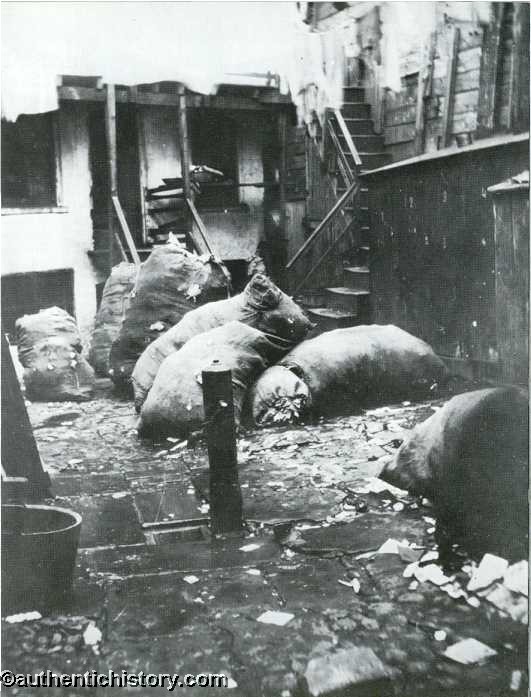
A typical scene down Bottle Alley

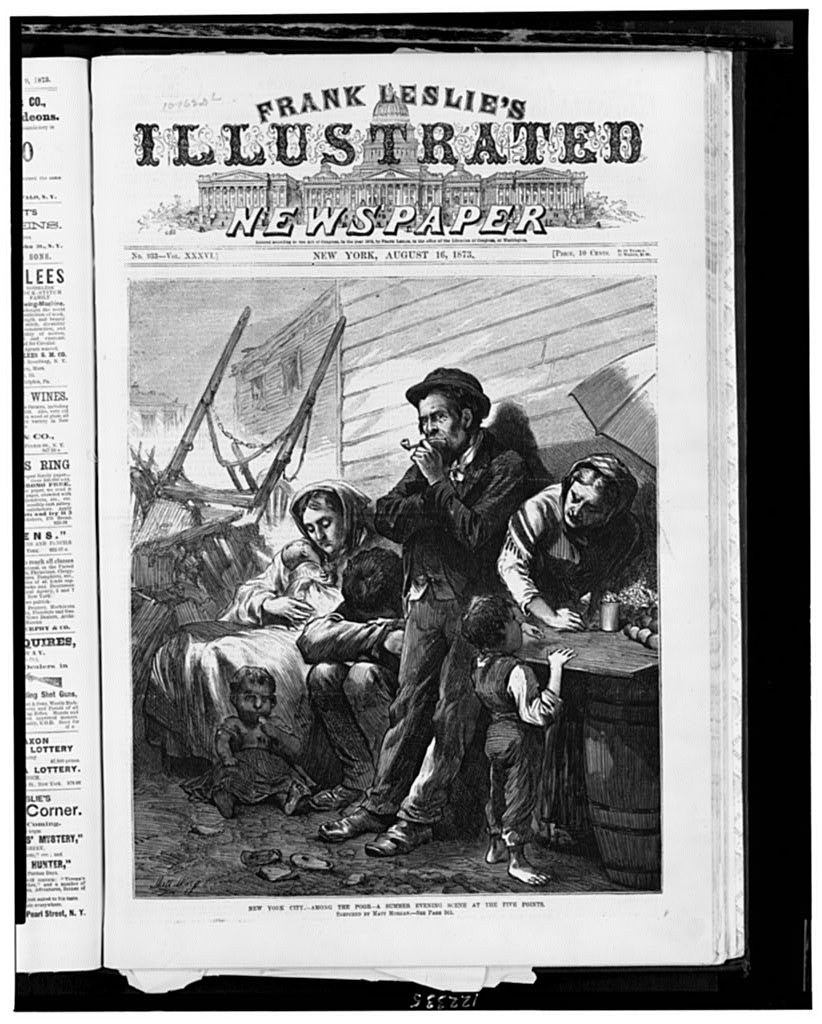
Newspapers kept images of Five Points’ squalor in the public eye for shock value

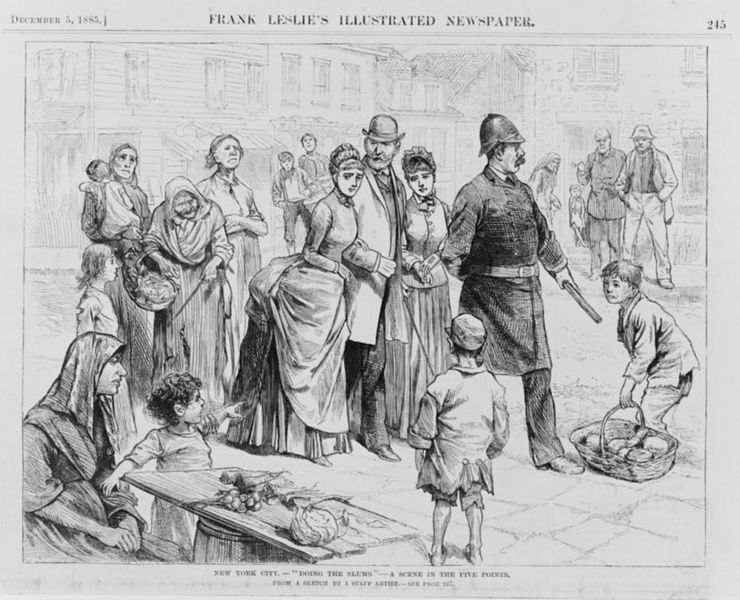
The rich would venture into Five Points on guided tours, observing its poverty and sordidness as though at a zoo

Charles Dickens’ guide to New York City low life


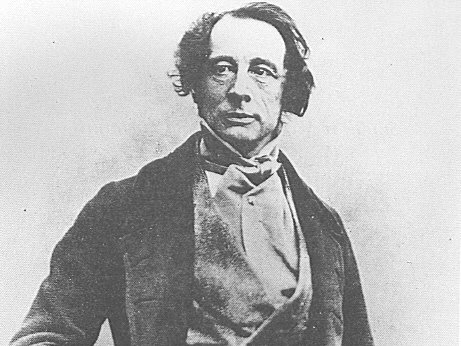
Dickens in 1850

What is this dismal-fronted pile of bastard Egyptian, like an enchanter’s palace in a melodrama! – a famous prison, called The Tombs. Shall we go in?

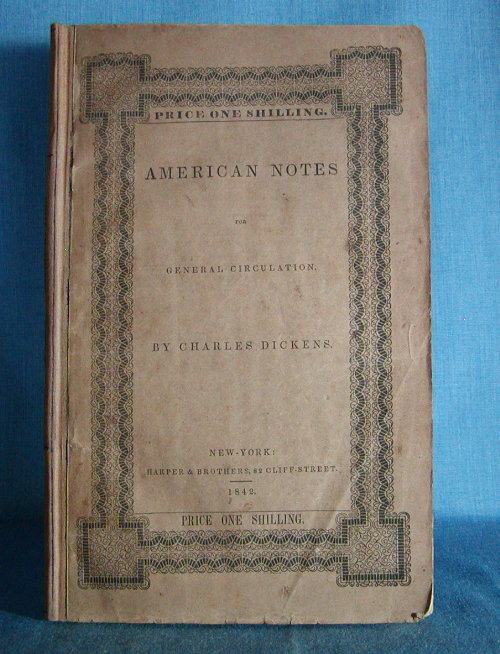
And thus in this voice continues the eager, fey, often condescending but spectacularly written account of Charles Dickens’ New York excursion as captured in his “American Notes for General Circulation,” written in 1842. (Read the entire thing here.)

Dickens’ was among the first published travelogues about America for European audiences, and among his travels through the states he devotes an entire chapter to young New York.

How young precisely? Dickens gives us a yardstick to measure it: “The great promenade and thoroughfare, as most people know, is Broadway; a wide and bustling street, which, from the Battery Gardens to its opposite termination in a country road, may be four miles long.” During the 1840s, the city would have ended at 42nd street, so this sounds accurate.

Dickens’ tone throughout “American Notes” is ebullient but persnickety, as if he’s smiling and curling his nose at the same time as the sights and sounds of the city. In real life, Dickens was treated like royalty, feted in sumptuous celebrations at the Park Theatre and Delmonico’s, courted by literati such as New York Evening Post editor William Cullen Bryant and aging Washington Irving.

Dickens had an ulterior motive to his American journey: to discuss international copyright laws, presently being violated with American reprints of Dickens novels. Surprisingly he turned most Americans off with what they considered to be ungrateful sniping. A bit of that shared animosity seeps through some of Dickens depictions, especially those in New York, which was doing a bulk of the copyright violation.

The book’s most famous descriptions come in his colorful look at Five Points, already a legendary neighborhood of filth and vice by 1842. These passages could have been ripped from any of his most famous novels:

“Ascend these pitch-dark stairs, heedful of a false footing on the trembling boards, and grope your way with me into this wolfish den, where neither ray of light nor breath of air, appears to come….”

“Here too are lanes and alleys, paved with mud knee-deep, underground chambers, where they dance and game; the walls bedecked with rough designs of ships, and forts, and flags, and American eagles out of number: ruined houses, open to the street, whence, through wide gaps in the walls, other ruins loom upon the eye, as though the world of vice and misery had nothing else to show: hideous tenements which take their name from robbery and murder: all that is loathsome, drooping, and decayed is here.”

And as if that wasn’t enough gothic material for him, he ends his New York piece by touring Blackwell’s Island (today’s Roosevelt Island), home of the city’s various asylums for lunatics and criminals:

“…everything had a lounging, listless, madhouse air, which was very painful. The moping idiot, cowering down with long dishevelled hair; the gibbering maniac, with his hideous laugh and pointed finger; the vacant eye, the fierce wild face, the gloomy picking of the hands and lips, and munching of the nails: there they were all, without disguise, in naked ugliness and horror.”

The New York chapter is reprinted in full here.

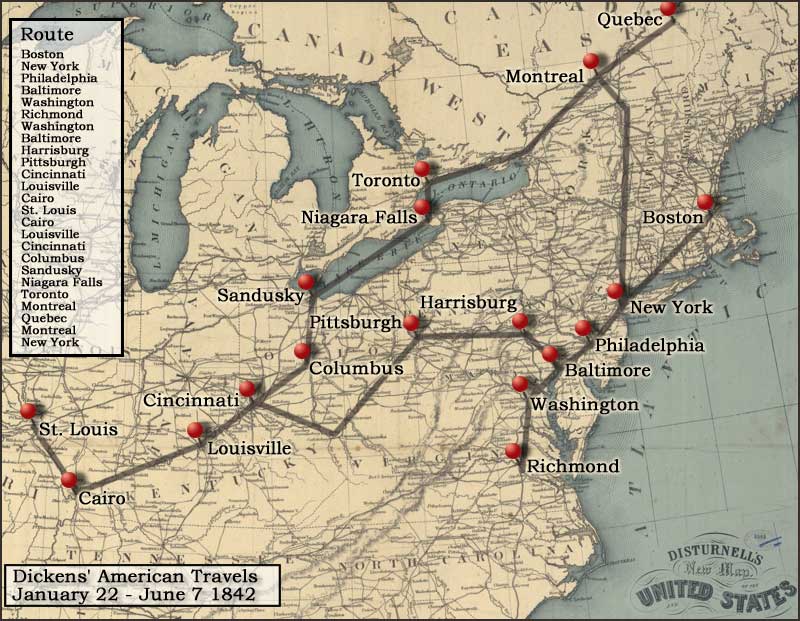
Below from the Charles Dickens Page, a list of all the places he visited during his American stay. They also feature a thorough description of his entire journey.

Categories
Podcasts

PODCAST: Delmonico’s Restaurant Francais

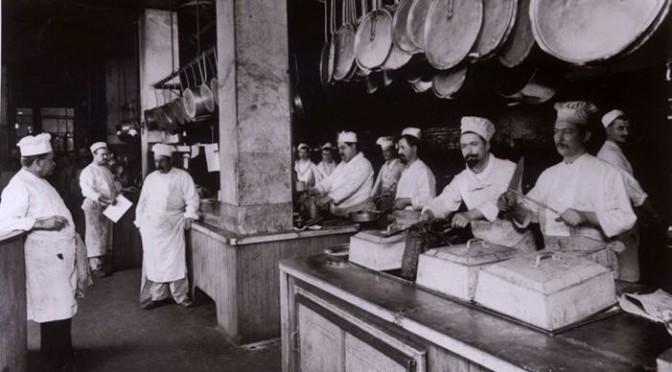
The kitchen staff, 1902

Before Delmonico’s, New Yorkers ate in taverns or oyster houses. But the city caught the fine dining bug at this family-owned business, which standardized everything you know about restaurants today. Find out about “menus”, “fresh ingredients”, “dining rooms for ladies” and other unusual and exotic Delmonico innovations.

Listen here:

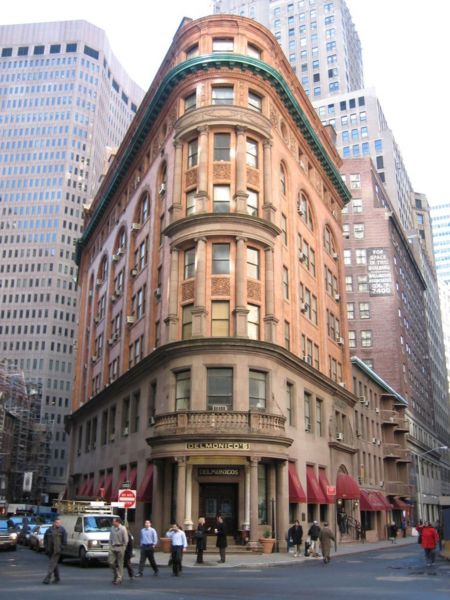
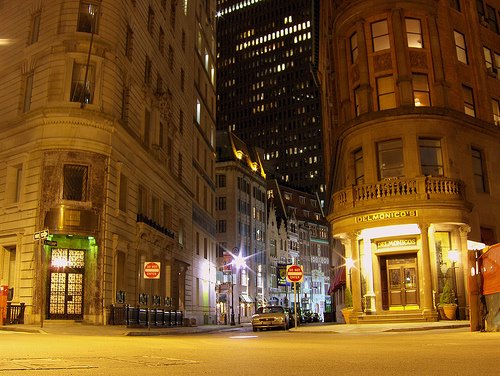
The Delmonico building today, with alleged Pompeiian column intact. Although the current incarnation has nothing to do with the original, but you can still get a few of the famous Delmonico dishes there.

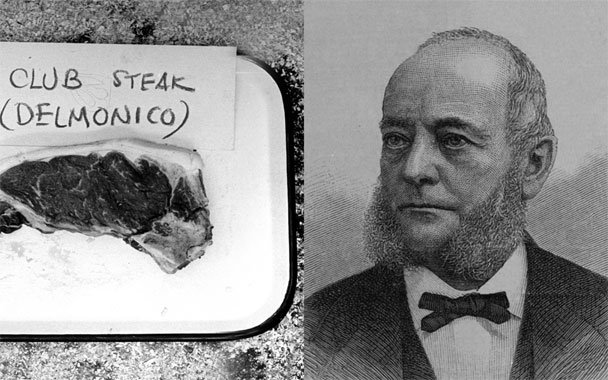
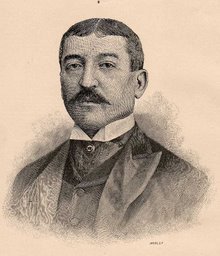
Lorenzo Delmonico, the inspired and flamboyant owner during the restaurant’s heyday

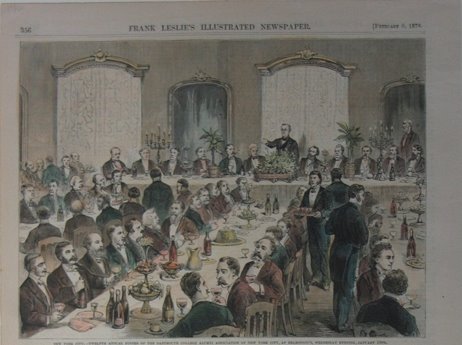
A dinner at Delmonico’s from 1876, in this case the “Twelfth Annual Dinner of the Dartmouth College Alumni Association of New York City” Fancy!

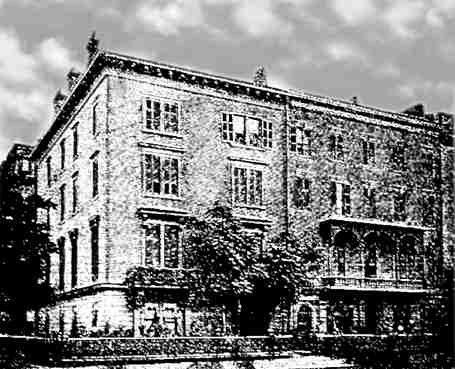
The location at 1 E. 14th Street

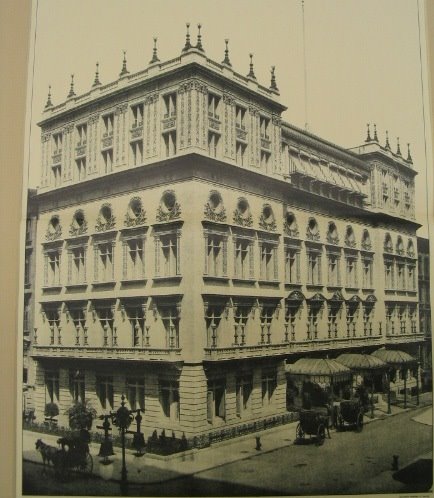
The ‘uptown’ location at Fifth Avenue and 44th Street

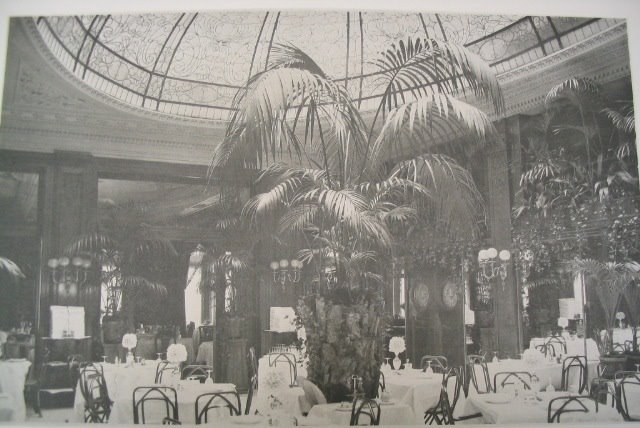
Inside the ‘Palm Garden’ dining room, at the Fifth Avenue location, upstairs…

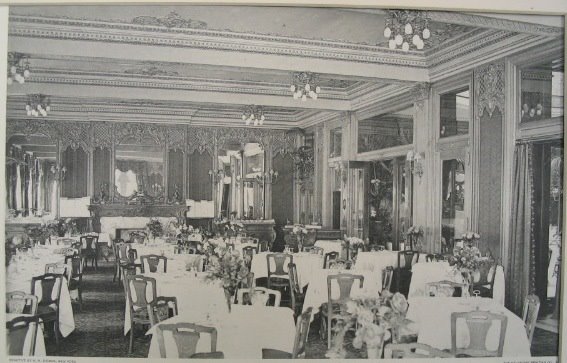
…and downstairs

Alessandro Filippini, head chef of Delmonico’s during the 1850s

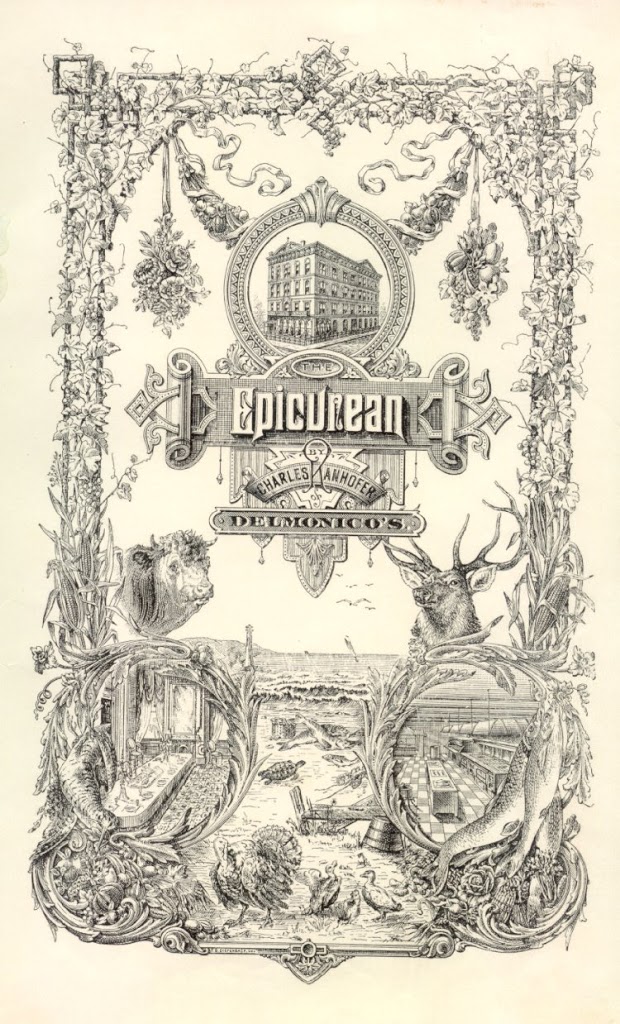
Chef Charles Ranhofer, in the kitchen of Delmonico’s from 1862 to 1896, threw 3,500 of his favorite recipes into his seminal 19th Century cookbook The Epicurean

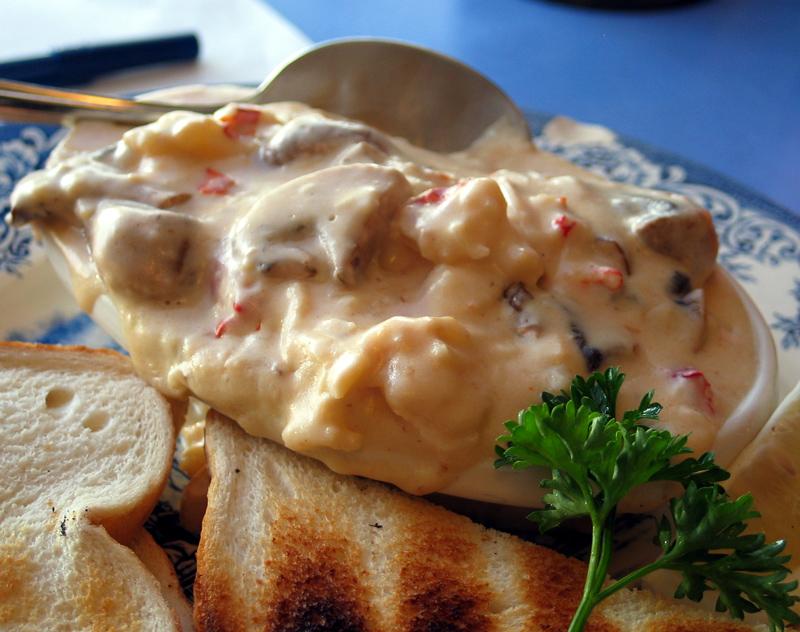
A heaping plate of Lobster Newberg

The current Delmonico at night