Categories
Those Were The Days

Before the flapper, the naughty ‘vamp’ scandalized New York


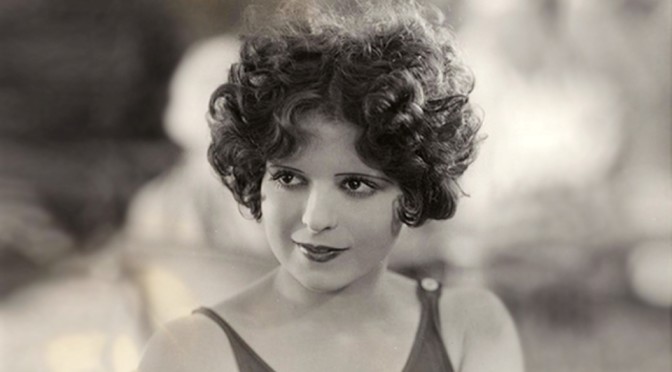
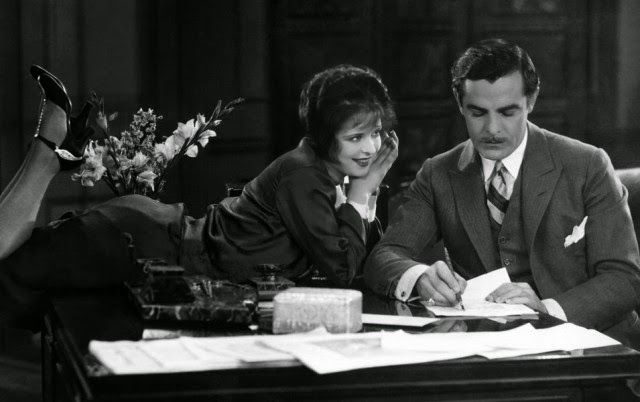
Above: Clara Bow, in It (1927), one of the roles that made her an major film star.

Two iconic actresses of the early silent film industry share a birthday today — Theda Bara (born July 29, 1885) and Clara Bow (born in Brooklyn, July 29, 1905).  Bow became the screen’s leading flapper archetype of the 1920s, but Bara’s exotic, controversial antics set the stage one decade earlier.  In honor of their birthdays, I’m re-running this article from last year about ‘the vamp’, a sort of proto-flapper popularized by Bara and the ladies of the Ziegfeld Follies, later to influence the changes in perceptions of women in the 1920s.

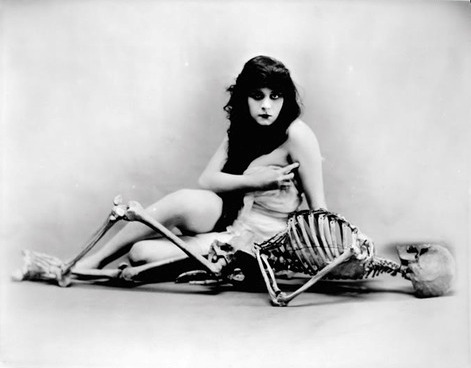
Maneater: Theda Bara in an unconventional portrait. Her publicist claimed it was her lover and that ‘not even the grave could separate them’.

“A vampire is a good woman with a bad reputation, or rather a good woman who has had possibilities and wasted them” — Florenz Ziegfeld

Progressive, liberated women were clearly so frightening one hundred years ago that equating them to undead, bloodthirsty creatures borne of Satan didn’t seem so unusual.

In the late 1910s, women were on the verge of winning the right for equal representation in the voting booth. Women were asserting power in unions, and, in the wake of disasters like the Triangle Factory Fire, those unions were influencing government policy. They were taking control of their destinies, their fortunes, even their sexuality (Margaret Sanger‘s first birth control clinic opened in 1916).

This surging independence came just as the entertainment industry heralded the female form as one of its primary attractions. Ziegfeld’s sassy, flesh-filled Follies — and its many imitators — defined the Broadway stage, mixing  music, sex and glamour with a morality-shattering frankness.

But it was the birth of motion pictures that gave the allure of female bodies an unearthly, flickering glow, as nickelodeon shorts became feature-length films, and the first era of the movie siren was born.

Combine the power of liberation with the erotic potential of cinema, and in the late 1910s, you got the vampire (or as we would come to know, the ‘vamp’).

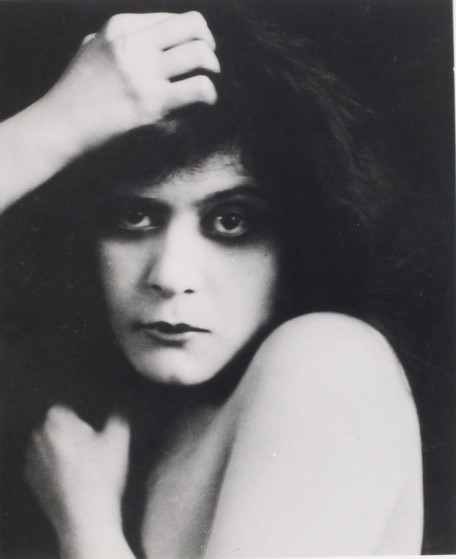
The queen of the vamps was one of America’s most mysterious movie stars — Theda Bara (at left). The magnetic actress, with her steely gaze and jetblack hair, was the prototype for a movie bad girl. She shook convention so dramatically that a critic called her a “flaming comet of the cinema firmament.”

From 1915-1919, she made over three dozen films, most in movie studios located in Fort Lee, New Jersey. It were here that she acquired her famous nickname, based upon her role as a home wrecker in a film inspired by Rudyard Kipling’s ‘The Vampire’. During this period, Bara lived in Manhattan’s Gramercy Park with her family — at 132 E. 19th Street.

She put a face to a new sort of young lady. These were the spiritual children of the prior generation of newly empowered women who fought against the constraints of Victorian society. A few years later, as another vein of female power (the temperance movement) helped bring about Prohibition, these young women would be called flappers, carefree and fueled on the powers of jazz and illegal alcohol.

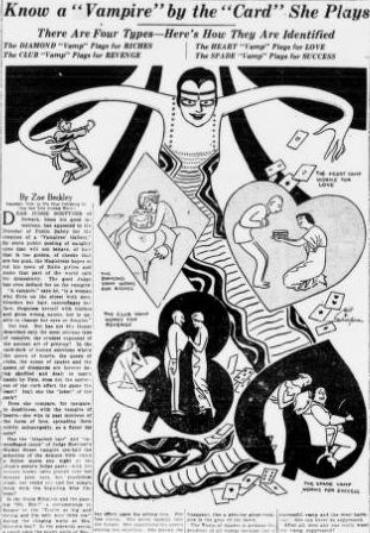
But to the established class, these ladies weren’t trend-setters. They were devils in black gowns. ‘Know a ‘Vampire’ by the Card She Plays‘, warned a New York Evening World article from March 1919, accompanied by a Theda Bara-like illustration of a snake-like monster.

The article recounts the efforts of a Newark judge attempting the rid the streets of “flirty girlies,” as he called them. “A vampire is a woman who flirts on the street with men, bleaches her hair, camouflages her face, disguises herself with clothes and gives wrong names, but is unable to change her eyes or dimples.” The article laughs off his puny efforts. “Can vamps, of whatever sort, BE suppressed?”

Vampires were of course more readily seen in Times Square, dancers, actresses or cabaret stars. But even your stenographer could be one!, warned one article.

Unlike Bara’s iconic identity as a raven-locked seductress, most ‘real’ vampires were blondes. “[T]he vampire of real life hath the golden hair of an angel, which is never disarranged, same when she letteth it down, to DISPLAY it, on the beach,” warned columnist Helen Rowland, with a little tongue in cheek. (Ms. Rowland was famous for her writings as a ‘bachelor girl’.)

“No one ever saw a vampire in a high neck dress,” said an Evening World advice columnist in 1918. “All vampires must reveal their collar-bones and the contiguous territory.”

The woman vampire was an urban creature, up all night, sleeping all the day. The city was partial cause for her condition. As the New York Times suggested in 1920, “The idea of New York as a vampire to the rest of the country is one which a number of persons have entertained and expressed. To some of them the vampire is Wall Street, to others it is the region of white lights [Broadway].”

Many actress got stuck with the term ‘vamp’ or ‘baby vampire’ — or else, embraced the coy terminology. Juliette Day was a known ‘baby vampire’ for her role in the scandalous 1916 play ‘Upstairs and Down’. It’s no surprise that in the film version from 1919, the role is reprised by the notorious Olive Thomas, a Ziegfeld girl who met a bitter end the following year.

Some actress fought against the alleged stigma. Actress Clara Joel, playing a vampire-type role in a 1918 film, made it known in the Tribune that “she is not a vampire and that she was born in Jersey City.”

The irony of stage actresses trying to shed a vampire image is that Theda Bara, the original vampire, in her first stage attempt in 1920, flopped. The play was supernatural-themed ‘The Blue Flame‘ which opened at the Shubert Theater to cavalcades of unintentional laughter.(A ‘terrible thing’, according to the Times critic.) Bara, who had to deliver such lines as “Did you remember to bring the cocaine?” was roundly trashed.

Shortly thereafter, the vampire moved to Los Angeles. Her film career lasted a few more years, but sound pictures and a strict Hollywood production code pretty much eradicated the existence of vamps on the screen. In New York, meanwhile, her sultry spawn morphed into flappers, populating the speakeasies and cabaret nightclubs of the city.

Below: A 1919 romp called ‘The Vamp’ performed by the Waldorf-Astoria Orchestra

Categories
Those Were The Days

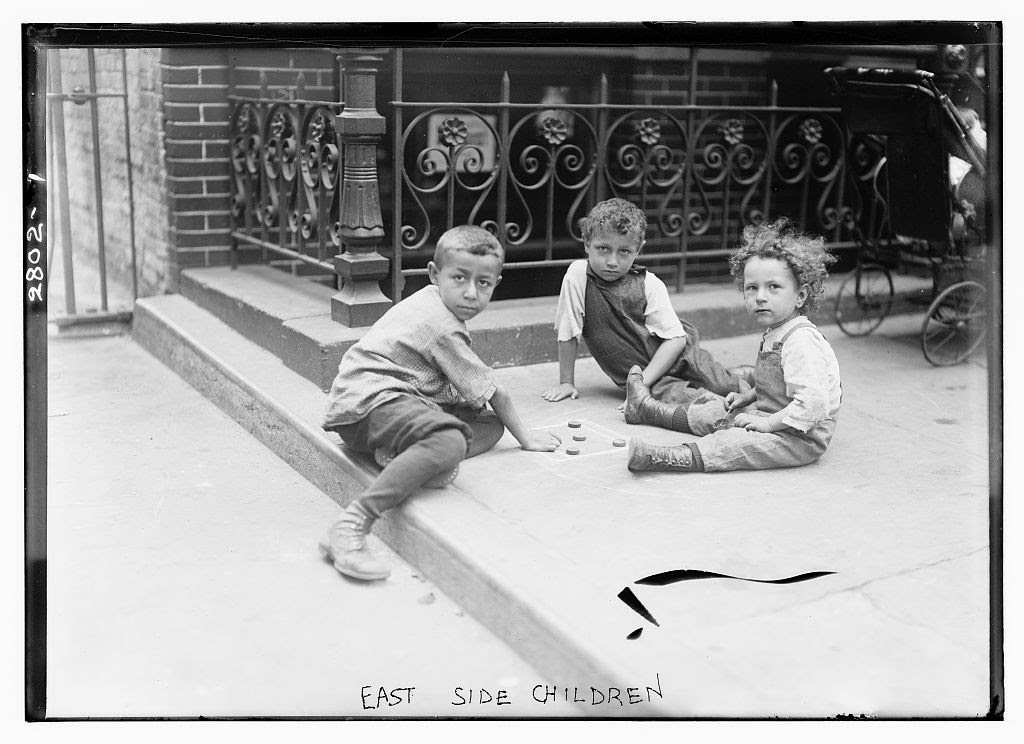
Dollhouses, skully and puddles: Lower East Side children, actually having fun

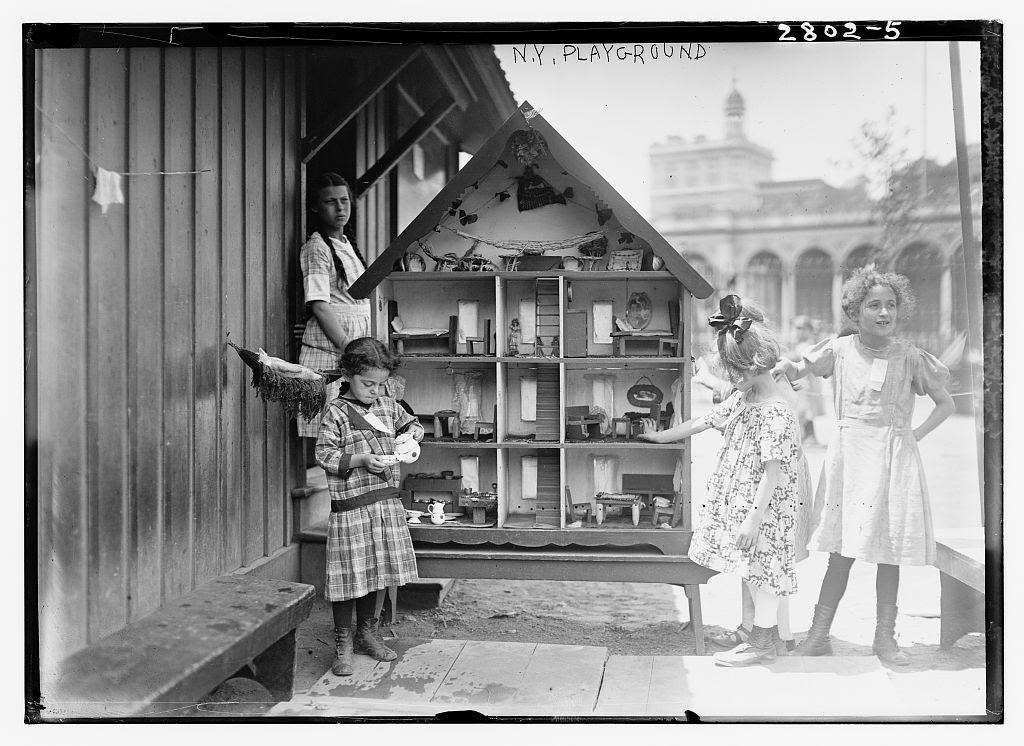
Girls with a pretty amazing dollhouse at Seward Park playground.  Photo labeled August 1913

I’ll be traveling for the next few days so I’ll be posting here a bit less than normal. Next week I’ll re-post some interesting stories from the back catalog. Enjoy your weekend!

I recently discovered this first image in a collection of Lower East Side photographs, and realized how unusual it was to see pictures of children before the 1920s actually smiling and happy in photographs.  This is partly due to a certain awkwardness around cameras and the relative slow process in taking a picture back then.

Also, children were usually photographed doing things that did not make them happy.  The two best known social photographers of the era — Lewis Hine and Jacob Riis — were specifically trying to capture poor working and living conditions. Images of life’s little pleasures did not fit the narrative. Although in some of Hine’s photographs of tenement life, some happiness peeks through.

But I did find these images of kids at play, most all of them in the summer time. Take a little of their enthusiasm with you this summer! Click into the pictures for a larger view.

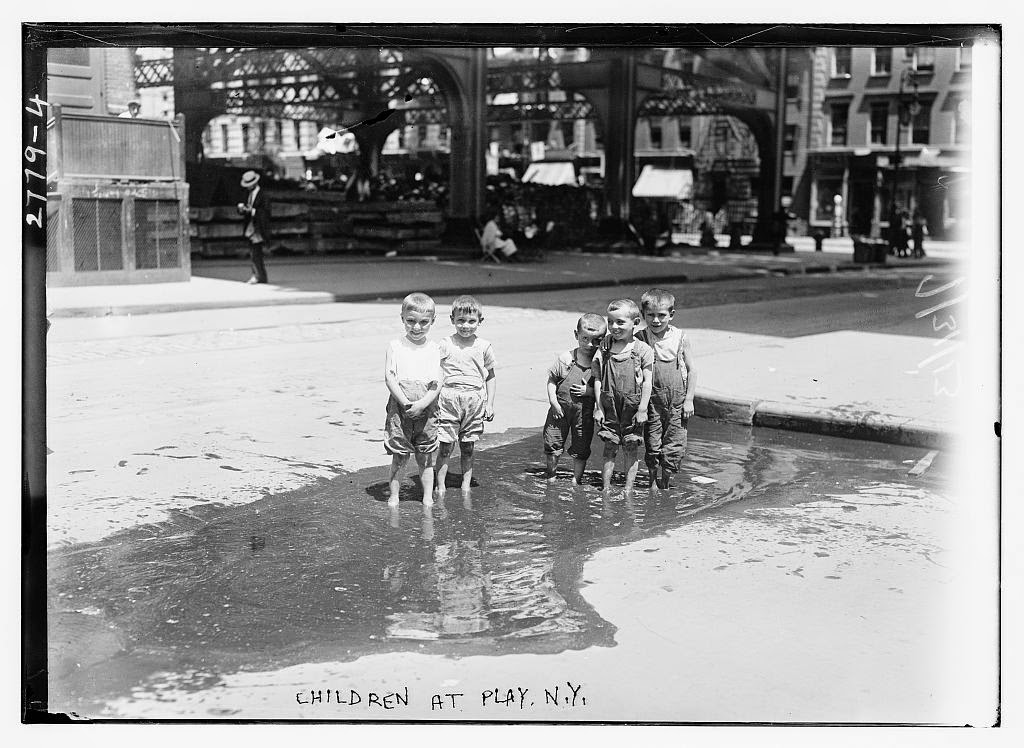
Children find some joy near the elevated, July 31, 1913.  The kid in me wants to jump in and join them.  The adult in me is thinking, “That water must be filthy.”

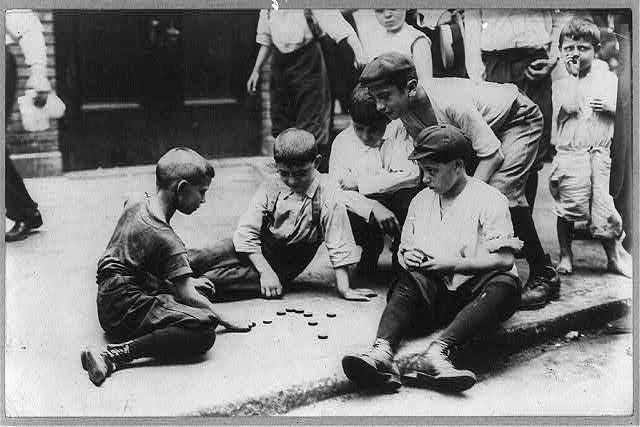
I believe the boys in the two pictures above are playing checkers*.  Top photo is labeled August 1913, the second around the same time period.

Craig on our Facebook page clarifies the images above: “I suspect that the boys in that picture aren’t playing checkers, but a distinctly NYC game called “Skully” or “Skullsy,” as some call it. At least that’s the first thing that I thought of.” Good catch!

I’m putting this in a blog post about children playing, but I do not think the boy being leaped over is having too much fun.

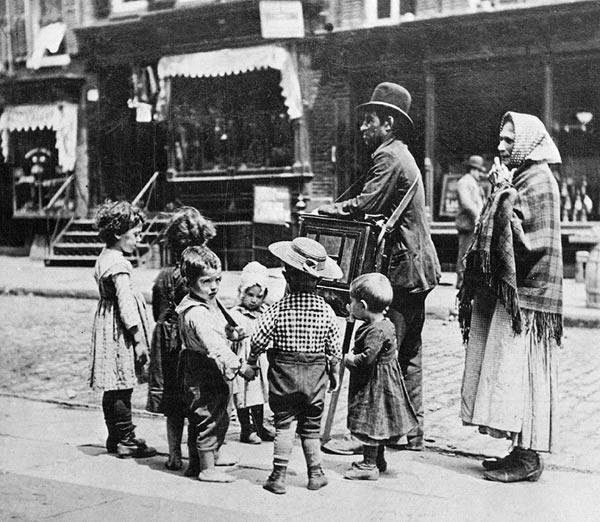
Children being drawn to the streets by the intoxicating sounds of the organ grinder (and monkey, although I don’t see one here).


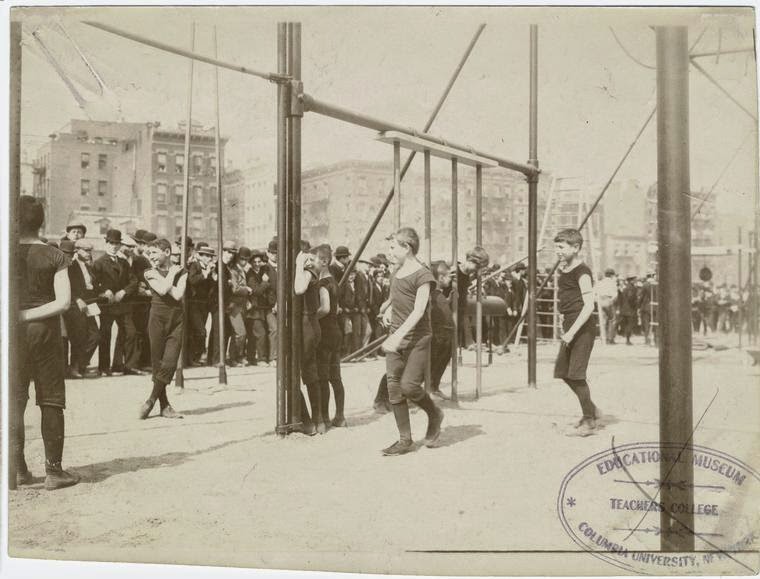
At the Seward Park playgrounds.  The dark clothing doesn’t appear to make the scene very jovial, but everybody is all smiles.


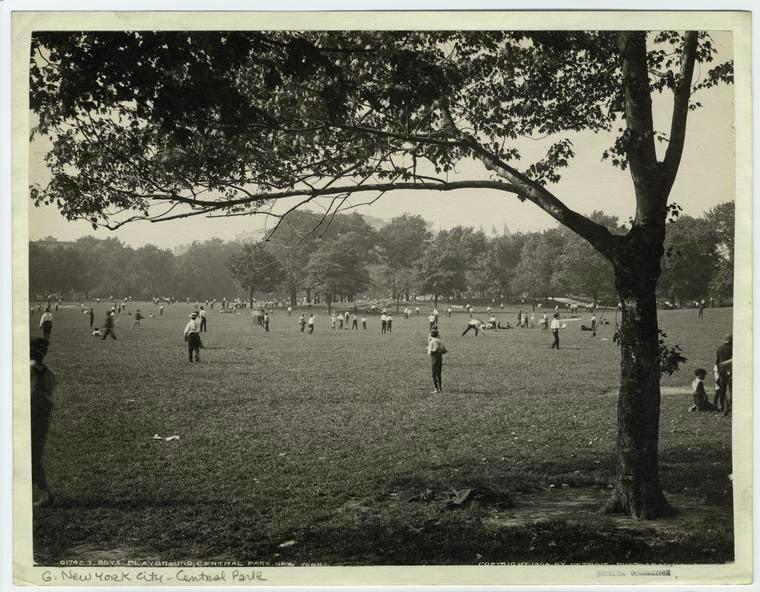
And a bonus picture above of boys playing in Central Park, 1904.  This is a quite extraordinary picture because for half a second, I thought they were sheep.

Photos above are courtesy the Library of Congress, the Tenement Museum, and the New York Public Library

Categories
Mysterious Stories True Crime

The Dictaphone Murder Trial of 1914: A Mystery In Pictures

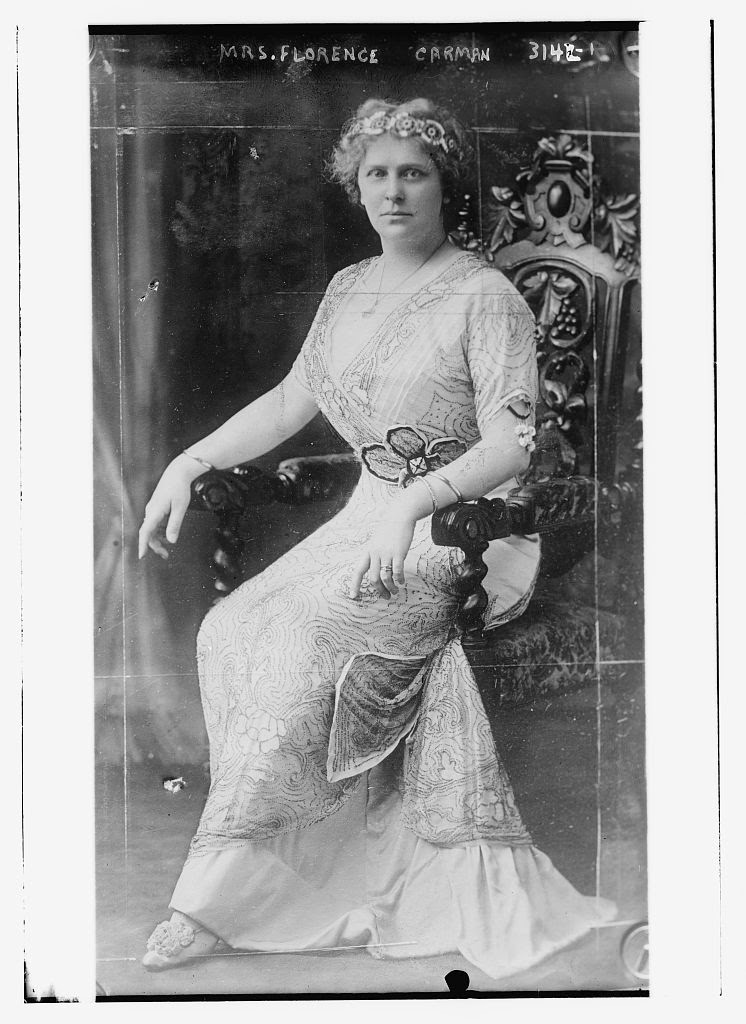
Does this woman look like a murderer to you?

This is Florence Carman, the wife of Dr. Edwin Carman, one of the most respected men in Freeport, on Long Island’s south shore.  Mrs. Carman would be at the center of a murder trial that captivated New Yorkers 100 years ago.

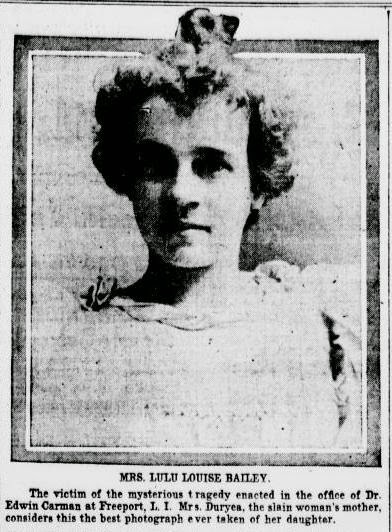
Dr. Carman received a visitor in his office on July 1, 1914, one Louise “Lulu” Bailey.  Her visit was after hours, so we can perhaps surmise the tenor of their engagement.  So, does it seem, did Mrs. Carman.

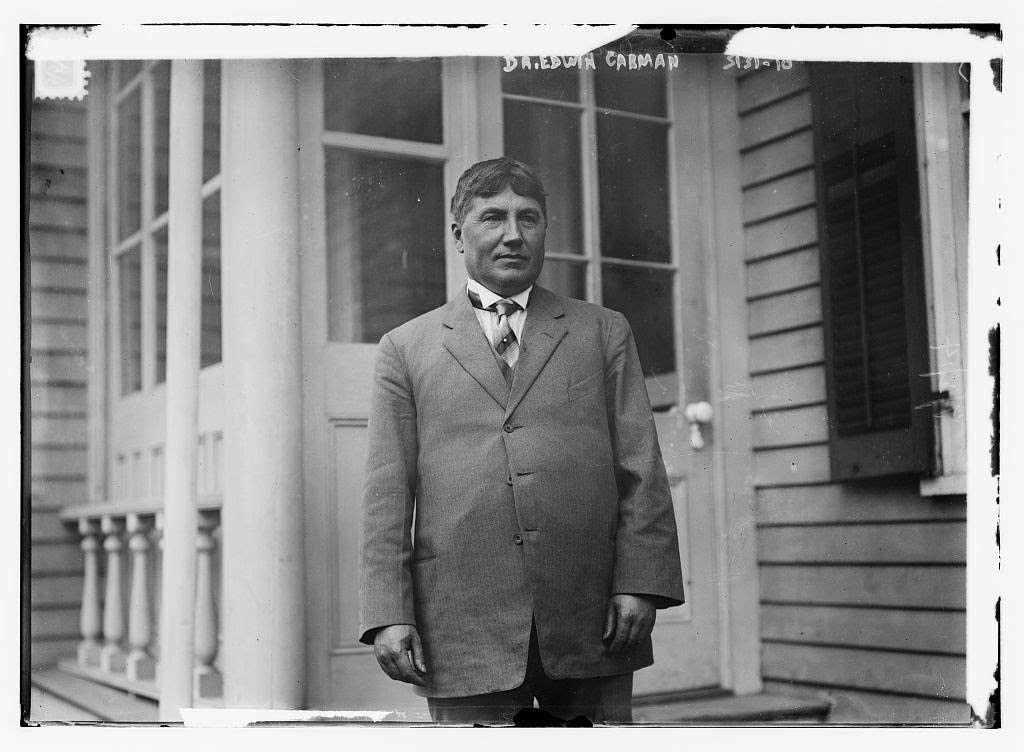
Here’s Dr. Carman, the subject of his wife’s suspicions and the possible recipient of Mrs. Bailey’s affections:

That evening, claimed Dr. Carman, as he entered his office to meet Mrs. Bailey, somebody shot at her through the window. She fell dead to the floor.  I should add that the office just happened to be on the ground floor of the Carman’s Freeport home, a handsome structure, “one of the show places of the village.”

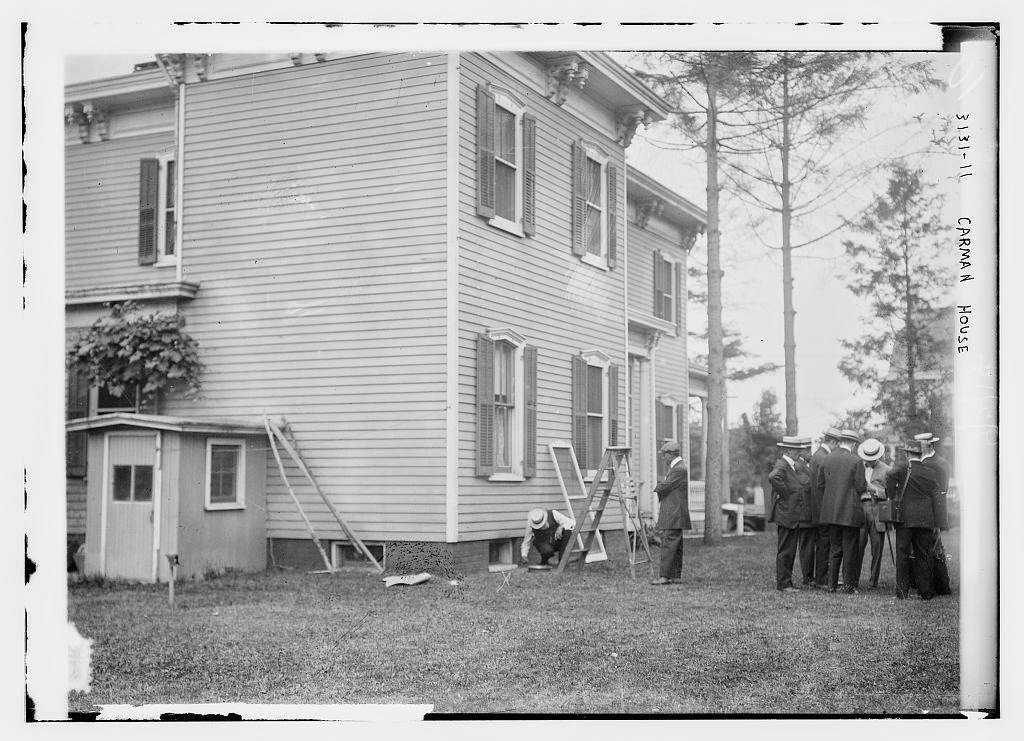
Below: Investigators case the Carman’s house for clues

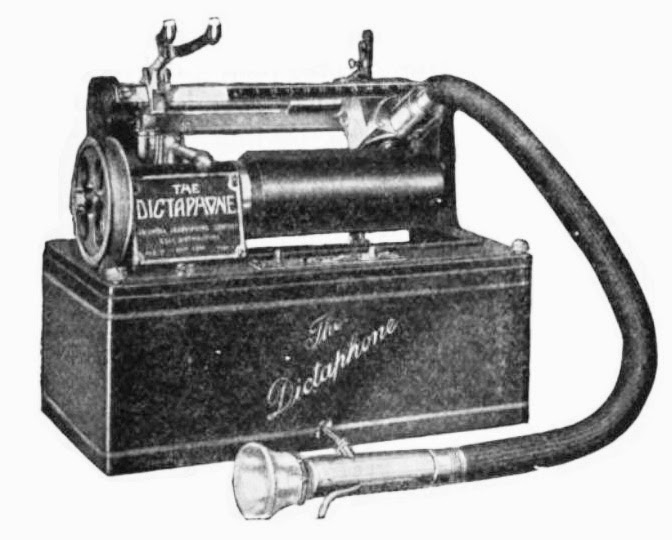
The following day revealed a bizarre twist — Florence had purposefully left on a Dictaphone machine on in the office.  After the police left, she removed it from the crime scene and hid it in the attic.

At right: One example of a Dictaphone machine from the 1920s..

Mrs. Carman, it seems, did not trust her husband with any female patients.  With the Dictaphone on, she could listen in on the conversations between the doctor and his patients.  In particular, she could spy upon any possible dalliance between her husband and Mrs. Bailey.

Her guilt seemed assured when witnesses declared seeing a “woman in white” standing on the porch at the time of the murder.

For many days, suspicions actually volleyed between the doctor and his wife.  For instance, some days later, Dr. Carman claimed that he was shot at by a man on a bicycle while entering his house, a tale others contradicted.  Detectives actually re-enacted the murder with the doctor and his wife.

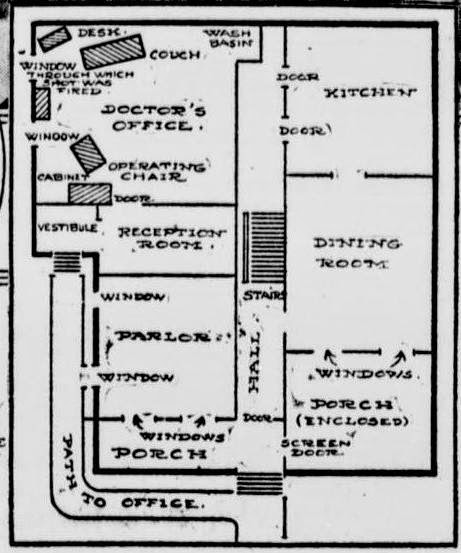
From the New York Sun:  “The detective took the part of the assassin, creeping at dusk among the hemlocks and crawling, pistol in hand, to the window of Dr. Carman’s office through which Mrs. Bailey was shot.”

At left: A map of the murder scene from the New York Sun

Guilt eventually rested on Mrs.Carman, who was arrested exactly one week after the murder.

Meanwhile, Bailey’s murder swept away all other news of the day, filling the New York newspapers for weeks with the possibility of a salacious scandal.

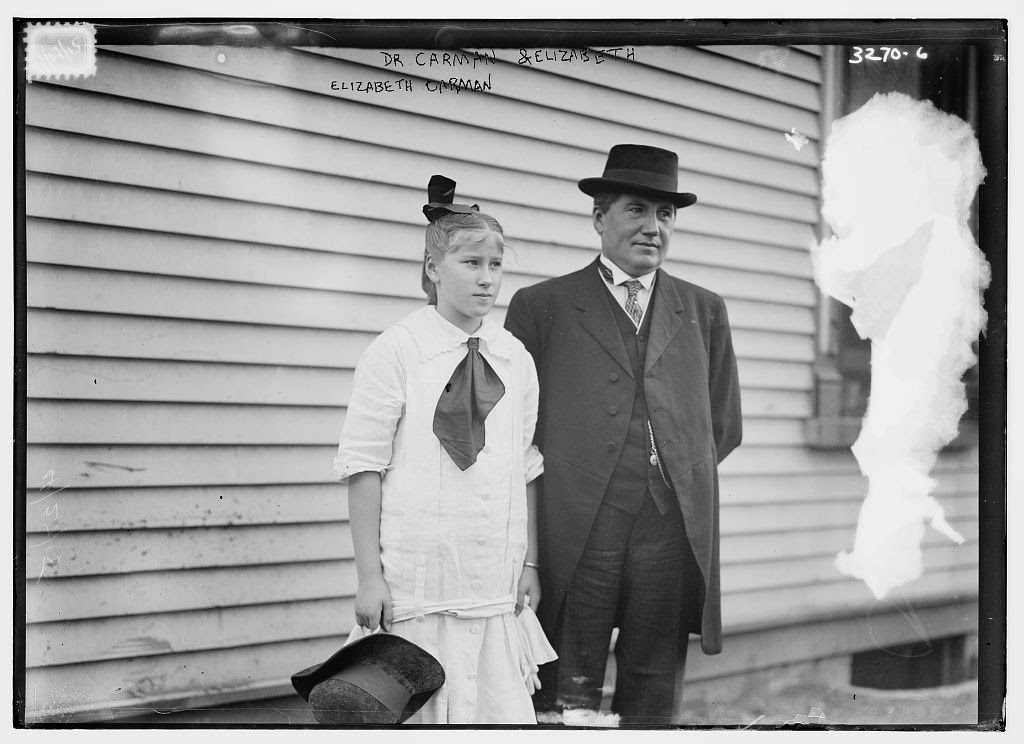
Here’s the Doctor with his daughter Elizabeth Carman, who later took the stand to defend her mother:

Florence was brought up on charges of murdering Bailey, and evidence was brought before the Freeport Justice of the Peace.  In October, the case went to trial in the nearby town of Mineola.

The following photographs were taken outside the courthouse.

Florence’s defense rested on the testimony of Celia Coleman, the Carman’s maid, who produced a solid alibi for Mrs. Carman, proving she was inside the house the entire time, not on the porch, and thus not the “woman in white.”

However, by October, Coleman claimed that Florence had in fact crept out the back door moments before the fatal murder.  Then she testified….
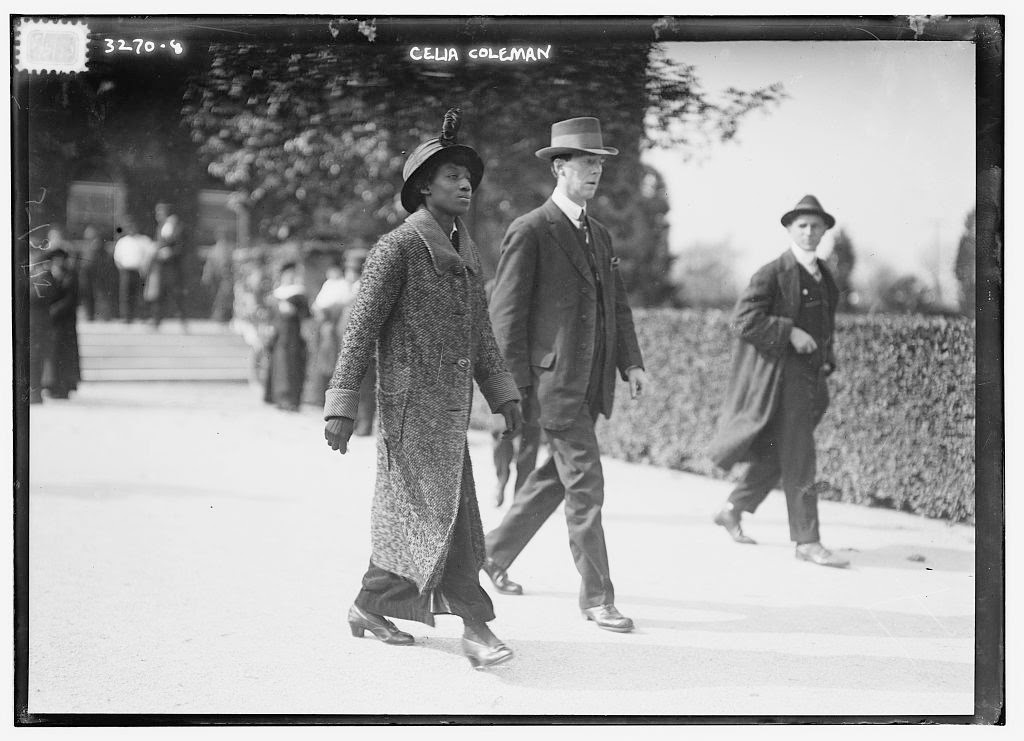
The reasons for her conflicting stories are muddled, but she may have been covering for her employer then later told the truth.  Or else, she was bought off, as a later conspiracy theorized, brought forth a more tantalizing story to the delight of newspaper men everywhere.
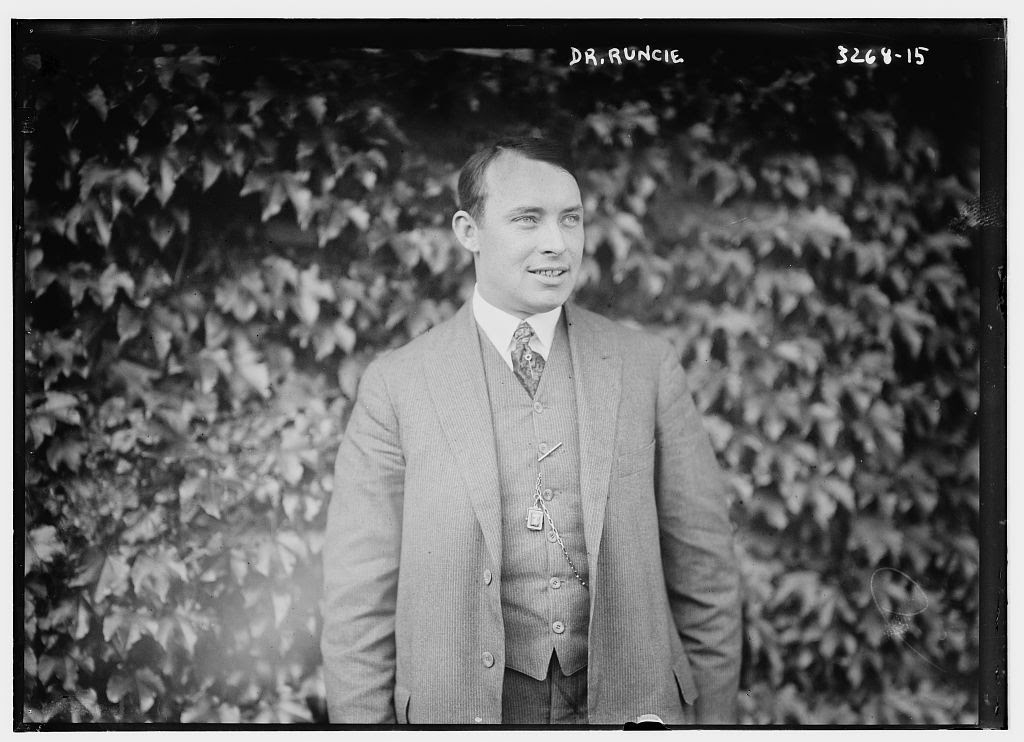
The dashing Dr. William Runcie also took to the stand in regards to the presence of the Dictaphone and whether it was an indication of her mental state.

Runcie had come to the house on the evening of the murder, and Florence had told her then of hiding the machine in the office. But she urged Runcie not to tell her husband this fact.  He tried to brush away this fact.  “While it is out of the ordinary, I cannot see why so much importance is given to it.” [source]

Another witness named George Golder, who had originally testified of Mrs. Carman’s guilt, now “made an affidavit practically repudiating his identification of the doctor’s wife as the woman he saw on the porch.” [source]  His testimony was later used to cast guilt upon Doctor Carman.

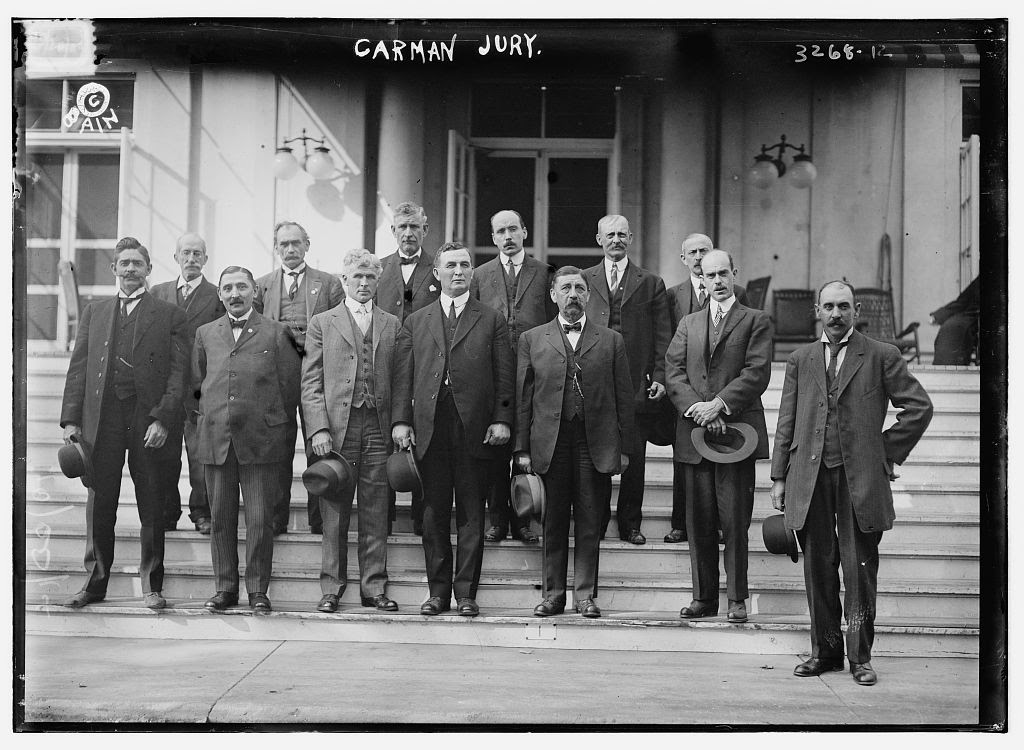
Below: A jury of her peers?

The family of the deceased woman made a dramatic entrance.  This is Lulu’s daughter, mother and husband.

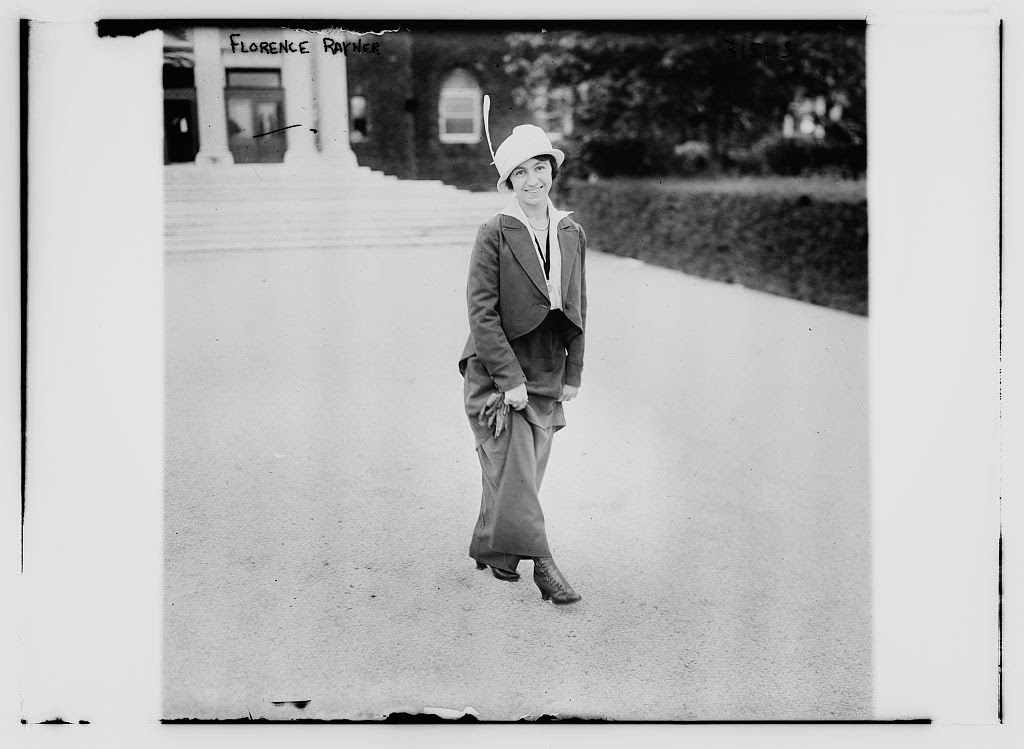
A little sex appeal was brought into the courtroom with the appearance of Florence Raynor, specifically there to contradict the testimony of another man who claimed to have seen Mrs. Carman on the porch that night.

In the end, the jury could not come to a consensus regarding Mrs. Carman’s guilt.  Wrote the New York Times, “After deliberating for thirteen and a quarter hours, the jurors in the trial of Mrs. Florence C. Carman for the alleged murder of Mrs. Lulu D. Bailey filed wearily into the Supreme Court room at 10:58 o’clock this morning and the foreman announced that it was impossible for them to come to any agreement.”

She was re-tried in May of 1915 and given a vigorous grilling on the stand. The New York Times makes note of the soft-spoken woman raising her voice for the very first time — evidence, so goes the inference, of the trial taking its toll upon her.  The jury sympathized with her and finally acquitted her of the murder.

By this time, of course, the story was relegated to the back pages, as world events — and other local murder cases — monopolized the attentions of New Yorkers.

To this day, the murder of Lulu Bailey has not been solved.  It’s unclear whether justice was really served that day.  “I do not believe a jury in Nassau County can be brought to convict a woman of murder in the first degree,” said the district attorney.

All the photographs above are courtesy the Library of Congress.

Categories
Amusements and Thrills Bridges

The ten greatest fireworks displays in New York City history

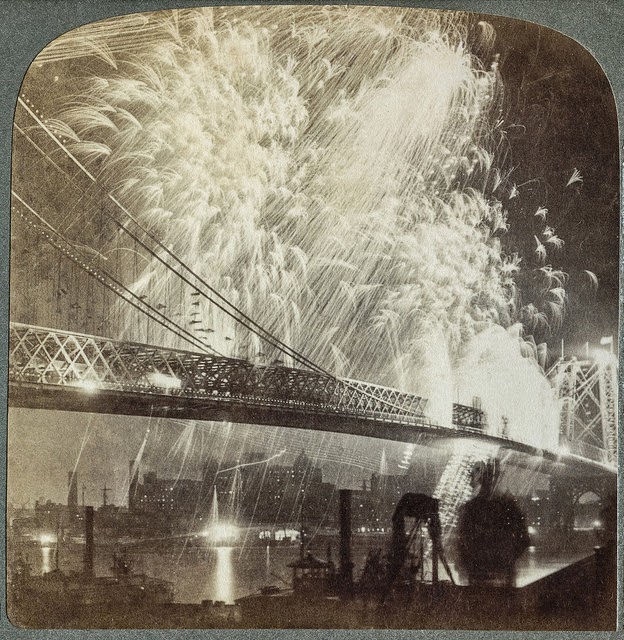
Above: One of my favorite pictures of the Williamsburg Bridge, at its opening in 1903
Nothing befits a fireworks display quite like a skyline to frame it, and no city has a skyline quite like New York City.  And so, despite the obvious dangers of setting off thousands of pounds of explosives in a crowded, flammable city, the city has been subject to some of the most beautiful feats of pyrotechnics in American history.
Here are ten of the greatest examples in the city’s history — celebrations not only of holidays, but vivid displays that highlighted the finest landmarks and accomplishments:

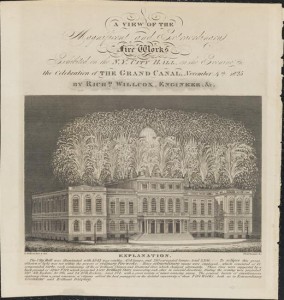
A View of the Magnificent and Extraordinary Fire Works Exhibited on the N.Y. City Hall

1. Opening of the Erie Canal — November 4, 1825
“On November 4, 1825, a spectacular extravaganza celebrated the just finished Erie Canal. City Hall, brilliantly illuminated, proudly overlooked a fireworks display in the park. There was good reason to celebrate:  the canal was the match that lit the fuse that detonated the boom of the 1830s” — Mark Caldwell, New York Night
(Illustration by John Francis Eugene Prod’Homme, Image courtesy MCNY)


2. Celebration for the Transatlantic Telegraph Cable — September 1-3, 1858
This called for a variety of elaborate pyrotechnic displays, including one 21-part program, which included “some new principles were attempted for the first time in the pyrotechnic art,” “two light houses connected by a line of rolling waters, on which the ships slowly moved towards their destination” and “all the splendor of the dazzling colors, assisted by all the mechanical contrivances of which the art is capable”. [source]

Incidentally, this fireworks festival caught City Hall on fire, burning down the cupola! (NYPL)


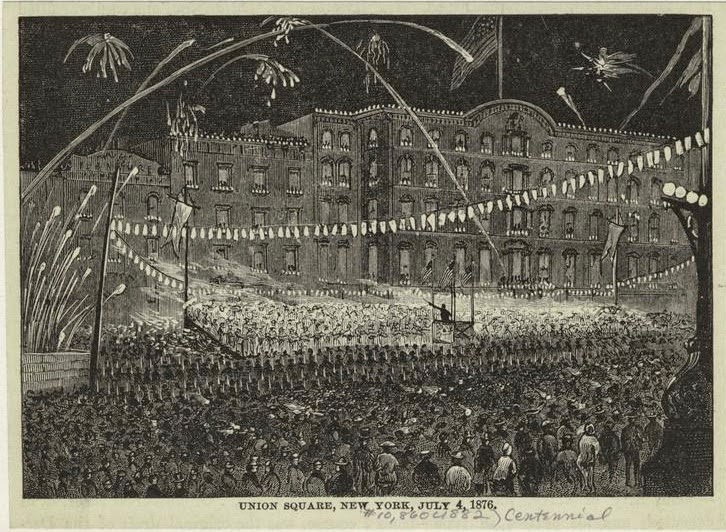
3. American Centennial — July 4, 1876
The all-day centennial celebration culminated in fireworks “representing the Goddess of Liberty sitting on a cloud in the act of greeting,” as well as several street-level “allegoric representations” illuminated in colorful fireworks. [source]


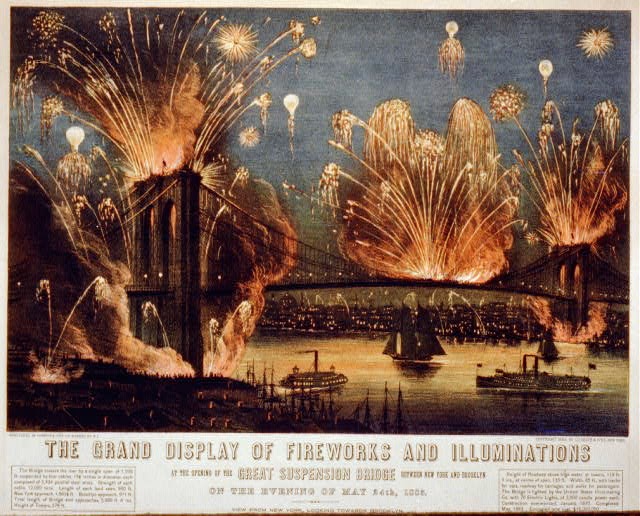
4. Opening of the Brooklyn Bridge — May 24, 1883
“Forty pyrotechnists superintended the display. There were 6,000 four-pound skyrockets, 400 bombshells and 125 fountains of colored lights.  Zinc bombshells of about ten inches in diameter were fired from mortars 500 feet in the air. Each bombshell held 600 stars of various colors.  A newly-invented rocket was displayed.  It held seven parachutes of cloth.  From these hung colored balls of fire.  The rockets burst, leaving the parachutes floating in the air. Five of these rockets were fired at once.  The result was thirty-five balls of colored fire floating in the air…..” [source]


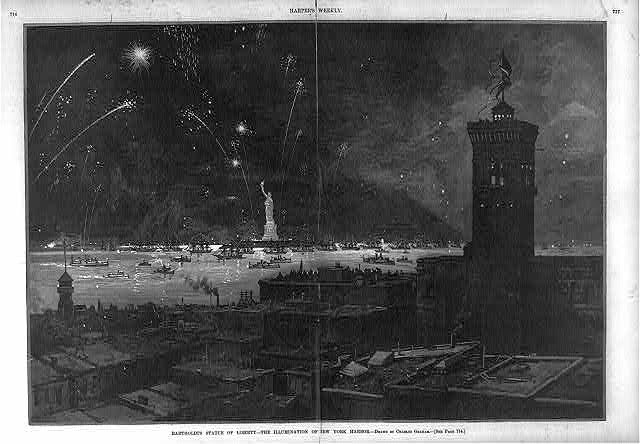
5. Dedication of the Statue of Liberty — October 28, 1886
Well, actually, three days later, on November 1.  A soggy day killed off the fireworks on the day of the statue’s dedication, but were finally launched the following Monday.

“At precisely the hour fixed there came a burst of kaleidoscopic lights from Bedlow’s and Governors Island, and in an instant the air was filled with flying fire balls of every color of the rainbow.”


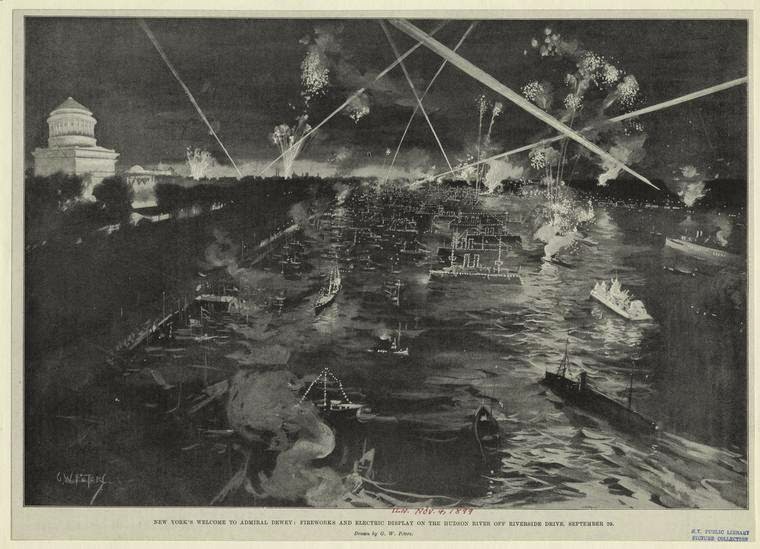
6. Hero’s Welcome for Admiral George Dewey — September 29, 1899
The arrival of Admiral Dewey, the face of the U.S.’s victory in the Spanish-American War,  inspired an exuberant celebration throughout the city.

“The day of Dewey celebration on the water ended in a roaring, popping, banging blaze of glory last night. Fireworks displays lit up the east side, the west side and all around the town. Not only did great boats loaded down with fireworks sweet down all the water-ways and circle about the lower Bay, but in the parks throughout the middle of the city the sky was painted red, white and blue and all the other shades of color known to the pyrotechnic art. ” [New York Sun]  (Illustration by GW Peters, courtesy NYPL)

7. Opening of the Williamsburg Bridge — December 19, 1903
“Then, without warning, the bridge was suddenly transformed into a sheet of flame.  From tower to tower the flames turned and writhed and flared high in the air, illuminating the waterfront for blocks.  Then came a kaleidoscopic medley of colors, red, green, purple, orange, violet — more colors than French ribbon dealer could enumerate — from huge rockets that sails two hundred feet above the bridge.” [source]

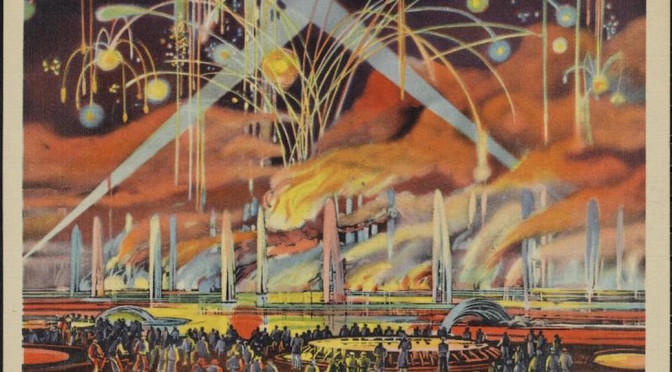
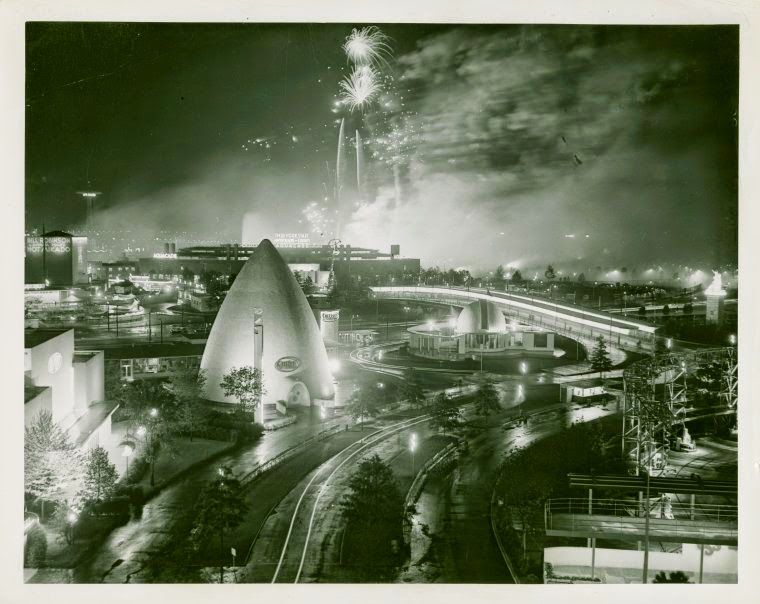
8. New York World’s Fair — July 4, 1939
“Fireworks colored the sky with the red, white and blue of the nation’s colors over the World’s Fair Grounds last night as two spectacular and elaborate displays of fire, water and music were set off, first from the Lagoon of Nations in the exhibit area and a short while later from Fountain Lake in the amusement area.”


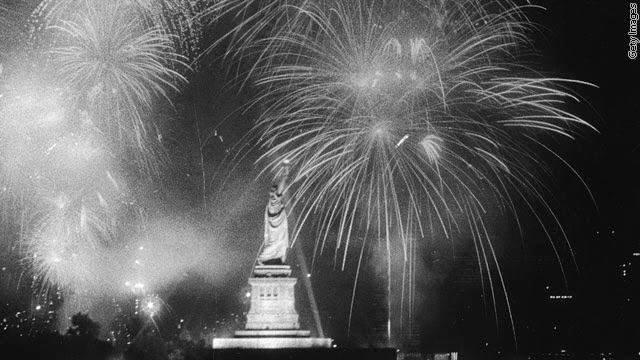
9. America’s Bicentennial — July 4, 1976
This event was notable not only for its visibility across the nation — thanks to a television special — but it was the first fireworks display sponsored by Macy’s.   “New York Harbor became more brilliant than Broadway last night as the biggest and most colorful fireworks display in the city’s history exploded for half an hour in celebration of the nation’s Bicentennial.” [NYT]


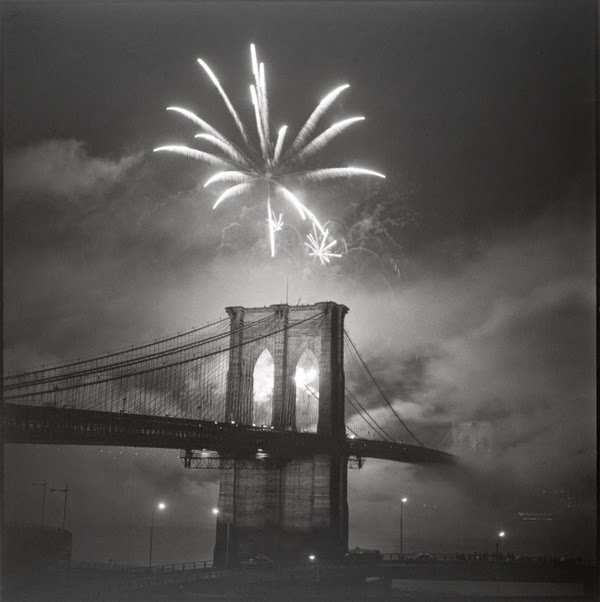
10. Brooklyn Bridge 100th Birthday — May 24, 1983
“Then the sky simply exploded with fireworks. Red, white and blue shells, golden comets changing to silver, crackling stars in red and green, appeared to fill the entire sky, while hundreds of thousands of people gasped at the sheer dazzle of it all.” [New York Times]
(Bruce Cratsley, courtesy Brooklyn Museum)

Categories
Health and Living

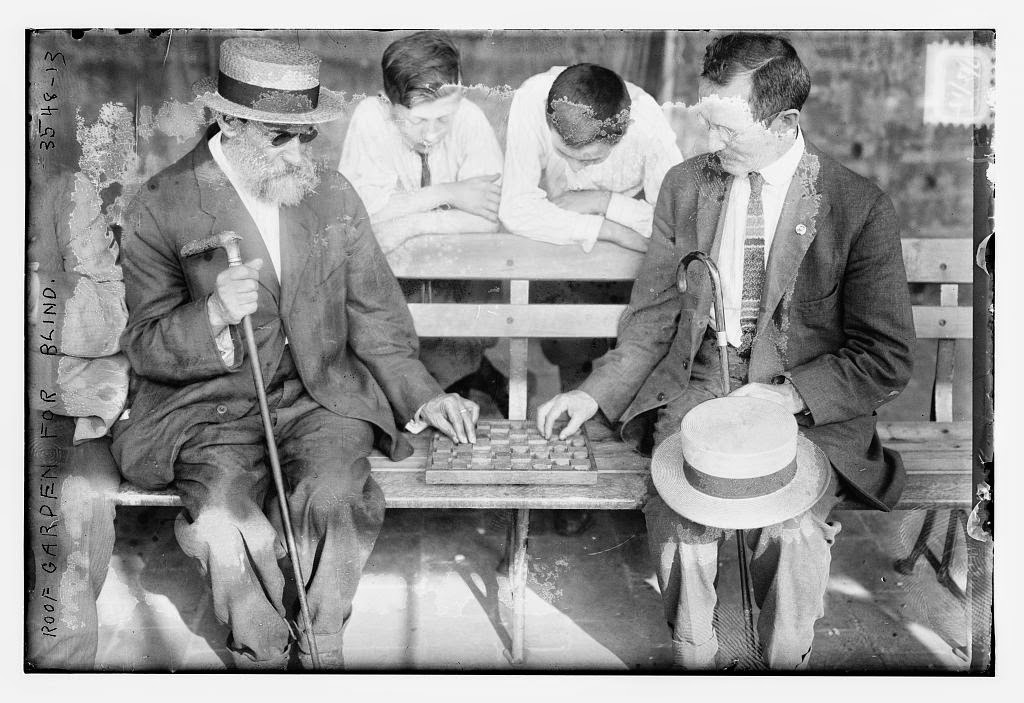
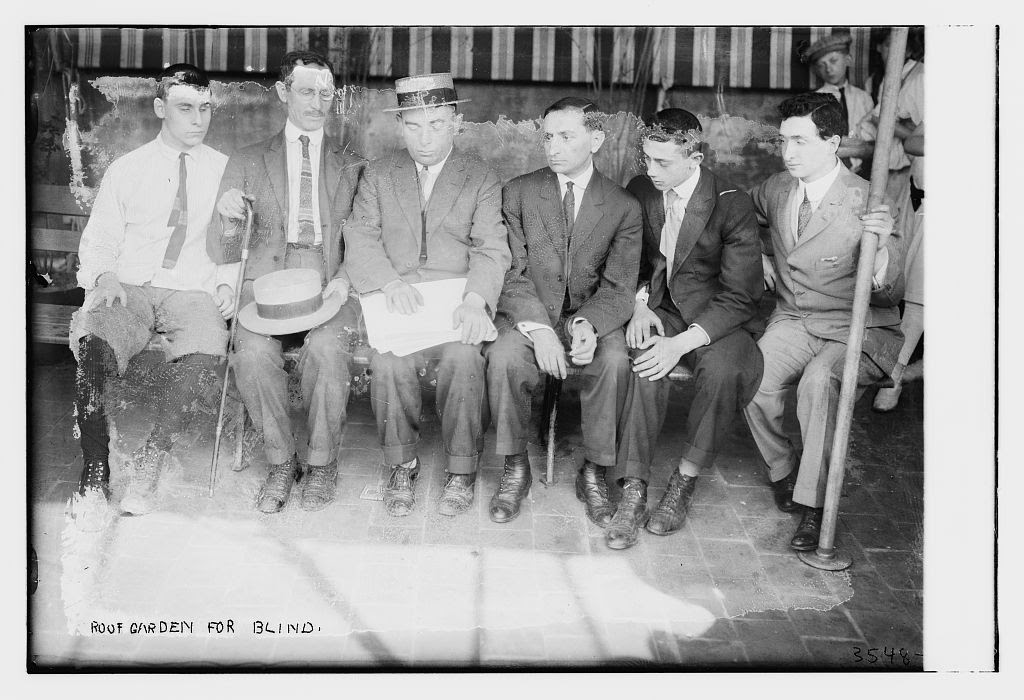
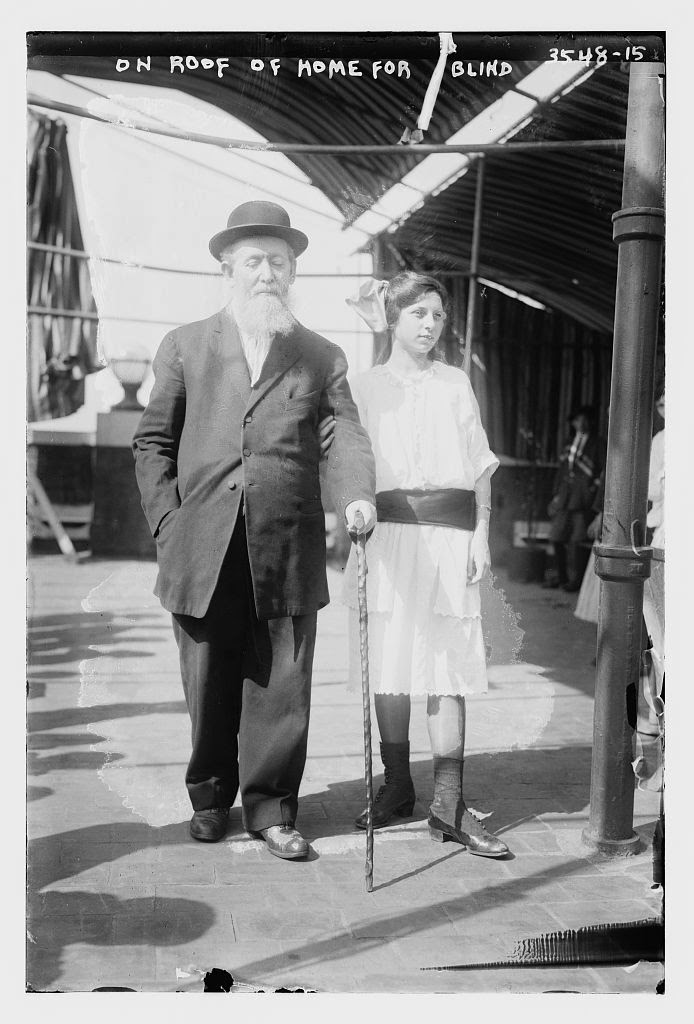
Above Delancey and Allen Streets: a roof garden for the blind and its unfortunate connection to the 1929 stock market crash

Above (and in the photographs below): Young and old alike enjoy the roof garden atop the Bank of the United States building, on the corner of Delancey and Allen

Next to the Tenement Museum in the Lower East Side on Delancey Street stands an elegant grey building incorporating regal Doric columns on its face. Echoing its facade is the restaurant and lounge on its ground floor — the Grey Lady.   It was constructed over one hundred years ago for the Bank of United States, a commercial bank that did not survive the Great Depression.

The bank, a venture by Jewish financier Joseph S. Marcus, had an attention grabbing name, sounding like a branch of the federal government.*  But it was the unusual feature on the top of the building that summoned the most attention at first — a rooftop garden for the blind.

While services for blind people in New York greatly improved with the social changes of the late 19th century, most facilities were in small rooms in overcrowded neighborhoods.  With the 20th century came the concept of “open air” schools and libraries for the prevention of diseases.

From the 1919 book called the Education of the Blind:  “Whatever may be said of sports and games for the blind, the “open air” principle must be strongly emphasized;  if the ever present germs of cold and of the dread tuberculosis are to be conquered, there cannot be too much cheerfully undertaken exercise in the open, where the health-giving sunshine and fresh air can exercise their curative powers the best.”

Marcus followed the examples of many Jewish philanthropists is reaching out to the communities of tenements around his bank.  His lofty Bank of the United States building opened at the corner of Delancey and Allen Streets in 1914, and, believing that the freshest air in the city could be obtained atop buildings, he topped it with a rooftop garden, devoted only to the needs of the blind.

It initially opened with “flower beds and settees under the awning [several] stories above the street, where it is always cool.”  The following year, the New York Times reported “[t]he roof is floored with tile and surrounded with a high wall so that the blind may move about in safety.”

“This is said to be the only place on the Lower East Side where the blind can be sure of safety from pickpockets.” [source]

Blind residents of the Lower East Side were brought to the roof garden with the help of “light bringers,” a group of 150 child volunteers from the local public schools.

The roof garden was operated by the Hebrew Association for the Blind, who had offices in the bank building.  The garden featured entertainment by local school choirs and lectures by “well known men.”

It’s the entertainment and leisure activities of Marcus’ roof garden that distinguished it from other rooftop gymnasiums which also offered outreach to blind New Yorkers.

An open-air gym at the Lighthouse for the Blind at 111 East 59th Street provided a rooftop running and roller-skating track while such services as cooking classes, swimming pools and a bowling alley were offered in the rooms below.

“Health for the blind through recreation in the open air,” was the motto of this institution. [source]  Lighthouse International is still at that location today.

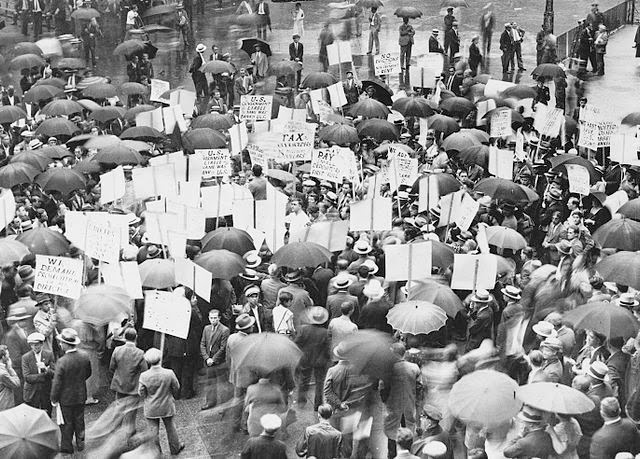
I’m not sure when the Delancey Street roof garden closed — more beneficial services for the blind emerged by the 1920s — but thankfully it wasn’t there on December 10, 1930, when a Bronx branch of the Bank of United States saw the first of many bank runs in the aftermath of the Stock Market Crash of 1929.

The following day, at the Delancey Street bank, “a line of 300 persons extended around the corner into Allen Street,” looking to withdrawal their money.  Judging from the photograph below (showing the mob at Delancey and Allen Streets on that very day), it appears that more than 300 people showed up!  That was the last day of business at the Bank of the United States. [Read its 1930 post-mortem here.]

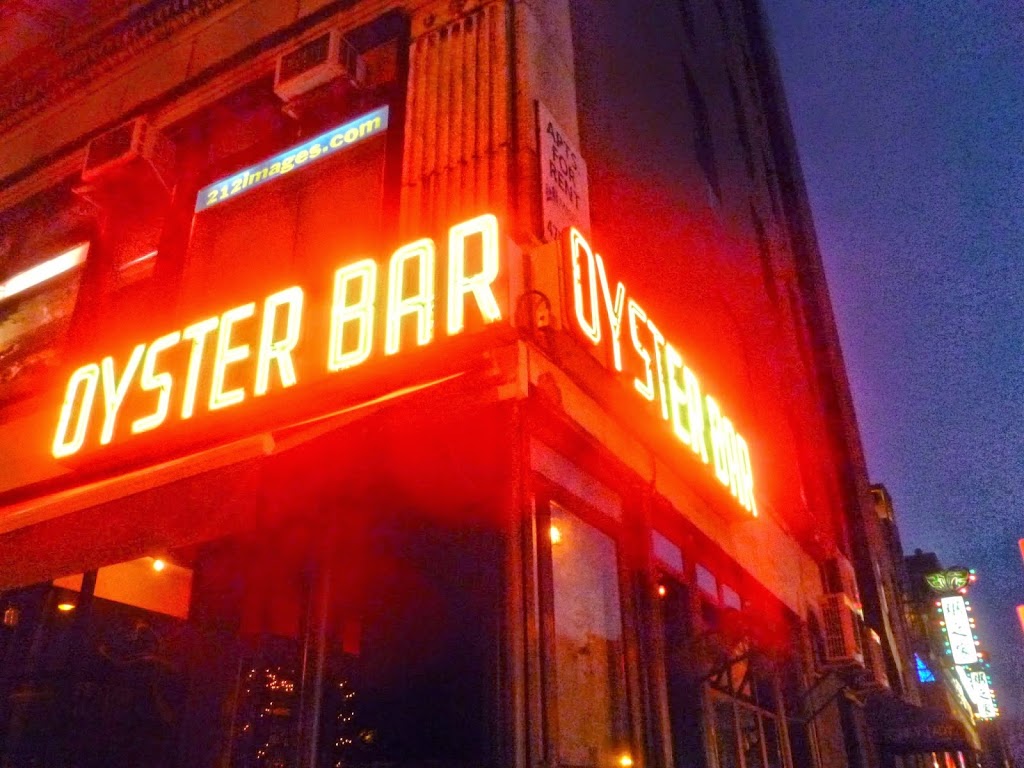
The building recently made the news — and made the day of nostalgists — when the proprietors of the Grey Lady installed the Famous Oyster Bar neon sign above their establishment, another sort of light bringer to this building’s unique history.

Picture courtesy Jeremiah’s Vanishing New York

* By the way, that lofty bank name was controversial back when it was chartered in June 1913. According to the New York Times, “The Bank of United States was chartered yesterday. This does not mean that the new national banking and currency system has gone into effect, and that the great United States is back of this institution, although interests which, it developed yesterday, have been making a hard fight against the use of that name say the ignorant immigrants of the east side are likely to think it does.”

Categories
Queens History

The religious controversy behind a lonely Roman column just standing around by itself in Flushing Meadows Park

.
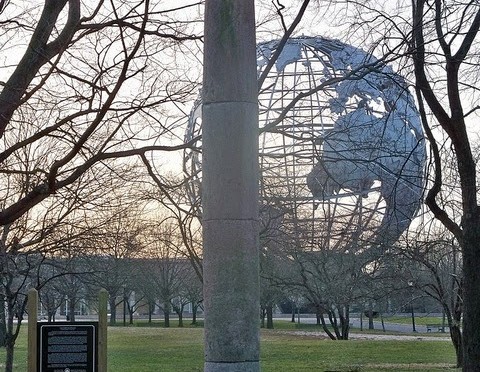
The second oldest manmade object in New York City — outside, that is, not in a museum or private collection — is a solitary little Roman column built in 120 AD for the Temple of Artemis in the ancient city of Jerash.  It once stood among a chorus of ‘whispering columns’, creating an effect in the temple which would magnify the human voice.
So why is it standing all alone in Flushing Meadows Park in Queens?

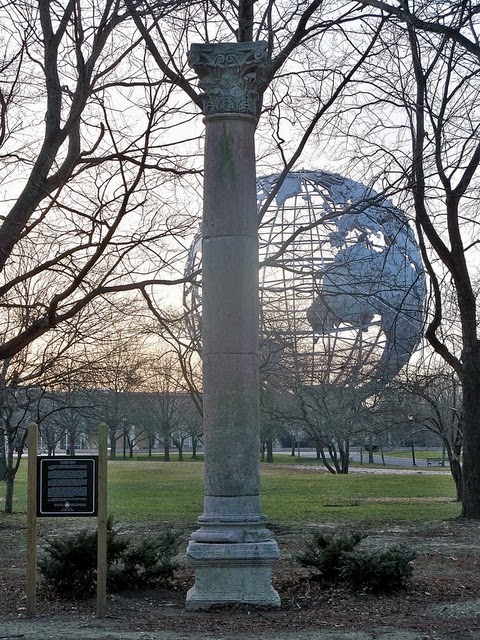
At right: The column stands alone, with the Unisphere in the background. Courtesy Flickr/Christoslilu

It was a gift of the Kingdom of Jordan for the New York World’s Fair of 1964-65, presented on April 22, 1964, by the young King Hussein to none other than Robert Moses. What did those two have to talk about?

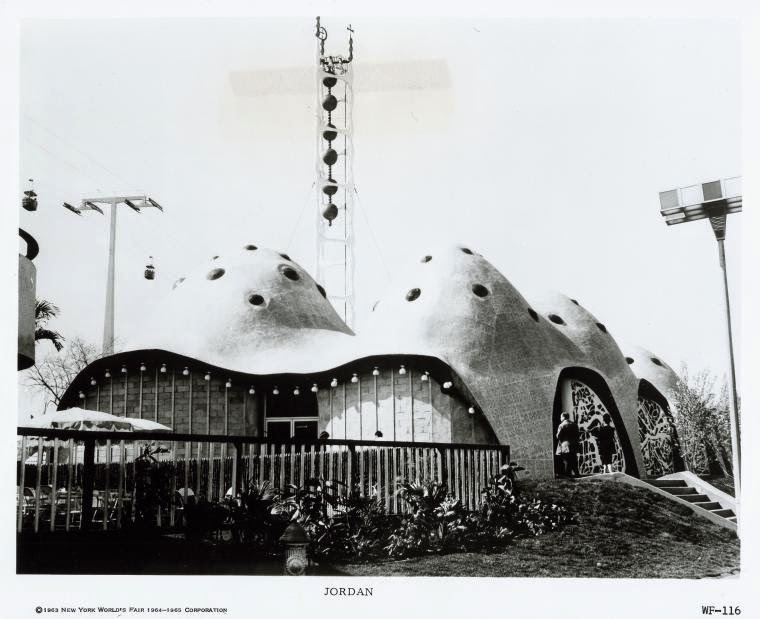
The Jordanian Pavilion at the World’s Fair was a particularly unusual addition to the unofficial (and incomplete) league of nations at the fair. Despite its almost alien appearance — curved and encrusted with gold mosaics — it was one of the most religious buildings there, embodying imagery of both the Christian and Muslim faiths.

Sculptural displays of Stations of the Cross by Antonio Saura decorated the exterior, and bright stained glass windows lit up spectacularly at night.  The Dead Sea Scrolls were displayed alongside a replica of the Dome of the Rock, and visitors could shop at a jewelry bazaar or eat traditional Middle Eastern food in the snack shop.

But despite the many artifacts of great historical provenance, the most controversial thing in this odd building were a set of newly painted murals.

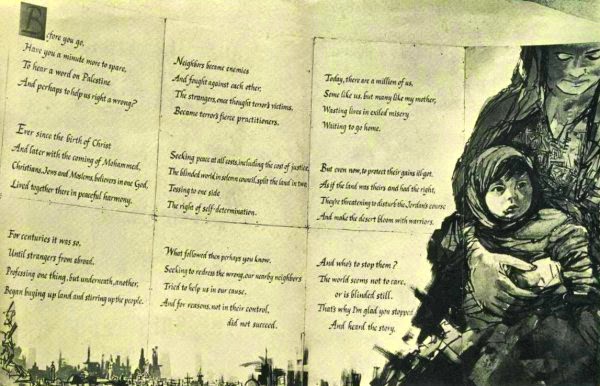
Some Jewish visitors to the pavilion were immediately offended by one particular mural depicting a young refugee expounding in a lengthy text about the Israeli-Palestinian situation at the Jordanian border.  “The strangers, once thought terror’s victims, became terror’s practitioners,” it said, implicating the Israelis (but never mentioning them by name).

“But even now, to protect their gains, illgot, as if the lands were theirs and had the right,” went the mural, “they’re threatening to disturb the Jordan’s course and make the desert bloom with warriors.”

Below:  The controversial Jordanian mural (Courtesy the excellent tribute site NYWF64 )

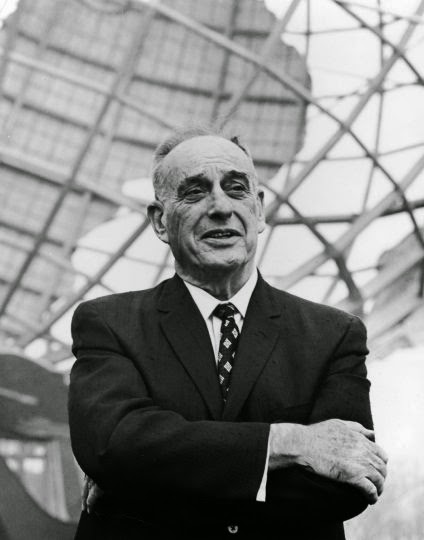
Organizers at the American-Israeli Pavilion wrote Moses to complain, saying the murals were not in keeping with the fair’s theme of “Peace Through Understanding.”  Moses (pictured below) initially rejected the request, but Mayor Robert Wagner, perhaps in an intentional slight to the former parks commissioner, promised to have the murals removed.

Members of the City Council even proposed a bill forcing the fair to remove the mural.  The Jordanians replied that they would rather close the pavilion than tear down the murals under pressure.  Israeli protesters picketed the pavilion;  at one point, the Jordanian flag was taken and temporarily replaced by the Israeli flag by a protester.

Of course, as a result, the Jordanian Pavilion became hugely popular in the early days of the fair, with thousands of visitors streaming in to see what the fuss was about.

The Isaeli pavilion then unveiled its own mural as a response to the Jordanian mural.  Further lawsuits, even fistfights, ensued over the controversy. In the end, none of the murals were removed.

What got sadly overshadowed in all this, of course, was the Column of Jerash, which could have been made of plaster for all the attention it received.

After the fair ended in 1965, the pavilions were mostly all torn down, but the column stayed behind, making the park its home for several decades now.  Today you can find it near the Unisphere next to a plaque which reads:

THIS COLUMN WAS PRESENTED TO/ THE NEW YORK WORLDS FAIR AND THE CITY OF NEW YORK BY/ HIS MAJESTY KING HUSSEIN / OF THE HASHEMITE KINGDOM OF JORDAN/ ON THE OCCASION / OF JORDAN’S PARTICIPATION IN THE FAIR./ THE COLUMN WAS RECEIVED BY THE HONORABLE ROBERT MOSES, PRESIDENT, / NEW YORK WORLD’S FAIR 1964-1965 CORPORATION./ THIS IS ONE OF MANY COLUMNS IN A TEMPLE ERECTED BY THE ROMANS/IN 120 A.D./ THAT STOOD IN THE ROMAN CITY OF JERASH, JORDAN./ THE COLUMNS ARE KNOWN AS THE WHISPERING COLUMNS OF JERASH.

——————————

Okay, so that’s the second oldest large manmade object in New York City?  What’s the oldest?

That’s the subject of our new podcast tomorrow so stay tuned!

Categories
Museums Podcasts

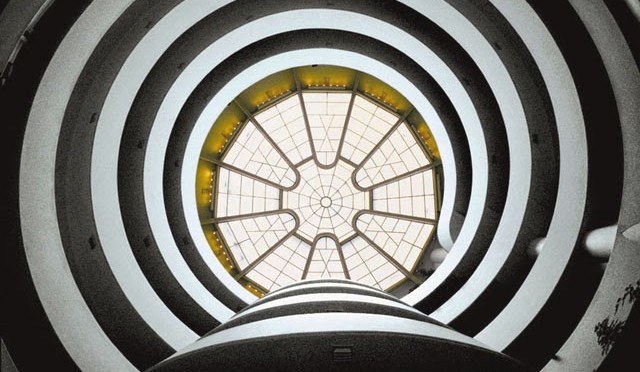
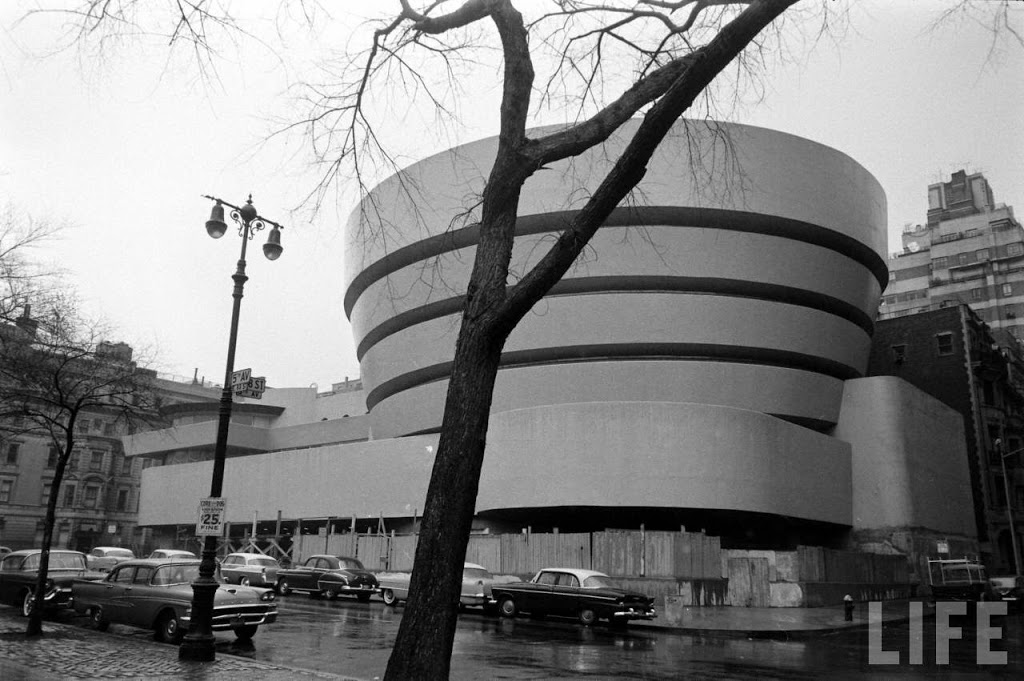
The wonderful mysteries of the Guggenheim Museum, the Frank Lloyd Wright ziggurat turned on its head

It’s ancient mysteries week on the Bowery Boys! What, you ask, I thought you only did New York City history? In fact, at least two great Manhattan landmarks evoke the great mysteries of ancient times, meant to bring mystical energy and revelation to one of the world’s greatest cities.

Here’s a replay of a podcast we recorded back in October 2008 on the history of the Guggenheim Museum, a space-age upside-down ziggurat originally designed to hold only the most unfathomable non-objective art in the world.

The spiral-ramped wonder that is the Guggenheim began as the dream of three colorful characters — a weathy art collector, a severe German artist and her rich patron art-lover. So how did they convince the most famous architect in the world to sign on to their dream for a modern art “museum temple”? Come meander with us through the Guggenheim’s quirky history. Co-starring Robert Moses!


Photographed by Walter Sanders, Life Magazine

PODCAST REWIND A special illustrated version of the podcast on the Guggenheim Museum (Episode #67) is now available on our NYC History Archive feed. Chapter headings with images have been embedded in this show, so if your listening device is compatible, just hit play and a variety of pictures should pop up. The audio is superior than the original as well. So dive into this weird, wild history of one of New York’s great museums!

When we recorded this, George W. Bush was still president of the United States, and the Guggenheim was just reopening after a major renovation. So even this podcast is a bit of history in itself!

Download it here or just subscribe to our archive feed — on iTunes or directly here. You can also stream it on Stitcher, although due to file incapability, it won’t be illustrated.

Categories
Neighborhoods

Inside Gimbels traverse, the secret perch near Herald Square

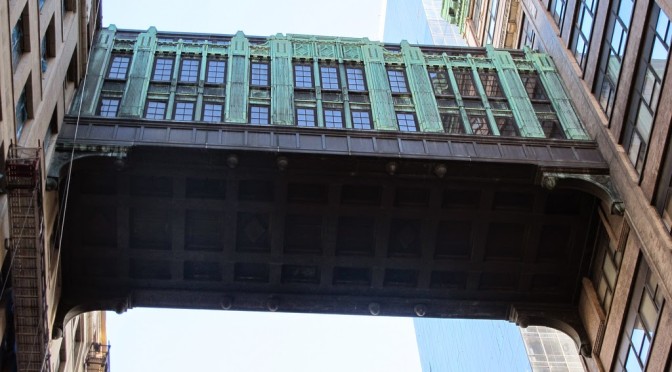
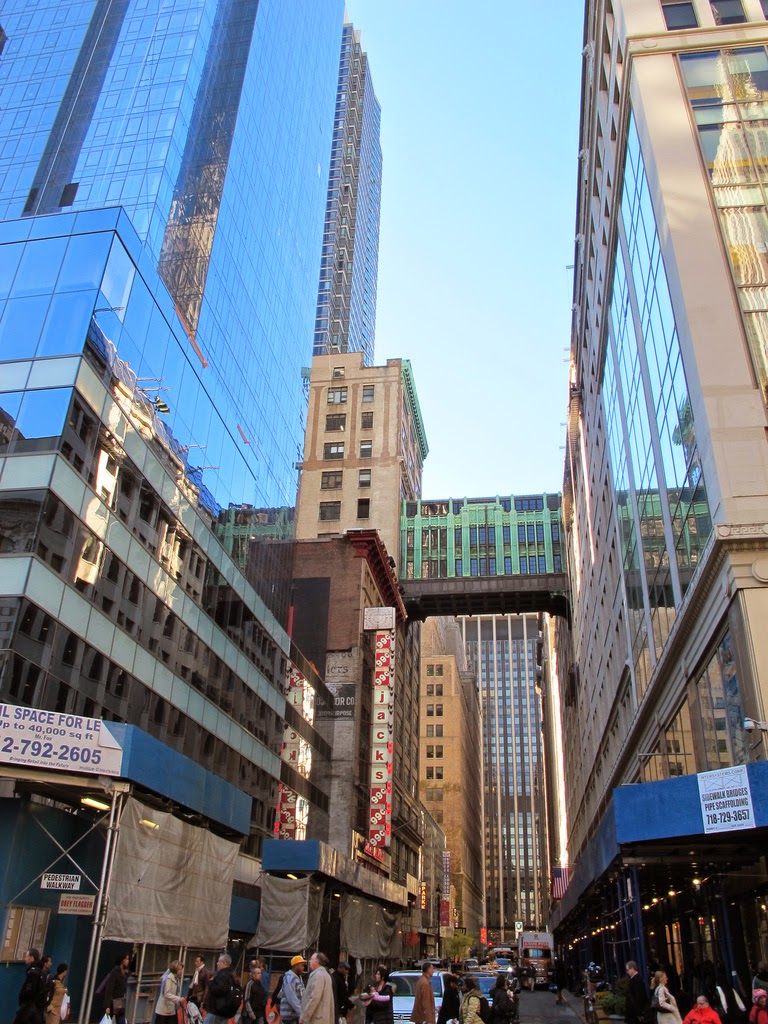
Looking up to the Gimbels traverse overhead on 32nd Street (Flickr/Docking Bay 93)

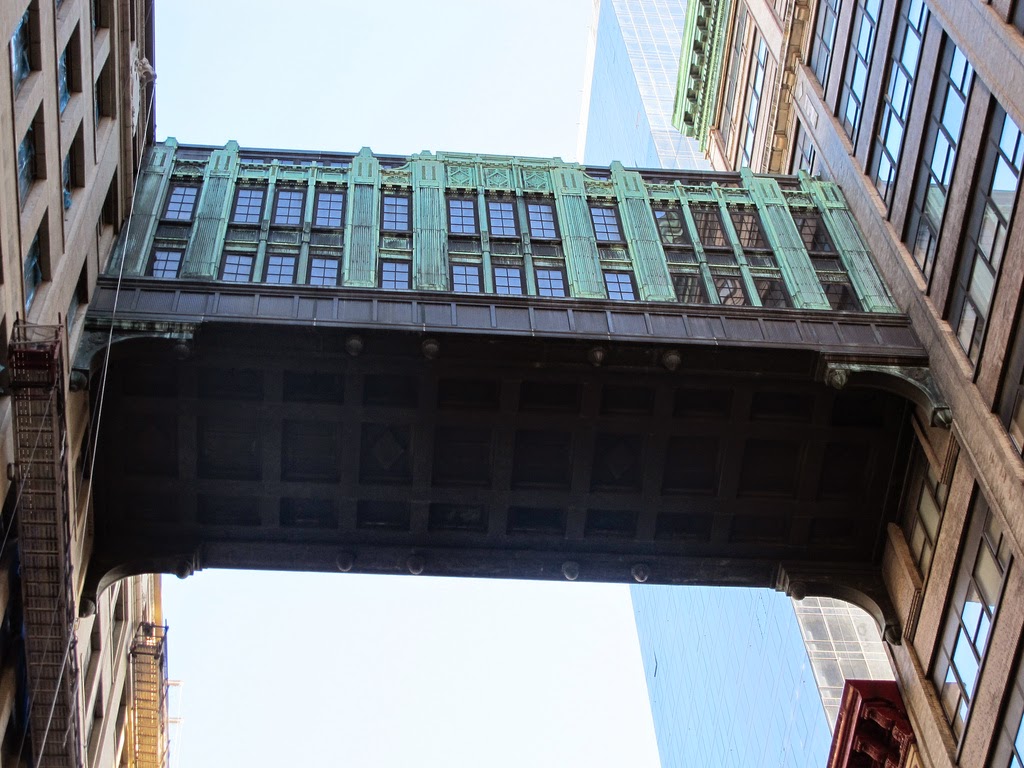
One of our podcast listeners Alexander Rea sent over the following photographs of a tucked-away place in one of the busiest areas of New York City — the Gimbels traverse on W. 32nd Street, in the Herald Square shopping district.

No doubt you’ve walked around the city and seen other sorts of traverses, those overhead bridges that link two buildings together, several stories up.  But the Gimbels traverse is perhaps the most interesting and the most beautiful in New York.  Today, this ornate treasure amusingly hangs right over Jack’s 99 Cent Store.  Here’s a bit of its history, revised from something I wrote a few years ago:

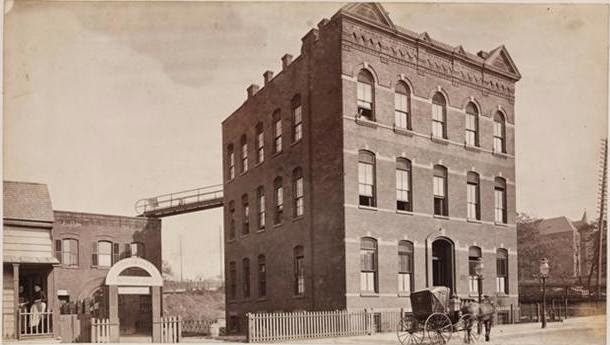
Macy’s kicked off the Herald Square department store district when it transferred here from its original 14th Street home in 1902.  [Listen to our Ladies’ Mile podcast for more information.]  Soon other department-store competitors of Macy’s flocked to the neighborhood in the early part of the 20th century. One strange vestige of this retail nostalgia still exists, in the form of a fabulous green copper traverse above W. 32nd Street.

Gimbels arrived in the Herald Square area in 1910 with a building designed by no less than Daniel Burnham (of Flatiron Building fame).  Gimbels was a more than worthy adversary of nearby Macy’s.  The early catchphrase ‘Well, would Macy’s tell Gimbels?’ exemplified the top-secret, competitive tactics of the two retail giants

Gimbels vied for attention with such wacky publicity stunts as sponsorship of a daredevil airplane race that sailed over the department store in 1911.  But despite (or perhaps, because of) other innovations such as the first ‘bargain basement’, Gimbels never reached the same hallmarks of class and reputation that Macy’s did.

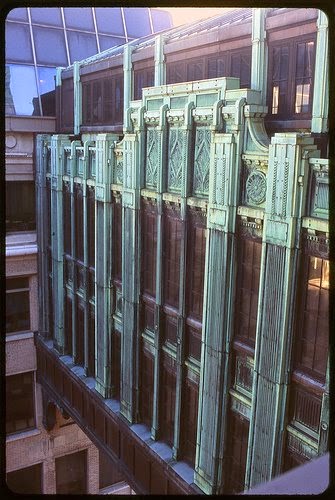
In 1925, Gimbels decided to link its Herald Square store to a recently acquired annex across the street, via a custom traverse, a beautiful copper bridge, three stories tall, created by Richmond H. Shreve and William F. Lamb, a teeth-cutting project for two young architects who would go on to help design the Empire State Building.

Both the original Gimbels store and its annex have been radically modified over the years. Thankfully, the copper bridge (now, like the Statue of Liberty, in bright verdigris) has been left virtually intact.  Despite some fears that it might be getting ripped down, the musty but still beautiful sky bridge still hangs high above shopper’s heads, a reminder of a universe of cut-throat department-store wars.  (Inset pictures courtesy Flickr/moufle, Docking Bay 93)

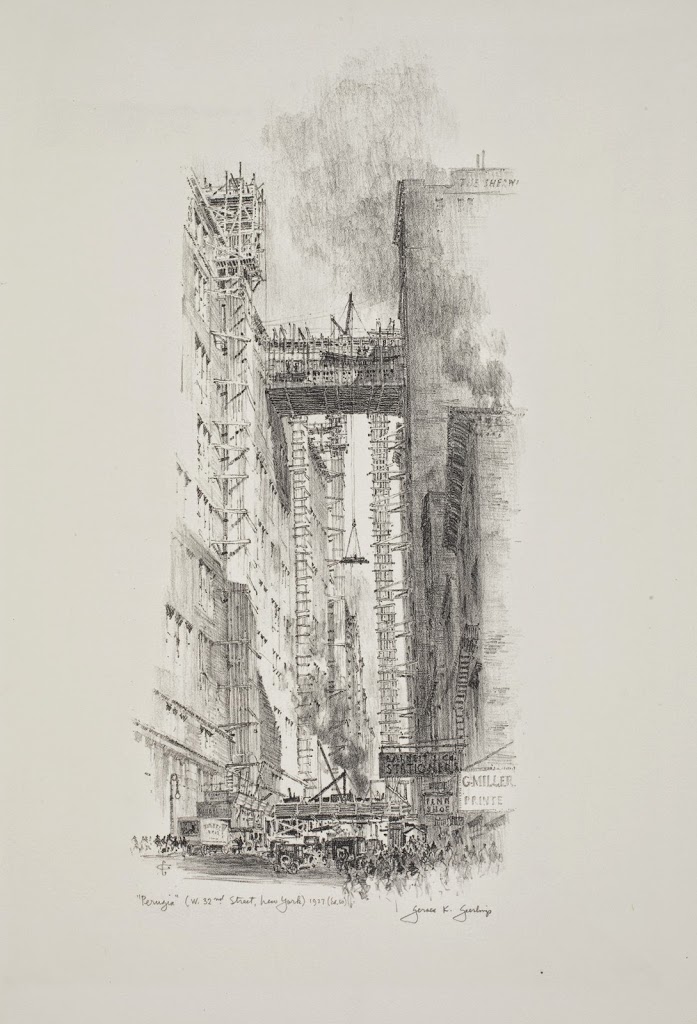
Below: A sketch, dated 1927, by Gerald K Geerlings, showing the construction of the Gimbels traverse. Courtesy the Museum of the City of New York


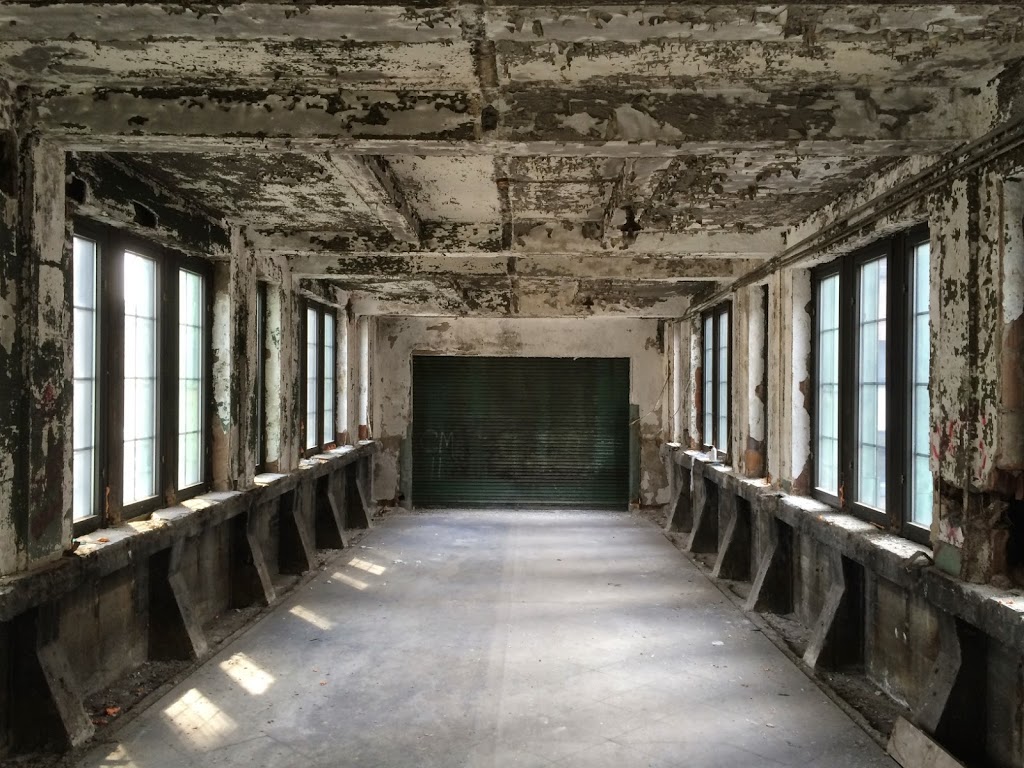
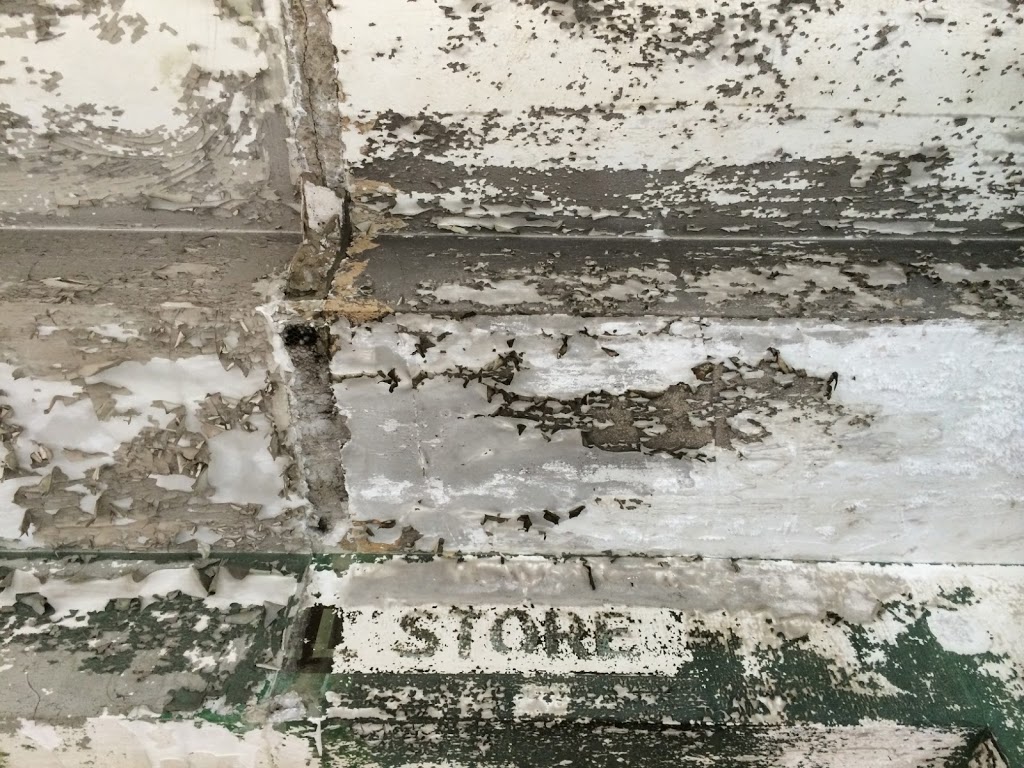
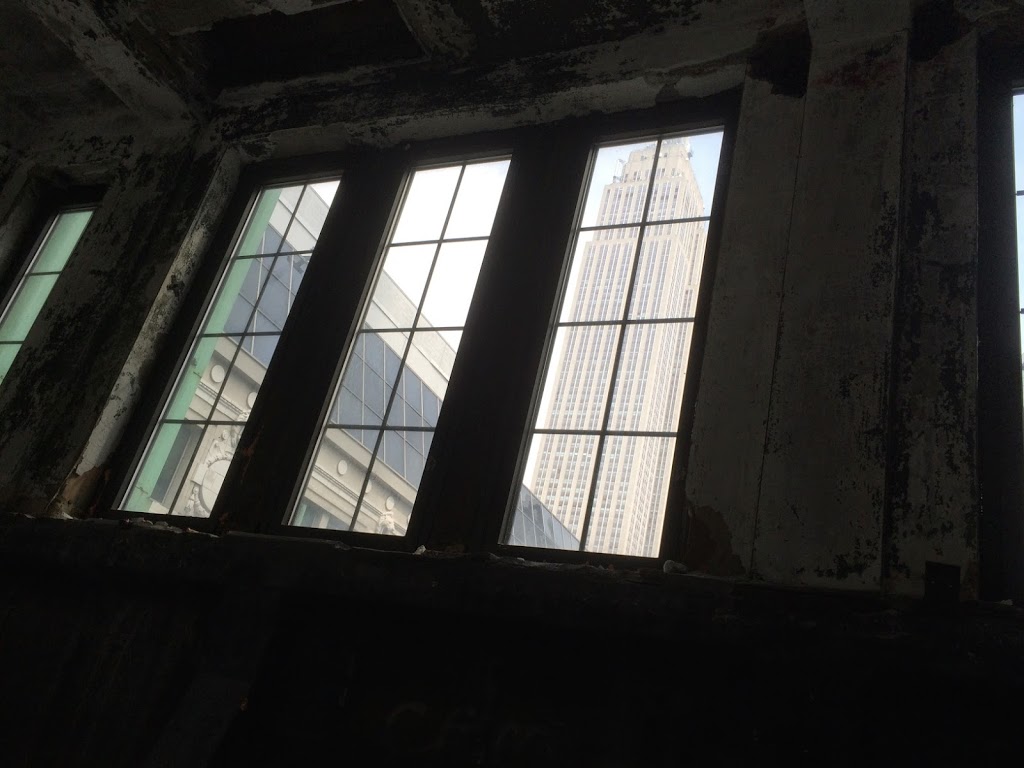
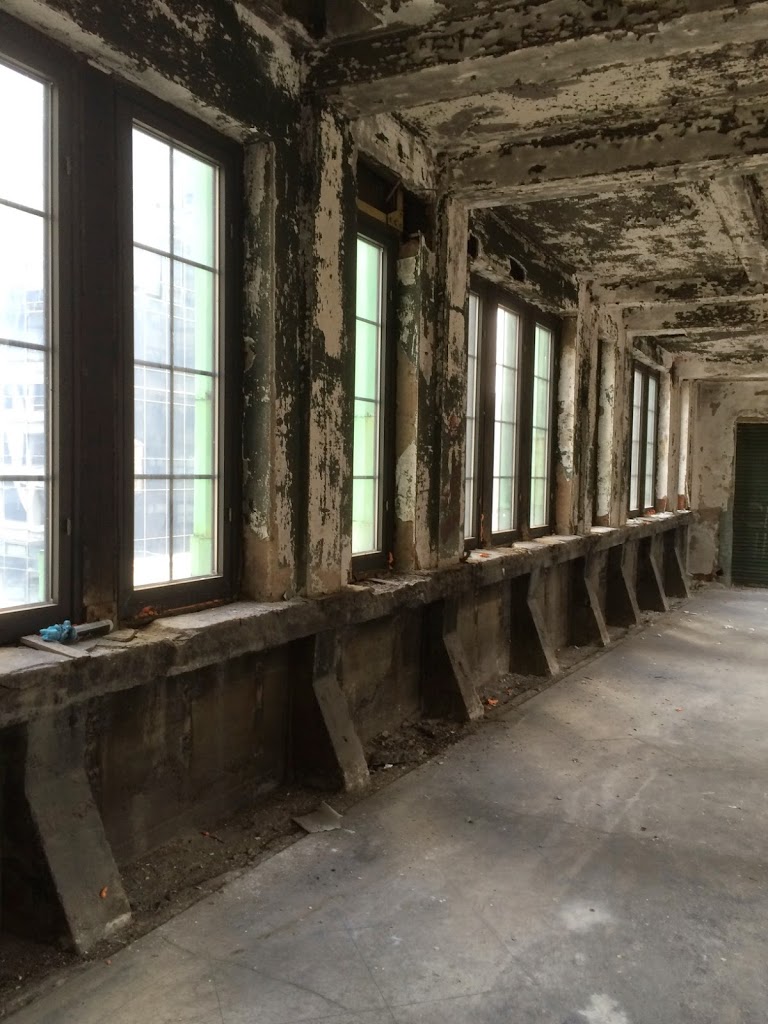
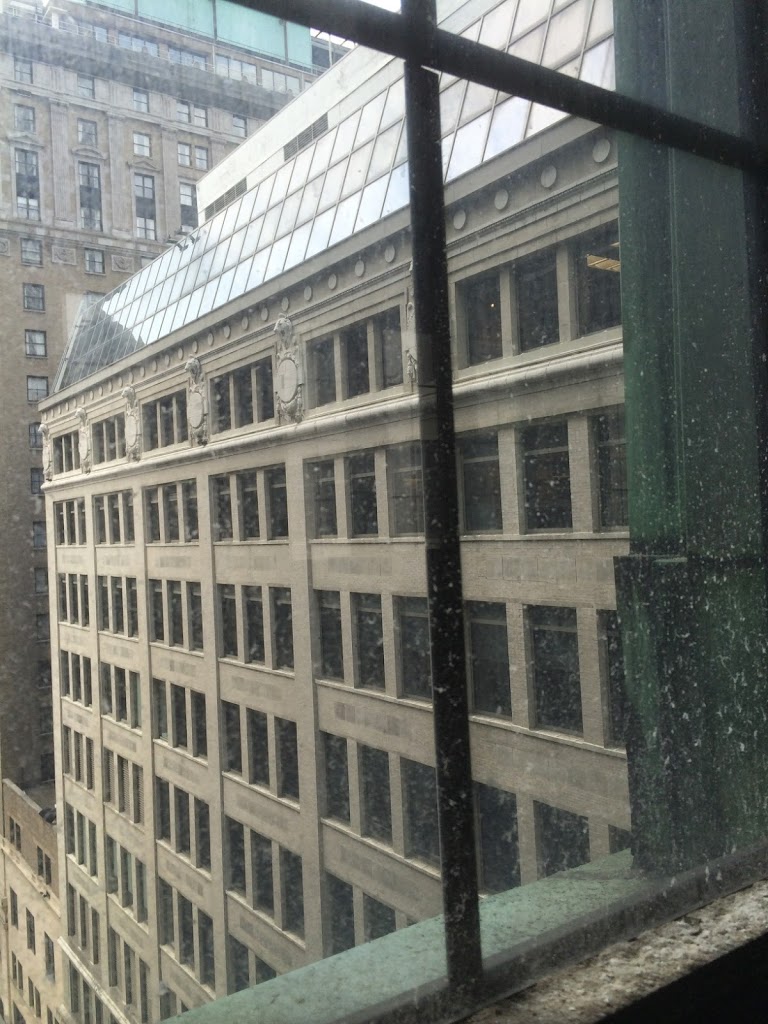
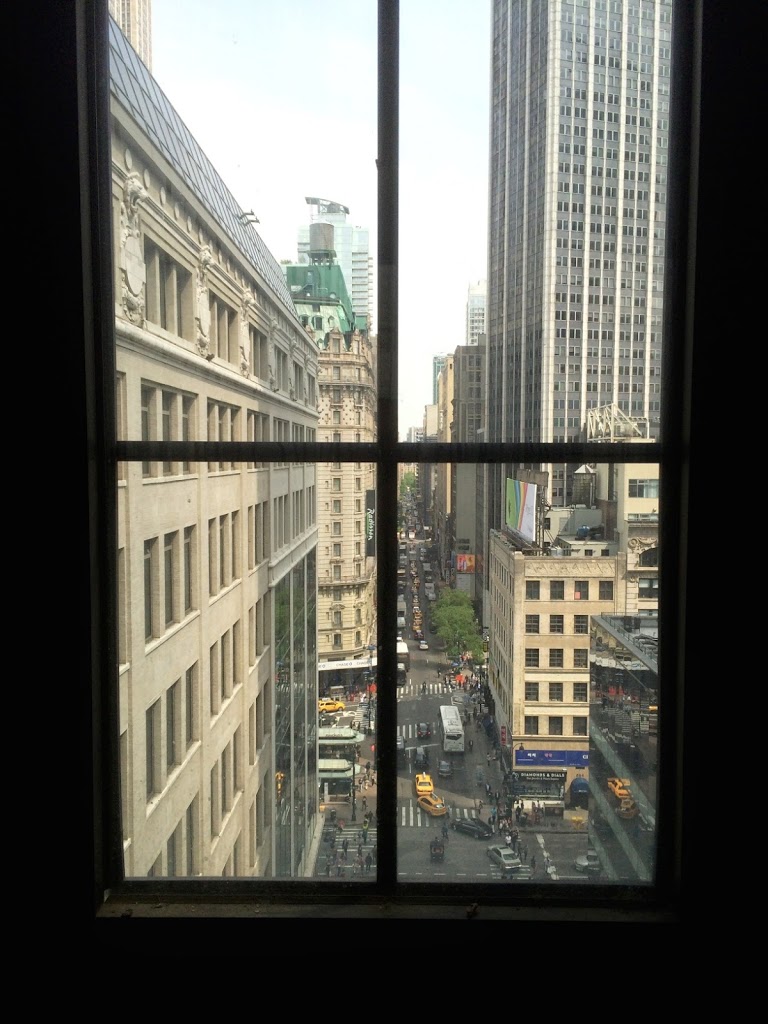
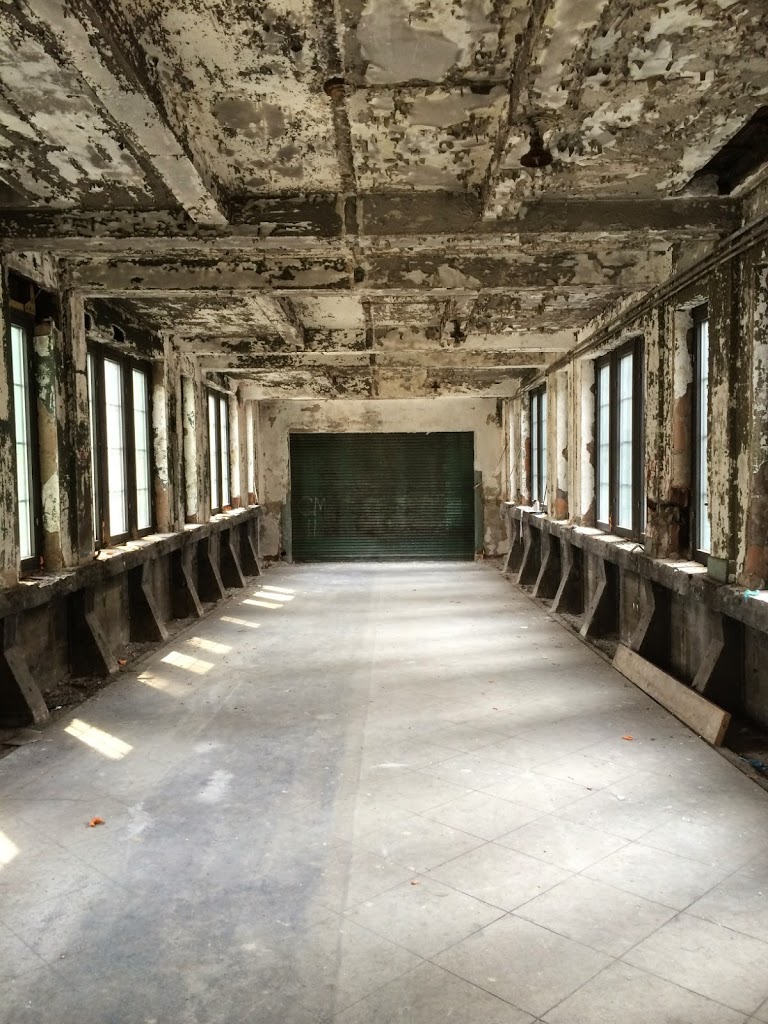
Rea, who works in the old Gimbels building (today the Manhattan Mall), was recently granted brief access into the traverse, which spends most its existence sealed off and empty.  Here are some of the images he was able to capture in his brief time inside, revealing some old signage and the world outside from this rare vantage.  Thanks for sharing, Alexander!

Categories
On The Waterfront

Troubled Waters: The story of the Grand Republic steamboat, the cursed sister ship of the General Slocum

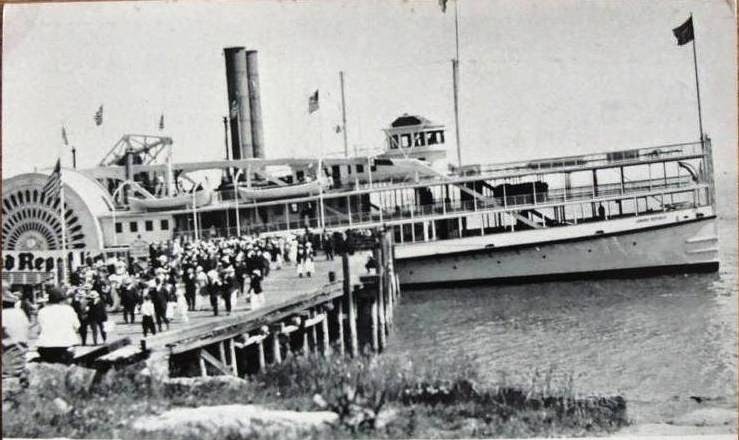
Above: The Grand Republic steamship. As you can see from its paddlewheel, it was a twin to the General Slocum [source]

This could not have made New Yorkers feel very safe about even the briefest of river excursions.

Days after the General Slocum excursion steamer caught fire and sank in the East River, killing over 1,000 people, its older sister ship the Grand Republic — a twin of the doomed vessel, owned by the same company — kept operating along the waters of New York Harbor.

To many, it looked like the ghost of the Slocum.

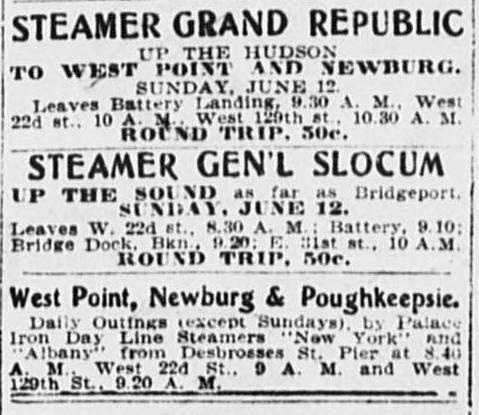
The Grand Republic often ran in tandem with the Slocum, transporting passengers to the seaside amusements of the Rockaways.  During the month of June 1904, the Grand Republic was assigned to the Hudson River, while the Slocum ran the Long Island Sound.

An advertisement in the New York Evening World, June 10, 1904

After the Slocum tragedy, steamboat inspectors were heavily scrutinized and excursion companies were accused of endangering lives for a fast dollar.

Rallying to the side of safety was, of all people, the venerated Daniel Sickles, former Congressman and Civil War officer.  (You may remember him from his early days back when he killed the son of Francis Scott Key.)

The retired politician had no tolerance for the bureaucrats he believed were responsible for the Slocum disaster.

“Scalp those moribund Federal officials who sit with their roll-top desks and draw their salaries for doing nothing while human life is allowed to be sacrificed by the hundreds,” he said. “Only yesterday, I am informed the Grand Republic was allowed to leave her wharf with more passengers than the law allows. Broadside these fellows and let every man and woman write President [Theodore] Roosevelt a letter demanding an investigation.” [source]

Sickles made good on his word, writing Roosevelt and lashing out at the steamer companies in no uncertain terms, the overcrowded General Republic his chief example of their continued malfeasance.

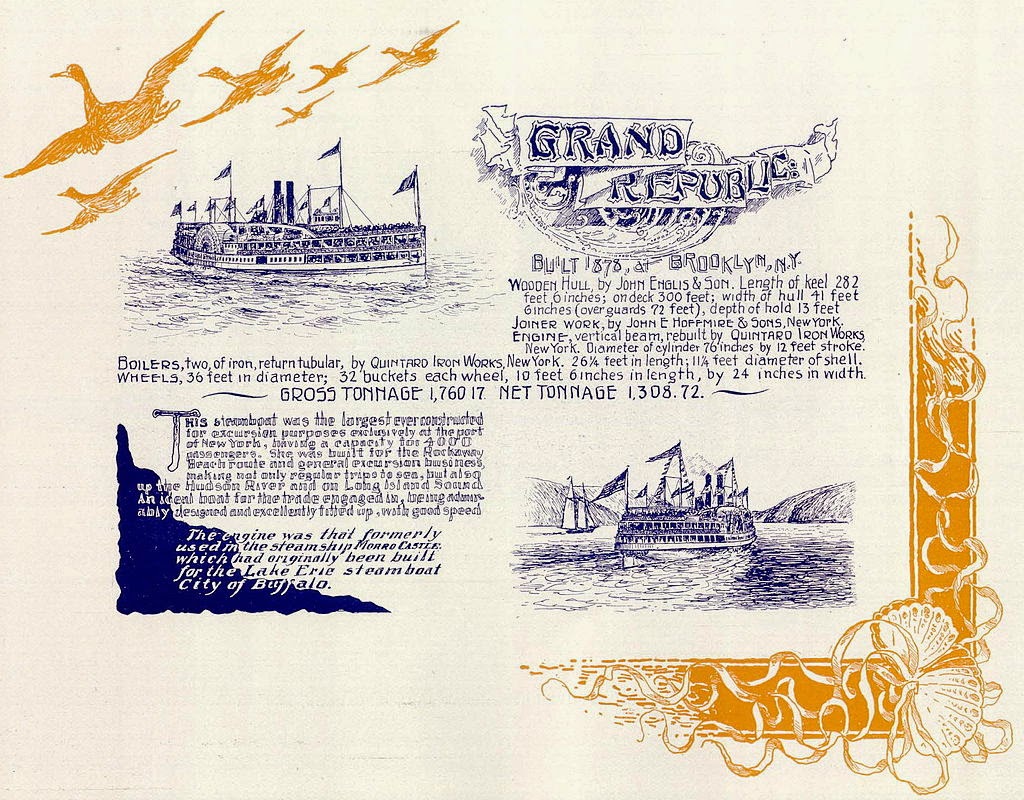
Below: A graphic on the Grand Republic in a book called American Steam Vessels. “Built in 1878” “This steamboat was the largest ever constructed for excursion purposes exclusively at the port of New York.”

The Slocum disaster obviously hit business hard for the entire excursion industry.  The weekend after the Slocum sank, the Grand Republic was supposed to host another church group for a tour of the Hudson, but, understandably, only one-fourth of its passenger list arrived. The Knickerbocker Steamboat Company, owner of the Slocum and Grand Republic, went out of business, and the Grand Republic was sold to another concern.

The captain of the Grand Republic steamer John Pease had been responsible for inspections on the Slocum and was eventually indicted, “criminally responsible for the Slocum disaster.”

Still that did not take the Grand Republic off the waters. ‘THE GRAND REPUBLIC STILL RUNS,” declared the Tribune on July 4, 1904.

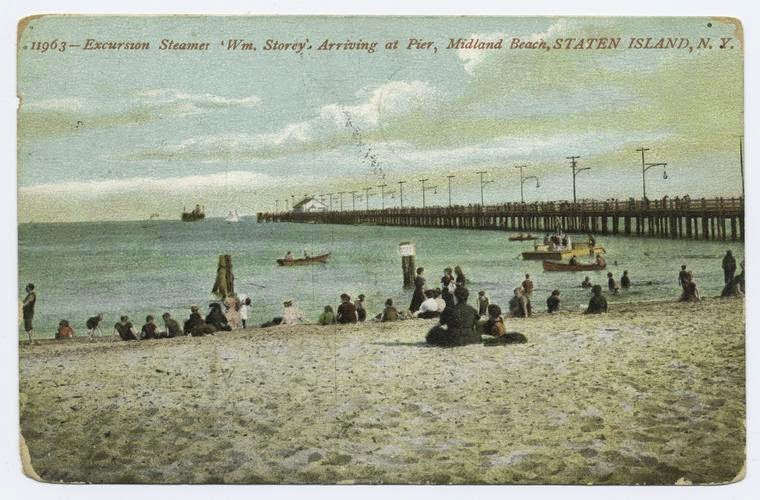
Below: A view of the Midland Beach pier, where excursion steamers would frequently dock. (NYPL)

Four days later, the Grand Republic almost crashed into another steamer off the coast of Coney Island. Two weeks later, with 500 passengers aboard, it slammed into the Kismet steam yacht.  In August, the boat was revealed to have the same sort of rotten life preservers that had so doomed the Slocum.

Still that did not take the Grand Republic off the waters. “GRAND REPUBLIC DEFIES ORDERS,” declared the Evening World on August 3, 1904.

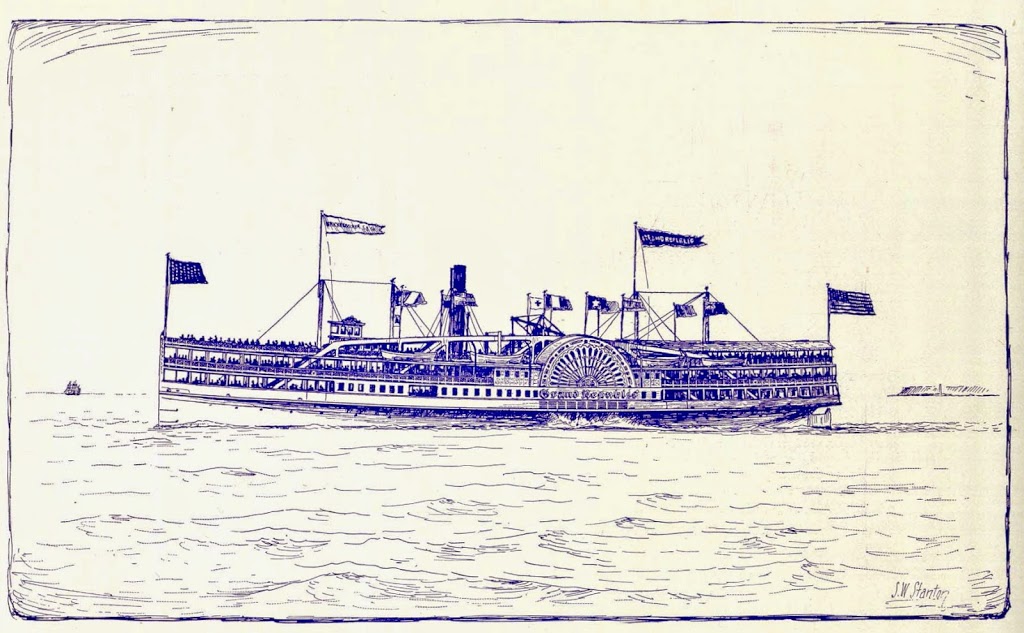
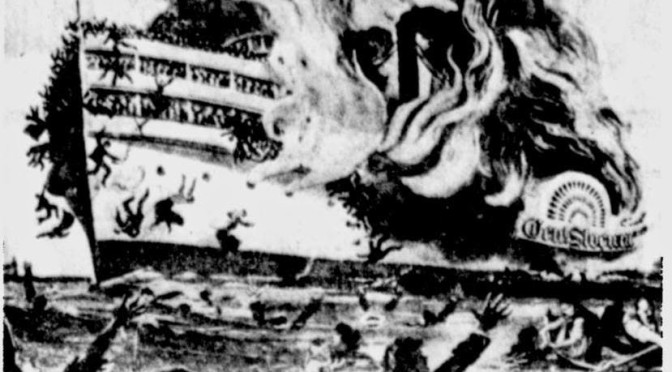
Below: The Grand Republic, illustration by Samuel Ward Stanton

The steamboat owners argued with the New York inspectors in the press, neither looking very trustworthy.  Eventually the boat owners surrendered the Grand Republic to the government for inspection.

Believe it or not, even with hundreds of life preservers declared ‘rotten’ and promptly removed, the boat was eventually declared safe, although its capacity was greatly lowered — from 3,750 to 1,250 passengers, a major financial blow to the owners.

It led a quiet career for many years afterwards, although many feared the boat’s association with the doomed General Slocum and refused to ride it.  It resumed trips to the Rockaways and Coney Island, taking tens of thousands of people through New York Harbor for many, many years.  And it even returned to taking church groups on day excursions, similar to the journeys that the General Slocum had taken.

But the boat would continue to get into rather significant accidents.  In 1915, even the suggestion of fire during one voyage sent a thousand people scrambling for the life preservers, resulting in several injuries.  In a disturbing parallel with the Slocum, “[w]omen shrieked as they were knocked down by the mob that surged about the lifeboats.” [source]

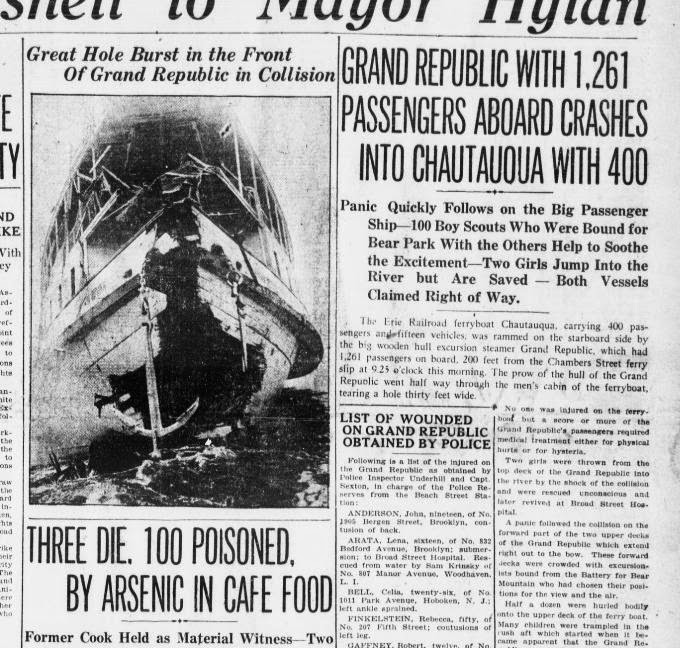
On August 1, 1922, the Grand Republic smashed into another boat in the Hudson River, injuring over a dozen people.  Luckily the boat was filled with Boy Scouts, who calmed the panicked passengers. (Below, from the Evening World)

You might think this would spell the end for the old steamboat, but no!  It remained in the waters, continuing to transport passengers to upstate New York, one of the oldest vessels in service.

The Grand Republic, like its sister ship, was brought down by fire, although luckily without the terrible casualties. In 1924, while docked along 155th Street, a severe dockside blaze caught several boats on fire, including the Grand Republic.

The fire erupted late at night, and thirty men were sleeping aboard the boat at that time. Fortunately, this was the era of the automobiles; car horns from a nearby street awoke two seamen, who safely evacuated the crew.  The Grand Republic, however, was lost, eventually sinking into the Hudson River.

By the time of its demise, the boat seems to have shaken off much of its bad reputation.  Later that year, in a sort-of obituary to the excursion steamer industry, the New York Times declared, “[C]ertainly the Grand Republic was a grand success as an excursion boat.”

Categories
On The Waterfront Podcasts

American tragedy: The tale of the General Slocum disaster

PODCAST On June 15, 1904, hundreds of residents of Kleindeutschland, the Lower East Side’s thriving German community, boarded the General Slocum excursion steamer to enjoy a day trip outside the city. Most of them would never return home.

The General Slocum disaster is, simply put, one of the greatest tragedies in American history. Before September 11, 2001, it was the largest loss of life of any event that has ever taken place here.

This is a harrowing story, brutal and tragic. The fire that engulfed the ship near the violent waters of the Hell Gate gave the passengers a horrible choice — die by fire or by drowning.

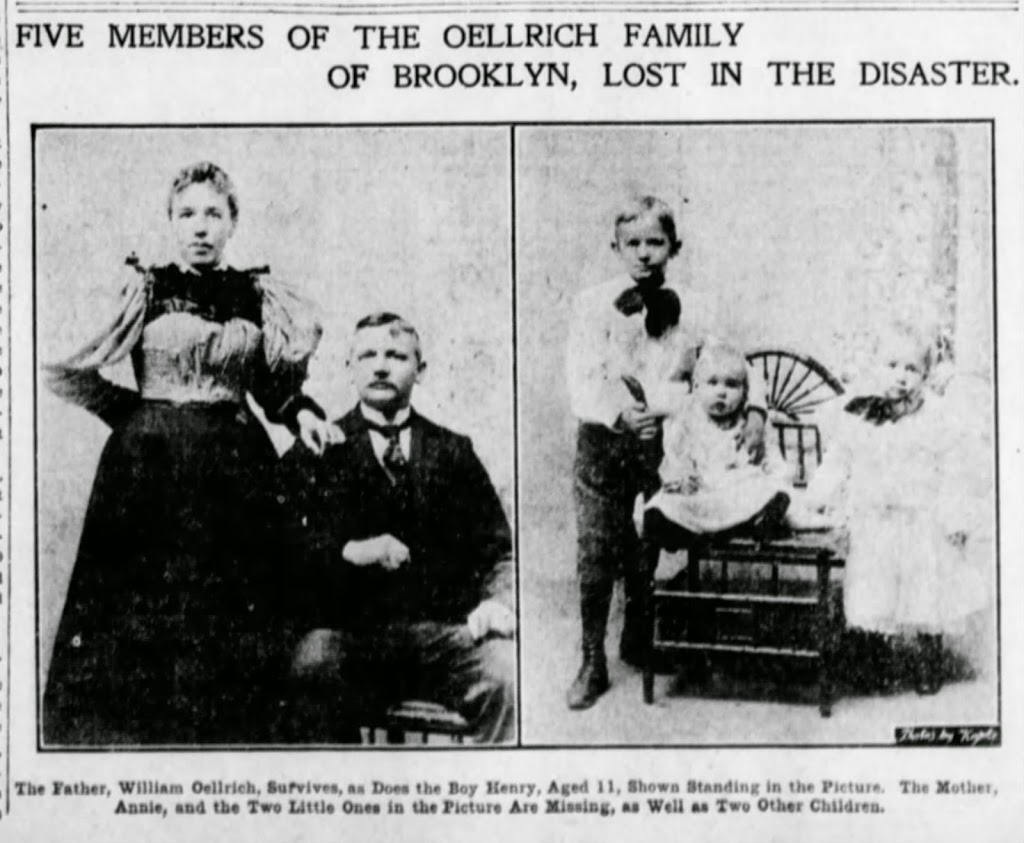
In the end, over one thousand people would lose their lives in an horrific catastrophe that could have been easily prevented. But there are also some surprising and even shocking stories of human survival here, real tales of bravery and heroism.

PLUS: The extraordinary fate of little Adella Liebenow Wotherspoon (at right)


And we would like to thank a new sponsor Audible, the premier provider of digital audiobooks. Get a FREE audiobook download and 30 day free trial at www.audibletrial.com/boweryboys. Over 150,000 titles to choose from for your iPhone, Android, Kindle or mp3 player Audible titles play on iPhone, Kindle, Android and more than 500 devices for listening anytime, anywhere.


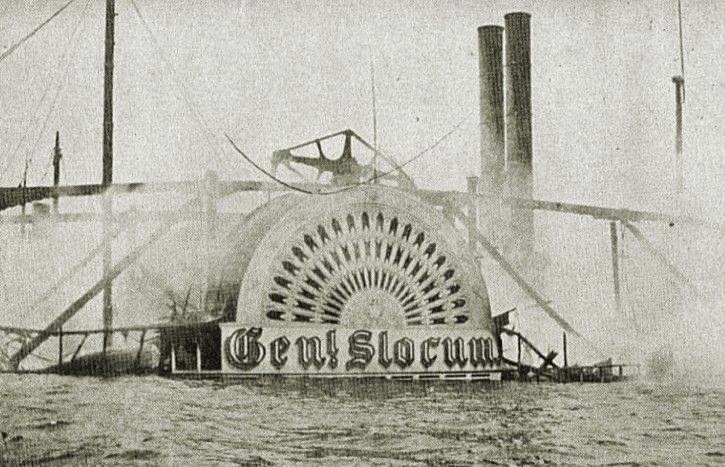
The General Slocum, in its glory days.  I believe this photograph was taken in the Rockaways.

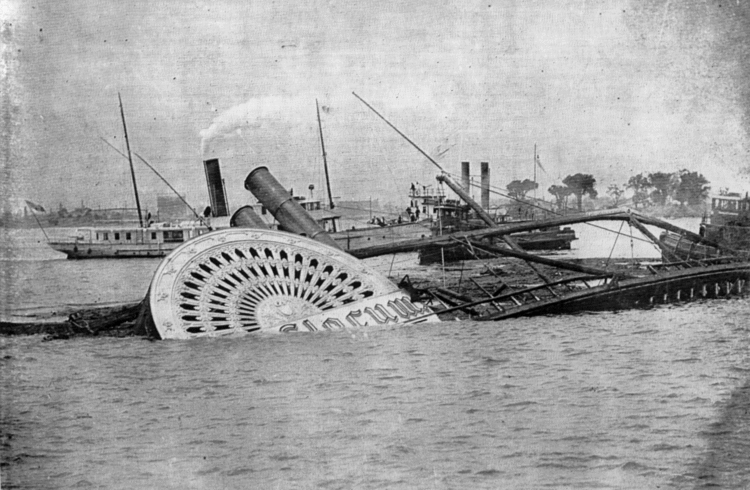
A tugboat attempts to put out the remaining flames of the Slocum, now a burning husk in the water.


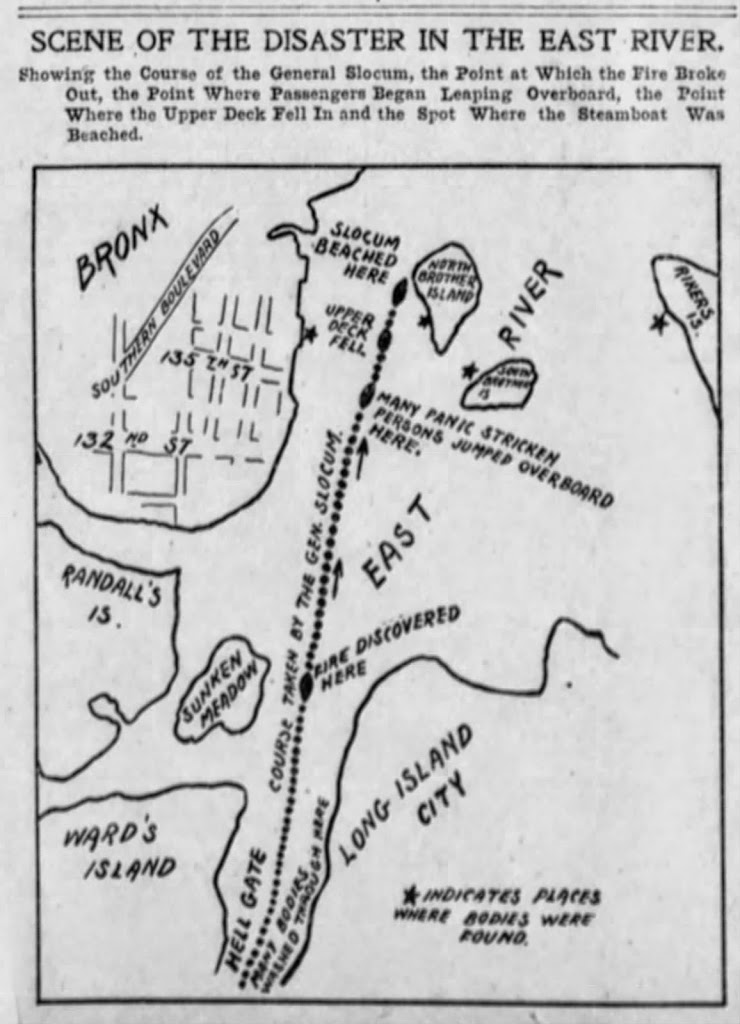
A make-shift map, from the Brooklyn Daily Eagle, June 15, 1904, late edition:

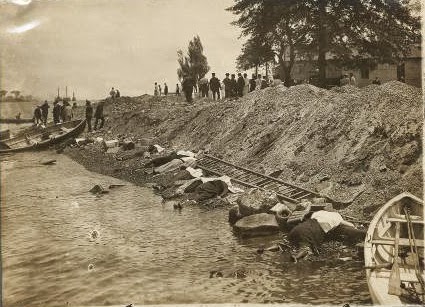
Bodies washed ashore on North Brother Island

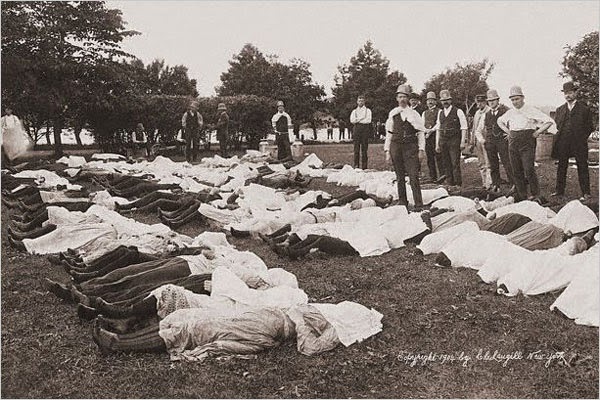
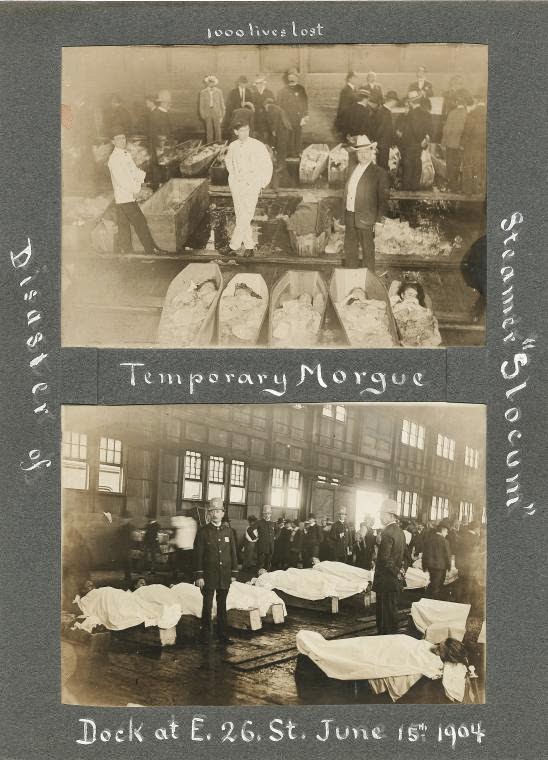
Two morbid photographs from Charities Pier:

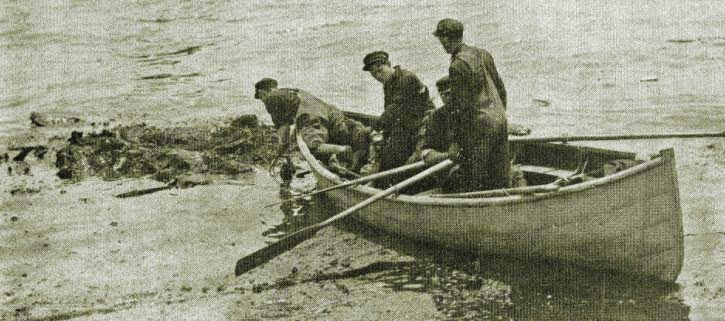
For days later, recovery workers sifted through East River debris, looking for additional bodies:

A funeral procession through the Lower East Side for some of the victims:

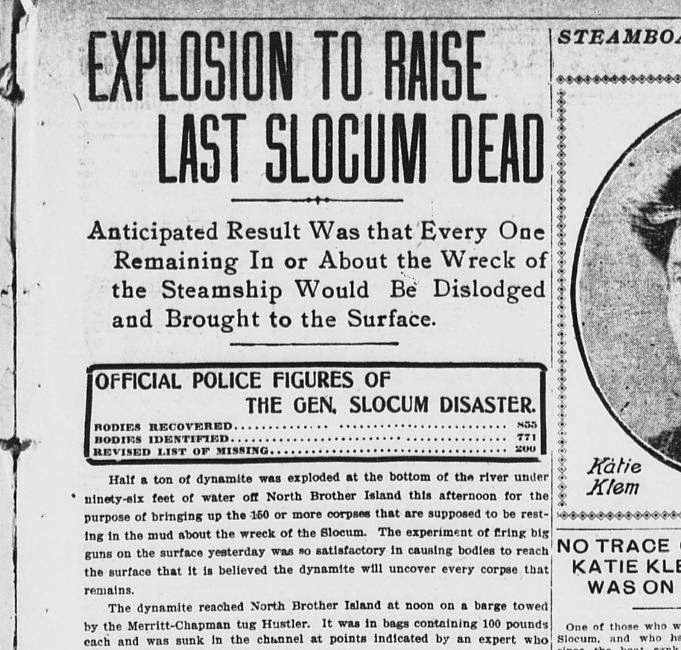
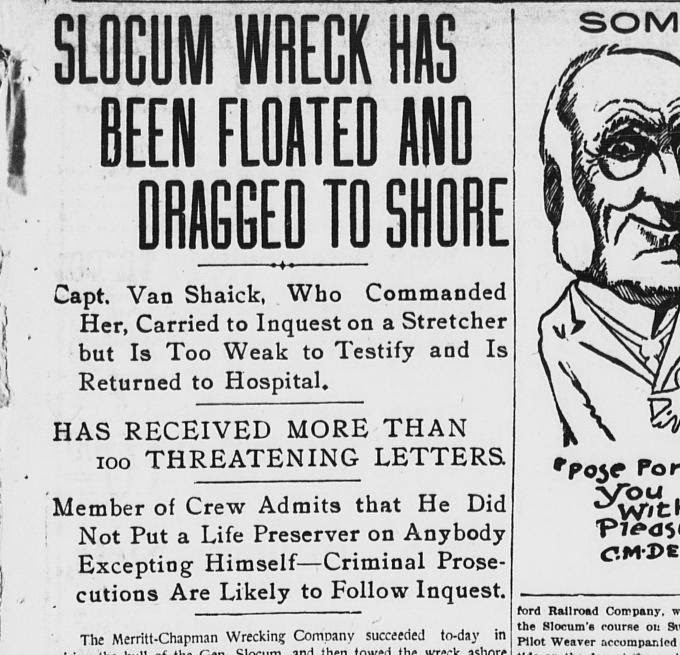
Two headlines from the New York Evening World, one week after the disaster:

The cover of Puck Magazine, one year after the disaster, wondering if justice would ever be served to those under indictment for the disaster. “Illustration shows an old and haggard “Justice” sitting in a chair on a rock in the East River, cobwebs have grown over her sword, scales, and an “Indictment” (Library of Congress)

From the Brooklyn Daily Eagle, the following day:

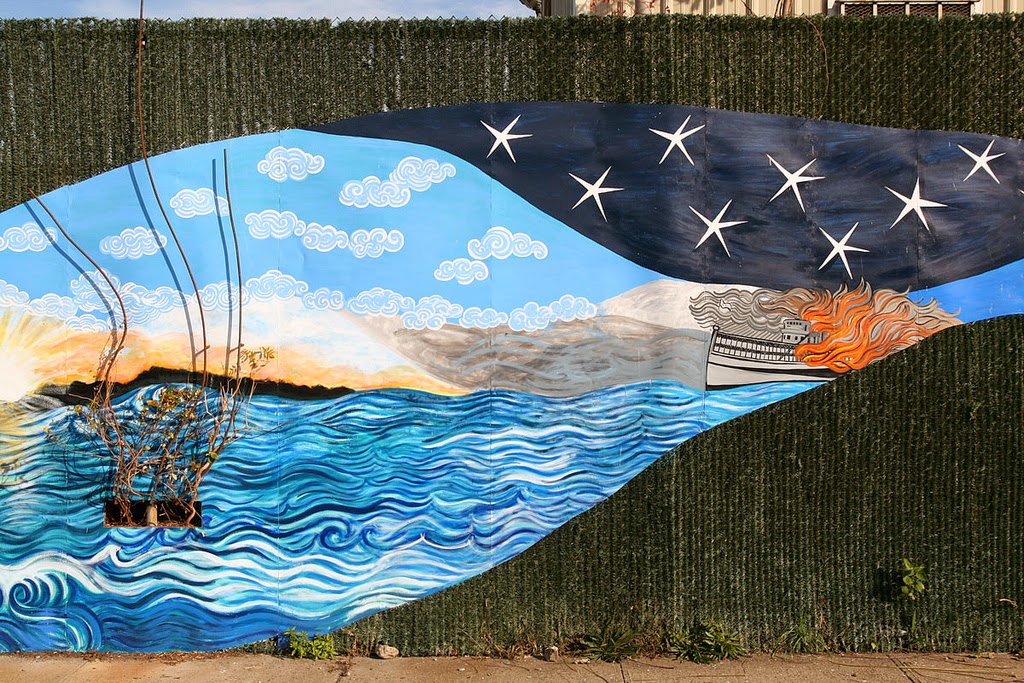
A mural in the Bronx that depicts the General Slocum disaster (courtesy Flickr/Joe Schumacher):

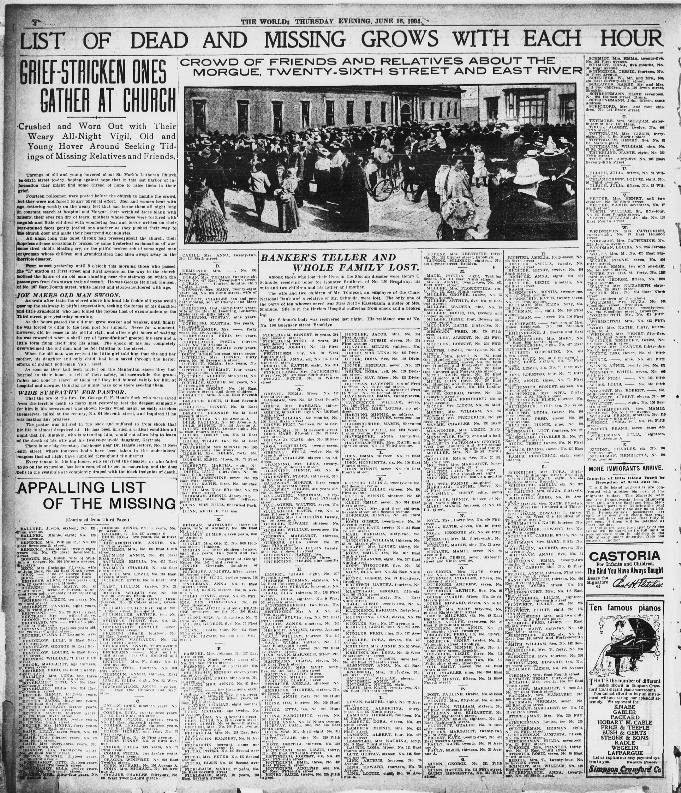
The initial list of the deceased, from the June 16, 1904 edition of the New York Evening World.  The number would increase over the coming days.


Categories
Amusements and Thrills

The decline and fall of Coney Island’s original Thunderbolt

Coney Island gets a brand new star attraction this week — the 2,000-feet Thunderbolt roller-coaster in Luna Park.  It’s “narrower than most apartments” (according to Gizmodo), a bright orange ribbon ride that squiggles, rises and plummets within a disturbingly wonky silhouette.

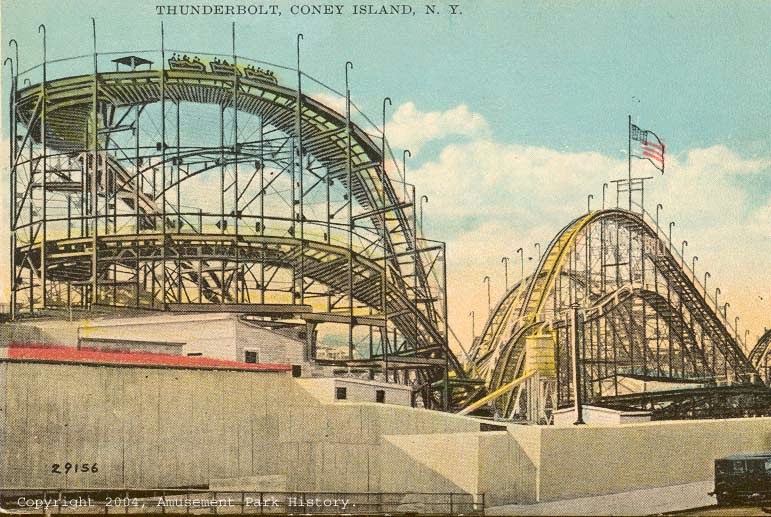
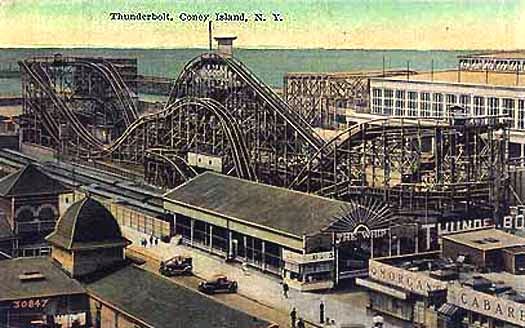
It also takes its name from one of Coney Island’s most famous roller-coasters, designed by famed ride designer John Miller. The Thunderbolt is considered by some to be one of Miller’s least impressive works. (The name is not even original; there are three other Miller-designed coasters named ‘Thunderbolt’.)

This jaunty “scenic railway,” as roller coasters were called then, was a huge success at its opening in 1925. One year later came the first accident, when the train “stalled half way up a steep incline, slipped back to the bottom of the dip and was crashed into by the succeeding train.”

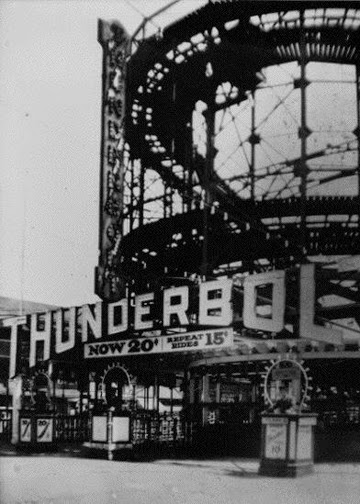
Twenty cents a ride, but a second one for fifteen cents. (Courtesy Brooklyn Memories)

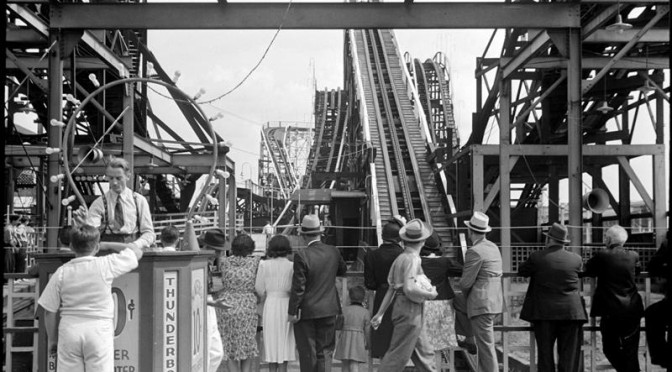
Below: Onlookers watch the cars go ’round the Thunderbolt, 1938 (Reginald Marsh photographer, courtesy MCNY)

It’s perhaps the cinema’s most famous roller-coaster thanks to Woody Allen and the Oscar-winning film Annie Hall.  John Moran and his son Fred, the operators of the Thunderbolt, really did live underneath it, “the back stanchions of the steel structure come down through the walls of the apartment.”   His home was used in the film. [source] [source]

Fred Moran died in 1982, and the ride closed later that year, in great need of repairs that never came.  It famously sat abandoned during the 1980s-90s, embraced in weeds and surrounded by a rusty fence. The land was sold to Horace Bullard, owner of the Kansas Fried Chicken fast-food chain, who intended on reopening it. 

He never managed to revive the Thunderbolt.   In 1991, the Moran house was destroyed in a fire, and the Thunderbolt itself succumbed to flames in 1998..  Its husk remained standing until it was controversially torn down (and with “deliberate indifference“) starting on November 17, 2000.

Below: The ruins of the Thunderbolt. And I believe the Moran home is also pictured her. (Courtesy the blog Coney Island Playground of the World)


Why rush the destruction of an artifact that, by that time, was one of New York’s best known ruins and a mecca for nostalgists?  The city was looking to lure minor league teams to New York, and with the construction of the new KeySpan Park, the nearby ruin was considered an “eyesore that looked dangerous.”

Ironically, the baseball team that would move into KeySpan would be named after Coney Island’s other famous roller-coaster — the Cyclone.


Less than 14 years later, a new Thunderbolt will make its debut near this very spot.

Categories
Neighborhoods

The link between Ladies Mile and the New York Public Library

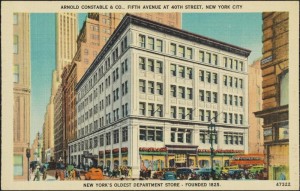
Arnold Constable & Co., Fifth Avenue at 40th Street, New York City, New York's Oldest Department Store -- Founded 1825.

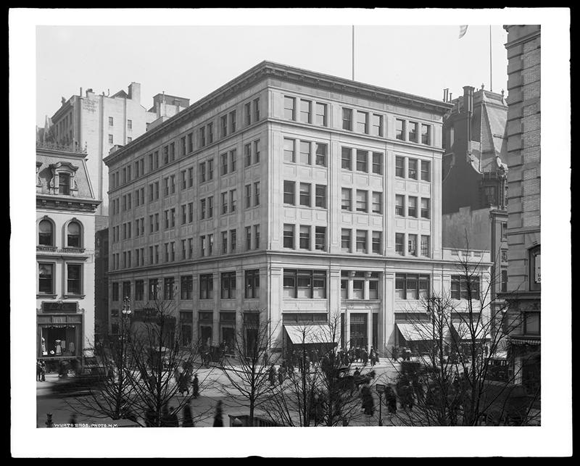
Arnold, Constable and Co’s new Fifth Avenue store.  Today it house the lending library for the New York Public Library.

When did Ladies Mile — New York’s elegant Gilded Age shopping district — finally become un-fashionable?

Unlike the slow demise of so many neighborhoods in the city’s past, the end of Ladies Mile was closely observed by the press.  On October 4, 1914, the New York Sun ran the foreboding headline “Last Chapter in Fall of Old Department Store Zone Recorded Last Week By Arnold, Constable.”

“When Arnold, Constable and Co. move next September to the new building that Frederick W. Vanderbilt is to erect on the site of his home at Fifth Avenue and Fortieth Street, not a department store will remain on Broadway between 14th and 23rd streets, for nearly half a century the recognized high class shopping center of New York City.”

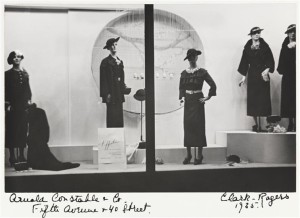
Below: Display windows at the 5th Ave location in 1935 (Pictures are courtesy MCNY)

Arnold Constable & Company, Fifth Avenue and 40th Street.

B Altman, the first of the major department store owners to move to Fifth Avenue, was immediately seen as a visionary. “Every one can see today that this shrewd business man knew what he was doing, for Fifth Avenue is not only the greatest shopping street in New York, but is said to lead all others in the world.”

The B Altman department store building is still around, on the northeast corner of 34th Street and Fifth Avenue. It’s now the home for the City University of New York.

The building which contained the Fifth Avenue store of Arnold, Constable and Co. is still around as well.

The upper-crust store was one of Ladies’ Mile’s last holdouts, even as the other fine shops like Lord & Taylor had already moved uptown.  Their new department store, catty-corner to the New York Public Library main branch, finally opened in November 1915 and stayed open for sixty years, until 1975.  The structure was then bought and turned into the Mid-Manhattan Library.

Incidentally, just yesterday, the New York Public Library released its newest plans to refurbish this much distressed building.

Compare this picture of Arnold Constable & Co., from 1915, with the one taken yesterday at the Mid-Manhattan Library:

Categories
Neighborhoods Podcasts

The sumptuous story of Ladies’ Mile: Cast-iron grandeur and Gilded Age architecture


The opening of Siegel-Cooper department store, 1896, created one of the great mob scenes of the Gilded Age.  Today, TJ Maxx and Bed Bath and Beyond occupy this once-great commercial palace.  

PODCAST  Ladies’ Mile — the most famous New York shopping district in the 19th century and the “heart of the Gilded Age,” a district of spectacular commercial palaces of cast-iron. They are some of the city’s greatest buildings, designed by premier architects.

Unlike so many stories about New York City, this is a tale of survival, how behemoths of retail went out of business, but their structures remained to house new stores. This is truly a rare tale of history, where so many of the buildings in question are still around, still active in the purpose in which they were built.

We start this story near City Hall, with the original retail mecca of A.T. Stewart — the Marble Palace and later his cast-iron masterpiece in Astor Place. Stewart set a standard that many held dear, even as his competitors traveled uptown to the blocks between Union Square and Madison Square.

Join us on this glamorous journey through the city’s retail history, including a walking tour circa 1890 (with some role play involved!) of some of the district’s best known buildings.

PLUS: Why is Chelsea’s Bed Bath and Beyond so particularly special in this episode? You’ll never buy towels there the same way again!


America’s first department store — A.T. Stewart’s Marble Palace, near City Hall. The building is actually still there today! The address is 280 Broadway. (Courtesy NYPL)

Stewart’s even more celebrated department store at Astor Place, nicknamed the Iron Palace with its cast-iron construction. Unlike Stewart’s first store, this one is no longer there. (NYPL)

1903: Ladies on a freezing day, surrounding the 23rd Street entrance to the Sixth Avenue Elevated Railroad, placing them just a few blocks from the biggest department stores in the world. (Courtesy Museum of the City of New York)

6th Ave & 23rd St.

The entrance to Stein Brothers on 23rd Street. There’s a Home Depot in this building today, but you can still see the SB insignia over the door. And below, the street scene in 1908.(Photo: Edmond V Gillon, MCNY)

[32-46 West 23rd Street.]
[West 23rd Street from 6th Avenue East.]

Adams Dry Goods, decades after the shop at closed. In later years, it was a Hershey’s plants and a military storage space. Today, on the ground floor, there’s a Trader Joe’s grocery store. (Photo: Edmond V Gillon, MCNY)

[675 Sixth Avenue.]

1901: Women in front of the Church of the Holy Communion, the elevated train in back of them. (MCNY)

Street Scenes, Sixth Avenue at 20th Street.

The windows at Simpson Crawford Co. at Sixth Avenue and 20th Street, 1904. (MCNY)

Simpson Crawford Co.

The Siegel-Cooper department store fountain, with a statue of Republic (by Daniel Chester French) and electric lights in a kaleidoscope of colors. And, below it, another view of Siegel Cooper from the opposite side of the tracks. (MCNY)

Siegel Cooper
Retail Trade - Dept. Store 1896. Siegel Cooper Co. (Exterior) 6th Ave at 18th St.

Ladies in the Siegel Cooper canned goods department. The store canned its own food. Very organic! (MCNY)

Retail Trade Dept. Store.

An overhead shot of Macy’s at 14th Street and the Sixth Avenue elevated railroad station. (MCNY)

[6th Avenue and 14th Street.]
Broadway and East 20th Street. Lord and Taylor, old building.

Lord & Taylor’s, at Broadway and 20th Street, 1904. (Wurts Brothers, MCNY)

Inside WJ Sloane, Carpets Rugs and Furniture, at Broadway and 19th Street (MCNY)

W.J. Sloane, Carpets Rug & Furniture, 19th St. & Broadway.

The Flatiron Building, completed in 1902, is considered part of the Ladies Mile Historic District, even though it was never a department store.

Categories
Gilded Age New York Neighborhoods

Chelsea and the Chocolate Factory (or rather, Hershey and his Sixth Avenue chewing gum plant)

Hershey’s employees cut and pack chewing gum at Sixth Avenue and 21st Street.

For five glorious years in the early 1920s, Hershey’s Chocolate operated a candy plant at Sixth Avenue, in the neighborhood of Chelsea. While chocolate bars and chocolate coating for other candies were produced here, the Chelsea plant primarily focused on a new confection, one that ultimately failed — Hershey’s Chewing Gum.

But let me back up. The grand building that sits there today — one of the prominent members of Ladies Mile Historic District and the current home of Trader Joe’s — was originally built for the department store Adams Dry Goods.  Founded in the mid-1880s, Adams Dry Goods had been slowly expanding along this block, enjoying a surge of business thanks to the Sixth Avenue elevated train.

Below: The Adams Dry Goods building in 1978 (photo by Edmund V Gillon, MCNY): 

Other department stores sprouted up along the street, most notably the Siegel-Cooper department store in 1896.  (That building is home today to Bed, Bath and Beyond.)  Siegel-Cooper was a sparkling Beaux-Arts treasure, 750,000 square feet with dozens of departments for shoppers, and its ambition and size drew headlines and the curiosity of New Yorkers.

Naturally, Samuel Adams, the proprietor of Adams Dry Goods, wanted to compete with this retail behemoth, so in 1899 he hired Siegel-Cooper architects DeLemos & Cordes to design a massive new store with an opulent interior central court.  Large second floor windows offered views to elevated train passengers of the store’s most notable trade — men’s clothing.  (Much of Ladies Mile, in contrast, catered to women.)

Below:  Adams Dry Goods today. After a period in the 1990s-2000s as a Barnes and Noble bookstore, today it holds a Trader Joe’s:

But Adams’ timing was rather poor.  For just a few years later, the more successful department stores (including Lord & Taylor and B Altman) fled to Herald Square and Fifth Avenue.  Hugh O’Neill’s, the department store one block south, bought Adams Dry Goods and prepared to merge the businesses, even planning an underground tunnel under West 21st Street to link to two large structures.  This never came to fruition, and both O’Neill’s and Adams Dry Goods went out of business for good.

The abandoned building was briefly used by the US Army for storage before being acquired by a most unusual new tenant — Hershey’s Chocolate.


Candy man Milton S. Hershey had been successfully manufacturing treats in his hometown of Derry Church, Pennsylvania (which now took the mogul’s name — Hershey) and was looking for a another hit after the success of the Hershey’s Kiss.  He thought chewing gum was the logical next step.

In New York he bought some gum-making equipment and had it shipped to his Pennsylvania plant where production began on Hershey’s Chewing Gum. “Six sticks for a nickel” went the slogan.

In January 1918, Hershey leased Adams’ former department store on Sixth Avenue and eventually moved elements of his candy production there, including his entire chewing gum business.

I haven’t been to locate the exact reason why.  Early in his career, Hershey operated a candy shop on Sixth Avenue and 42nd Street, and his wife had been a clerk at B Altman’s a few blocks down.  With his chief competitor Wrigley’s located in Chicago, perhaps his return to New York was his official stab at planting roots in an urban market.

Soon the Sixth Avenue shop was whirring with the sound of boilers, mixers, candy presses and wrapping machines, sending out five thousand boxes of chewing gum a day, and a lesser amount of other candy items.  Wheat was carried in from the Pennsylvania plant and added to the gum to make it more chewy.

As you can see here, the implements of candy-making fit oddly into the cavernous Sixth Avenue department store:

Sadly, future residents of Chelsea would be robbed of the delightful aromas of chicle and chocolate, as Hershey’s chewy offering did not take off.  With raw ingredients being hard to obtain in the early 1920s, the product was discontinued, and Hershey eventually closed the plant in 1924.

However I’m sure you can buy gum at Trader Joe’s that currently occupies the building.

Hershey’s plant photographs courtesy the Museum of the City of New York (see originals here)

Categories
Those Were The Days Wartime New York

The adventures of Tony Pizzo, the sailor handcuffed to a bike

It’s Fleet Week!  The streets of New York are filled with hundreds of Marines and sailors who arrived yesterday in New York Harbor.  I’m pretty sure, however, that none of them hit the streets handcuffed to a bicycle.

That distinction goes to the enigmatic Tony Pizzo who, in 1919, rode his bicycle from Los Angeles to New York City.  And then, the following year, he rode it back again.

Pizzo set off from Los Angeles in grand style 95 years ago this week (May 21, 1919), joined by fellow sailor C.J. Devine who was attached to another bicycle.  The men were handcuffed to these specially designed bikes during a ceremony in Venice Beach by none other that Hollywood’s greatest star — Fatty Arbuckle.

Pizzo embarked on the trip as a dare from Arbuckle, who wagered the sailor $3,500 that he couldn’t make it to New York by November 1.  Why a military man was wiling away his time doing this in the months after World War I is beyond me.  (One press clipping describes him as “a discharged sailor.”)  In reality this was an elaborate advertising stunt.  One newspaper reports that “[t]he men were advertising the Fisk tire, Morrow brakes and Crown bicycles.”

“One can hardly realize the trouble that these two riders were put to,” remarked the League of American Wheelmen, “for they had to eat, drink, wash and take care of themselves generally while handcuffed to their wheels.”

The two men made their way across America, selling souvenir postcards to fund their cross-country journey.  Unfortunately, in Kansas, Devine was hit by a car, so Pizzo went the rest of the way alone.

He finally arrived in New York on October 30, greeted by guests at the Hotel McAlpin in Herald Square. He checked into a room still handcuffed to his bicycle and was only separated from the device a day later by Mayor John Hylan.

Pizzo “regarded his bicycle with dislike,” according to the New York Times. “[H]e would not do it again for one million dollars.”

But, in fact, he did do it again, re-chained to the same bike, riding back to Los Angeles the following year.  Fortunately, Devine had recovered from his injuries and accompanied Pizzo as his manager.

Below: From a Philadelphia newspaper, May 1, 1920

Apparently Pizzo just couldn’t stop biking.  In 1921, he embarked on another dare, the intent of which is indicated on his retooled bicycle below — to visit the governors of all 48 states. (picture courtesy Flickr/Zaz von Schwinn)