Categories
Holidays

Wacky, windy and weird: 1964 Macy’s Thanksgiving Day Parade

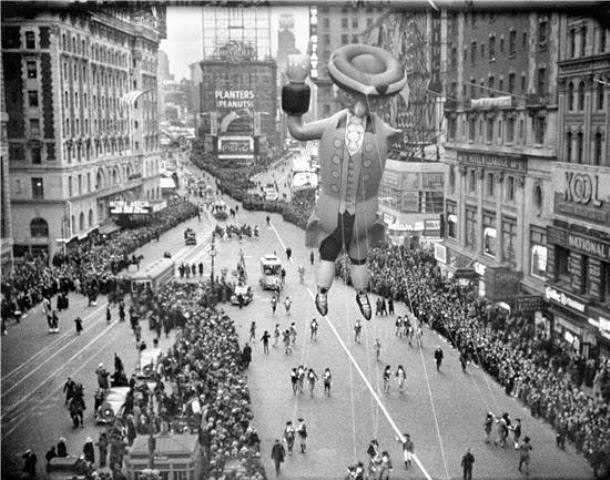
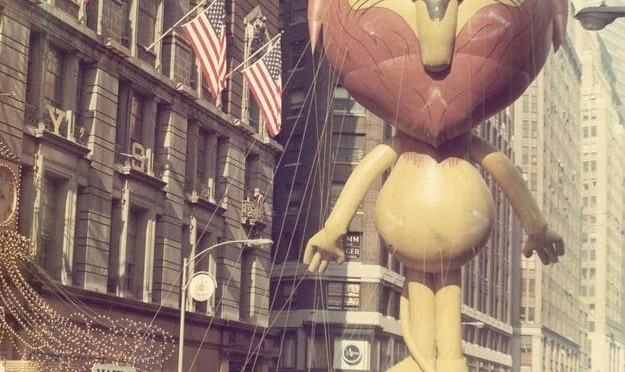
Linus the Lion-Hearted at the 1964 Macy’s Parade

The Macy’s Thanksgiving Day Parade of 1963 had been a downer of a parade.

President John F. Kennedy had just been assassinated a few days before but, deciding that cancelling the event would be “a disappointment to millions of children,” the parade went on as planned.

Leading the parade that year was a 38-foot rubber Unisphere to promote the upcoming World’s Fair. Further back in the line was young television star Michael Landon.

Flash forward to the following year — the World’s Fair out at Flushing-Meadows had celebrated a rocky first year. Landon’s Bonanza was about to become the most popular show on television, a distinction it would hold throughout the mid-1960s. New York City was, generally speaking, in a cautiously more festive mood.

Not that the specter of the previous year’s tragedy was far from people’s minds. “Americans plan to savor the traditional cheer of Thanksgiving today in an atmosphere that contrasts with the numbing experience of last year,” said the New York Times. [source]

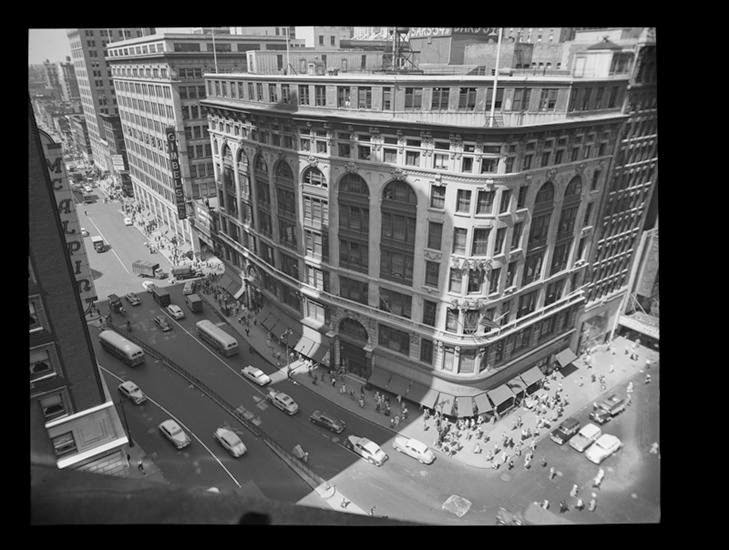
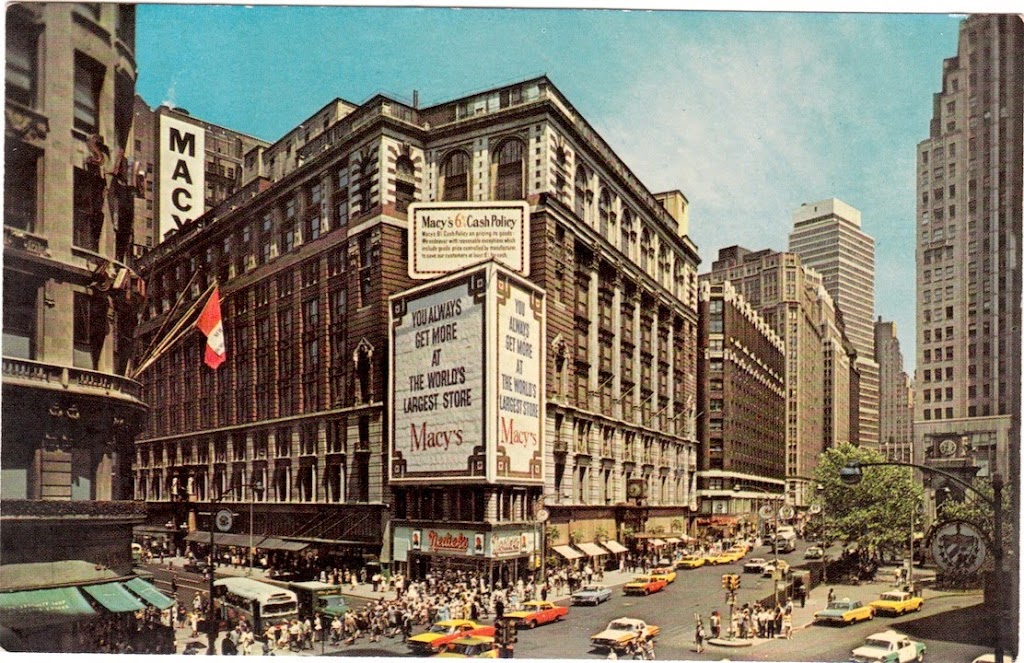
Below: Macy’s in 1964 (courtesy The Paper Collector)

For their part, Macy’s was trying to whip New Yorkers back up into a holiday shopping frenzy. Among the hottest items advertised by the department store during Thanksgiving week were Hitachi record players, Consolette hair dryers and mink coats for $99.99.


The 1964 Thanksgiving Day parade (November 27) held a certain campier flair than normal, loaded with family-friendly cheerfulness slightly more heightened than normal, with a few assorted mishaps and lots of goofiness mixed in. Why? For the same reason the 1964 is among the most memorable in parade history — television:

First in Color: NBC has been broadcasting the parade since 1952. By 1964 coverage had expanded to 90 minutes — in 2014, it’s three hours — and now, for the first time ever, it would be broadcast in color. Several NBC shows had gone to a color broadcast previously, but Americans didn’t yet have affordable color sets at home. But by 1964 sets were finally being mass produced and sold as luxury items in department stores.

There were a little over one million color televisions in American homes with the potential to tune in to a color broadcast in 1964. Ten years later, that number would rise to almost 45 million.

The Official Debut of Lip-Syncing: But some lamented the attention to the television audience. At one point, the parade was held up for eight minutes while waiting for a television signal. “Near Herald Square television took over the parade …. and some of the spontaneity went out of it.”  [source]

Performances were pantomimed while songs were pumped in for the television audience. The Times notes that cameras zoomed in on “performers who were only feigning a performance.” Today, of course, this is a regular feature of the parade and almost none of the performances (outside of the marching bands) feature live singing.

At right: The hosts at the 1968 parade

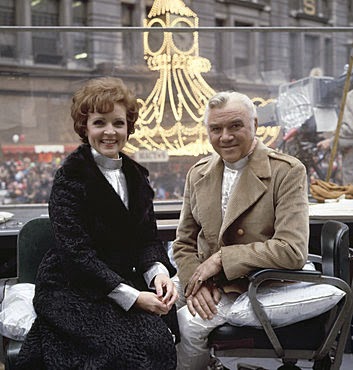
Lorne and Betty:  The hosts of NBC’s 1964 broadcast were Lorne Greene — Landon’s Bonanza co-star — and the effervescent Betty White, celebrated star of a 1950s show called Life With Elizabeth. Greene was perhaps one of NBC’s hottest actors at the time, while White was busy as a television spokeswoman. She was also a regular host of the Tournament of Roses parade. Almost every role you’ve ever loved Betty White in lay far in the future for her at this time.

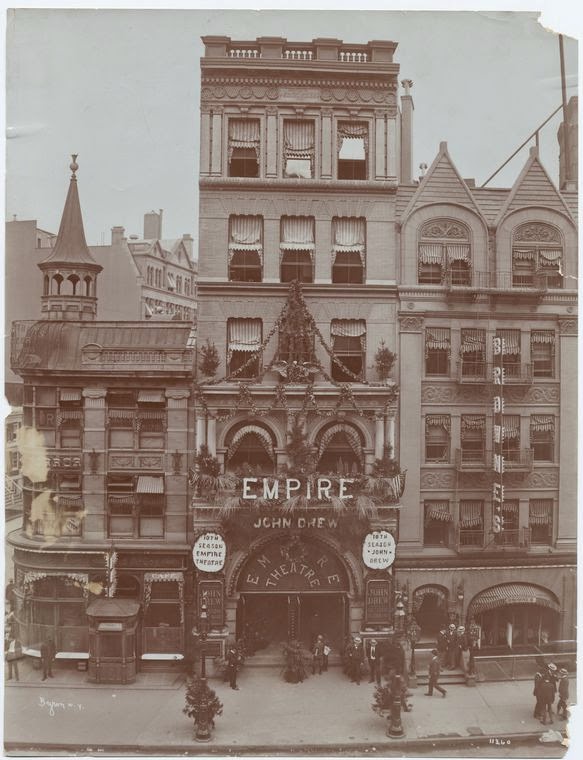
First Men In the Moon: Being a special televised event meant more promotion of film and television properties.  Among the most unusual was the space-themed float promoting the new film First Men In The Moon, a British sci-fi romp featuring special effects by Ray Harryhausen.

The float did its best to simulate Harryhausen’s unique creations — ‘Moon Cows’, gigantic bugs who poked their heads out of craters upon a floating moonscape. Lorne Greene is reported to have said, “Wow look at those big grasshoppers!” [source]

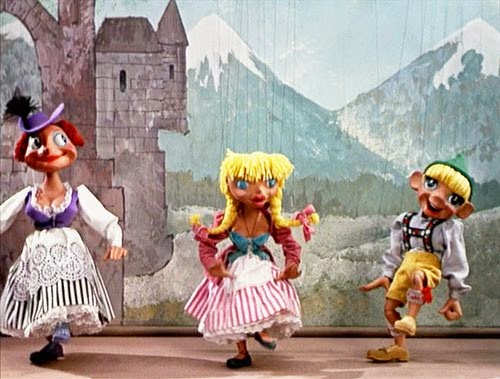
The Sound of Puppets: A few stars of the upcoming film The Sound of Music would appear in the parade. No, not Julie Andrews, bur rather the colorful marionettes of Bil Baird, featured in the ‘goatherd’ scene of the film. I’m not sure how they were presented, and I assume most of the spectators were unable to see them perform.

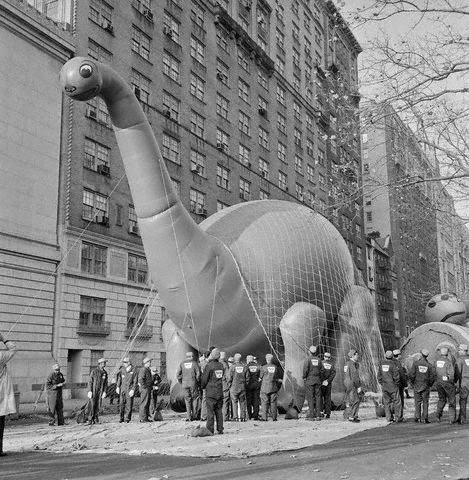
The Fate of Dino the Dinosaur: A great danger threatened the 1964 parade — horrible winds. Fortunately no spectators were injured by the gusts, some up to 21 miles an hour.

The balloons did not emerge unscathed. Dino the Dinosaur (not to be confused with Dino, the dog from the Flintstones) would grow to become a favorite site in the 1960s and 70s. (He’s pictured at right, from the 1963 parade.)

But at the 1964 parade, a sudden gust blew the dinosaur into a lamppost at Columbus Circle, tearing a hole in its side.  Its handlers along the avenue continued to pull the beast down the street, but by the time they got to Macy’s, the dinosaur was partially deflated and dragging the ground.

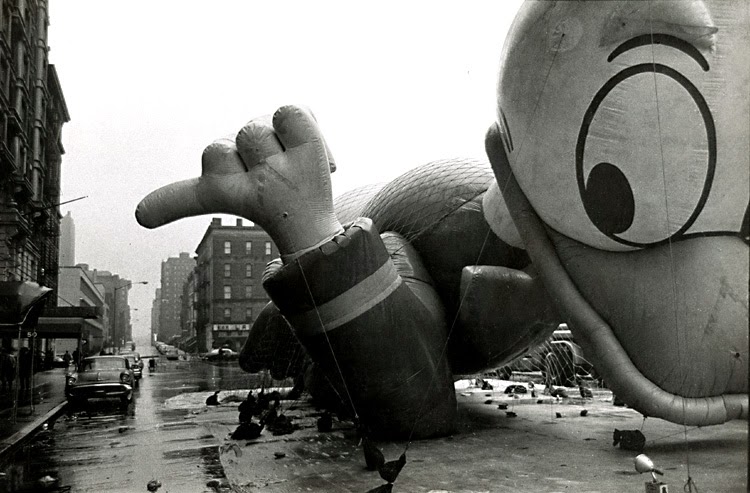
Popeye The Limp Sailor: Dino wasn’t the only balloon with performance mishaps. The impressively sized Popeye balloon failed to properly inflate the night before; or as the papers note, “there was not enough spinach in the pumps, and Popeye wouldn’t expand at all.”

He was unceremoniously replaced in the parade by a dragon balloon that Macy’s just had lying around.

Donald Duck (pictured below from 1964) had fewer troubles that year.

Linus the Lion-Hearted: Pictured at top, this balloon with excellent posture debuted at the 1964 parade. It was based upon a Crispy Critters breakfast cereal spokesman who had his own television show which debuted just a couple months earlier.  However, when the FCC determined in 1969 that advertising mascots could not also have children’s show, Linus was abruptly cancelled. He would still make frequent appearances in the parade until 1991.

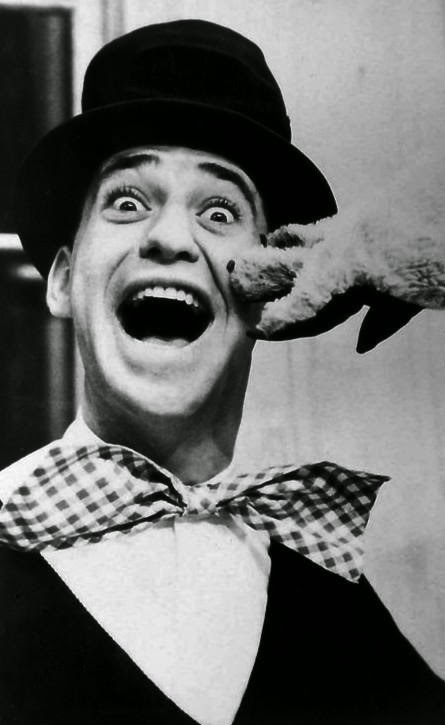
The Soupiest Star: New to NBC, New York City and to the parade itself was children’s comedian Soupy Sales (pictured at left), whose daily show Lunch with Soupy was a local hit that year. He was probably one of the biggest hits in the parade, riding atop a rocking horse, as his trademark beaming grin was as noticeable as the floats themselves.

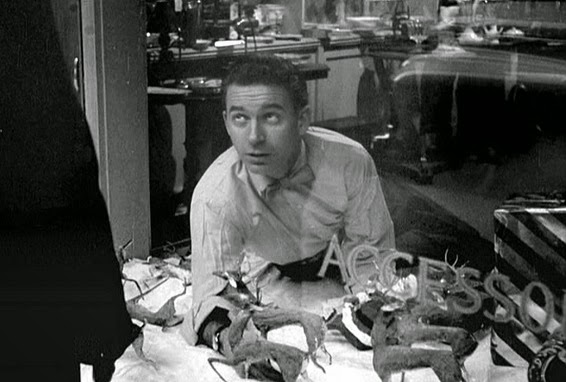
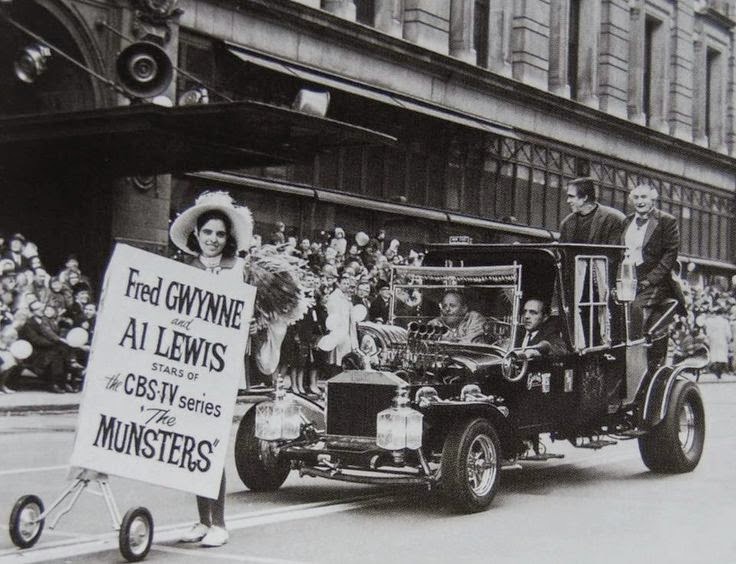
The Drunk Munster: And then there was Fred Gwynne and Al Lewis, the stars of NBC’s monster comedy The Munsters.

From a prior article — because this incident has fascinated me for years — “[The] stars of The Munsters, appeared in the 1964 parade in their ghoulish costumes, riding along in their ‘Munster Koach’ car. Neither star was very amused. Gwynne was high on ‘nerve medicine‘ and began cursing at the crowd.”

According to their makeup man (pictured below, in the front seat): “I was in the Koach handling the loudspeaker and radio system that was playing the Munsters song.  Fred had brought along a bottle with him, wrapped in a paper bag, and he got fractured [drunk]. And Al was mad at him. Fred was cussin’ at people. I just kept the music up so nobody could hear him.” [source]

Passing the hosts Greene and White in the media box, Herman Munster fired off a rude expletive in their direction as well

Here are some video highlights from the parade, with the Munsters stars prominently featured:


“Peacock NBC presentation in RCA color” Licensed under Fair use of copyrighted material in the context of NBC via Wikipedia  

Categories
Bridges

A very happy 50th birthday to the Verrazano–Narrows Bridge! Ten facts you may not know about the bridge’s origins

[Verrazano-Narrows Bridge.]

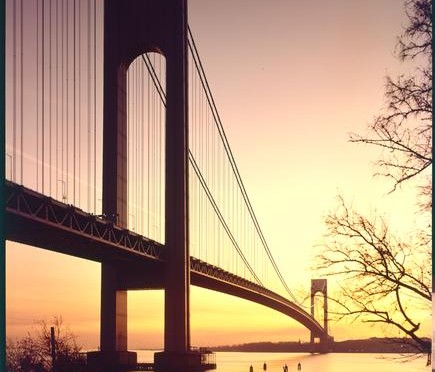
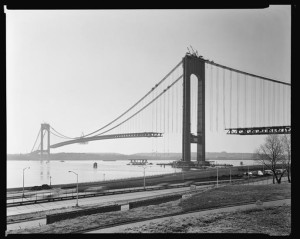
The new span in 1964, photographed by the Wurts Brothers (MCNY)

The Verrazano-Narrows Bridge — the first land crossing between Staten Island and the rest of New York City — officially opened for traffic fifty years ago today. It is one of America’s greatest bridges and a graceful monumental presence in New York Harbor.

Below is a list of ten things you may not have known about the bridge.

1)  The Tunnel to Staten Island
People have been dreaming of spanning the Narrows for several decades before the bridge was finally constructed. In New York’s subway fervor of the early 1920s, Mayor John Hylan authorized a tunnel be built to connect Staten Island to Brooklyn, ostensibly to link it to the city’s expanding subway network. Due to massive cost, however, the project was cancelled. For many years, the remnants of the aborted tunnels on either side of the Narrows were referred to as “Hylan’s Holes.”

2)  Verrazzano-on-Hudson
Giovanni da Verrazzano, who explored the shores of the North American continent in 1524, might have lent his name to the bridge which became the George Washington Bridge, a few decades before the Narrows Bridge was completed. The suggestion was made by a Newark resident and was at least passingly considered that the New York Times ran an article about it: “WOULD NAME NEW SPAN VERRAZANO BRIDGE.”  The article casts aspersions upon the notion that the explorer would ever be seriously considered enough to warrant his own bridge.

[Aerial view of Brooklyn, Staten Island and New York Harbor.]

Overlooking New York Harbor, Staten Island (and Fort Wadsworth) to the left. (MCNY)

3)  What’s In A Name? Tanto!
The Florentine explorer had much symbolic value to Italian New Yorkers, and in 1960, the Italian Historical Society of America managed to convince Governor Nelson Rockefeller to apply the name to the brand new bridge about to go under construction.

Some were not pleased with what many considered mere political appeasement. “I wouldn’t be surprised if the next move is to rename the Hudson River,” grumbled the vice president of the Staten Island chamber of commerce. [source]  Gripes over the name continued well up to its opening and beyond.  A couple weeks before its opening, one naysayer wrote the Times to propose alternate names: “Let’s call it Freedom Gate or Liberty Gate.” [source]

4) Spell Check
Even then, there was some debate about the proper spelling of the explorer’s last name — Verrazzano or Verrazano. (There was even a small, if vocal, group for Verazzano.) Official construction signs did say Verrazzano, in keeping with the traditional Italian spelling. However, despite strong support for the double Z version, the shorter spelling eventually won out.

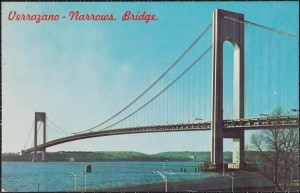
Verrazano-Narrows Bridge

5) The Grand Builders
Although this would be one of the final great projects overseen by Robert Moses, it’s also the final project of New York’s great bridge and tunnel builder Ottmar Ammann.  He died on September 22, 1965, less than a year after the bridge’s opening.

Milton Brumer is sometimes overshadowed by those two great icons of city building, but the chief engineer of the Verrazano-Narrows had worked with Ammann on almost every one of his projects and was probably more involved in the day-to-day operations than his boss.  In total, there were 200 engineers employed on building the bridge, on top of the hundreds of construction workers employed to bridge the Narrows.

Verrazano Narrows Bridge, general view  from Ft. Hamilton S.E.
Courtesy Museum of City of New York

6) Curvature of the Earth
When it opened on November 21, 1962, the Verrazano-Narrows Bridge was the longest suspension bridge in the world, so long, in fact, that bridge engineers had to take the curvature of the planet into account in its design.  As a result the tops of the towers are slightly farther apart than the bases. Or to put it another way, if the Narrows were drained, the towers would appear to slightly lean away from each other.

7) A Big Boy, and Loud Too
The Verrazano-Narrows Bridge weighs 1,265,000 tons — the longest suspension bridge in the world at its completion, surpassing the Golden Gate Bridge — but was not the most welcomed neighbor to the areas of Bay Ridge and western Staten Island when ground was broken in August 1959.  Many residents railed against its necessity, the displacement of businesses, even the constant noise assault. “That bridge — who needs it?” [source]  Once construction began, however, many business owners benefited from the influx of hundreds of workers entering the area.

Three workers were killed during the construction of the bridge, including young Gerard McKee who fell to his death in an accident which could have been prevented.  His death sparked an improvement in safety procedures at the bridge.  He’s memorably commemorated by Gay Talese, who closely documented the construction of the span in his classic book The Bridge.

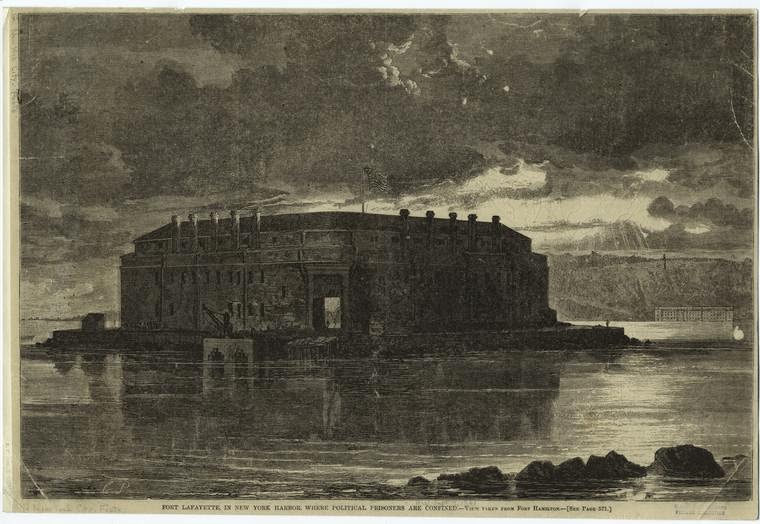
Fort Lafayette, 1861, from Harper’s Weekly (courtesy NYPL)

8) Goodbye Fort Lafayette
In building the Brooklyn anchorage, crews swept away the remainder of old Fort Lafayette, an entrenchment built during the War of 1812.  During the Civil War, Confederates were held prisoner here, including Robert Cobb Kennedy, who attempted to burn down New York during the Great Conspiracy of 1864. During the two World Wars, it held reserve ammunition. Moses personally fought an effort to turn the fort into a night club and now had a hand in dismantling it entirely.

Not only was the fort destroyed, the entire island on which it sat was virtually erased.  In addition, areas near Fort Hamilton and Fort Wadsworth were cleared away to make way for the bridge’s approaches. Perhaps to nobody’s surprise, the construction company tasked with clearing away the old fort employed the son-in-law of Robert Moses.

9) First Class Reception
The U.S. government did something a little different to honor the opening of the bridge — it issued a postage stamp featuring the bridge, to be sold on opening day.  For its 50 year anniversary this year, the Postal Service replicated the honor with an anniversary stamp.  The original stamp was for five cents.  The commemorative stamp is for $5.60 priority mail. (Times change.)

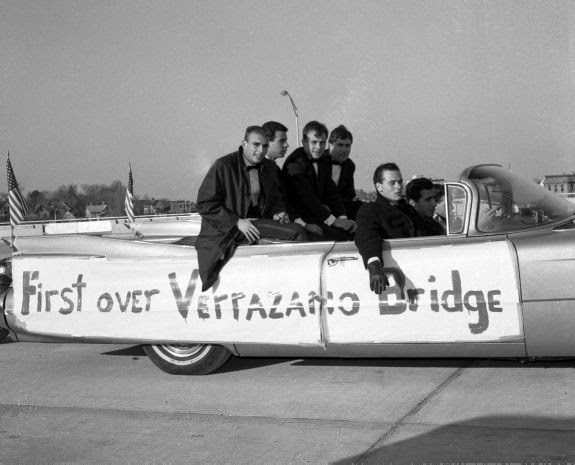
Photo NY Daily News/Leonard Detrick

10) Opening Day, First Traffic Jam
The opening of the bridge not only brought great pride to New York City, although a small number of protesters noted that the span did not have pedestrian walkways or bike paths (and it still doesn’t).  Among the dignitaries as the ribbon cutting ceremony were Governor Rockefeller, the Archbishop of New York Cardinal Spellman, Robert Moses and Mayor Robert Wagner.  They were all transported over the bridge in a somber 52-limousine procession.  The press of vehicles was poorly handled for it resulted in “a traffic jam … a half-mile beyond the point where the ribbon-cutting ceremony had been held.”

The first ‘regular’ toll-paying person over the Verrazano-Narrows Bridge was a carload of young men in rented tuxedos (pictured above), “driving a pale blue Cadillac convertible with flags flapping from the fenders,” who had parked behind the toll gate for an entire week to earn the special privilege.”

Below: The bridge’s most famous film appearance in Saturday Night Fever — but don’t watch if you haven’t yet seen the entire film!

Categories
Podcasts Queens History

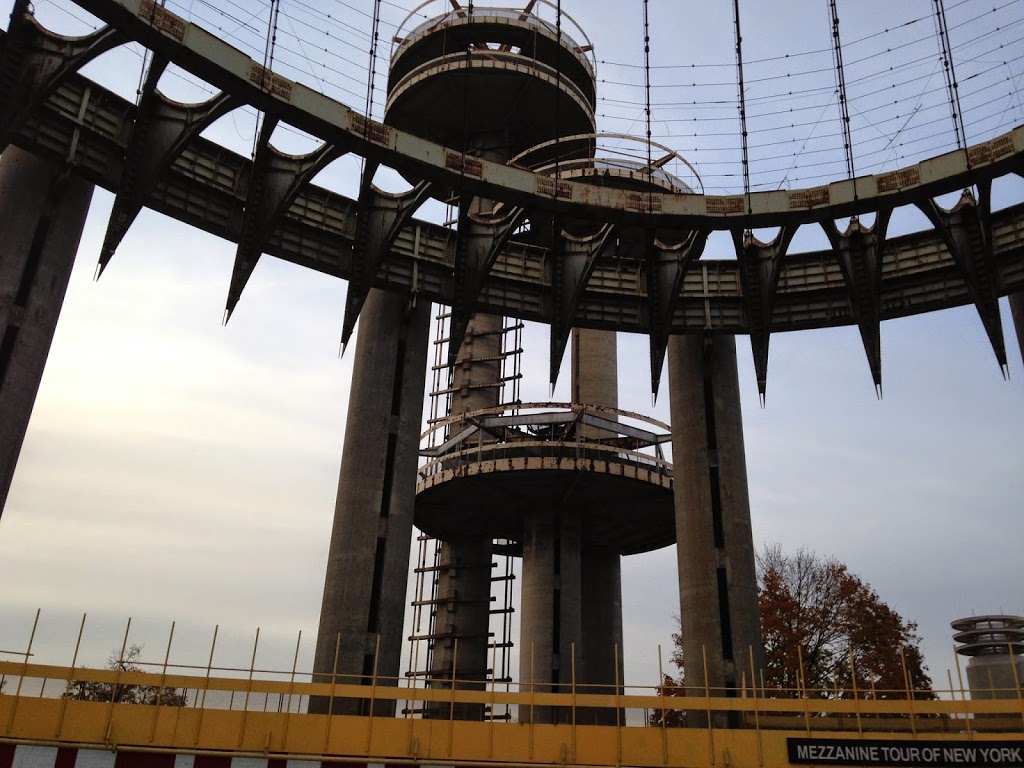
Ruins of the World’s Fair: The New York State Pavilion, or how Philip Johnson’s futuristic architecture was almost forgotten


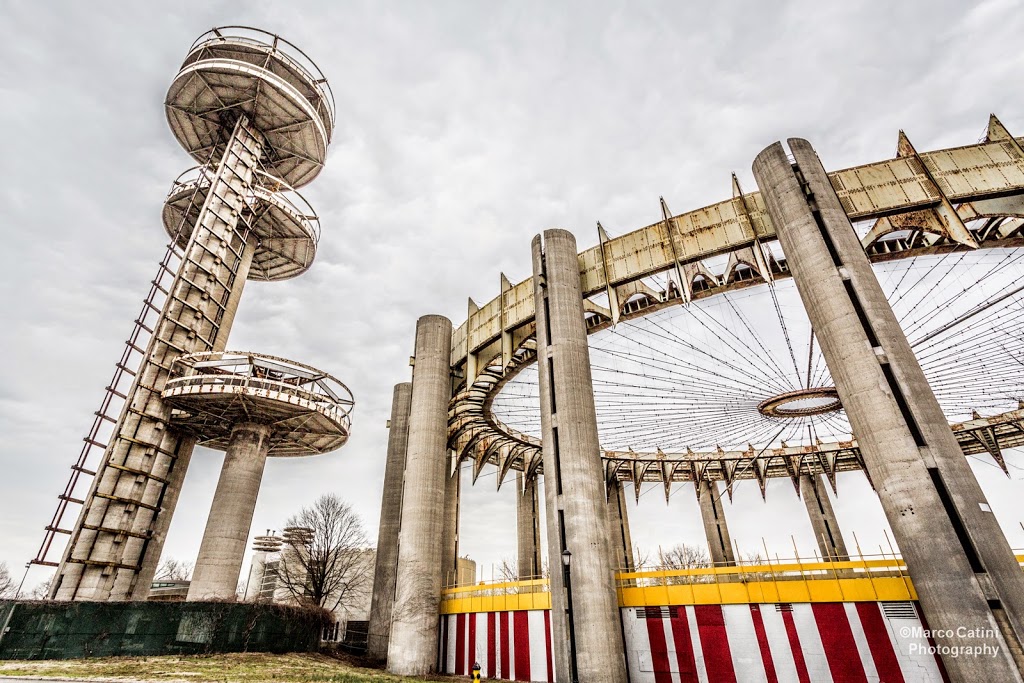
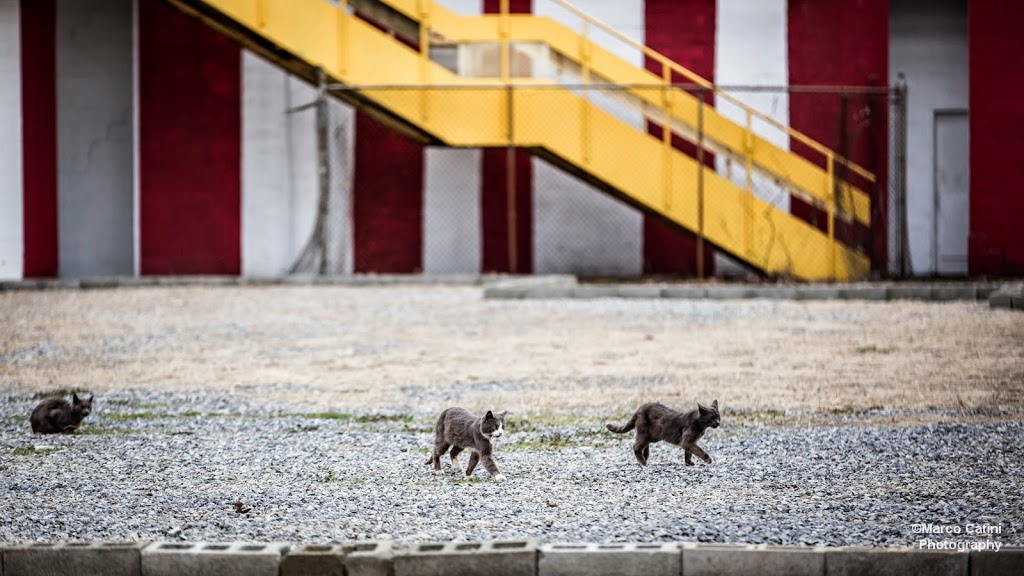
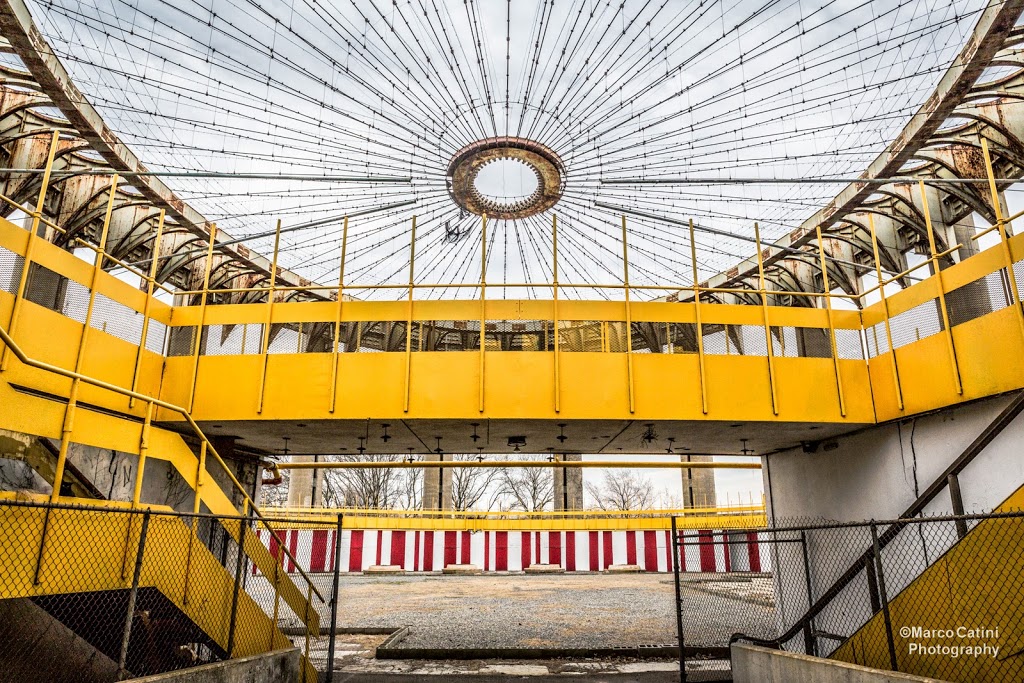
A little bit Jetsons, a little bit Gladiator, a little bit P.T Barnum. Photo/Marco Catini

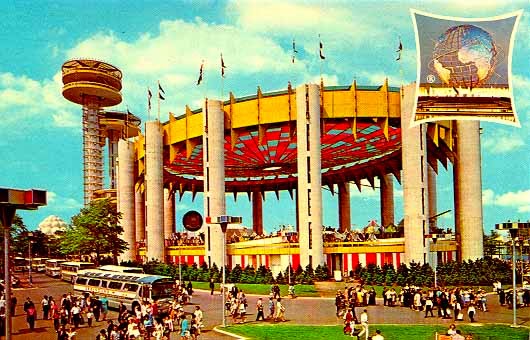
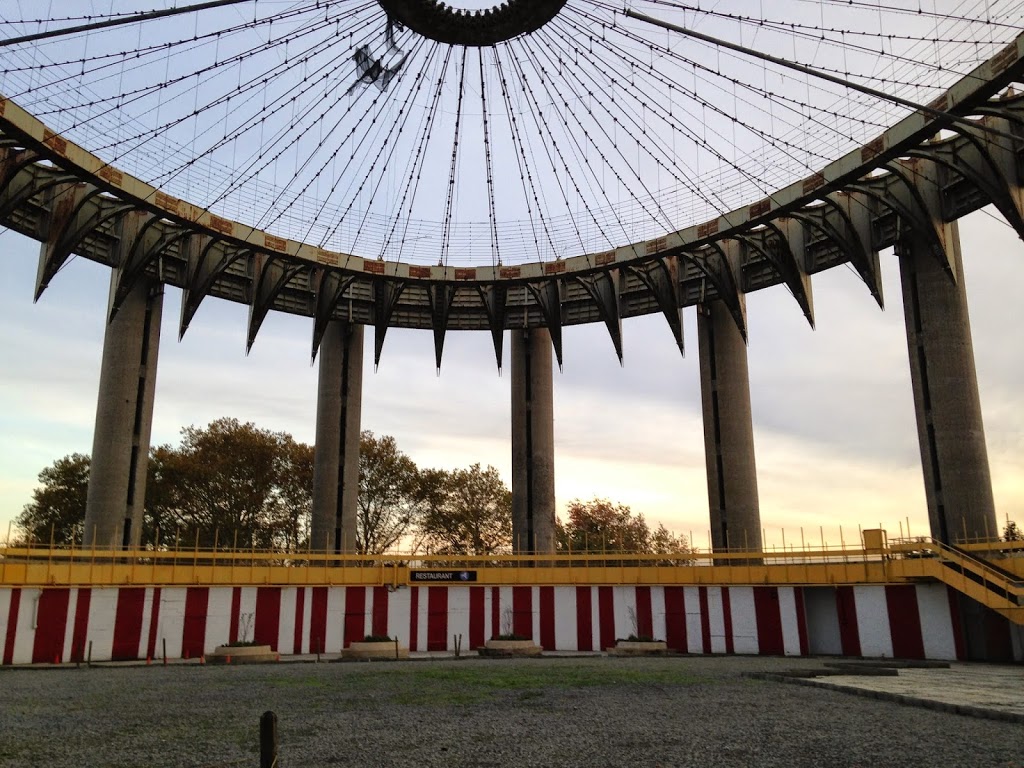
PODCAST The ruins of the New York State Pavilion, highlight of the 1964-65 World’s Fair in Flushing Meadows-Corona Park, have become a kind of unofficial Statue of Liberty of Queens, greeting people as they head to and from LaGuardia and JFK airports. Its abandoned saucer-like observation decks and steel arena have inspired generations of New Yorkers who have grown up with this oddity on the horizon.


The Pavilion holds a great many surprises, and its best days may be yet to come. Designed by modernist icon Philip Johnson, the Pavilion was saved from the fate of many of the venues in the World’s Fair. But it’s only been used sporadically over the past 50 or so years, and the fear of further deterioration is always present.

For the first part of this very special episode of the Bowery Boys, I take you through the pavilion’s presence in the World’s Fair, a kaleidoscopic attraction that extolled the greatness of the state of New York. In its first year, however, a battle over controversial artwork was waged, pitting Robert Moses and Nelson Rockefeller against the hottest artist of the day — Andy Warhol. Other controversies at the Fair threatened to derail the message behind its slogan ‘Peace Through Understanding.’

In the show’s second half, I head out to record at the Queens Theater — the only part of the New York State Pavilion that’s been rehabilitated — to explore the venue’s ‘lonely years’ with filmmaker Matthew Silva, a co-founder of People For The Pavilion, an organization that’s successfully bringing attention to this weird little treasure. Matthew gives us the scoop of the pavilion’s later years, culled from some of his interviews in the film Modern Ruin: A World’s Fair Pavilion.

This is crucial time in the history of this spectacular relic. With public attention at an all time high, we may now be at the right time to re-purpose the Pavilion into a new destination for New Yorkers. What do you think should be done with the New York State Pavilion?

An airplane passes over the park, its shadow captured inside the Pavilion. (Photo by George Garrigues)


And we would like to thank our sponsors:

Audible, the premier provider of digital audiobooks. Get a FREE audiobook download and 30 day free trial at www.audibletrial.com/boweryboys. Over 150,000 titles to choose from for your iPhone, Android, Kindle or mp3 player Audible titles play on iPhone, Kindle, Android and more than 500 devices for listening anytime, anywhere.


Here’s the trailer to Matthew’s film Modern Ruin: A World’s Fair Pavilion:


Modern Ruin: A World’s Fair Pavilion – Promo I from Matthew Silva on Vimeo.

Thank you Matthew for helping out with the show this week! He’s finishing his film. If you would like to help out, go over to the Modern Ruin GoFundMe page and donate. You just be helping out the film, but the Pavilion itself. The film will probably be the first time many people ever hear of the New York State Pavilion.

And for a different (fictional) film take on the Pavilion, try out these appearances from The Wiz, Men In Black and Iron Man 2:

And thank you to commenter Signed D.C. who points out that the venue was featured in an music video by They Might Be Giants who, generally speaking, who a bit obsessed with the World’s Fair. (It pops up in several of their songs, including a lyric to their song “Ana Ng.“) At one point, the lead singer floats over the Texaco map.


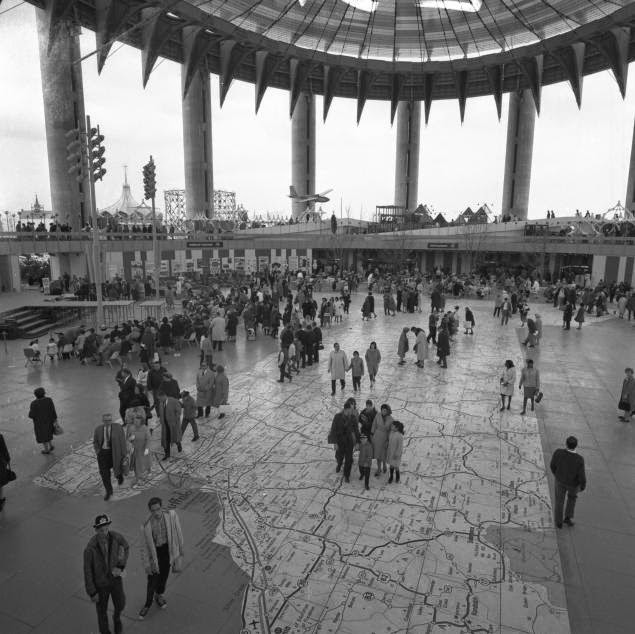
Looking down at the Texaco map of New York state. (Courtesy New York Daily News)


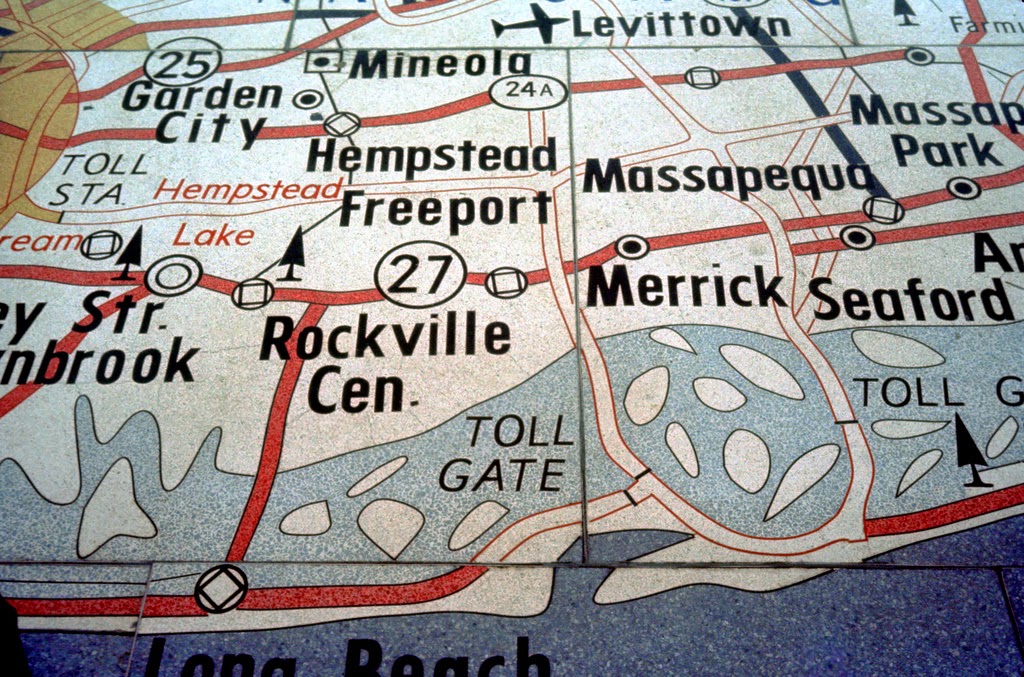
A close up of Long Island, photo taken in 1964. (Courtesy Flickr/Susan DeMark)

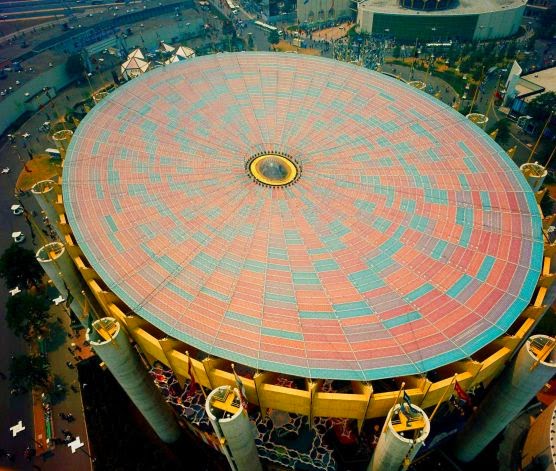
An overhead shot of Philip Johnson’s extraordinary rooftop, a stunning colorful ovoid that projected a rainbow of colors down upon fair-goers. (Courtesy AP)

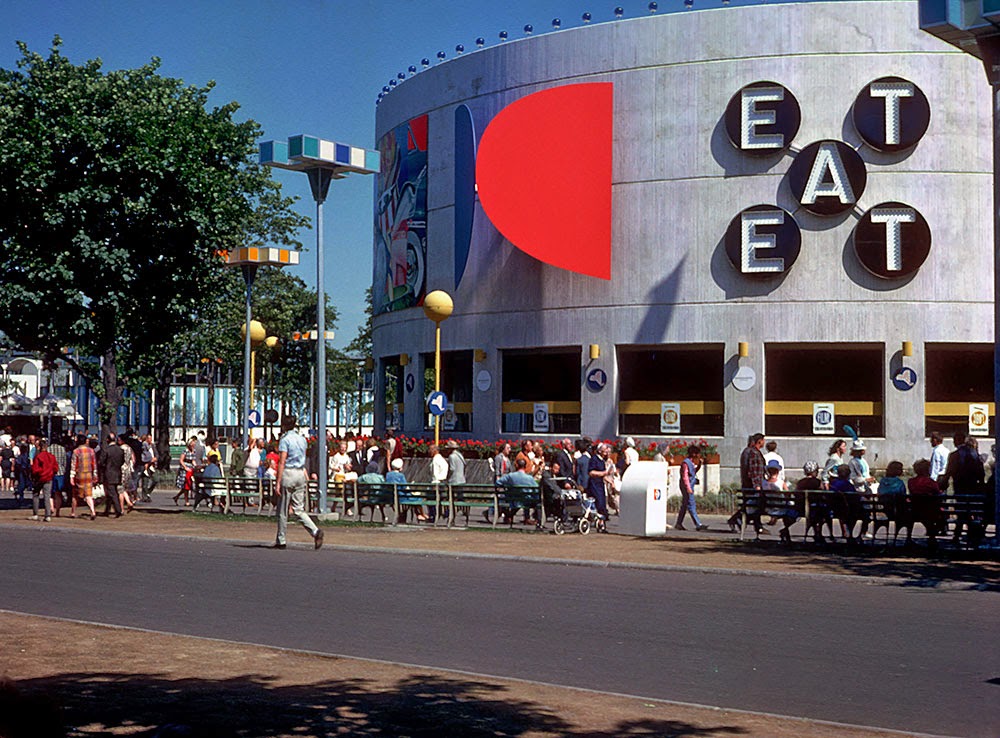
Theaterama, part of the New York State Pavilion, is today’s Queens Theater. Johnson commissioned the work of several pop artists to hang along the walls of the pavilion. (Courtesy Bill Cotter/World’s Fair Community)

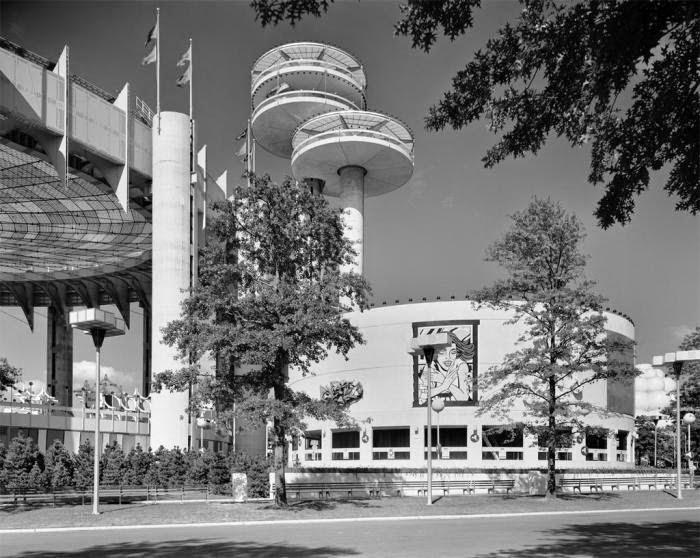
A view of Theaterama showing the Roy Lichtenstein mural upon its side (Courtesy Jon Buono):

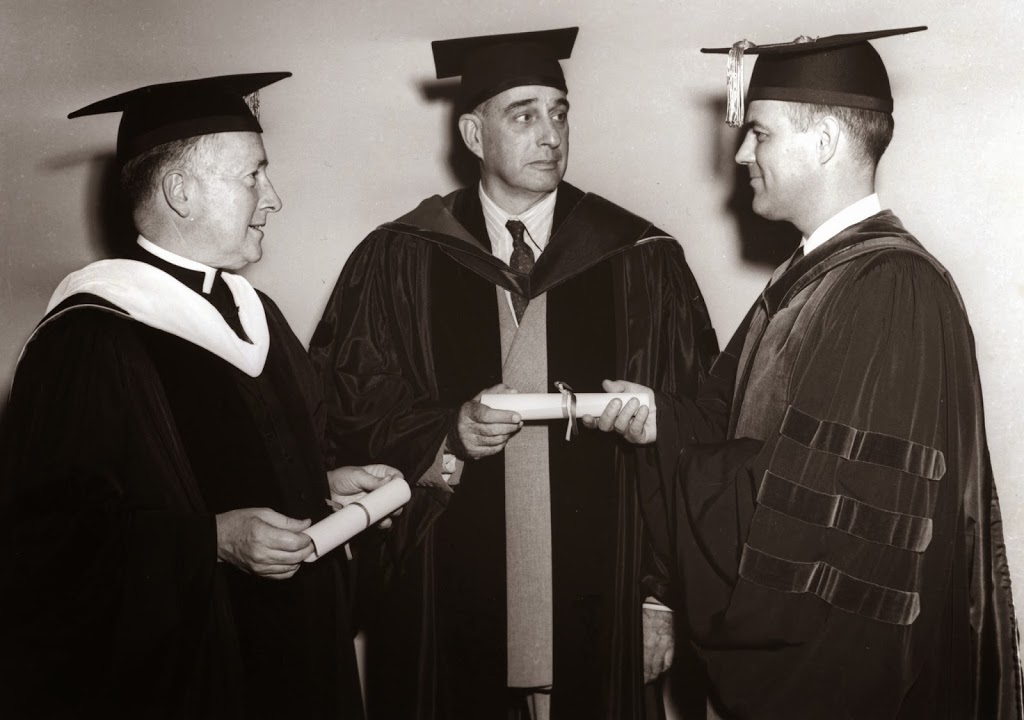
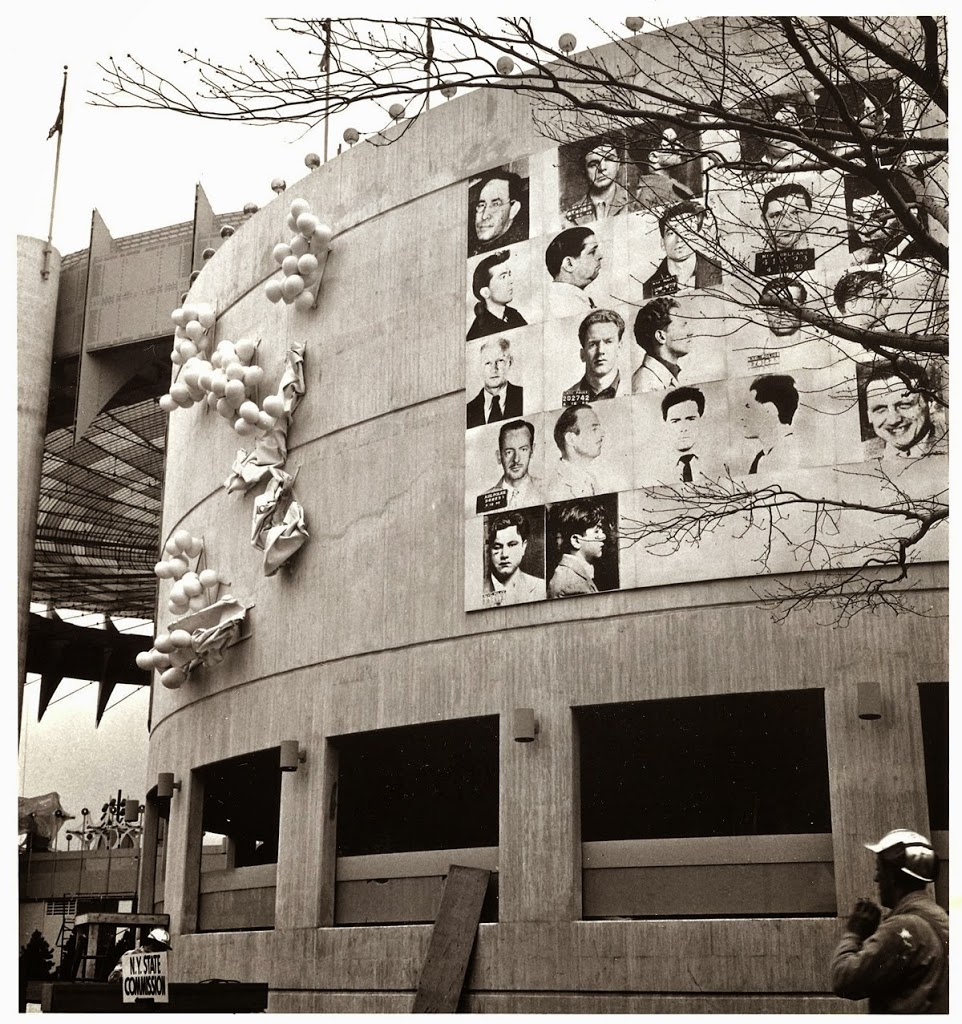
Andy Warhol‘s Ten Wanted Men on the side of Theaterama, with the Tent of Tomorrow in the background. Although we can almost guarantee that it was not beloved by Robert Moses, it’s believed it was taken down because of Governor Rockefeller.

Robert Moses beams from the sidewalk of Flushing Meadows-Corona Park. The mosaic is based on the work of Andy Warhol.

The Federal Pavilion — “the square donut on stilts” — was designed by Charles Luckman, who also designed the current Madison Square Garden.

The photographer Marco Catini has taken some recent images of the Pavilion. You can find much more of his work here. Thanks Marco for letting me use your work here!

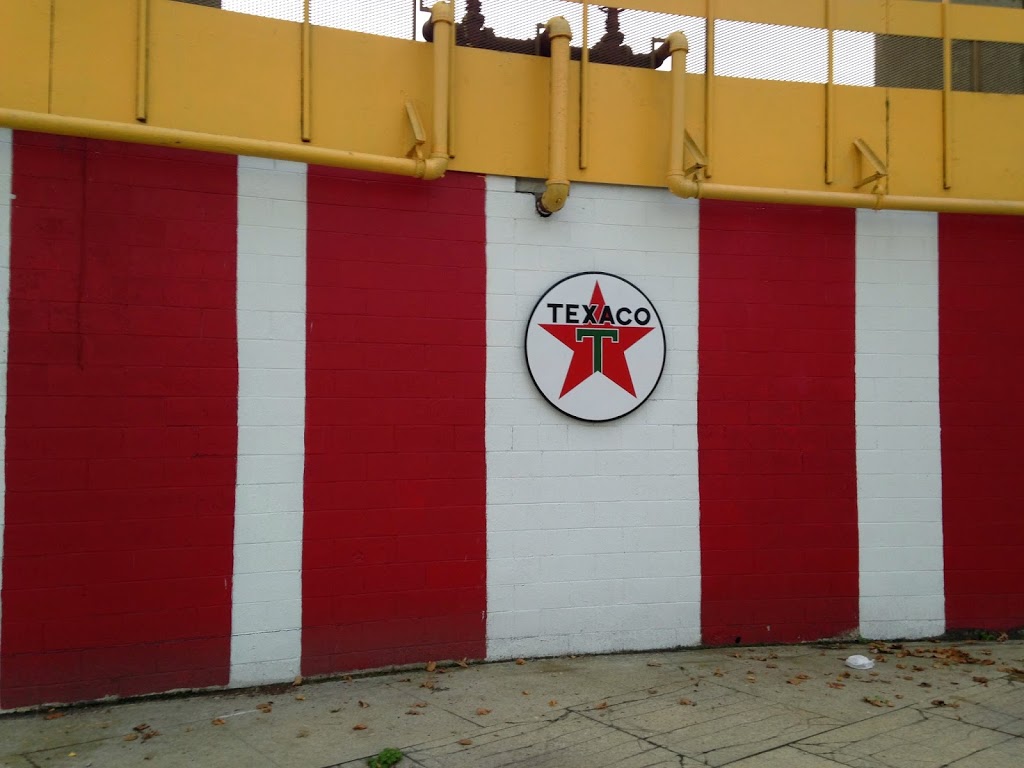
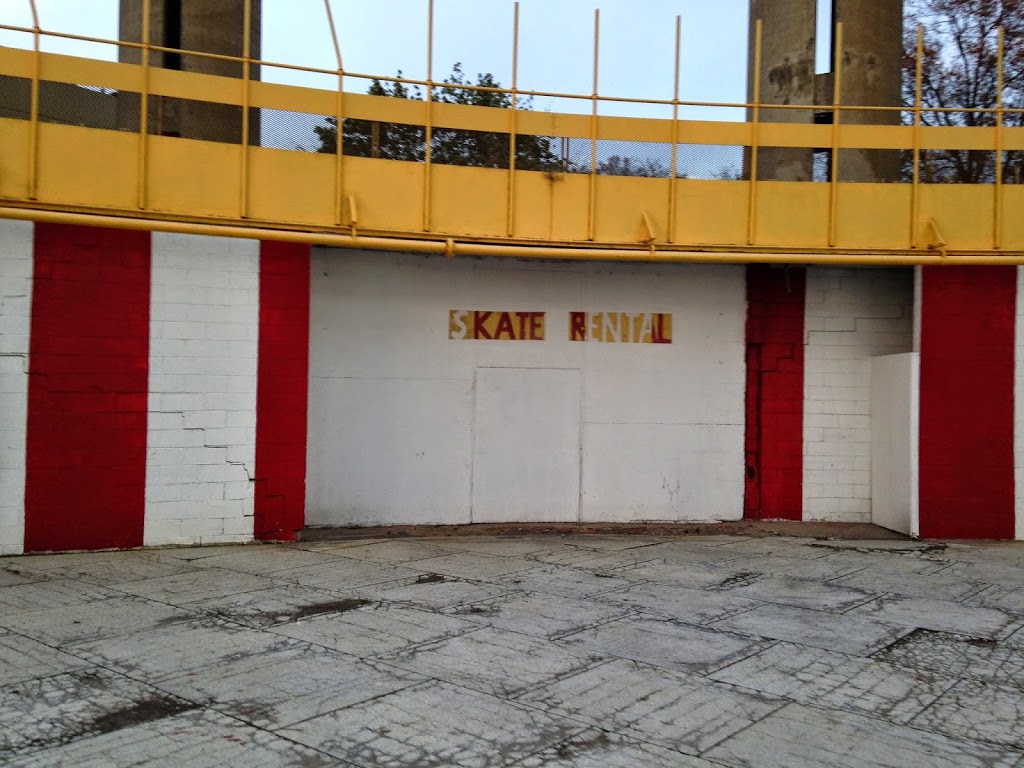
Here are a few of my photos taken on the afternoon of recording. The New York State Pavilion Paint Project is responsible for keeping the place is festive shape. The candy stripes are similar to the look of the 1964 pavilion.

MY THANKS AND GRATITUDE to the Queens Theatre in The Park for allowing us to record in the cabaret room! I know we went on and on about the observation desks and the Tent of Tomorrow, but you should really check out a show within the greatly renovated theater. Coming in December: Charles Dickens’ A Christmas Carol!

Visit the People For The Pavilion website for more information on upcoming events, news and fund-raisers. And a shout-out to the organization’s co-founder Salmaan Khan!

The New York Daily News just yesterday published an article about People For the Pavilion and its co-founder Christian Doran who passed away in February. There’s a fund-raiser tomorrow in his honor. [More info here]

ALSO: I didn’t get to plug this on the show, but historian Christian Kellberg has just released a book of photography of the New York State Pavilion, part of the Images of America series. Most of the pictures are exclusive to this book including some extraordinary shots of the pavilion construction.

And of course there’s Joseph Tirella‘s terrific book Tomorrow-Land: The 1964-65 World’s Fair and the Transformation of America, putting the entire fair within context of the rapidly changing America of the 1960s.

And since I mentioned it on the show, here’s a link for Robert Caro‘s The Power Broker as well!

Categories
Queens History Robert Moses

Robert Moses rejected this terrifying Margaret Keane painting from hanging at the 1964-65 World’s Fair

The World’s Fair of 1964-65 at Flushing Meadows-Corona Park was a major American event forward-looking in its intent and, in many ways, backwards in its practice.  In particular, Robert Moses did not care for cheap carnival amusements, nor did he care for music or art that was particular edgy or controversial. Moses’ tastes ruled supreme over the Fair as he held veto power over any works that were in “extreme bad taste or low standard.”

There was no pavilion dedicated to art although several independent partners funded their own art displays.  The New York State Pavilion presented the work of brand-new pop artists; an objectionable piece by Andy Warhol entitled Thirteen Wanted Men was eventually painted over (although it was the governor Nelson Rockefeller who objected in this case).

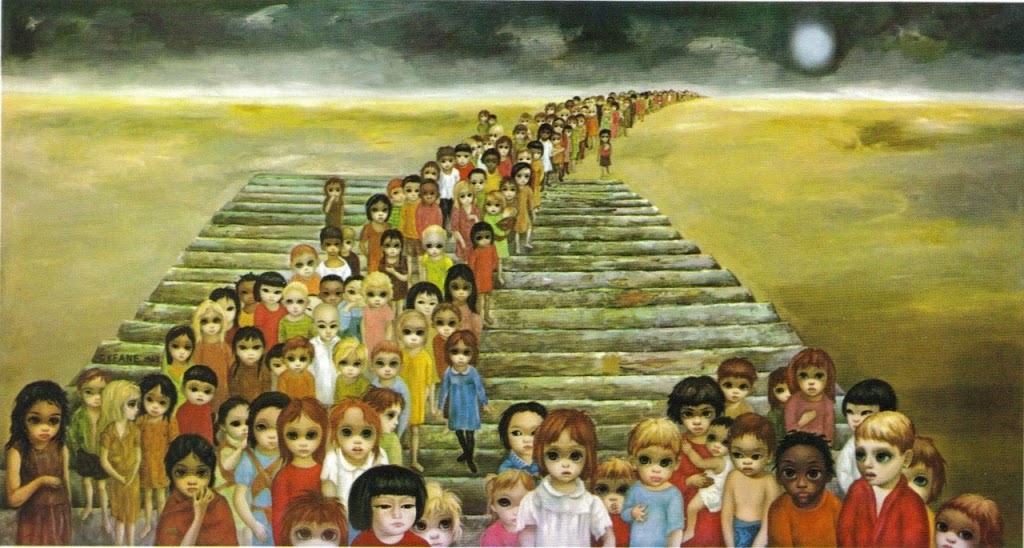
Moses did eventually throw out one surprising piece of artwork — Tomorrow Forever by Margaret Keane.

The Keane painting was to have been displayed in this building at the fair.**

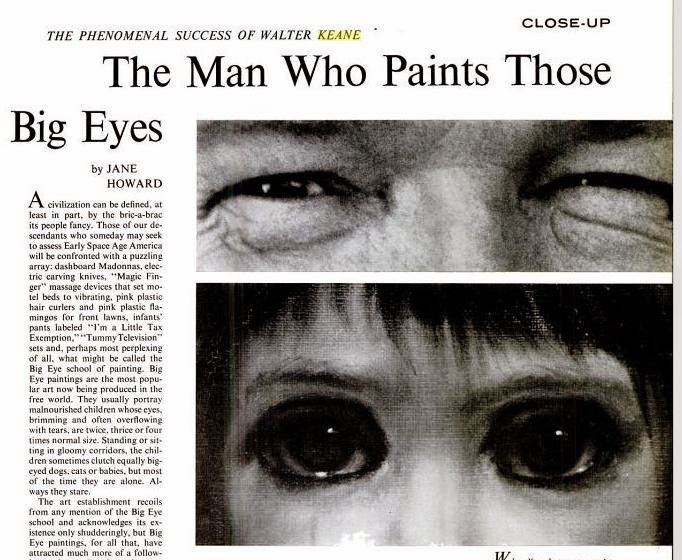
Keane was known for her bizarre and haunting images of children and animals with large empty eyes.  During the 1960s, her husband Walter Keane claimed to be the creator of her paintings.  It was he who was announced as the painter of this macabre work, chosen in February 1964 to grace the Fair’s Hall of Education.   The venue devoted to the future of schools would feature a scale model of an elementary school from the year 2000, a playground with “futuristic climbing structures,” and from the entrance way, the terrifying painting you see above.

The work by Keane, representing “something which would be symbolic for the aspiration of children,” was not exactly heralded as the pinnacle of artistic expression in 1964.

The New York Times’ art critic John Canaday could barely conceal his disgust at this “grotesque announcement,” adding, “Mr. Keane is the painter who enjoys international cele­bration for grinding out form­ula pictures of wide‐eyed children of such appalling sentimentality that his product has become synonymous among critics with the very definition of tasteless hack work.”   [source]

To be fair, Canaday had only seen a photograph of the painting, which depicts an endless sea of soul-crushing zombie children, rising out of a morose and barren wasteland. “That’s true,” he confessed to a Life Magazine reporter. “It’s normally a principle of mine never to judge just by a photograph, but in this case it didn’t matter.”

Moses seemed to agree with Canaday, demanding the Hall of Education cancel the planned installation before it was even mounted.  Thanks to Canaday’s protest, Moses’ office was inundated with letters from angry intellectuals and aesthetes. “[T]he perpetrators of this art burlesque,” wrote Joseph James Akston, “expose us to veritable scandal sure to incur ridicule and laughter of the whole civilized world with possible exception of Russians.” [source]

Keane, who of course didn’t paint the artwork attributed to him, nonetheless seemed to revel in the critical potshots.  The following year, he issued a press releases from San Francisco and Tahiti, declaring himself “the American Gauguin.”  Canaday would continue to take aim at Keane’s kitschy work.  Imagine how Canaday felt when he discovered that Walter hadn’t even painted the works he so deliciously despised?

Margaret eventually left her husband and sued for rightful ownership of her artwork.

Below: From a Life Magazine profile in August 1965:

NOTE: I’m being a little irreverent in calling the painting “terrifying” as the artist clearly intended the subjects to be starving, sad children.  However, the passage of time has been a little strange to Keane’s legacy.  She is perhaps more beloved than ever — there’s a new Tim Burton film coming out this year — but the flagrant sentimentality of the work has given way to their spectacular kitsch value.

** The Hall of Education picture courtesy the blog Little Owl Ski which has a few other nifty World’s Fair pictures.


Categories
Holidays

On this Veteran’s Day, a salute to the Harlem Hellfighters!

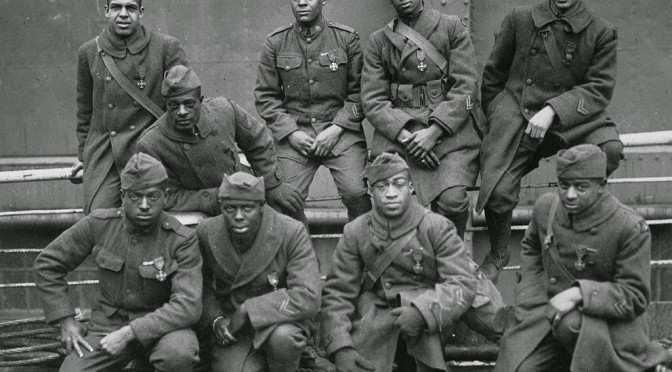
The men of the 369th who were awarded France’s Criox de Guerre for distinguished acts of heroism:  Pvt. Ed Williams, Herbert Taylor, Pvt. Leon Fraitor, Pvt. Ralph Hawkins. Back Row: Sgt. H. D. Prinas, Sgt. Dan Strorms, Pvt. Joe Williams, Pvt. Alfred Hanley, and Cpl. T. W. Taylor

New York’s 369th Infantry Regiment was America’s first African-American regiment engaged in World War I.  While many white American soldiers would have been happy to serve next to trained regiments of any color, intense racial prejudice in the United States forced many who signed up to fight for their country to instead be assigned to the French army.

Nicknamed the Harlem Hellfighters, the regiment served alongside the French during the summer and fall of 1918.  Perhaps the most famous soldier of the 369th was Private Henry Lincoln Johnson (at right) whose deadly efficiency on the battlefield earned him the grim nickname Black Death.  He became the first of dozens from the 369th to receive the prestigious Criox de Guerre, the equivalent of the American Medal of Honor.

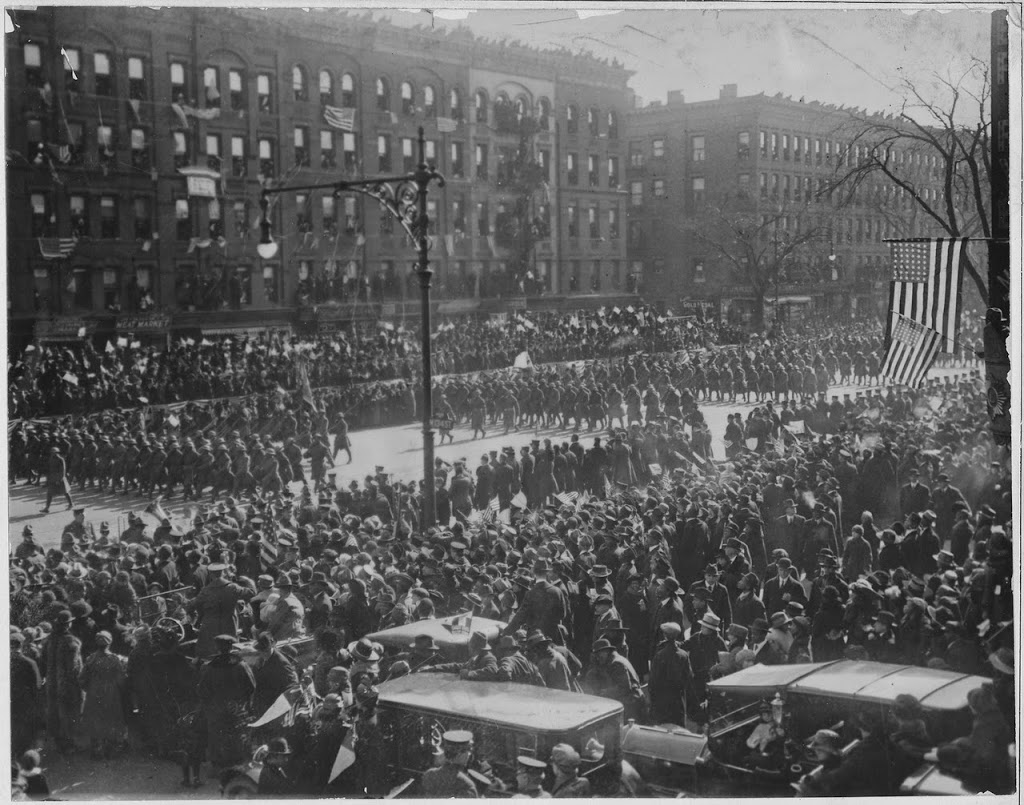
They returned to New York in February 1919 and marched through the streets of Manhattan on February 17 — from Greenwich Village to Harlem, in triumph.

From the New York Times the following day:

New York’s negro soldiers, bringing with them from France one of the bravest records achieved by any organization in the war, marched amidst waving flags and cheering crowds yesterday from Twenty-third Street and Fifth Avenue to 145th Street and Lenox Avenue.”

“At Thirty-Fourth Street the men marched under a shower of cigarettes and candy, and such tokens were pitched at them at other points in the line, but the files did not waver for an instant.

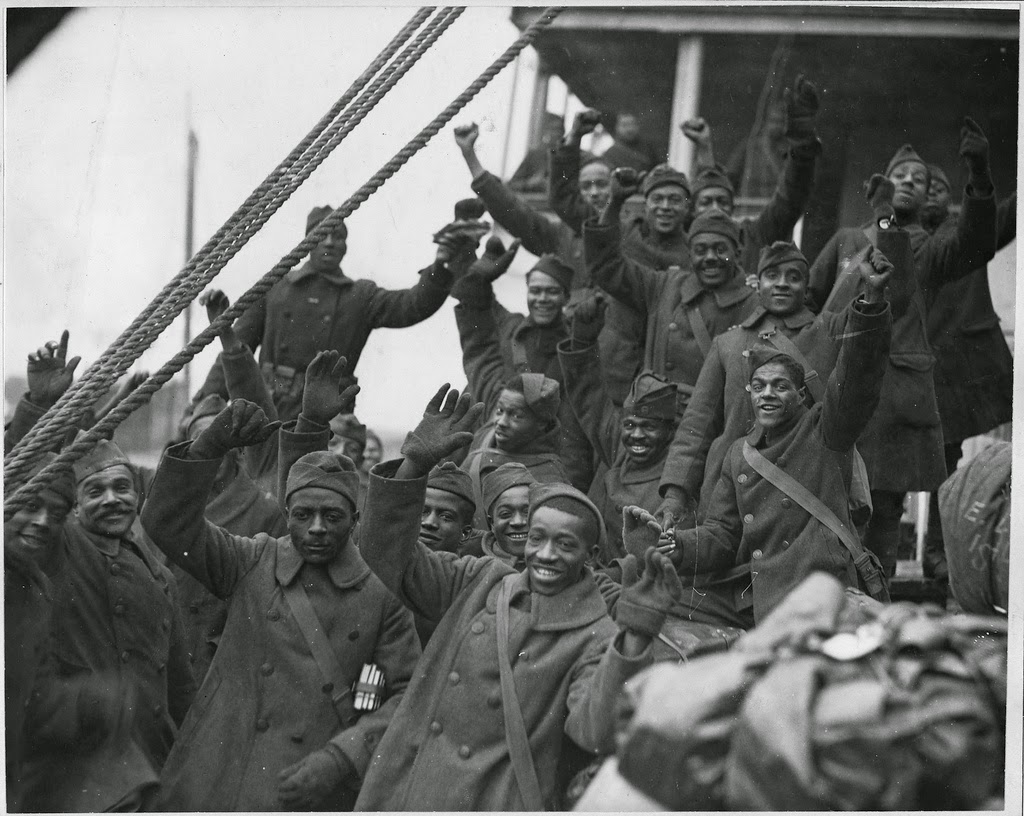
The men of the 369th photographed as they arrive back in New York City, 1919

From original caption (courtesy US National Archies):  “[The] 369th New York City Infantry (old 15th) [African American] troops and some of the 370th Infantry, Illinois [African American] troops, one of the most decorated regiments in the United States Army return to New York City. They saw [the] longest service of any American regiment as part of a foreign army, and had less training than any before going into action. They were never in an American division or brigade always being with the French.”

The 369th marching up Fifth Avenue.

The men are shown here in this assortment of newsreel footage from the war:

Pictures from the U.S. National Archives

Categories
Health and Living

The first appearance of the shower or “rain bath” in New York

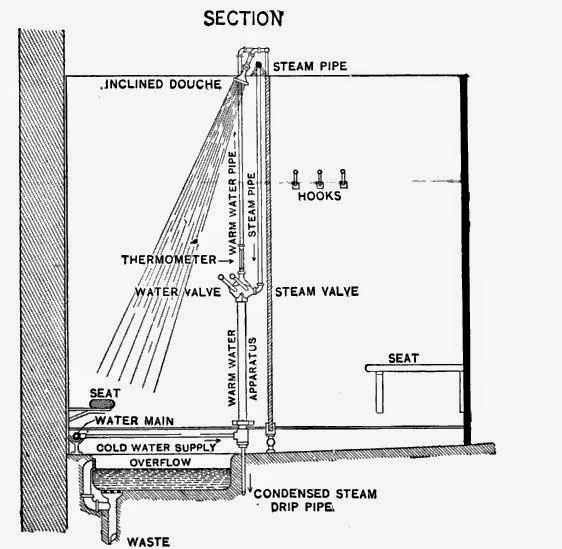
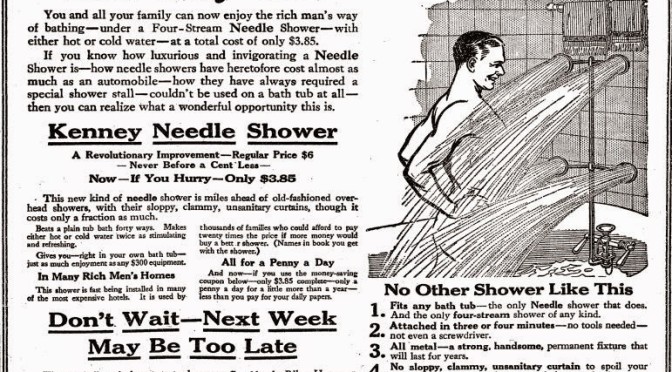
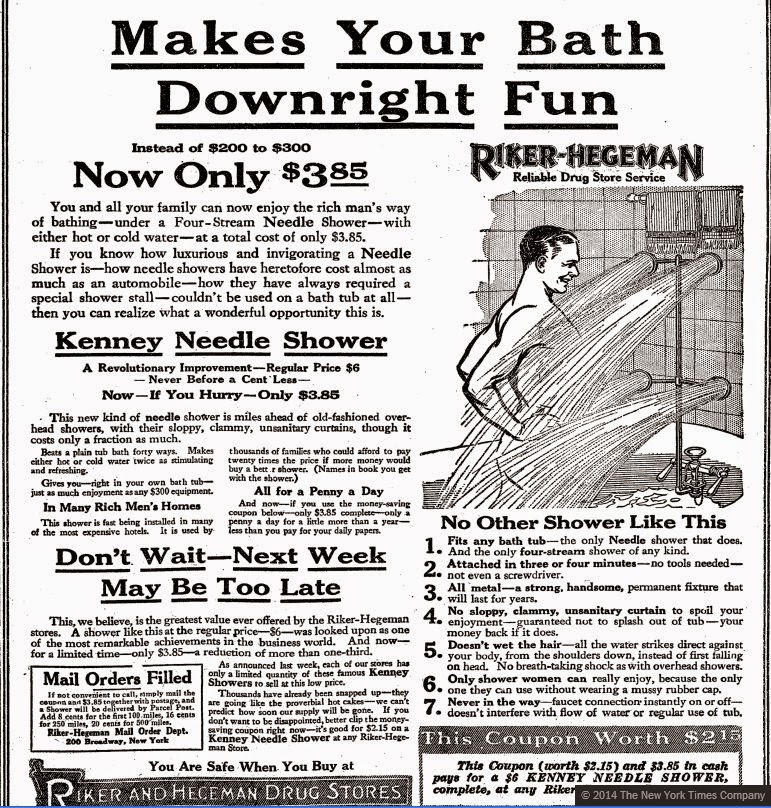
With major improvements in plumbing and home design, private ‘rain-baths’ or showers began to be installed in the wealthier American homes. This is a New York Times advertisement from November 11, 1914 for a Kenney Needle Shower which inundated the body with water from multiple showerheads.


The modern form of shower was once referred to as a “rain bath”, invented in Europe in the 19th century.

From a 1908 journal called “Modern Baths and Bath Houses“:

“The rain bath is the most important form of cleansing bath, from a hygienic point of view, hence it is deserving of special attention.  Since the first introduction, about the year 1883, of the so-called ‘rain baths’ in Germany, I have followed with keen interest and close attention the gradual development and rapid spread of this new system of baths.

In the modern ‘rain bath’ system …. tubs are entirely abolished, simple spray or shower baths being substituted for the same, and being installed in the bath compartments as a distinct and independent form of bath.


One feature of construction, which is novel and of much importance, is that the shower or spray in placed at an inclined angle in the rain bath, the object being to avoid a vertical stream from the shower striking the head of the bather, which to many person is quite disagreeable.

In the new form of rain bath .. the lukewarm water strikes the body only from the neck downwards, and the head is not wetted, except when the bather purposefully places the same under the descending shower of water.”

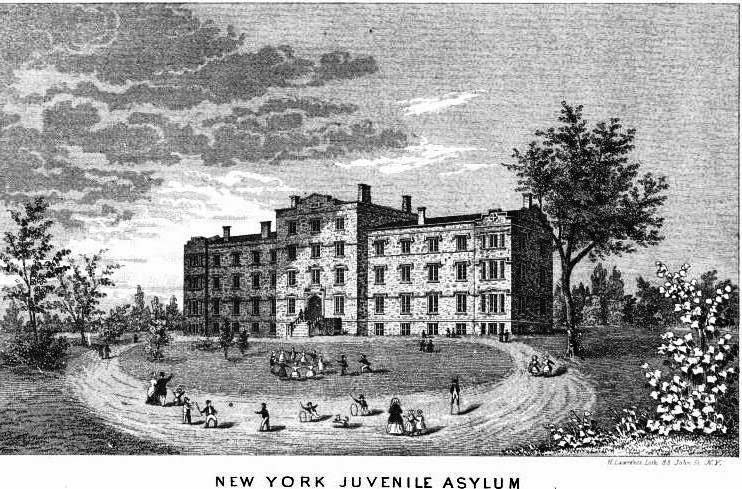
The very first ‘rain bath’ installed in New York, according to the 1908 journal, was at the New York City Juvenile Asylum, located at 175th Street and 10th Avenue. (Pictured below.) Delinquents taken to the asylum were stripped of their street clothing and thrown into the new showers, then provided proper uniforms.

After what appeared to be a successful trial upon these poor children, rain baths were installed in public hospitals and bathhouses throughout the city.

Private application of this technology, however, took a bit longer to catch on.

Home installations, such as the ones illustrated at top, came with the advent of improved apartment living in the early 20th century.

Apparently there was some concern that the rain bath could be successfully applied to private dwellings that weren’t for the wealthy.

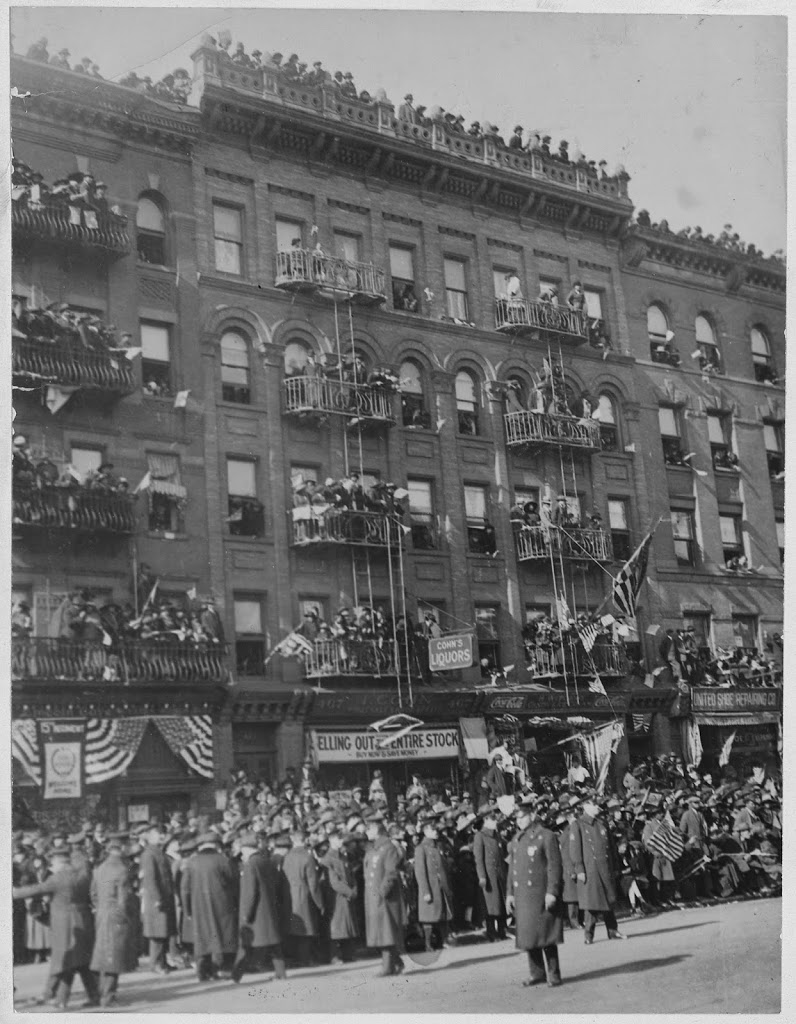
“[T]he middle classes who, in New York City, for instance, are largely compelled to live in flats or apartment houses (the higher-sounding name for improved tenement houses), have, with rare exceptions, only a narrow, dark and generally uninviting bathroom, and the mistake is usually made by architects or buildings of locating the water-closet [toilet] almost invariably in the same room.”

Imagine, putting the shower in the same room as the toilet!

Categories
Mysterious Stories

Ghost Bluster: Arthur Conan Doyle and his wacky ectoplasm

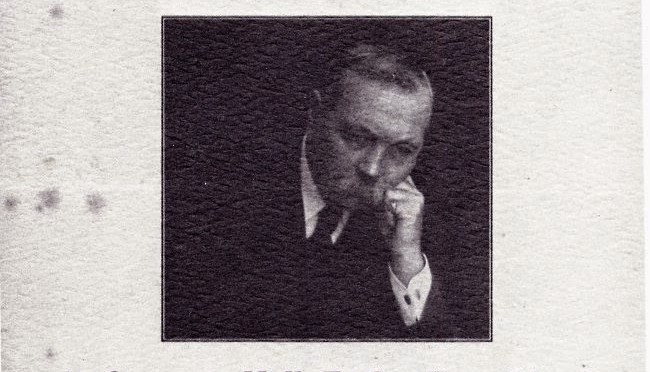
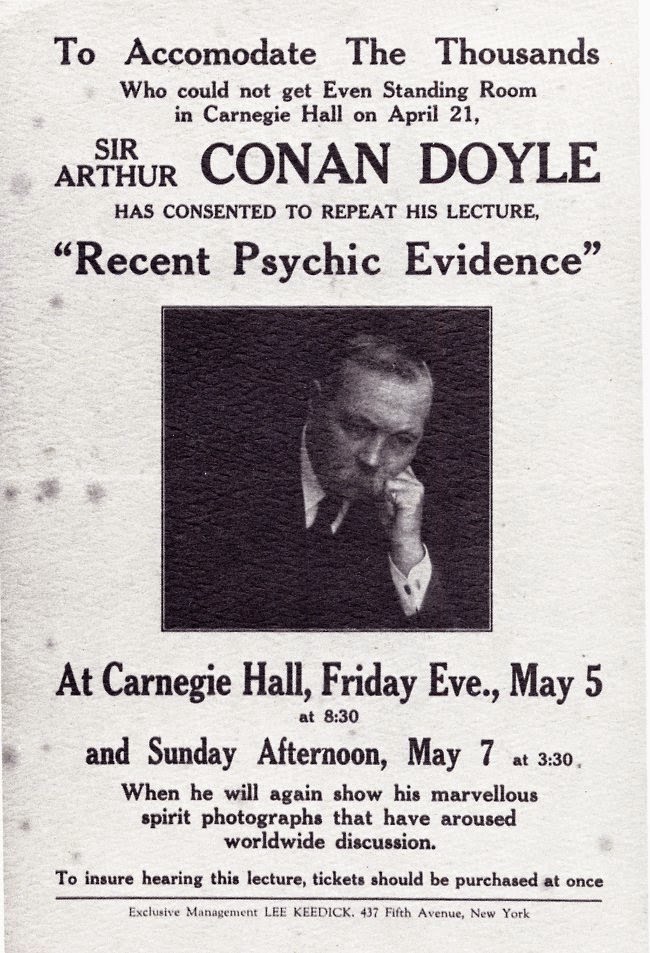
A flyer for one of the author’s many Carnegie Hall lectures. (Courtesy Carnegie Hall archives)

Sir Arthur Conan Doyle made a startling announcement in April 1922. Known for his beliefs in communicating with the afterlife, the famed creator of Sherlock Holmes announced an extraordinary discovery — the existence of ectoplasm, the ghostly goo that emits from mediums possessed with the spirits of the dead.

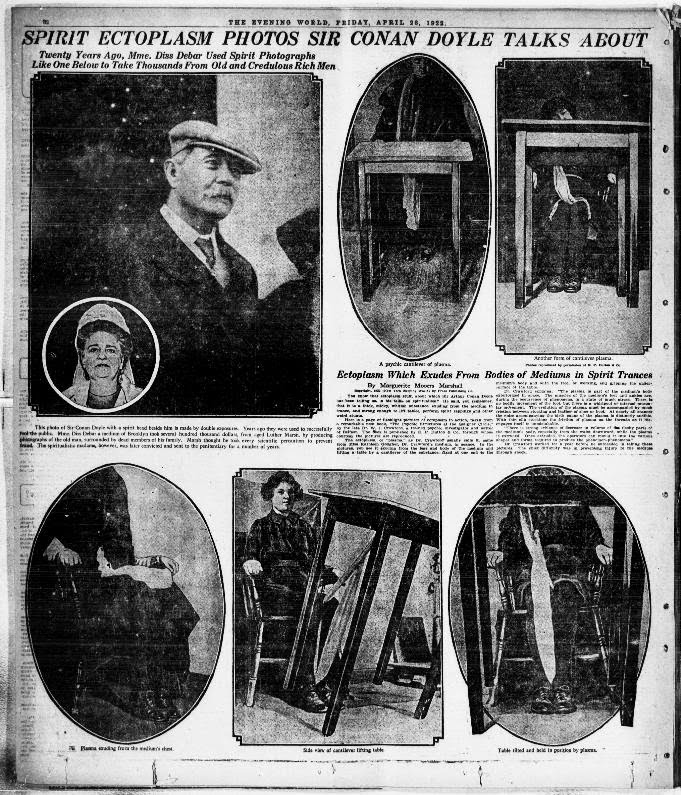
“Ectoplasm is a thick, vapory, slightly luminous substance which exudes from some materializing mediums,” Conan Doyle told the author Marguerite Mooers Marshall in an interview with the New York Evening World. “Immediately there comes from her body this vaperous substance which surrounds her like a fog. As the ectoplasm increases it becomes more dense. It coalesces, becomes sticky. It can be felt. It can be photographed.”

To prove the existence of this viscous residue, the Evening World published photographs of alleged ectoplasmic events on April 26, 1922.

The root of all this sudden interest in bizarre supernatural events during the spring of 1922 was a series of lectures Conan Doyle gave at Carnegie Hall and the Brooklyn Academy of Music, shaking proper society to the core with Spiritualist talk of mediums and psychic planes far outside those commonly prescribed by Western religion.
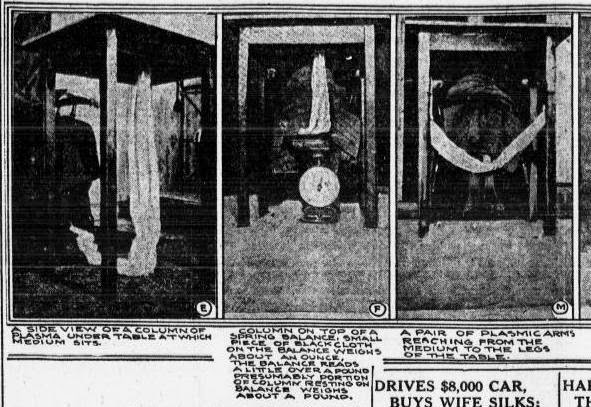
Among the spirit photography he displayed in the legendary Carnegie stage were several examples of ectoplasmic events, thick wisps of ghostly material issuing from the bodies of entranced mediums.
His lectures were received with great interest and much mockery. In reference to the author’s peculiar views of the afterlife and days before run the odd photography posted above, the Evening World intoned in a headline, “ALL WOMEN PRETTY AND 25, MEN 30, IN DOYLE’S HEAVEN.

Others blamed a series of mysterious murders and suicides in New York City during this time period on Conan Doyle’s disturbing lectures.

It was in May of that year that Conan Doyle met with Harry Houdini, magician and famous spiritualist skeptic.  (We speak of the results of this encounter in our podcast Mysteries and Magicians of New York.) Among their lengthy debates regarding the spiritual realm were discussions on the existence of ectoplasm.

Below are some of the more disturbing photographs of alleged ectoplasmic activity.  It was similar photos to that that Conan Doyle displayed at Carnegie Hall in 1922.

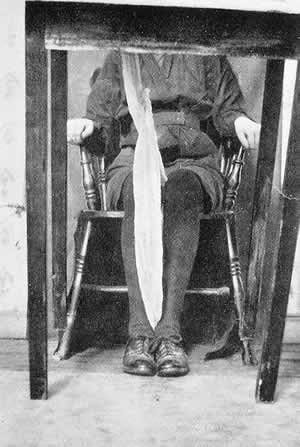
1913 — The medium Stanislawa emitting ghostly ectoplasm (Courtesy Univ of Sydney)


Katherine Goligher, subject of the Evening World photographs, issuing ectoplasm that looks suspiciously like regular fabric


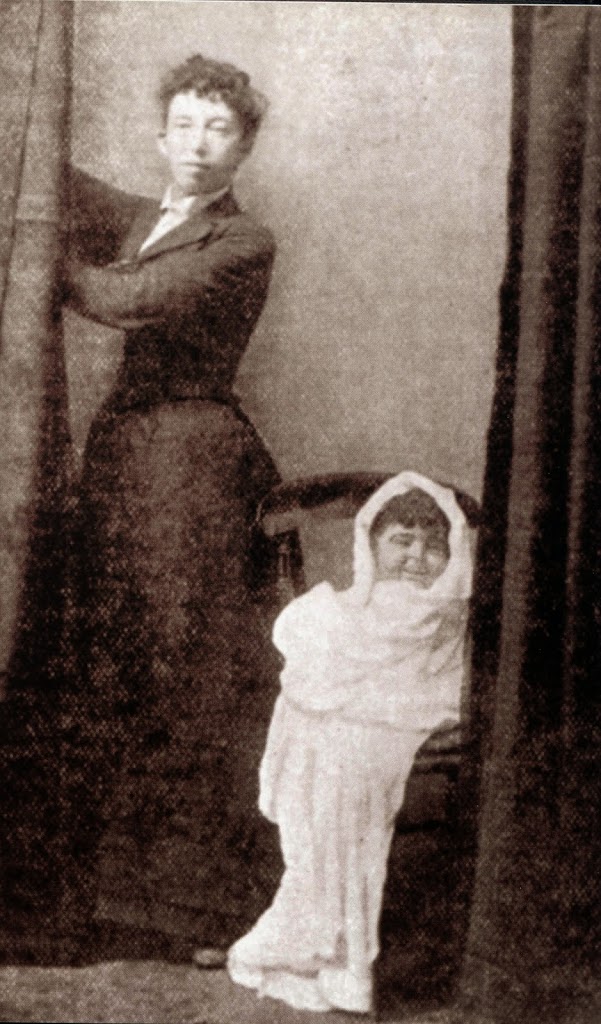
Sometimes the ectoplasm came out in the form of little people, as in this photo of Annie Mellon and an entity named ‘Cissy’, c. 1890 (Univ. of Sydney)


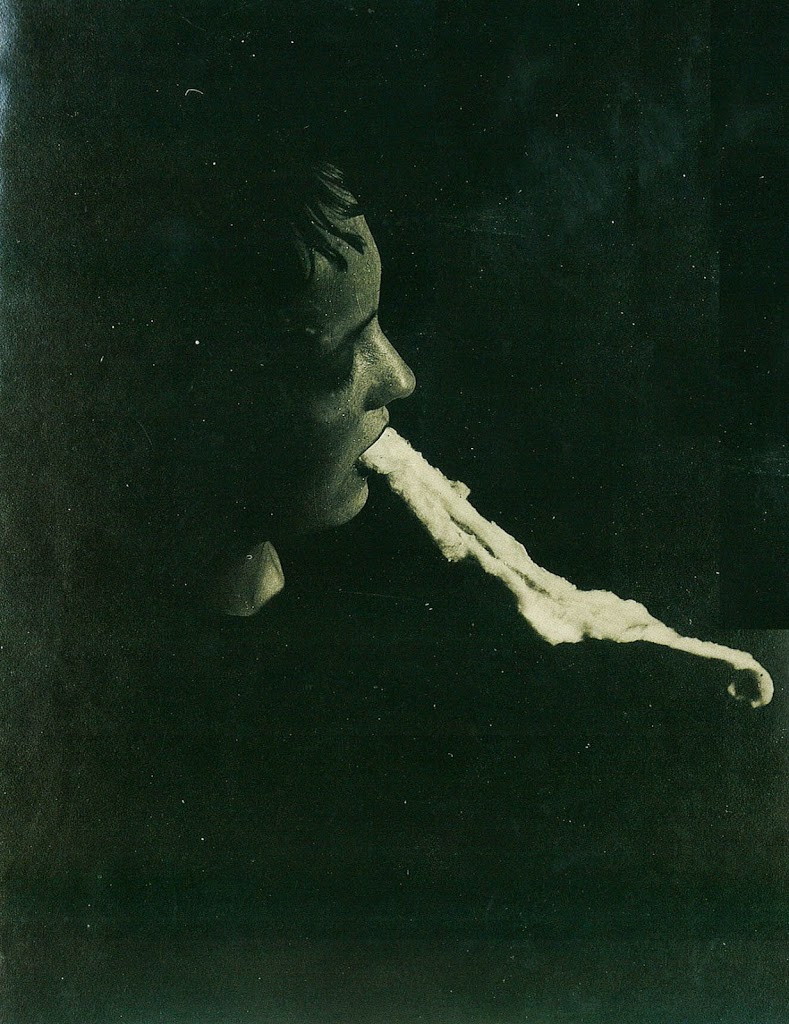
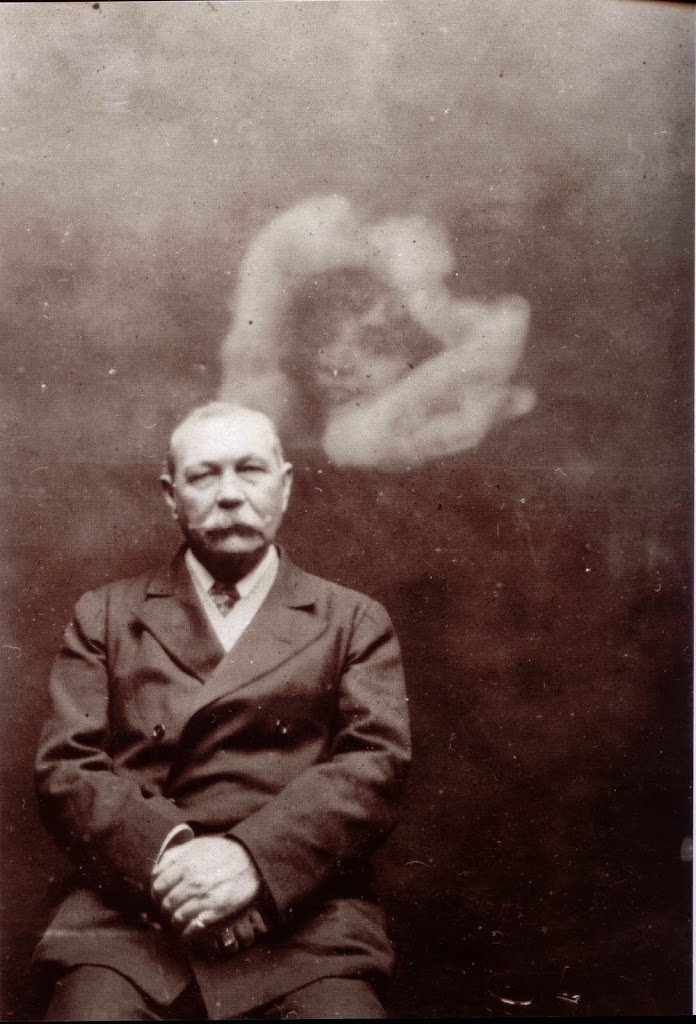
Conan Doyle himself could even expel ectoplasm, especially in front of a camera!  This was taken in 1922, possibly while he was in New York


Below: Video evidence of ectoplasm and creatures made from the substance 


(If you’re in a Ghostbusters mood, read my exhaustive breakdown from last year of all the fun New York trivia from the 1984 film classic.)

Categories
Planes Trains and Automobiles

The New York City subway system opened 110 years ago today; An interview with The Race Underground author Doug Most

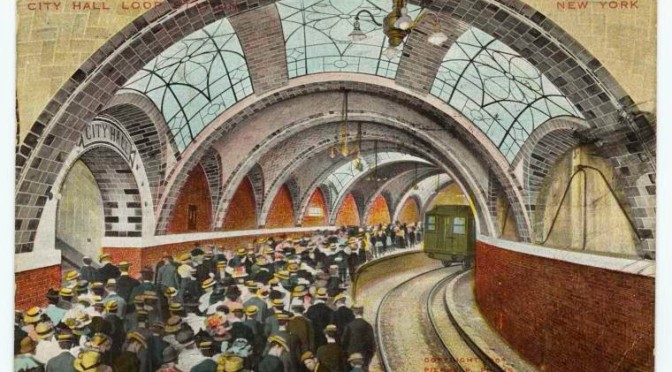
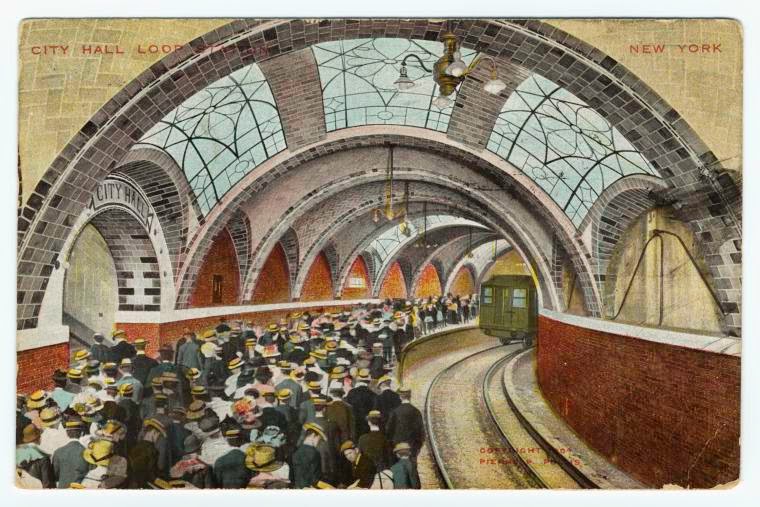
Crowds at the now-defunct City Hall Station of the brand new New York subway system. (NYPL)

One hundred and ten years ago today, the first train of the New York City subway system began its first trip underneath the city, filled with eager and excited passengers.  Thousands lined up to take this revolutionary new ride, promising a jaunt from City Hall to Harlem in under 30 minutes. At the helm of the very first subway ride was the mayor himself, George B McClellan Jr., refusing to relinquish the wheel until he had completed most of the distance.

The subway is one of the defining creations of New York’s Gilded Age, but it was hardly a foregone conclusion.  Early attempts at underground transportation by innovators like Alfred Ely Beach were waylaid by political corruption.  Elevated railroad and streetcar companies were hardly enthusiastic about it. Even the idea of going below disturbed and frightened some people.  Proponents of the subway in New York must have grimaced when Boston beat them to the punch in the late 1890s.

Both the Boston and New York subway systems benefited from great genius and even greater wealth. As Boston Globe editor Doug Most notes in his terrific book The Race Underground: Boston: New York and the Incredible Rivalry that Built America’s First Subway, the systems even shared wealthy benefactors — the brothers Henry and William Whitney, one in each city, negotiating a  host of political and technical speed bumps on their quest to build the country’s first subterranean route.

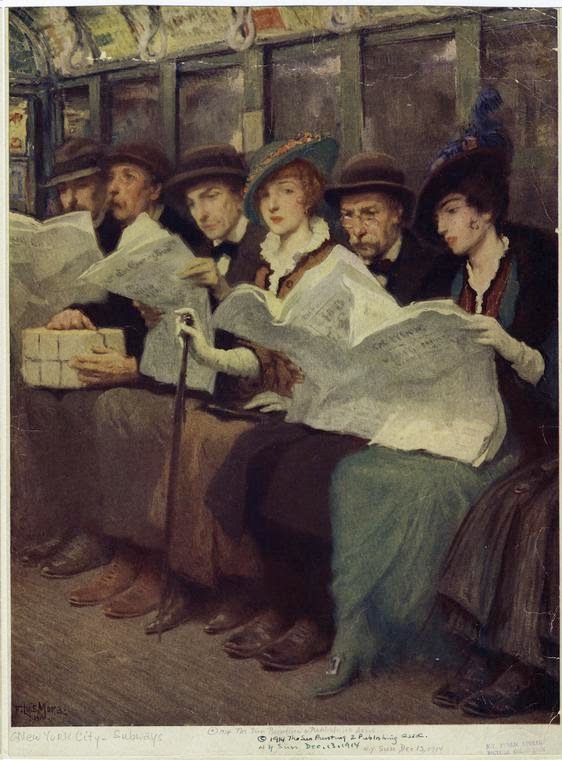
At right: Subway riders, painting by F. Luis Mora, 1914 (NYPL)

Most’s story is especially fascinating in outlining the difficulties of these ambitious projects.  What seems an absolutely sound decision today was deemed highly risky and politically fraught in its day.  On this important anniversary, I thought I’d ask the author to elaborate on the significance of this day and the spectacular achievements of these two rival cities. (And I highly recommend picking up his book this week. After all, has there ever been reading material better suited to commute reading?)

The final chapter of The Race Underground is actually titled “October 27, 1904 “? This is obviously an important date for New Yorkers, but what is it about the events of that particular day that make this a milestone in American (and even world) history?

Doug Most: ​Well, first I loved the contrast between how Boston celebrated opening its subway and New York celebrated its subway opening. Boston opened in the morning and just treated it like any other day. Here it is, we built it. New York celebrated like New Yorkers, they made it a spectacle, a party, and all the politicians and key figures wanted to play their part. Very different openings.New York’s subway was a huge achievement for many reasons. That it was built, tunneling through the ​Manhattan schist, using dynamite where needed, was incredible. Many workers died during the construction and my book tells the dramatic story of how they worked, dug, and died tragically. But that’s how society makes progress, right? We have to learn through tragedy. The New York subway was a great example of that.


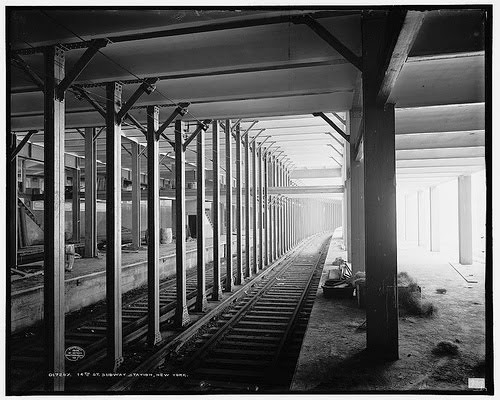
The newly completed subway tunnel in 1904, before the big inaugural ride on October 27, 1904 (Library of Congress)

The greatest obstacle for the creation of the subway wasn’t merely physical or political; it was convincing people that travelling underground could be a clean and safe experience. What were a few of the beliefs or superstitions people held in the early days?

DM:  ​It’s something we take for granted today. We bound downstairs staring at our phones and tablets and papers, and don’t give a second though to the underground. But back then in the 19th century, the underground was terrifying for people. It was where Lucifer lived! The Devil! Where vermin made their home.People needed to be convinced subways could be clean, safe, dry and healthy, that the air would not be poisonous and kill them. I love the story of London opening a pedestrian tunnel around 1840, and thousands of people taking one look down that tunnel and going right back up to the street, refusing to walk through it. That was 1840! In terms of history, not that long ago. It took a long time for society to accept the underground as a safe place to travel.​

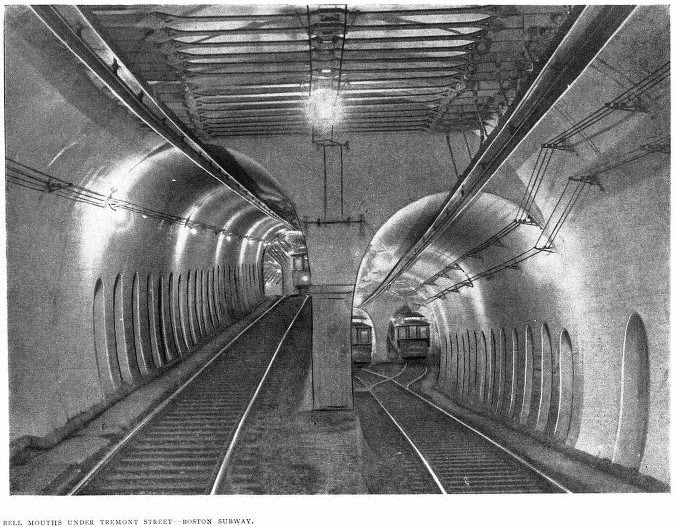
Under Tremont Station in Boston (courtesy nycsubway.org)
Your story is framed as the glorious rivalry between two brothers – Henry and William Whitney – and two rival cities, Boston and New York. But Boston really manages to pull ahead for much of the story. Was this because the needs of the city were easier to accomplish or was it because of New York’s corrupt political system at this time?

​DM:  I think it’s both. New York struggled politically with some big decisions and some key characters stood in the way of progress, including of course Boss Tweed. New York absolutely should have been ahead of Boston; they were talking about a subway in New York in the mid 1800s, but it didn’t get built until 1900.Boston didn’t start thinking subway until 1887 and then moved very quickly. New Yorkers were not happy to see that little podunk city to the north making so much progress while their city kept getting bogged down in politics.​


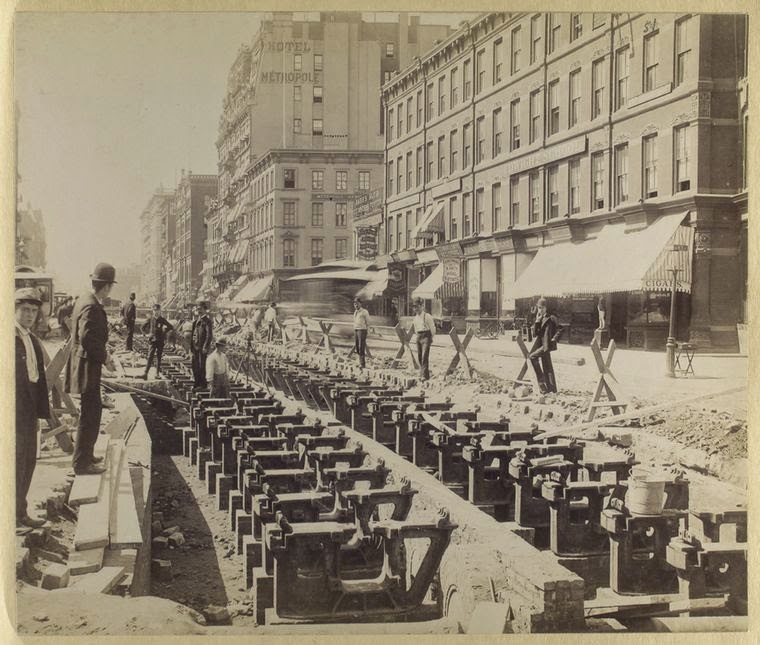
Digging up Union Square to lay cable-car lines, 1891. (New York Public Library)
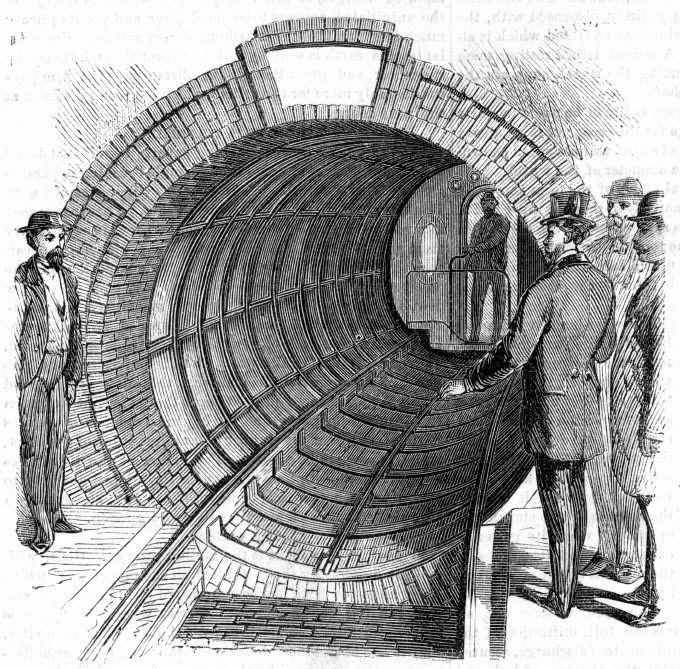
The story of The Race Underground features an extraordinary build-up of transportation technologies, from noble but failed technologies (the pneumatic tube) to others that led to the birth of the subway (like electric streetcars). What do you personally consider the most interesting or surprising development in transportation prior to the birth of the subway?

​DM:  Well the story of the cable car was fascinating, because it seemed like for a few years that was the future of urban transportation. It was cleaner and faster and smoother than the horse-pulled carriage, and people enjoyed riding them and it really looked like it might take off. San Francisco gave birth to it, and other cities, including New York, experimented with it.But as cities quickly learned, the cable car had a big problem. Those cables could twist and snap and fixing them was slow and expensive. And when a cable snapped, the entire system ground to a halt. Plus, cables were only effective in cities with lots of long straight roads like New York. But in smaller cities, like Boston, with twists and turns and narrow streets, cable cars just didn’t make sense. I love the story of how the cable car was almost our future, and then suddenly, it was gone!​

Now speaking of that pneumatic tube, here’s a what if? – say Beach faced no opposition from Boss Tweed and the elevated railroads. Could New York have actually built a viable transportation system using this method? After all, people are looking into pneumatic systems for possible high-speed travel today!

​DM:  No. Chapter One in my book, the story of Alfred Beach and Boss Tweed, is really my favorite chapter for so many reasons. And the great fan he used, the Western Tornado, to blow his subway car down the tracks. But was a fan really going to blow subway cars all over the island of Manhattan? No it wasn’t. The technology being talked about today is so sophisticated, involving electromagnetic charges and other methods far beyond basic pneumatic tubes. ​But Beach was a dreamer, a lot like Elon Musk of Tesla, and we need dreamers like that to push us forward as a society. So that’s why I love his story so much.

What features of the modern New York City subway system are you the most impressed by today? And what could use some serious improvement?​DM:  The speed is impressive and so is the reach of it — how you truly can reach almost every corner of the five boroughs on the subway. That’s so different than other cities, especially Boston and Washington, for starters, where the transit systems are much smaller and harder to survive on without a car. I am not sure I have any great suggestion for New York’s subway. I’m a big fan of it, and loved riding it when I lived at 80th and Broadway, and love taking my kids on it today when we come back to visit. It’s a treat and it’s a part of history I hope people appreciate.​

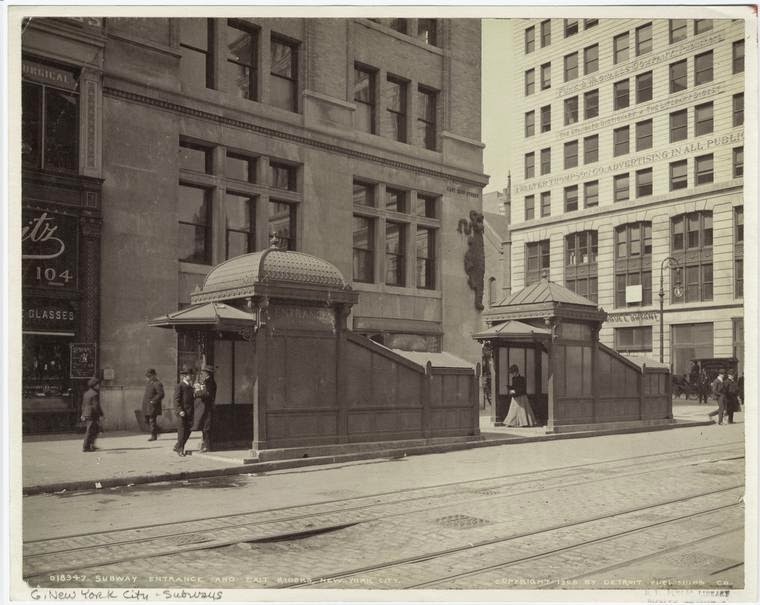
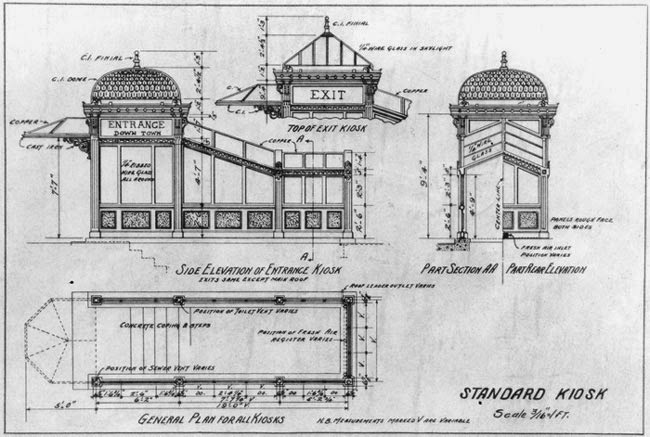
Below: New York’s distinctive subway entrances, inspired by the subway system in Budapest, 1905 (New York Public Library)
Categories
Mysterious Stories Podcasts

Haunted Hipsters: Four Ghost Stories of Brooklyn

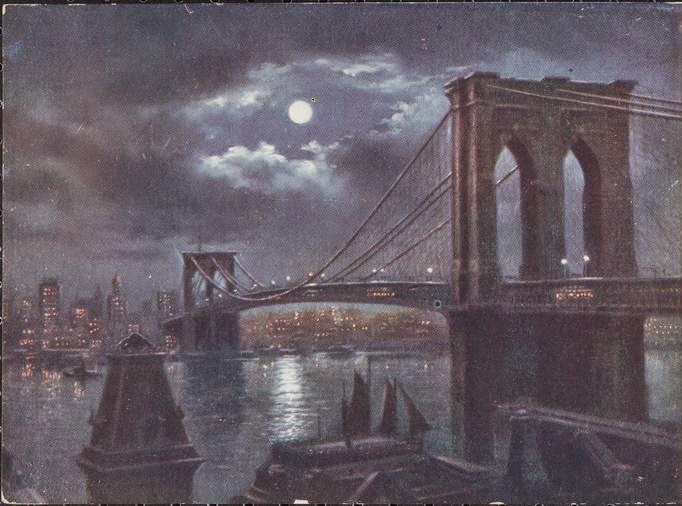
Dark skies over the Brooklyn Bridge, from a 1905 postcard (courtesy MCNY)

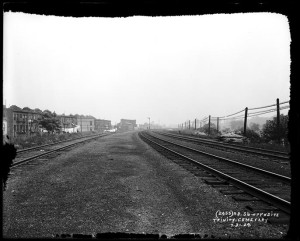
PODCAST  Brooklyn is the setting for this quartet of classic ghost stories, all set before the independent city was an official borough of New York City.  This is a Brooklyn of old stately mansions and farms, with railroad tracks laid through forests and large tracks of land carved up, awaiting development.  These stories also have another curious resemblance — they all come from local newspapers of the day, reporting on ghost stories with amusement and more than a little skepticism.

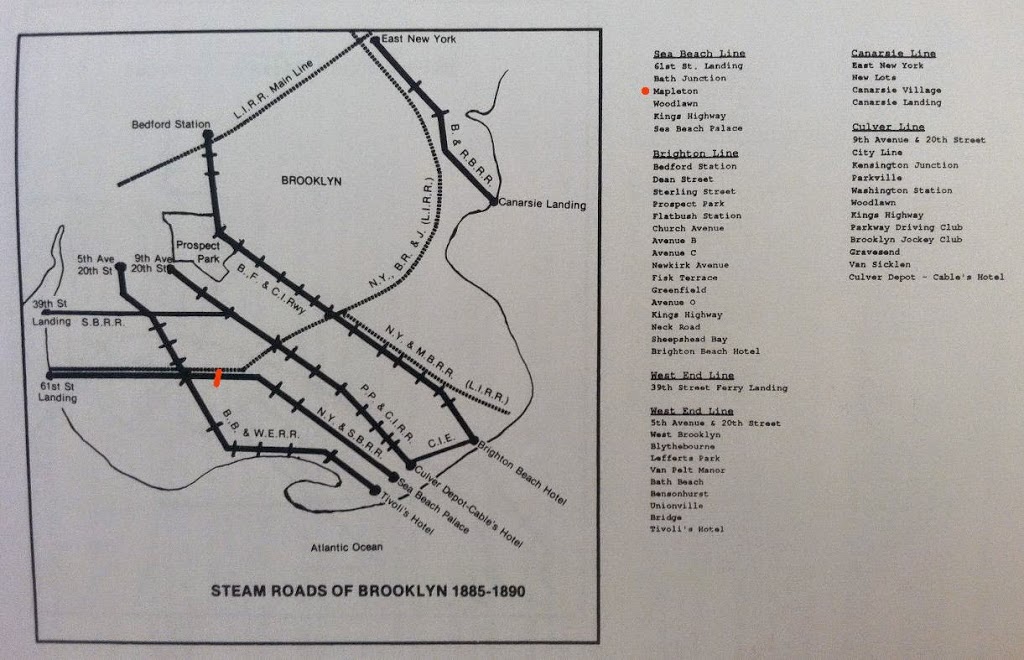
1)  The Coney Island and Sea Beach Railroad took passengers to and from Brooklyn’s amusement district.  But nobody was particularly amused one evening to be stopped by a horrific, gangly ghost upon the tracks near Mapleton.

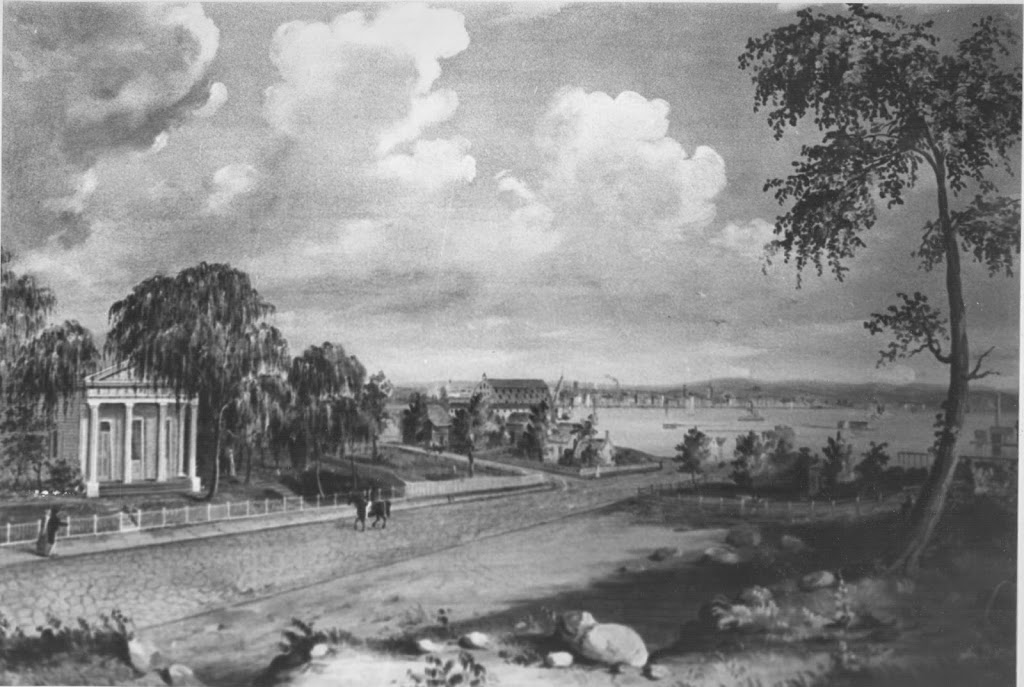
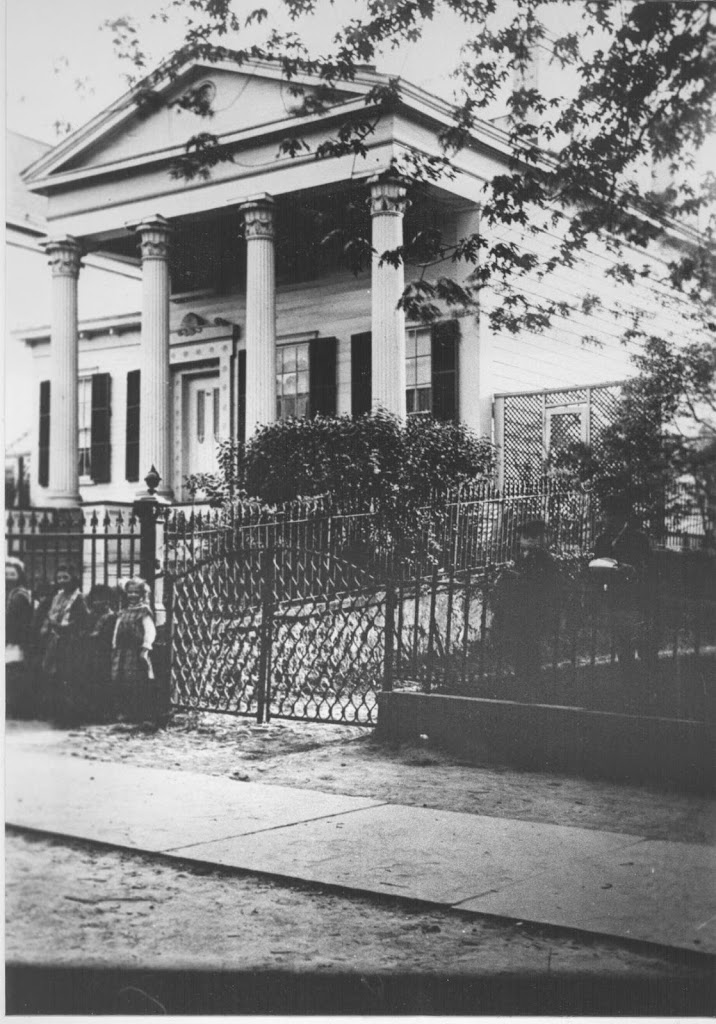
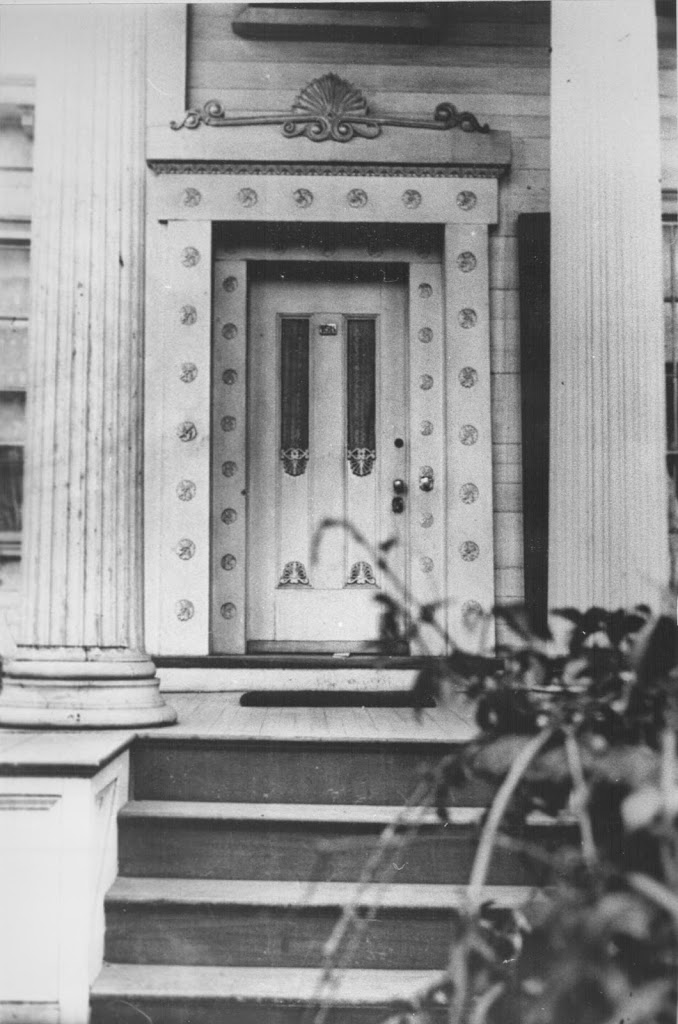
2)  In Clinton Hill, a plantation-style house built in the early years of the Brooklyn Navy Yard has survived hundreds of unusual tenants over the years, but certainly the scariest days in this historic home occurred in 1878 with a relentless, invisible hand that would not stop knocking.

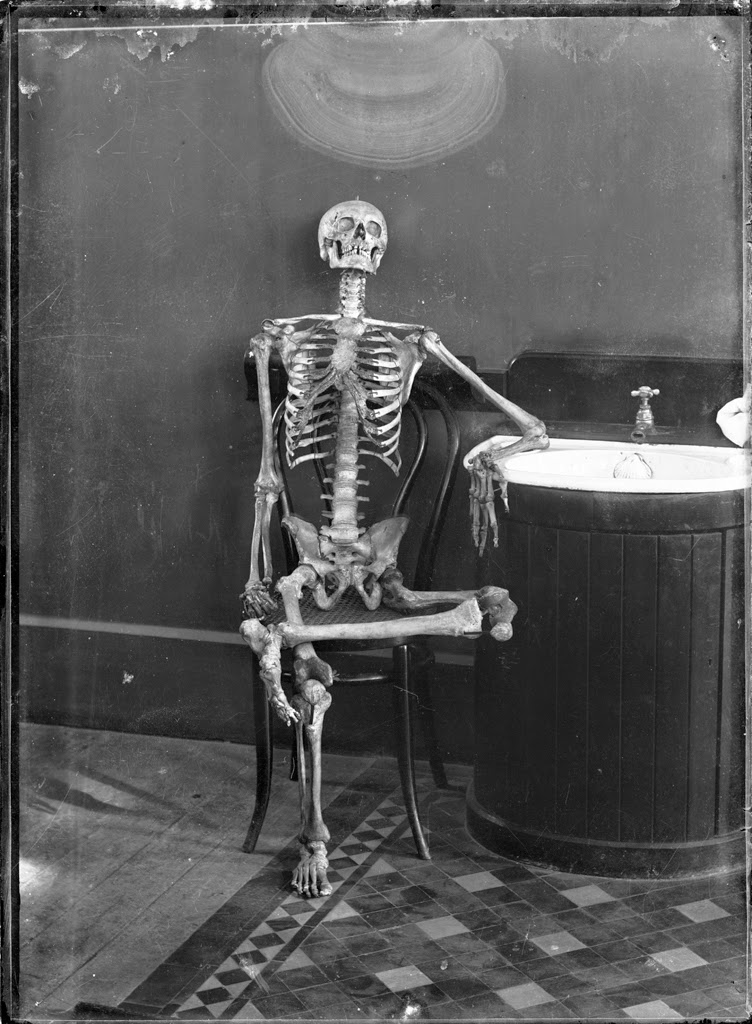
At right: Death will not deter this Brooklynite from ordering a great craft beer. (courtesy Powerhouse Museum)

3)  The Oceanic Hotel was one of Coney Island’s first great hotels, an accommodation for almost 500 near the increasingly popular beaches of Brighton Beach.  But in 1894, the hotel was virtually emptied out and reportedly haunted.  Did it have something to do with the murder upstairs in Room 30?

4) And finally, the area of Bushwick nearest the Queens border are populated with various burial grounds like the Evergreens Cemetery, borne of the rural cemetery movement which transplanted thousands of previously buried bodies from Manhattan to Brooklyn.

In 1894, with Bushwick prepared for a spate of new development, the sudden appearance of an oddly dressed spirit threatens to disrupt the entire neighborhood.  During one evening, a drunken party of 300 ghost hunters, brandishing swords and revolvers, come across one terror that proved to be very real indeed.

ALSO: Secrets of The Sentinel, a 1977 horror film set in an old house along the Brooklyn Promenade.


10 Montague Terrace, setting for the 1970s horror film The Sentinel, sits at the end of this elegant block on the Brooklyn Promenade.

[Looking west from Brooklyn Bridge Park to the houses on Montague Terrace.]

The theatrical trailer to The Sentinel

1) MIDNIGHT TRAIN TO TERROR
Phenomena reported August 1894 in several publications, including the New York Evening World

The incident in question occurred near the Mapleton station along the Coney Island and Sea Beach Railroad (Map of Brooklyn railroad lines courtesy The Weekly Nabe who has more information on the early days of Mapleton.)


2) WHO’S KNOCKING AT MY DOOR?
Phenomena reported December 1878 in several publications, including the New York Sun
 
A view of Wallabout Bay and the land which became the Brooklyn Navy Yard, circa 1830s.  That would appear to 136 Clinton Avenue (the oldest house in the area) however the general proportion of the region looks a bit off.  Below it, two pictures of the house on Clinton Avenue, including a close-up of the infamous door. (Pics courtesy Flickr/sjcny and Long Island Historical Society)


3) THE GHOSTLY GUEST IN ROOM 30
Phenomena reported August 1892 in several publications, including the Brooklyn Daily Eagle

The haunted Oceanic Hotel, located at Neptune Avenue and W. 6th Street. Perhaps this looks surprising for a 500-room hotel, but out of frame are bungalows and other adjoined buildings.  But you can see how this sort of accommodation went out of fashion rather quickly.

[First hotel at Coney Island, Oceanic Hotel.]
http://timesmachine.nytimes.com/timesmachine/1930/07/01/98307449.html?pageNumber=18

4) THE GHOST OF KNICKERBOCKER AVENUE
Phenomena reported November 1894 in several publications, including the New York Times

1924 — A view of the tracks which separate Bushwick from a cluster of cemeteries. Buildings to the left sit in the vacant lots which were mentioned in this story.  The cemetery nearest this photograph is Most Holy Trinity Cemetery.  You may remember the name Most Holy Trinity for it was this Bushwick congregation that was featured in a ghost story a couple years ago in the show ‘Haunted Histories of New York.’

Opposite Trinity Cemetery.


Categories
Mysterious Stories Queens History

MYSTERY! “Doctor Busted” and the skeleton of College Point

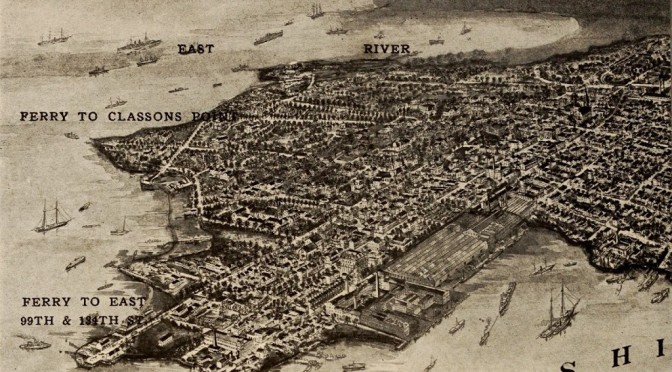
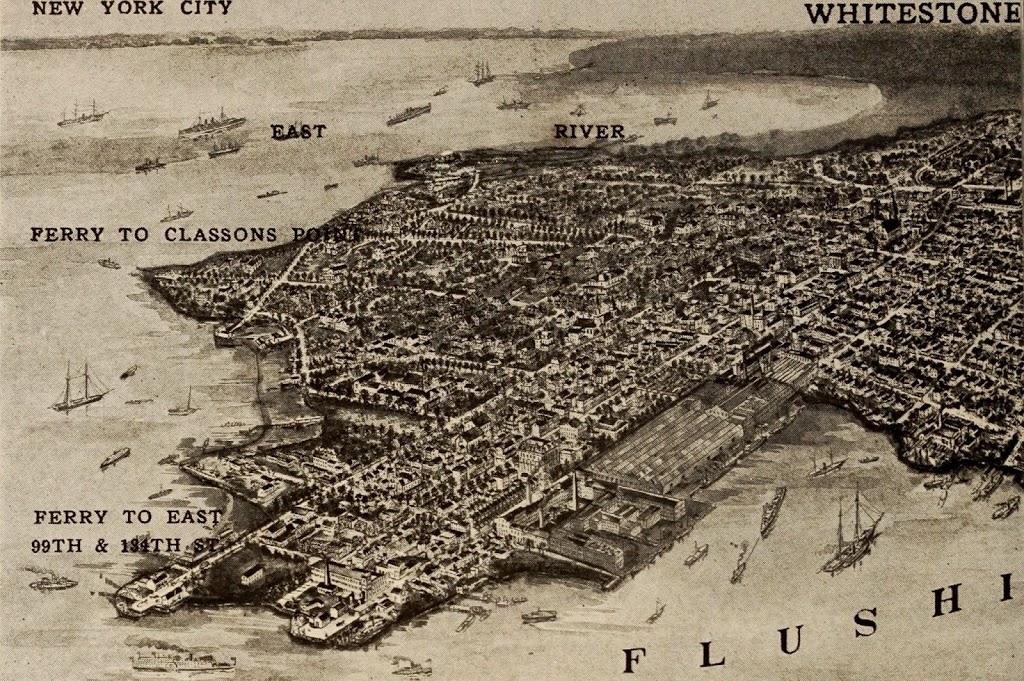
Above is an illustrated bird’s eye view of College Point, Queens, from a 1917 guidebook “Illustrated Flushing and vicinity.”

As that book goes on to describe, “COLLEGE POINT is essentially a manufacturing town—the industrial center of the Flushing District.  It is an old settlement like Flushing and Whitestone, both of which it immediately adjoins on Flushing Bay, and like both, it is rich in its possession of old trees and old houses. It has many fine modern residences, too; and even the proximity of its scores of factories doesn’t seem to spoil its charm as one of New York City’s pretty home suburbs.”

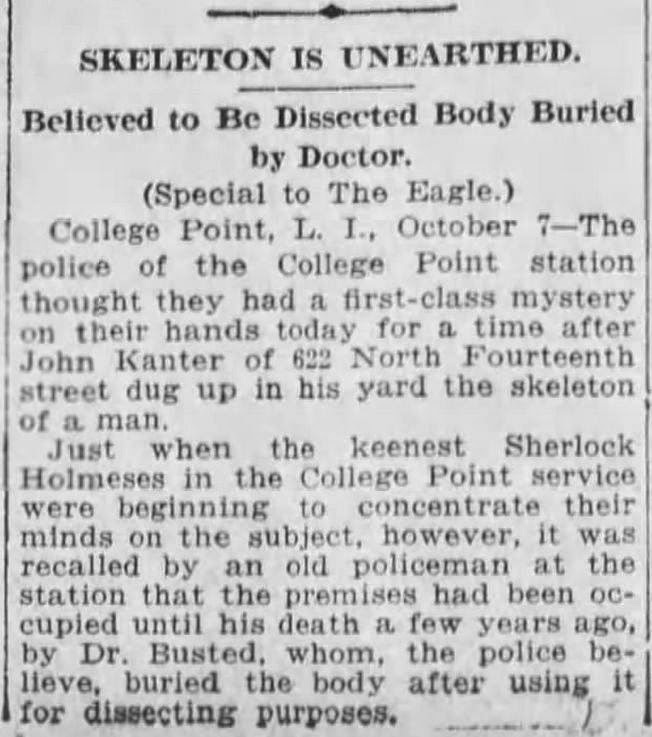
But for a ‘pretty home suburb’, you never know what you’re going to find as you’re digging up out in your yard.  I found the following disturbing notice in the Brooklyn Daily Eagle, October 7, 1914:

“College Point, LI, October 7 — The police of the College Point station thought they had a first-class mystery on their hands today for a time after John Kanter of 622 North Fourteenth Street [sic] dug up in his yard the skeleton of a man.

Just when the keenest Sherlock Holmeses in the College Point service were beginning to concentrate their minds on the subject, however, it was recalled by an old policeman at the station that the premises had been occupied until his death a few years ago by Dr. Busted whom, the police believe, buried the body after using it for dissecting purposes.”

It’s more likely the doctor’s name was Busteed.  Dr. Busted sounds like a character from a 1980s horror film.

Here’s a proper mystery: Would somebody like to figure out where 622 North 14th Street in College Point, Queens, is today?  Many streets and roads in Queens were renumbered in the 1920s.  I believe the house mentioned in the article above is on today’s 14th Avenue, but there’s also a 14th Road.  And neither of them is numbered in the 600s.

If there was one skeleton in the yard, might there still be others?

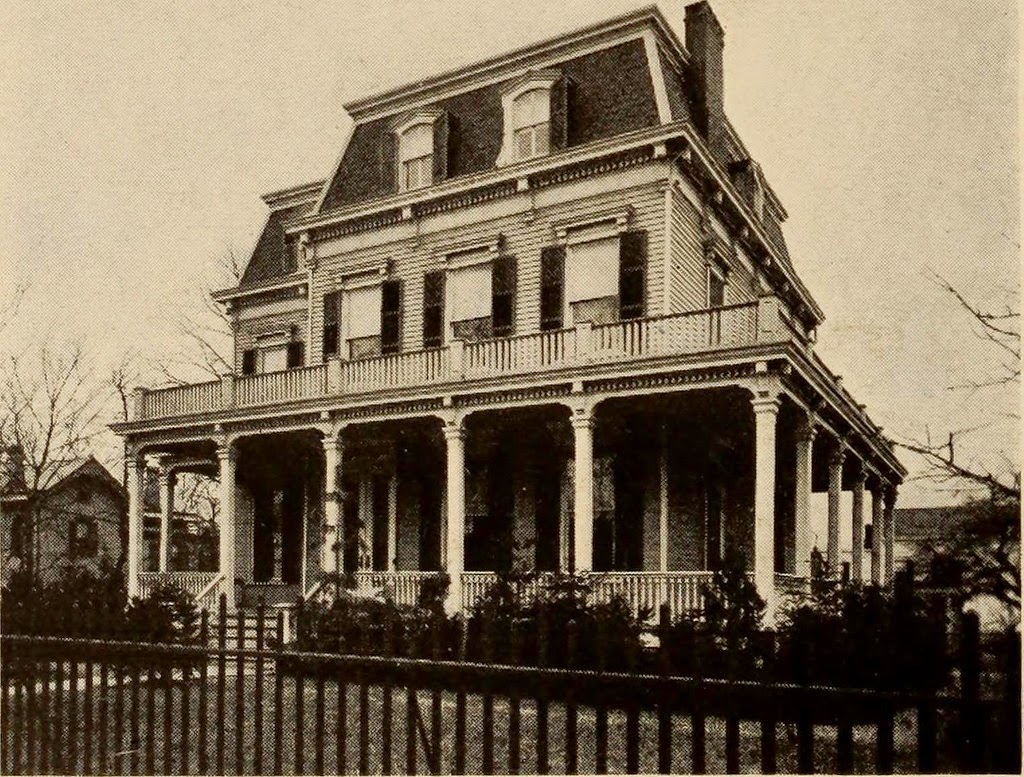
Below: A College Point home from the brochure described at top, belonging to a silk manufacturer.  From the brochure:

“As a bit of prophecy, the reader is asked to lay aside this book for ten years and then compare this portrayal of College Point-Flushing conditions as they now exist with those of a decade hence. It is pretty safe to say that the two old mansions, pictures of which are printed with this article—the Stratton and Graham homesteads — that today stand as landmarks on the trolley line between College Point and Flushing will long since have disappeared, and in their places and on their surrounding acre swill have risen many beautiful, modern residences and apartment  houses, and that the meadows some distance away will have been covered with manufacturing plants all th eway from the hills to the waters of Flushing Bay.”

Categories
True Crime Wartime New York

In 1914, a Jersey City fireworks and munitions plant exploded. Was it sabotage by the Germans?

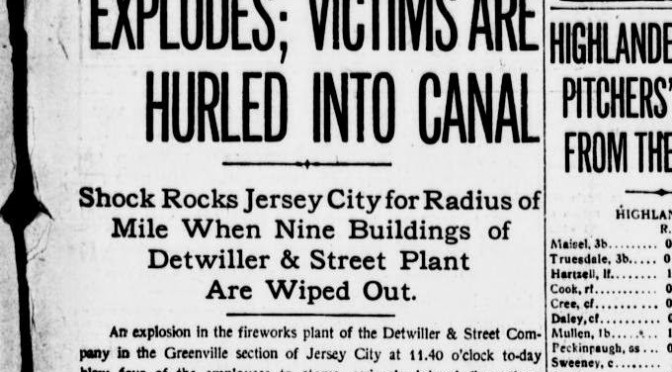
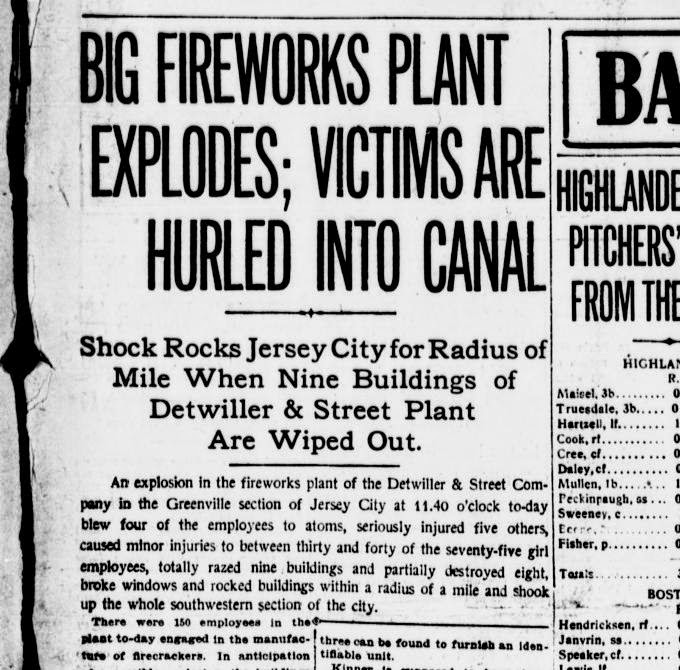
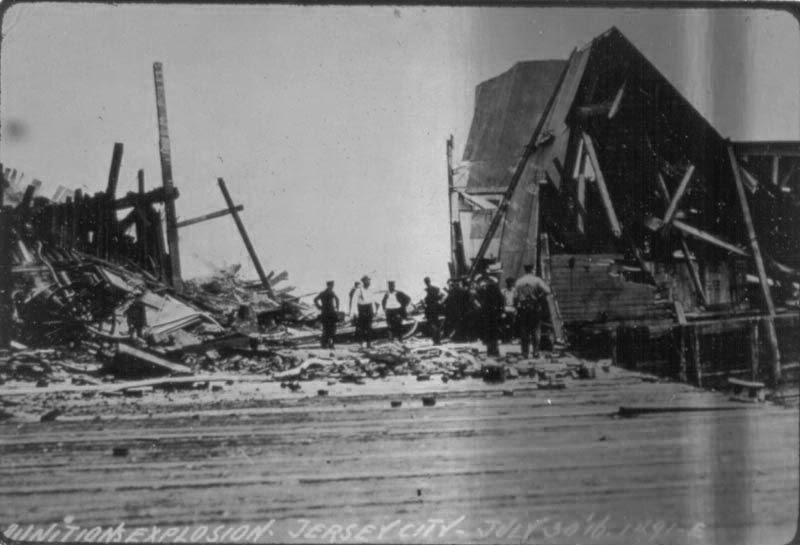
One hundred years ago today, the Detwiller & Street fireworks plant, located in the Greenville section of Jersey City, exploded in a horrible shower of fire and glass.  Four men were killed instantly and dozens of employees were injured.  Several surrounding buildings “fell to pieces like houses of cards.”   The rumble shook buildings throughout the city, up to Weehawken and even into Manhattan and Staten Island. [sources]

This was the sad, weird reality of munitions plants in the New York metropolitan area.  Staten Island was one of America’s largest producers of fireworks and saw its share of disasters, including a 1907 explosion in Graniteville.

But there was one huge difference between the 1907 Graniteville disaster and the 1914 Jersey City explosion — World War I.  Fireworks manufacturers during the war also produced munitions.  As the United States wasn’t yet engaged in the European conflict, some manufacturers were hired directly by the Allied nations.

The New York Tribune notes the unwillingness of executives to talk about the blast, and eventually the plant’s superintendent was eventually charged with “violations of the Crimes act, which makes it unlawful to store high explosives within 1,000 feet of a  highway unless in a fireproof vault.”

From the Evening World, October 3, 1914:

While the press reports of the day never explicitly mention Detwiller & Street’s munitions productions, it’s clear from later incidents that this was probably at least part of the plant’s output that year.  Another explosion at the very same plant in 1917 killed nine, all women.  A safety report clearly indicates then that “[t]he company is engaged in the manufacture of munitions for the Russian government.”  On hand to rescue some of the women was a Russian munitions inspector. [source]

This naturally leads to a more disturbing question — was the 1914 explosion sabotage by the German?

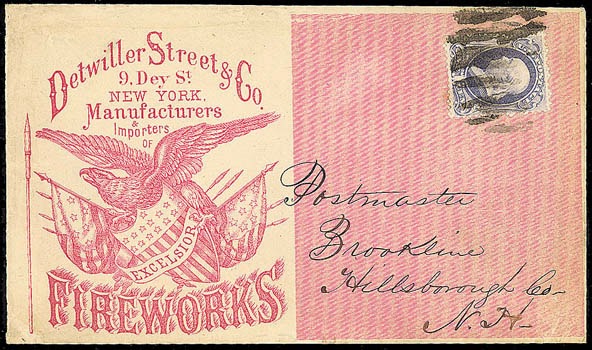
An early postcard from 1873.  The New York based Detwiller & Street specialized in “fireworks, time danger signals, railroad track torpedoes, etc.”  They were also responsible for the spectacular fireworks display at the opening of the Brooklyn Bridge.

That’s one suggestion according to a 1918 book The German Secret Service In America 1914-1918, listing a set of suspicious fireworks accidents in New Jersey before Oct. 3, 1914, Jersey City disaster. While these early accidents may have been due to increased munitions contracts in the hands of inexperienced employees, the authors admit ominously, “These explosions were the opening guns.”

German orders from that year make clear the focus on American targets.  From the German Secret Service book: “[A] circular dated November 18, issued by German Naval Headquarters to all naval agents throughout the world, ordered mobilized all ‘agents who are overseas and all destroying agents in ports where vessels carrying war material are loaded in England, France, Canada, the United States and Russia.”

This had horrible consequence for the United States and those plants in New Jersey, New York and Pennsylvania in particular, leading to the greatest act of sabotage prior to America’s involvement in World War I — the Black Tom Explosion. (Pictured above: Aftermath of the Black Tom Explosion, courtesy Liberty State Park)

On July 30, 1916, a munitions depot on Black Tom pier in Jersey City was set ablaze by German agents.  The resulting explosion killed seven people on neighboring Ellis Island  in Jersey City and ricocheted through the metropolitan area, shattering windows in Times Square and over at St. Patrick’s Cathedral and shaking people from their beds in Brooklyn.  The Statue of Liberty also suffered damage from this act of sabotage.

And so it’s hard to read accounts of the Jersey City explosion from one hundred years ago and not imagine the possibility of sinister intention.


Categories
A Most Violent Year Pop Culture

1981 was indeed “A Most Violent Year” in New York City

In 1981, there were more reported robberies in New York City (over 120,000) than in any year in its history.  There were over 2,100 murders that year (slightly down from the previous year) including such infamous crimes as the mob-related Shamrock Bar murders in Queens. After years of steadily increasing crime rates, it seemed unlikely in 1981 that New York would ever reverse course.

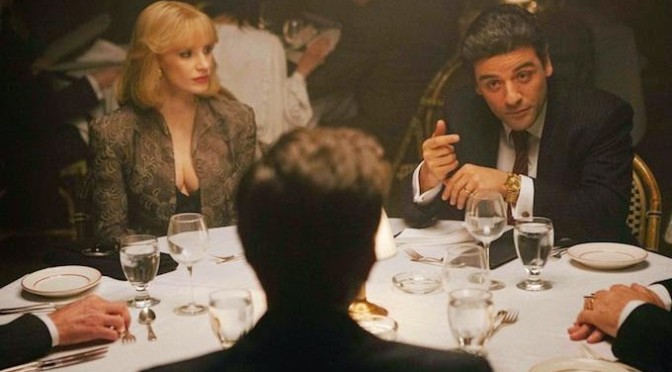
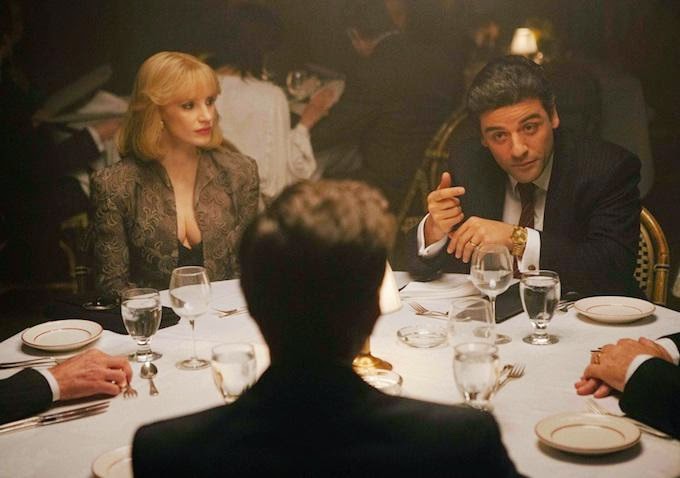
This should make a very intriguing backdrop for the new film A Most Violent Year by J.C. Chandor, starring Jessica Chastain and Oscar Isaac.

We last saw Isaac in another New York flashback — Inside Llewyn Davis — which gave us a spectacular view of 1960s Greenwich Village.  And Chandor himself dabbled in some recent history with his debut film Margin Call, about the 2007 financial crash.

The film is set for an end-of-the-year release. So far the production design looks very promising:


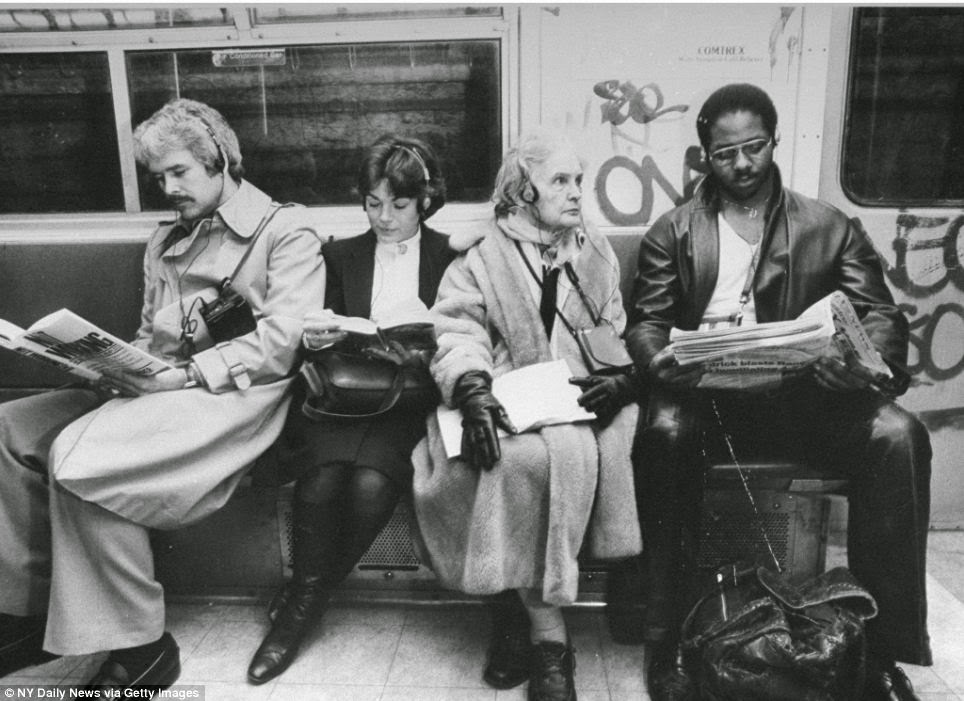
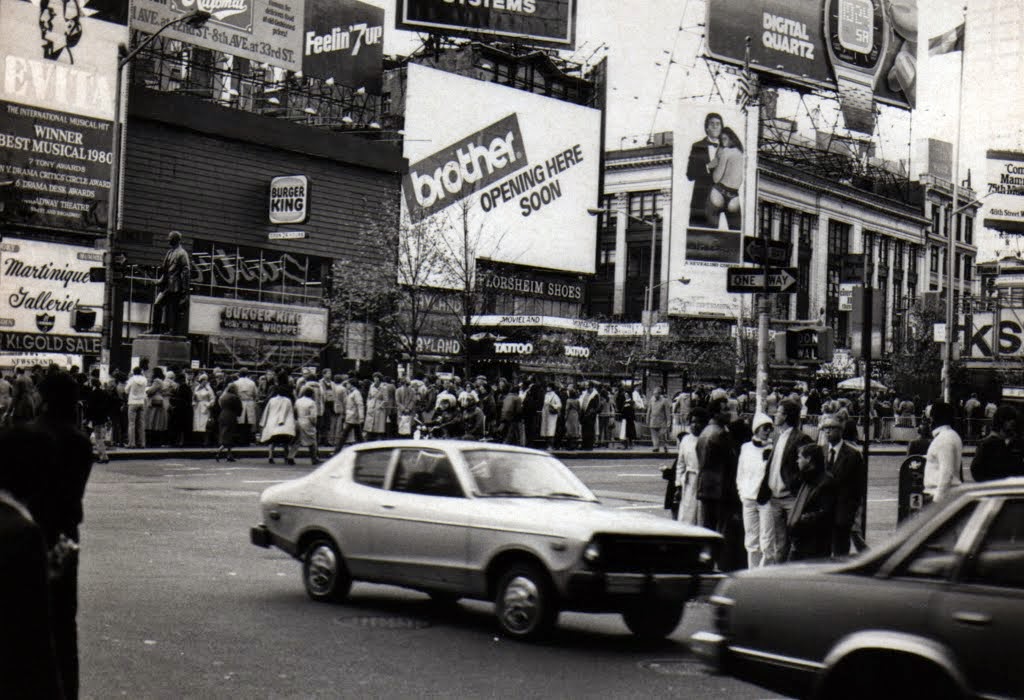
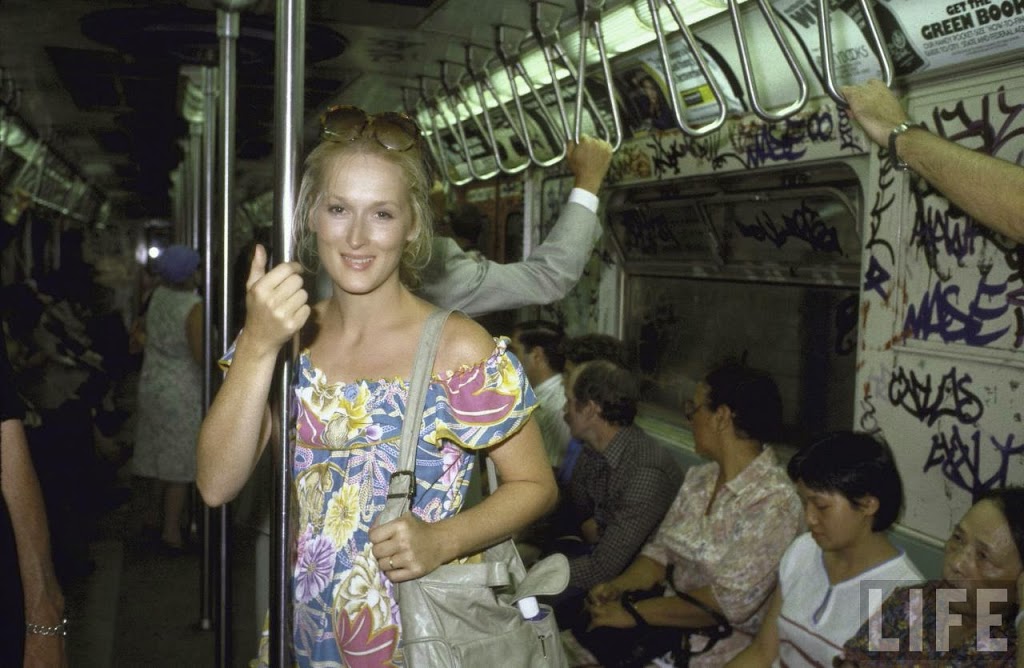
And here’s a few images of New York City in 1981 for comparison:

Top pic courtesy New York Daily News/Getty Images. Middle picture courtesy Luper/Panoramio.  Meryl Streep courtesy Life Magazine!

Categories
Those Were The Days

Housewives demand open markets! One century ago, New York radically changed how people bought groceries

[Manhattan open market.]

Setting up a market under the Manhattan Bridge. (Courtesy MCNY. Note: This photo may be of an earlier market here, but this gives you an idea of where the 1914-15 markets would have been located.)

Groceries are becoming more expensive as retailers mark up prices due to food shortages (or simple price gouging at perceived shortages). So people are turning to rather unconventional methods of getting fresh meat and produce.  Is this 2014 or 1914?

At the start of World War I, there was an immediate shortage of certain food items at New York grocers. Local distributors greatly took advantage of this special circumstance, marking up a variety of essential items.  “Sugar and flour, which have been increasing in price so rapidly, gave indications of continuing their upward march,” an article from August 19, 1914 proclaimed.

Shopping at a typical New York grocer, 1903 (MCNY): 

266 Seventh Avenue c. 1903.

Fifty years before, New Yorkers could interact with farmers and butchers directly at open-air markets.  But by the 1910s, most transactions were governed by local distributors. Old Washington Market was by this time a thriving indoor wholesale market. Local grocers had limited space with limited selection. The era of the modern supermarket — with greater selections and better values — was still a decade or two in the future. (The first supermarket is often considered to be Piggly Wiggly, which opened in Tennessee in 1916.)

To fend off rising food rates, the city of New York did something rather extraordinary:  it opened its own direct markets (or “open markets”) which cut out the middle-man entirely.

Manhattan Borough President Marcus M. Marks authorized the opening of four such markets in the following open areas — under the Manhattan sides of the Manhattan and Queensboro Bridges, the intersection of 3rd Avenue and 129th Street (today’s Harlem River Park), and the Fort Lee Ferry Terminal (West 139th Street and the Hudson River, near today’s Riverbank State Park).  A similar program was also set up in Tompkinsville, Staten Island.

Below: Interior of the Queensboro Bridge Market, 1915 (MCNY)

[Interior of market under the Queensboro Bridge.]

The markets opened in September 1914 with dozens of Long Island and New Jersey farmers bringing their wares to New York. Pushcart vendors, already spread throughout the city, also set up shop here.  What makes this such a controversial move is that it was a clear attempt to undercut all established grocers, to force distributors to quit gouging price.

They were an immediate hit despite being located in areas quite distant from certain populated areas. The markets appealed to women of many classes, because who doesn’t love a bargain? “At this market were many housewives who came in automobiles to buy from the farmers,” said a report from September 20, 1914. “Baskets filled with fresh vegetables and fruits were on seats, and the legs of more than one chicken projected from paper parcels under the chauffeur’s elbows.”  By 1915, the markets were considered by some “a social affair.”

Below: from an April 1915 profile from the Sun:

 The open markets were so successful that stock was usually emptied out by mid-morning.  Late-arriving women “actually wept when the market was bought out.” [source]

Naturally, retail grocers were angered by the city’s bold move and soon went on the offensive. “There is nothing but politics in this open market game, gentleman, from start to finish,” declared one speaker at a grocers union rally that October.

The city counteracted the grocer’s propaganda by providing ‘bargain days’ for extra values, reeling in the participation of farmers, butchers, poultry brokers and even honey producers.  “A butcher, who will open a new stand, says that he will give a head of cabbage in lieu of trading stamps to every purchaser of a piece of corned beef.” [October 15, source]

The markets lasted only a few months and, strangely enough, it was the city itself that killed them. Obviously bending to pressure from local businessmen, the city began charging high rents for a spot at the markets, and smaller farmers soon fled.  The Evening World noticed rents that would equal up to “$900 a year”. That’s $20,000 in 2014 currency.

In essence, this was one end of New York government attempting to dampen the authority of the other (namely, the borough president’s office).  Vendors had to raise prices to keep their place, and so the usefulness of the markets swiftly faded.

Categories
Holidays

Happy Rosh Hashanah! Images of Jewish New Years’ past

Look to the stars children! A vintage Rosh Hashanah card manufactured by the Williamsburg Art Company in the 1920s.

Rosh Hashanah is here — the first of Tishrei, year 5775.  Presented here are a selection of photographs from the Library of Congress depicting Jewish New Yorkers celebrating the new year (or, at least, on their way home to start the festivities).  These images date from 1909-1915, although most are 1912.  As most of these photographs were possibly taken (or labeled) by non-Jewish photographers, some of the meaning is a little lost.  If you have any insights into these images, please leave a comment!

And there’s some detective work to be done here. For instance, anyone recognize this synagogue?

One hundred years ago, Jewish New Year celebrations were especially fraught due to the events in Europe. Ethnics groups from embattled countries, in fear their rituals made them targets for local violence, made doubly sure to distance themselves for the politics of the day, while affirming their continuing connection to their Jewish brethren.

A leader of the reformed Jewish congregation proclaimed, “The conservative and patriotic citizenship of America refrains from endorsing the attitude of any country involved in the horrible European conflict. … [O]ur hearts go out to the 300,000 men in the Russian army who, having bled and suffered at the hands of their country on account of being Jews, are now suffering and dying for their country because as Jews they are loyal to the flag under which they live.” [source]

This one is dated September 1912 although there was not a “Jewish New Year Parade” and this is hardly an image of a parade anyway!

There appear to be a series of old Rosh Hashanah photographs focusing on boot blacks polishing the shoes of young ladies.  I doubt this was an actual custom but more a recognition of the fact that many young boot blacks came from Jewish families. (However, for Passover, people leave their shoes at the door.)

The smile of the girl at center is totally making my day:

Here’s a telling detail from 1914:  New Jersey decided to hold a statewide primary election on the same day as Rosh Hashanah that year, disenfranchising thousands of Jewish voters “who are prohibited from signing their name.” Registering to vote was quite different back in the day; luckily, there was an alternate date provided that fell before the holiday, but no attempts were made to actually move election day.  [source]

Then there’s this captivating image:

So what’s going on in the picture above, taken on the Williamsburg Bridge in 1909?  Per some commentary from a Library of Congress commenter:  “If this was photo was indeed taken around Rosh Hashanah (Jewish New Year) as the notation implies then these people are most likely taking part in a “tashlich” ceremony. The ceremony is when the previous year’s sins are symbolically “cast off” by throwing pieces of bread into a flowing body of water.”

And finally here’s some rather imaginative Jewish New Year postcards that were manufactured by the Williamsburg Art Company sometime in the 1920s.  While the company was located in Brooklyn, all of these were actually manufactured in Germany. 


Categories
Parks and Recreation Podcasts

The Secrets of Gramercy Park (and you don’t even need a key)


PODCAST Gramercy Park is Manhattan’s only private park, a prohibited place for most New Yorkers. However we have your keys to the history of this significant and rather unusual place, full of the city’s greatest inventors, civic leaders and entertainers.

Literally pulled up from swampy land, Gramercy Park naturally appealed to the city’s elite, a pocket neighborhood with classic old brownstones so vital to the city’s early growth that two streets sprang from its creation — Irving Place and Lexington Avenue.

Within the story of Gramercy Park there are echoes of modern debates over class and land usage. The area’s creator Samuel Ruggles was a New York developer before his time, perfecting techniques that modern developers are still using to convince both the city and its residents of the importance and vitality of their high-end projects.

At right: Inside the park with Edwin Booth (Photo by Helaine Magnus, courtesy NYHS)

In this show, we give you an overview of its history — a birds eye’s view, if you will — then follow it up with a virtual walking tour that you can use to guide yourself through the area, on foot or in your mind. (You can follow along virtually starting here.) In this tour, we’ll give you the insights on an early stop on the Underground Railroad, the house of a controversial New York mayor, a fabulous club of thespians, and a hotel that has hosted both the Rolling Stones and John F. Kennedy (though not at the same time).

ALSO: We tell you the right way to get into Gramercy Park — and the wrong way.


Below: Looking west onto Gramercy Park, photo between 1909-1915.  You can see both the Flatiron and the Metropolitan Life Tower in the distance. [LOC]


And we would like to thank our sponsors:

Squarespace, the all-in-one platform that makes it fast and easy to create your own professional website or online portfolio. For a free trial and 10% off (your first purchase), go to squarespace.com and use offer code BOWERY.


Audible, the premier provider of digital audiobooks. Get a FREE audiobook download and 30 day free trial at www.audibletrial.com/boweryboys. Over 150,000 titles to choose from for your iPhone, Android, Kindle or mp3 player Audible titles play on iPhone, Kindle, Android and more than 500 devices for listening anytime, anywhere.


Samuel Ruggles, the mastermind behind the Union Square and Gramercy Park developments, two parks with drastically different fates. While Union Square would eventually be considered ‘the people’s park’ and a center of working class protest, Gramercy Park would retain its guarded, exclusive character.

A 1831 map outlining the lands owned and developed by Samuel Ruggles. Lexington Avenue and Irving Place have already been planned by this time. (Courtesy MCNY)

Lands of Samuel B. Ruggles in the Twelth Ward in the City of New York

The 1918 unveiling of Gramercy Park’s one permanent resident — the statue of Edwin Booth. (NYPL)

The esteemed Dr. Valentine Mott who lived (with his large family) at 1 Gramercy Park. 

3 and 4 Gramercy Park from 1935 — and they look exactly the same today! The lampposts indicate that this was once the home of former mayor James Harper.  (Photo by Berenice Abbot, NYPL)

A architectural cross-section of 4 Gramercy Park, showing the size of the house.

New York governor and almost-U.S. president Samuel Tilden lived in Gramercy Park. His home would later be transformed into the National Arts Club.

Enjoying a banquet at the National Arts Club in 1908. As you can see, the membership has always been open to both men and women, a trait few social clubs of the day enjoyed. (NYPL)

The Players Club in 1905. In this photo the building is mournfully adorned in black crepe in honor of the actor Joseph Jefferson.

The Friends Meeting House in 1965. It would become the Brotherhood Synagogue ten years later. (Courtesy Wurts Brothers, MCNY) 144 East 20th Street. Exterior of Friends Meeting House.

Children within the park, 1944. The Edwin Booth statue stands in the background here (MCNY)

Child drinking from water fountain, Gramercy Park