Categories
Pop Culture Uncategorized

Pete Seeger 1919-2014

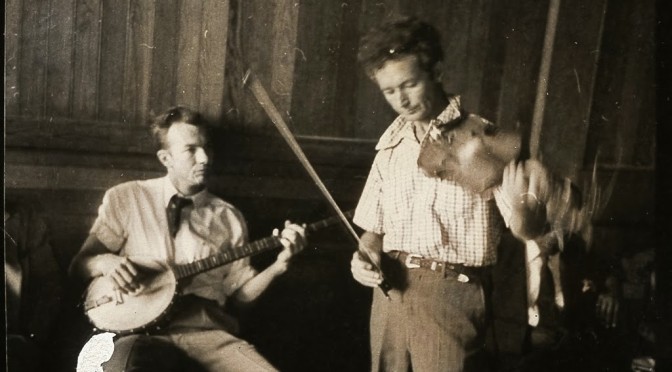
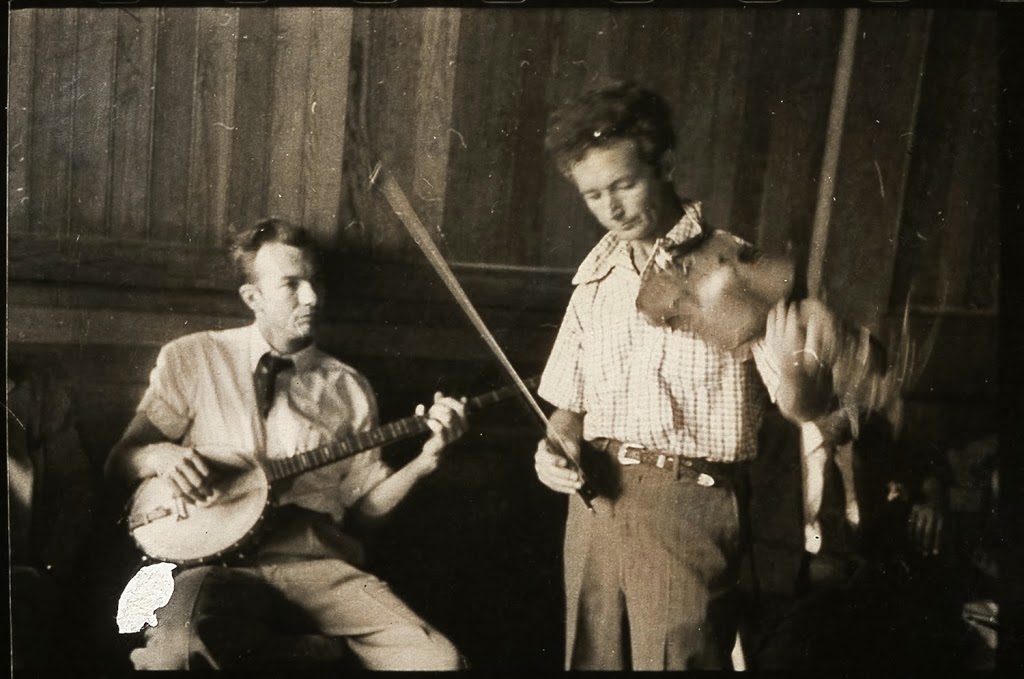
 Pete Seeger with Woody Guthrie, performing at the Music Inn in Lenox, Massachusetts, 1950 (Photo courtesy NPR)

 “I have sung in hobo jungles, and I have sung for the Rockefellers, and I am proud that I have never refused to sing for anybody.” — Pete Seeger

Pete Seeger with the Weavers — Washington Square Blues


Pete Seeger had a television variety show in the 1960s called Rainbow Quest, filmed from studios in Newark, New Jersey.  Interestingly, the shows were broadcast on WNJU, better known as a Spanish-language station and today the flagship for Telemundo!

Luckily, many of these programs are available to watch on YouTube. Here’s a clip of Seeger with BJ Reagon (from Sweet Honey In the Rock) and Jean Ritchie (aka ‘the mother of folk):

In 1974, he recorded the first album for Sesame Street to feature new material not featured on the show. Here, he duets with Oscar the Grouch about, of course, ‘Garbage’:

Categories
Those Were The Days

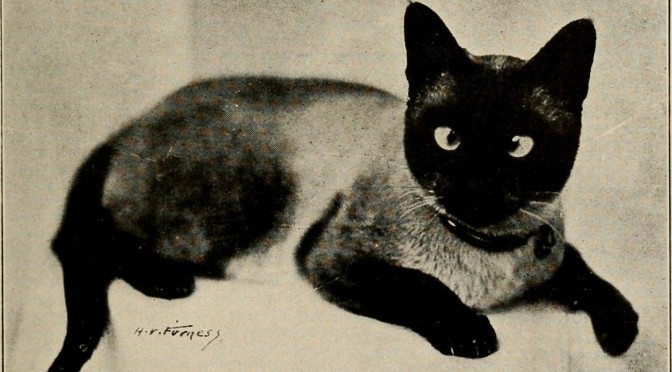
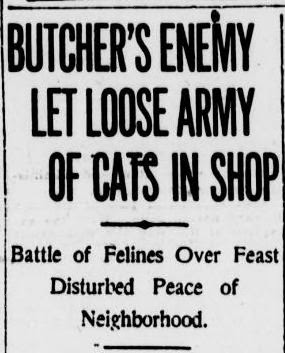
Cat-astrophe! Hungry felines attack a Lower East Side butcher

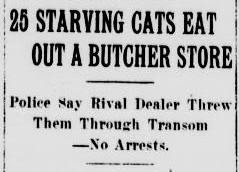
Presented without commentary, from the front page of  the New York Sun, January 24, 1914:

“Policeman James Kenny, trudging along James Street at 10 o’clock last night, heard horrendous sounds coming from the market of Brighton Beef Company at No. 72.  A hundred drunken burglars couldn’t have made more noise.

Kenny, remembering that a bomb went off in front of this same market six months ago and blew the store front to pieces, blew his whistle and thumped his night stick for assistance.   Seven other patrolmen came running.

They stole up to the door with pistols pointed.  They lunged together and burst in.  Twenty-five cats fled at their approach.  The cats were of all sizes and colors.  They had been hungry, but were no longer.  They had eaten every scrap of meat in the market — chicken and beef and everything else, and were fighting over the bones.

The eight policemen pocketed their pistols but swung their clubs.  They also said ‘Scat!’ and the cats ran into the street and scurried through the East Side with great news for their tribe.  There were no arrests.

The police suspected that some rival butcher had collected the cats,  starved them and thrown them through the transom of the Brighton Beef Company’s store.”


And excerpts from a similar story in the Evening World from the same day:

“[T]he owner has two cats of his own, trained to eat no meat, which he always leaves in the shop overnight.

The first peripatetic pussy that was pushed through the fanlight was pounced upon by the faithful feline guards of the pork chops.  They grabbed him and sought to shove him into the sausage chopper.  But other felines came through the fanlight. It began to rain cats.  The guardians of the garbage cans made short shrift of the tame tabbies of the butcher shop.”

What the Sun story fails to report is that a young man was pushed through the fanlight before the cops stormed the shop.

The policemen couldn’t open the door.  They shoved Tommy Laura, a young man of James Street, through the fanlight. A dozen cats scrambled over Tommy when he fell to the floor.  He turned up the lights and got a pair of pliers with which he opened the door…..”

One man had to be taken to the hospital when he grabbed the tail of a cat perched upon a meat hook.

Cats and butcher shops, clearly, do not mix!

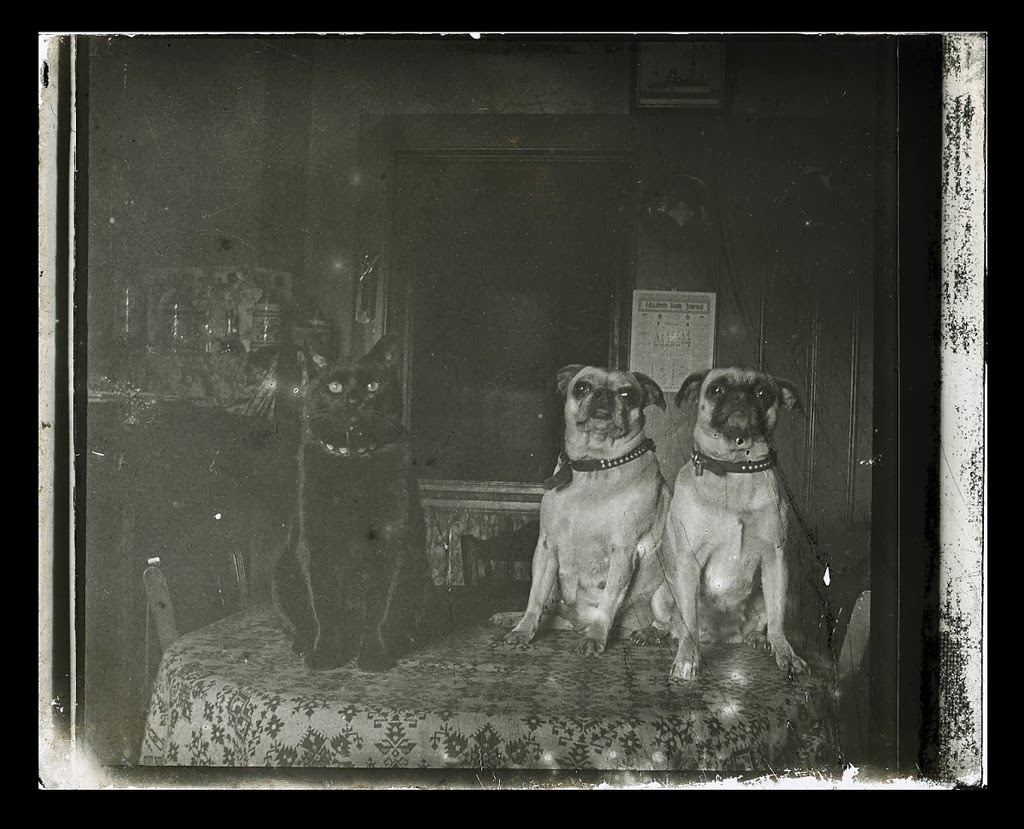
Below: Do you trust this cat with your perishables? It’s a cat and two dog companions in Flatbush, circa 1900s, photographed by Daniel Berry Austin, courtesy the Brooklyn Museum


Categories
Mysterious Stories Planes Trains and Automobiles

“This hypocritical, swindling world” — One hundred years ago, a mysterious suicide in the halls of Pennsylvania Station

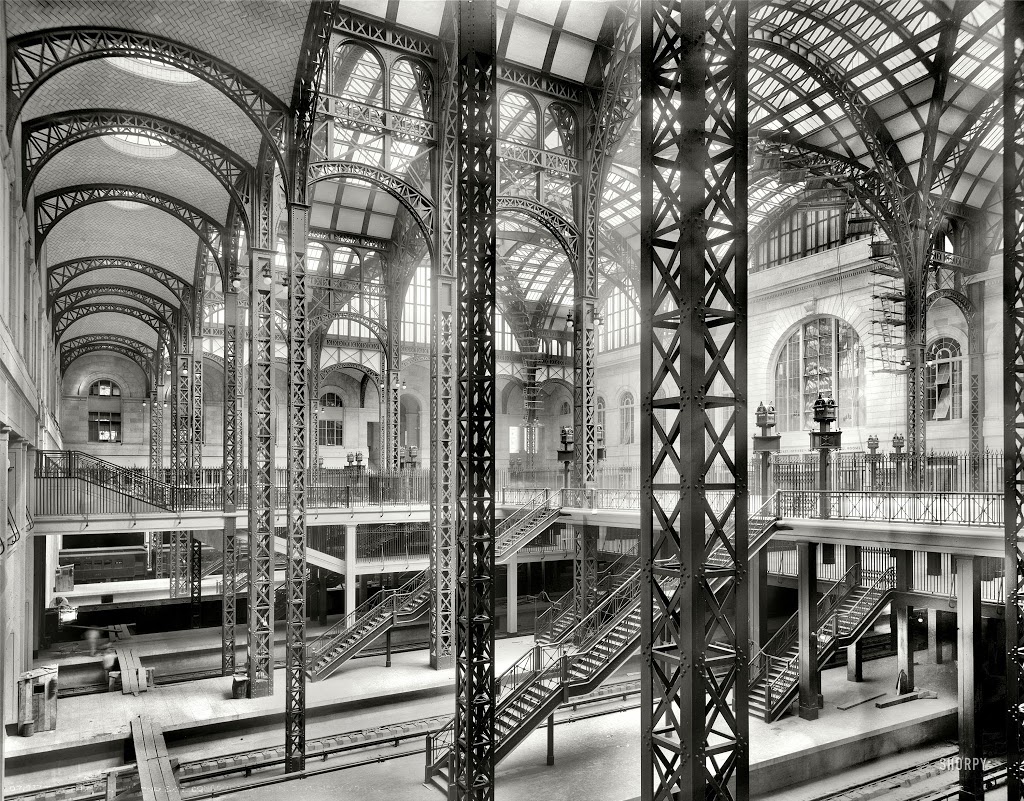
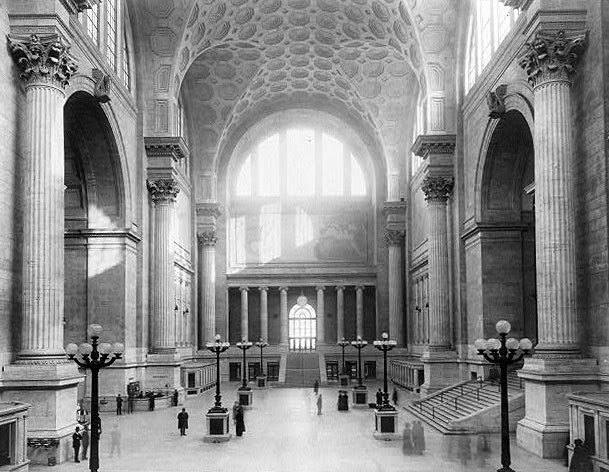
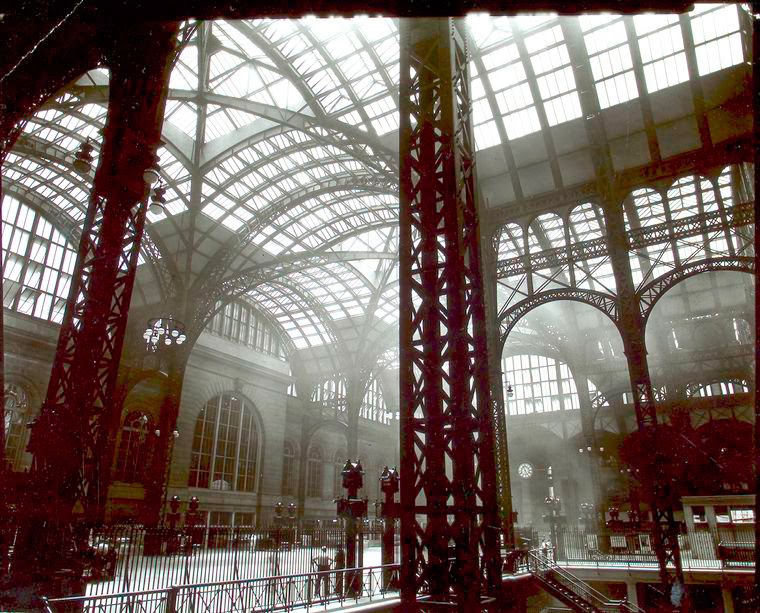
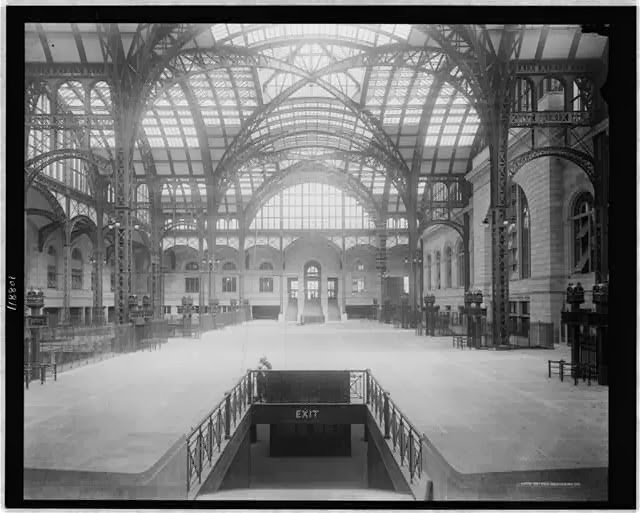
The halls of Pennsylvania Station, conjuring the grandeur of a Roman temple, would have created an otherworldly echo at rush hour on January 22, 1914.  Thousands of commuters hurrying across the marble floors of McKim, Mead and White’s steel-latticed terminal, rushing to arriving trains pulling into the sunken boarding area from deep tunnels beneath Manhattan and the Hudson River.

It was in the cavernous waiting room of Penn Station at rush hour that a gentleman was seen nervously pacing the floor — “a well-dressed man of 40 years, with a high forehead and black curly hair.” [source]  He wore a dark grey overcoat, his pockets full.  He was taller than most around him, and his brow was furrowed in anxiety beneath a gray plaid hat.  The man had just come in from Philadelphia, judging from the newspaper clippings on his person.

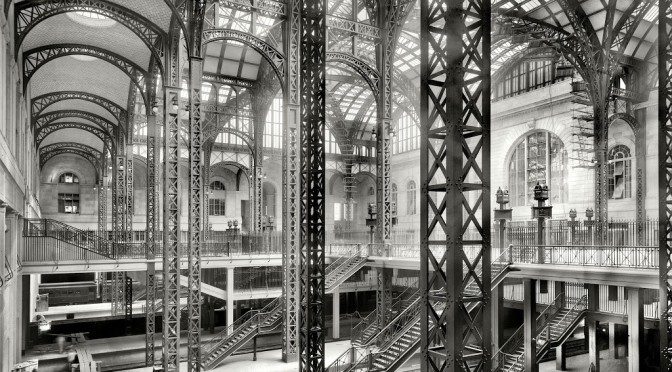
The Penn Station waiting room:

Precisely at 6 pm, the curly-haired gentlemen left the waiting area and entered the men’s washroom.  It was here that he reached inside his coat, pulled out a revolver and shot himself twice in the head.

Almost any sound made in old Penn Station dramatically amplifies under its high vaulted ceilings.  Two gunshots during rush hour certainly must have stopped foot traffic, if only for a moment.   The gentleman was discovered by Penn Station’s chief detective and taken to the West 37th Street Police Station where officers inspected the body for signs of identification.  None were found outside of the address for a gas company in Newark, NJ. Did he work there?  Did he owe them money?

More disturbing was a hand-written suicide note, which read:

“It is time that I end this useless existence.  I’ve taken all the facts into consideration and have concluded that death is the only way to get out of this hypocritical and swindling world.  I hope to make a good job of it.”  On the other side of this note was written a more direct meaning for this gentleman’s grief — “Out of work and funds.”

Investigators also found a whisky flask, a few quotations from Shakespeare and a grand total of 47 cents.  But perhaps the oddest possession in his pocket was a magazine clipping featuring the writings of Maurice Maeterlinck, the Belgian intellectual who had won the Nobel Prize for Literature just two years previous.  It’s not surprising that a person in the depths of depression would turn to Maeterlinck, a playwright known for exploring the enterprise of death.  (Later in life, Maeterlinck would also be accused of being a towering plagiarist.)

The New York Sun made note of the fact that the Maeterlinck clipping featured several underlined passages in an article headlined ‘Death’, including this one:  “In any case, it seems fairly certain that we spend in this world the only narrow, grudging, obscure and sorrowful moments of our destiny.”

While this man’s sad demise made the front sections of all the local newspapers — after all, you can’t shoot a revolver in Penn Station without some notice — I was unable to find any further follow-up to this man’s identity.  And so, on the one hundredth anniversary of this stranger’s passing, he joins the many other ghosts of this legendary old building, itself nothing more than a memory.

Pictures courtesy Library of Congress

Categories
Parks and Recreation

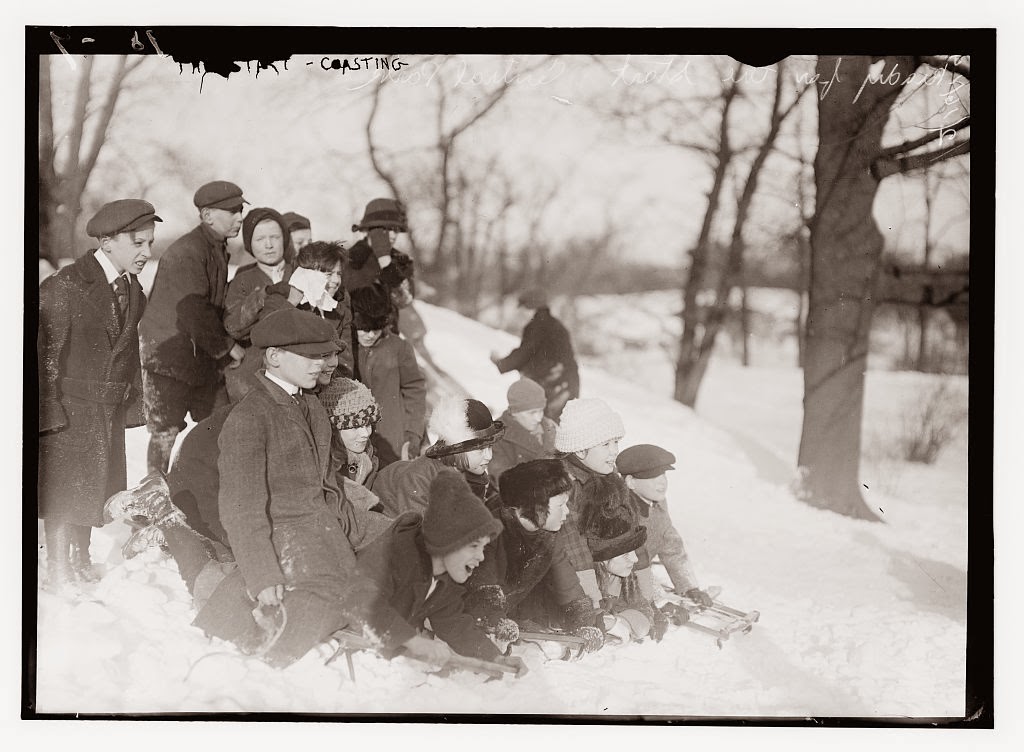
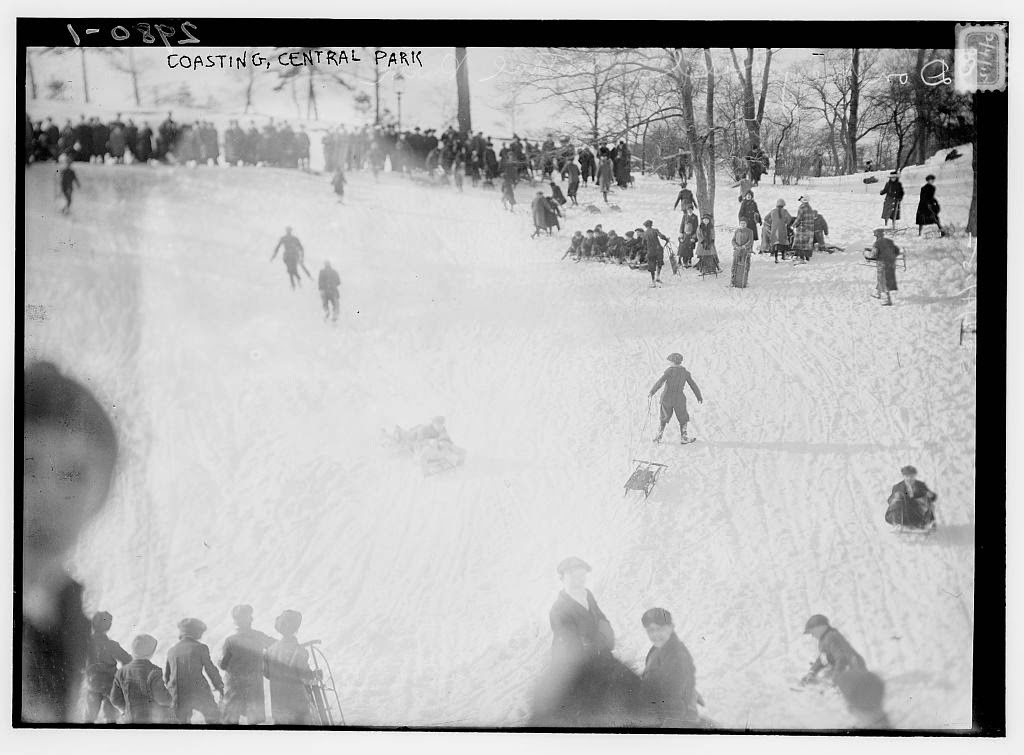
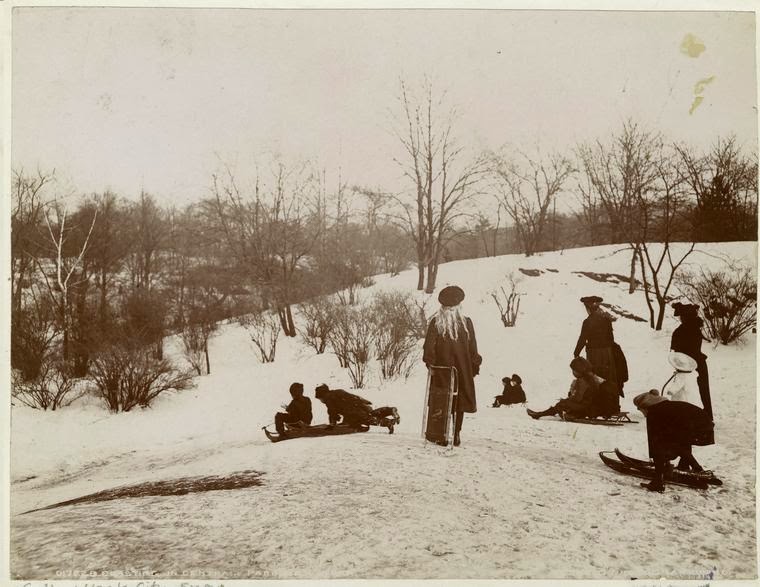
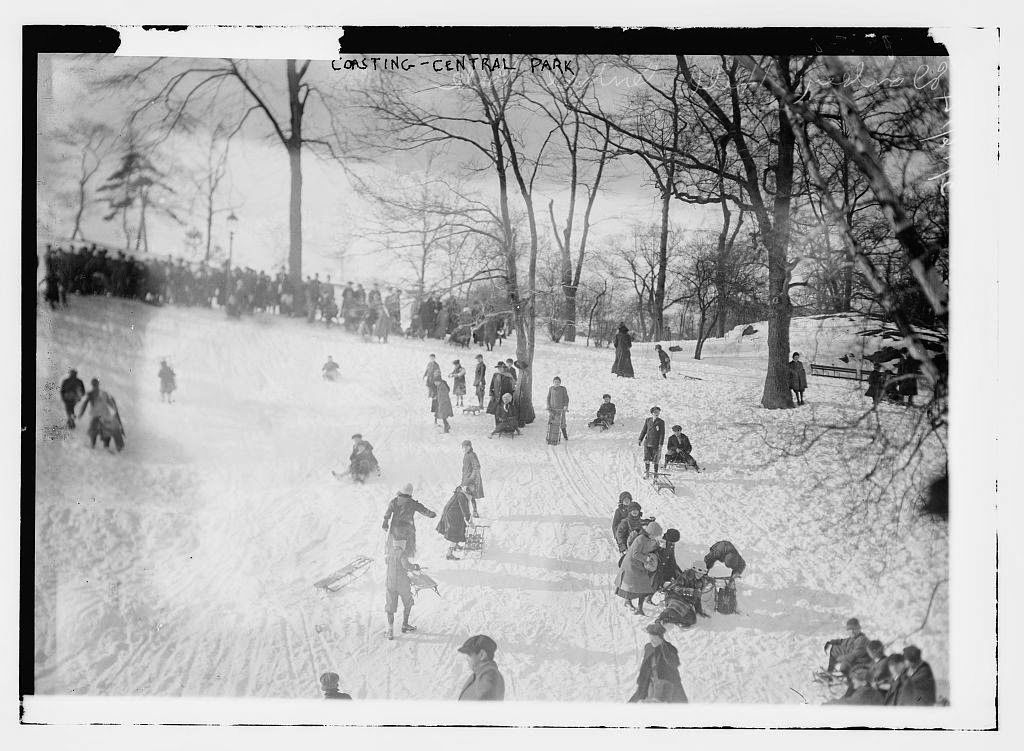
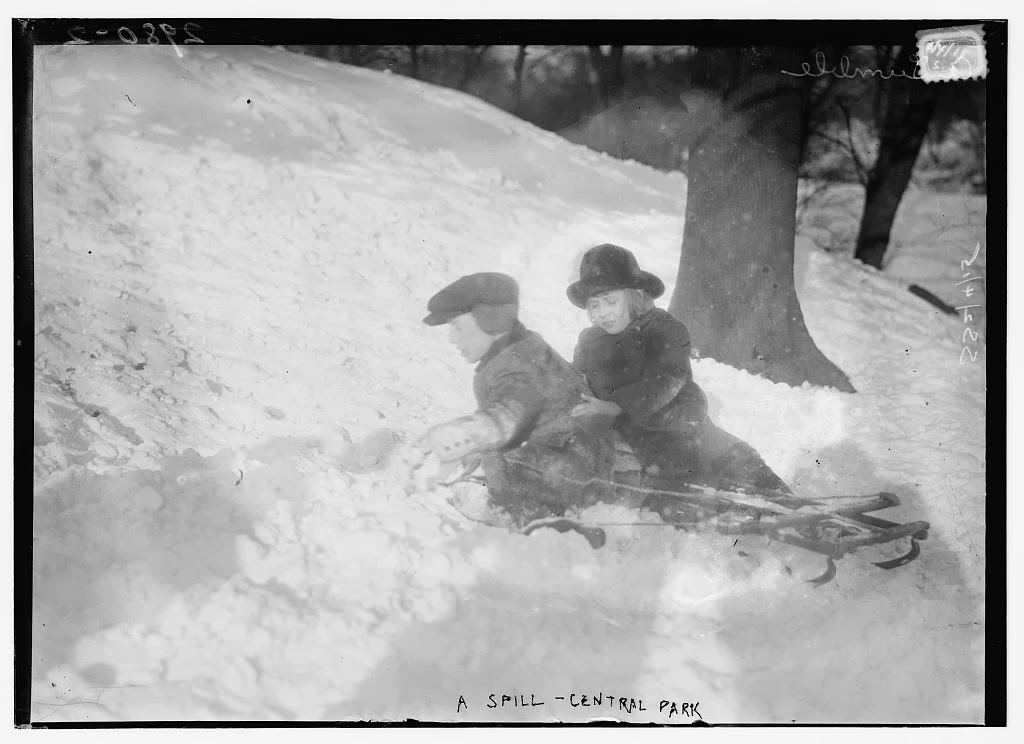
Never Too Cold: Crazy kids conquer Central Park on sleds

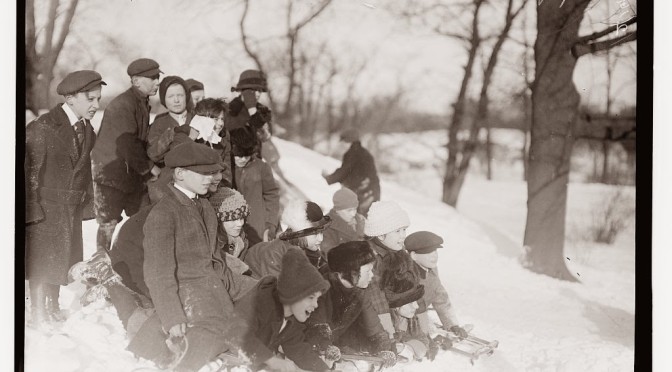
During one particular winter in the early 1910s, Central Park was invaded by an army of young sledders, tearing over the snow-covered terrain without thought to temperatures or bodily injury.

Believe it or not, the city encouraged children to use the city parks for sledding, especially given that the alternatives were slicked-up city streets.  In fact, New York did everything possible to make parks an ideal sledding destination.

“Snow from the sidewalks around Hamilton Fish, DeWitt Clinton and East River parks has been thrown over the fences to form an embankment from which the youngsters can coast.” reported the New York Tribune in 1910.  In Central Park, “never before were so many coasters in evidence.”

Indeed, automobiles posed a grim and dangerous threat to children sledders. The newspapers between 1909-1919 are filled with sad stories of children killed in sledding accidents, with autos frequently involved.  Vehicles from the early days (not to mention, their novice drivers) were simply ill-equipped for icy conditions.

While some in the community lamented the mess made in public parks, most preferred keeping children safe.  These pictures kind of make you want to make a go of it, don’t you think?

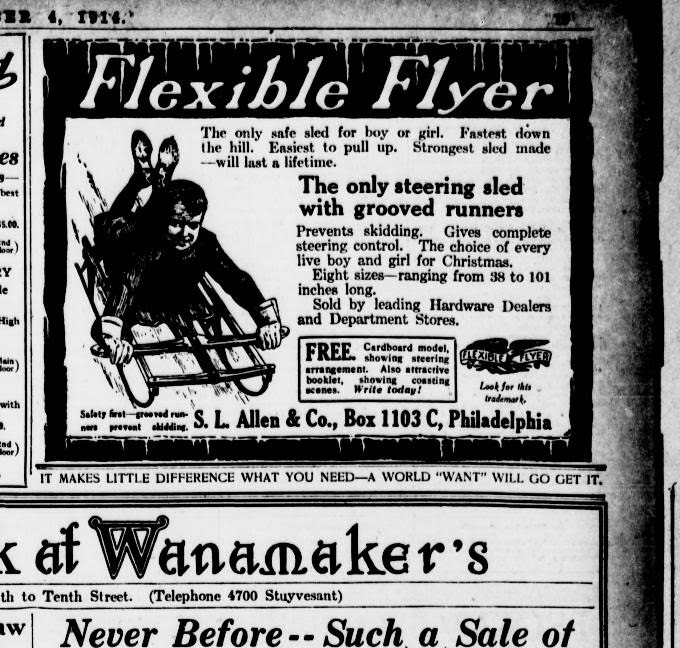
Of course, wealthy people could always go on a sleigh ride in the park, but the mass production of individual flyers (like the one advertised below) and homemade facsimiles soon brought middle and working class into the park for fun.  I would like to think this sled model (advertised in a Dec. 4, 1914 edition of the Evening World) was used by some of those intrepid spirits pictured above:
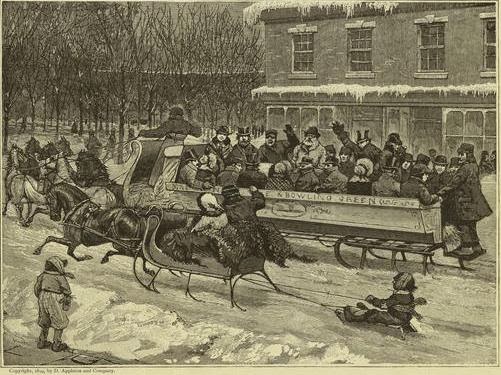
And you think that all looks a little dangerous, here’s some adventurers from 1860, using Broadway as their personal ice sheet, with a child tied to the back!
Images courtesy Library of Congress and New York Public Library
Categories
Bowery Boys Bookshelf

Solomon Northup’s ominous journey to New York City, 1841

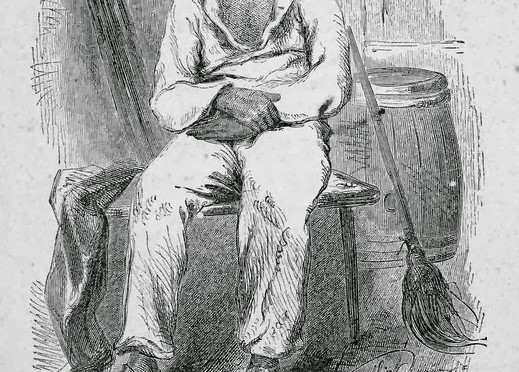
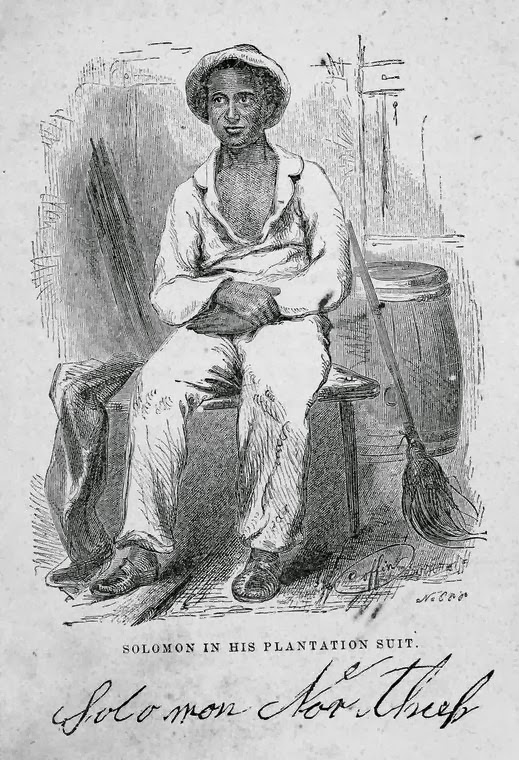
An engraving featured in Solomon Northup’s narrative Twelve Years A Slave, published in 1853.

The New York farmer and musician Solomon Northup was sold into slavery in 1841, tricked by two supposed members of a circus troupe, promising Northrup work in their traveling show.  Instead, Northrup awoke in bondage, eventually smuggled to New Orleans where he faced years of cruel servitude under a variety of plantation owners.   After regaining his freedom in 1853, he wrote the narrative Twelve Years A Slave, his harrowing account of his years in the South.

The book became a best-seller within Republican abolitionist circles, released a year after Harriet Beecher Stowe‘s Uncle Tom’s Cabin.  It was certainly in the possession of Henry Ward Beecher, Harriet’s younger brother, who turned his Brooklyn pulpit at Plymouth Church into a sounding board for abolitionist ideas.  (One hundred and sixty years later, the Oscar-nominated film version of Twelve Years A Slave, starring Chiwetel Ejiofor as Northup, played at Brooklyn Heights Cinema, located one block away from Beecher’s church.)

Northup and his family lived in upstate New York, but New York City proper plays a small but ominous role in his narrative.  Lured by the promise of employment by two men named Brown and Hamilton, Northup travels from home in Saratoga, first to Albany, then to New York itself:

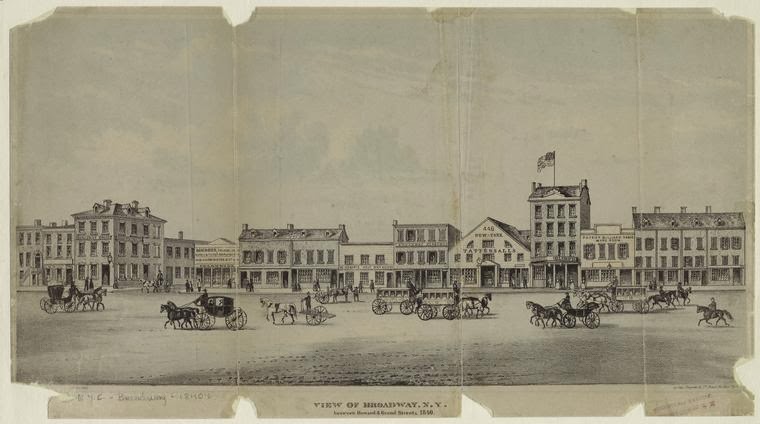
“They hurried forward, without again stopping to exhibit, and in due course of time, we reached New-York, taking lodgings at a house on the west side of the city, in a street running from Broadway to the river.”

Below: A view of Broadway (between Howard and Grand Streets) in 1840.  To the south of this view was Canal Street and Five Points.


“I supposed my journey was at an end, and expected in a day or two at least, to return to my friends and family at Saratoga.   Brown and Hamilton, however, began to importune me to continue with them to Washington.  They alleged that immediately on their arrival, now that the summer season was approaching, the circus would set out for the north.   They promised me a situation and high wages if I would accompany them.  

Largely did they expatiate on the advantages that would result to me, and such were the flattering representations they made, that I finally concluded the offer.”

Northup agrees to accompany them further north to Washington DC.  It would be there that Northup would be drugged and sold into bondage by his two nefarious companions.  But before they leave New York, they suggest that Solomon perform a certain task, curious given the subsequent events which occurred:

“The next morning they suggested that, inasmuch as we were about entering a slave State, it would be well, before leaving New-York, to procure free papers.  The idea struck me as a prudent one, though I think it would scarcely have occurred to me, had they not proposed it. 

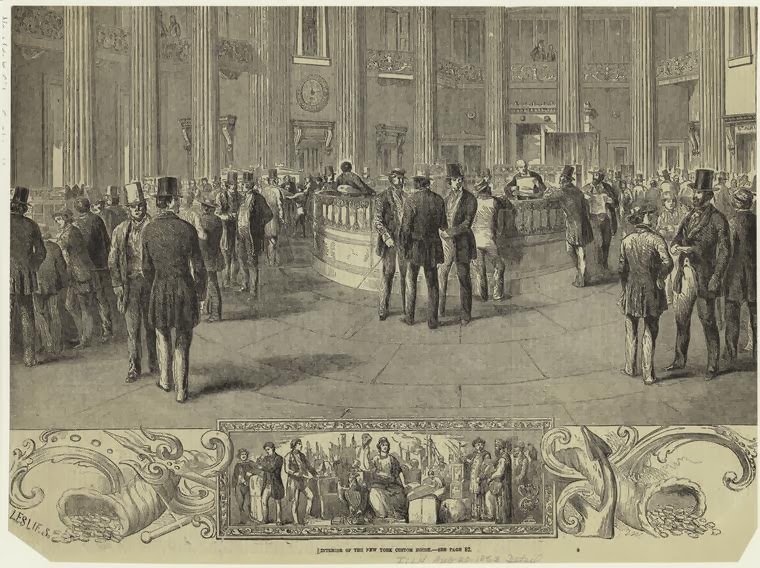
We proceeded at once to what I understood to be the Custom House. They made oath to certain facts showing I was a free man.” 

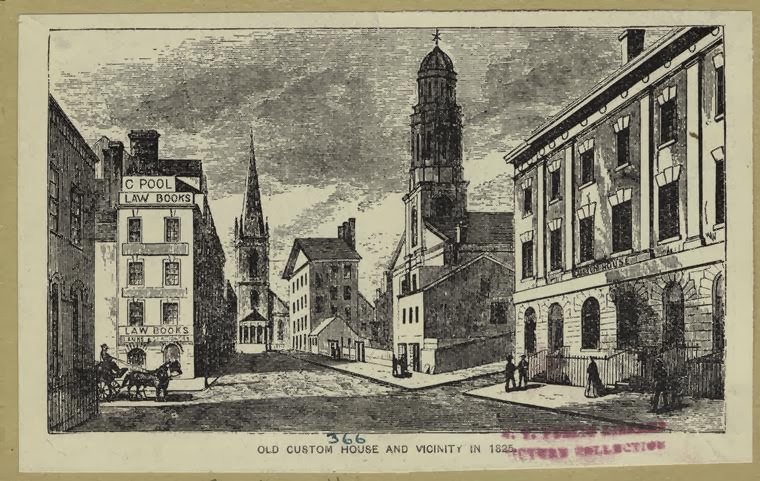
Why is there a little confusion in Northrup’s statement regarding the Custom House?  Perhaps because the building he would have visited — at 22-24 Wall Street — was in its final days as New York’s Custom House, an office which had grown far too small for the task.  The following year, New York’s new Custom House would have at last been opened at the other end of the block — the building that is today’s Federal Hall.

Below: Northrup and his associates would have entered the building at the far right of this illustration (which depicts Wall Street in 1825)

“Some further formalities were gone through with before it was completed, when, paying the officer two dollars, I placed the papers in my pocket, and started with my two friends to our hotel.  I thought at the time, I must confess, that the papers were scarcely worth the cost of obtaining them – the apprehension of danger to my personal safety never having suggested itself to me in the remotest manner.”

Below: The interior of the New York Custom House, 1853

All images courtesy New York Public Library

After its publication in 1853, Northup’s account would be available for sale in certain New York bookstores for several years.  But keep in mind New York’s divided loyalties to the South; it would not have been a universally popular read here in the city.

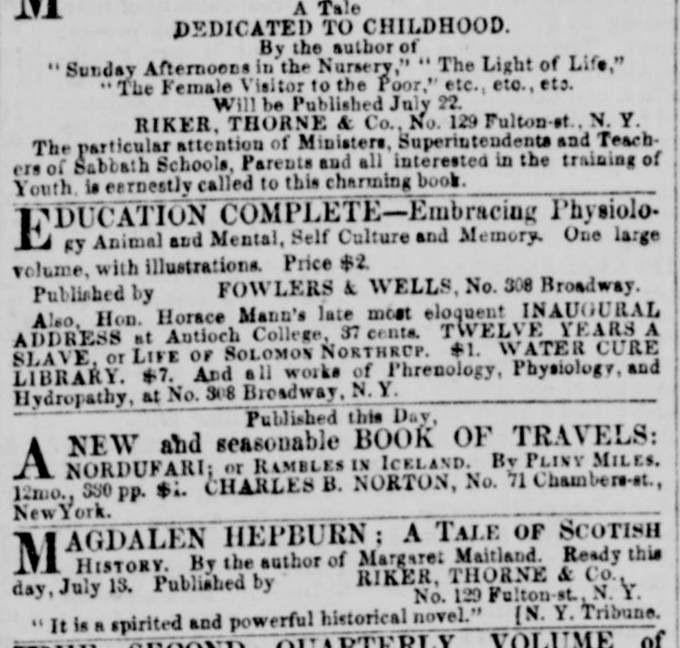
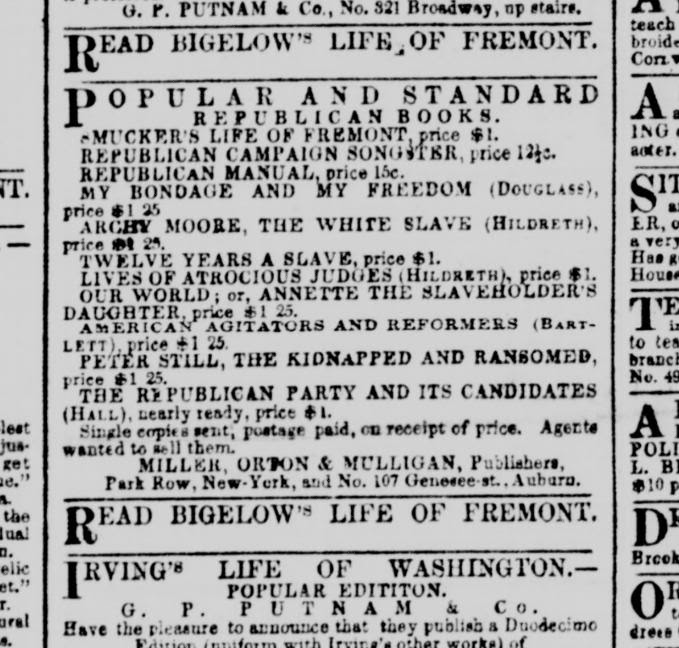
Below: the book for sale in 1854 at a bookstore at 308 Broadway, and in 1856, at a Park Row bookseller, both ads from the New York Daily Tribune


Categories
Bowery Boys

The Bowery Boys Year In Review: Our 2013 podcasts

Here’s a recap of all the Bowery Boys podcasts from 2013 — from the most shocking art show of all time to the weirdest mayoral election in history, from the corridors of New York’s scariest psychiatric ward to the altar of the city’s most transformed church.  From colonial America to Sesame Street, through several feet of snow and into the lobby of Harlem’s most glamorous hotel.  We introduced you to the first television broadcasts and the first Broadway musicals.  And for 150th episode, we looked at the formation of the five boroughs and the sometimes contentious tale of becoming Greater New York.

Thank all of you for helping make this our greatest year ever.  Seriously.  This has truly been a game-changing kinda year for us, and we hope to provide you with even more interesting content next year.  I’m really looking forward to what the next year holds, and we hope that you’ll join us for more adventures through New York City history.  We’ll see you in 2014 with a whole new set of shows!

Episode #147:  The Armory Show of 1913

Blog post — Art Insanity: The elegant audacity of the Armory Show of 1913, the daring exhibit that awed and outraged America

Episode #148:  The Great Blizzard of 1888
Blog post — Frozen in time:  The Blizzard of 1888 knocks New York City off its feet, creating the deadliest commute in history
NOTE: This podcast has the unusual distinction of being released the same day as New York’s biggest snowstorm of the year!

Episode #149: John Peter Zenger and the Power of the Press
Blog post:  The Cosby Show: A despotic governor in colonial New York and the sensational trial of John Peter Zenger

Episode #150: Consolidation! The Forming of the Five Boroughs
Blog post: Consolidation: The tale of five boroughs and one big city

Episode #151: The Limelight: Church, Club and Mall
Blog post:  The many lives of the Limelight, aka the facade formerly known as the Church of the Holy Communion

Episode #152: Bellevue Hospital
Blog post: The startling history of Bellevue Hospital, beyond the horror stories, the last resort for the New York unwanted

Episode #153: NYC and the Birth of Television 
Blog post: New York and the birth of the television industry, experimental broadcasts from the city’s greatest landmarks

Episode #154:  New York in the Golden Age of Television 
Blog post: New York City in the Golden Age of Television: Behind the scenes with nine classic TV shows filmed in the city

Episode #155:   Sesame Street to Seinfeld: NYC TV 1969-2013 
Blog post: NYC in the modern TV age, from Sesame Street to Seinfeld, as the arrival of cable brings new productions to the city

Episode #156:  The Boy Mayor of New York
Blog post: The Boy Mayor of New York — John Purroy Mitchel and a series of unfortunate events shake up a New York election

Episode #157: Early Ghost Stories of Old New York
Blog post: Ghost stories of old New York: Tales from the Revolution, restless Indians, haunted forts and a drunk, headless actor

Episode #158: Hotel Theresa: The Waldorf of Harlem
Blog post: The Hotel Theresa — An historic treasure in Harlem

Episode #159: The Broadway Musical: Setting The Stage
Blog post: The Broadway Musical — A trip through NYC’s musical history, from HMS Pinafore to Show Boat, along its most famous street

Categories
Know Your Mayors

The mayoral inauguration 100 years ago was quite a headache — “the Most Cheerless Day Ever Known at City Hall”

On Wednesday, January 1, 2014, Bill de Blasio will be inaugurated at City Hall to become the 109th Mayor of New York City, sworn in by President Bill Clinton.  Mayoral inaugurations are never very exciting, but they’re often reflected upon later as setting the tone for an administration, a clue to a possible style of governance.

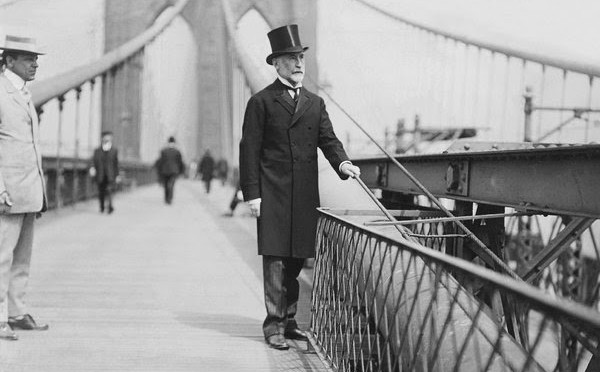
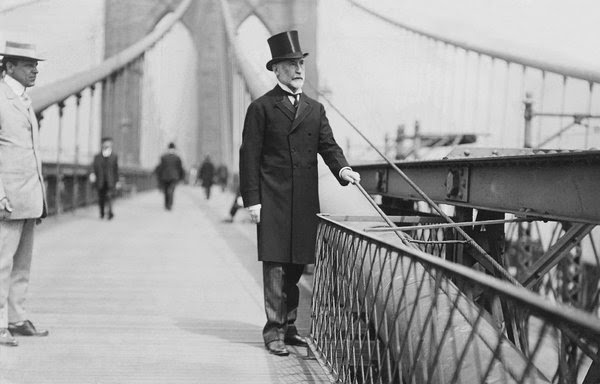
A fine, athletic example that Mayor-elect de Blasio might consider would be that of William J. Gaynor, who celebrated his inauguration on January 1, 1910, by walking from his home that day in Park Slope, over the Brooklyn Bridge to City Hall.  Brooklyn had been a part of Greater New York for only a decade by that point, and Gaynor one of its most esteemed residents.  Nobody doubted Gaynor’s pride that day in his home borough.  (De Blasio is also from Park Slope; his home is about ten minutes away from Gaynor’s residence on Eighth Avenue.)

Below: Mayor-elect Gaynor as he strolled across the bridge to City Hall

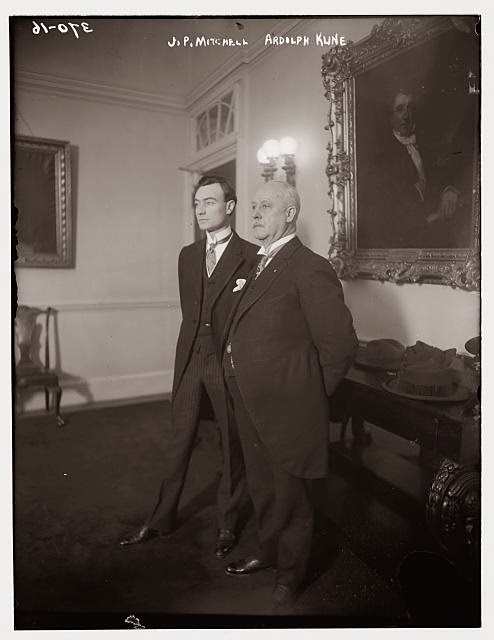
Four years later — after Gaynor died in office, from the internal injuries of an assassin’s bullet — New Yorkers elected the reformer John Purroy Mitchel.  He also made a bold statement during his inauguration on January 1, 1914, although one that cast a lingering pall over his subsequent accomplishments.

At right: Mayor-elect Mitchel with interim mayor Adolph Loges Kline, on inauguration day, 1914

Unfortunately for the young mayor-elect, he suffered from intensely painful headaches, and that morning, as he arrived at 9 a.m., Mitchel could barely withstand the pressure.

After greeting a few well-wishers and a brief meeting with reporters, he was sworn in during a private ceremony, made a five minute speech, then escaped into his private office, even as thousands lingered in the hallways and around City Hall for hopes of something — anything in the way of celebration — to occur.

Mitchel was noticeably aggravated and avoided any major announcements (such as the hotly contested job of Police Commissioner).

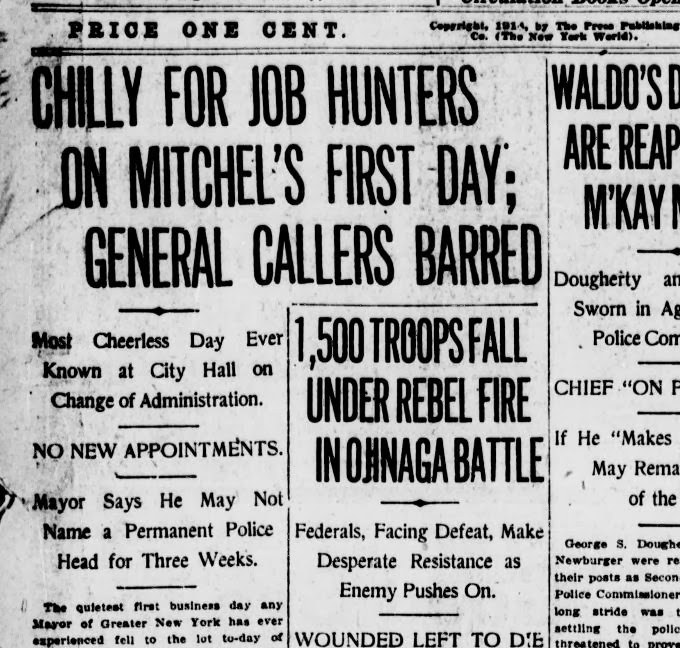
Early on, the police even dismissed the official receiving line of well-dressed politicians, the phalanx leaving with their hands unshaken.  This was a slight that many would never forget.  “[T]he reception room and corridor outside his office carried all the surging, bustling human exhilaration of Grant’s Tomb,” said the Evening World, who characterized the ceremony as “the most cheerless day ever known in City Hall.”

Many would consider this a hallmark of Mitchel’s style — distant and removed, hardly politic — a demeanor which would eventually label him as an elitist.

From the January 2, 1914, Evening World

For more on Gaynor, Mitchel and the tumultuous politics of 1914, check out our podcast on The Boy Mayor Of New York (Episode #156).

Categories
Christmas Neighborhoods Uncategorized

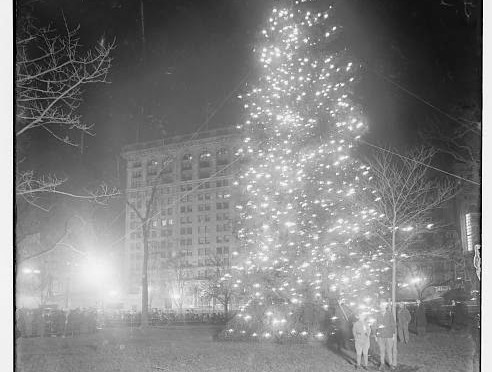
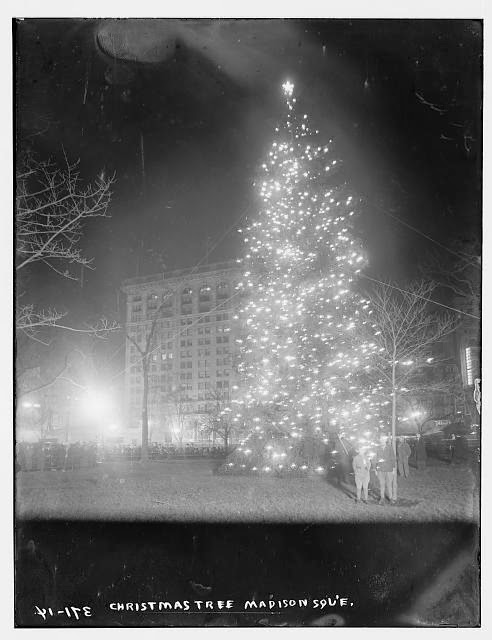
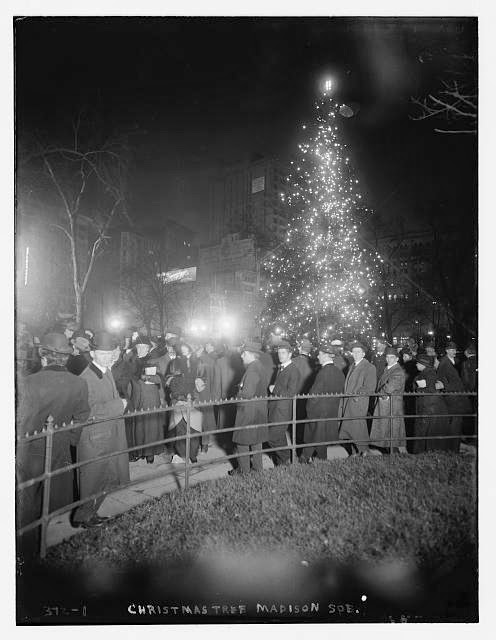
The lights of Madison Square: A Christmas tree at night

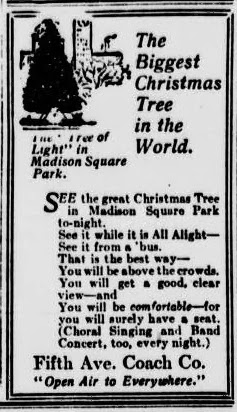
I’m not sure if the Madison Square annual Christmas tree was really the biggest in the entire world — as the 1913 Evening World at right suggests — but it was most certainly the largest in New York City. Its closest competitor in size would have been the City Hall Christmas tree.

This unique tradition in Madison Square began just the year before, in 1912, and is often considered to be the first community Christmas tree in America.

From my 2010 article: “This ‘Tree of Light’, mounted in cement, was such a novelty that almost 25,000 people showed up that night to witness it and enjoy an evening-long slate of choral entertainment.”  [Read more about its history here.]

I’ve seen a few photographs of the Madison Square Christmas ceremony from this period, but rarely any at night.  I’m not sure whether the pictures at top and at bottom are from 1913, but they’re definitely from the early 1910s.

We’re so used to novelty lighting features now that it’s difficult to imagine the extraordinary effect of a single tree draped in electric illumination.

From the ad by the Fifth Avenue Coach Company:
“See the great Christmas Tree in Madison Square Park to-night.
See it while it is All Alight —
See it from a ‘bus
That is the best way —
You will be above the crowds.
You will get a good, clear view — and
You will be comfortable — for you will sure have a seat.”
(Choral Singing and Band Concert, too every night”

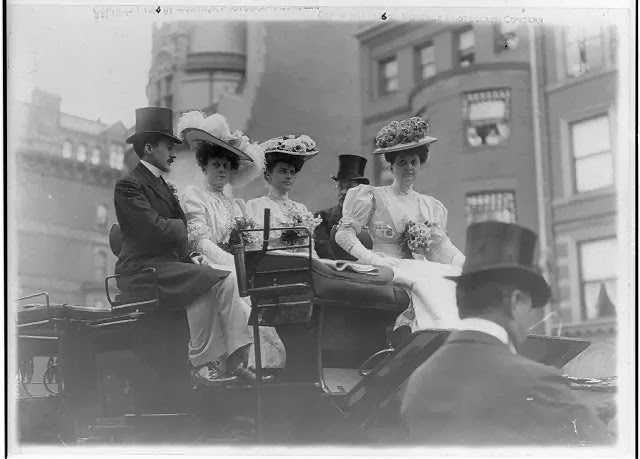
Here’s one view of a grand Fifth Avenue Coach omnibus of the type advertised (pictured here in 1906) that you might have been riding that particular evening.  I can’t imagine this was the most enjoyable ride on a chilly December evening, especially passed the famously windy Flatiron Building:

Pics courtesy the Library of Congress


Categories
Landmarks

The wonder of the Chelsea Hotel: ‘Inside the Dream Palace’ — an interview with author Sherill Tippins

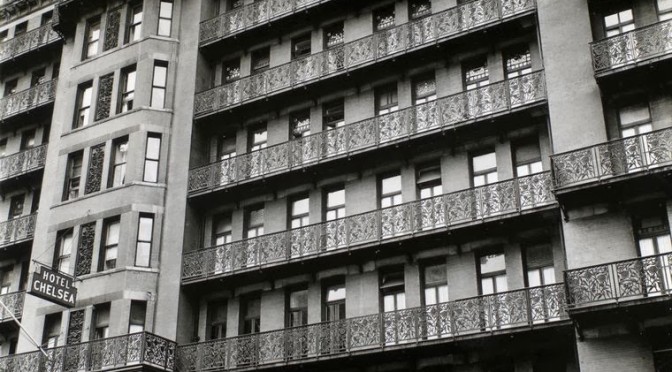
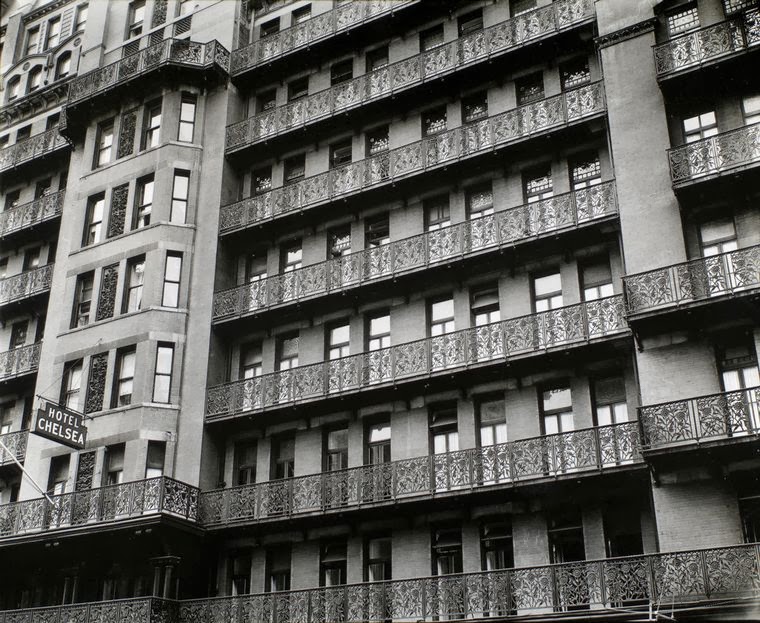
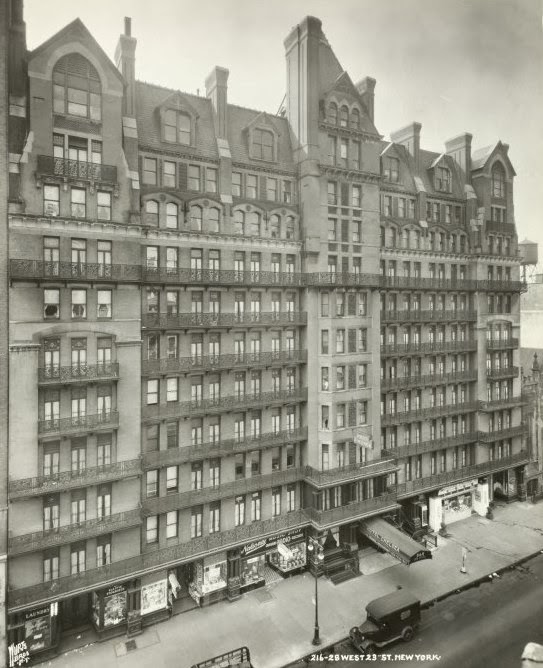
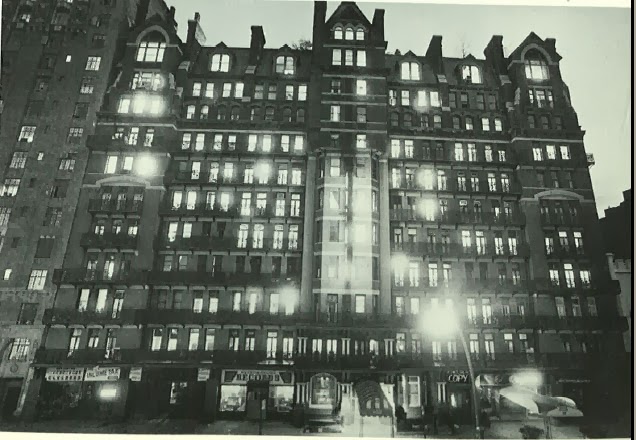
The Hotel Chelsea, August 1936, photograph by Berenice Abbott (NYPL)

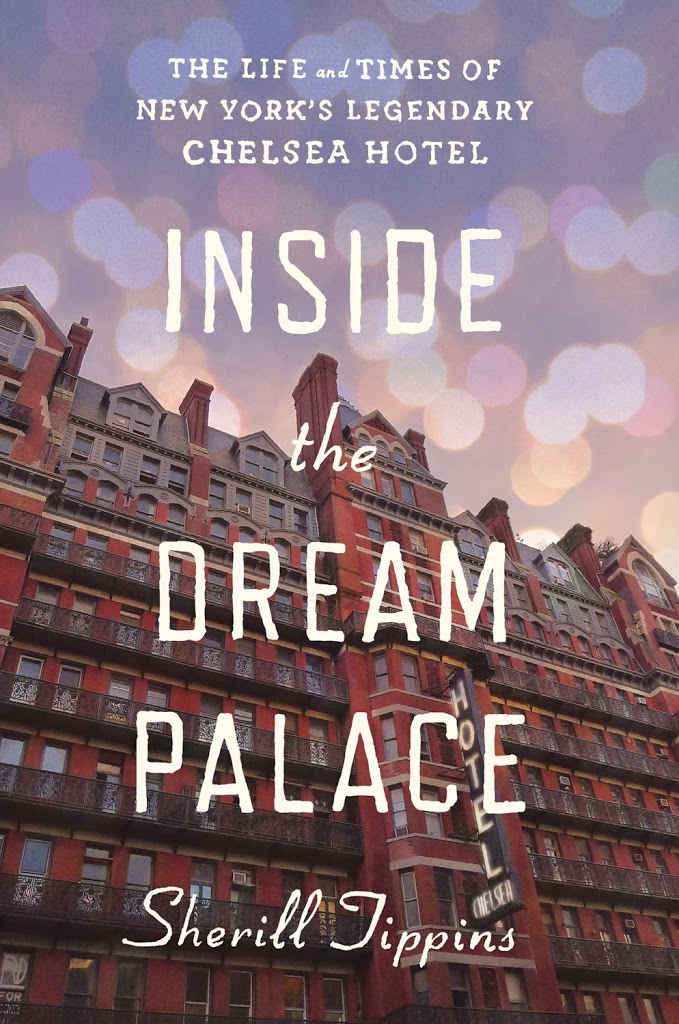
Inside the Dream Palace
The Life and Times of New York’s Legendary Chelsea Hotel
by Sherill Tippins
Houghton Mifflin Harcourt

Few places in New York exist with so many ghosts as the Chelsea Hotel. Oh, I don’t know if it’s really haunted, but the historical figures that have gained inspiration from their stays at this storied place have certainly left their mark.  But with geniuses — with the pressure of being genius — also comes drama, escapism, and tragedy.

Sherill Tippins‘ new book on the Chelsea Hotel — aptly named Inside the Dream Palace — does double-duty as a hall of fame for great substance-abusing artists and writers.  It’s a wondrous, colorful account of a unique social living experiment as it slowly dismantled its pretensions and became a rustic den of creativity, community and debauchery.

All the great tales are recounted here — from Dylan Thomas‘s death to Sid and Nancy‘s tragic evening — and a many new ones introduced.  For all the names I expected to see (Henry Miller, Arthur C. Clarke, Thomas Wolfe, Patti Smith), there were a great many more that have surprising connections to this unique landmark.

I had such a fantastic time sampling the lives of the Chelsea’s various characters that I wanted to ask the author a few questions myself.  Here’s Sherill Tippins, elaborating upon the hotel’s unusual origins, its tenacious spirit and uncertain future:

Reading of the original philosophies behind the Chelsea Hotel – the utopic, if somewhat simplistic notion of communal living of various types of classes – I kept thinking ‘Wow, imagine if somebody tried floating this idea today!”  What was it about this period and this project specifically that made people open to such a radical suggestion?

ST:  In the wake of Boss Tweed’s thefts, the long, deep recession of 1873, and the usual massive shift of wealth to the top one percent that followed (sound familiar?), the city’s social fabric seemed to many New Yorkers to be irredeemably destroyed.  People were so desperate for some kind of workable solution that New Yorkers from different economic classes started meeting in unprecedented ways – “bankers sitting next to bakers,” as one reporter put it in amazement – to discuss what had happened to the city and how it might start to recover.

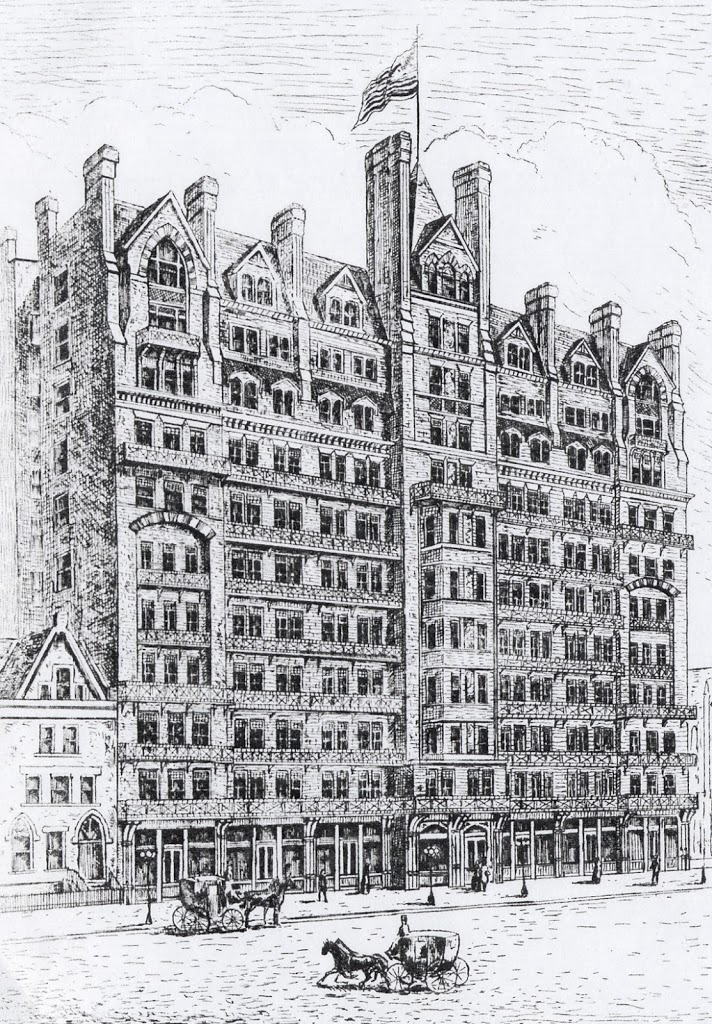
Into this critical moment in history walked the Chelsea’s architect, Philip Hubert.  Basically, Hubert appealed to New Yorkers in the same way every successful idea man has in New York, before or since – via their pocketbooks.  (Below: The Chelsea, photographed by the Wurts Brothers, NYPL)

He introduced the concept of cooperative living – showing how much cheaper it was for New Yorkers to form a “club” to buy their own land, build an apartment house to their own liking, and share the costs of maintenance, fuel, and other services.  The new cooperative apartments were so appealing and cheap that the demand for them proved nearly insatiable.

Here was a way to bridge the stultifying divide that had opened up between classes in a society where status was determined by the size of an individual’s bank account, so that citizens felt compelled to isolate themselves, as Hubert put it, “to guard their dearly cherished state of exaltation.” New Yorkers who lived together, on the other hand, would have to converse and exchange ideas. Alliances would form, and perhaps these alliances would arm groups against the chicanery of the next Boss Tweed.

To create real diversity, Hubert had to make cooperatives not only practical but, in a sense, sexy.  He managed that feat with the Chelsea Association Building, set in the heart of New York’s racy theater district, at the intersection of all the new elevated railroad lines and equidistant from the Ladies’ Mile shopping district and the decadent Tenderloin.  To make life at the Chelsea even more enticing, he built a cooperative theater and a drama school to go with the cooperative, and invited in an assortment of artists, musicians, actors and writers to spice up the core population of businessmen, financiers, and working people.

You walk us very vividly through different decades of the Chelsea’s strange and storied existence. If you could re-visit a particular era of the Chelsea yourself, to which time period would you like to see? Its earliest days, the wild 60s, or another era?

ST
:  Every time I’m asked this question I respond differently, because in fact I love every era at the Chelsea. Today, though, I’ll choose the Depression era as the one I’d most like to experience.

It was a surprisingly idyllic time at the hotel.  Room prices had lowered to a level that artists could actually afford, and secondly because many residents experienced a new kind of creative freedom as they were subsidized financially by the W.P.A. (“I can’t begin to tell you how rich everyone was,” one artist recalled.)

This was the era when the residents laid down a set of “house rules” that have been followed, more or less, ever since: don’t interrupt people during work hours; don’t visit without an invitation; don’t hit up famous neighbors for a job or a connection, and so on.  With their privacy protected, working artists felt comfortable socializing after hours: Edgar Lee Masters entertaining Thomas Wolfe in his suite, Masters and the artist John Sloan listening to music on the Victrola together, Van Wyck Brooks dropping in for cocktails with Sloan….  It was from these interactions that a real, lasting Chelsea Hotel culture was born—a culture that would nurture generations of artists in the decades to come.

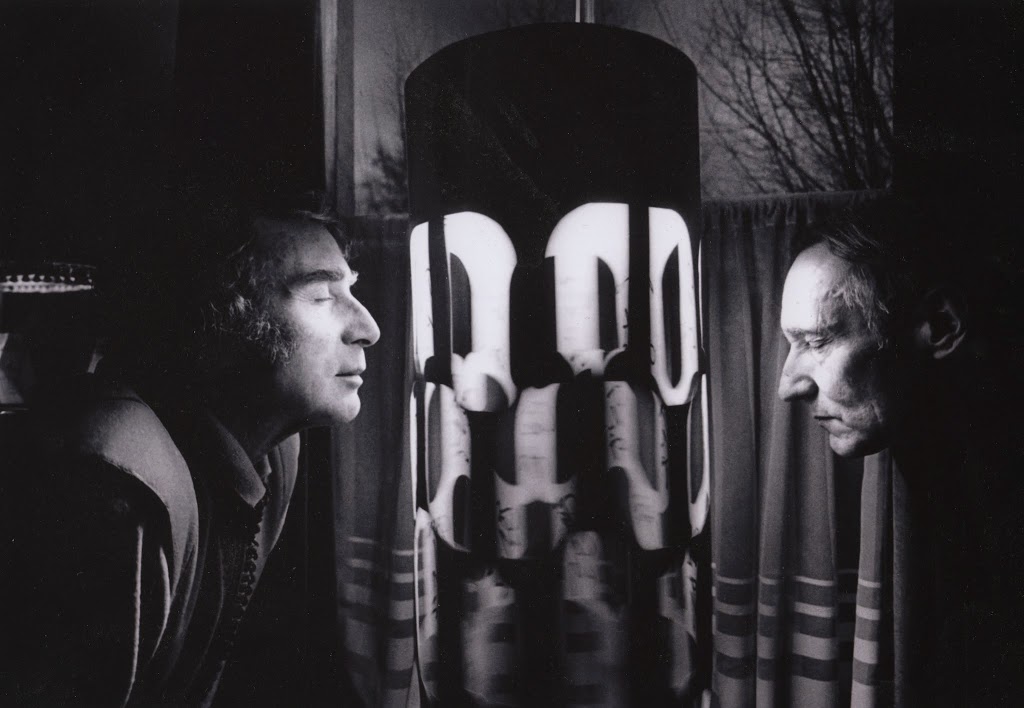
From ‘Dream Palace’: “The artist Brion Gysin and his close friend William Burroughs arrived to market their new invention, the Dream Machine.”

You’ve written about so many iconic writers and artists, both in this book and in your past projects. And this is really a story of icons, as they pass through this extraordinary landmark.  But I greatly enjoyed stumbling upon some of your rather obscure figures here, those fairly forgotten today. Any particular individuals that you newly discovered in your research that were a particular favorite of yours?

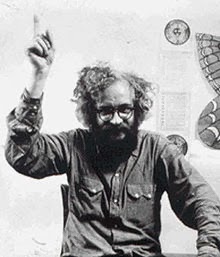
ST:   One of the most fascinating longtime Chelsea Hotel denizens, who is known surprisingly little considering his cultural contributions, is the anthropologist-musicologist-artist-filmmaker-occultist Harry Smith (at right).  Smith created The Anthology of American Folk Music, a collection of powerfully resonant American blues, ballads, gospel, and other songs that helped inspire the 1960s folk music movement and that inspired Bob Dylan in particular.

At the Chelsea, in his role as house magician, Smith provided the Yippies with a magic spell for levitating the Pentagon and Leonard Cohen with a love spell to seduce the singer Nico. (It failed, sadly.) Smith was also an experimental filmmaker, considered a genius by the underground film community; his films were designed to affect viewers neurologically, presumably altering their state of consciousness as a path toward further evolution. In the 1970s, Smith created a film, Mahagonny, based on the opera by Kurt Weill and Bertolt Brecht and featuring such Chelsea Hotel residents as Patti Smith, Robert Mapplethorpe, and Allen Ginsberg—a film intended to communicate to all cultures, regardless of language or location, humanity’s troubled state.

There are others I found captivating, even if they weren’t known outside their small circles of admirers.  In fact, I would have included hundreds more if I’d only had the pages to contain them.

There’s also a large amount of tragedy associated with the Chelsea, from the most famous events (Dylan Thomas and Sid Vicious, of course) to even the footnotes of history, those known only for their awful ends.  For instance, the woman who cut off her hand and jumped off the roof. (I went back and read that sentence like six times!)  Did you sense any particular reason for this in your research? Is it just the density of dramatic figures that stayed here? 

ST: I’m so glad you asked that question, because I’ve asked it myself so many times!  Unfortunately, I’ve never come up with a definitive answer, but I can give you my hypothesis.

Somehow, from the beginning—according to the letters and other writings in various archives—the Chelsea has always felt feminine to those who have lived in it.  Feminine and maternal, like a mother welcoming her children into her arms.  I would imagine that if one were in a state of existential despair or psychological extremity, one might look for comfort to an architectural (archetypal?) mother figure, particularly as one made the ultimate decision to end one’s life.

I’m thinking of Frank Kavecky, the impoverished young artist who was robbed on the subway of funds he was holding for the Hungarian Sick and Benevolent Society.  Discovering his loss, he went straight to the Chelsea – checking into a room for the afternoon, locking the door, settling himself into a rocking chair, and shooting himself in the head.

And Almyra Wilcox, the well-to-do visitor who overdosed on pills while writing a love letter to someone she knew she’d never see again. She was found dead the next morning, unfinished letter in hand.  Reading these stories, I think, if I were ready to do myself in, I might choose the Chelsea.  Wouldn’t you?

Photo by Claudio Edinger (courtesy Ed Hamilton/Living With Legends)

The fate of the Chelsea Hotel remains undecided, sitting empty, “like a corpse in its niche on Twenty-Third Street.”  If you could somehow dictate the future of the Chelsea yourself, what would you like see happen here? A return to its transient roots or an entirely new purpose altogether? 

ST:  Of course, the obvious desire would be to bring back the old days, with the former co-owner Stanley Bard managing the Chelsea and his son, David Bard, waiting in the wings. But since life is about moving forward, I would hope that the new owner, Ed Scheetz, will respect the Chelsea’s traditional function as fully as he claims to do.

The new owner has some intriguing ideas for the “new” Chelsea: creating a small, urban MacDowell-colony type program in which a half-dozen artists would enjoy free room and board, along with space on the ground floor to display or perform finished work.  He has shown me his plans for placing large, expensive rooms next to small, relatively cheap ones, to encourage a mix of people in the traditional Chelsea Hotel way.  He has assured me that he intends to maintain the building as a hotel, with the much-needed circulation of daily visitors from around the world, along with permanent residences whose occupants can pass on the community’s memories and values.

All of this sounds wonderful. The challenge, as always, lies in making this culture both “real” and affordable. It’s ultimately my hope that Ed Scheetz will be willing to go so far as to make the Chelsea the loss leader of his collection of New York hotels, if that’s what it takes to keep the life of the Hotel Chelsea going.
_______________________________________

Sherill was also on the Leonard Lopate Show on WNYC, talking about the book. Here’s the show (and thanks to Chip Pate on Twitter for pointing this out!): 


Other recent selections from the Bowery Boys Bookshelf:

Categories
Robert Moses

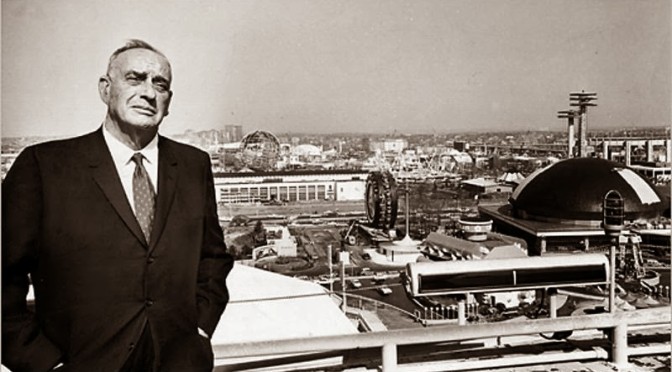
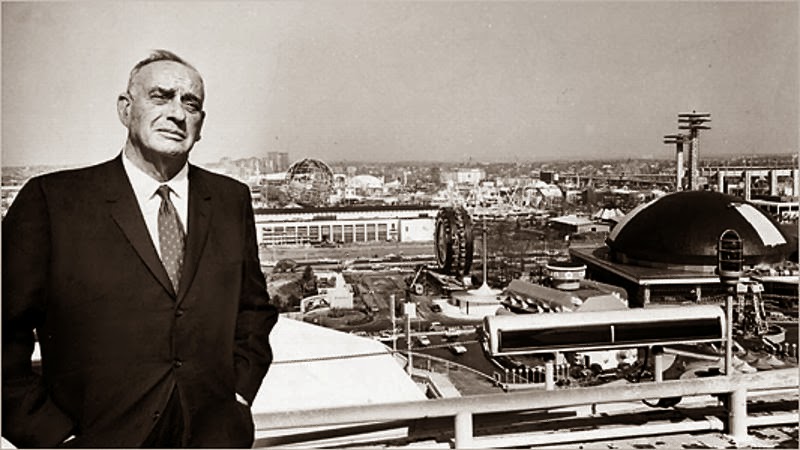
Robert Moses was born 125 years ago today. Here’s ten ways to celebrate/mourn his magnificent, controversial legacy

One hundred and twenty-five years ago today, Robert Moses was unleashed upon the world, born in New Haven, Connecticut, on Dwight Street.  He remains today one of the most powerful civic figures in American history, and obviously one of the most controversial.  Because of Moses, we have the modern New York City.  Many of its strengths and its difficulties can be traced, in some way, to decisions he made, from roads and housing to parks and waterways.

Can you really “celebrate” Robert Moses?  Of course you can.  Here’s ten particular ways you can ruminate upon the changes he inflicted upon the city, from the mighty highways to the large, concrete-heavy parks.

1) Read his obituary in the New York Times. Robert Moses died on July 29, 1981.

An excerpt: “Robert Moses was, in every sense of the word, New York’s master builder. Neither an architect, a planner, a lawyer nor even, in the strictest sense, a politician, he changed the face of the state more than anyone who was. Before him, there was no Triborough Bridge, Jones Beach State Park, Verrazano-Narrows Bridge, West Side Highway or Long Island parkway system or Niagara and St. Lawrence power projects. He built all of these and more.”
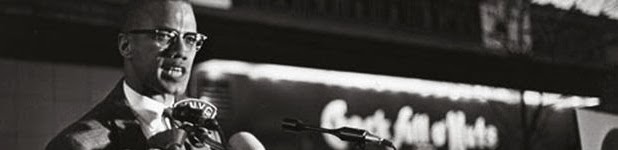
You might also like to know the contents of his will.

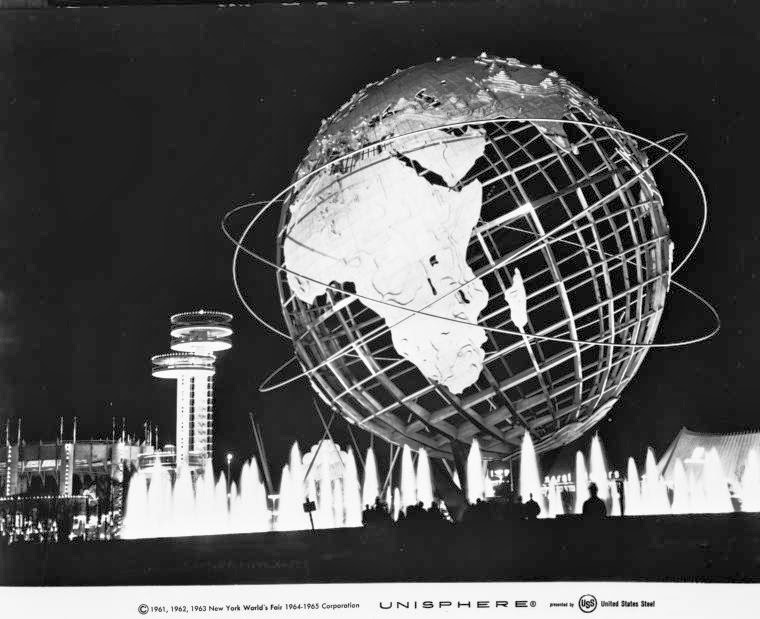
The Unisphere is still around (and presumably in no danger), but the New York State Pavilion, seen in the background, could face demolition. (NYPL)

2) Help save the New  York State Pavilion.  
The curious remnants that remain of the World’s Fair 1964-65, located in Flushing Meadows-Corona Park, are in danger of being torn down.  Certainly Moses himself would have approved of tearing down these useless — and yet, priceless — relics.

After the city projected it would be cheaper to tear them down than to renovate, many in the community rallied to save the embattled old ruins.  A couple weeks ago, Gizmodo asked the question ‘Should Queens Tear Down The 1964 World’s Fair Pavilion’.  Prepare an interesting preservation battle over this historic piece, designed by Philip Johnson.

3) Visit neighborhoods plucked from Robert Moses’ grasp.
Had Moses had his way, a variety of beloved neighborhoods would have been wiped from existence — parts of the Lower East Side and SoHo (thanks to the Lower East Side Expressway proposal), Willowtown in Brooklyn, just to start.

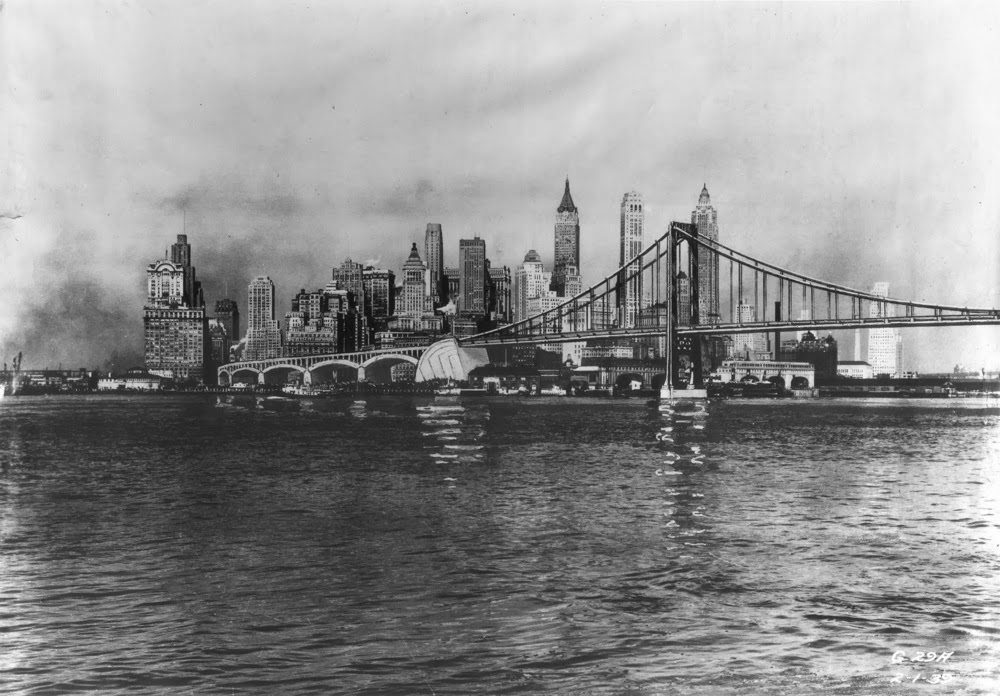
In particular, go to Battery Park and physically embrace Castle Clinton if you can. (It was still behind fences last I checked.)  Moses wanted to construct a bridge over to Brooklyn that would have wiped it from existence.  From my original article:  “The Brooklyn-Battery would be designed by bridge master Othmar Ammann, designer of nearly half the bridges of New York City, with an anchorage plopped in the middle of Governor’s Island.”

Fortunately, the community intervened, and the Brooklyn-Battery Tunnel was built in its place. But a vision of what it might have looked like is above.  (Courtesy Urban Omnibus)

4) Visit those neighborhoods he did replace.
This is a far more depressing stroll and far more common.  Moses’ use of funds from Title I of the 1949 Housing Act replaced some serious New York slum conditions with low-income housing developments, but some of it was poorly designed and shoddily planned.  According to Joel Schwartz, “To a generation of critics … Title I was also synonymous with reckless power that went unchecked until a small band of urban liberals rallied the conscience of the city.”  Not surprisingly, Moses focus was on neighborhoods that were predominantly black and Latino.

Most striking of these was East Tremont in the Bronx and Manhattantown on Manhattan’s Upper East Side:

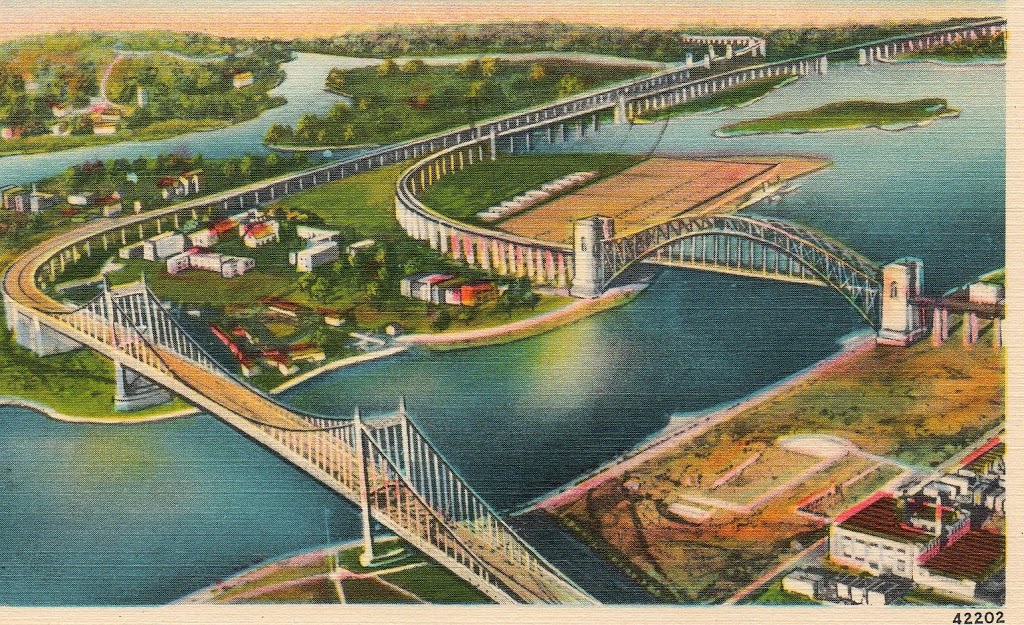
5) Ride over the Triborough Bridge and head to Randall’s Island
Easily one of Moses’ biggest successes, the Triborough Bridge Authority took in millions of dollars in tolls which then funded other ambitious projects throughout the state.

Over at Randall’s Island,  you should visit the Triborough Bridge Authority Building, which was the homebase for Moses for decades.  It was here that many of his greatest triumphs — and a few city downfalls — were planned.

6) Check out the ghastly Robert Moses mosaic in Flushing-Meadows Park.
The mosaic underfoot is based upon a work by Andy Warhol which the artist created after Moses destroyed Warhol’s outdoor art piece involving the FBI Most Wanted list. From my previous article ‘Most Wanted: Robert Moses vs. Andy Warhol’:  “[H]is mural was literally whitewashed. Warhol intended to replace it with a new design: 25 silkscreen panels of Robert Moses’ face in a Joker-like grin. Unsurprisingly, [Philip] Johnson did not think this appropriate for the main pavilion of Moses’ fair.”

Listen to the WNYC piece from 2010 for more information!

7)  Ponder his vast, virtually unchecked power.
Can you imagine if a politician or city leader were actually as successful as Robert Moses in getting anything done?  His reach and output makes him one of the most powerful city builders in modern human history.

Imagine such power in the hands of a modern politician today. Scratch that. Imagine that power in the hands of an unelected civic leader, as Moses was.

He was so powerful, in fact, that he changed the names of neighborhoods — on a whim!  Like Throggs Neck, for instance.  Excuse me, Throgs Neck.

From my article on the origin of the name: “You may have noticed that John’s last name [Throgg] has two g’s in it, while most common spellings have only one. Legend has it that this is another thing you can blame on Robert Moses.  Not exactly known for reaching out to communities for their thoughts and opinions, Moses decided to drop a ‘g’ in 1955 when the bridge started construction, believing it would fit on more traffic signs without an additional and needless letter.  Who cares if it was in use that way for over 300 years!”

8) Watch Robert Moses on TV in 1953
Moses was even a guest on an early television show called Longines Chronoscope, sponsored by Longines.  This isn’t the most fascinating television that was ever made, but it’s interesting to hear Moses’ authoritative voice during the era of his greatest power.

And check out this bonus video on Robert Moses’ “improvement plans” for Coney Island:

9) Visit his burial site 
He’s buried in a crypt at Woodlawn Cemetery in the Bronx.  So is his most prominent collaborator, Mayor Fiorello LaGuardia.

10) Listen to our podcast (Episode #100) on Robert Moses!

And check out our other podcasts and pages which feature Robert Moses and his effects on the city including the Verrazano-Narrows Bridge, Shea Stadium, Shakespeare In The ParkThe Rockaways and Rockaway Beach and Central Park

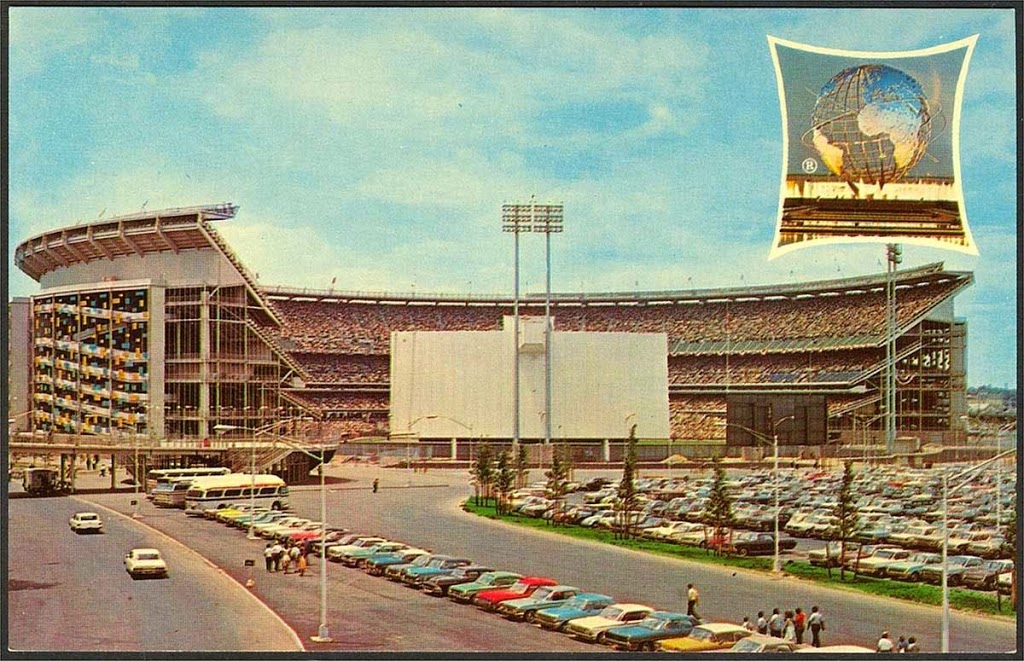
Below:  The glory that was Shea Stadium  (NYPL)

Categories
It's Showtime

Podcast Extra! The Hippodrome and its famous ice ballet

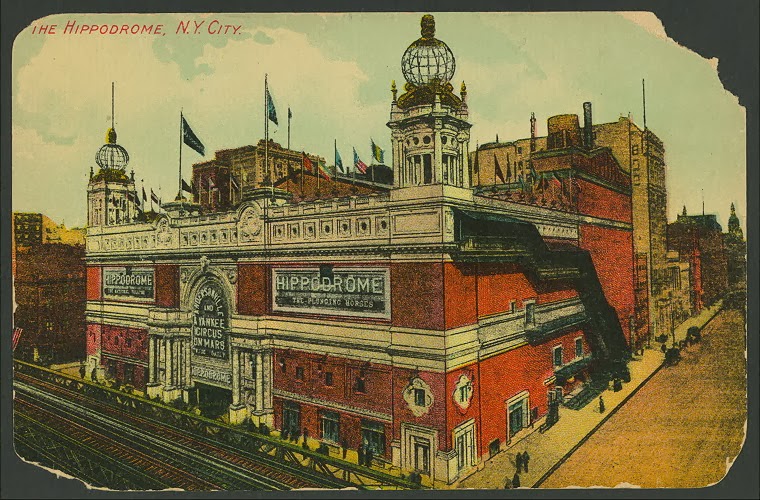
Our show on the Broadway musical was quite epic, and we ended up cutting out some interesting stories to make the show a reasonable length.  However I’ll leak out a couple of these ‘deleted scenes’ over the next couple weeks.

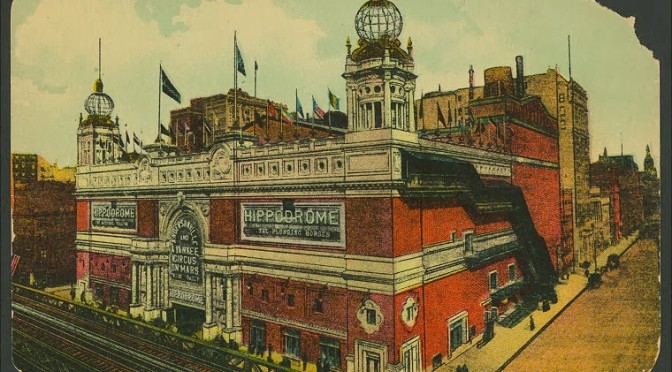
For instance, here’s a segment about another great Broadway theater. In fact, one of the biggest stages ever — the Hippodrome


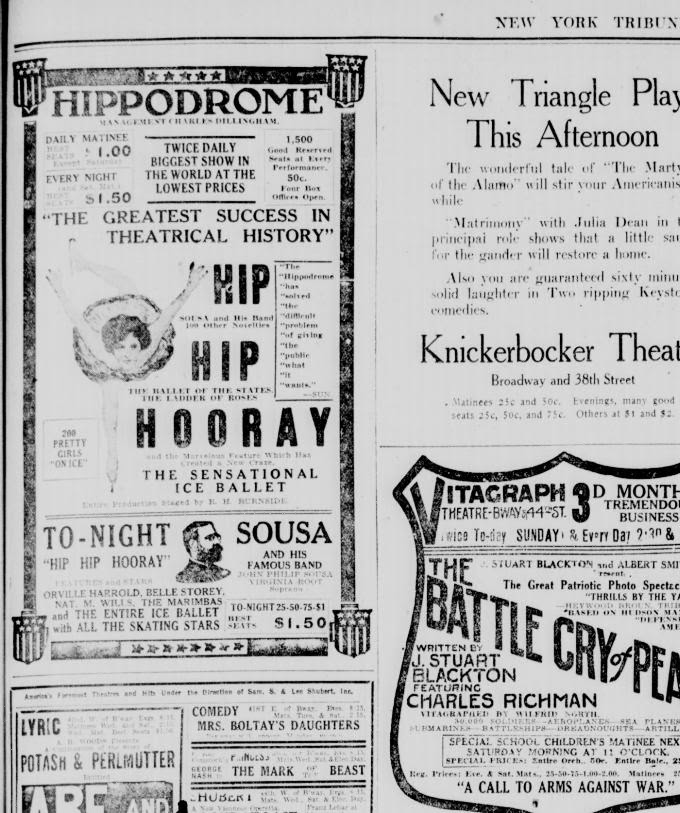
And, as I referenced in this segment, here’s the advertisement featuring John Philip Sousa.  “The Greatest Success in Theatrical History”!:

You can hear music that was performed at the Hippodrome by the Victor Military Band in a prior post.

Picture courtesy New York Public Library. Newspaper clipping from the New York Tribune, courtesy the Library of Congress.

Categories
Pop Culture

Inside ‘Inside Llewyn Davis’, a gauzy, surreal homage to 1960s New York bohemian life


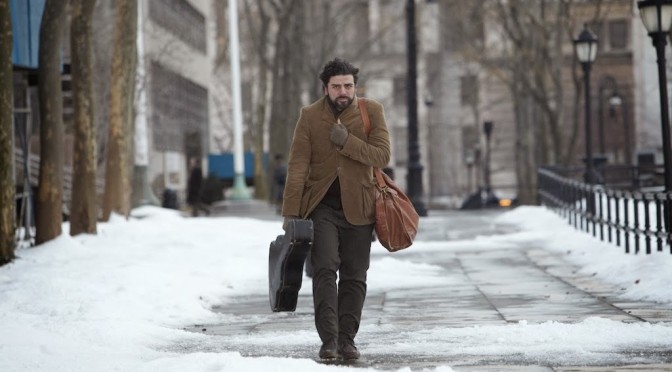
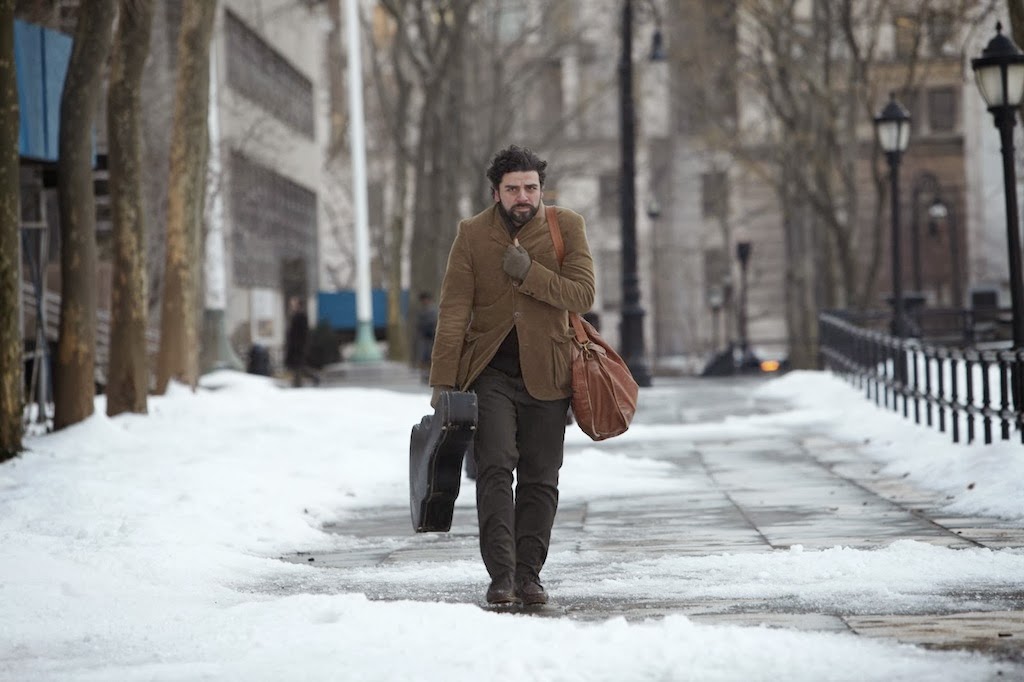
Out in the cold: Llewyn Davis gets no respect. Pic courtesy CBS Films

NOTE: This article contains minor spoilers for the film Inside Llewyn Davis, so proceed with caution if you have not yet seen the movie!

The latest movie by Joel and Ethan Coen, Inside Llewyn Davis, meanders through a coolly tinted rendition of New York in 1961, depicted as a chilly and even mystical place and time.  Davis (the brilliant Oscar Isaac), our scruffy hero, is introduced in a beautiful musical number down at a basement basket house in Greenwich Village. Certainly this singer is about to be discovered? Or perhaps he’s already a star? Quite the opposite, in fact.

Inside Llewyn Davis is a trademark Coen brothers movie, rarely straight-forward in narrative, with a bounty of great songs allowed to linger and finish.  As in O Brother Where Art Thou, there’s a mythical road trip with kooky characters, but the movie eventually returns to New York.  You’ll be happy to know that the second most important character in the film is probably a cat.

The movie doesn’t need to be so historically detailed — it feels mostly like a dream — but thankfully the production design takes its cues from places that actually existed.  Here’s a few significant historical New York details that I noted from a first pass at the movie this weekend.  I certainly might have missed something while scribbling notes in the movie theater, so please don’t hesitate to leave a comment if you have a correction!

Breakfast at Tiffany’s — The film, set in 1961, makes a clever nod to a movie that was actually released that year, Breakfast At Tiffany’s.  In both movies, an unusually named orange cat retreats down a fire escape, leading to a frantic search through the streets of New York.  In Breakfast, the apartment is in the Upper East Side; in Llewyn Davis, the Upper West.

The current film, however, seems to reflect the more melancholy ending of Capote’s original novella, not the bright-and-happy ending of the Breakfast film.  I imagine that the Coen brothers’ screenplay might have been inspired by this line:  “It took weeks of after-work roaming through those Spanish Harlem streets, and there were many false alarms — flashes of tiger-striped fur that, upon inspection, were not him.  But one day, one cold sun-shiny Sunday winter afternoon, it was.”


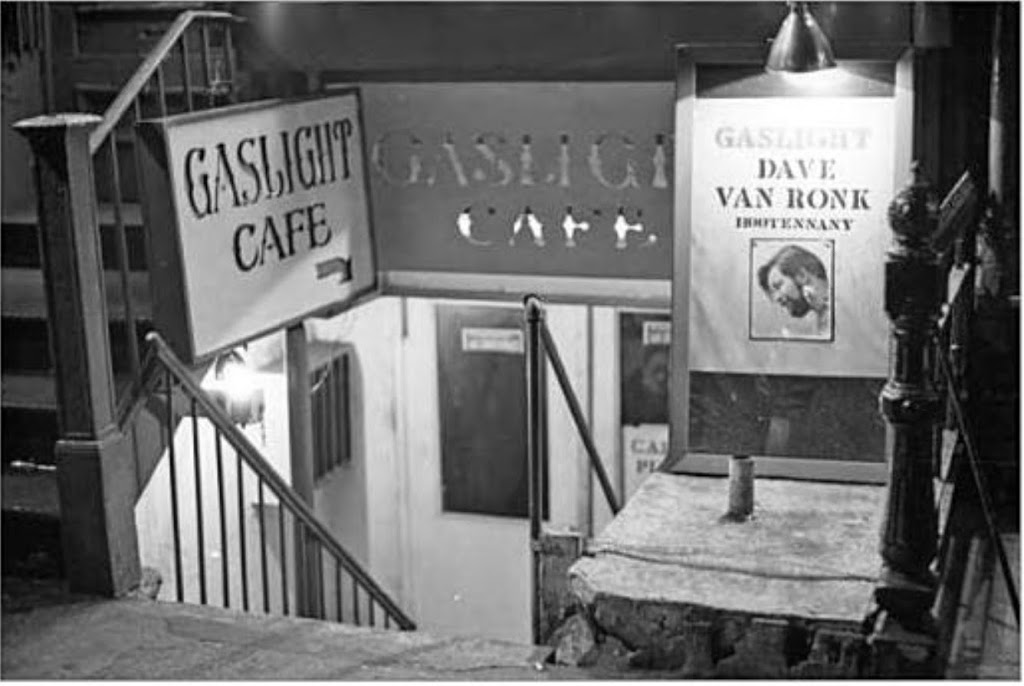
The Gaslight Cafe — One of New York’s greatest (and smallest) venues for folk music in the 1960s, the Gaslight was located at 116 MacDougal Street.  Today its the low-key bar 116. (Hey, would you prefer it be a Chiplotle?)  Along with Cafe Wha? and the Village Gate, the Gaslight provided stages for Greenwich Village’s burgeoning folk music scene.

A pivotal scene near the end did not actually take place at the Gaslight, but instead over at another seminal music venue, Gerde’s Folk City.

Dave Van Ronk — The character of Llewyn Davis is loosely based (depends on your definition of loosely, I guess) on this regular of the Village folk scene, one who never broke through in the same way as his peers.  Like Davis, Van Ronk grew up in Queens, but in Richmond Hill, not Woodside, as the film depicts for Davis.

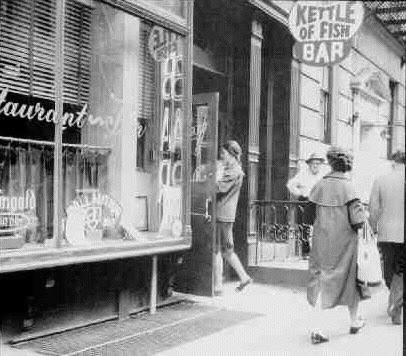
Kettle of Fish — Also seen along the streets next to the Gaslight is the tavern Kettle of Fish, back when it was on MacDougal Street.  Today, Kettle of Fish is located on Christopher Street, on the site of the old Lion’s Head bar, a writer’s hangout and favorite of Norman Mailer‘s back in the day.

At right: The original Kettle of Fish in the 1950s. Photo courtesy Ephemeral New York

Both the Lion’s Head and Dave Van Ronk are featured players in a bit of Christopher Street history — namely, the Stonewall Riots.  Van Ronk was celebrating his birthday at the Lion’s Head in the early morning of June 28, 1969, when the police came to shut down the mob-operated gay bar, located nearby.  Van Ronk got involved in the riot himself, allegedly throwing coins at the police.  The singer was then beaten by police and dragged into the Stonewall bar.

Caffe Reggio — This dark and weathered old cafe across the street from the Gaslight is a Village treasure, opening in 1927 during the days when its neighbors were speakeasies.  It’s one of the few places depicted in Llewyn Davis that’s not only still open today, but pretty much in the same condition, at least judging from the last time I had a cappuccino here.  According to Mitch Broder, “Reggio is the mythic Village hangout that’s not a myth:  It would like like it did eighty years ago if it weren’t for the customers.”

And Calvin Trillin, in a New Yorker article in 1963, described Reggio as a place “whose ornate espresso machine and quiet interior seemed to belong to some other neighborhood.”

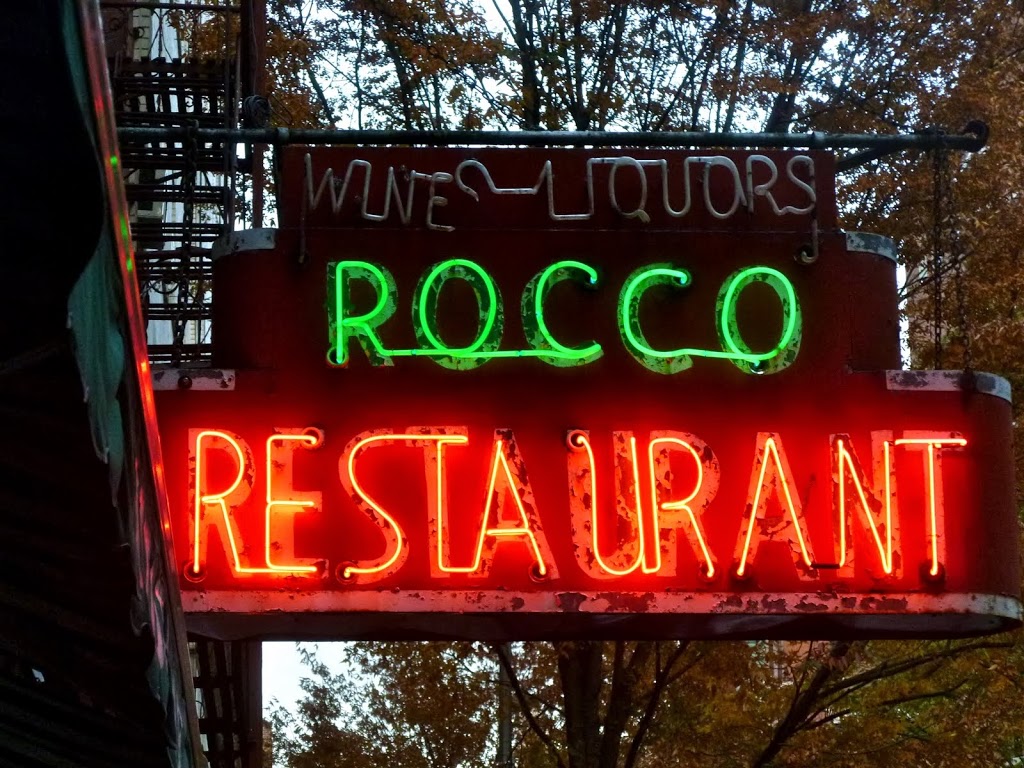
Rocco Ristorante — This grizzled old eatery, dating from 1922, was located at 181 Thompson Street, its fantastic old neon sign still a treasured mark of the Village.  It closed in 2011, but recently reopened as a restaurant again as Carbone. (Picture of sign courtesy Jeremiah’s New York)

Washington Square Park — It wouldn’t be a folk movie without a scene here, the heart of the 1960s music scene.  However, in 1961, it might have been a rather tense time in the park, and not welcoming to folk musicians at all.   When the park association closed the park to “roving troubadours,” the musicians fought back.  On April 9, 1961, thousands of artists and their supporters flooded the park, an outpouring that became derisively known as the Beatnik Riot.  (You can hear more about the riot and the history of Washington Square Park in my walking tour on the subject.)

Columbia Records — The label which would later sign Bob Dylan is featured briefly in the film.  In 1961, their big star would have been Andy Williams, a far cry from the sounds of coffee-shop culture.  Columbia’s well-known offices in the CBS Building, designed by Eero Saarinen and nicknamed Black Rock, would not have been completed yet, so this scene would have been in Columbia’s old offices at 485 Madison Avenue.

George Washington Bridge — This is the location of a off-screen suicide and a subsequent off-color joke about the rarity of such suicides at this location.  As we know from modern news events, however, the GWB is actually a frequent site for suicide attempts.  Two years ago, a staggering 43 people reportedly tried killing themselves from this spot.  And I can’t help but think of another great movie musical (Saturday Night Fever) which also features a tragedy off another large New York bridge.

New York Subway — For a film planted in the Village, there’s a lot of travelling around on the subway — to the Upper West Side, to downtown Varick Street, even Queens.  According to the 1959 subway map, Davis rides the IRT’s Flushing line to Woodside/61st and the Broadway local line to Varick.

Fred Harvey — The most unusual scene in the movie takes place at the Fred Harvey roadside restaurant inside the Illinois Tollway oasis in northern Illinois.  It’s here that I want to plug one of my favorite podcasts, the American history show Backstory, as just last week they featured a story on Fred Harvey and his ubiquitous chain of restaurants.  You should check out their show ‘Three Squares’, on the history of mealtime in America, where they discuss Harvey’s innovations as perhaps America’s first chain-restaurant mogul.

Categories
Pop Culture

AMC’s ‘Turn’: The next great New York history TV show?

BBC America’s Copper, depicting the grit and crime of 1860s New York, was recently cancelled (although petitions are currently circulating, demanding a Season Three).

But the void of history-related television will soon be filled again with Turn, AMC’s Revolutionary War-era drama on George Washington’s spy network, called The Culper Ring.  What do you think?

Although this clearly depicts a variety of locations pivotal to the American Revolution, much of Washington’s spy ring was located near British headquarters — namely New York and the surrounding area.  So the show should eventually turn its attention to the city in the Revolutionary era.

We’re sure to see not only the bustling, over-crowded streets around St. Paul’s Church and Bowling Green — possibly even the ruins from the 1776 fire which incinerated almost a fourth of the city — but imagined locations in Long Island and Westchester.

You’re not seeing things — that’s Jamie Bell (aka Billy Elliott) as the leader of the spy ring Abraham Woodhull (aka Samuel Culper).

They’ll certainly take a lot of liberties given the secrecy of the Culper Ring.  I can’t wait to see how they depict the most intriguing alleged member of the gang — Agent 355.  The show is set to air in early 2014.

And although though it’s not set in New York, if you like history and mobsters, check out Mob City tonight on TNT, set in Los Angeles in the 1940s and based on John Buntin’s excellent book L.A. Noir: The Struggle for the Soul of America’s Most Seductive City.

——
And speaking of George Washington, today marks the 230th anniversary of the General’s farewell speech to the officers of the Continental Army, given at Fraunces Tavern just days after the British were permanently expelled from New York in 1783.

His toast to his men: “With a heart full of love and gratitude, I now take leave of you. I most devoutly wish that your latter days may be as prosperous and happy as your former ones have been glorious and honorable.”

There was not a dry eye in the house.

For more information, give our podcast on Fraunces Tavern a listen. The building has a fascinating, even dizzying history.

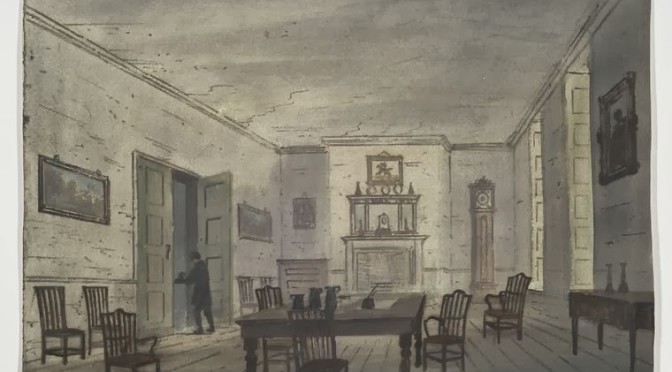
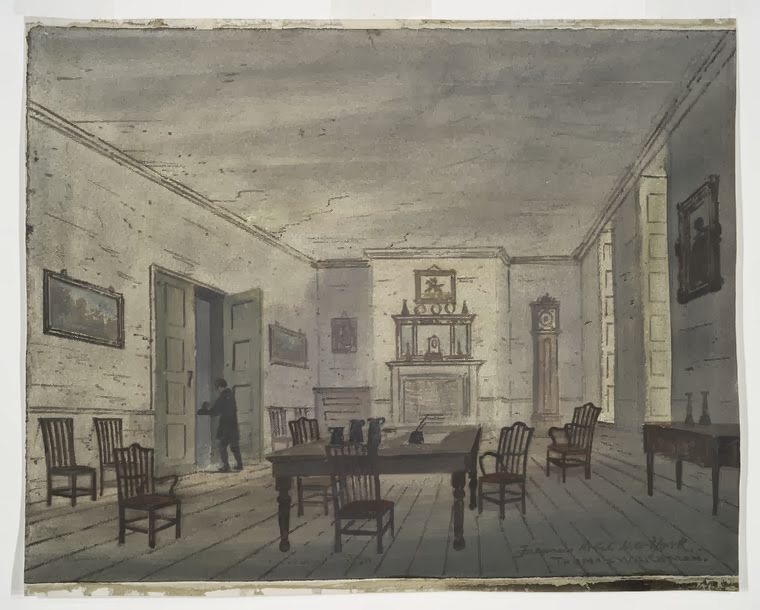
Below: Fraunces Tavern’s lonely dining hall, deputed by artist Thomas Wakeman in 1850.


Categories
Those Were The Days

Venuses in Fur — New York society ladies in fancy animal skin

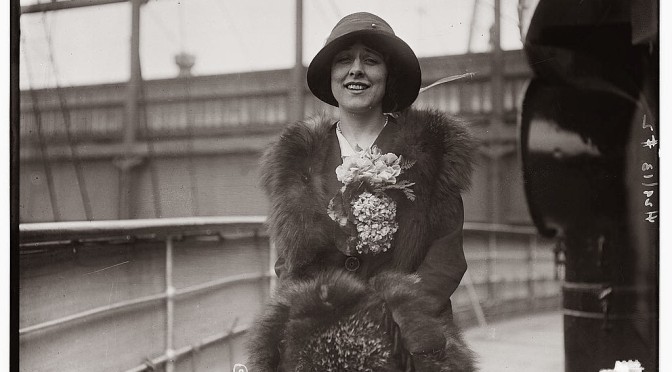
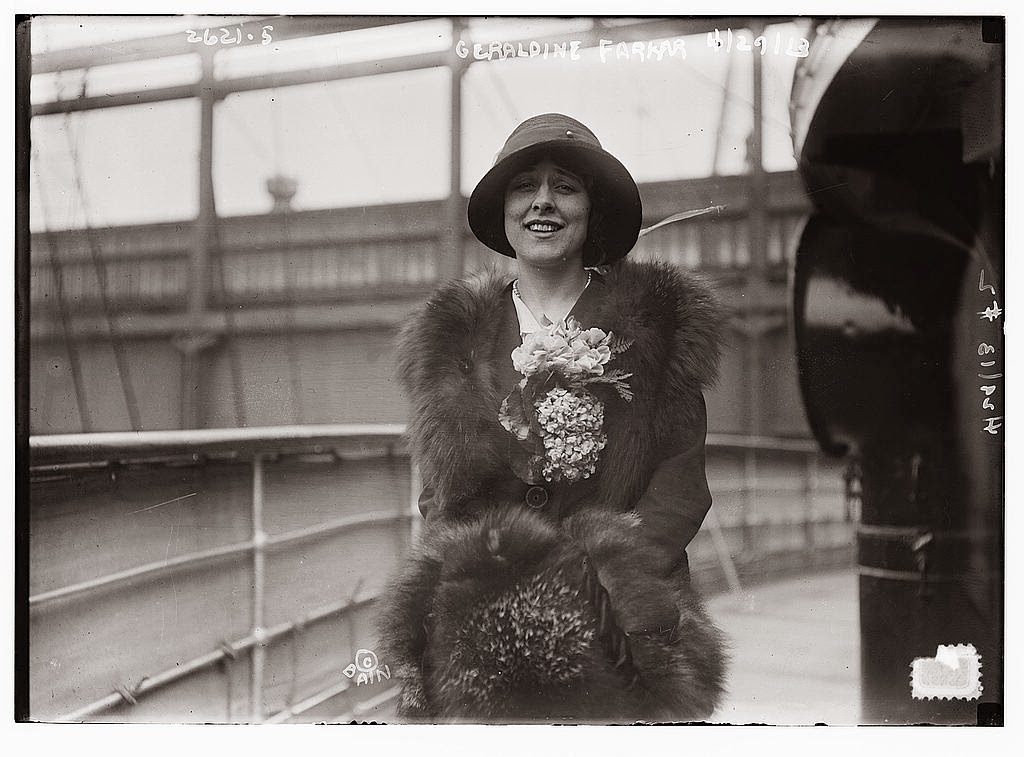
The Metropolitan Opera’s soprano sensation Geraldine Ferrar, photo taken April 1913. I guess fur was never out of season a century ago!

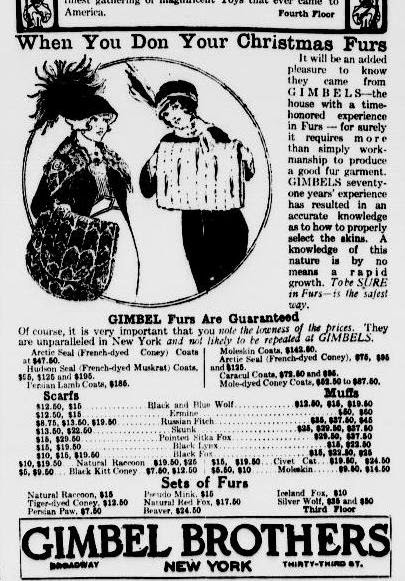
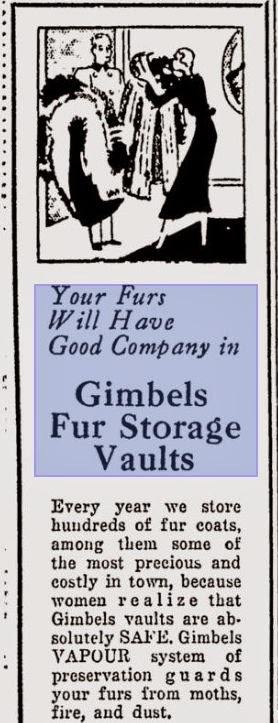
“When You Done Your Christmas Furs — It will be an added pleasure to know they came from Gimbels — the house with the time-honored experience in Furs — for surely it requires more than simply workmanship to produce a good fur garment.  GIMBELS seventy-one years’ experience  has resulted in the accurate knowledge as to how to properly select the skins.”

Some of the furs sold at Gimbels for the holiday season in 1913 — wolf, muskrat, skunk raccoon, lynx, lamb, stoats (otherwise known as ermine), several kinds of fox, beaver and ‘tiger-dyed coney’ or rabbit skins dyed to resemble exotic animals.  You could get coney skins in zebra and leopard prints.

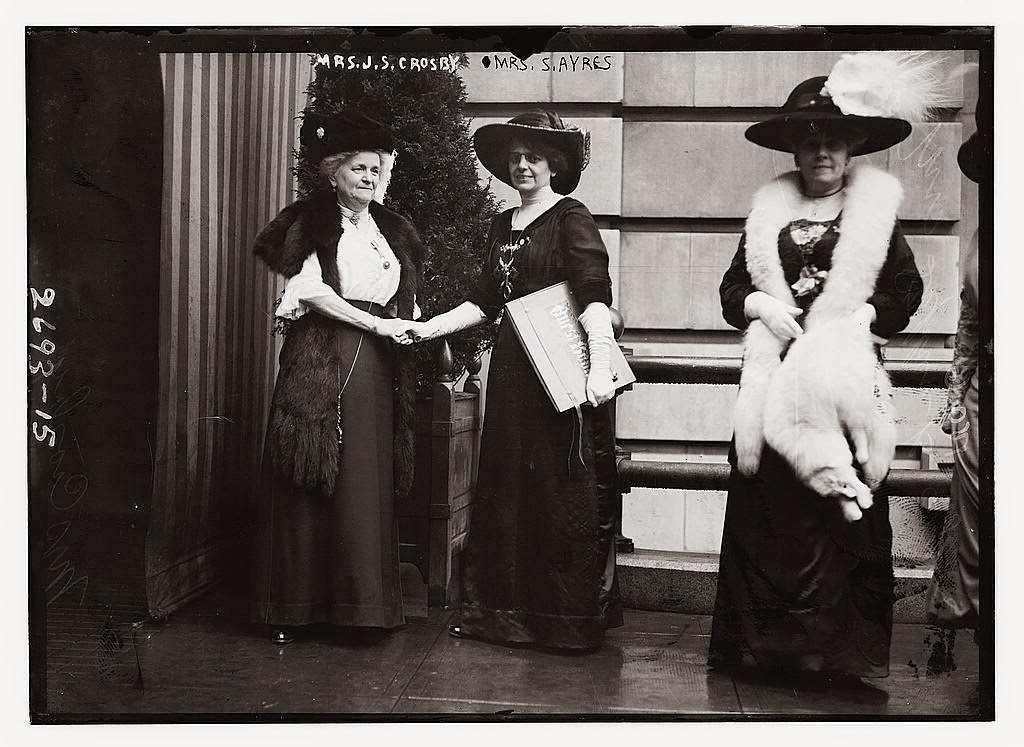
Nellie Fassett Crosby (Mrs. John Sherwin Crosby), president of the Women’s Democratic Club of New York City and founder of the Woman’s National Democratic League, and Mrs. Steven Beckwith Ayres, also active in the WNDL.

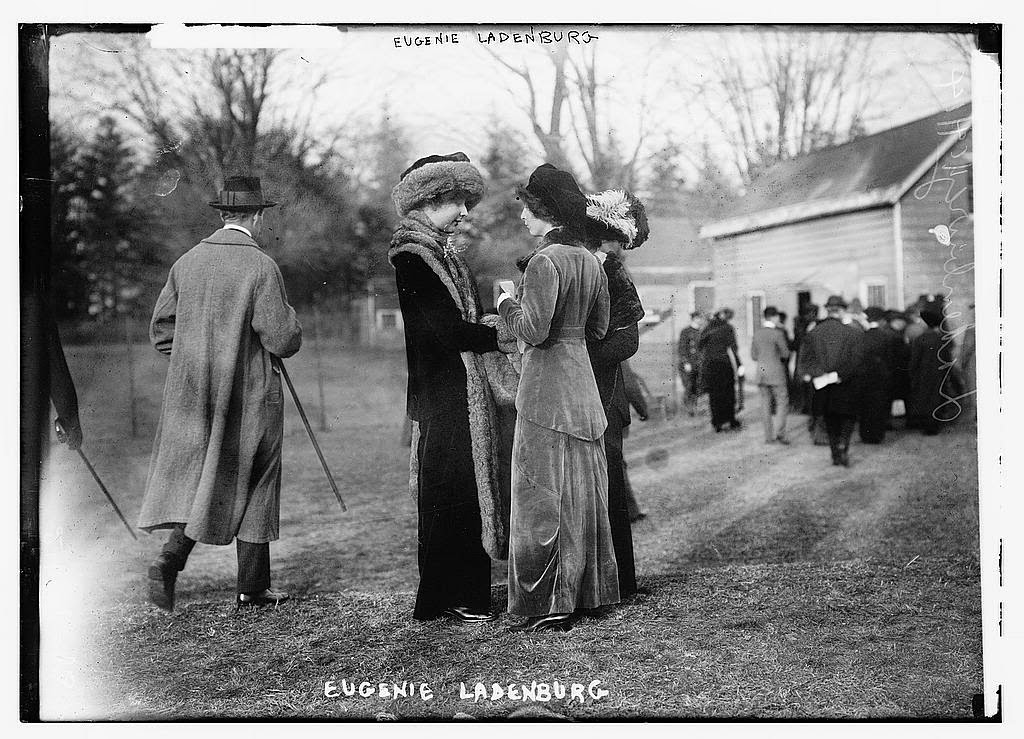
Eugenie Mary “May” Ladenburg Davie, noted Republican activist in New York and a director of the Pioneer Fund.  She was apparently a bit of a political spitfire, even while draped in the latest fashion.
 

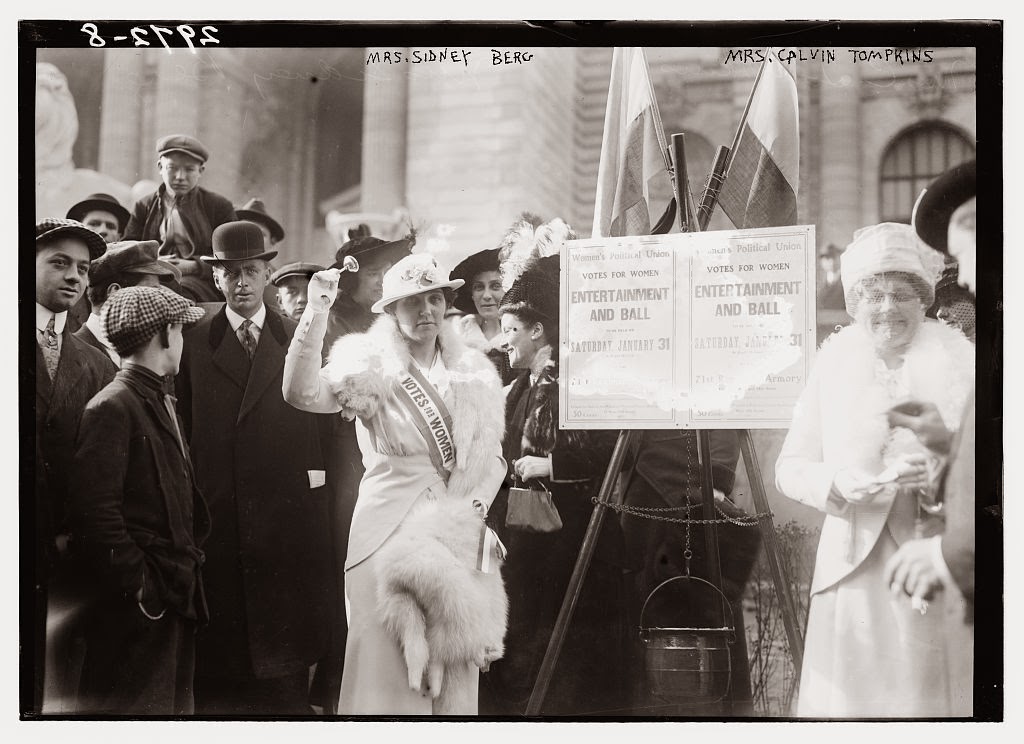
Suffragists at the Armory, January 1914

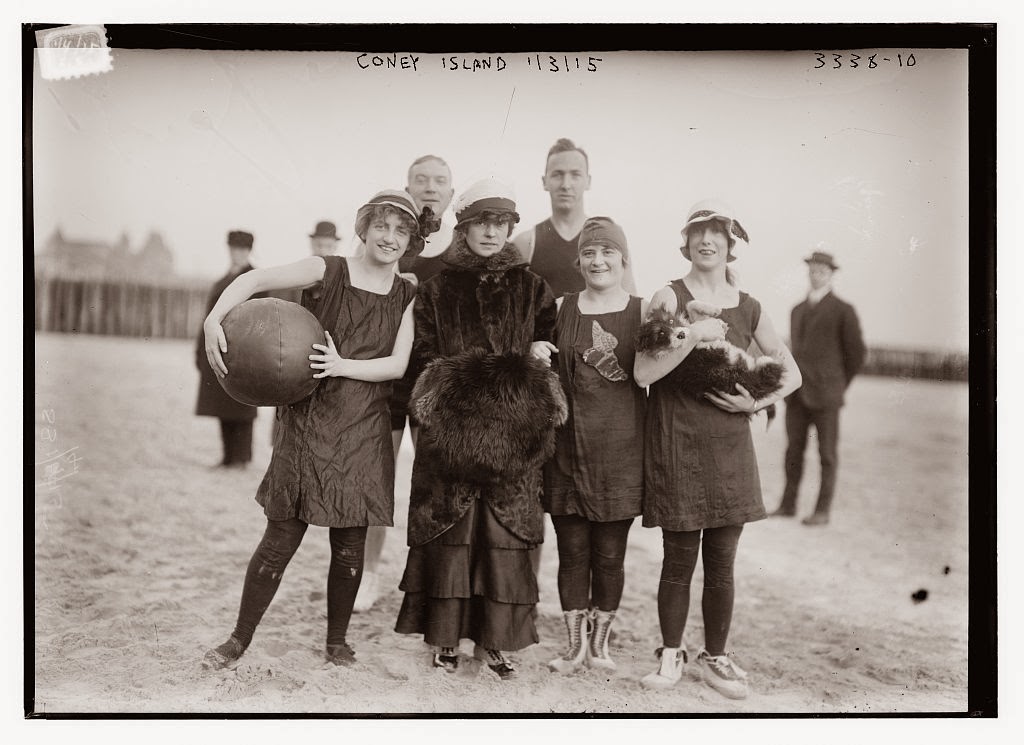
It’s even suitable beach wear! A group of friends at Coney Island, January 1915

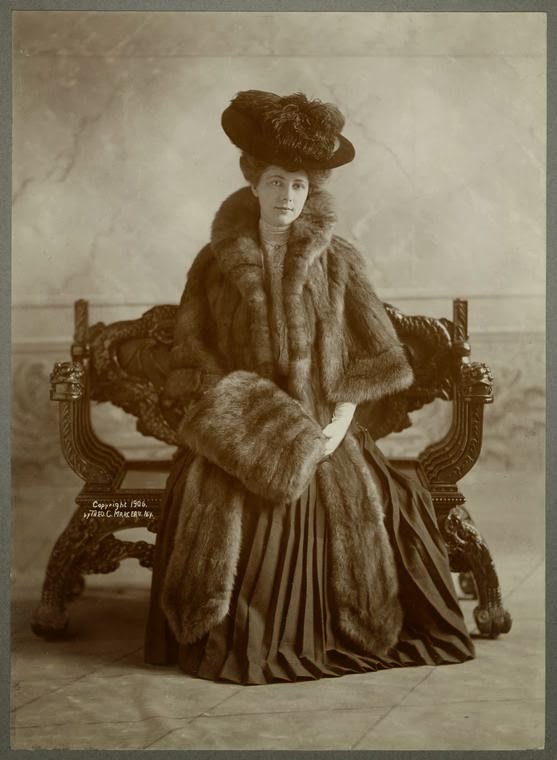
From the studio of New York portraitist Theodore C Marceau, 1906

Gimbels not only sold furs; they stored them for you in the summertime. Can’t have a frock made entirely of animal skin just sitting in your closet!


Categories
Holidays

Months after the Draft Riots, New York celebrates the first national Thanksgiving, in the shadow of war and lunar eclipse


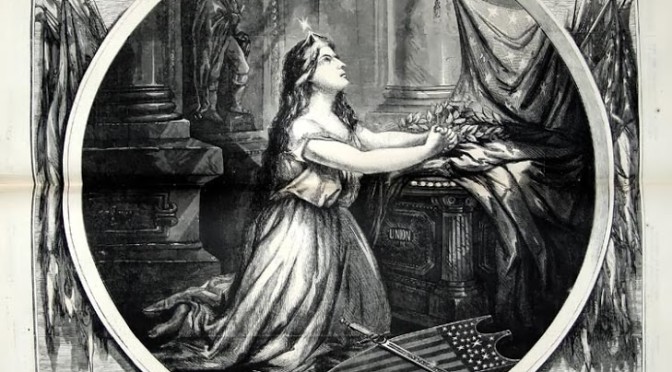
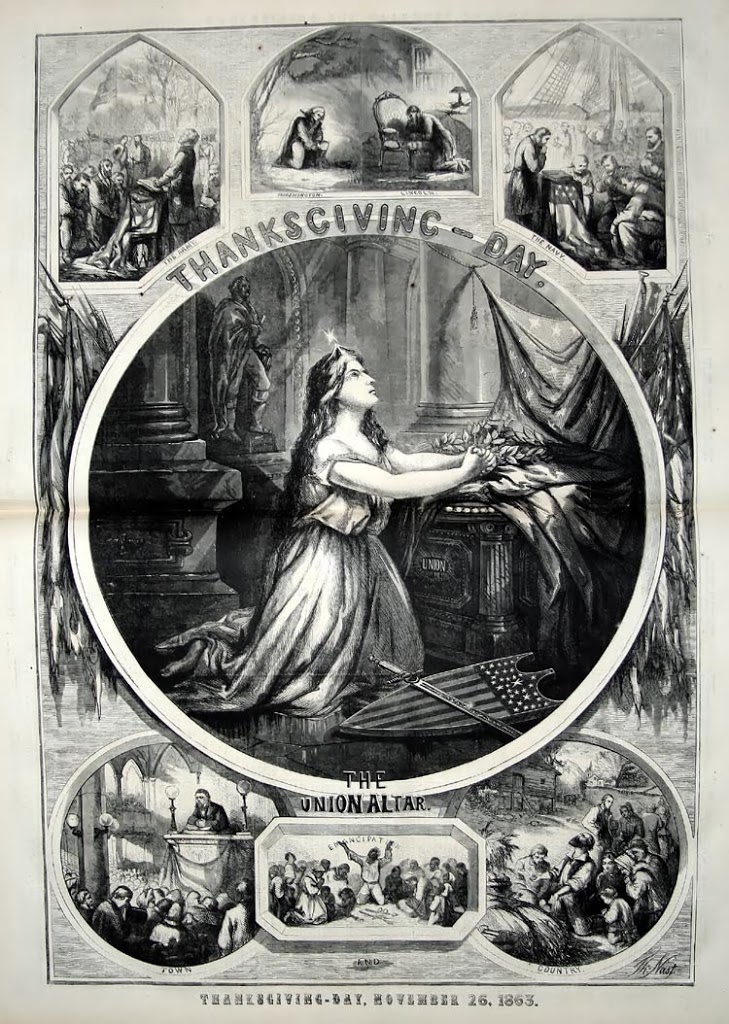
Above: A Thomas Nast illustration from Harper’s Weekly, November 1863, clearly putting the event in the context of war and hardship. 

In practice, Thanksgiving celebrates the supposed feast between the Pilgrims and their Native American neighbors in Massachusetts. But meals of ‘thanksgiving’ have been part of the Western world customs for hundreds of years, and today the meal is more an excuse to gather the family together and count the seconds until holiday shopping.

Because that ‘original’ meal was only vaguely documented, let me give you a more definite event — 150 years ago, President Abraham Lincoln declared a national celebration of Thanksgiving for the last week in November:

“I do therefore invite my fellow-citizens in every part of the United States, and also those who are at sea and those who are sojourning in foreign lands, to set apart and observe the last Thursday of November next as a day of thanksgiving and praise to our beneficent Father who dwelleth in the heavens.”

Perhaps you did a double-take at that statement.  There’s no mention of Pilgrims or Indians in Lincoln’s proclamation, which was made on October 3, 1863.  There is, of course, several soothing religious references. (You can read the entire statement here.)  After all, the United States had been fighting a Civil War for over two and a half years. Any words of peace and calm, paired with boasts of American bounty and expansion, would have put the bloody conflict in a divine context.  “[H]armony has prevailed everywhere except in the theatre of military conflict,” Lincoln wrote.

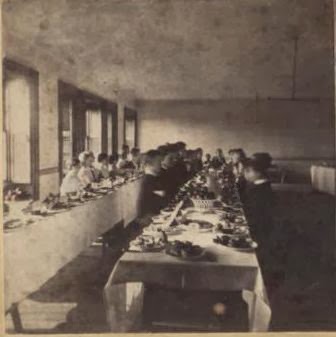
At right: Thanksgiving dinner at ‘the Home for the Friendless’, 1860s.  I cannot imagine a more grimly named institution! courtesy NYPL

New Yorkers had celebrated a form of Thanksgiving for many years prior to the 1863 proclamation.  But the feast had always been considered a regional, New England celebration, one a little foreign for the city.

From The New York Sun, November 26, 1863:  “The sights and scenes in our city yesterday afforded evident indications of a unanimous determination … to break up once and all the monopoly of Thanksgiving, so long enjoyed by the New Englanders.  For years past, it had been a standing boast of the genuine ‘Down Easters’ that the air of New York was unsuited to the festival of the Pilgrim fathers.”

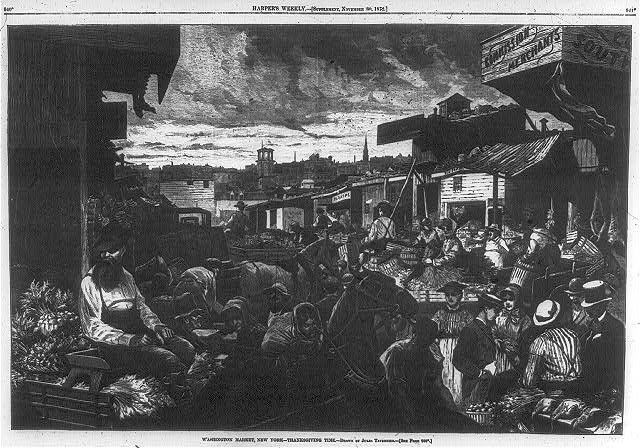
Below: Washington Market, always a hectic place, was especially so on Thanksgiving. This scene from Harper’s Weekly depicts frantic shoppers in 1872. Courtesy Library of Congress

Don’t tell New Yorkers what they can’t have!  The Sun promised a “racy and peculiar” New York Thanksgiving that year.  The markets were clogged with shoppers, as New Yorkers came out in force to purchase items for their own Thanksgiving meals.  Every other man on the street seemed to have a naked bird flung over their shoulders.  “Evidentally, every family man and woman, who could raise the number of greenbacks, invested them in Thanksgiving fixings.”

This might have been a little journalistic posturing.  Just five months earlier, New York had been ablaze in the Draft Riots, several days of violence towards its own citizens, fueled by an unfair conscription policy and the fears and racial hatreds of its citizens.  Most of the burned buildings had been cleared, but the bloodshed was on many minds.  Many benefits throughout the city raised money for injured Union soldiers and the families of those who had died in battle.

The Sun quietly refers to the Draft Riots’ most sickening event, the burning of the Colored Orphan Asylum.  “At the Five Points House of Industry the little ones are to have a bountiful feast.   The colored children burnt out by the mob will be taken care of at Carmansville.”

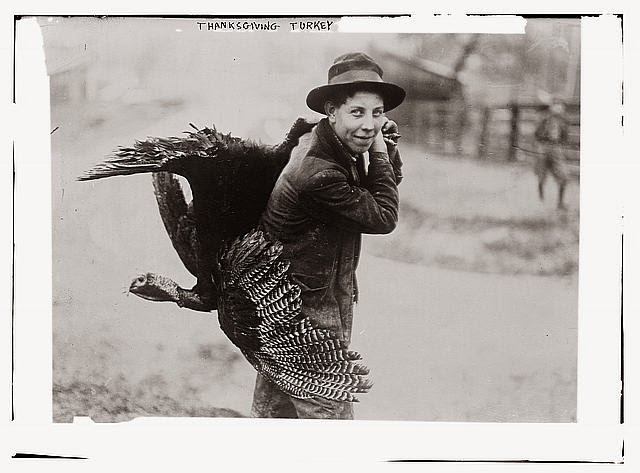
Below: Boy with a turkey, circa 1910-1915 (LOC)

Generally speaking, celebrations went forward as they would in subsequent years — the food, the church services, the carousing, the merriment, decades before anybody would think of blowing up gigantic balloons and dragging them down Broadway.

However, one thing had been very different that year.  On the evening before Thanksgiving, New Yorkers looked up into sky and witnessed a partial lunar eclipse.

While the event might have filled some with dread, it cast a mysterious pall further south, on the battle field of Lookout Mountain in Chattanooga, Tennessee.  It occurred hours after the Confederacy’s defeat by the Union army and helped shield the Southern forces as they slipped away by cover of fog.

Alongside news of New York’s embrace of Thanksgiving, the newspapers that day reported of a victory and a death toll:  “General [Joseph] Hooker, in command of General Geary’s division, Twelfth corps, General Osterhau’s divison, Fifteenth corps, and two brigades, carried the north slope of Lookout Mountain, with small loss on our side, and a loss to the enemy of five hundred or six hundred prisoners: killed and wounded not reported.”