Categories
Those Were The Days

Where did New Yorkers first buy recorded music?

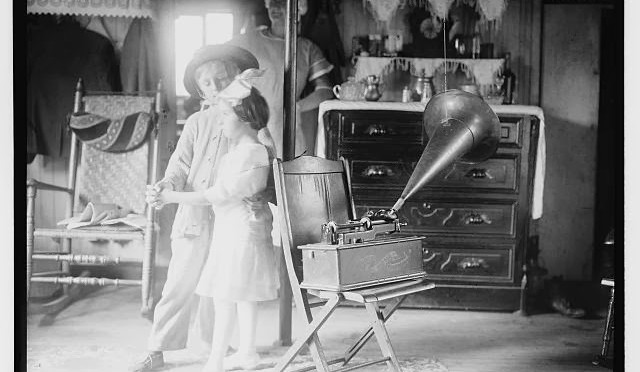
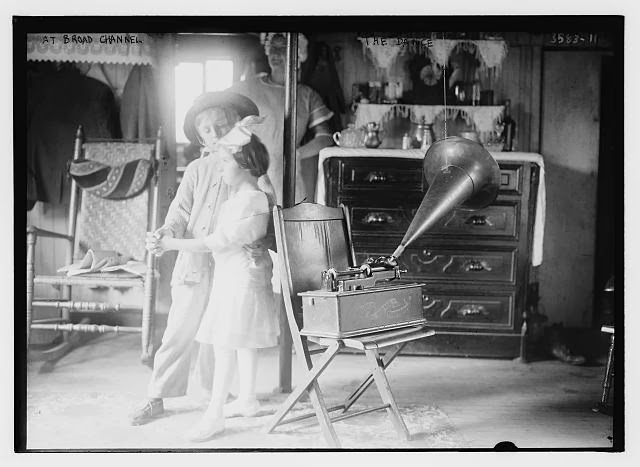
“Photograph shows a boy and a girl dancing while an Edison Home Phonograph plays in a house in Broad Channel, Queens, New York City.” — taken between 1910-1915

Here’s something many people thought they’d never see again in New York City — the opening of a new record store.  Rough Trade, known for their famous London record shop, will open an awesomely spacious new store in Williamsburg this week, with vinyl-record listening stations, a coffee shop, live performances and a heap of nostalgia on its shoulders.

Remember Tower Records on Broadway?  Virgin Records in Times Square?  The old subway Record Mart? The long-vanished Commodore Record Shop?  The past is littered with the ghosts of music stores long gone.

But where did people first buy recorded music in New York City?  The first recordings came on phonograph cylinders, long tubes with the grooves etched along the front, often made with wax.  Essentially, they looked like — and probably smelled like — big, decorative candles.

They were soon in competition with phonographs in a flat, wax disc form, the musical delivery device which eventually won out and became the standard for decades.

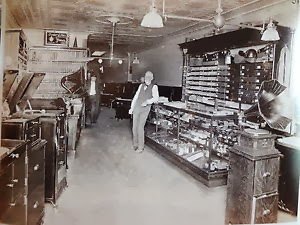
In the beginning, recorded music was played in exhibition halls, not available for home use.  By the 1890s, the first musical devices were available for purchase, and phonographs were sold in establishments that offered instruments, music boxes or early electronics — Broadway piano stores (like the one above, in 1910) or the places down on the soon-to-be-named Radio Row which offered New Yorkers the latest technology.

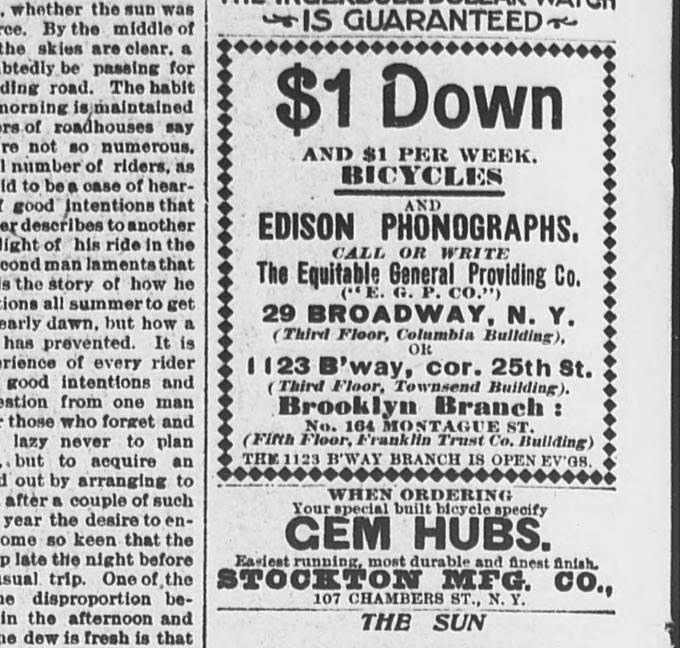
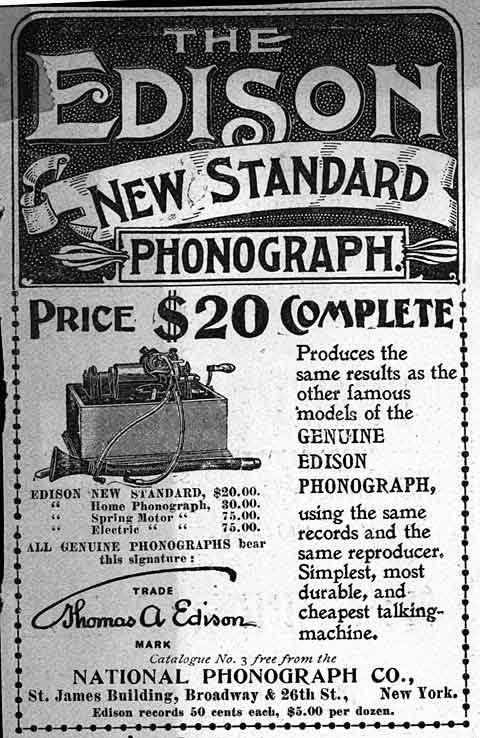
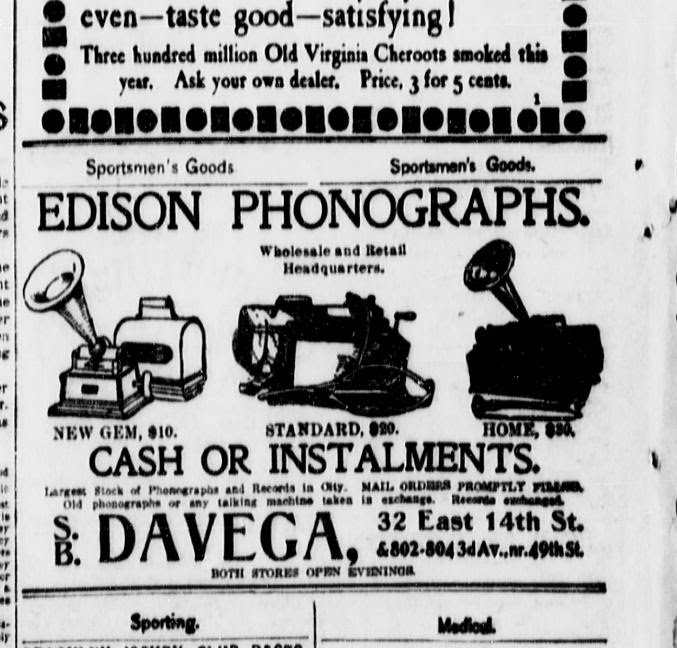
Naturally, the first records were made to play on Edison machines, pricey novelties in the late 1890s.  Here, in 1898, you could put a down-payment on the purchase of a phonograph machine and a bicycle — a real hipster double-play today!

Another advertisement from 1898 presents Edison records at just “$5.00 a dozen”, found at the St. James Building at Broadway and 26th Street.  Of course, a great many of these records were spoken word, not music;  after all, they were nicknamed ‘talking machines’ at this time.

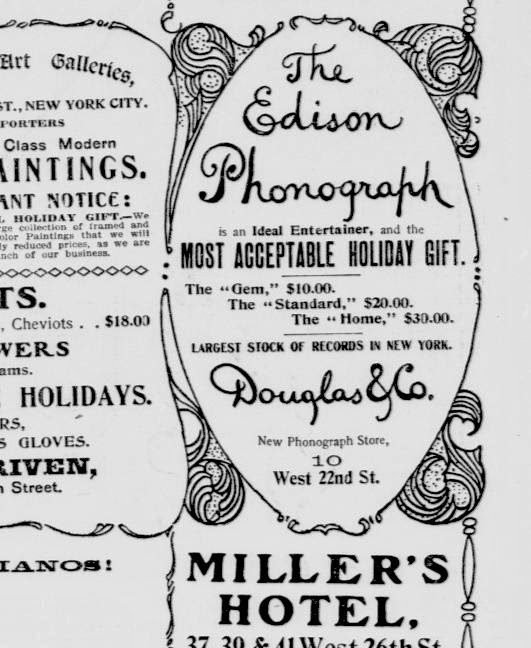
I was able to find a few other early photographer retailers in old newspaper advertisements.  For instance, Douglas & Co., at 10 West 22nd Street, appears to be one of New York’s earliest retailers specializing in recorded sound.  From Dec 16, 1900:

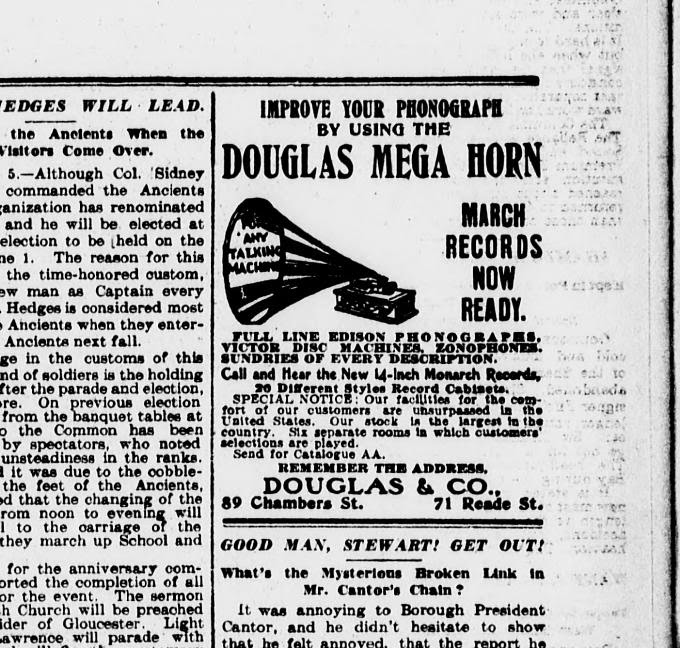
By 1903, Douglas & Co. had moved downtown, closer to the electronic retailers that would later specialize in radio and televisions:

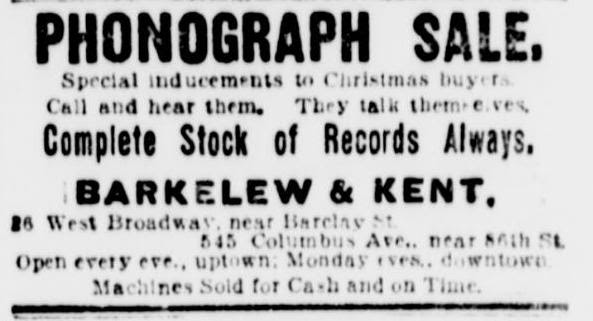
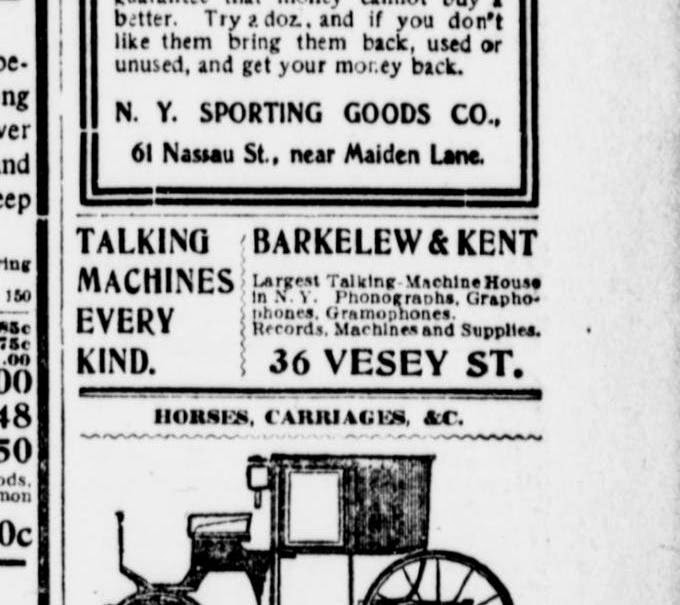
Another early phonograph retailer I was able to locate was A.B Barkelew & Kent.  “Call and hear them. They talk themselves.”  They would eventually move to Vesey Street and, in 1902, claim “the largest stock in New York.”

As early in 1899, Barkelew & Kent could claim to be one of New York’s first used record stores.  From a trade ad: “We exchange records you tire of and do not like.”

Interestingly, early record stores were listed alongside advertisements for sporting goods.  This ad is from May 1902:

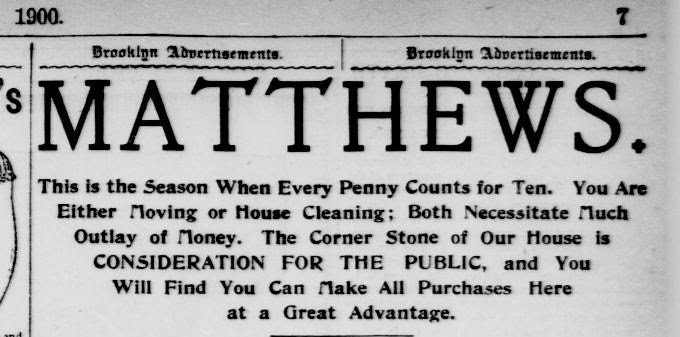
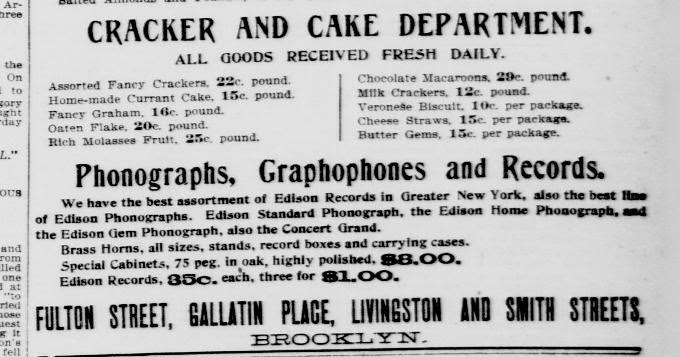
And since we’re celebrating the opening of a new record store in Brooklyn, I should add that one of Brooklyn’s first major record stores was at A.D. Matthews Department Store on Fulton Street.

From an April 1900 advertisement:

Categories
It's Showtime

Harlem on a high note: The grand Harlem Opera House

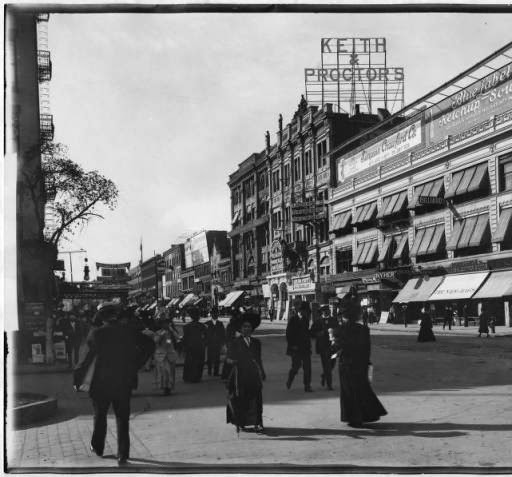
Proctor's Harlem Opera House.

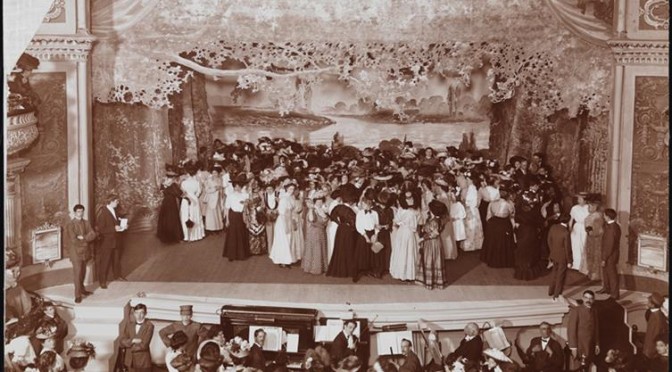
A ton of people on-stage at the Harlem Opera House in 1907. During this period, it was owned by vaudeville impresario Keith Proctor and called Proctor’s Harlem Opera House. Pictures courtesy the Museum of the City of New York 

 The Hotel Theresa, subject of this week’s podcast, had a rather unusual neighbor in its early years.

Harlem is known for a rich musical heritage in a variety of genres, but did you know it also had very old ties to world of opera, from as far back as the 19th century?

Oscar Hammerstein was a wealthy New York cigar maker who decided to dip his toe into real estate ventures, and in a most surprising neighborhood.  Thanks to the construction of the elevated railroads in the 1880s, the once-distant Harlem was now linked to the heart of the city, and thousands began moving there, particularly European Jewish immigrants.

Theatre, Harlem Opera House 125th St. & 8th Ave.Hammerstein built dozens of rowhouses for prospective residents, but his real vision was the Harlem Opera House (at right), constructed in 1889 and located at 207 West 125th Street, on the other side of the street from the Hotel Winthrop (later the Hotel Theresa).

For a time, it really did just showcase operatic productions, of both the severe and light varieties.  According to author Jonathan Gill, “Hammerstein had a broad vision of what uptown theatergoers wanted, and he produced both popular and genteel drama and opera in English translation, an experiment that proved attractive to audiences who were willing to pay up to $2.50 a ticket.”

Famous stars were drawn here from the stages of Herald Square.  For instance, Edwin Booth performed Shakespeare here in 1889, a few years before his death.  Lillian Russell, a favorite of the New York pressperformed the show ‘An American Beauty’ here in March 1897.

The Opera House helped create a miniature theater district here along 125th Street.  Hammerstein himself built the Columbus Theatre the following year, bringing more popular fare — namely, vaudeville.  Soon the street would become one of New York’s great centers of burlesque entertainment.  Many years later, Hurtig & Seamon’s New Burlesque Theater would open a couple doors down from the opera house, later changing its name to the Apollo Theatre.

Hammerstein, however, could not make the Harlem Opera House a financial success, and he was soon lured downtown to build his most renown theaters (and places that would later inspire his grandson Oscar Hammerstein II.)  The Harlem Opera House was sold and transformed into a more traditional vaudeville house.  By the 1930s, to compete with the thriving amateur nights over at the Apollo, the Harlem Opera House had its own amateur nights.  Its most notable discovery is one of the greatest names in music — Ella Fitzgerald.

Below: Another view of the Opera House, here as Proctor’s Opera House, courtesy NYHS.  The balconies to the left belong to the Winthrop Hotel — compare this picture to the Winthrop photo here — to be replaced in a few years by the Theresa.


The Opera House was torn down in 1959.  Surprisingly, it appears there was the possibility of a new opera house in Harlem being built in the late 1960s, under the guidance of Gian Carlo Menotti, but that never panned out.  However, the operatic tradition lives on today with the Harlem Opera Theater, founded in 2001.

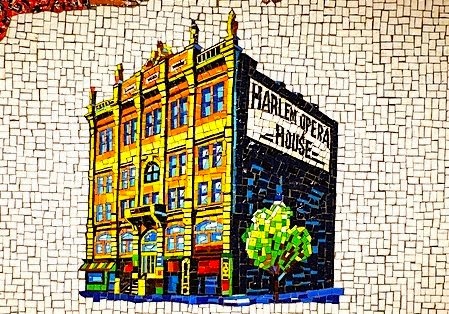
Below: You can still find the Harlem Opera House in Harlem — on the walls of the 125th subway station, in mosaic form!

Categories
Amusements and Thrills

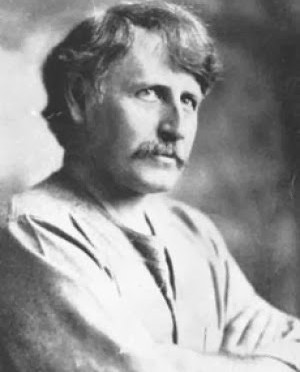
Charles Kellogg, the man who put out fires with his voice

New York has seen its share of bizarre entertainments, especially back in the days of vaudeville, when people would pay for almost anything that amused or titillated.  A few months ago, I wrote about the novelty star Don the Talking Dog, who allegedly spoke a handful of English and German words.

But another vocally talented star was the hot vaudeville ticket one hundred years ago — Charles Kellogg, the man who could extinguish fire with his singing voice.

Kellogg was an early environmentalist and promoter of California’s redwood forests.  He billed him as ‘California’s Nature Singer,’ known for his sterling emulation of bird song,  recording his aviary music for Victor. “He was born with the throat of a bird,” said the New York Times.  Imagine cranking up this record on your Victrola, his ‘duet’ with Romanian soprano Alma Gluck:

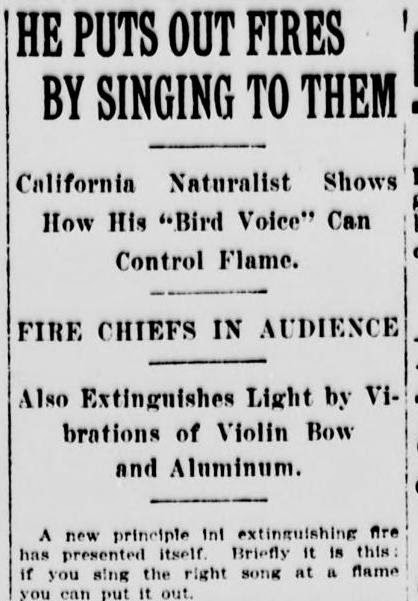
Kellogg voice was allegedly superhuman.  It could not only emulate the sounds of nature, but it could protect nature from devastating flame.

He performed this particular trick in New York on November 11, 1913, at the brand-new Palace Theater (Broadway/47th Street), performing for an audience which included various New York fire chiefs, several scientists, and an auditorium full of curiosity seekers.  Also on hand: William Temple Hornaday of the Bronx Zoo, his reputation recently sullied over the whole Ota Benga scandal.

During the demonstration, Kellogg proved he could affect the flickering flame on the other side of the stage by first aiming his ‘bird song’ at it, then by drawing a bow across a sheet of metal.  “He stood fifty feet away from the flame and drawing the bow across the metal and singing his bird song the flame acted the same way, finally going out.”

Kellogg continued his display of natural gifts by demonstrating a divining rod for finding water, then by dropping to the floor and “demonstrated the Indian way of making fire by friction with two pieces of redwood.”

Captivating, I’m sure, but not enough to convince New York’s fire chiefs.  “It has not yet reached a point where Fire Commissioner Johnson will put male quartets in the fire house ready to dash to a fire and render a popular ballad.” [source]

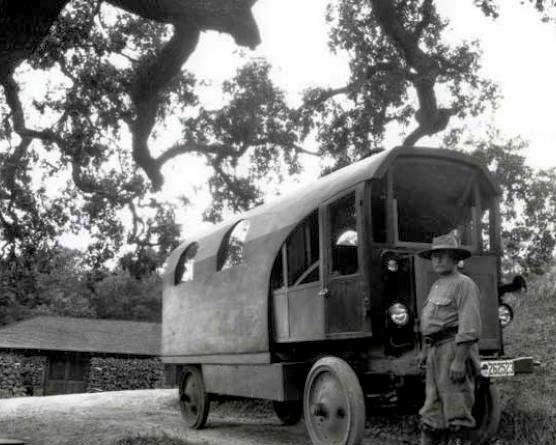
Kellogg returned to New York in 1917 with another redwood-inspired creation — his ‘redwood motor home’, called the Travel Log (pictured below), which he and his wife took cross-country.  The idea of a ‘mobile home’ was a true novelty for the day.  Kellogg’s Travel Log was briefly displayed at a motor car salesroom on Broadway and 57th Street to the delight of auto enthusiasts.

Picture courtesy NPR

By the way, Mythbusters recently took up Kellogg’s challenge as to whether the human voice could put out a fire.  The verdict — yes, it can, but not at any decibel Kellogg could have possibly been singing in. More information here.

Categories
Wartime New York

The end of war: New York newspapers celebrate Armistice Day and the end of World War I

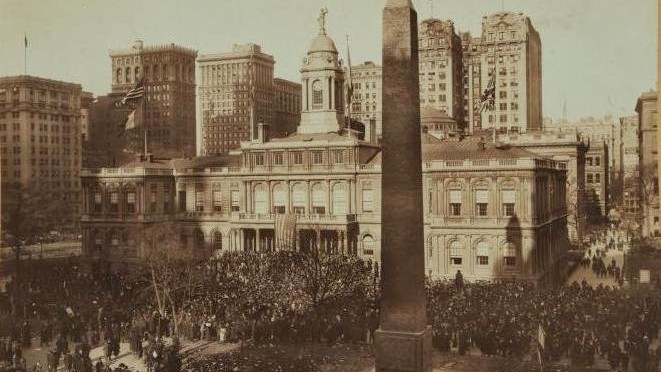
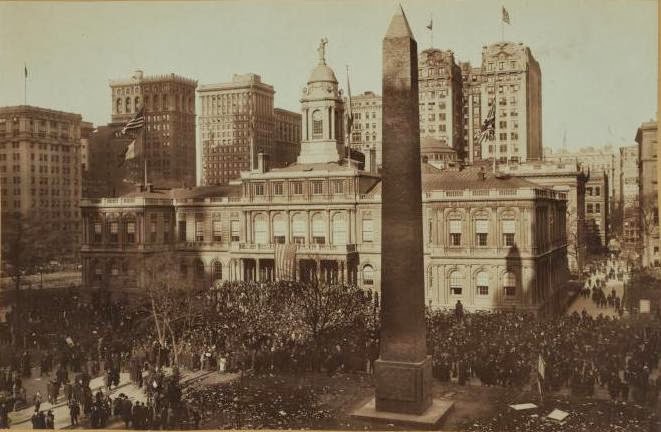
Armistice Day 1918: An impromptu gathering of New Yorkers gathered in front of City Hall. (NYPL)

Today is Veterans Day in the United States, a holiday devoted to the memory and service of those in the American armed forces.  While this is a commemoration of all men and woman who have served — during war and peace-time — the specific date of Veterans Day (November 11) derives from one particular moment — the end of World War I, on November 11, 1918.

By 1919, several individual states had already made Armistice Day a holiday.  According to the New York Tribune, the first Armistice Day parade that year took place at four in the morning, when Brooklyn post office workers and a thousand other well-wishers took to the streets in front of Brooklyn Borough Hall.

Armistice Day was declared a national holiday in 1938.  At the completion of World War II, the national holiday was expanded to include those who had served in that war, officially renamed Veterans Day in 1954.

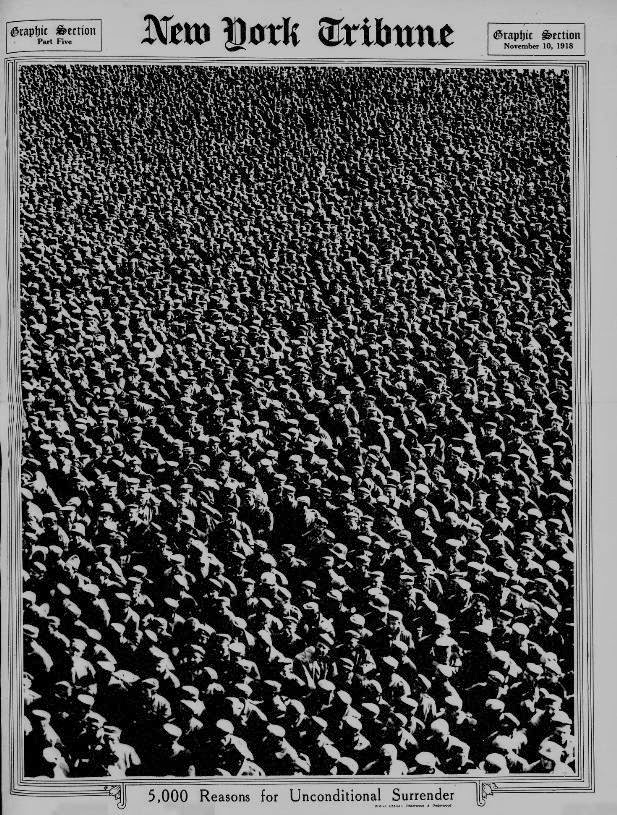
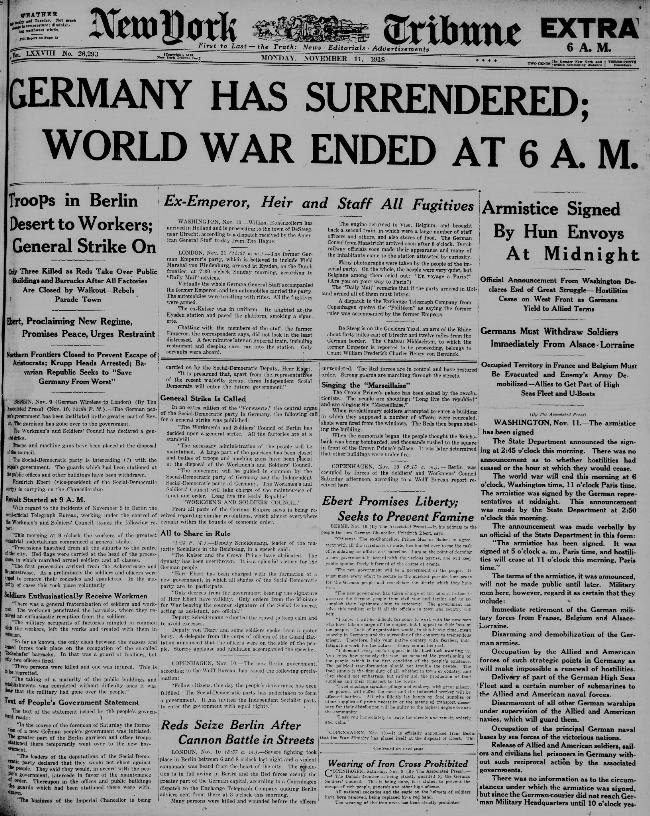
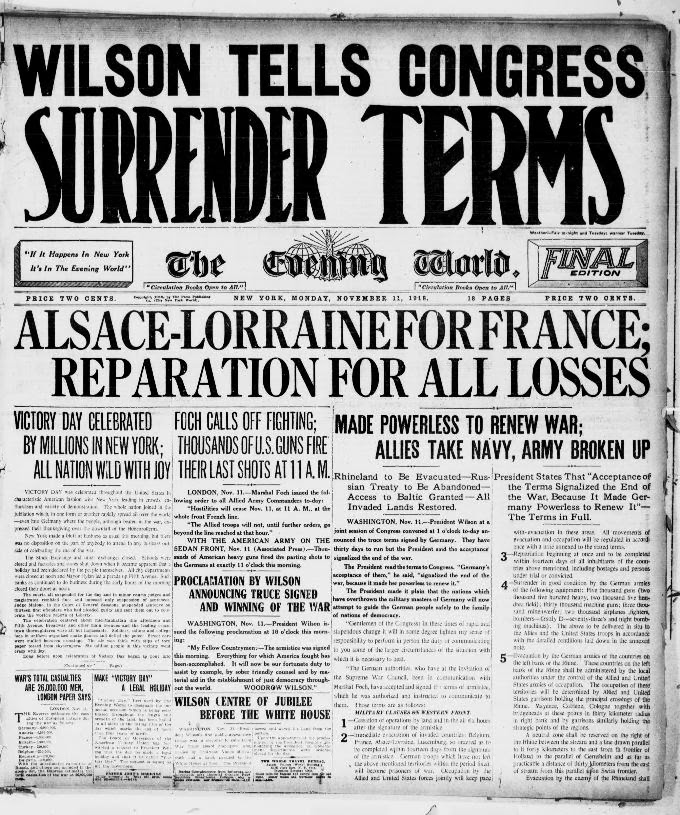
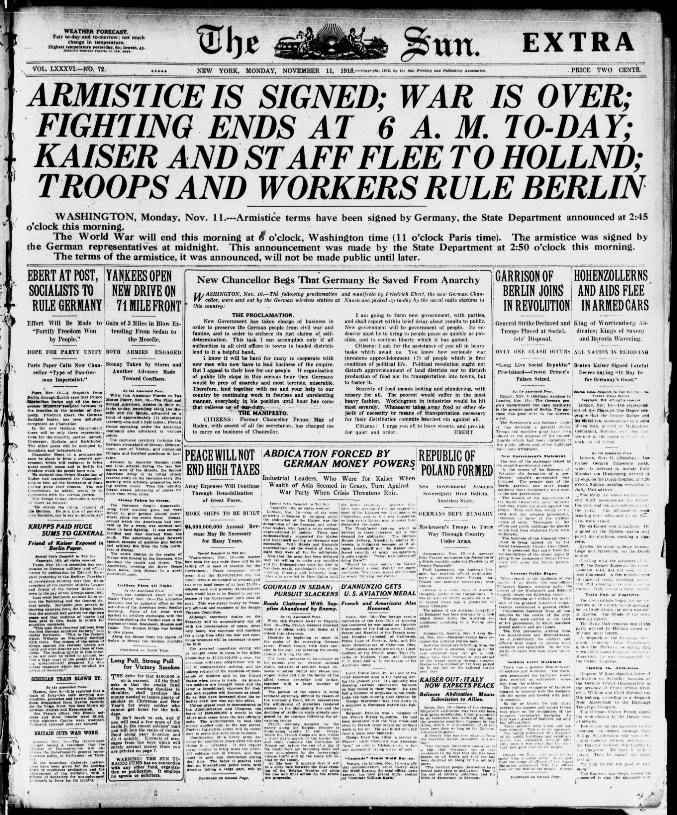
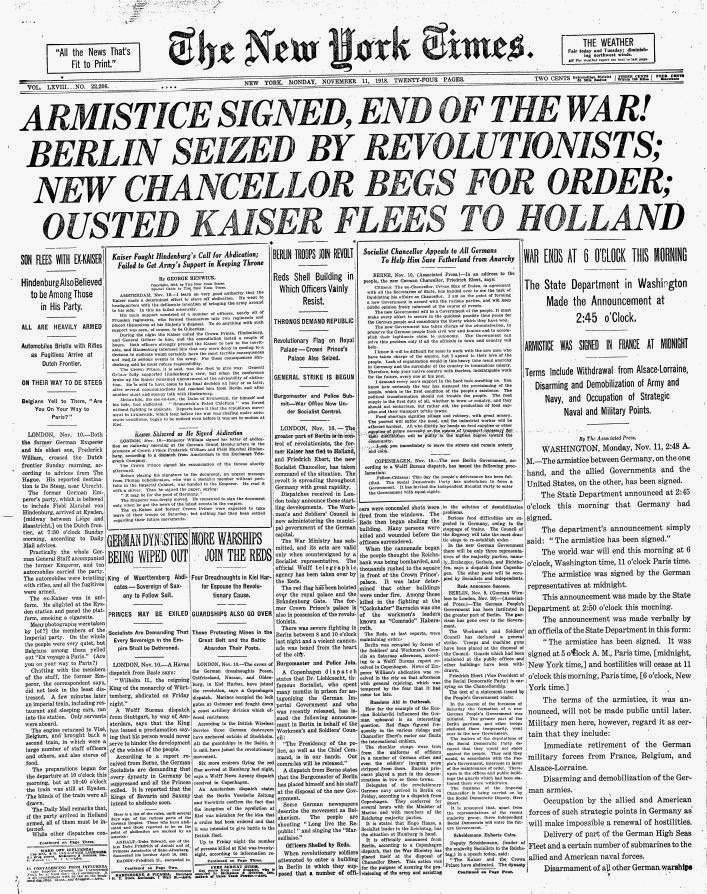
But I do find it interesting that the date itself commemorates a specific event, and one that brought a flood of relief and passion to millions of people around the world.  Here’s how the major New York City newspapers presented the event to their readers:

  The New York Tribune, November 10, 1918

The New York Tribune, November 11, 1918

 
A font-kerning nightmare! The New York Evening World, November 11, 1918:

Semi-colon heaven! The New York Sun, November 11, 1918

The New York Times, November 11, 1918

Categories
Those Were The Days

Let’s go see the horses at Madison Square Garden!

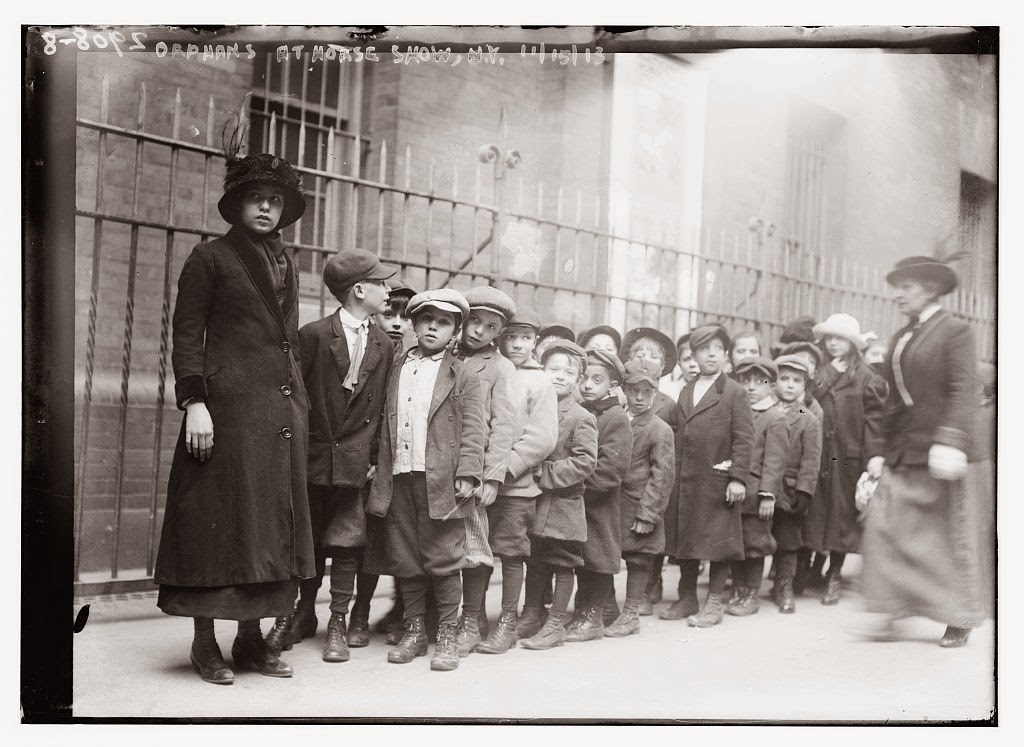
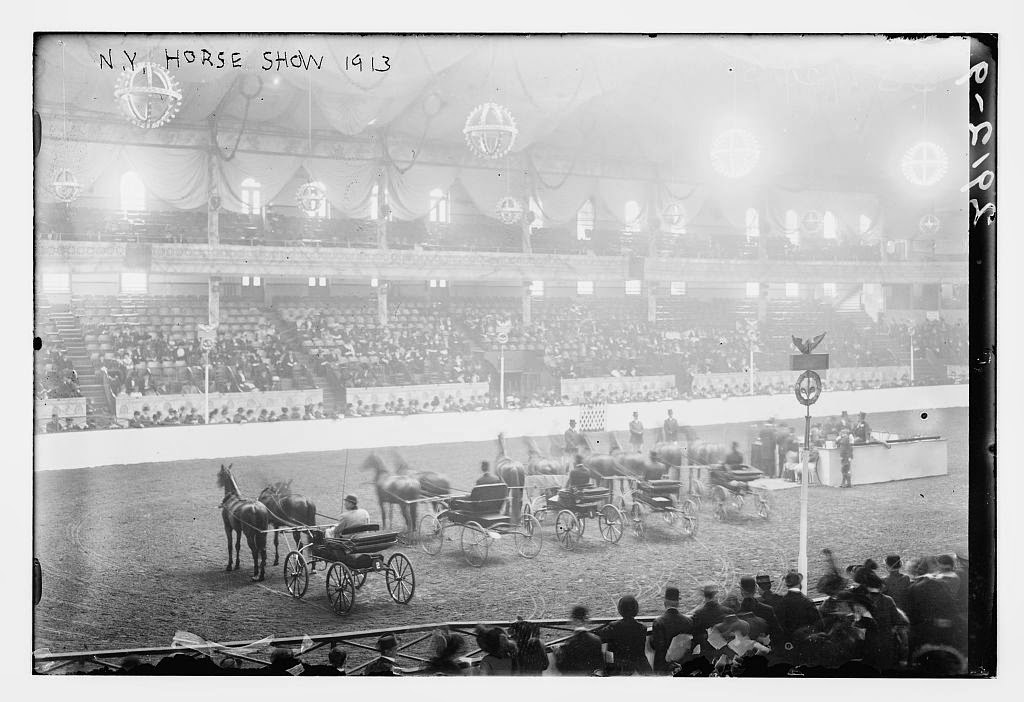
These unbearably cute orphans seen above were lined up to go to the National Horse Show at Madison Square Garden which began on November 15, 1913.  These are of course the days of the Garden down at the northeast corner of Madison Square, the glorious McKim, Mead and White structure topped with a glittering statue of Diana.

Once inside, the children were witness to a marvelous variety of events, including horse racing, pictured here:

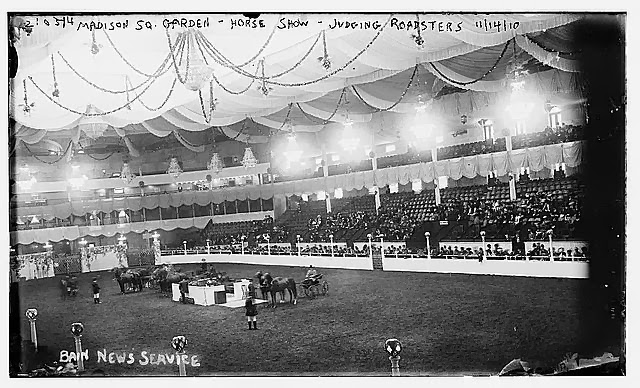
Here’s another view of an earlier event from 1910:

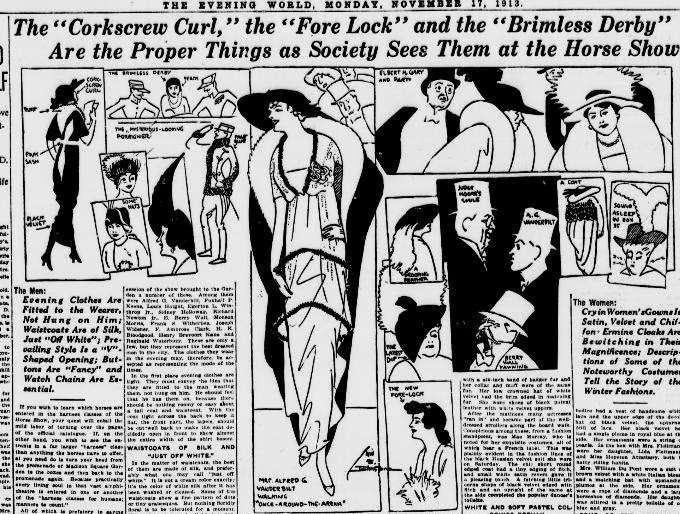
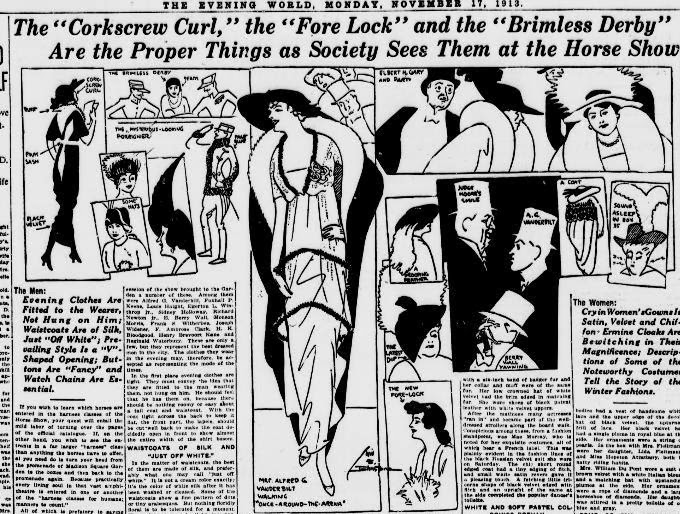
The National Horse Show was one of New York’s big society events, as much a see-and-be-seen spectacle as the opera.  Did anybody care about the dressage, the equestrian excellence?  Perhaps some. But many were just there for the fashion show as society doyennes and big-money mogul strutted the latest styles.

“If you wish to learn which horses are entered in the harness classes of the Horse Show, your quest will entail the mild labor of turning over the pages of the official catalogue.  If, on the other hand, you wish to see the entrants in a far larger “harness” class than anything the horses have to offer, all you need do is turn your head from the promenade of Madison Square Garden to the boxes and then back to the promenade again.”

From the Nov. 17th Evening World

From the Nov. 21st Evening World

So how did a group of poor orphans get invited to high society’s big event? It was a gesture of charity by the Vanderbilt family — Alfred Gwynne Vanderbilt* was president of the horse show — who invited 3,000 orphaned children from around the city to sit in the balconies.

The city’s little wards have looked forward to this occasion for many months.  They always do.  They know Santa Claus Vanderbilt.  After the show each of them will leave the Garden with a substantial present.  It is their Christmas Day.” [source]

* Two years later, Mr. Vanderbilt would die in the sinking of the RMS Lusitania.

Photographs at top courtesy the Library of Congress
Categories
The Knick

The Lower East Side went back in time this week

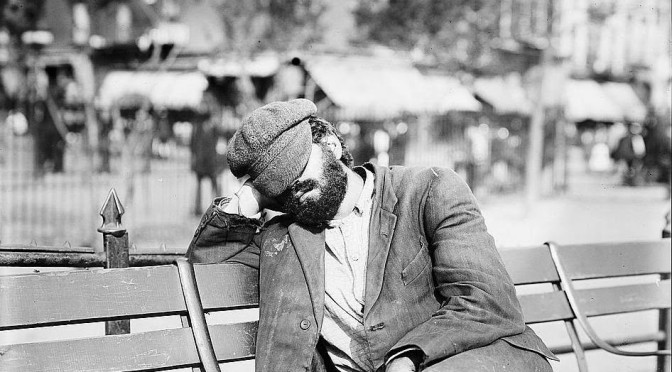
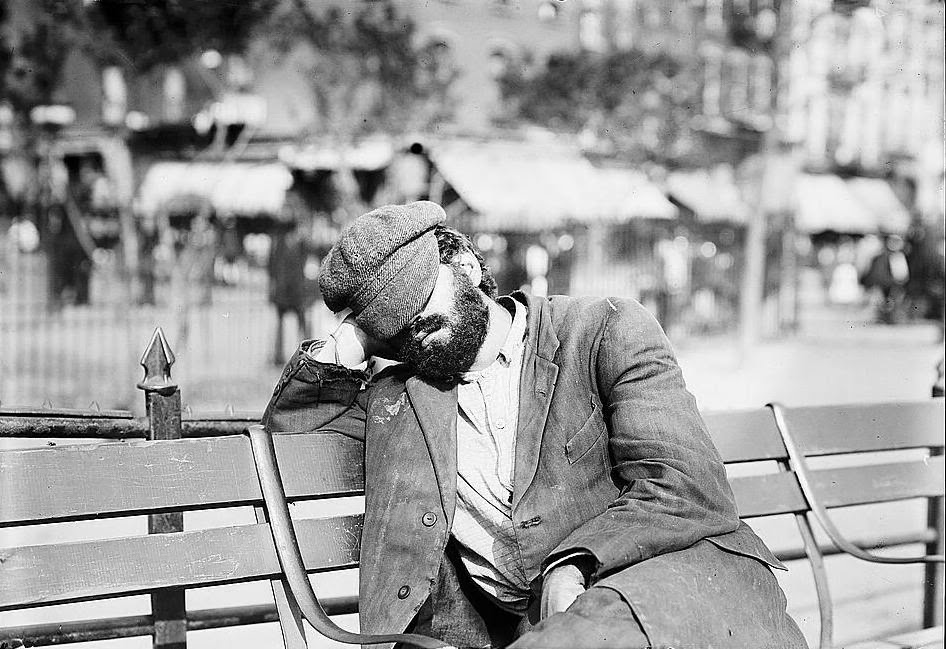
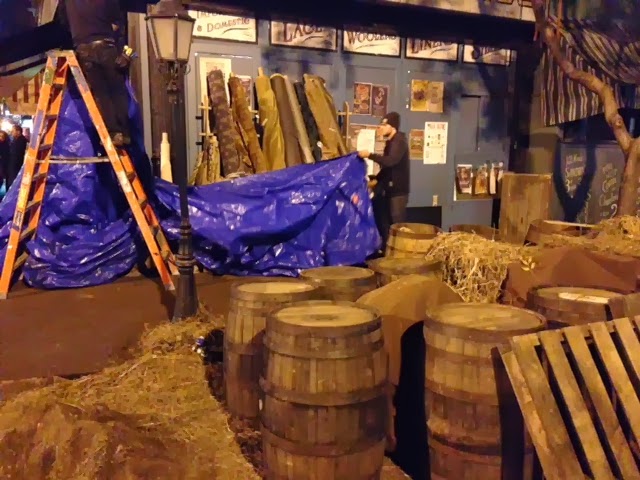
Was this photograph taken yesterday on the set of Steven Soderbergh’s new mini-series The Knick, or was it taken back in the 1910s?  The answer is at the bottom of this blog post!

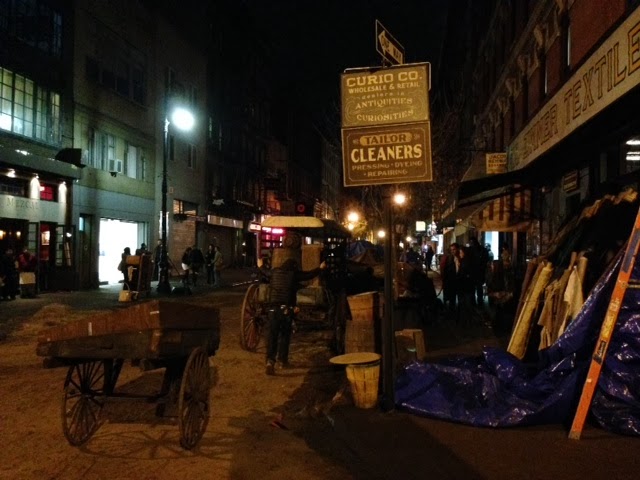
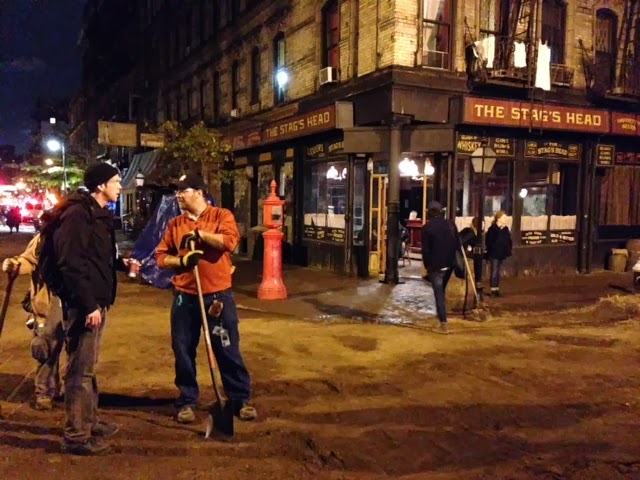
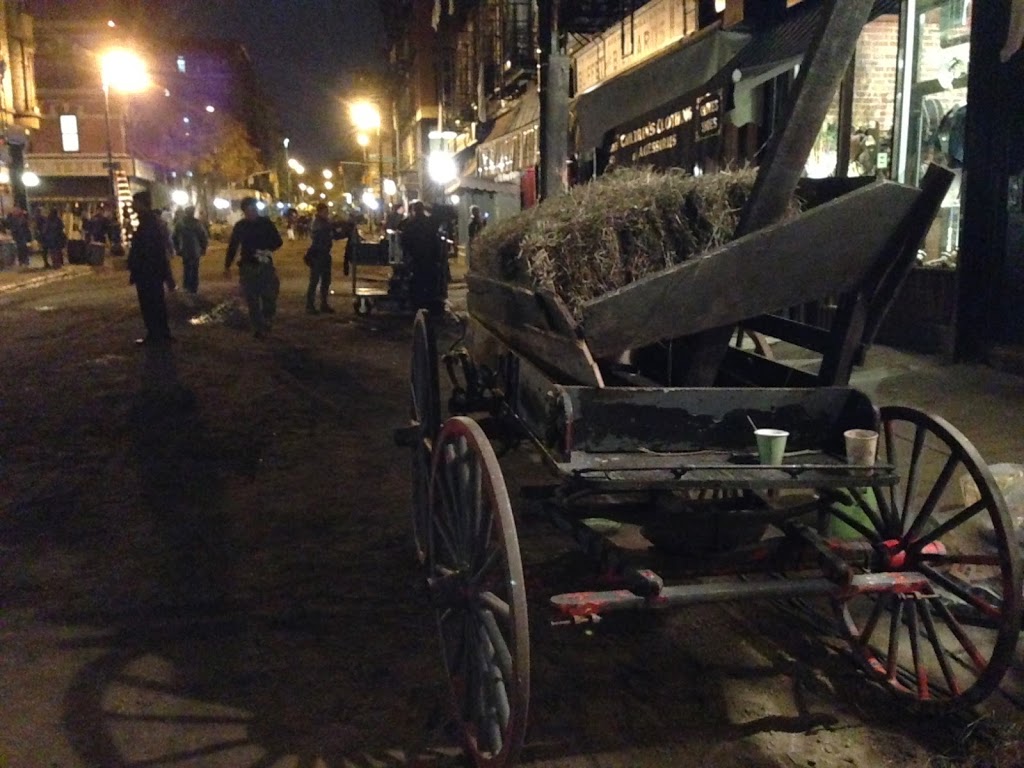
This week, a little stage magic is manifesting in the Lower East Side. The Broome Street of 2013 has been turned briefly into the Broome Street of 1910!  Steven Soderbergh has been shooting his new mini-series The Knick in New York this week, a tale of old Knickerbocker Hospital set over a century ago.  This required the boutique-and-lounge strewn Broome be reverted to its days of immigrants, wagons and pushcarts.

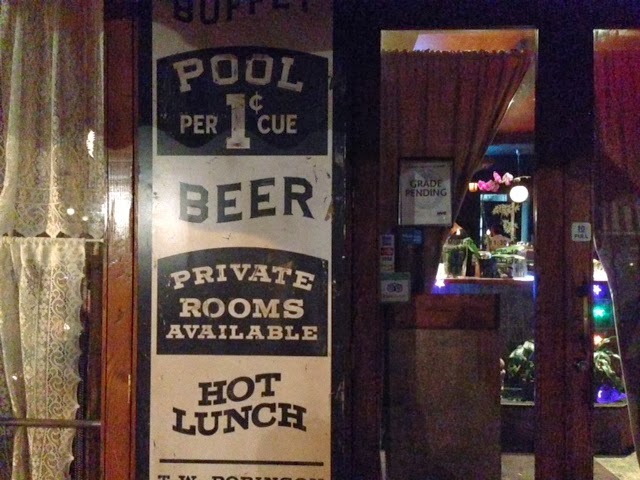
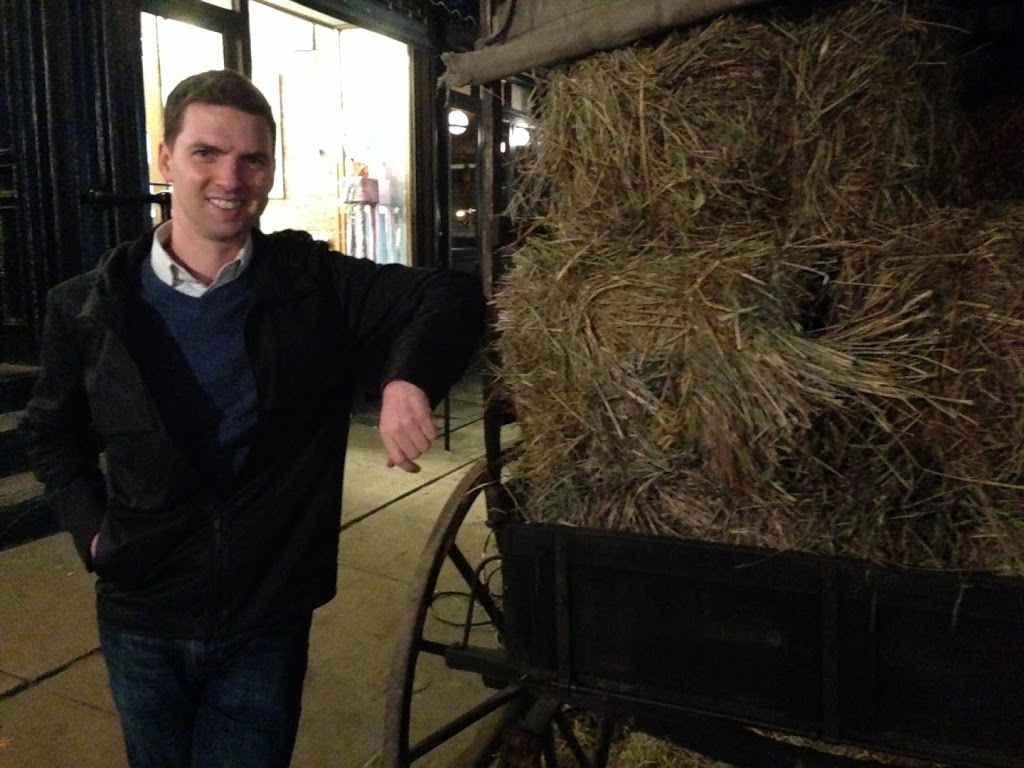
Tom wandered through the set last night and took these photographs:

Hay, it’s one of the Bowery Boys!

Interestingly,. there’s an actual Stag’s Head up on 51st Street!

Gothamist also has a fine set of pictures from the set, featuring some extras in costumes.  The Soderbergh mini-series will debut on Cinemax in 2014. 
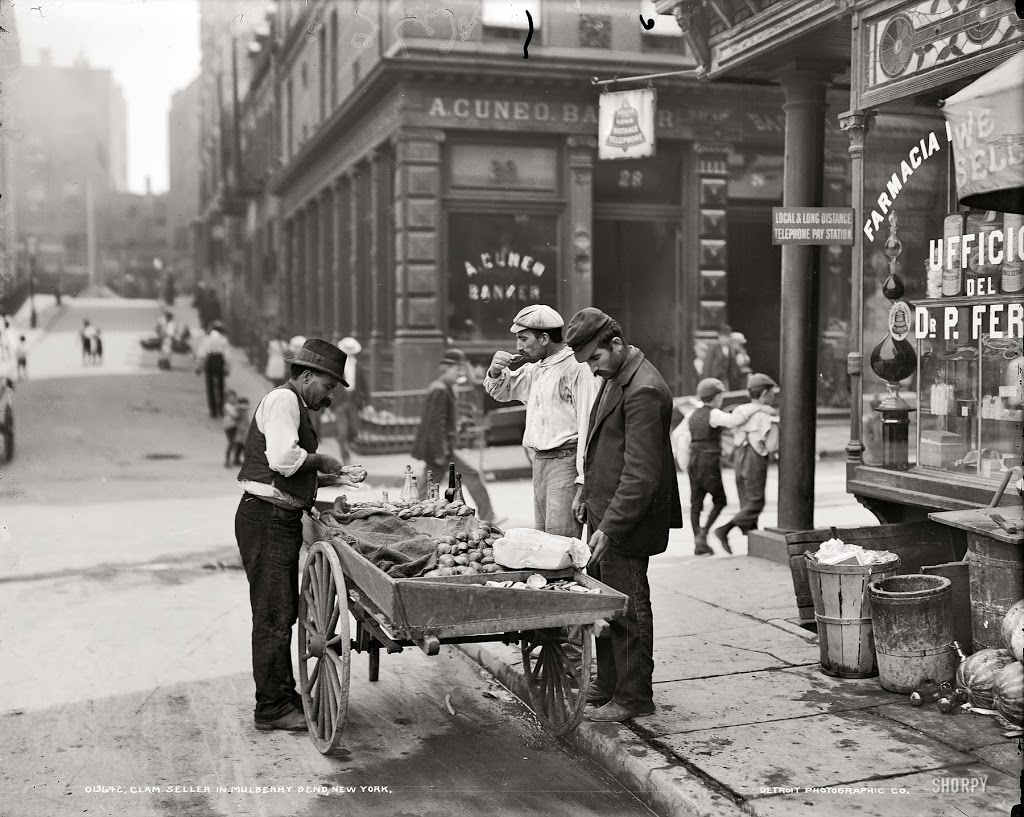
Compare these with some actual pictures and illustrations of the Lower East Side in the early 1910s:
Mulberry Street clam seller (circa 1900-1905), cleaned-up image courtesy Shorpy.
Street scene from 1915,” actual street unknown (NYPL)
A Lower East Side hot-potato merchant (NYPL):
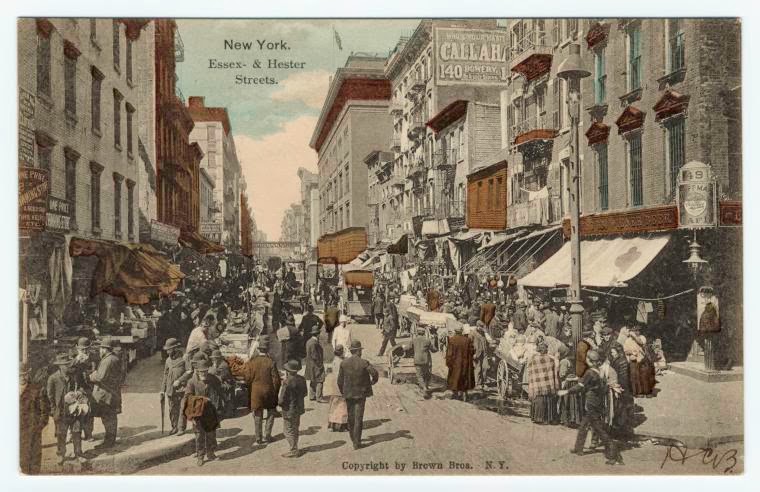
Essex and Hester Street, photo-mechanical postcard, date unknown (NYPL)
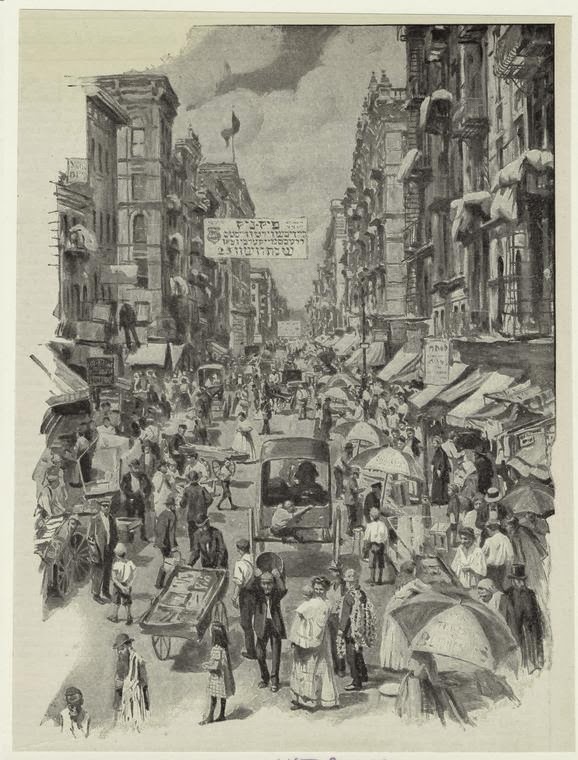
Illustration from Ladies Home Journal, Sept 1910, of a typical LES ‘street scene’ (NYPL):
As for this photograph — this is not a picture of a hipster film extra from 2013, but a man taking a brief nap in a park in the Lower East Side, photo dated 1912. ( LOC)
Categories
Neighborhoods

What Lies Beneath: New York’s long-forgotten graveyards


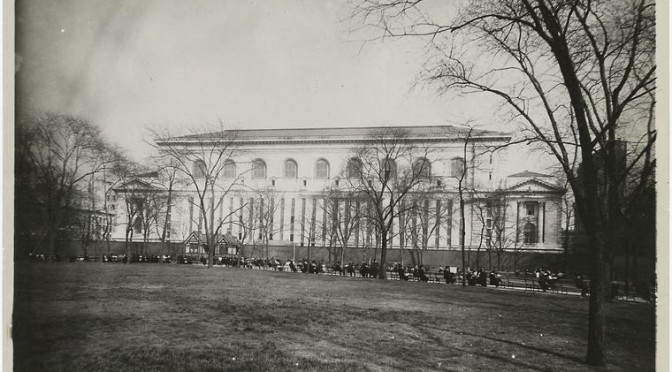
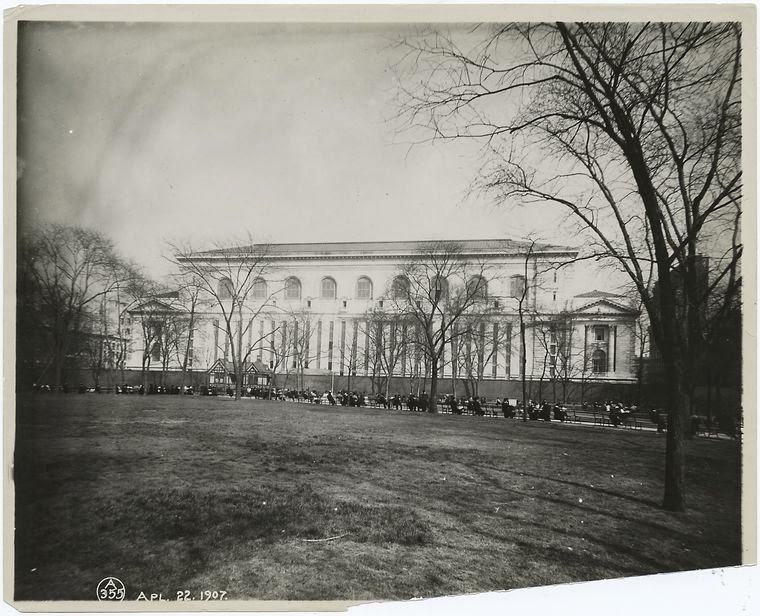
Bryant Park in 1907, with construction on the library well underway.  This was the site of one of the final official potter’s fields in Manhattan before they were moved to the islands of the East River. (Picture courtesy New York Public Library)

Happy Halloween!  To put you in the spirit of the season, take a look at my new article for the Huffington Post: Manhattan’s Forgotten Graveyards, Under Public Parks, Famous Hotels and Supermarkets

Will you ever visit the Houston Street Whole Foods the same way again?

And if you haven’t listened to our newest podcast Early Ghost Stories of Old New York, this is the perfect occasion.

Categories
Bowery Boys Bookshelf Museums

Edgar Allan Poe: Terror of the Soul at the Morgan Library: Genius from a dark place, his strange torment on display

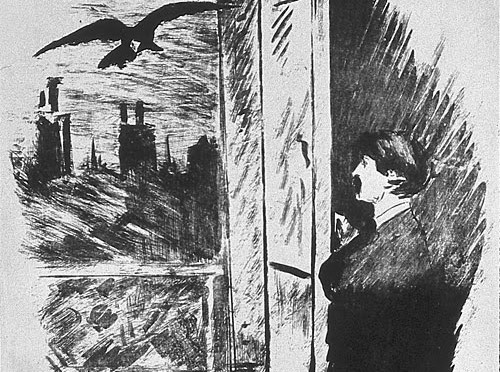
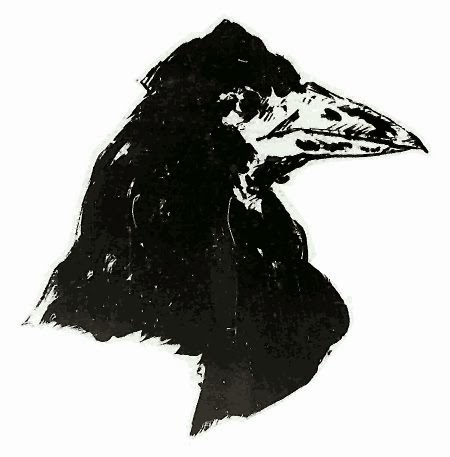
An illustration by Eduardo Manet from a 1875 French reprinting of “The Raven”

We are all too comfortable with Edgar Allan Poe in the abstract.  His fingerprints seem to be on everything these days.  His morbid tastes and the flowering dark genres he helped create appear just underneath much of American pop culture in the 21st century, from crime procedurals to teen supernatural romances.  He inspired the modern detective novel (and, by extension, film noir) and an uncountable number of American mystery and horror stories.

But do you dare get closer to the man, to the stained papers and morbid inner thoughts of a writer who practically cornered the market on early 19th century American perversity?  In Edgar Allan Poe: Terror of the Soul, the brilliant new show at the Morgan Library & Museum, you are trapped in a bloodred box with the writer, his letters, notes and original publications in an intimate and vaguely disturbing setting.
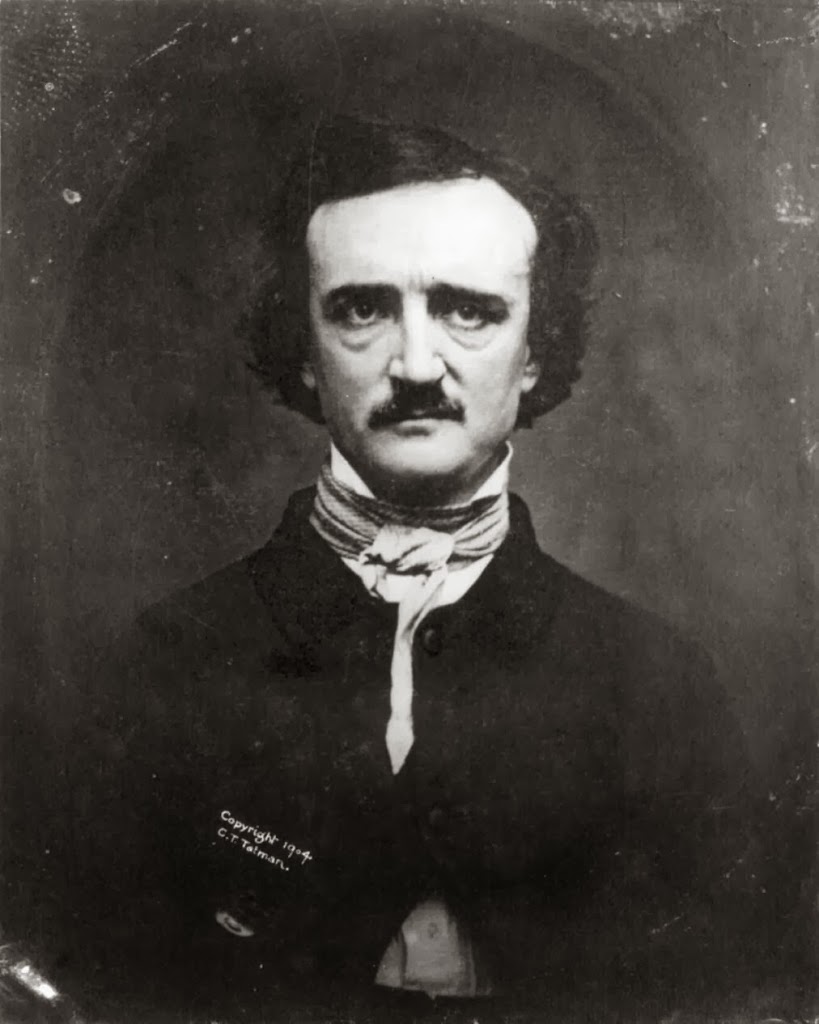
Yes, the room is actually painted red.  And a silhouette of Edgar’s haggard face glares down at you as you huddle in a perfectly awkward closeness over evidence of Poe’s brilliance, fame and madness.  Terror of the Soul is an autopsy of a strange career, revealed through first edition volumes and original newspaper clippings, then confirmed through bold, occasionally terse letters from the author himself.  A vivid portrait of the public Poe emerges — erratic, rarely satisfied — allowing you to speculate upon his private, tormented side.

Among the treasures here is a copy of Poe’s first book of poetry Al Aaraaf, Tamerlane and Minor Poems, published in 1829, a book so rare that it inspired one of the 20th century’s great book thefts.  Nearby sits the first publication of “The Raven,” next to handwritten notes from Poe about changes to be made in future reprintings.

Terror of the Soul is as much about other people’s perception of Poe as it is about the writer himself.  Eduardo Manet‘s expressive lithographs from a 1875 French edition of “The Raven” are a highlight of the show, a perfect synthesis of elegance and gloom.  A selection of sketches, daguerreotypes, photographs and even a bust of Poe are on display, his hollow face in an array of contortions and somber moods.

Most of the objects here require you to move closer, your eyes peering over old text of a sometimes unsettling nature.  Often the format is downright alien, as in the odd, mysterious scroll on which he chose to lavishly transcribe his poem “The Bells” in 1849, one month before his death.  The scroll has pencilled changes along the margins; in one change, he ponders using the word ‘menace’ over ‘meaning’.  Along the edges of the scroll is evidence that it had been set on fire at some point.

There are many such tiny mysteries among the artifacts of Edgar Allan Poe: Terror of the Soul, a show with more horrors contained within it than any Halloween-inspired haunted house could ever provide.

Edgar Allan Poe: Terror of the Soul, at the Morgan Library & Museum, through January 26, 2014.  Visit their website for more information.
Categories
Those Were The Days

Turkey raffles were 19th century versions of bar trivia nights

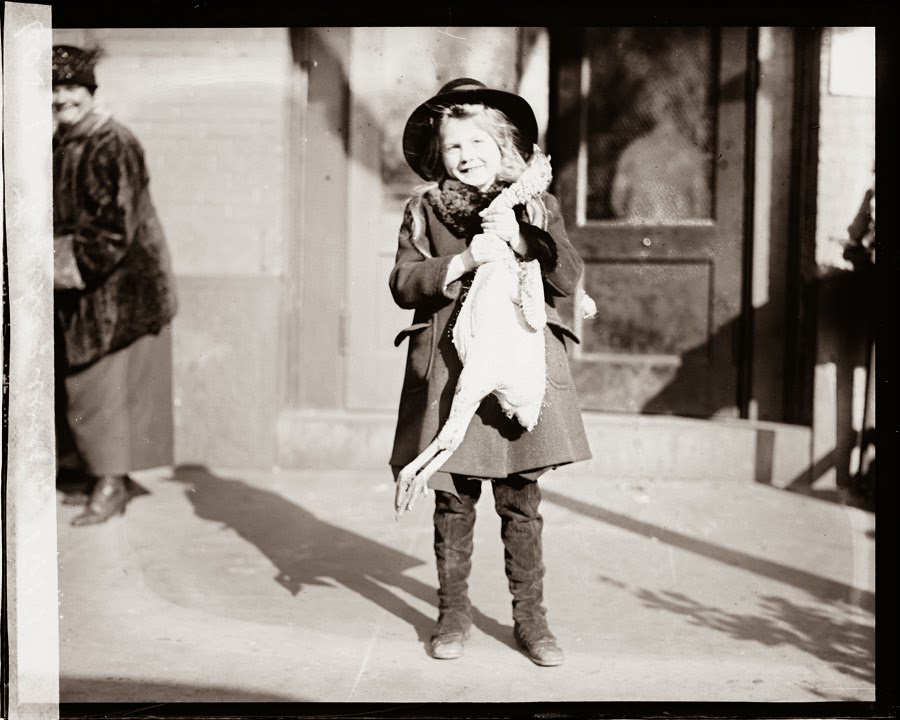
Hopefully this young lady acquired this turkey by legitimate means.
In this week’s podcast, I feign shock at the wild party held at the old home of famed actress Charlotte Melmoth, a former school for etiquette-turned-booze hall.  To quote historian Henry Reed Stiles directly:

After [Charlotte’s] disease, the house was converted into a tavern, which became the favorite resort for the dissipated young men of the town, who there indulged in drinking, eating oysters, raffling for turkeys, geese, etc. their orgies being carried on with a freedom to which the retired character of the spot was particular conducive.”

What’s so indulgent about a raffle?  Today they’re used mostly in expos and high school fund-raisers, a relatively benign form of gambling (although governed by specific state-wide rules).  But in the 19th century, raffles were widely seen in saloons, a jovial excuse for men to get liquored up and throw their money in for a chance at a moderate prize.  In essence, it was gambling most fowl.

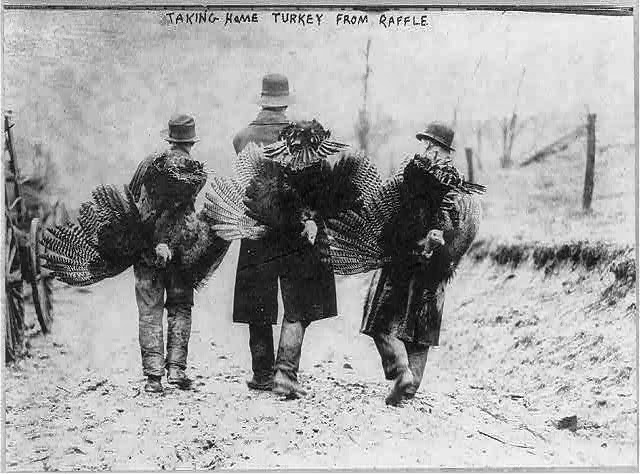
Below: Three victors at a local turkey raffle, 1912, location unknown (LOC)

“[T]here are many men on this fast old planet who are unable to resist the seductiveness of a turkey raffle,” the New York Sun reported in 1891.  “[P]erhaps there are enthusiasts who regard the practice of turkey raffling as not gambling, but a spirited method for the distribution of food products.”

The most common form of turkey raffle involved a game of dice.  Men paid for the privilege of rolling a pair of dice three times, and the man with the highest total score took home the turkey.

Another popular raffle method involved tossing several pennies into a hat, then dumping them out on a table.  The man who had the most pennies to come up heads would get his choice of the turkey or its cash equivalent. (Author Andrew Smith reports of one such raffle with a turkey value of 4 shillings, an approximate value of $10-$20 today.  Most took the money.)

Raffles were a quick and easy way for bartenders to get patrons to drink more. In this way, they’re very much like a weekly karaoke party or a pub trivia night.

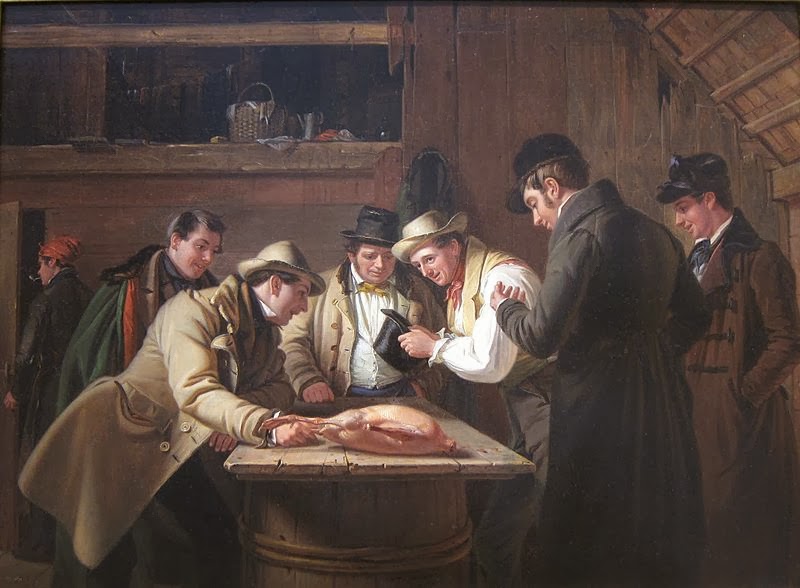
Below: Geese also got into the game. This great 1837 painting is by Long Island artist William Sidney Mount, called “The Raffle (Raffling For The Goose).”  The scene takes place in the backroom of a tavern, the hat containing raffle tickets.  Today this painting hangs at the Metropolitan Museum of Art.

A November 1887 account in the New York Evening World (reprinting an article from Buffalo) recounts the tale of a bank teller who won a six-pound turkey in a bar raffle:

“[H]is friends, many of whom he had never met before, crowded around him and congratulated him.  Then they swarmed him over to the bar and, of course, it was necessary to order some slight liquid refreshment for the gentlemen who felt some amicably disposed to him.  One hundred and fifty lagers were quickly disposed of, and the bank teller waxed hilarious.  Taking the turkey by the legs he swung it around his head in triumph……. Before he had left the place he had paid for $20* worth of liquor.”

*According to the Inflation Calculator, that’s about $500 today. 

The reputation of the turkey raffle as an instrument of vice and debauchery was such that a 1914 article in the New York Sun heralded their demise. “It has long been suspected that this form of gambling was ruining men and wrecking homes.”

Turkey raffles were finally outlawed in New York bars in 1914.  “That kind of chance taking is now classed as gambling, and every holder of a liquor license is forbidden to allow it in his place.” [source]

Categories
Neighborhoods

A short history of a short street named Raisin Street

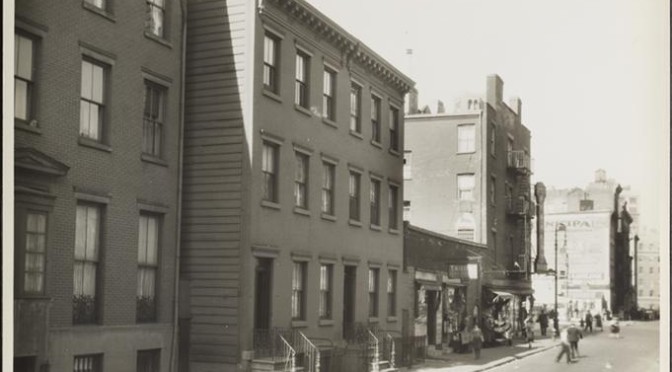
[34-36 Barrow Street]

A 1932 photo of 34-36 Barrow Street by Charles Von Urban, courtesy the Museum of the City of New York. Click here to see what this section of the street looks like today

In this week’s Ghost Stories of Old New York podcast, Tom speaks of the ghosts at romantic restaurant One If By Land, Two If By Sea, located in an old carriage house that was moved from its original location to its present home on Barrow Street in today’s West Village.

Barrow Street is a quiet hook of a path, emanating from the southeast side of Sheridan Square, bending west when it meets odd, little Commerce Street, then wanders westward to the water’s edge.  If you’ve ever been lost amid the crooked streets of the West Village — and who hasn’t, at some point — then you’ve certainly stumbled onto Barrow.

The road that became Barrow was close to the estate of Richmond Hill, the esteemed manor that was once home to America’s first two vice presidents, John Adams and Aaron Burr.  In the heady post-Revolution period, this path was originally named Reason Street, for Thomas Paine‘s ‘The Age of Reason’.  Indeed, Paine once lived at a couple nearly locations, at 309 Bleecker Street and 59 Grove Street (where he died).

As legend has it, however, residents soon took to calling it Raisin Street, both as an accented corruption of the original name and a possible insult to Paine (who was not beloved at the time of his death in 1809).

Raisin Street, most notably, became the home of New York’s first ‘Orphan Asylum’ in 1805.  Six orphaned children were placed here under the care “of a pious and respectable man and wife.” [source]

While many streets in New York City are named for healthy fruits — Brooklyn produces Pineapple, Orange and Cranberry Streets, for instance — few are named for shriveled ones.  In 1807, Trinity Church, the principal landowner of Reason/Raisin Street, directed that the street be renamed for Thomas Barrow, a vestryman and agent for the church.

I’m sure it is a happy accident that a principal character in Downton Abbey is also named Thomas Barrow.

Categories
Mysterious Stories Podcasts

Ghost Stories of Old New York: Tales from the Revolution, restless Indians, haunted forts and a drunk, headless actor


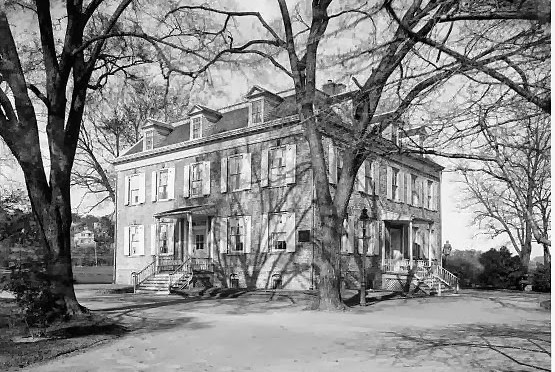
The Van Cortlandt House, 1906

PODCAST This is the Bowery Boys 7th annual Halloween podcast, with four new scary stories to chill your bones and keep you up at night, generously doused with strange and fascinating facts about New York City.

For this episode, we’ve decided to go truly old-school, reaching back to old legends and tales from the years of the Revolutionary War and early 19th century.   These ghosts have two things in common — George Washington (directly or indirectly) and ghosts! Although no ghosts of George Washington.

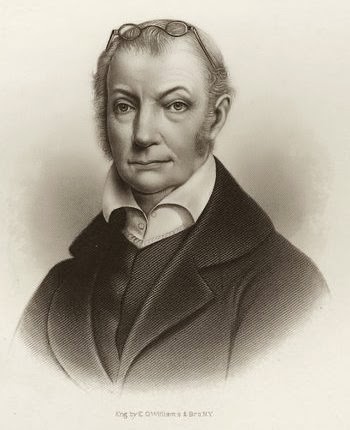
We venture to the haunted woods of Van Cortlandt Park for the tale of an Indian massacre and a forlorn servant girl, looking for her master’s silver.  From there, we head to the early days of Greenwich Village and tormented vice president Aaron Burr (at right), waiting for his daughter’s return.

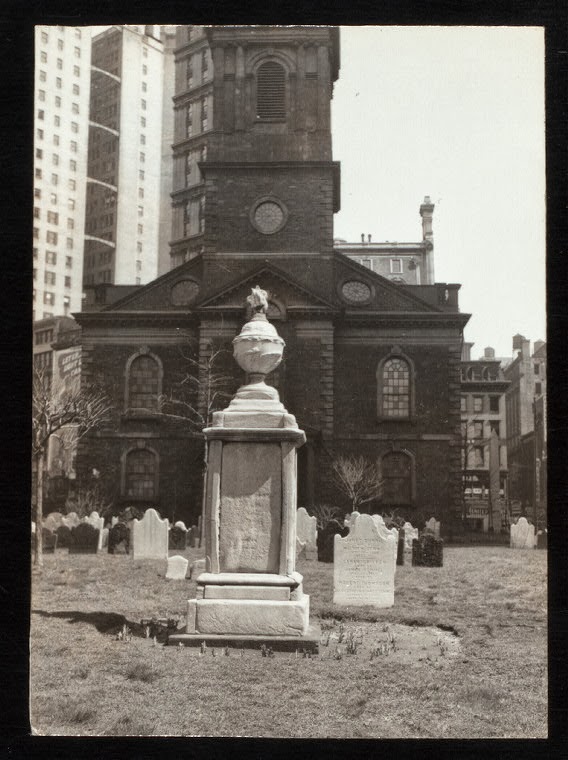
Meanwhile, over in Brooklyn, the ruins of an old Revolutionary War fort in the future neighborhood of Cobble Hill provide the setting for a horrific tale of a late-night booze run gone wrong.  And, finally, no Bowery Boys Halloween podcast would be complete without an historic cemetery (in this case, the burial ground at St. Paul’s Chapel) and the ghost of a dramatic actor — in this case, one without his head!

PLUS: How did Westchester County become so rocky? The Devil did it!


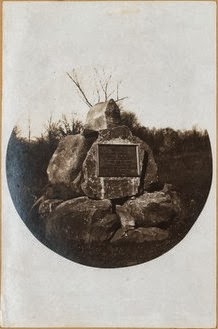
A cairn of stones memorializing Danial Nimham at Indian Field in Van Cortlandt Park, in 1906, the year it was placed here by the Daughters of the American Revolution.  The original plaque states that 17 members of the Stockbridge Militia lost their lives, though it’s now believed that up to 40 men may have died during the massacre of August 1778. (NYPL)

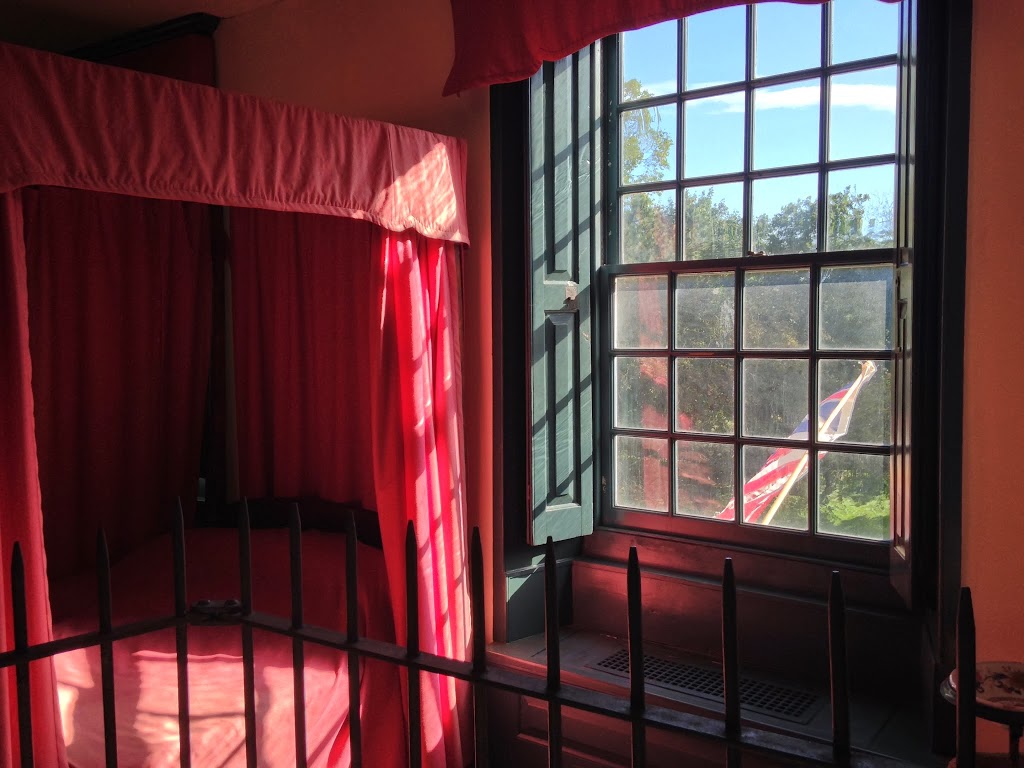
Looking out the upstairs window of the Van Cortlandt House, looking out in the park. The house has seen its share of strife and, if legends can be believed, more than a few spirits.

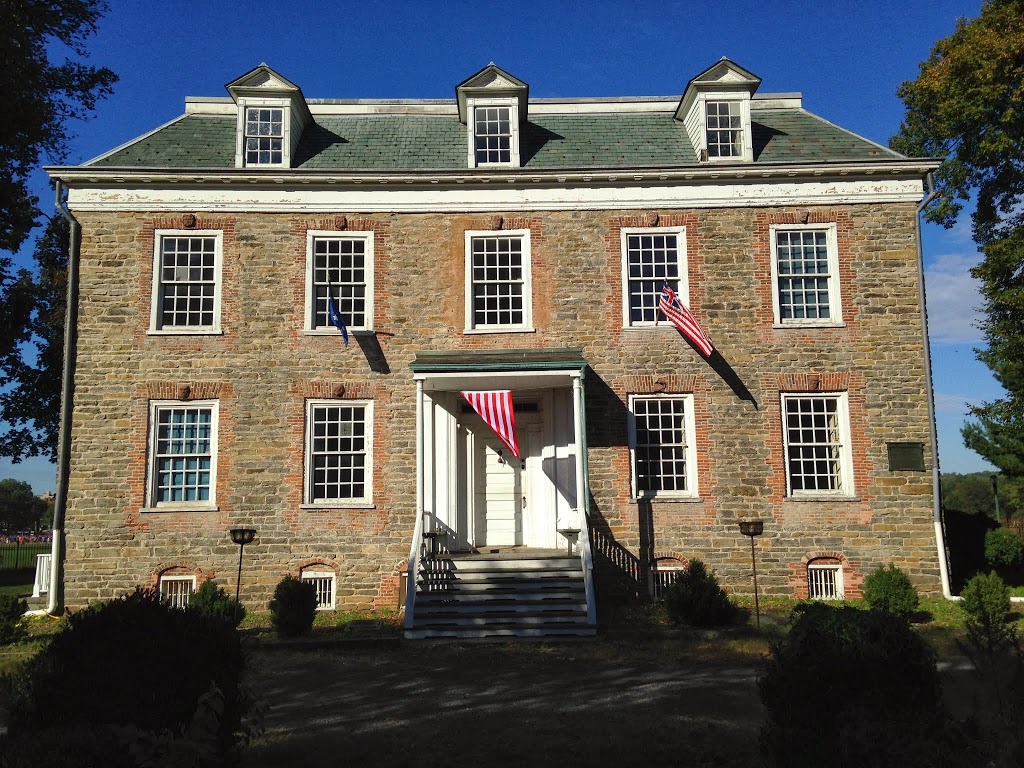
Van Cortlandt House as it looked last weekend. What’s that in the window?

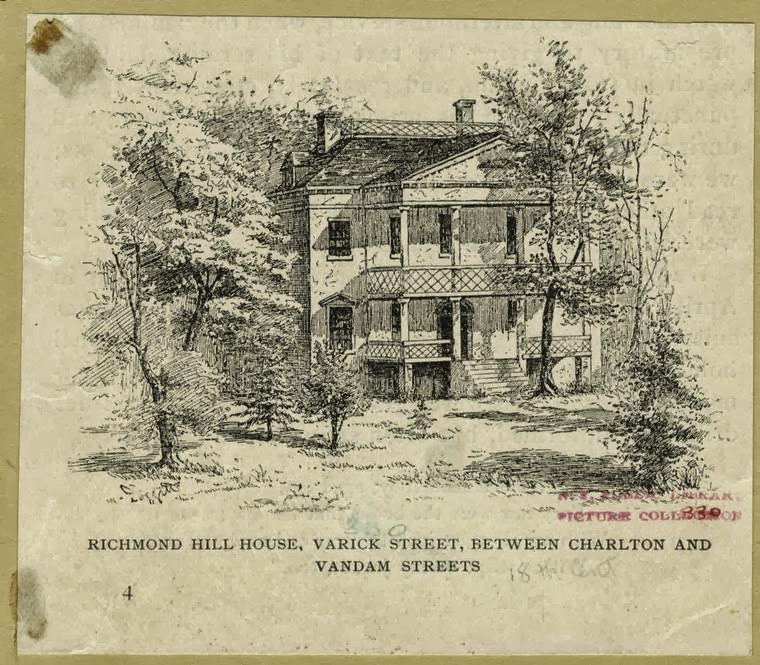
Richmond Hill, the beautiful mansion home of both John Adams and Aaron Burr.  The carriage house from this old manor was moved to Barrow Street and is today the restaurant One If By Land, Two If By Sea. (NYPL)

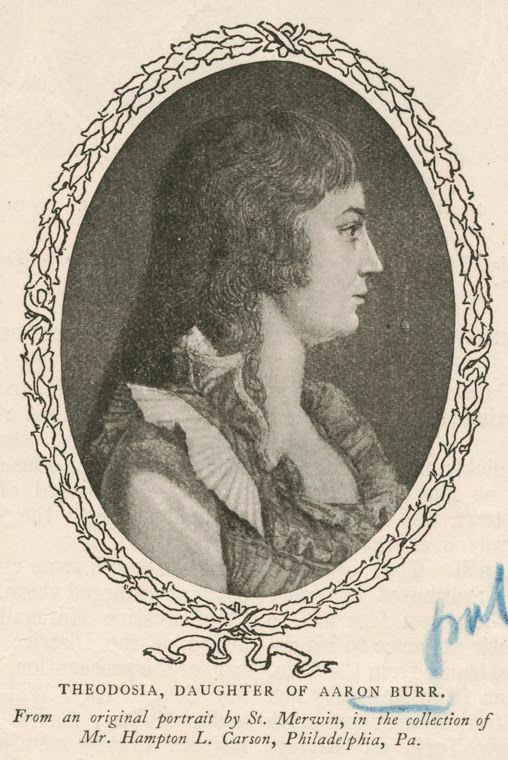
Theodosia Burr, the daughter of Vice President Aaron Burr, who was mysteriously lost at sea. Was she shipwrecked, rescued by an Indian prince, or forced to walk the plank? (Courtesy NYPL)

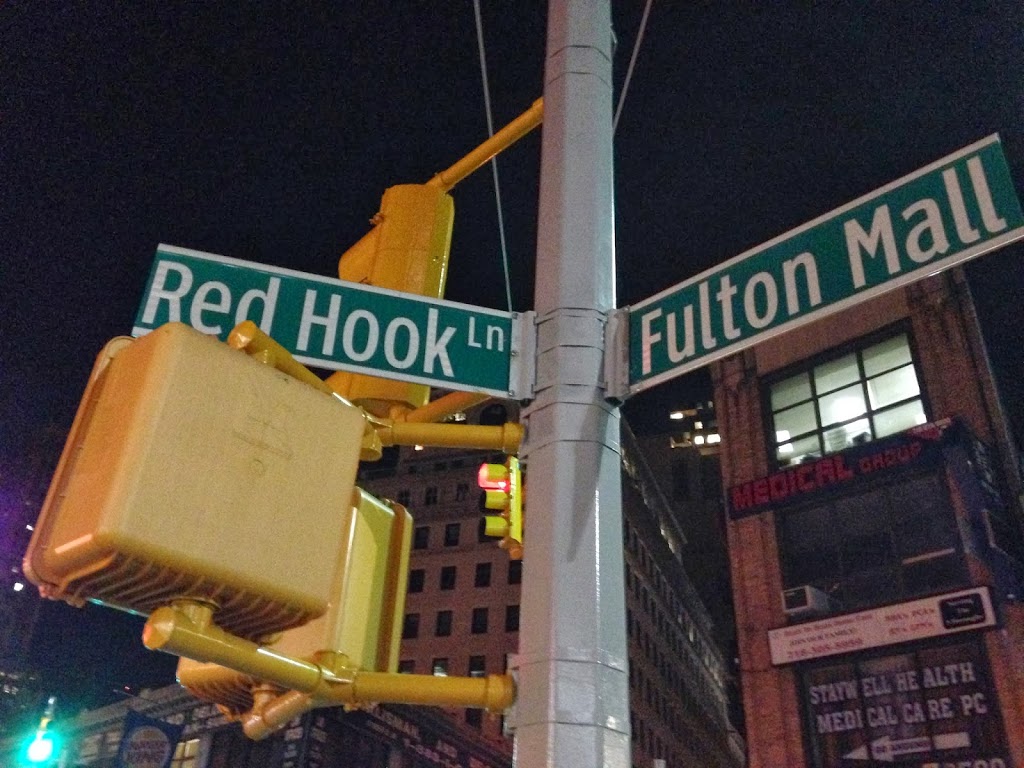
A short remnant of Red Hook Lane still exists in downtown Brooklyn.  You are unlikely to find anything too scary at this street corner however.

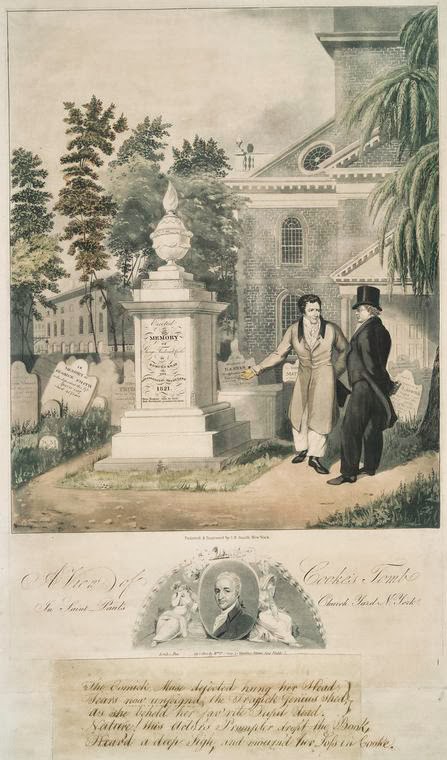
A 1822 illustration of the George Frederick Cooke monument and the man who paid for it, actor Edmund Kean.  Kean so admired the late actor that he actually took a very odd portion of his body back with him to England.

The monument to George Frederick Cooke in the graveyard at St. Paul’s Chapel, pictured here sometime in the 1940s.  Does his ghost still linger here? [NYPL]

We had a very chilling event occur as we were recording last weekend.   Just as I began to launch into the ghosts of the Stockbridge Militia, our recording equipment went all insane, spewing out a distorted and very disturbing version of our voices.  It went on for about 20 minutes.  Below is a sampling of the audio.  What do you think — otherworldly interference or a faulty mixing board?


Categories
Friday Night Fever

Remnants of the Bull’s Head Tavern: Could this be the greatest New York archaeological find of the year?

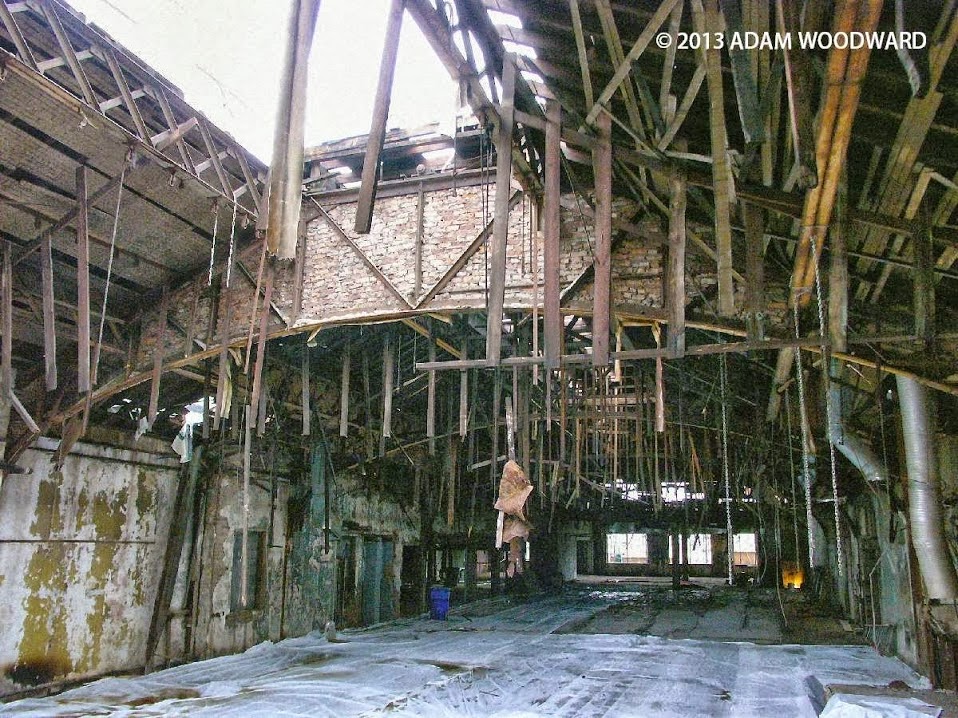
The former Atlantic Gardens, revealed during a demolition. Underneath it lies evidence of an even greater historical discovery. Courtesy Adam Woodward/Lower East Side History Project

Big news on the urban archaeological front — remnants of the Colonial-era Bulls Head Tavern may have been discovered during an excavation for a new hotel.  The Bull’s Head was itself built over in the late 19th century for the grand Atlantic Gardens beer hall (mentioned in our Beer History podcast). then enjoyed a rather non-descript past century at 50-52 Bowery in various guises, most recently a drug store and restaurant.

Check out the story here (Unearthed: A Possible Stop Along the Revolution) and follow The Lo Down for all the latest developments in the coming days.  And take a few minutes to marvel at preservationist Adam Woodward’s photographs of the site here.  It might not look like much, but verification of its identity would prove to be a pretty big deal for lovers of American history.

Below, I’m re-posting my article from 2009 on the history of the Bull’s Head Tavern.
__________________


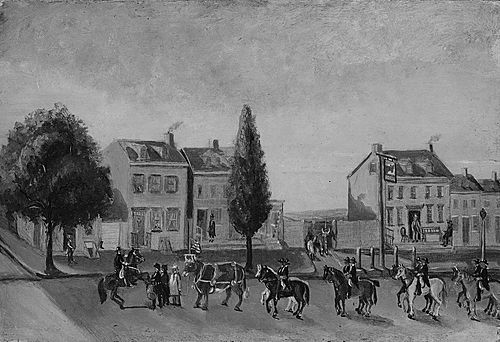
The Bull’s Head Tavern was the gathering-place for farmers, drovers, and merchants in the 18th century, located well outside city boundaries just east of Collect Pond. (At the Bowery, right at the entrance to the Manhattan Bridge.)

It soon became the center of Manhattan’s entire meat selling and rendering industry, with the area surrounding the nearby Collect overrun with tanneries and slaughterhouses.  As the Bull’s Head was also located right on the Boston Post Road (later the Bowery), situated at a crossroads of livestock yards and stables, it became an ideal place for both commerce and carousing.

The Bull’s Head was in operation as early as 1755, enjoying business as “the last halting-place for the stages before entering the city.”

Within the next few decades, industry enveloped the area, transforming the Bull’s Head into a cattle market, with pens adjoining the main building where farmers from the surrounding area herded their best specimens for sale.  Inside the tavern became a literal stock market, with transactions, news and gossip being shared over brew and a hot meal in “smoky, low-ceilinged rooms.

Those who lingered well into the night sometimes played a strange game called crack loo — often gambling away any profits they might have made earlier in the day. Out in the pen, dog fights and “bear baiting” sometimes occured as entertainment.

As Washington Irving describes, at the Bull’s Head he would “hear tales of travelers, watch the coaches and envy the more pretentious country gentlemen in Castor hat, cherry-derry jackets and doeskin breeches.”

On November 25, 1783, Evacuation Day, the Bull’s Head entered history.  As the British fled New York that day, George Washington and his entourage met at the Bull’s Head, preparing themselves for their triumphant entry into town. Governor George Clinton and over 800 uniformed troops and town people gathered right outside, preparing for the procession.

Henry Astor, the older brother of John Jacob, stepped in as owner of the Bull’s Head in 1785.  Already an accomplished butcher, Henry served his “celebrated cuts of meats” and often outpriced his own clientele when a particularly choice herd of cattle came travelling by.

Of course, New York was outgrowing its old boundaries by then.  By 1813, Collect Pond had been drained and high society eyed the Bowery, sweeping away the filthy stockyards and factories to construct homes, shops and theaters.  Moving with the changing times, some civic minded businessmen bought out Astor and moved the Bull’s Head somewhere safely outside the city — this time at 3rd Avenue and 24th Street!

In 1830, this new location fell into the hands of young rancher and entrepreneur Daniel Drew, who turned the tavern into a sort of bank, marketplace and social club for local cattlemen, upgrading the establishment and building his own reputation as a savvy financier.  The neighborhood was even sometimes referred to as Bull’s Head Village.

As this time, according to an old history, “various types of men mingled in the bar-room of the Bull’s Head, from the rough country man to the speculative citizen, butcher and horse-fancier. Plain apple-jack and brandy and water… were the principal liquors passed over the bar. Guests were so numerous that at the first peal of the dinner-bell. it was necessary to rush for the table or fail miserably.” And of course, after hearty meal and vigorous drink, came the gambling, “throwing dice for small stakes.”

Drew eventually went on to become a steamboat mogul.  The site of the old Bull’s Head eventually hosted the notorious Bowery Theatre (built upon its old cattleyards), then the sumptuous Atlantic Gardens by the mid-19th century.  Drew’s uptown location on 24th caved in to a growing residential neighborhood and soon moved again — this time to 42nd Street.  That location was famous torched during the Draft Riots.

However, near the 24th Street location, there is a new Bull’s Head Tavern that probably smells a lot better than the original.

And not to forget, there was also a Bull’s Head Tavern in Staten Island, at Victory Boulevard and Richmond Avenue. Built in 1741, this Bull’s Head was a popular destination for British-loving Tories before the days of the Revolutionary War.  Before it was destroyed in a fire, “people from all over the country made special trips to the old house, just to see the famous Tory headquarters,” according to one old history.

The neighborhood that sprouts around that intersection at Victory and Richmond is named Bulls Head in the old tavern’s honor.

Categories
Amusements and Thrills

Meet the Mastodon Hog, the biggest star at a 14th Street museum

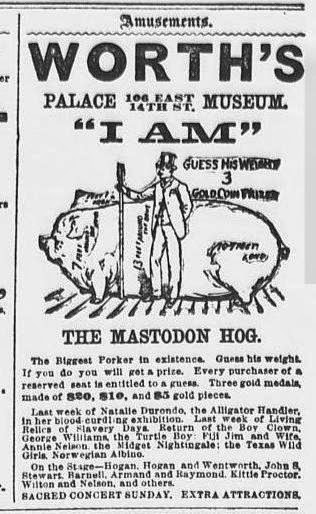
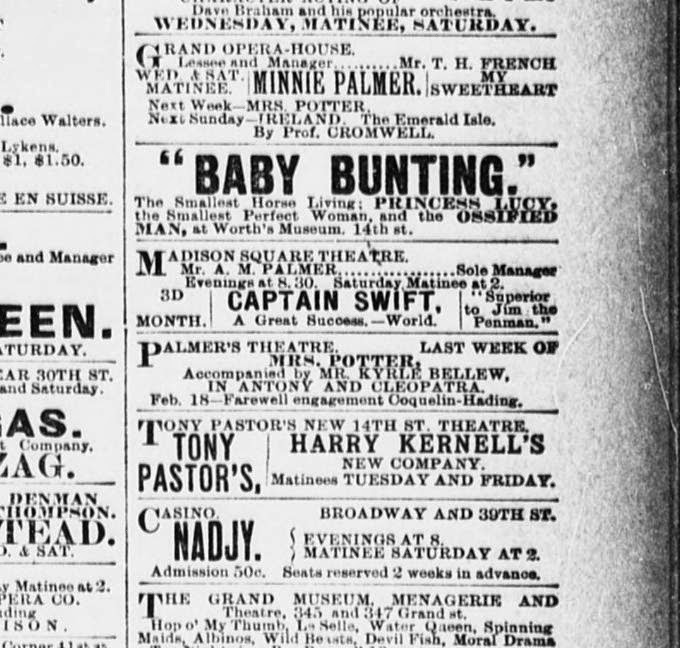
Worth’s Museum of Living Curiosities, one of New York’s most popular dime museums, paired cheap ‘curios’ with vaudeville performances on the main stage.  On December 29th, 1889, the star of the show was a massive hog named I-Am. “The Biggest Porker in existence. Guess his weight. If you do you will get a prize. Every purchases of a reserved seat is entitled to a guess.  Three gold medals, made of $20, $10 and $5 gold pieces”.

I can find no information on what the correct weight of this monster was.  However, this large animal capped a year of peculiarly sized beasts at Worth’s.  The year began with what was proclaimed as Baby Bunting, “the smallest horse living.”

Worth’s Museum was located at 106-108 East 14th Street, across from the Academy of Music.  The buildings were demolished in the 1920s — near the same time that the Academy was itself demolished — and the lavish Palladium concert hall was put in its place.  The Palladium became a nightclub in the 1990s.  It too was later bulldozed and replaced with a New York University residence hall.

Categories
Neighborhoods Those Were The Days

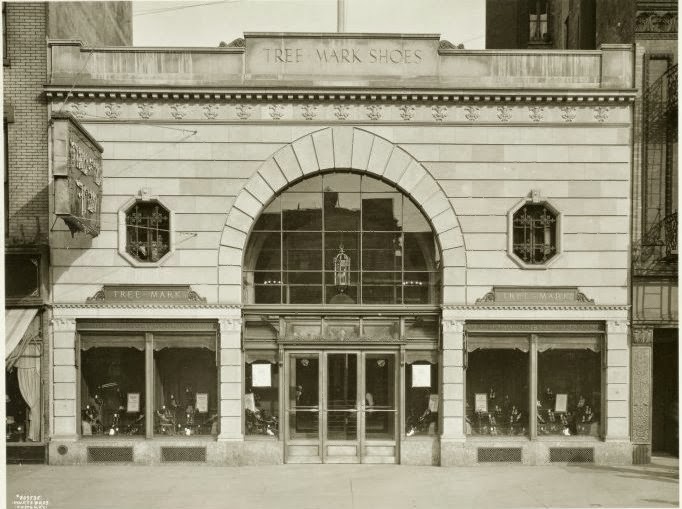
When the Bowery Ballroom was a shoe store and other scenes from Delancey Street in the 1930s

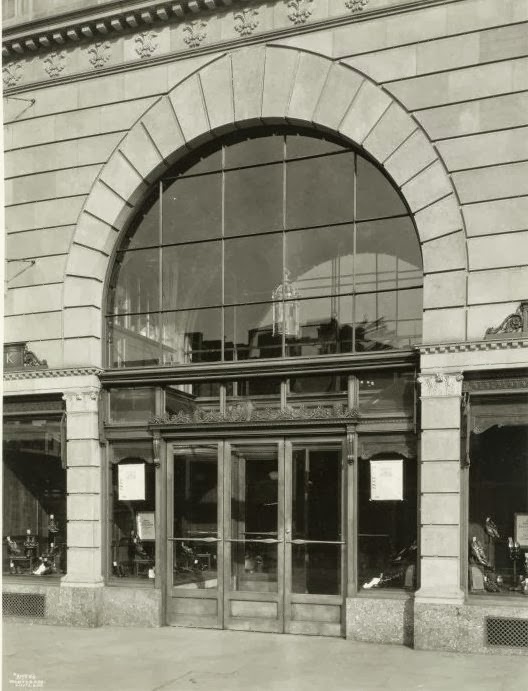
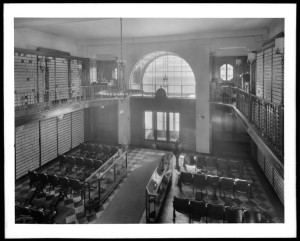
The Tree-Mark Shoe Store at 6-8 Delancey Street. You may know this building today as the Bowery Ballroom, a music venue since 1997. (Wurts Brothers, date unknown, both courtesy NYPL)

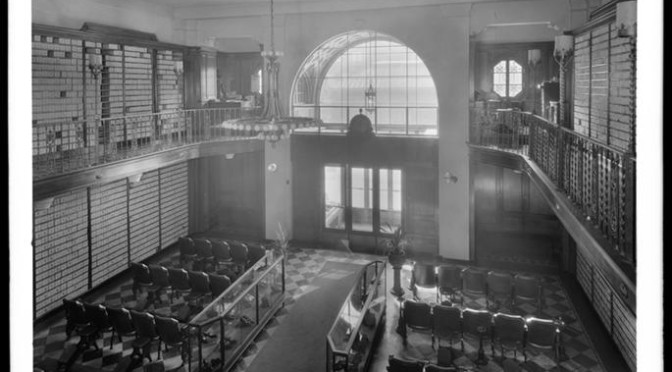
The interior of the shoe store, 1930 (Pic courtesy MCNY)

8 Delancey Street. Tree-Mark shoe store, interior.

This building has had a rocky history, according to historian Matthew Postal.  Using remnants of an old theater at this spot, the current building was constructed in 1928 as a retail store, but the stock market crash the following year ensured tenants never stayed for long.  Tree-Mark was home here the longest, almost thirty years.

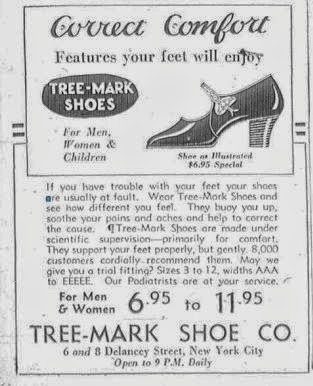
Tree-Mark Shoe Stores, a family-owned establishment since 1919, was an affordable shoe outlet with three locations in New York by the late 1950s — the original Delancey Street location, one off Herald Square and another on Kingsbridge Road n the Bronx.

“Comfort, rather than high style, is the goal,” the New York Times mentioned in a fashion write-up of the shoe franchise.  “However, it is possible to get a good-looking pump with a stacked heel for as little as $13.95.”  In a later article about the popularity of boots, Tree-Mark is mentioned as “specializ[ing] in boots for women with larger than average calves.”

The advertisement, at right, is from a 1934 issue of the Brooklyn Daily Eagle.  “8,000 customers cordially recommend them.”

On an unrelated note, in 1971, employees at the Herald Square location all chipped in to buy a lottery ticket and won $100,000.
_________________________________

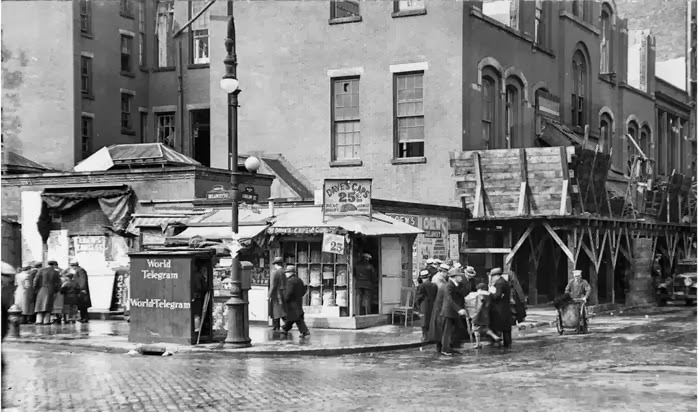
Here’s a couple bonus photos of life along Delancey Street in the 1930s. The first captures the southwest corner of Delancey and Ludlow. Judging from this 1929 picture of the same corner, that building being torn down is a public school.  Today that is the location of the swanky lounge The DL.

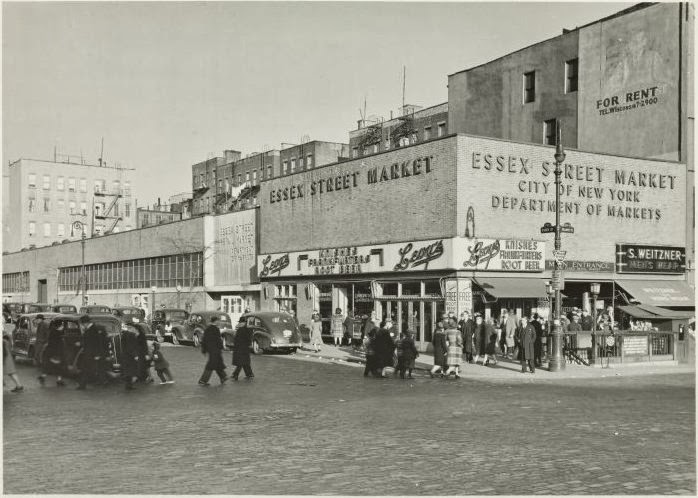
And here’s the northeast corner of Delancey and Essex, Wurts Brothers, date unknown (NYPL)  Outside of the Blue Building towering over it all, this street corner isn’t that much different today.

Categories
Those Were The Days

How well can you do on this New York history trivia quiz — from 1914? Prepare to be a little frustrated.


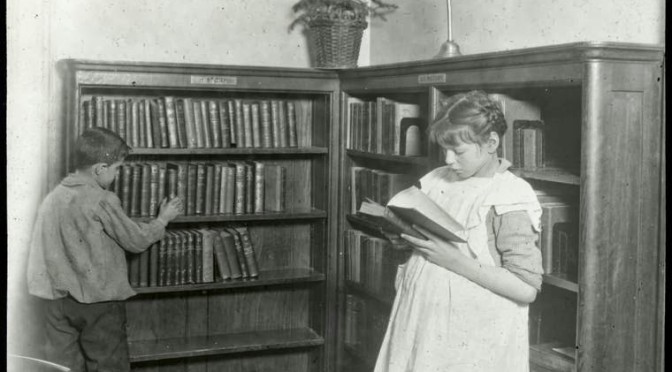
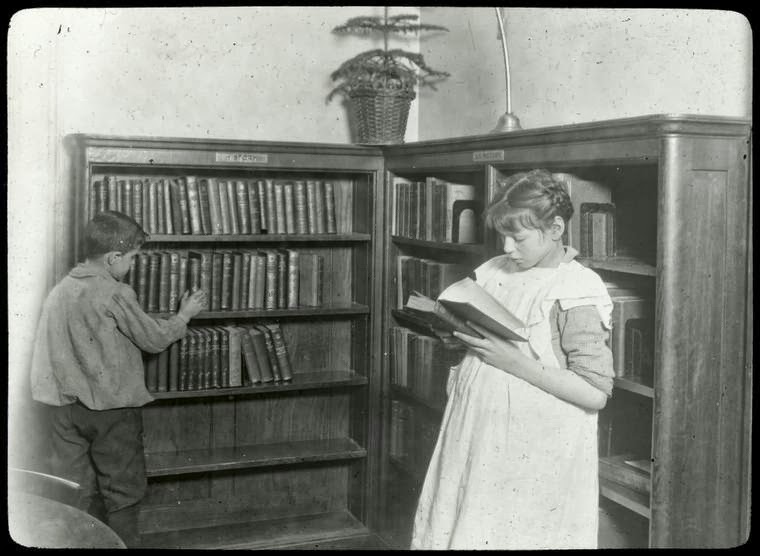
No amount of studying will prepare you for some of these odd questions.  (A girl at Seward Library, photographed by Lewis Hine.)

Trivia quizzes are very popular today in bars and pubs throughout the city, but in the past, they’ve had more elitist purposes.  In November 1914, a group of possibly insecure ex-New Yorkers in Chicago — united under the organization named the Empire State Society of Chicagoannounced a contest featuring fifteen questions on New York history.

The New York Sun got hold of this list of questions and posed them to people actually living in New York. What they got was mostly befuddlement and blank stares.  Rather than admit they were stumped, many basically said, whatever, they’re in Illinois.  “Some have been heard to give as an excuse for their ignorance — judged by the contest questions — that perhaps the Chicago-New York exiles have selected such queries as will reveal what is greatest and best in the State according to Illinois standards.”

From the Sun:

The fifteen history questions published by the New York Sun are below.  How many can you answer correctly?  The answers are below the jump.

Keep in mind these questions pertain to the entire state of New York, not just the city.  Good luck!

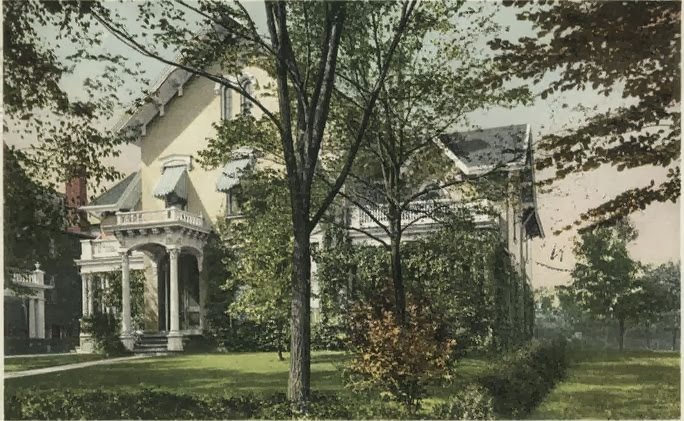
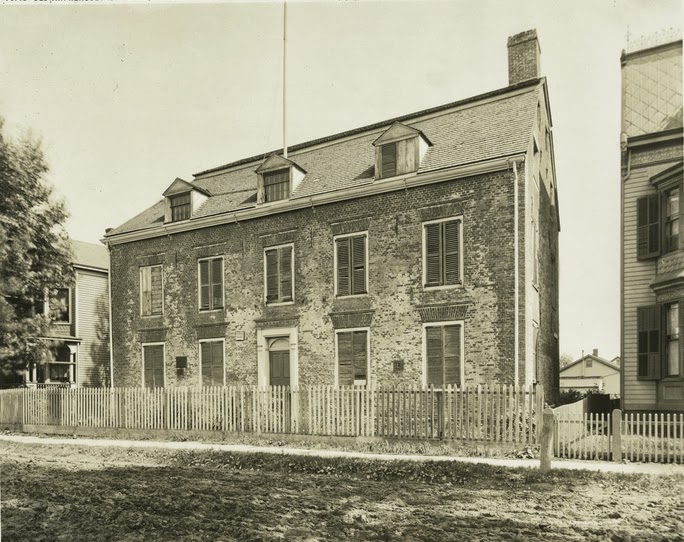
1. Where is the Milburn House (below) and with what event is it associated?

2. What happened at Dunkirk, May 15, 1851?

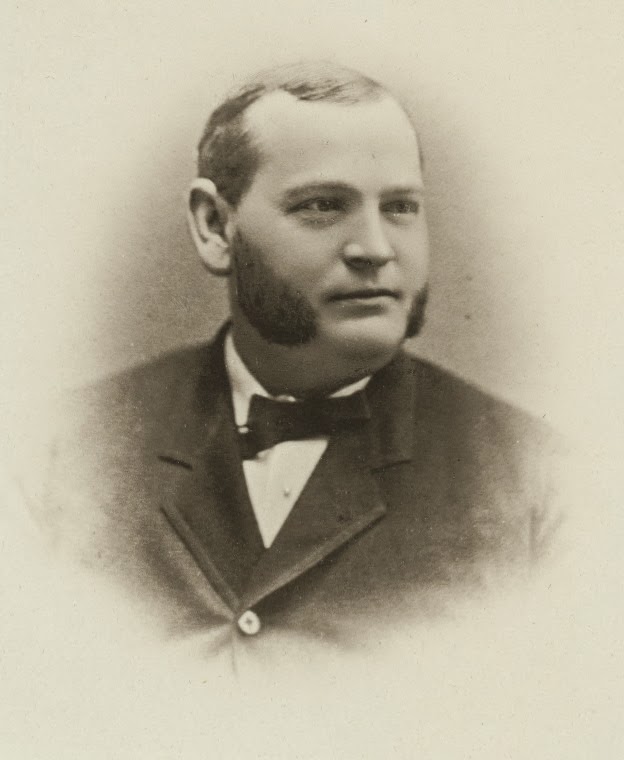
3. Identify the following well known New Yorkers:  Roswell P. Flower (below), Clement C. Moore, Marshall Lefferts, William Cooper


4. In what famous work of fiction is the story of the Bloody Pond massacre related?

5. In what great work of fiction does the character of Anthony Van Corlaer appear?

6. What great religious movement originated in Palmyra?

7. Whose monument stands at Stone Arabia and what occurrence does it commemorate?

8. From what does the town of Painted Post derive its name?

9. Name one person of national reputation whose name is prominently associated with each of the following places:  Auburn, Kinderhook, Tarrytown, North Elba, Yonkers

10.  Relate the history of the ‘Yankee Doodle’ house at Rensselaer. (Pictured above)

11. To what natural advantage is attributable the commercial supremacy of Rochester?

12. Give the name and work of a woman of Troy who made an important contribution to the cause of higher education of women.

13. Who was ‘the Poet of the Revolution‘ and where did he reside?

14. When and where was the New York City Chamber of Commerce organized?

15. What building once stood at the northeast corner of Wall and Nassau streets, and with what great event is it associated?

ANSWERS BELOW:

1. The house is in Buffalo, NY. It is where President William McKinley was taken after he was shot by the assassin Leon Czolgosz, and it’s where the president died.

2. According to the article: “What Happened in Dunkirk —  There was a celebration at Dunkirk about the time mentioned in the question, for the purpose of letting Dunkirk whoop and hurrah over getting railroad facilities.  The Erie Railroad entered the town and in consequence there was a celebration.  But as an event that has a place in New York history it takes a strain of the imagination to rate it so high.”

3. R.P. (Roswell Pettibone) Flower was the governor of New York (1892-94).  Clement Clarke Moore was owner of the Chelsea estate and author of ‘Twas The Night Before Christmas.  Marshall Lefferts was a Civil War veteran, the “long Colonel of [New York’s] Seventh Regiment.”  “He marched down Broadway at the head of his command when war broke out in 1861 and presented a martial figure that was long remembered.”  William Cooper was founder of Cooperstown and the father of James Fenimore Cooper.

4. Speaking of Cooper, the Bloody Pond massacre is from James Fenimore Cooper’s The Last of the Mohicans.

5. Washington Irving‘s A History of New-York from the Beginning of the World to the End of the Dutch Dynasty, by Diedrich Knickerbocker.

6. Mormonism.

7. Stone Arabia is today a hamlet in the town of Palatine, New York.  The Sun doubts there was ever such a monument here at all.  If there was one, it was dedicated to a Revolutionary War battle from 1780, “a battle fought between the colonists on the one hand and the Indians under Sir John Johnson, son of the famous Sir William Johnson.”

8. A Native American wooden post and alleged burial spot of Captain Montour, son of the famous Iroquois leader Queen Catherine.

9. This question is so open-ended!  But the answers they might have been looking for are William Seward (Auburn);  Martin Van Buren (Kinderhook);  John Andre or Washington Irving (Tarrytown);  John Brown (North Elba); and Samuel Tilden (Yonkers)

10.  I’ll quote the answer straight from the Sun article:   “The ‘Yankee Doodle’ House — Who really wrote ‘Yankee Doodle — the words and music — is not positively known, according to many authorities.  Therefore it cannot be told positively where it was written.  There is a Yankee Doodle House in Rensselaer-on-the-Hudson.  It was used as a British army headquarters in the French and Indian War, so it is said.  The author of the song is declared to have been Dr. Richard Shuckbergh….He was a surgeon in the British army.”

11. Rochester is known as the The Flour City, believe it or not.  Flour mills there used the waterfalls of the Genesee River.

12. “The Troy Woman Educator — This refers of course to Emma Willard, who in 1814 submitted to Gov. Clinton the manuscript of an article entitled: ‘A Plan For Improving Female Education.’ “

13. Philip Freneau and he was born in New York. (But odd question, as he’s often associated with Philadelphia and is in fact buried in Matewan, NJ.)

14. There’s a long-winded answer in the original article, but essentially the answer is — Fraunces Tavern.

15.  “The old City Hall at Wall and Nassau was altered for use as the first Capitol of the United States.”  In 1914, the building was the U.S. Custom House, later to be reclaimed as a historical relic and renamed after the original Federal Hall.

Pictures all courtesy New York Public Library