Categories
Bowery Boys Bookshelf

‘New York Neon’: A history of the city’s most mythical lights

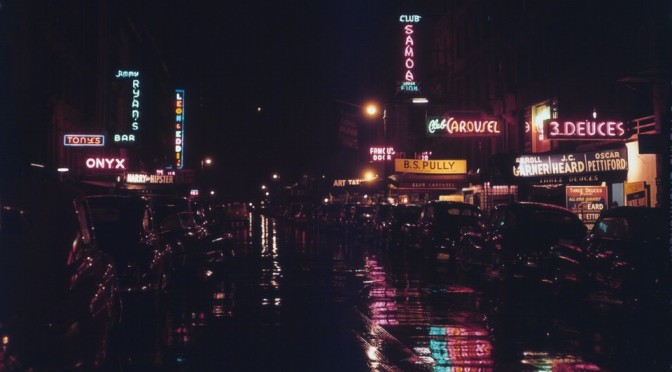
A sizzling 52nd Street in July 1948 (courtesy LOC)

BOWERY BOYS BOOK OF THE MONTH Each month I’ll pick a book — either brand new or old, fiction or non-fiction — that offers an intriguing take on New York City history, something that uses history in a way that’s uniquely unconventional or exposes a previously unseen corner of our city’s complicated past.  Then over the next month, I’ll run an article or two about some of historical themes that are brought up in the selection. 

New York Neon
by Thomas E. Rinaldi
W.W. Norton

Neon has been a most attractive tool for pop American graffiti for well over one hundred years, glowing tubes of foggy color alighting the simple and the sublime, from jagged old signs along Route 66 roadsides to those lining the most flamboyant casinos of Las Vegas.  In Los Angeles, stand-alone neon signs along Sunset Strip typify the glamour of old Hollywood, the buzz of Mildred Pierce‘s restaurant and the cocktails at the Brown Derby.

New York City also has its share of iconic neon signs — some of the greatest, in fact — but amid the blinding lights of an ever-changing modern metropolis, they frequently recede into the background. But no longer. In Thomas Rinaldi’s excellent ‘New York Neon’, these representatives of an elusive, nostalgic past finally receive a warranted inspection.  And I guarantee you that after reading this book, you’ll see neon popping up all around you on the city streets. It’s always been here.

No city has a more complicated relationship with the neon glow than New York City. Once the material of great advertisements and tony nightclubs, neon became associated with the seedier parts of town by the 1940s and 50s.  Their singular appeal — handcrafted works, often one-of-a-kind — initially threatened their existence in a city of heightened sensation.  Fortunately, detective novels, film noir and the embrace of nostalgia saved the idea of neon from total oblivion;  more than any other visual queue, warm neon evokes a sense of a faded city, its melancholy and mystery.

Rinaldi gives a one-stop primer on all things neon, from its early history and development to its present creation by local craftsmen.  He identifies possible moments in time when neon became ‘cool’ again and speculates on why it may never completely disappear. He writes: “For its sheer charisma, neon will likely live on as a specialty item.”

Indeed, New York’s romance with neon signage mostly veers from the mainstream today.  The neon spectaculars of Times Square have given way to explosive LED high-definition displays, washing thousands of color gradients over the eyes of stunned tourists.  As Rinaldi illustrates, the survival of neon has depended on small, private businesses; it glows above the doorways of New York’s most famous delis, pharmacies and bars.

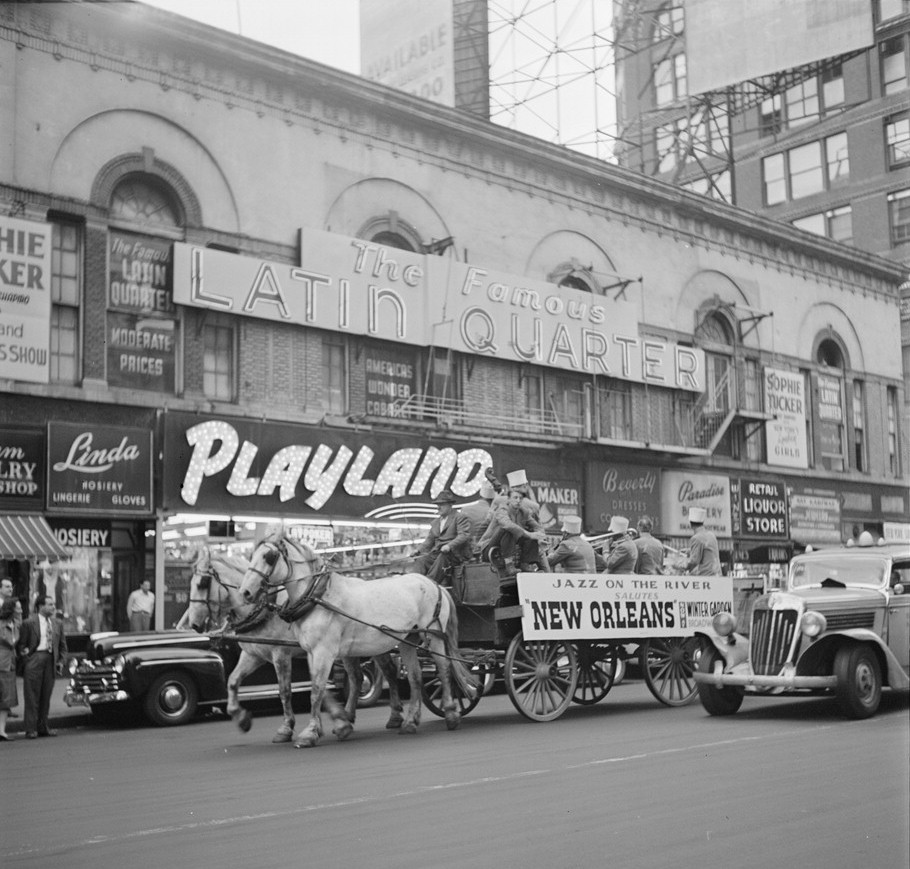
Above: The nexus of neon was probably at Broadway and 47th Street in its heyday. Here, the 1947 sign of the Latin Quarter nightclub joins the party. (LOC)

And here’s where the book comes in most handy, going through every borough to locate some of the finest examples of neon currently existing in the city. The author even finds the origin stories to a few of these treasures, from the pastel silliness of the Papaya King to the haunting glow of a neon crucifix on East 2nd Street.

The great, old taverns of New York are often defined by their neon. Sometimes whole neighborhoods are too, as in the case of Long Island City and its 1936 Pepsi-Cola sign.  But collect it all together into one resource like ‘New York Neon’, and you’ll come to realize that neon has had a lasting effect on the entire city.  Your dreams of New York are likely illuminated in neon.

Times Square will always glow with the latest in lighting technologies. Subway signs and chain stores signage may render everything into a dulling uniformity. But nothing will speak for New York more than the signs of Katz’s Deli, or the Chelsea Hotel, or the Odeon Restaurant, or Loew’s Paradise.

Later this week: An interview with the author Thomas Rinaldi who also maintains a great blog on the subject.

PAST BOWERY BOYS FEATURED BOOKS:

Categories
Podcasts Pop Culture

New York City and the birth of the television industry, experimental broadcasts from the city’s greatest landmarks


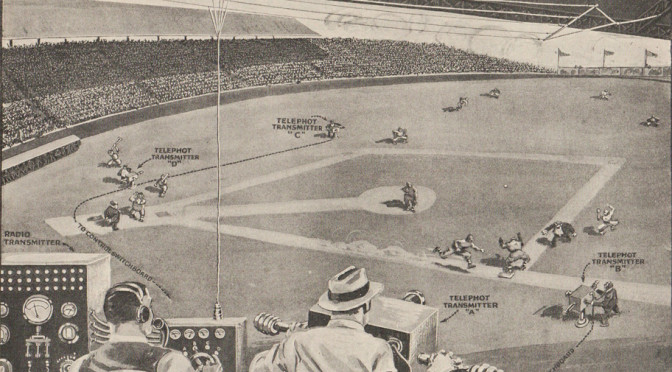
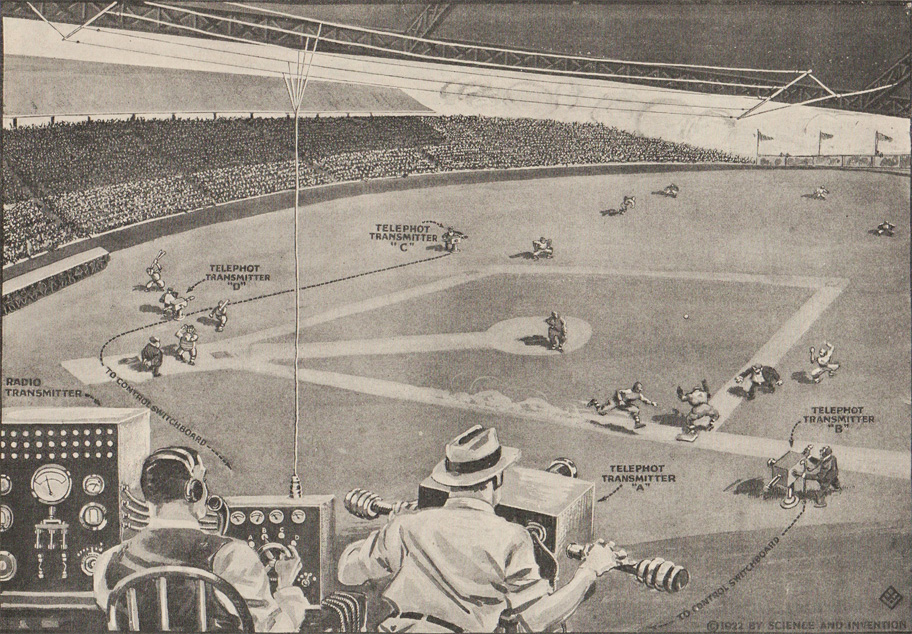
An illustration from Science & Invention, one of Hugo Gernsback’s many technology journals, demonstrating the possibilities of his ‘telephot’ system. (Courtesy The Verge)

PODCAST It’s the beginning of The Bowery Boys Summer TV Mini-Series, three podcasts devoted to New York City’s illustrious history with broadcast television — from Sarnoff to Seinfeld!

 In our first show, we go back to the start of the invention of the television and the city’s role in both the creation of the complicated technology and the early formation of programming.

We begin with the Electro Importing Co. and the imagination of one of the greatest names in science fiction.  Then head into scientific realities — the failures of mechanical televisions and the brutal patent wars between RCA’s David Sarnoff and one of the great inventors of television, Philo Farnsworth.

 In victory, Sarnoff claimed the mantel of ‘father of television’ at the 1939 World’s Fair in Flushing Meadows-Corona Park, Queens.  It’s but one of many great New York City’s beloved landmarks with ties to television’s early history, from the heights of the Empire State Building to even a floor at Wanamaker’s Department Store.

Video telephones in the West Village. Spectacularly strange television displays at Madison Square Garden. News broadcasts in Grand Central Terminal.  And we even go drinking with a few stars at McSorley’s Old Ale House!

ALSO: Why is Greg singing Cole Porter?

To get this week’s episode, simply download it for free from your favorite podcast player

Or listen to straight from here:
The Bowery Boys: New York City and the Birth of Television 1909-48

—–
A couple clarifications: Hugo Gernsback‘s experimental station WRNY at the Hotel Roosevelt operated radio frequencies in 1925 and tried out television broadcasts in August 1928.  I use both dates inter-changeably at one point.

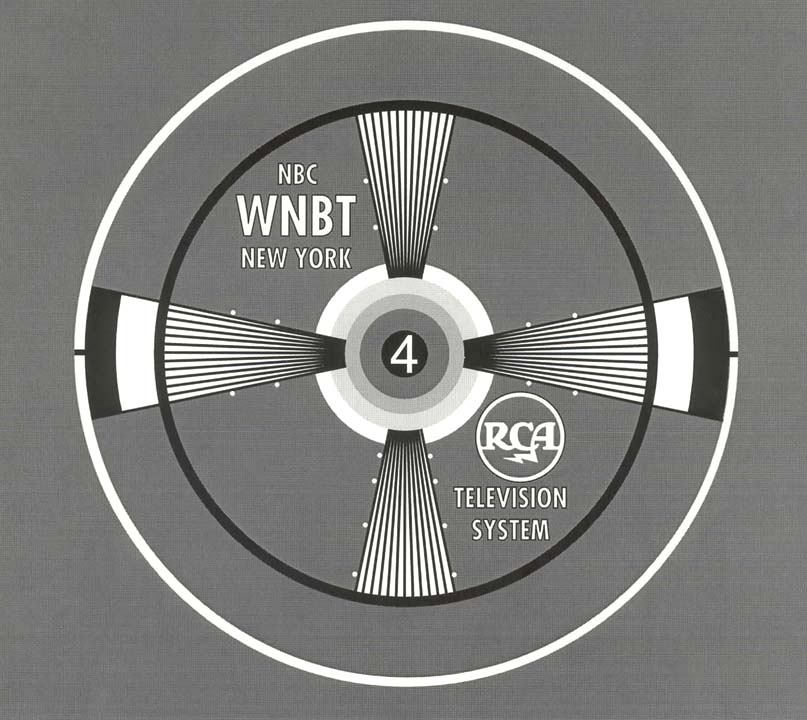
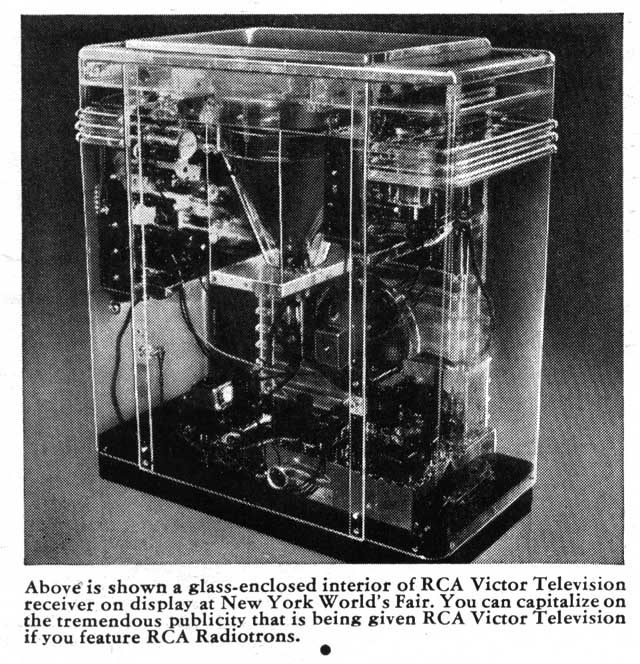
RCA had 13 sets from 4 different models of televisions at their World’s Fair pavilion.  I think Tom said 12 sets. Maybe one of them was that plastic see-thru version (see below)?

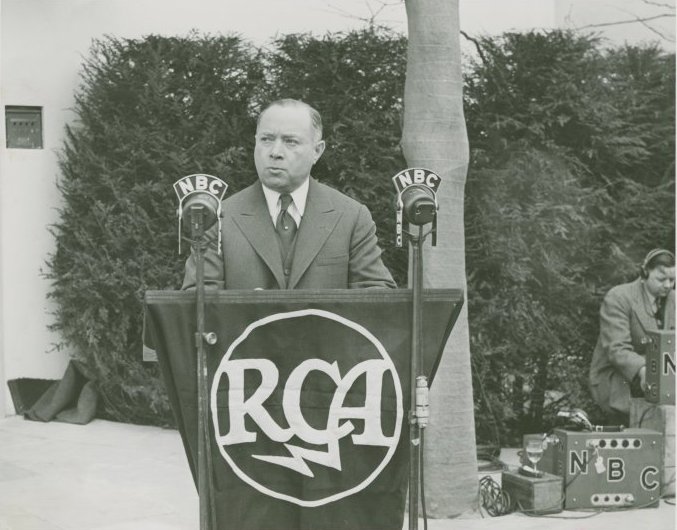
David Sarnoff speaking at the 1939 World’s Fair, presenting the ‘debut’ of television. Although, of course, television had been around in some form or another in New York for over ten years by that time.

 
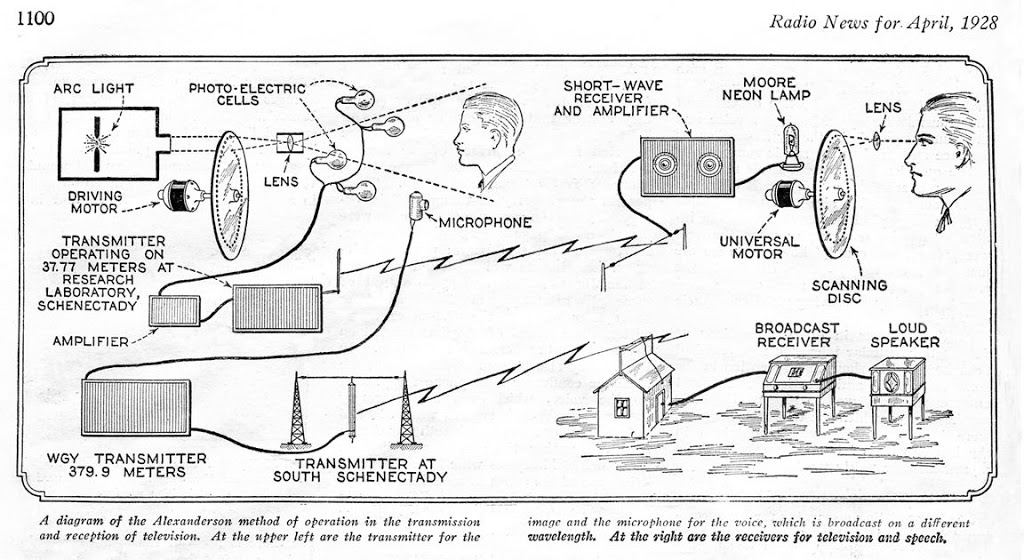
A diagram from 1928 outlining the mechanical television process, as described in the Hugh Gernsback-owned journal Radio News:
 

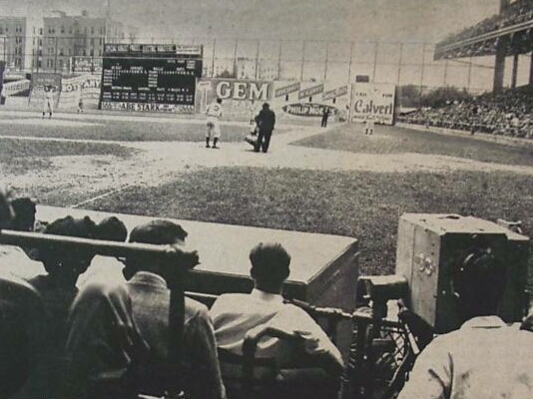
The first televised Major League baseball was broadcast by W2XBS on August 26, 1939, a game at Ebbets Field between the Brooklyn Dodgers and the Cincinnati Reds.  It would also be the first television broadcast of the Dodgers losing a game! (source)

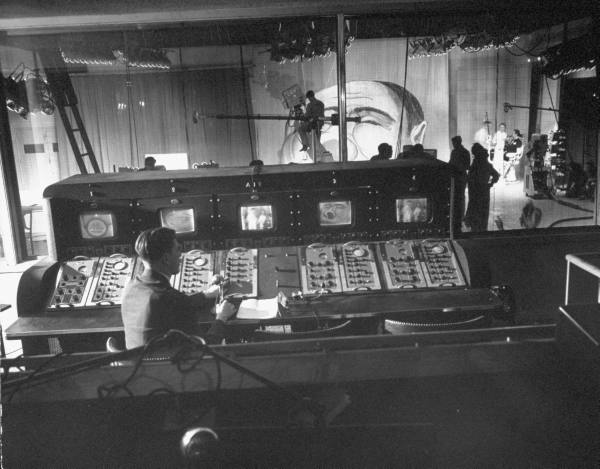
From the Dumont studios in the Wanamaker’s Department Store, 1946 (courtesy Eyes of a Generation):

Categories
Brooklyn History

Henry Ward Beecher, on the 200th anniversary of his birth

If anybody could be called a patron saint of Brooklyn, one of the nominees would be Henry Ward Beecher, born 200 years ago today.  In 1847, he arrived in Brooklyn at the behest of a new congregation and, within a few years, his pulpit there at Plymouth Church would draw thousands.  Perhaps Beecher would also be called Brooklyn’s second great tourist attraction, after Green-Wood Cemetery (which opened nine years earlier and where Beecher is buried today).

Beecher is known for his famous sister Harriet Beecher Stowe, his relatively progressive views on abolition, and his famous friendships with people like Abraham Lincoln, Elizabeth Cady Stanton, and Henry David Thoreau.  But his reputation was besmirched in 1870 in a shocking adultery scandal involving the wife of newspaper editor Theodore Tilton and even free love advocate and scandal magnet Victoria Woodhull!

Celebrate Beecher’s two-hundredth birthday with a visit to is monument facing into the plaza at Brooklyn Borough Hall and short walk to Plymouth Church at 75 Hicks Street.  And listen to my podcast recorded back in 2008!  You can find it in the Bowery Boys Archives on iTunes (here), download it at this link or play it here below, via SoundCloud!

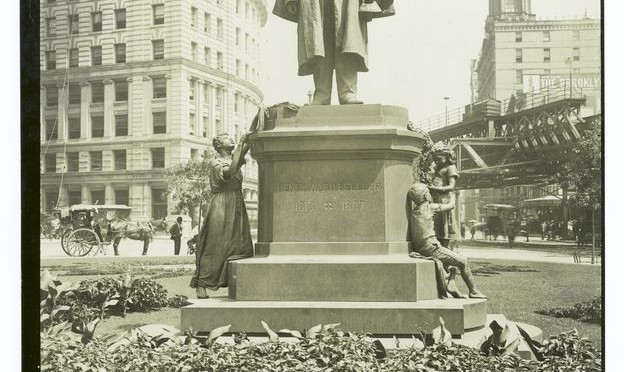
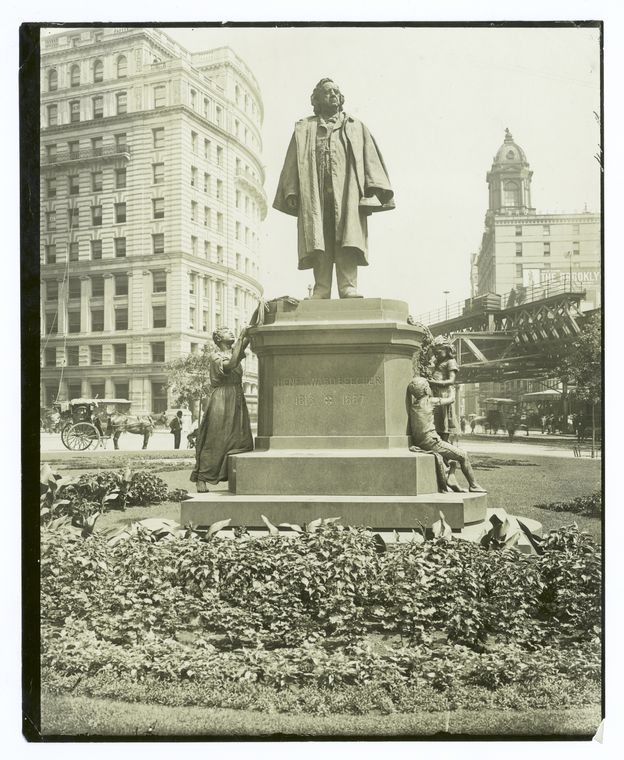
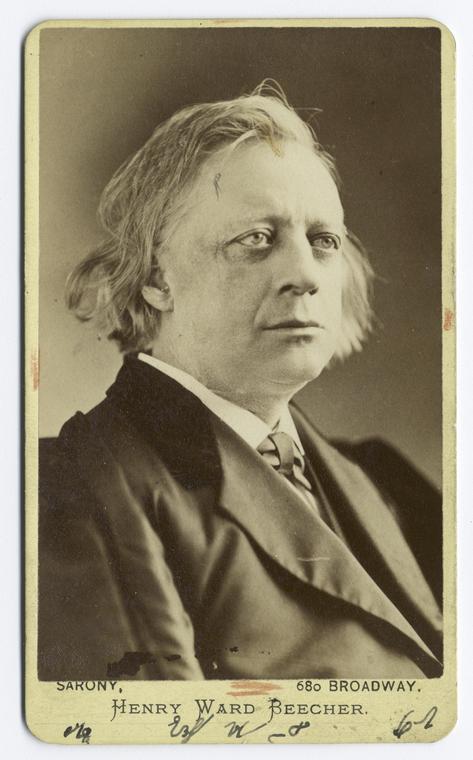
At top: the Beecher statue created by John Quincy Adams Ward, as it looked in the 1890s with horsecars and elevated railroads in the background.  At left: Beecher’s carte de visite

Categories
Mad Men Pop Culture

‘Mad Men’ ends this Sunday, and ‘Copper’ begins, but war and assassinations unite both

WARNING The article contains a couple light spoilers about the current season ‘Mad Men’ on AMC and a few on last season’s ‘Copper’ on BBC America.  

While 1968 comes to a close on Sunday night with the season finale of ‘Mad Men‘, another version of New York history returns on another channel.

Copper‘, starting season two on BBC America, will open in the early months of 1865, in the wake of a failed attack by Confederates that past November.  Just as in this season’s ‘Mad Men’, set in a year of two assassinations, you can only begin watching a show set in early 1865 with the anticipated dread of one future tragedy.

If it makes you feel better, keep it all in the world of pop culture and imagine the events of Steven Spielberg’s ‘Lincoln occurring simultaneously to those on ‘Copper’.   Abraham Lincoln, fresh into his second term, was only just employing often cynical efforts to get the Fourteenth Amendment passed as the war between the states wound to its eventual completion.

Lincoln was still a divisive figure.  In 1864, New York City, a Democratic stranglehold, had voted to replace him with George B. McClellan.  Indeed, the city has such affection for McClellan Sr. that, fifty years later, they installed his son George B. McClellan Jr. as mayor.  For many in New York, Lincoln represented a strike against common prosperity, flagrantly destroying America’s future — both literally, on the battlefields, and figuratively, with the freeing of slaves, weakening Southern commerce (and New York’s Southern interests).

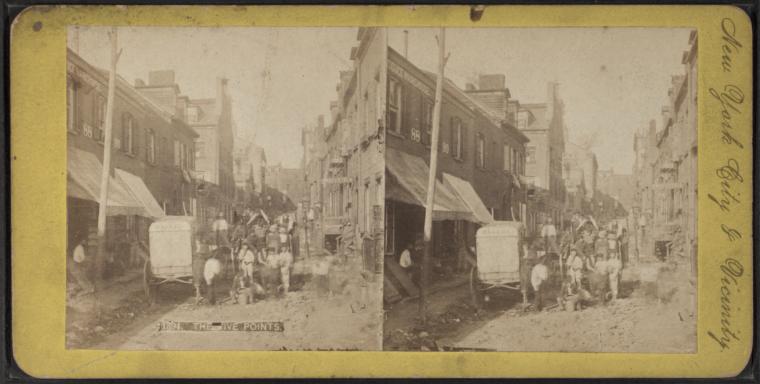
Below: A stereoscope photograph of Five Points in 1865 (NYPL)


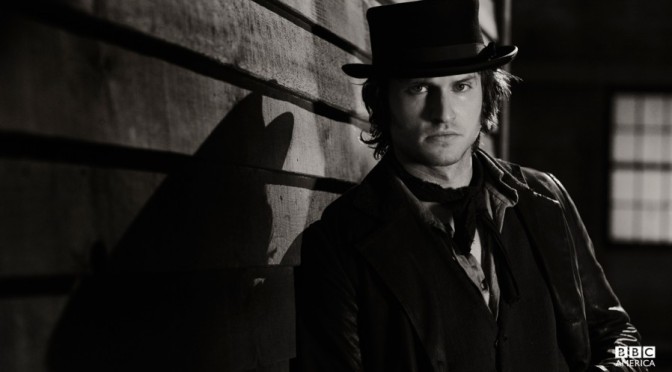
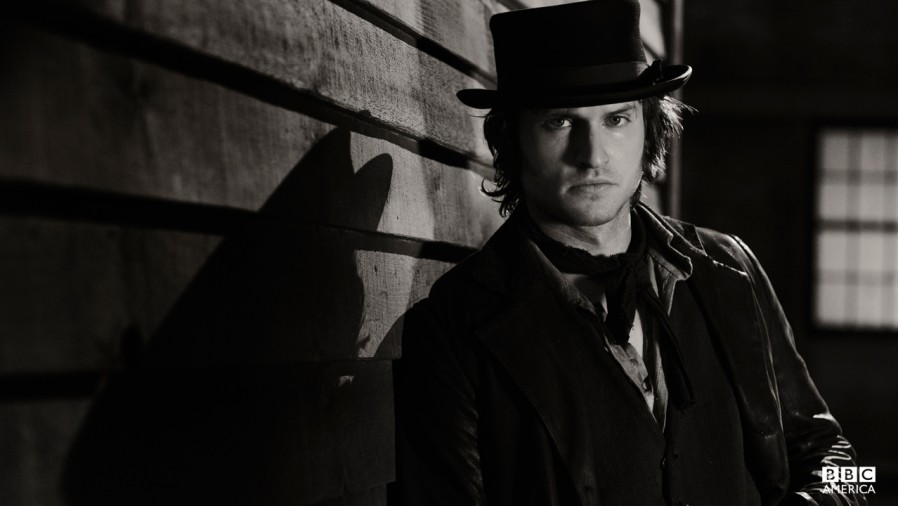
‘Copper’ follows the adventures of streetwise police officer Kevin Corcoran through the streets of Five Points, interacting with both the disreputable characters of that neighborhood (including one sassy brothel owner) and few genteel sorts from Fifth Avenue.  Between thwarting criminals and Confederate plots, Corky also found his amnesiac wife in an asylum.  He also seems to have developed a morphine problem.

What’s might we see in Season Two in regards to New York? 1865 was the year the city got serious about cleaning itself up physically — construction of city sewers was commissioned in this year — even as its government infrastructure was getting ever more corrupt (as in, Tweed was now the ‘Boss‘).

The new episode is set on the date February 5, 1865.  The new New York Stock Exchange opened a few days before that date, reinforcing New York’s real center of power. The consequences of a long war were still ever-present; that February 4th, on Governor’s Island, a Union deserter was even executed.. And there’s still loose ends from that ugly Confederate ‘Greek fire’ business, namely the captive Robert Cobb Kennedy, held in old Fort Lafayette.

But the most tumultuous event of the year came with Lincoln’s assassination, throwing the entire country — and especially the city — into chaos.

Two political assassinations played central roles in this season of ‘Mad Men’, and some professional ones too.

Season Six was a full-on assault on the early ’60s complacency of the show’s initial premise.  In prior seasons, New York City was almost solely depicted via bars and restaurants.  In this season, we got grimy squatters apartments, rat infested walk-ups and allusions to race riots in far-off neighborhoods.

The sky-high haven of  Don and Megan Draper was invaded by imposters, glamorous lesbians and even the encroaching sounds of a dangerous city.  This was a season of menace, the usual bedroom/boardroom operatic antics, scored with the violent tones of the Vietnam War and a cynical presidential campaign forever in the background.

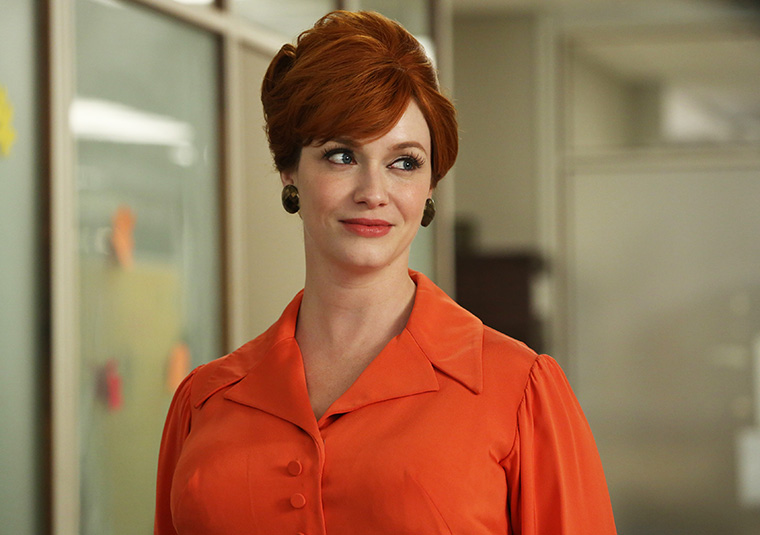
Maybe that’s why some of Don’s storyline this year felt so labored. Why should we care so much about his perpetual indiscretions when the world around him has shifted? How can we keep focused on him?  Characters like Joan Holloway (above, fetching in orange) used the changing times to her seeming advantage.  Pete Campbell, once again, tripped over himself.  Peggy was forever caught between the old and the new, from her lifestyle and career to even her romantic interests.

And then we got an enigmatic new character, one who I fully expect to see hanging out at Stonewall in the summer of 1969, his Greek coffee cups replaced with watered-down cocktails.   I mean, will the creators of ‘Mad Men’ be able to resist it?

As always, you can follow along with me on Twitter at @Boweryboys during the live airing of New York City history-based shows like AMC’s ‘Mad Men’ and BBC America’s ‘Copper’ (along with ‘Boardwalk Empire’, later this year).  As the season finale of ‘Mad Men’ and the season premiere of ‘Copper’ are on at the same time this Sunday (10pm EST), I’ll be Tweeting along with ‘Mad Men’ first, then immediately following with ‘Copper’.

Categories
True Crime

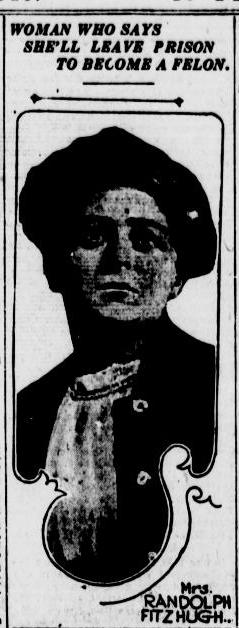
Presenting Mrs. Randolph Fitzhugh, Kaleidoscope woman, society church thief: “I am being hounded to prison by men”

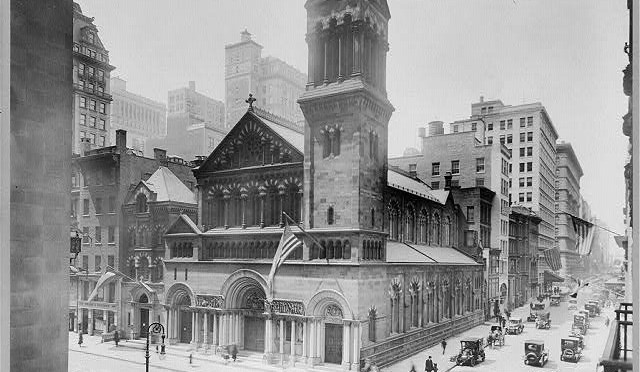
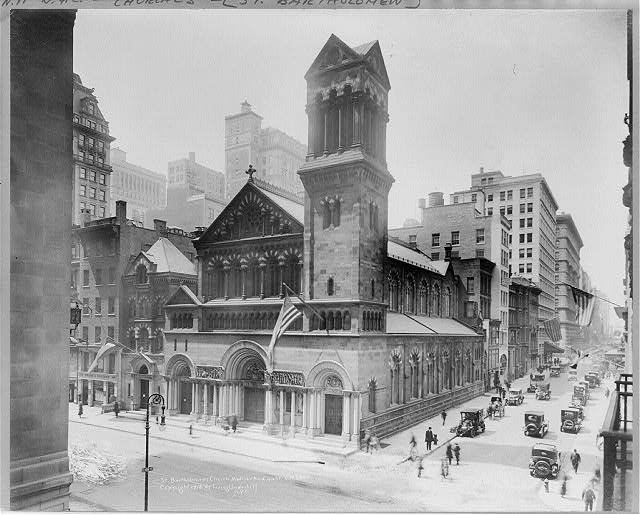
The former St. Bartholomew’s on Madison Avenue and 44th Street, burgled by one Mrs. Randolph Fitzhugh. [LOC]

NOTE: I revised this article this afternoon which some additional information just discovered, making this story ever stranger! New information includes Mrs. Fitzhugh’s real name, details about her baby, her length of stay in the Tombs, and information on another arrest at St. Patrick’s.

The papers called her ‘woman of mystery’ and a ‘woman enigma‘. Later on, she would garner a new nickname — the Kaleidoscope woman.

Rarely had a female criminal so confused New York law enforcement as the unusual Southern woman arrested in early 1913 for stealing from society ladies prominent New York churches.

She called herself Mrs. Randolph Fitzhugh, a Southern woman with a demeanor as such that she could spirit into any number of prominent churches and snatch up a host of items, including a diamond bracelet at the Church of the Transfiguration and a $500 gold mesh bag at St. Bartholomew’s (at its previous building on Madison and East 44th Street, see above).

The revelation of this crimes was most strange.  The owner of the bag received a letter from the Hotel Flanders (6th Ave/W.46th Street) claiming a woman carrying that bag was staying there. Fitzhugh was staying at the hotel with an infant; later witnesses claimed the hotel was holding the baby for an “unpaid rent bill.”

To those in the hotel, Mrs. Fitzhugh claimed she was only “renting the child” due to some troubles in Washington DC. The baby was taken to an acquaintance in Brooklyn, and Mrs. Fitzhugh arrested.

The story with Mrs. Fitzhugh (her real name was Catherine Fennell or Northrup) wasn’t her crime but her reaction to prosecutions.  She plead guilty to avoid a sentence at Auburn Correctional Facility.  But she didn’t stop with that.

A reporter from the New York Evening World interviewed the convicted from her cell at the Tombs where she had been a prisoner for almost seven months.

She told a remarkable tale of a runaway betrothed to the previously-named Randolph Fitzhugh.  It was apparently a controversial marriage, for when he died, her family rejected her. She was then arrested for stealing from a department store.  “All I had done is charge some goods to an intimate friend of mine who had an account at the store . I had often done it before and she gave me carte blanche.”

She then claimed to have married and had a child, although she “never bothered to take good care of our marriage certificate” and was later sued by the man.  Most likely the child was hers, but the ‘renting’ business is still a mystery.  She used the child in later testimony to claim that she took the solace of random churches because she believed somebody was trying to kidnap her baby.

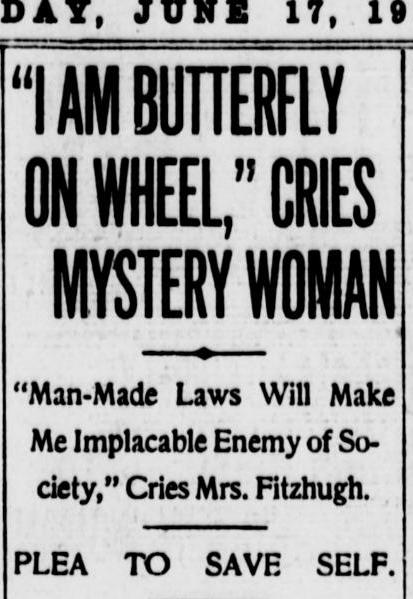
She then exploded with emotion at the Evening World reporter.  “I tell you I am being hounded to prison by men–men–men.  It is ‘The Butterfly on the Wheel’ all over again! I cannot get justice from men.”  The phrase ‘butterfly on the wheel’ is from Alexander Pope‘s ‘Epistle to Dr. Arbutnot’, meaning a concerted effort in appearance to break to the will of something insignificant.

Whatever is going on with Mrs. Fitzhugh — bad luck, desperation, mental illness — it’s easy to sympathize with her from our vantage a century later.  She feared the prison system, knowing it would change her forever, knowing she might never break from it.  She was instead put to a lighter sentence at Bedford Hills in Westchester County.  But she issued a grave warning.

“I am not a common woman.  I understand that almost every inmate of that Bedford place is such a woman. To be thrown with them may embitter me to such an extent that I shall ever after revenge myself on society and turn a really clever, unscrupulous thief.  I may and very likely shall become a professional thief.”

Indeed, she lived up to her word.  After she was released, she returned to a life of crime.  She was arrested once again in February 1915 in front of St. Patrick’s Cathedral.

And later that year, from her perch at the Holland House at 5th Avenue and 30th Street, Mrs. Fitzhugh again plundered neighborhood churches, stealing from the Catholic parish St. Leo’s Church on 28th Street.

To avoid suspicion — although this seems to have failed — Mrs. Fitzhugh changed costumes “six to eight times a day” and was known to hotel staff as the Kaleidoscope woman due to her ever-different garments.

Somehow, Mrs. Fitzhugh had befriended a film actress and was living in her flat at the Holland House.  Most likely, it was the clothing of this unnamed actress that Mrs. Fitzhugh was wearing.  “Her bills, according to the management of the hotel, had been always promptly paid.” [source]

From there I’m able to find anymore information about Mrs. Fitzhugh, the Kaleidoscope lady. She disappears from the criminal record under that name. But I’ll continue to look, because she strangely fascinates me.

Categories
Neighborhoods

Why are there so many Henry Streets in New York City?

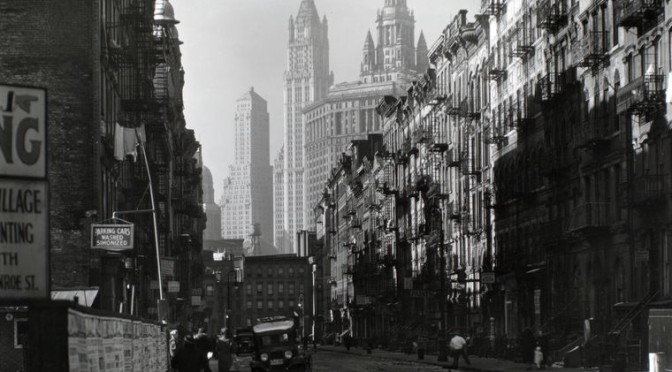
Manhattan’s Henry Street looking south, 1935, photo by Berenice Abbott (NYPL)

Since Manhattan and Brooklyn developed as two separate cities before they were intertwined within consolidated New York City in 1898, it’s not surprising to see similar street names in both boroughs, deriving from different origins.  But the Henrys being honored in these street names are quite different:

Henry Street (Manhattan) is named for Henry Rutgers, the Revolutionary War hero and the financial savior of Queen’s College in New Jersey, who thanked him by renaming themselves Rutgers College (later University).  You’ll find a Rutgers Street in the Lower East Side too; in fact, it intersects with Henry Street. I wonder if he had a middle name?

This of course the Henry Street of  Henry Street Settlement, the pivotal health and social services provider which opened on this street in 1895.

Henry Street (Brooklyn), however, is named for Dr. Thomas W. Henry, a prominent physician in the 1820s who treated the early aristocracy of Brooklyn Heights.  

Although Henry was president of the Medical Society of the County of Kings from 1831-32, it doesn’t seem like he was a name for the annals of medical history. The reason he got his own street has to do with one of the families he treated — the Middaghs.

Lady Middagh, as legend has it, wanted more colorful names for her neighborhood and led a movement to rename certain streets for pieces of fruit — which is why Brooklyn Heights has a Cranberry Street, an Orange Street and a Pineapple Street.

Despite her aversion to pompous street names, one street is actually named for her own family (Middagh Street) and, of course, one for her beloved doctor.

North Henry Street (Brooklyn) was just regular Henry Street in the independent town of Greenpoint.  But that changed in 1855, when Greenpoint — and its neighbors Williamsburg(h) and Bushwick — were annexed into the city of Brooklyn.  

Dozens of old street names were changed when the annexation took place. Here’s a lengthy list of other altered names.  Since the southern Henry Street was the ‘original’ Henry Street of Brooklyn, this one got a North stuck to it.

It’s not clear to me which Henry this is named after, but it’s possible that it took its name from Revolutionary War hero Patrick Henry.  

If so, it would have shared this trait with one of Brooklyn’s greatest politicians, Patrick Henry McCarren, who represented the Williamsburg(h) and Greenpoint areas during the years of the Gilded Age.

Interestingly, none of these Brooklyn Henry Streets are named after Henry Ward Beecher, although his pulpit at Plymouth Church sits near the ‘original’ Henry Street.

Henry Place (Staten Island) is in the neighborhood of South Beach.  I’m not sure of the origin of the name, but one possibility could be a farmer named Henry Bedell, whose mill gives its name to Mill Creek, or even Henry Hudson, who landed here in 1609 before heading over to Mannahatta.

But according to this census report from 1930, Staten Island had a great many more streets named for Henry!  As this borough was a collection of small villages — and still feels that way in some areas there today — there were various Henrys that had to be eliminated for the ease of mail delivery and mapping.

If you have any information on the more unknown Henry Streets, any speculation, or if I missed any Henry Streets, please leave a comment below or email me at greg@boweryboyspodcast.com.

Categories
Landmarks

The Astor House came tumbling down one century ago

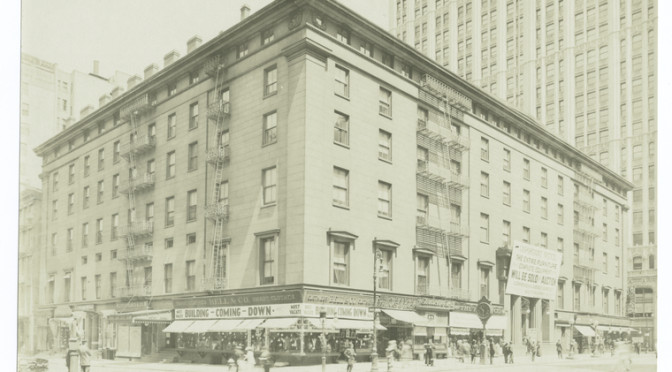
The Astor House was New York City’s first great hotel, opened in 1836 by John Jacob Astor himself, a premier accommodation for the city throughout the 19th century.  But by 1913, it was time to tear it down.

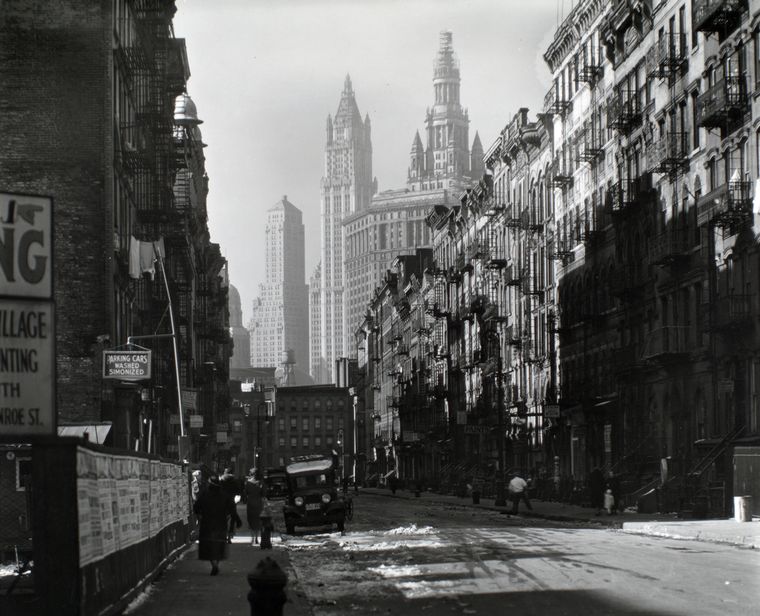
It was a symbolic moment for many older New Yorkers.  As you can tell from the image above, the ancient hotel had a new neighbor:  the Woolworth Building, a symbol of the ‘new’ New York City.  As dozens of more modern hotels opened uptown, the old Astor was greatly reduced, with whole sections partitioned for other uses.

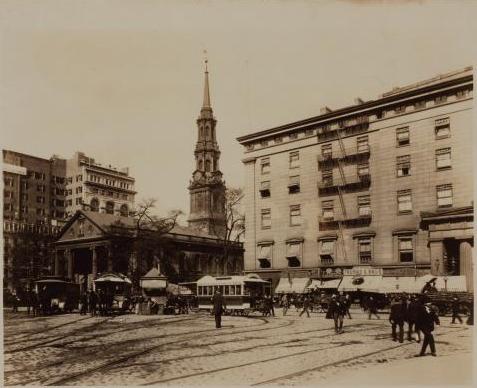
For a little comparison, here’s how the building looked in the 1890s, already minimized in its appearance:

Hotels were now flocking to the Times Square area. In fact, so to did the Astor name, with the beautiful Hotel Astor opening there in 1904.

The hotel might have survived a little longer if not for new subway construction in the area, endangering the foundation of the old building.  On May 29, 1913, the hotel closed its doors, and over the next few weeks, the southern section of the Astor House was torn down.  But not without a bevy of reminiscences from old New Yorkers, and a little teeth-gnashing too of a colder, modern city overtaking the gentle comforts of the old.

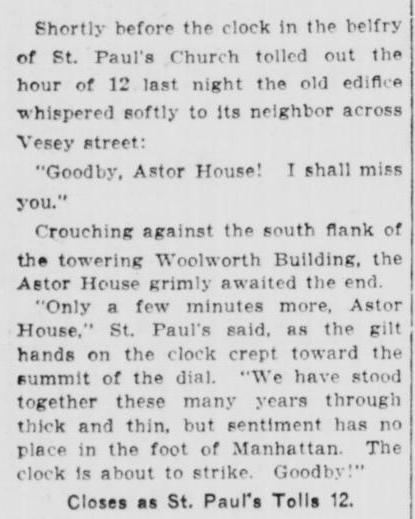
And then, there’s this dramatic article from the New York Tribune, depicting a literal farewell between the Astor and its neighbor to the south, St. Paul’s Church:

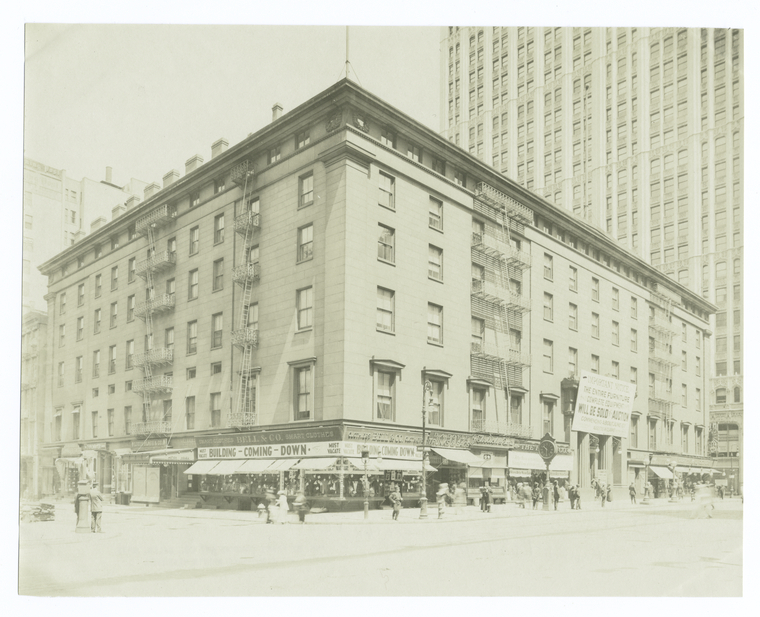
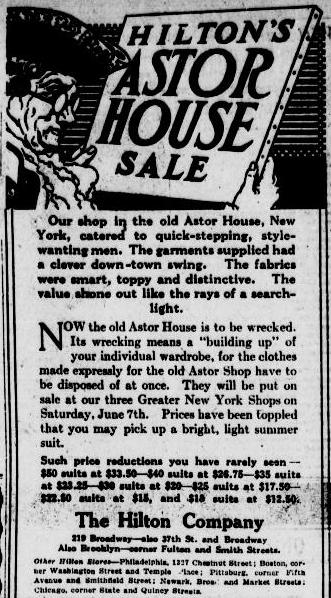
While this spelled doom for a certain memory of New York, those who liked firesales of sorts could take comfort in liquidation sales from famous shops which operated from the old Astor Hotel, such as the Hilton Company:

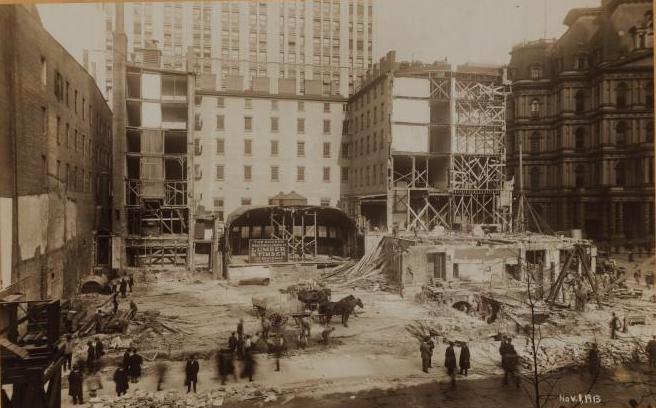
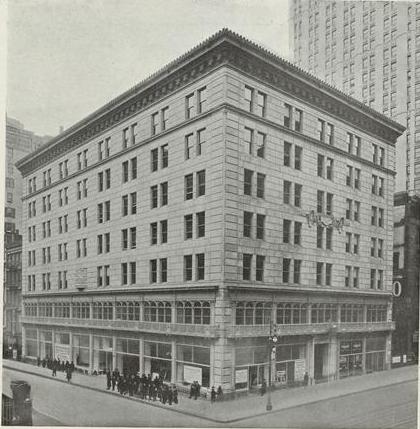
This is what the space looked like within a couple months.  By the way, that’s the old Post Office to the right of the picture, a structure that would last another quarter century before it too was demolished in 1939:

In 1915, it was replaced with the Astor House Building, a small suite of office spaces that remains on that street corner to this day.  It’s where the Staples store is

All pictures courtesy New York Public Library. By the way, have you check out their incredible new search function?

Categories
Those Were The Days

Detonations and flying cheese: Annotated news from 1913

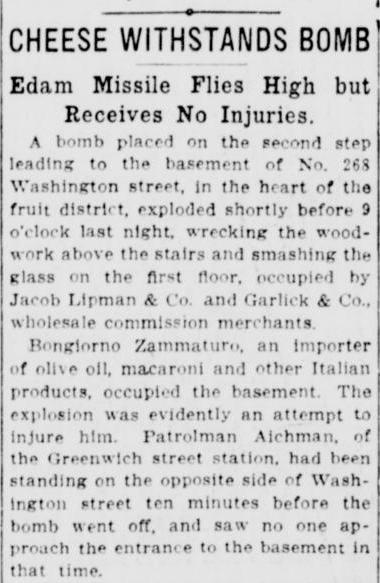
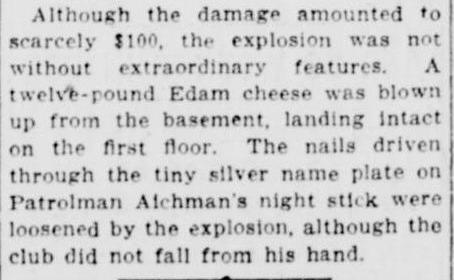
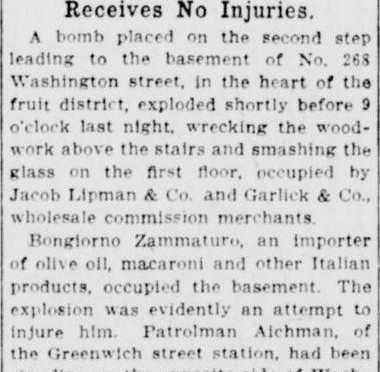
I present this little news item from the June 6, 1913 New York Tribune in its entirety:

1)  The idea of bombs exploding all over the city is shocking to us today.  But in fact the threat of makeshift bombs were sometimes employed in extortion plots such as those by the Black Hand.  Most of these bombs were homemade and many never detonated. When they did, they were usually used to kill particular individuals.  The police department even had a Bureau of Combustibles; in 1913 they reported 125 such explosive devices.
2)  This bomb was placed at 268 Washington Street.  That stretch of Washington no longer exists today, but it would have been located in today TriBeCa neighborhood.  The building which sat at this address predictably held grocers of various sorts.
3)  Notably this address is indeed in “the heart of the fruit district,” Washington Market, where the city went to get one’s produce right off the trains from St. John’s Freight Depot.
4)  Garlick & Co. was a produce “commission merchant,” i.e. a grocery middle-man who buys or sells items for a percentage of the price, obviously a familiar concept today.  
5) The spectacularly-named victim, Bongiorno Zammaturo, was unharmed. I have a feeling the Tribune has gotten his last name wrong. Zammataro is a more frequent variation of this name.
6) This particular Greenwich Street Police Station, where officer Aichman reports, was closed by the police department five years after this incident for “lack of business.”  Another police station of Greenwich Street was active by the 1930s as the man who kidnapped and killed the baby of Charles Lindbergh was taken there.
7) The damage “amounted to scarcely $100” = $2,348.00 according to the Inflation Calculator.
8) An intact flying “twelve-pound Edam cheese” is the comic star of the show of this article.  For those not versed in delicious cheeses, Webster’s describes Edam as “a mild Dutch cheese of yellow color and fine flavor, made in balls weighing three or four pounds, and usually colored crimson outside.”  It’s that outside shell that turned this little cheese into a virtual cannonball, explaining why it “landed intact”.
By the way, did you know that New York state was America’s leading cheese maker in the mid-19th century, although by the time of this article, major cheese manufacturing was centered in the northern Midwest.
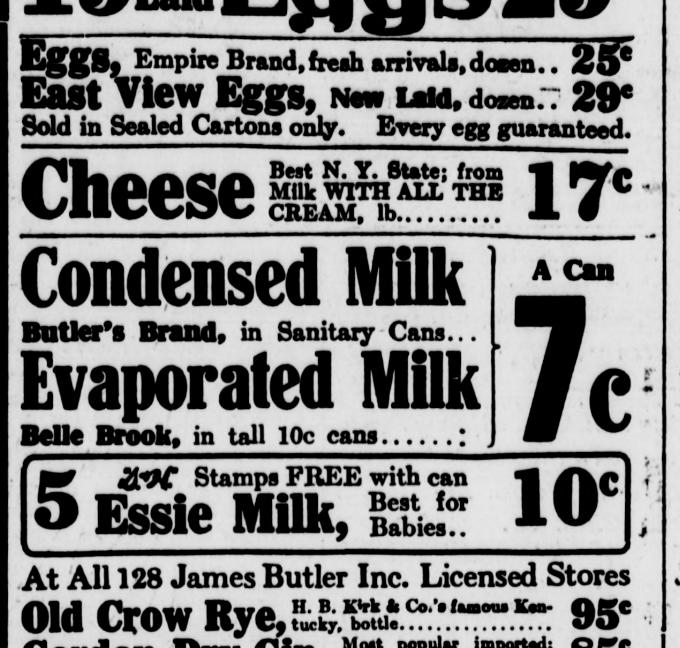
Below: An advertisement from April 1913, for cheese “with all the cream”
IN OTHER NEWS THAT DAY: The big local news of that day was the announcement that New York district attorney Charles S. Whitman was running for mayor to replace William Jay Gaynor who was not running again (and in fact would die in office that September).  Whitman became a national hero during the gangland murder trial that eventually convicted Charles Becker.  
As it turns out, Whitman wouldn’t run for mayor; instead, he ran for governor in 1914 — and won.
______________________________________
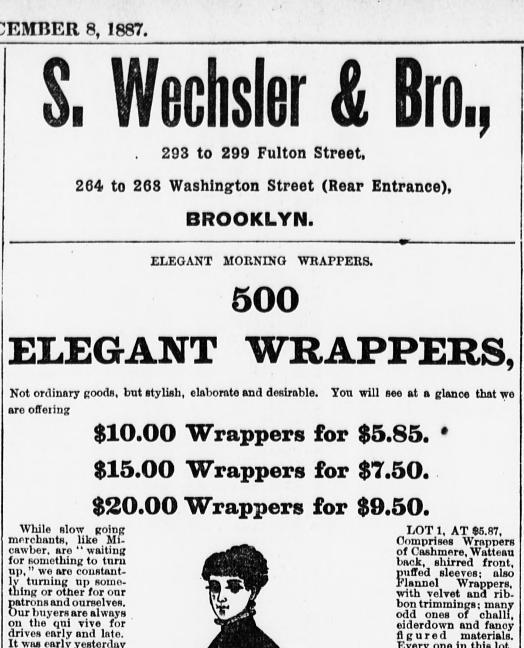
Edit: I originally ran this ad in context of the article above, thinking it was Manhattan’s Washington Street, although it clearly says Brooklyn.  My apologies.  However since this ad was so interesting I thought I would keep it here anyway.  I find the pricing structure particularly interesting:
Categories
Health and Living Podcasts

The startling history of Bellevue Hospital, beyond the horror stories, the last resort for the New York unwanted

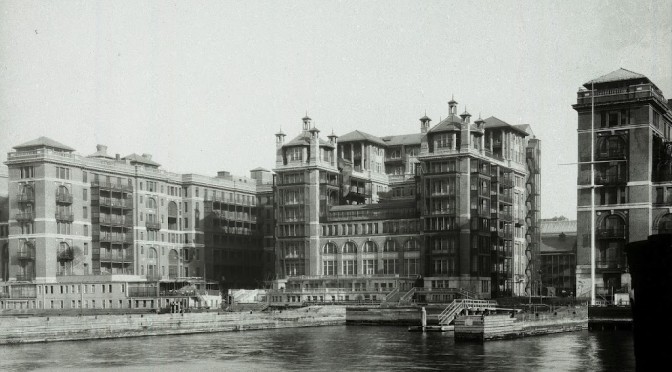
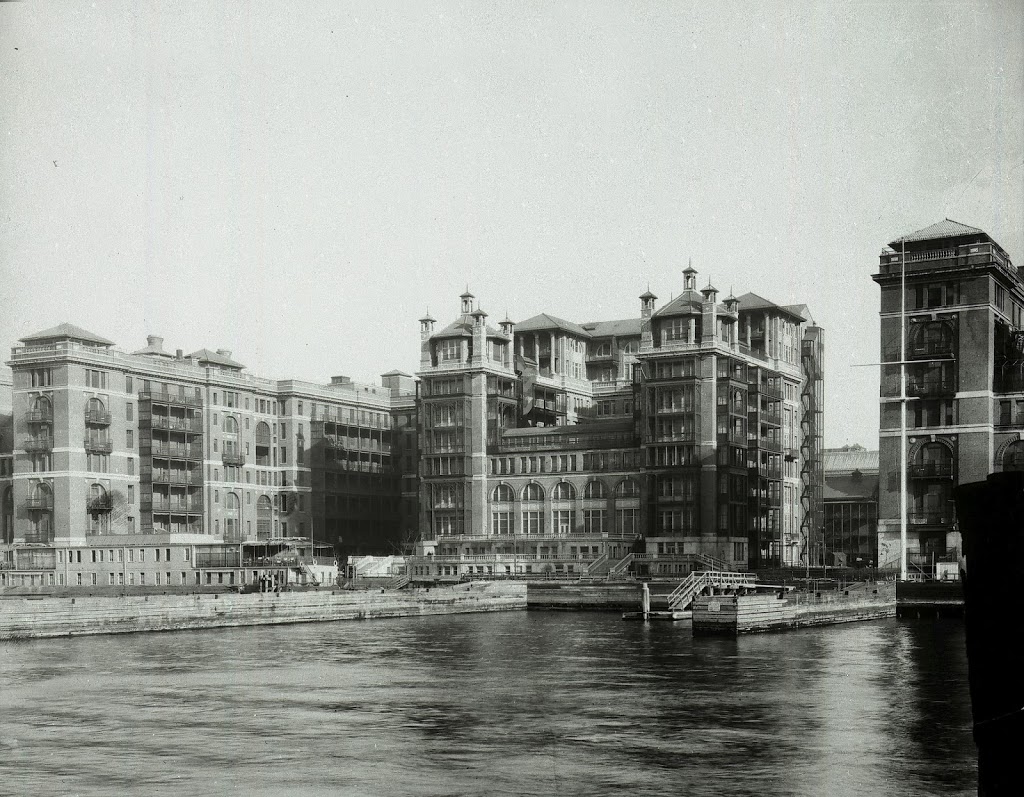
Bellevue from the waterfront, 1879.  Proximity to the shoreline — which once gave the original mansion here that ‘belle vue’ — was key in the early years of Bellevue, as sometimes it was the fastest way to get to the hospital when roads were less than ideal. (Courtesy NYC HHC)

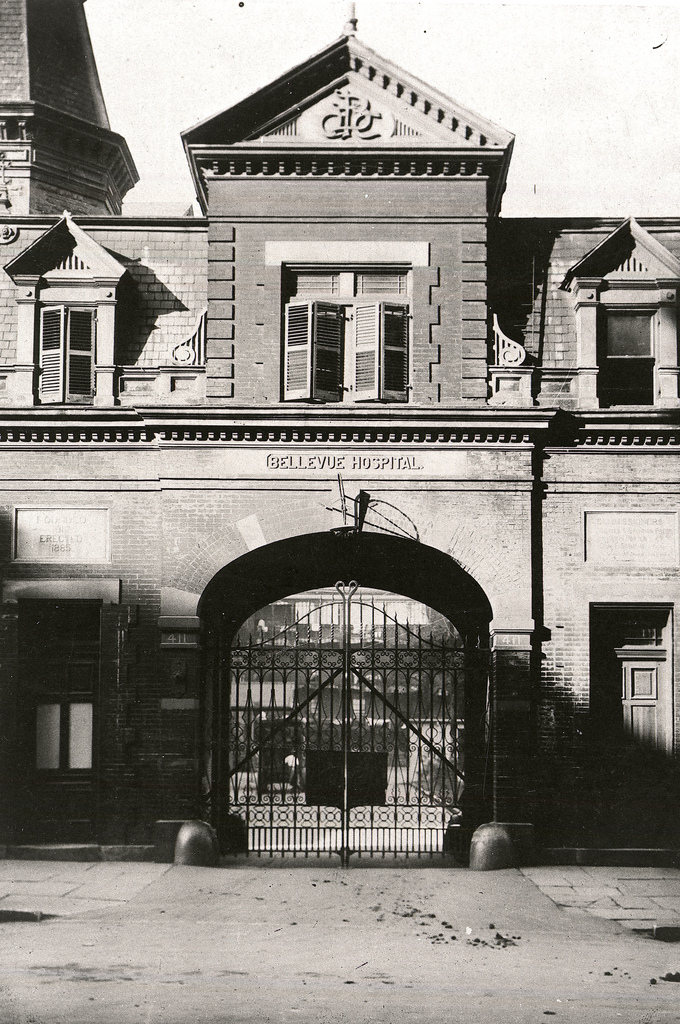
PODCAST Bellevue Hospital, you might have heard, once had a very notorious psychiatric ward. But those horror stories have only distracted from the rather breathtaking — and heart-breaking — history of this historic institution, a lifeline not only for the sick, but for the poor, the incarcerated, the abandoned — even the dead!

The hospital traces its origins to a six-bed almshouse that once sat near the location of New York City Hall today. Despite its humble and (to the modern eye) confusing original purposes, the almshouse was miles better than the barbaric medical procedures of early New York, courtesy the ominous sounding ‘barber-surgeons‘.

A series of yellow fever epidemics moved care for the sick to a former mansion called Belle Vue near Murray Hill — and, in fact, with a strong connection to the Murray of said Hill.  Soon the institution fulfilled a variety of roles and in rather ghastly conditions, from ‘pest house’ to execution ground, from a Pathological Museum to New York’s first city morgue.

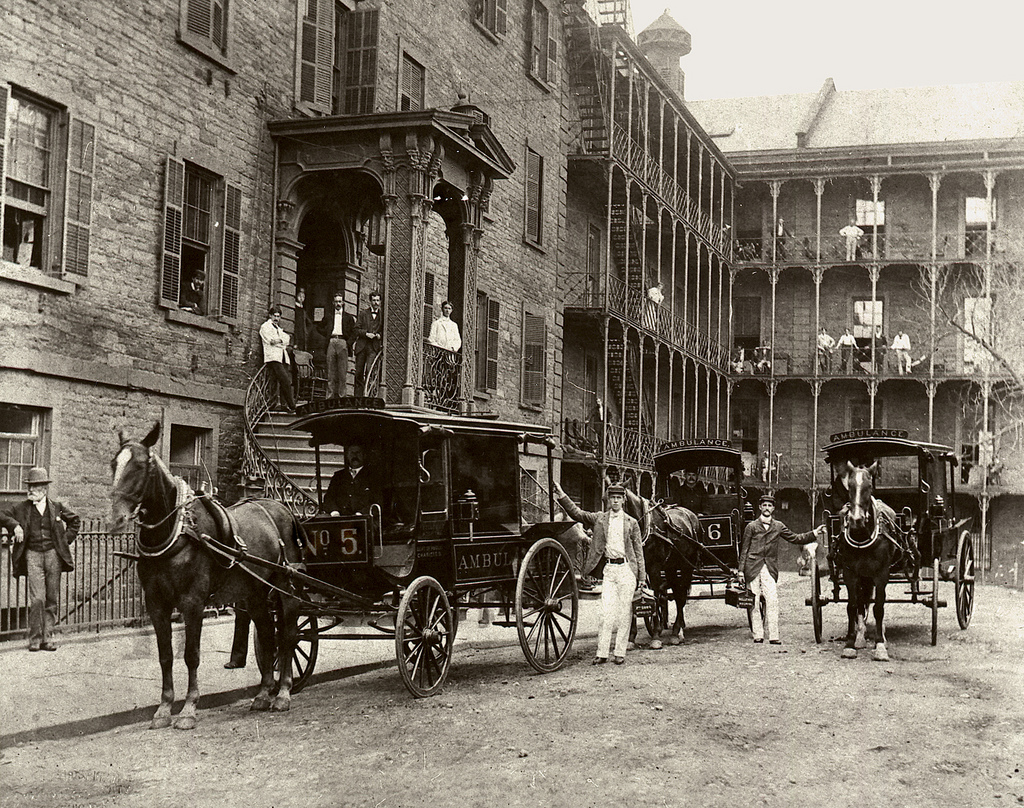
A great many medical advances came from Bellevue, not least of which the origins of the modern ambulance. But some of that progress has been obscured by the reputation of the Bellevue Psychiatric Hospital which opened in 1931 and ‘hosted’ a variety of famous people with disturbing issues.  And in the 1980s, Bellevue would take on another grim role — during the most distressing years of the AIDS crisis.

To get this week’s episode, simply download it for FREE from iTunes or other podcasting services, subscribe to our RSS feed or get it straight from our satellite site.

You can also listen to the show on Stitcher streaming radio and Player FM from your mobile devices.

Or listen to straight from here:

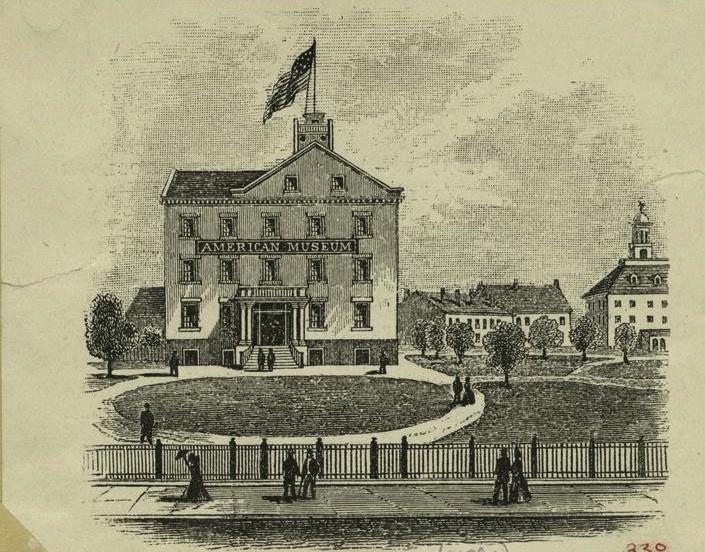
Bellevue traces its start to the original Almshouse which sat in the old common ground that is today City Hall and City Hall Park.  The first infirmary was on the second floor, a total of six beds and originally just one doctor.  When it moved to the Belle Vue mansion during the yellow fever years, this building became refashioned for several institutions, including (as seen below) Scudder’s American Museum, which became the basis for P. T. Barnum‘s museum of the same name. (Courtesy NYPL)

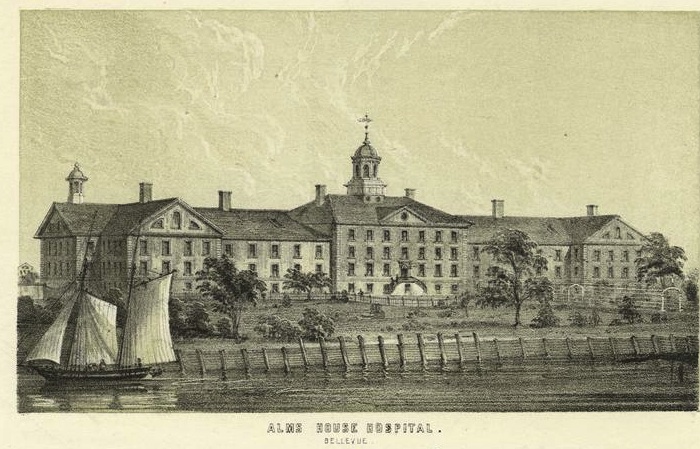
The first incarnation of the ‘almshouse hospital’ in 1852.  By this time, the city had expanded up to this area of Bellevue, and the hospital both farmed out services like its penitentiary and ‘pest-house’ to Blackwell’s Island and expanded its current site to serve the needs of thousands of newly arrived immigrants. (NYPL)

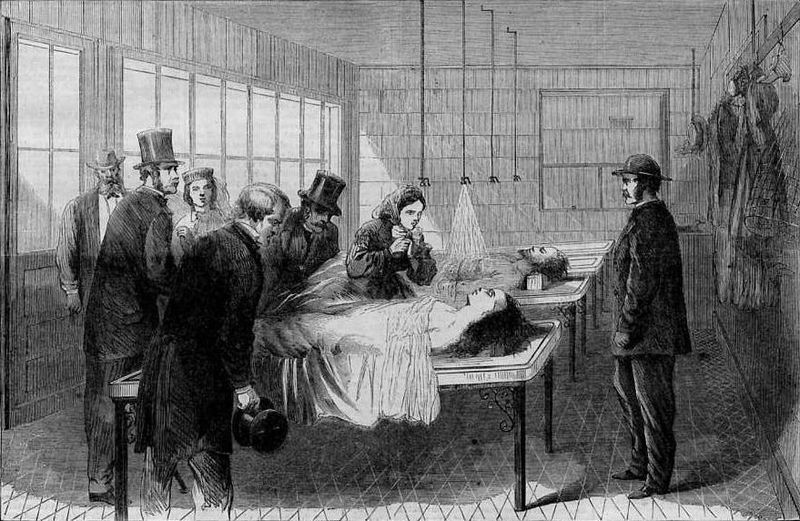
The hospital always had a morgue — its mortality rate, after all, was quite high in the 1830s-40s — but in 1866, it expanded to become New York City’s first city morgue.  Bodies had to be buried after a few days, but for identification and forensic purposes, clothing and other personal articles were kept on display for a month then put into storage.

The first ambulance service ever started at Bellevue in 1869, thanks to the hospital’s connections to the Civil War. The fleet of horse-drawn ambulances features a gong to get through busy streets and a container of brandy as an early reliever of pain.

By the way, I read in one source that the railing of that spectacular entrance to the left was actually taken from the balcony of the demolished Federal Hall, where George Washington was sworn in as America’s first president! I’ll have to find out more about that…. (NYC HHC)

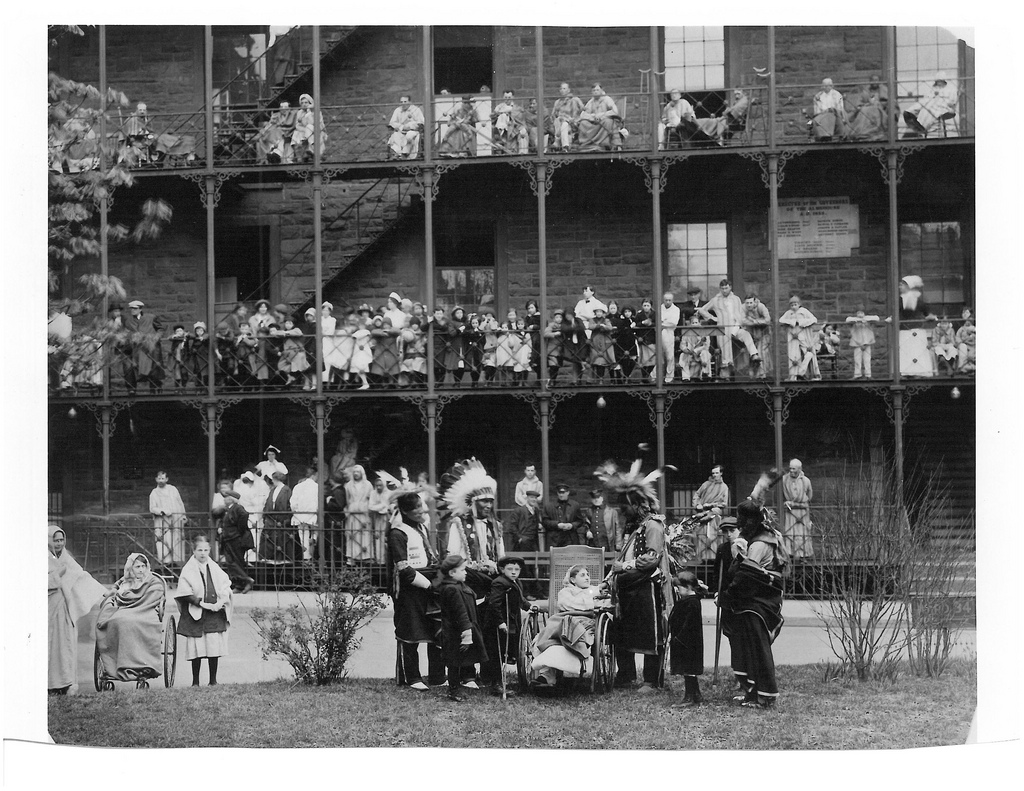
The circus of Barnum and Bailey annually visited the old hospital, entertaining the patients who watched from those glorious iron balconies.  This picture is from 1919 and featured some performers dresses as Indians. (Courtesy Bellevue Hospital Archives)

The hospital’s enduring reputation for treating alcoholics — and the less-than-glowing reputation of its psychiatric ward — were featured in the Billy Wilder film ‘The Lost Weekend‘, which won the Oscar for Best Picture.

Patients had to be evacuated in October 2012 during Hurricane Sandy and was only restored to full service in February of this year.

CORRECTION: In discussing early hospitals that moved into old mansions, I mention Long Island City Hospital, but meant Long Island College Hospital.

http://www.flickr.com/photos/hhcnyc/6507317011/

Categories
Health and Living

The Strangers Hospital: Your special home on Avenue D, brought to you by Boss Tweed’s plumber king

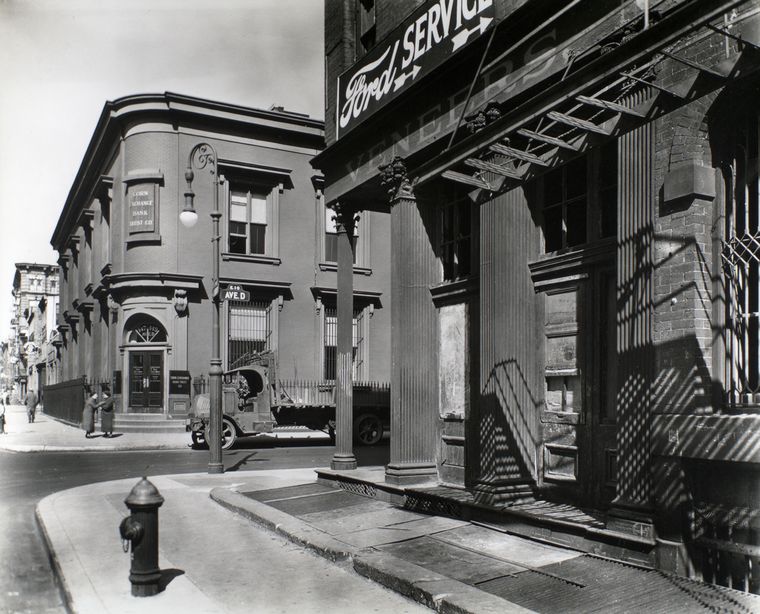
A genuine survivor: The building to the right was once the Strangers Hospital in the 1870s.  This picture, by Berenice Abbott, was taken many decades later, in 1937.  And the building is still around today! (Picture NYPL)

New York used to lump the sick, the poor and the homeless into one mass of needy unwanted.  Since its founding, the city has struggled take care of the growing dual problems of poverty and plague, but in a way that kept the unwanted safely invisible to its wealthier classes.

With the rise of immigration starting in the 1840s, the problem became too pervasive to simply throw people into large catch-all institutions like Bellevue Hospital (which, in its early years, served as almshouse, hospital, quarantine, prison and morgue).  Soon Blackwell’s Island became the solution, with a string of grim institutions lining the East River island.

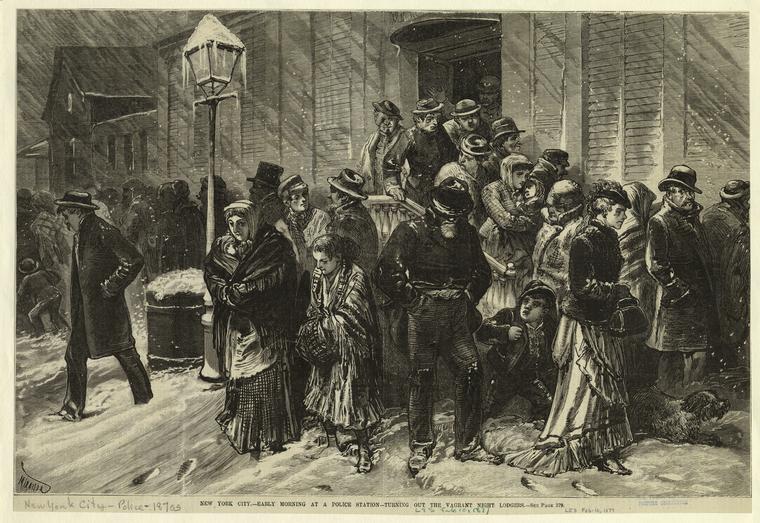
Below: For those less ‘worthy’, a cold night might have meant sleeping in the local police station. In the illustration below (1877), the homeless are turned out into the street at morning’s light. (NYPL)

Another solution for the homeless arose in 1870s in the delirious days of the scandals of the Tweed Ring.  John H. Keyser made his fortune in the growing new field of indoor plumbing; in fact, he seemed to be wildly successful at it, a sudden millionaire in an era were certain men — with certain connections — grew wealthy overnight.

Keyser may have had friends in high places, but he expressed an unusual need for the common man. Perhaps his outreach was a tad cynical; the poor he helped often voted the way Keyser preferred.  But with the city facing a severe poverty crisis, even the baited gesture had beneficial results.

The plumber king operated a ‘Strangers Rest’ at 510 Pearl Street in 1869, a boarding house for vagrant men and women.  The vagrant house was situated halfway between City Hall and Five Points, and it operated on that spirit as well, an abode of good will and a little favoritism.  You could stay if you were deemed “worthy,” meaning either good behavior or an unofficial pledge of allegiance to the Democratic Party.

The following year, Keyser purchased a building for $8,000 owned by the New York Dry Dock Company and transformed it into the Strangers Hospital, a vagrant home and care center in the vastly crowded Lower East Side.  The building is still standing today at 143-145 Avenue D.  Across the street is the Dry Dock Playground.

The Strangers Hospital opened in January 1871 with dozens of bed in several wards, a reading room, Russian and Turkish baths, a recreation room, and a chapel, with walls made of “India rubber, to avert the absorption of any infectious materials.”

An opening day blessing announced its unique mission: “It is not intended for the benefit of the wealthy, who in times of sickness can command the comforts of a well-ordered home and the attendance of a skillful physician or surgeon.  Nor yet the beggar, who leads a life of dissolute idleness, rotating in winter and in sickness about the charitable institutions of this city.  It is intended for the succor and restoration of the deserving poor……strangers — strangers to the home of plenty and comfort in which they have been born and nurtured, and from which misfortune and disease have parted them.”

In other words, you were worthy if they deemed you to be so.

It was an odd differentiation.  As an accommodation for up to 200 people, it served not only as a regular treatment hospital for the ‘deserving poor’, but as a convalescent home and halfway house.  Most likely, you had to be recommended but a tenant in good standing and, as I mentioned, it probably helped if you were a Democrat.

I underscore that because the Strangers Hospital didn’t last very long, closing in 1874. And this is why — Keyser was known as the ‘Ring Plumber’, a crony of William ‘Boss’ Tweed who enjoyed thousands of dollars in kickbacks and special favors.  Tweed went to trial in 1873 for his crimes, and his cronies, although never formally charged, were disgraced.

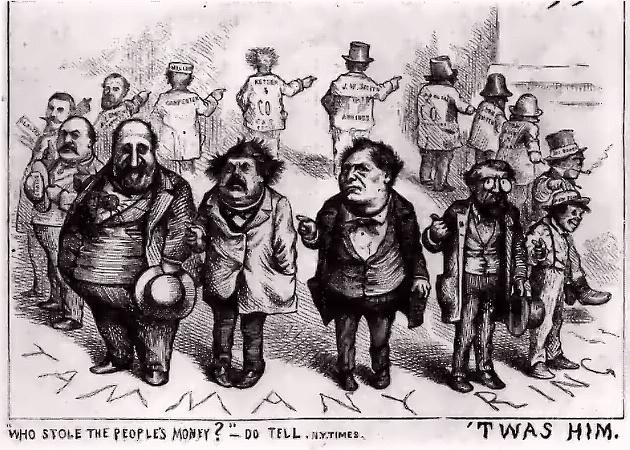
Below: Keyser would have been one of the links of this chain of favoritism, envisioned by illustrator Thomas Nast 

Contemporary sources of the day are not kind to Keyser, with one account call him “a real live Oily Gammon [arch-villian, from an English phrase which meant fatty ham], an Americanized specimen of the article — revised and improved in order to fit him to be a bright and shining light in the fraternity of which he is a member.”

By 1877 Keyser went bankrupt.  Still, his obituary lists several more philanthropic efforts by Keyser, including a “free eating house” in Washington Square in 1888.  From the headline: “Thousands were aided by Man Accused to Being Tweed’s Partner.” So whether or not his actions were sincere, he did manage to fund the feeding and caring of thousands of poor and sick New Yorkers.  Where does such a legacy stand?

Categories
It's Showtime

The Evangelist of Kitsch: Liberace’s final performances, with the Rockettes, at Radio City Music Hall 1986

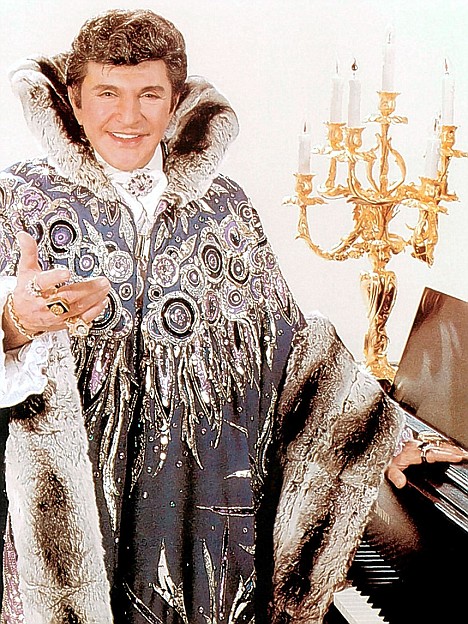
Liberace is the embodiment of a certain California flamboyance, but New Yorkers were as susceptible to his allure as anyone.

In fact, for this brightly-painted musical showman, Radio City Music Hall was a second home.  He continued to smash box office records here year after year as late as the 1980s, well past his prime as anything more than a jewel-encrusted artifact.  In 1985, his stint here grossed more than $2 million.

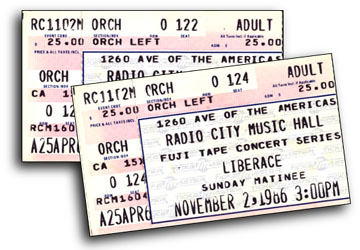
He went out, of course, in a blaze of glory and sequins.  His final live show anywhere was at Radio City on November 2, 1986, capping two weeks of consecutive shows at the venue. (Most stars have a hard time packing the house one night!)

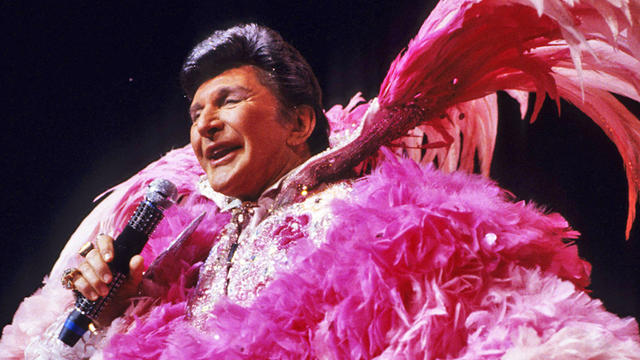
The entertainer, with his flowing robes, acres of feathered frippery, furs and wires and “dancing waters,” was enough spectacle for any stage, but for this series of shows, he was also joined by the Rockettes and a gigantic simulation of the Statue of Liberty holding a candelabra. Photo of the tickets courtesy Bob’s Liberace

Time Magazine’s Richard Corliss, in a 1986 article called ‘The Evangelist of Kitsch, sets this scene:  “The lights go down in Manhattan’s deco dream palace, Radio City Music Hall, and Mr. Showmanship makes his entrance, flying across the huge stage in a cocoon of feathers, enough for a whole flock of purple ostriches.”

That’s right;  in a move that would inspire future boy bands, Liberace flew in, “attached to a wire like a puffed-up Peter Pan, in a hundred pounds of purple and white feathers,” according to the New York Times.

The audience lapped up every bon mot of coy comedy.  Corliss: “They laughed as he sat down on his studded coattails and remarked, ‘If the rhinestones are turned the wrong way it’ll kill ya.'”

Liberace was assisted on stage by his new handsome assistant Lee;  his last assistant and chauffeur — and not-so-secret lover — Scott Thorson had settled his palimony lawsuit out of court just earlier that year for $95,000. (This is the subject of Sunday night’s Behind the Candelabra with Michael Douglas and Matt Damon.)

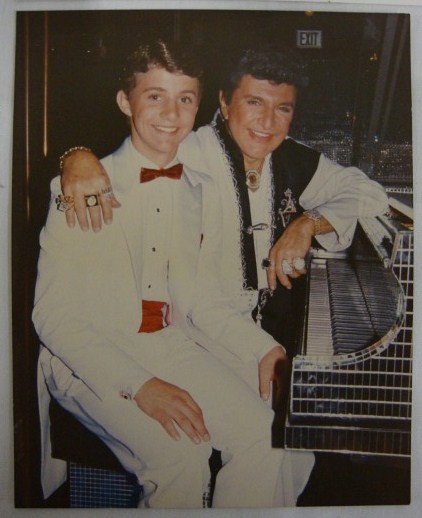
Believe it or not, it wasn’t Lee or the Rockettes that got the most stage time with Liberace during the Radio City Music Hall performances.  That honor belonged to 14-year old child pianist and “Liberace protege” Eric Hamelin, who performed a piano duet with the feather-frocked superstar (“Slaughter on Tenth Avenue”) and a couple other numbers. At right: the star and his protege (source)

Stephen Holden at the Times was understandably critical of the actual performance.  “His heavy-miked pianism is at once metallic sounding, exaggeratedly florid in ornamentation and unbendingly rigid in tone and phrasing,” said the critic.

But the audience lapped it up, as he buoyantly hopped from classic to classic with jokey classical trills linking the songs together.  His tribute to Chopin led right into “Mack the Knife.”  His mournful, dripping “Send In The Clowns” spiraled into the silly ’60s novelty song “Bumble Boogie.”

His final song that final evening was “I’ll Be Seeing You”.  The audience leaped to their feet as Liberace in his sumptuous robes and dazzling bejeweled rings gave his final bow.  Three months later, Liberace would be found dead of AIDS-related pneumonia in his Palm Springs home.

He left the stage with his personal charms intact even as his engineered facade had practically disintegrated.    “Too many young performers have forgotten that the most important part of show business is not the second word, it’s the first,” he was quoted as saying . “Without the show there’s no business.”

Believe it or not, video footage from those final Radio City Music Hall concerts.   While this footage is poor quality, the fact that it exists at all is extraordinary.  Pop open the champagne and enjoy!

Courtesy showmanlee on YouTube.

:

Top picture courtesy NBC/wire image

Categories
Health and Living Those Were The Days

Close shave: A century ago, barbers riot through New York, leaving half-shaved men in vacated barber shops

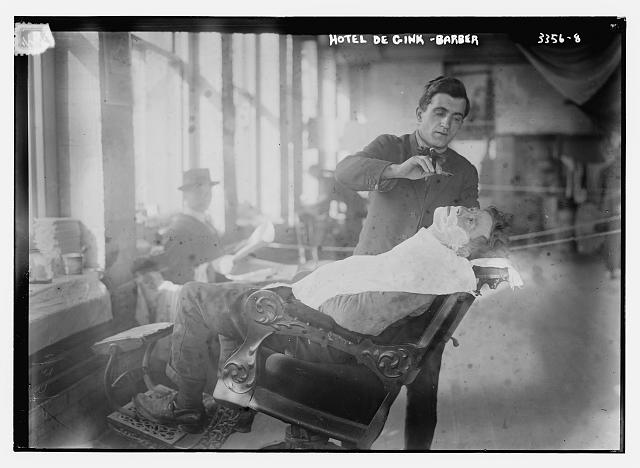
A barber shop at the Hotel de Gink on the Bowery, circa 1910-15 [LOC]

The fight for worker’s rights swept through a variety of occupations over a century ago as New York City laborers rebelled against unfair corporate practices and unsafe working conditions.

Garment workers marched the avenues in protest following the tragic Triangle Factory fire of 1911, as did underpaid street cleaners and ashcart men, leaving heaps of un-retrieved rubbish on the street in protest.  The following year, the waiters and staff of dozens of New York’s finest hotels took to the streets for better pay. Why, by 1913, even some players on the Brooklyn Dodgers were unionizing!

And one hundred years ago this month, it was the barbers turn to march.
Many of the same leaders from other occupational strikes were at the center of the barber strike, which got its footing in the Brooklyn neighborhood of Brownsville.  Soon, barbers across the city had dropped their razors and foaming brushes and left work in consolidation for better hours.
A letter-writer to a wonderfully named 1913 journal called Journeyman Barber, Hairdresser, Cosmetologist and Proprietor wrote, “I will say that on a certain bright morning in the month of May, I found that the entire barber industry was paralyzed.  Nearly 13,000 workingmen were out on strike. Isn’t that a miracle?  Thirteen thousand barbers on strike!”
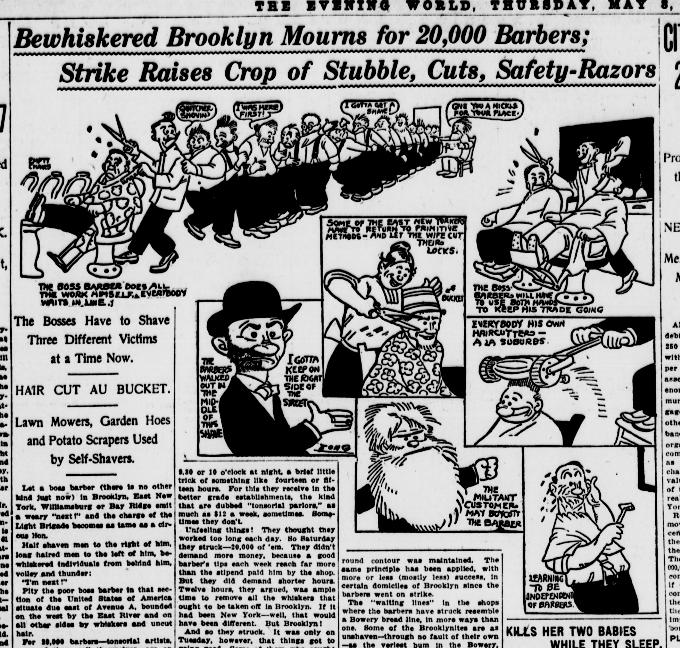
Mayhem reigned upon the craggy, unshaven faces of Brooklyn men.  “From Bushwick to Bay Ridge haggard men go about with the telltale blemish encroaching upon their visages like a noxious fungus.  Half-shaved men slink about the alleys, avoiding the light of day.” [source]
Scenes of violence did erupt throughout the city, as strike-breakers were attacked and angry mobs filled the street.  A mob of 5,000 strikers — “singing socialistic songs,” noted the New York Tribune — clashed with police in Brownsville on May 7th, customers fleeing barber shops in “a shower of vegetables” and the occasional flying rock.

Below: a cheeky editorial cartoon from the May 8th 1913 Evening World

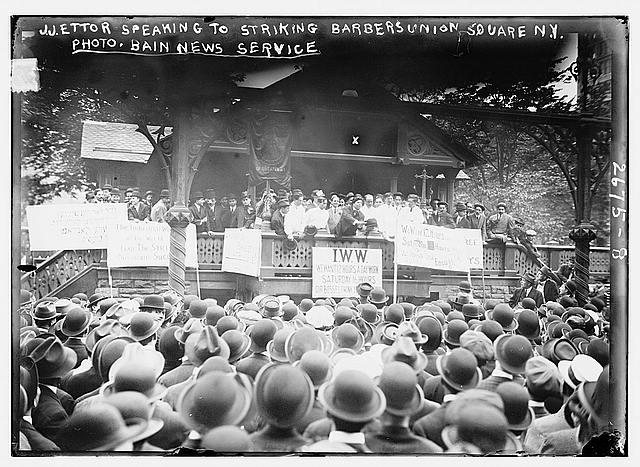
A couple days later, thousands of barbers marched across the Brooklyn Bridge to Union Square, gathering up working men along the way, emptying barber shops of employees and leaving stunned customers in their chairs.  In Union Square the strikers heard speeches from organizers including Joseph James Ettor (pictured below), who had helped organize the waiter’s strike just a few months before.

The Evening World makes curious note of one exception to this striking throng. “ONLY LADY BARBERS WORK IN BROOKLYN WHILE MEN STRIKE” went the headline.  “Such a business as the feminine barber shops did!”

Manhattan barbers joined their Brooklyn brothers by mid-month, setting up a Manhattan strike headquarters at 140 Second Avenue.  (Today, that the address of the Ukrainian East Village restaurant.)  Arlington Hall at nearby St. Mark’s Place was the scene of several union gatherings for striking barbers.

Descriptions of rioting barbers sound a bit like scenes from the Civil War draft riots, although much of that description was the newspaper flourish of the day.

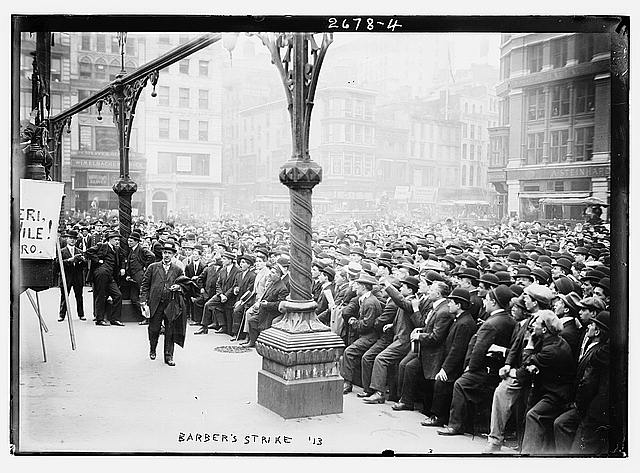
Below: Thousands of barber shop workers and their supporters gather in Union Square in 1913. I believe this is the northwest corner of the park. (LOC)

But it does sound like a violent few days in Manhattan.  Shop windows were smashed by rioters in the Ladies Mile shopping district, and altercations with store owners put many in the hospital.  The Sun noted: “Window smashing and attacks on workers, common all day, culminated in dozens of small riots all over the city, so many and so rapid that police headquarters heard of them in bunches.”

Eventually, the strike proved a success, as barbershop owners agreed to worker’s demands.  According to one source, instead of working up to 92 hours a week, employers now agreed to the relatively mild 62 hours a week for their workers, with one entire day off on Sunday! [source]

“2,300 Boss Barbers Capitulate,” declared the Evening World on May 30th. “Brooklyn Strike Over.” By the first of June, it was safe again to go to a barber shop.

Categories
Landmarks

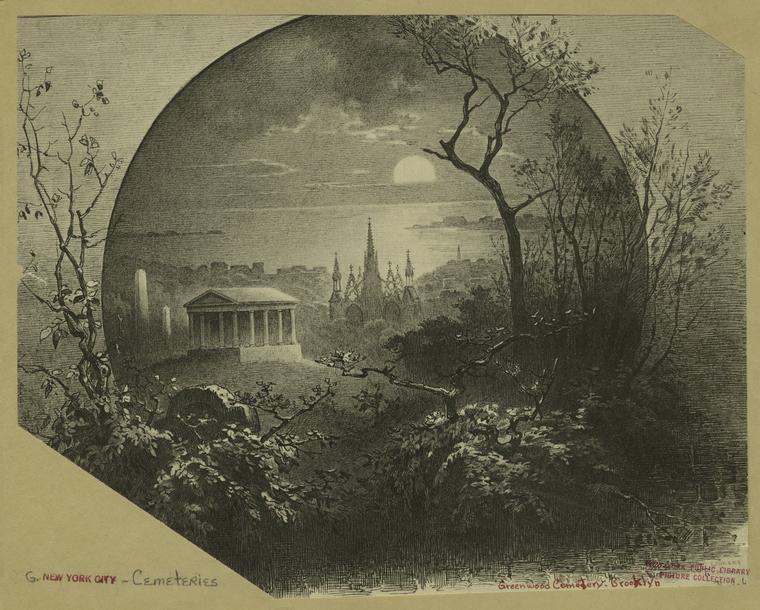
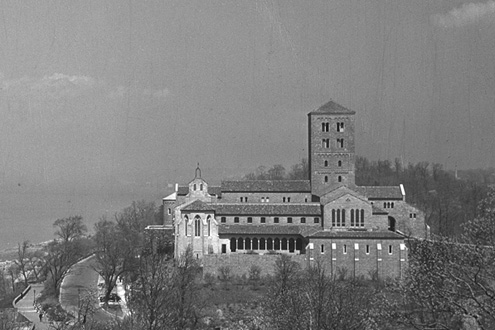
Green-Wood Cemetery, Katz’s Deli and The Cloisters: Three great New York institutions, three big anniversaries

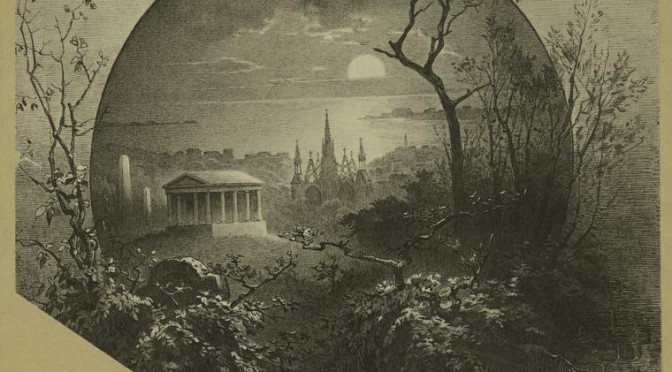
Green-Wood Cemetery celebrates its 175th year as Brooklyn’s oldest greenspace, populated with deceased politicians, writers and actors.  It’s the final resting place for some of New York’s most famous and notorious characters — Henry Ward Beecher, Horace Greeley, DeWitt Clinton and Boss Tweed among them.

The Museum of the City of New York debuts its new exhibit “A Beautiful Way To Go: New York’s Green-wood Cemetery” this week, while the cemetery itself is planning a host of events, including trolley tours, concerts and their popular twilight tours. (The nighttime tour this weekend is sold out, but you can visit their website for future events.)

It’s a good time to chow down at Katz’s Delicatessen again on the occasion of its 125th birthday.  It was in the year 1888 that a deli officially opened at the southeast corner of Ludlow and Houston, serving the neighborhood’s immigrant community.  It was sold to the Katzs in 1910s, renamed and moved to its present location.

They’re throwing a big birthday bash on May 31 with all proceeds going to another great Lower East Side institution, the Henry Street Settlement.  But if you can’t make that, you can always go online and buy anniversary souvenirs.

And finally, the Cloisters Museum, the medieval branch of the Metropolitan Museum of Art at Fort Tryon Park, is celebrating its 75th birthday this month.  This unusual collection of European buildings were shipped over and reassembled upon a famous Revolutionary War site by John D. Rockefeller Jr., and they house one of America’s most beautiful collections of medieval artworks, including, of course, the Unicorn Tapestries (another gift from Rockefeller).

Opening this week is ‘Search for the Unicorn: An Exhibition in Honor of The Cloisters’ 75th Anniversary‘, a perfect time to revisit these strange, fantastical pieces of art.

If the weather’s nice, why not visit all three? There just happen to be Bowery Boys podcasts on all three places! You can find them all for free on iTunes and other podcast aggregates. Or download them from these links:

Green-Wood Cemetery
Katz Delicatessen
The Cloisters and Fort Tryon Park

Green-Wood pic courtesy NYPL; Cloisters courtesy Met Museum

Categories
Queens History

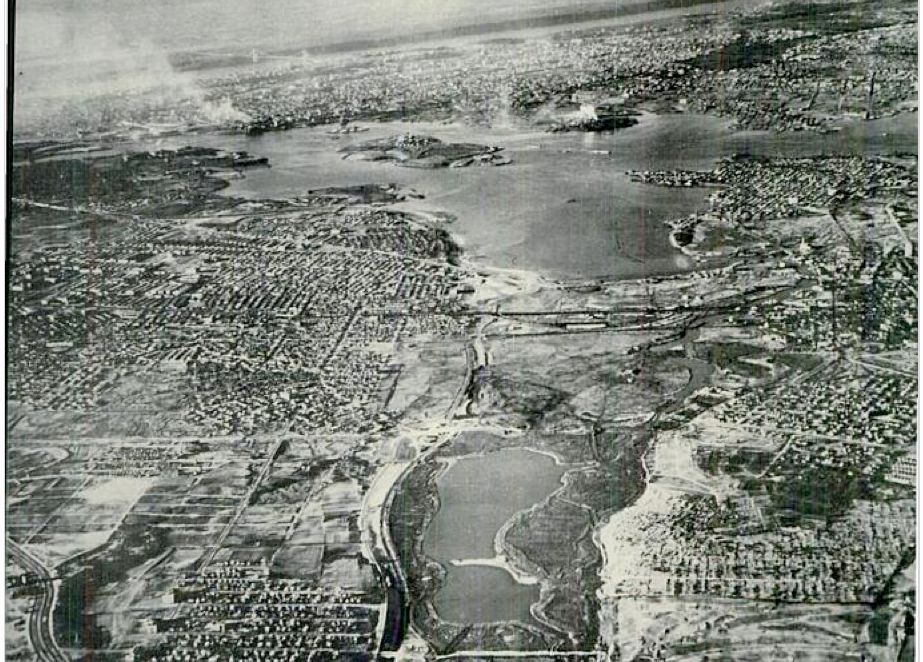
The Corona Ash Dump: Brooklyn’s burden on Queens, a vivid literary inspiration and bleak, rat-filled landscape

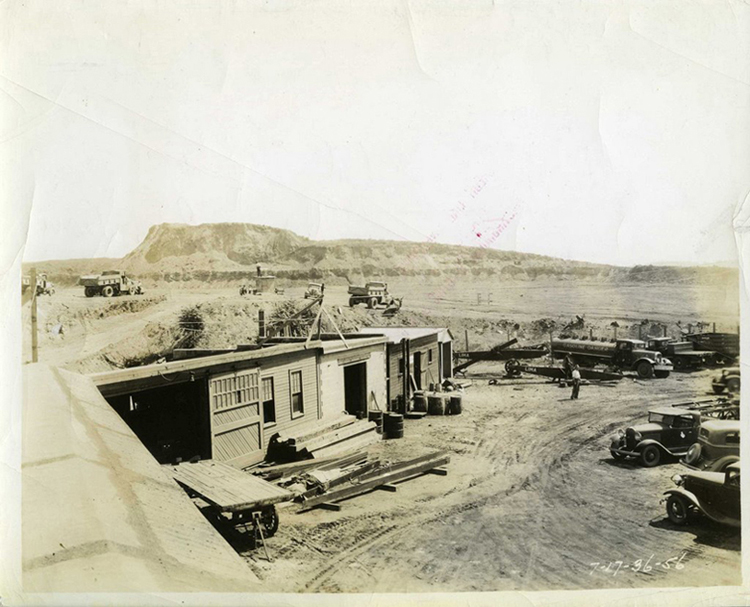
Ah, take in the horrid reality of the Corona marshes with their ashes, manure and garbage! (Courtesy CUNY)

Outside of probably Hell, there is no literary landscape as forlorn and soul-crushing as the ash dumps of Corona, Queens.

This is the valley of ashes,” writes Fitzgerald in The Great Gatsby, “a fantastic farm where ashes grow like wheat into ridges and hills and grotesque gardens; where ashes take the forms of houses and chimneys and rising smoke and, finally, with a transcendent effort, of men who move dimly and already crumbling through the powdery air.”

The Corona ash dump was a stain on Queens every bit as real as Fresh Kills landfill would later be on Staten Island, a repository for the detritus from Brooklyn coal furnace that created crud-caked mountains amid a salty marsh.

The salt marshes sat relatively untouched, along with other large stretches of the newly formed borough. The Brooklyn Ash Removal Company moved here in 1909 after it outgrew its dumping grounds on a small island in Jamaica Bay named Barren Island.  (The island no longer exists per se; landfill connected it to the mainland and Floyd Bennett Field was built there in 1930)

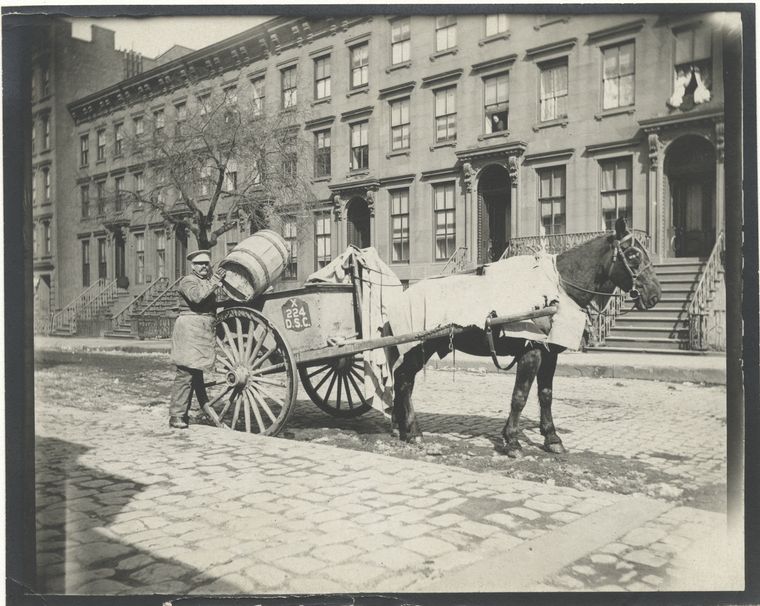
Below: A sanitation worker carting carting away a full barrel of ash. The open cart would be filled, taken to barges, then sent to far-away dumps. In the 1910s, Brooklyn ash went to Corona. {NYPL}

With the increase of coal-burning furnaces in the late 19th century, the city had yet another sanitation crisis sullying the streets.  Even by 1910s, New York was trying to clamp down on the situation — literally — attempting to get residents and private businesses to cover their ash carts and containers “as to protect pedestrians from the annoyance of flying ash dust.” [source]

In Queens, mountains of choking, awful ash made for poor living conditions for neighboring Corona on one side, Flushing on the other.  It was a constant eyesore for early commuters, as the Long Island Railroad went right past it, as did the main thoroughfares of northern Long Island — roads taken by many of the wealthy ‘Gold Coast’ families.

One ash pile was so large — almost 100 feet — that it was christened Mount Corona.  And of course it wasn’t just ash; barges filled with animal manure docked here as well, awaiting local farmers who used the waste as fertilizer.

And new menace was introduced in 1920  — an infestation of rats. “War Declared Upon Rats,” declared the New York Times. An army of exterminators were sent to wipe out the colony of rats that lived among the ashen meadow dumps.

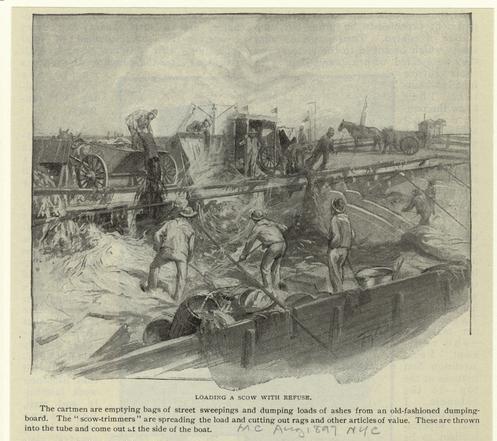
Below: From 1897, loading a scow full of ash to be taken to the local dump (NYPL)

Believe it or not, the Brooklyn Ash Removal Company tried to convince residents that presence of the grim, brimstone terrain next to their homes was getting rid of pests. When they were taken to court in 1923, “charged with permitting dense smoke to issue from the dumps,” they claimed the dumping grounds were good for the salt marshes, as they helped rid the neighborhood of mosquitoes!

With the population of Queens almost doubling during the 1920s, it seemed the days of the Corona Ash Dump were numbered. Enter Robert Moses, with his dreams of a large and spectacular park for the growing borough.  He swiftly moved in, bought all the marshland, all the mountains of ash, and filled in wetlands and the dark hills to create Flushing Meadows-Corona Park.  If you’ve been to Citi Field or the Billie Jean King Tennis Center, then you have sat upon land that was once the Corona ash dumps.

Categories
Bowery Boys Bookshelf

The Great Gatsby’s New York City, in ten different scenes, from the Queensboro Bridge to the Plaza Hotel

BOWERY BOYS BOOK OF THE MONTH

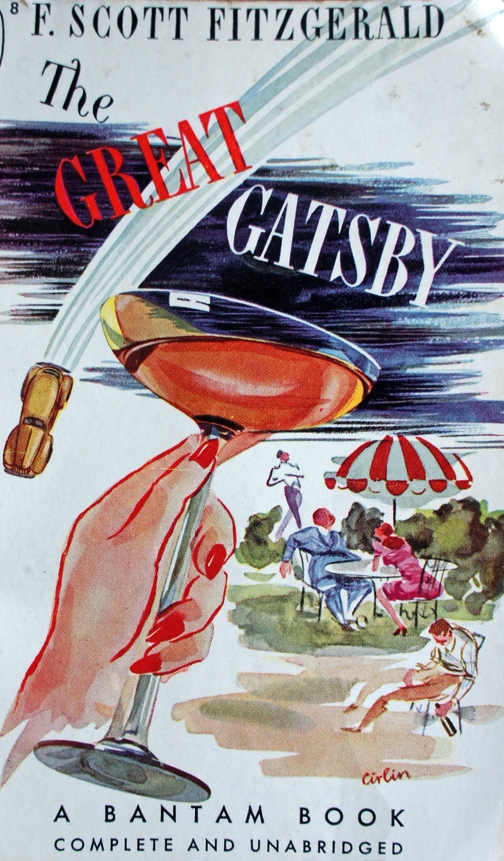
The Great Gatsby
by F. Scott Fitzgerald

I re-read The Great Gatsby a few weeks ago on purpose, not because I had a school assignment. Unlike my first experience with Gatsby at age 14, I actually read it, without the signposts of a Cliff’s Notes to tell me what I was supposed to be getting from it.

Of course the impetus for re-discovering F. Scott Fitzgerald‘s masterpiece is the flashy new Baz Luhrmann film coming out this weekend, which uses the text as an excuse to throw an expensive 3-D party, starring Leonardo DiCaprio, Beyonce, large champagne bottles, fifty shades of pink, the ghost of Mae West and a whole host of other drunk guests.

Few works of American literature have been as comprehensively analyzed as The Great Gatsby, by which I mean, of course, over-analyzed. One reason I’m excited about the film, with all its superficial decadence on display, is that it seems to discard several decades of nine-dimensional analyses that have settled upon the book like a thick shroud of dust. Maybe that’s wearing white to a funeral, so to speak, but true masterpieces can weather an occasional glare.

The Great Gatsby deserves to be savored for many reasons that I had forgotten or never noticed through the filter of creating a B+ term paper in my teenage years.  It’s one of the most economic stories of the 20th century, an exercise of graceful control, an epic with powerful restraint.  In comparison, try reading Fitzgerald’s The Beautiful and the Damned — an embittered New York book twice as long with half as much to say– to appreciate the brevity of Gatsby.

Fitzgerald uses the locales of 1922 New York City so precisely — jetting around Long Island and over the bridge to Manhattan — that it seems almost possible to map the characters’ every move.

There are three principal types of locations in The Great Gatsby.  About half the novel’s actions take place on either East Egg or West Egg, fictional northern Long Island villages still graced with the mansions of Gilded Age millionaires.

Characters escape to Manhattan, big and glittering, either to entertain their mistresses or to dine with gentlemen of suspicious occupation.

And then, of course, there’s the wasteland in between, where secrets are laid bare and burnt to ash.  Welcome to Queens!

Fitzgerald paints a very lush, cockeyed view of New York City in the early 1920s. Here are some of the more interesting city locations you’ll visit as you read along, and some of the words he used to describe them:

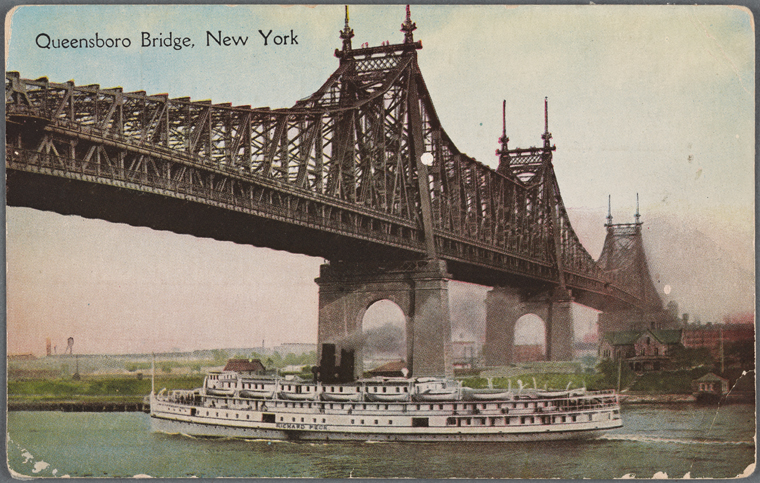
Queensboro Bridge
“The city seen from the Queensboro Bridge is always the city seen for the first time, in its first wild promise of all the mystery and the beauty of the world.”

‘Anything can happen now that we’ve slid over this bridge,’ I thought; ‘anything at all….’ 

Even Gatsby could happen, without any particular wonder.”

The 1920s were more than just a decade of speakeasies and spendthrifts. It was the decade of immense growth for Manhattan’s outer boroughs, none more so than Queens, thanks mostly to the opening of the Queensboro Bridge in 1909 and a connection to New York’s new subway system.

The IRT Astoria line
“[W]e sped along toward Astoria at fifty miles an hour, until, among the spidery girders of the elevated, we came in sight of the easy-going blue coupe.”

Astoria’s elevated subway train opened in 1917, at the time servicing only cars from the IRT. (The trains of the BMT are a little too wide to use the stations.)  So as Gatsby, Nick Carraway and the gang race underneath it to get onto the Queensboro, they’re really experiencing something quite new, a symbol of New York’s expansion into Queens.

Corona Ash Dumps
“We passed Port Roosevelt, where there was a glimpse of red-belted ocean-going ships, and sped along a cobbled slum lined with the dark, undeserved saloons of the faded-gilt nineteen-hundreds.  Then the valley of ashes opened out on both sides of us.”

Once the place where New York and Brooklyn dumped their ash from coal-burning furnaces, the old ash dumps of Corona turned a bit of Queens into a gloomy and unpleasant landscape.  It would take Robert Moses and dreams of a World’s Fair to transform the ashen landscape into Flushing Meadows-Corona Park in the 1930s. (Picture courtesy the Queens Museum)

3

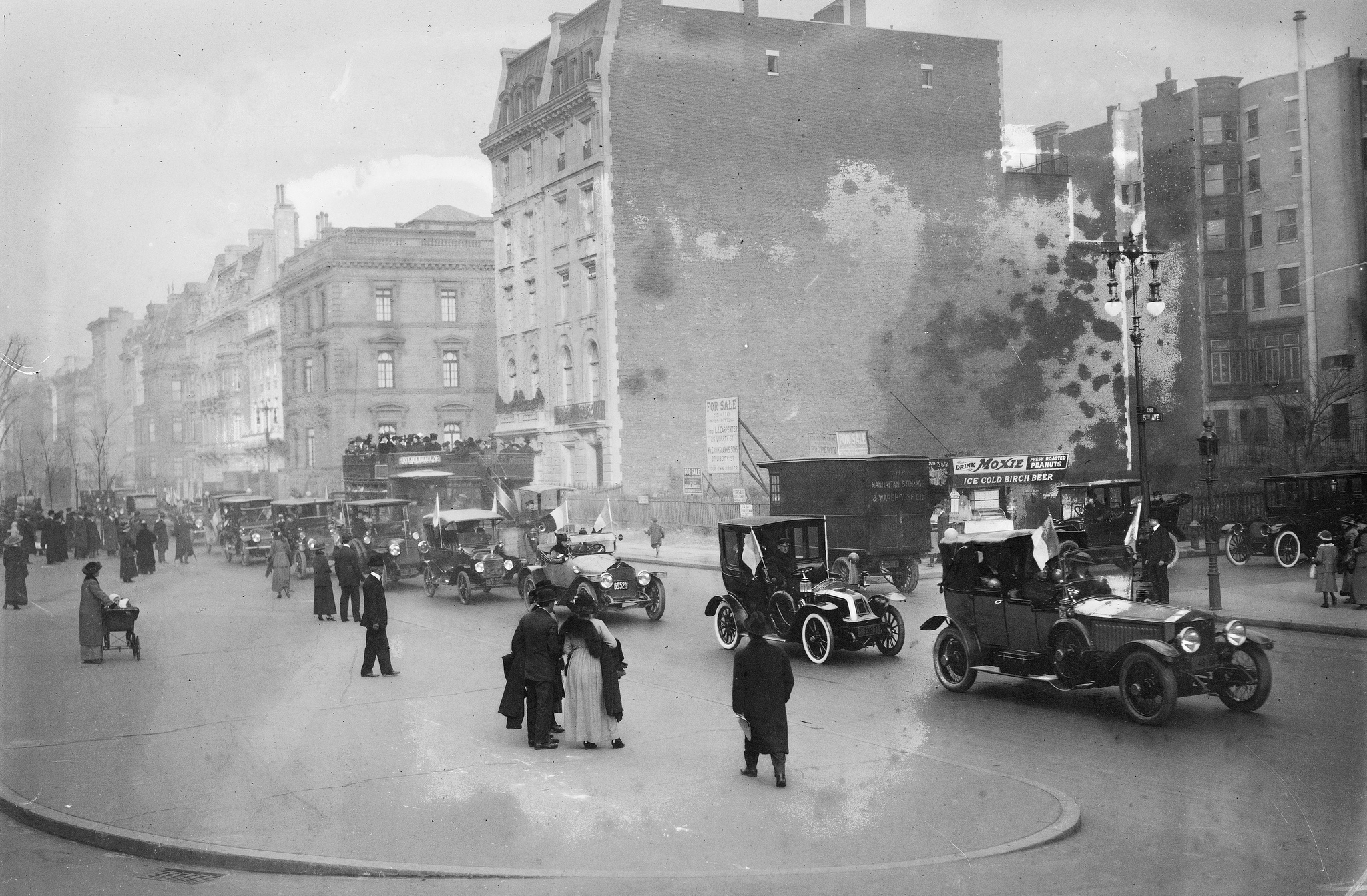
Automobile parade on Fifth Avenue, approx. 1915 (Courtesy LOC)

Upper Fifth Avenue
“We drove over to Fifth Avenue, so warm and soft, almost pastoral, on the summer Sunday afternoon that I wouldn’t have been surprised to see a great flock of white sheep turn the corner.”

This was not as bizarre as it sounds, for nearby Central Park actually had sheep grazing in it until 1934.  Granted, they would have been on the other side of the park, in today’s aptly named Sheep Meadow.

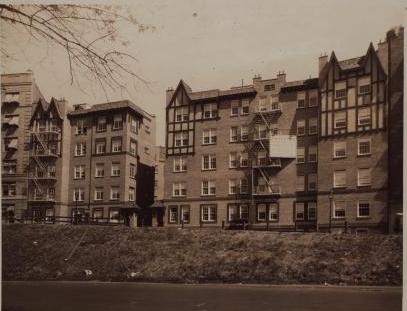
Above 158th Street and Riverside Drive, 1921 (NYPL)
Washington Heights
“We went on, cutting back again over the Park towards the West Hundreds. At 158th Street the cab stopped at one slice in a long white cake of apartment-houses. Throwing a regal homecoming glance around the neighborhood, Mrs. Wilson gathered up her dog and her other purchases, and went haughtily in.”

Once the respite of wealthy manors in the 19th century, the upper reaches of Manhattan gave way to middle-class housing at the start of the new century.  Myrtle’s perch here in Washington Heights would have been appropriately out of the way in the 1920s.

1a
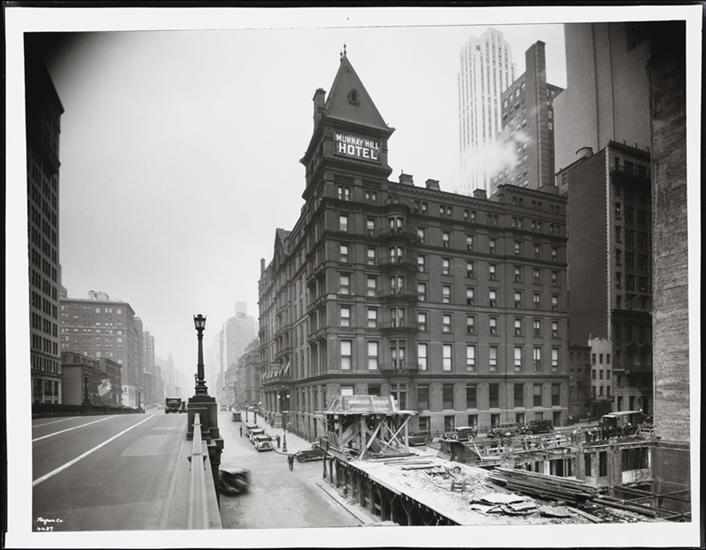
The Murray Hill Hotel on Park Avenue, 1931, courtesy Museum of the City of New York

The Murray Hill Hotel

“After that, if the night was mellow, I strolled down Madison Avenue past the old Murray Hill Hotel and over 33d Street to the Pennsylvania Station….I liked to walk up Fifth Avenue and pick out romantic women from the crowd and imagine that in a few minutes I was going to enter into their lives, and no one would ever know or disapprove.

Opening in 1884 to serve the needs of those arriving from Grand Central Depot, the Murray Hill Hotel kept its halls fully occupied until its demolition in 1946.  The Daytonian In Manhattan blog has a wonderful tale of the hotel’s colorful history.

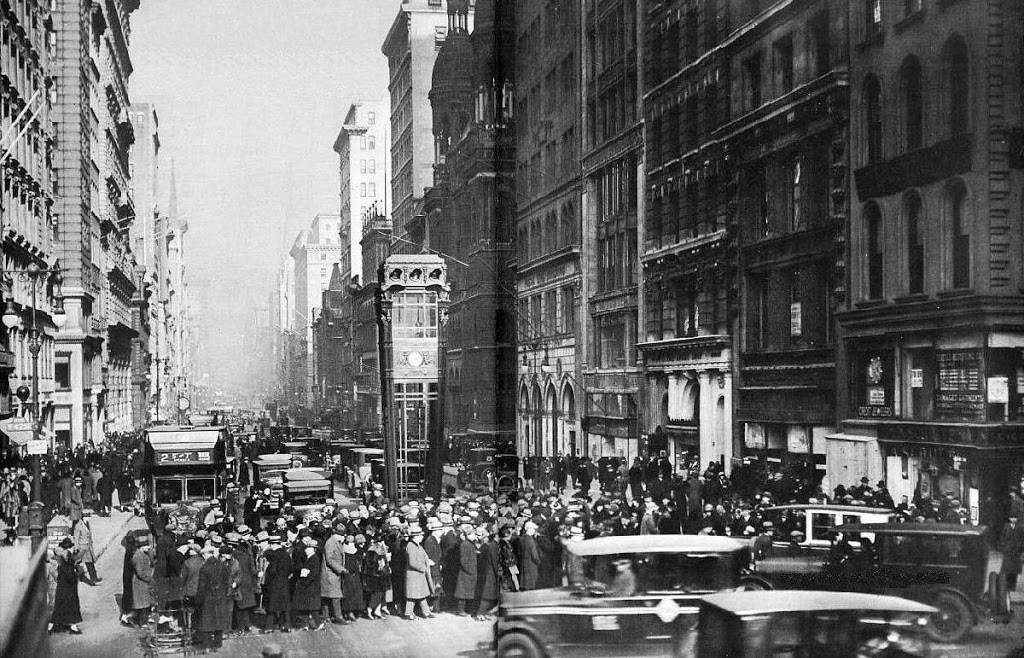
Above: 42nd Street in 1926 (Courtesy Kings Academy)

Forty-Second Street

“Roaring noon. In a well-fanned Forty-second Street cellar I met Gatsby for lunch. Blinking away the brightness of the street outside, my eyes picked him out obscurely in the anteroom, talking to another man.”


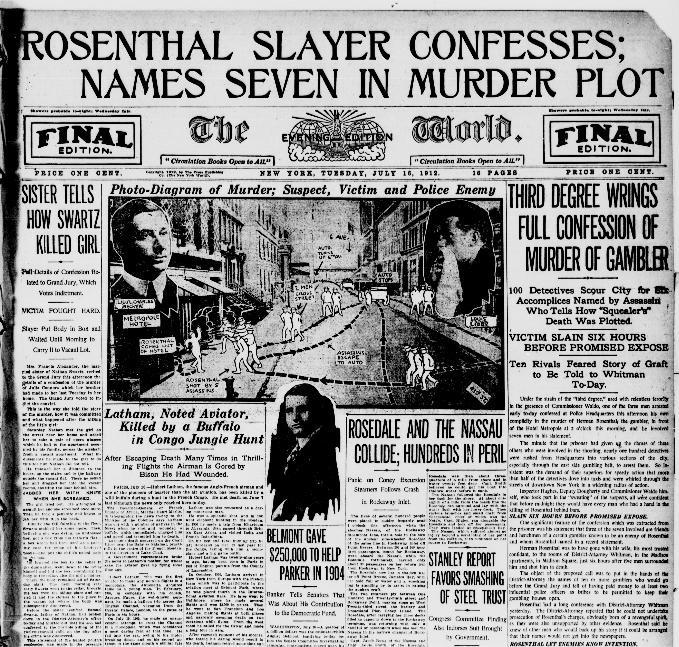
From the July 16, 1912 edition of the New York Evening World

Hotel Metropole
“The old Metropole,” brooded Mr. Wolfsheim gloomily.  “Filled with faces dead and gone. Filled with friends gone now forever. I can’t forget so long as I live the night they shot Rosy Rosenthal there.”

The Hotel Metropole was a swanky Times Square hotspot located at 147 W. 43rd Street.  Mr. Wolfsheim (himself a stand-in for gangster Arnold Rothstein) spends a moment recounting the assassination of Herman Rosenthal, gunned down by the mob.  Charles Becker, who was accused of orchestrating the murder, became the first police officer to ever be given the death penalty.

We talk about the Rosenthal assassination in our podcast Case Files of the New York Police Department.

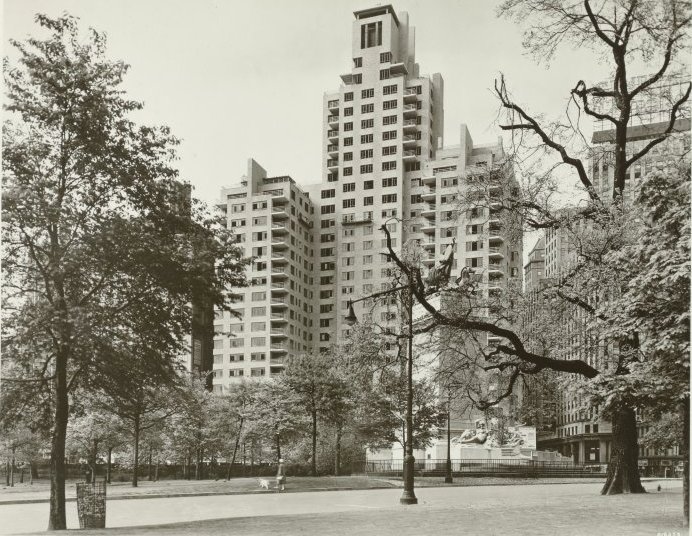
Above: The southwest corner of Central Park, photo by the Wurts Brothers (NYPL)
Central Park
“When Jordan Baker had finished telling all this we had left the Plaza for half an hour and were driving in a victoria through Central Park. The sun had gone down behind the tall apartments of the movie stars in the West Fifties, and the clear voices of little girls, already gathered like crickets on the grass, rose through the hot twilight.

We passed a barrier of dark streets, and then the facade of Fifth-ninth Street, a block of delicate pale light, beamed down into the park.”

3

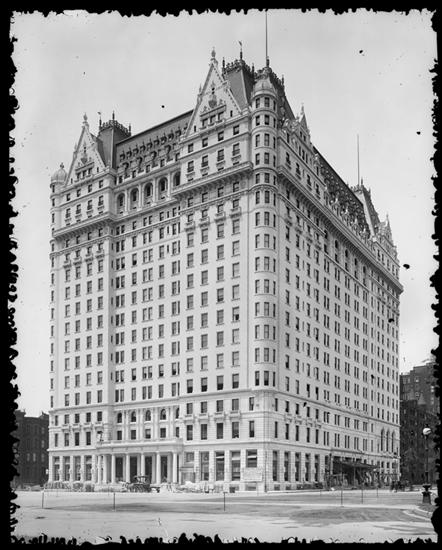
The Plaza, photo by the Wurts Brothers (NYPL)
“And we all took the less explicable step of engaging the parlor of a suite in the Plaza Hotel.

The room was large and stifling, and, though it was already four o’clock, opening the windows admitted only a gust of hot shrubbery from the Park.”

The Plaza Hotel
The beginning of a string of violent acts in the book begins here at The Plaza, at perhaps the epitome of class in the early 1920s. It was only open about 15 years when the events of the book take place here.

Check out our podcast history of the Plaza Hotel and some more glamorous pictures of the hotel here.

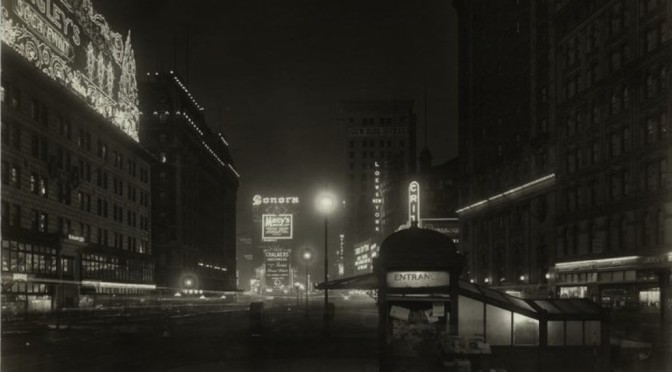
Top picture: Times Square at night, 1921 (NYPL)