Categories
Uncategorized

Where are New York City’s oldest living trees?

The oldest living New Yorkers outdate all the skyscrapers, the highways and the parks in which most of them live. They have seen generations of New Yorkers come and go. And at least one of them even remembers the region’s original indigenous people.

We’re talking about the native trees of New York City, those that were planted naturally and not transplanted from elsewhere, giants that have weathered storms and interactions with humans long gone.

Of course it is impossible to know with absolute certainty the oldest trees as not every single one has been measured. There are, in fact, according to MillionTreesNYC, 5. 2 million trees in New York City, about a tenth of which are actually on the streets.

Some other wonderful trivia from MillionTreesNYC:

“– Standing trunk to trunk, New York City street trees would form a line 118 miles long–the distance from Manhattan to Hartford.

— Number of tree species: 168

— Percent of land covered in trees: 24%  “

I was not able to find complete info for all five boroughs, and I will indicate where I could not come to a definitive answer. If you have any leads, please post them in the comments section.

I’m obviously no arborist, so the details below are based on the research of others. However maybe someday I’ll trek out to these various sites armed with a tape measure and an layman’s knowledge on how to evaluate tree age.
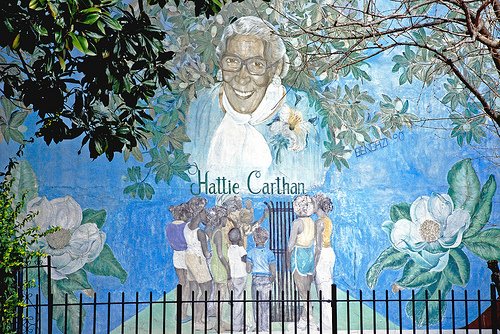
Hattie Carthan, Brooklyn’s tree saviour

BROOKLYN
It appears that the oldest tree in the borough — among, as Betty Smith well knows, the many, many trees that grow in Brooklyn — is undetermined. Most likely it sits in Prospect Park which contains most of the borough’s remaining natural forest — about 100 acres.

Formerly, the title holder was a 220-year old black oak which once stood here; sadly it uprooted during a storm many years ago and tumbled into the ravine.

However, one of Brooklyn’s most famous trees sits in the neighborhood of Bedford-Stuyvesant — a southern magnolia tree Magnolia Grandiflora, brought to Brooklyn from North Carolina in 1885 and located near 667 Lafayette St.

It happens to be the only landmarked living tree in the city, thanks to community leader and nature lover Hattie Carthan, back in 1970.

BRONX
With the borough’s thousands of acres of park land, the real candidate for borough’s oldest may as yet be undiscovered.

However, the leading candidate is currently a handsome white oak tree around the 18th hole of the Split Rock Golf Course in Pelham Bay Park. The oak is well ‘over 200 years old’ although its location by a golf course can’t be good for its health.
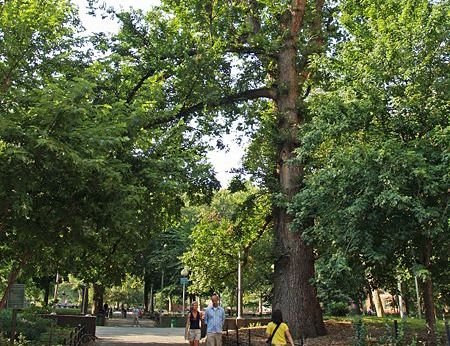
Hangin’ around with New York’s oldest and most legendary elm

MANHATTAN
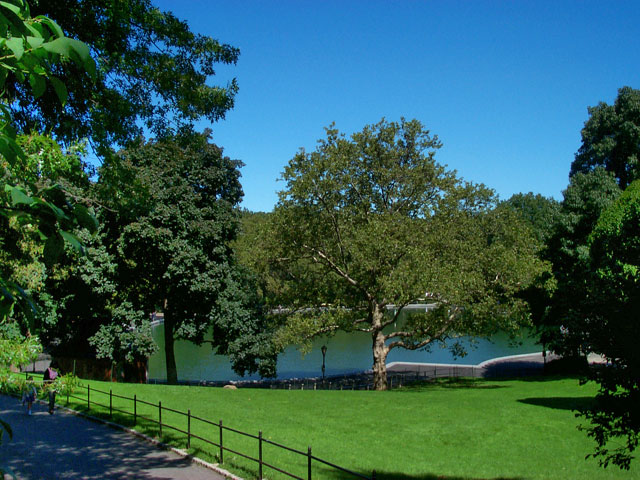
One might naturally assume Manhattan’s oldest tree must be in Central Park. It’s a very manicured place though, and most of its older vegetation was transplanted here. However, the great London plane tree near the Reservoir (pictured below) is said possibly pre-date its construction in 1862.

There are two other candidates for oldest tree on the island. One is in Washington Heights, a 110-foot elm at 163rd Street and St. Nicholas. Known as the Dinosaur, it reportedly shaded George Washington as he surveyed his shifting fortunes during the Battle of Washington Heights.

The most renown candidate is, of course, the Hangman’s Elm, in Washington Square Park. At a reported 310 years old, this arboreal old man in the northwest corner of the park most likely never really saw any hangings as its legend indicates, but its certainly fun to morbidly gander at its branches.

The top two candidates for New York’s oldest tree have been the fascination of tree lovers since their discovery.

Below: The London plane tree near the Reservoir, most likely Central Park’s oldest tree (pic courtesy Central Park 2000)
STATEN ISLAND
The two oldest trees in New York happen to be tulip trees, a common tree of the region named for its flower-shaped leaves. The charming Clove Lakes Park, at Forest Avenue and Clove Road, takes its name from the Dutch word “kloven” or cleft. Its granddaddy entry into the tree race is known as the Clove Lakes Colossus is a monstrous 119 feet tall with a circumference of 21.4 feet.

It’s reported to be well over 300 years old, predating all but the most rudimentary European settlement here in Staten Island. It’s actually a thicker tree than the tulip which is New York’s oldest, but that’s due to more ideal growing conditions. Unlike many other ‘oldest tree’ candidates, Clove Lakes takes good care of its elders, easily located at the park’s north end near a paved path.
QUEENS
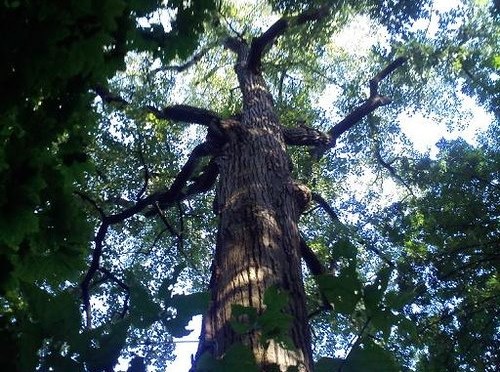
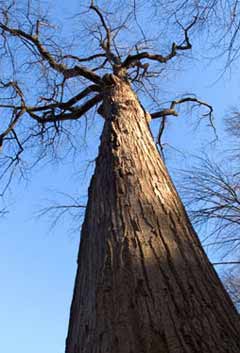
Say hello to the Queens Giant (pictured at top), the grandmother of all native New York City plants. Located along a secluded trail in Queens’ Alley Pond Park, this monster is also one of the city’s tallest trees at 133.8 feet — just 20 feet shorter than the Statue of Liberty.

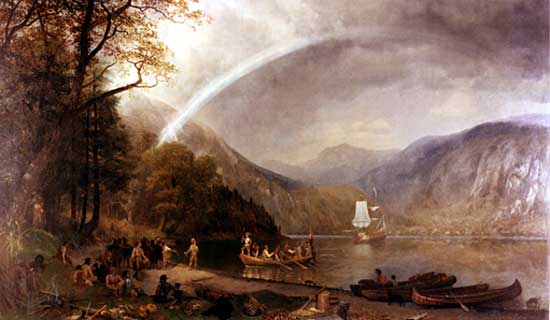
It may be one of the few remaining living things from the era before Henry Hudson sailed into New York harbor, with its age calculated at anywhere from 350 to 450 years old. This would make it one of New York’s truly extraordinary natural features. Interestingly, in the past, the city has taken a stance of ‘benign neglect‘ to the tree, arguing that it shouldn’t be better accessed in order to protect it.

Revised from a previous article which ran in 2009
Categories
Uncategorized

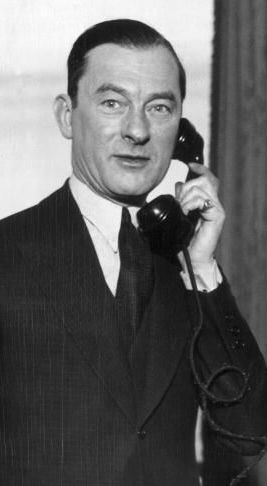
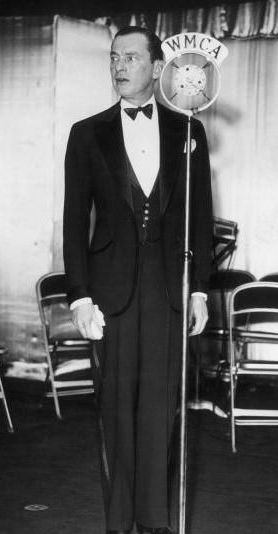
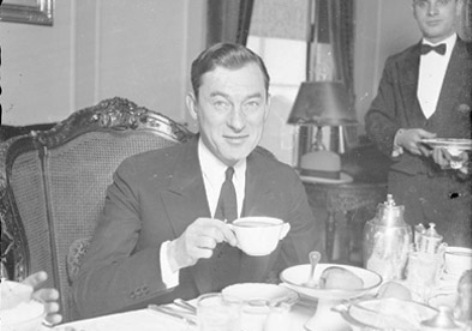
Mayor Jimmy Walker: a finer class of corruption

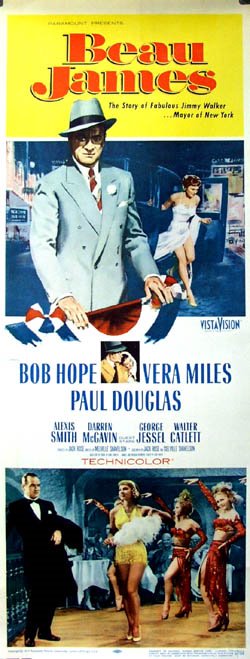
Jimmy Walker, Hollywood version of a mayor

KNOW YOUR MAYORS Our modest little series about some of the greatest, notorious, most important, even most useless, mayors of New York City. Other entrants in our mayoral survey can be found here.

MayorJimmy Walker

In office: 1926-1932

Has a New York mayor ever reflected the decade he governed more perfectly than Jimmy Walker? Although John Hylan was actually the 1920s more effective mayor, it was Walker who embodied the Jazz Age spirit in his style, and the tragic Depression-era change of fortune in his downfall. He glamours us today because he’s both movie star and rebel; but the corruption of his regime is equally as striking and even disturbing in its grandiosity.

Walker is easily one of the most notorious mayors of New York, but today we can appreciate his brashness, his independence and class, just as we can lament his subservience to diabolic Tammany-era politics. He wasn’t the last disgraced mayor the city would see in the 20th century, but his abdication neatly defines the modern era’s defining fall from grace.

Jimmy, born June 19, 1881, was a New York boy and a golden one at that, raised in Greenwich Village among the bohemians, the son of an Irish immigrant who became a well connected Democratic assemblyman. Walker’s first passion seems to be music; in 1905 he stormed Tin Pan Alley writing songs such as “There’s Music In The Rustle Of A Skirt” and “Will You Love Me in December As You Do in May?” with its melancholy refrain:

Will you love me in December as do in May,
Will you love in the good old fashioned way?
When my hair has all turned gray,
Will you kiss me then, and say,
That you love me in December as do in May?

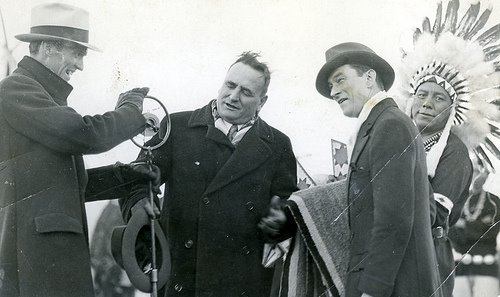
Below: In an odd ceremony with the mayor of Albuquerque

He had even less hesitation in announcing a political career, especially as Father had connections to a certain Al Smith, governor of New York. An adopted son of Tammany Hall, elected first to the state assembly in 1910 then to the state senate in 1914, young Walker sought Smith’s guidance and the governor soon took a fancy to the smooth, impeccably dressed young man, who shone like a new penny on the Senate floor. As he was described by Robert Caro:

“Pinch-waisted, one-button suit, slenderest of cravats, a shirt from a collection of hundreds, pearl-gray spats buttoned around silk-hosed ankles, toes of the toothpick shoes peeking out from the spats polished to a gleam. Pixie smile, the ‘vivacity of a song and dance man,’ a charm that made him arrive n the Senate Chamber like a glad breeze’ The Prince Charming of Politics…..slicing through the ponderous arguments of the ponderous men who sat around him with a wit that flashed like a rapier. Beau James.”

Smith took him under wing, maneuvering him through the entanglements of state politics, shielding Walker when his excesses got the better of him. He was a philandering cad and a boozer, even then. When opportunity arose to challenge the successful John Hylan for mayor of New York, Smith wanted Walker to run, but only if he would change his ways. Walker changed them all right; instead of partying out at speakeasies with chorus girls, he moved the whole production to a private penthouse funded by Tammany favors.

That election in 1925 was fierce. First, Smith had to dispense of Hylan in the Democratic primary — and in the halls of Tammany. The two split the storied political machine, but eventually Walker won out. Next, he faced the Republican-Fusion candidate Frank Waterman in the general election, who cried of potential Tammany corruption to the new subway system if Walker were elected. (Waterman would, of course, be right.) Beau James, however, went unabated. He ran as a people’s mayor, somebody who enjoys and the same pleasures as those voting for him:

“I like the company of my fellow human beings. I like the theatre and am devoted to healthy outdoor sports. Because I like these things, I have reflected my attitude in some of my legislation I have sponsored — 2.75 percent beer, Sunday baseball, Sunday movies, and legalized boxing. But let me allay any fear there may be that, because I believe in personal liberty, wholesome amusement and healthy professional sport, I will countenance for a moment any indecency or vice in New York.”

Right! Walker was one of the people. Everybody bought it but nobody believed it. He swept into office because New York, in 1925, was prosperous, a Jazz Age mayor for a Jazz Age city.

Once elected, of course, Walker countenanced all sorts of indecency and vice. He was frequently in Europe on vacation. When he was in town, it was rarely at City Hall. The lavish new Casino nightclub in Central Park became his unofficial headquarters, with Ziegfield dancer Betty Compton at his side. (Walker’s wife was out of town, frequently.) City business was often discussed with the pop of champagne cork.


Some things got done that first term: the New York hospital system was consolidated on his watch, he purchased thousands of acres for park land (including Great Kills in Staten Island), and grew the municipal bus system — greatly benefiting more than a few friends who happened to own the bus company given the exclusive franchise.

He managed to turn on his old ally the governor, scrubbing City Hall of any Smith loyalists, granting more jobs to his type of Tammany men, filling their own pockets but allied to the charming man in charge.

How did he stay so popular? This was the late ’20s and people wanted the mayor to reflect prosperity and confidence. He also gave back, in symbolic gestures. Even as the new subway system became clogged with corruption, he staved off a strike while keeping the fare at five cents, thought at the time to be an incredible concession.

He easily won election in 1929 against a largely outmatched Fiorello LaGuardia. Tammany was in place and unstoppable; but the voters still chose not to look askance at Walker’s dalliances, and even the newspapers were charmed. The New York Times wrote of his “great personal charm, his talent for friendship, his broad sympathies embracing all sorts of conditions of men,” then recommended him under the guise that “the Mayor that he has been gives only a hint of the Mayor that he might be.”

That hinted-at mayor never materialized, because the Stock Market crash did, plunging the city’s fortunes into ruin and exposing the weaknesses of a government consumed with greed. Suddenly, having an extravagant, indecent mayor didn’t seem like such a good idea.

Archbishop of New York Cardinal Hayes, once dazzled, now condemned the mayor’s amoral ways, opening the flood doors for others to lay the city’s problems was Walker’s feet. Eventually the accusations reached the ear of governor Franklin D. Roosevelt.

A commission lead by Justice Samuel Seabury exposed deep veins of corruption throughout the city’s legal system and police force. Innocent citizens, often women, would be charged with crimes and forced to pay steep fines to get out of jail time. (Many times they couldn’t pay, and off they went, dozens at a time.) Neighborhoods, most often Harlem, would be routinely raided and its residents taken in, wild charges conjured for maximum penalty.

This would line the pockets of dozens of judges and vice squad officers. Newspapers dubbed it the Tin Box Parade, “after one testified that he had found $360,000 in his home in a ‘tin box…a wonderful tin box'” (Caro).

Walker himself was brought to the stand to testify, the judge warning those in the court room not to look the mayor in the eye, lest they succumb to Walker’s sensational charm.

After months of epic battles on the stand — Walker eluding hot button questions about his personal bank accounts, delaying appearances until after Roosevelt’s nomination for president was assured — the embattled mayor could fight no longer. With Roosevelt mere months from his national election, he needed to be rid of Walker. Walker obliged in the classiest way possible: he resigned on September 1, 1932, and went on a grand tour of Europe with his Ziegfeld girl.

He was never charged with a crime. He was barely even held accountable for anything. Back in New York three years later, he held a series of smaller posts, including one for the New York garment industry that was assigned to him by new mayor LaGuardia, his former rival.

Nothing stuck to him. He died in November 1946 of a brain hemorrhage, just two years after returning to his first love as the head of a big-band record label with a stable of artists that included Louis Prima and Bud Freeman. Ten years later, Hollywood decided to do something very redundant and make a movie of his life, starring Bob Hope as Beau James. It would follow a screenplay only slightly less glamorous than the real thing.

Categories
Podcasts

Henry Hudson and the European Discovery of Mannahatta

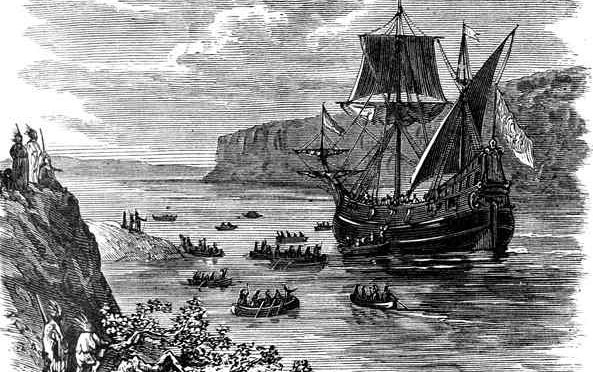
We turn the clock back to the very beginnings of New York history — to the European discovery of Manahatta and the voyages of Henry Hudson.

Originally looking for a passage to Asia, Hudson fell upon New York harbor and the Lenape inhabitants of lands that would later make up New York City. The river that was eventually named after Hudson may not have provided access to Asia, but it did offer something else (hint: PETA won’t be happy) that attracted the Dutch and eventually their very first settlement — New Amsterdam.

LISTEN NOW: Henry Hudson

The island of Mannahatta in the days before the Dutch (courtesy the Mannahatta Project). Hudson would have anchored off the tip on the western side, his eyes on the river that stretched north.

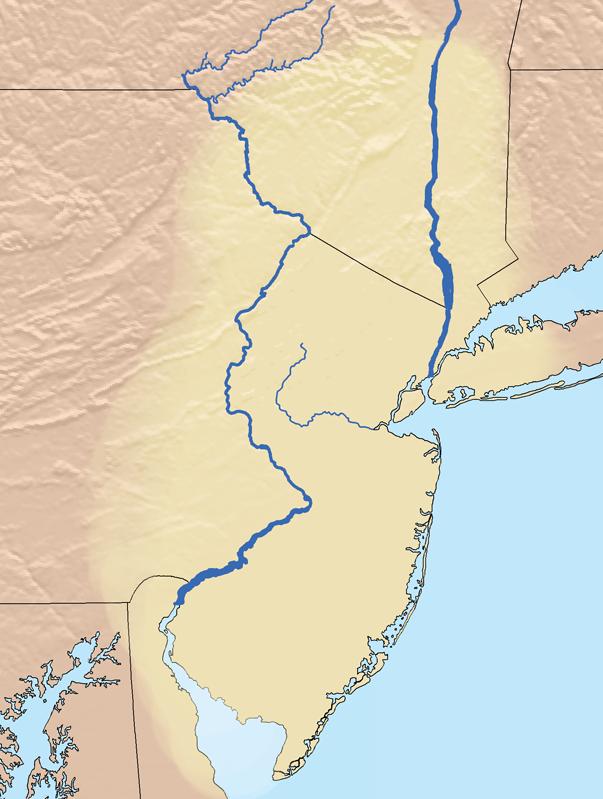
Lenapehoking: that’s what the original inhabitants of the area called the land that comprised the New York City metro area, New Jersey, western Long Island and surrounding areas (map courtesy wikimedia)

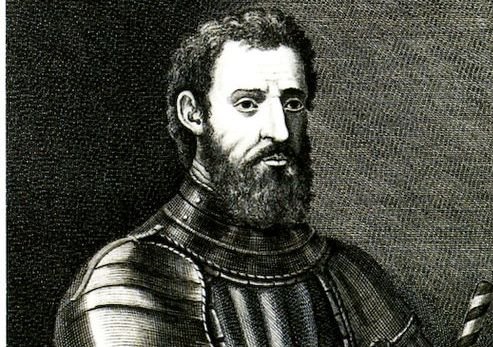
The first guy to arrive, Giovanni da Verrazano (or Verrazzano, depending on where you look), was greeted by the Lenape at the mouth of New York harbor. He touched down on today’s Staten Island but never ventured further into the harbor.

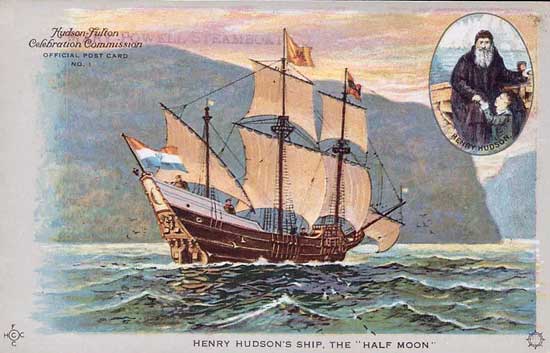
Hudson’s ship the Half Moon — or rather a replica that was launched for the 1909 Hudson-Fulton Celebration
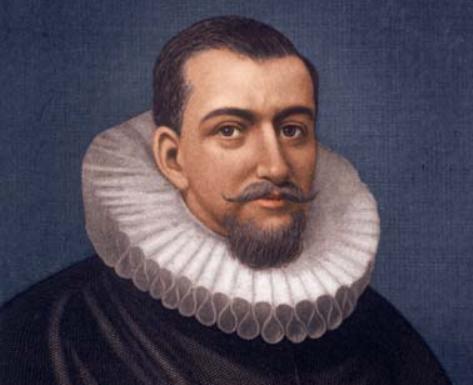
Henry Hudson, an Englishman who tried twice for his country to find a northern route to Asia before being enlisted by the Dutch East India Company. He never found a passage for them either, but he did find the river that today bares his name.

Hudson’s voyage up the Muhheakantuck (the Lenape name for the Hudson River) brought him into contact with several tribes, with encounters growing increasingly unfriendly. By the time he sailed back down the river to Mannahatta, they were flat out attacked by natives in canoes.

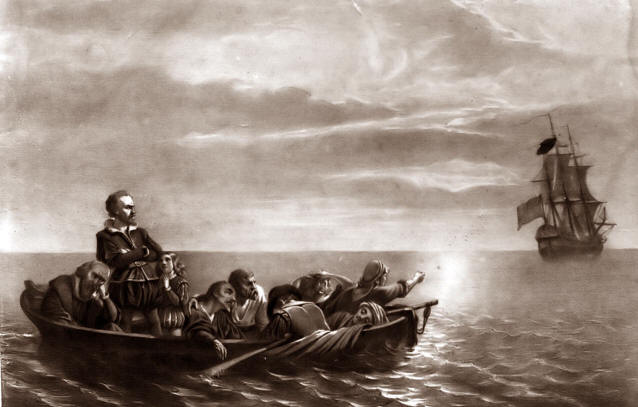
On his last voyage, Hudson’s crew mutinied, throwing the captain, his son and a few remaining loyal crewmen into a boat and setting it adrift in the Arctic.

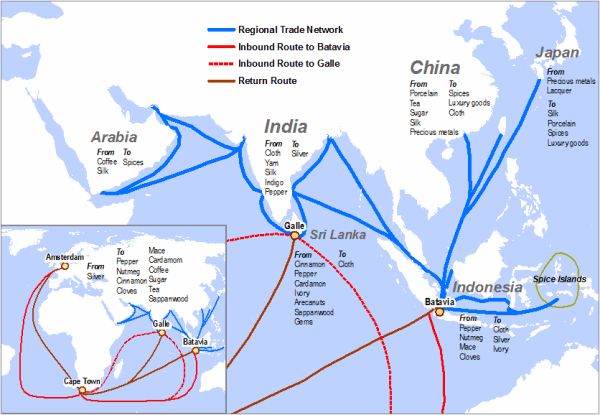
With no alternate route to Asia, the map below illustrates the trade routes the Dutch East India Company had to eventually travel to build their empire. (map courtesy Hofstra)

There are lots of events planned to celebrate the 400th anniversary of Hudson’s discovery. NY400: Holland on the Hudson celebrates New York’s Dutch heritage. Hudson 400 focuses on the explorer himself, with a timeline of events. Meanwhile Explore NY 400 lists statewide celebration.

I wrote about some of the more curious events of the Hudson-Fulton Celebration in a prior blog posting.

And for your immediate gratification, check out Amsterdam/New Amsterdam, the well reviewed show at the Museum of the City of New York

Apparently, the replica of the Half Moon was in Poughkeepsie just yesterday!

At last! Washington Square Park returns

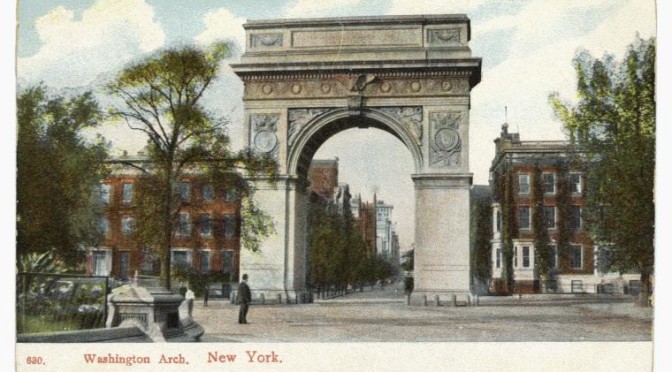
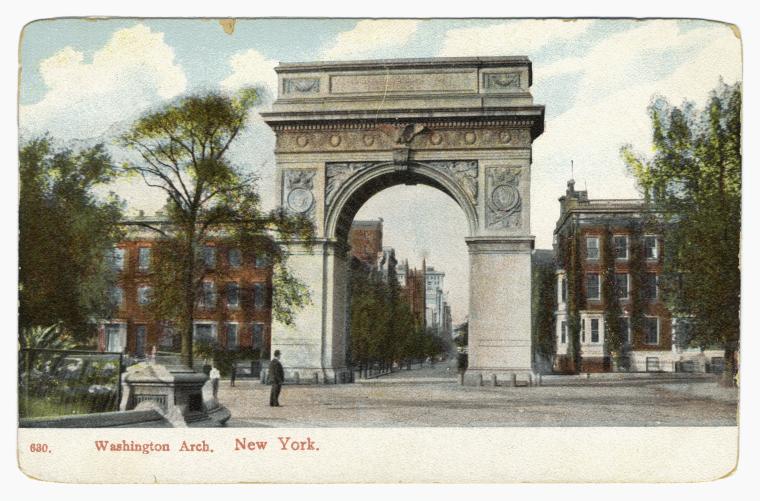
The Washington Square arch, in quieter times

The newly symmetrical, freshly renovated Washington Square Park took down the security fences yesterday, finally allowing people back in to enjoy one of Manhattan’s oldest parks.

Gothamist has photographs from the park’s grand re-opening yesterday. You might also like to check out our podcast on Washington Square Park — one of our very first shows! — which you can download for free in iTunes or listen to right here, then head on over and take a gander at the accompanying photo page.

Jungle Alley and wild nights at Connie’s Inn

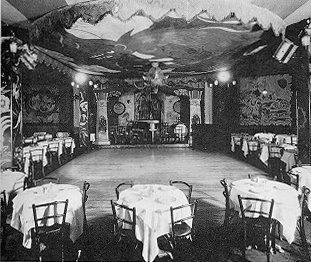
Connie’s during the day, with the Tree of Hope directly in front of it

FRIDAY NIGHT FEVER To get you in the mood for the weekend, every other Friday we’ll be featuring an old New York nightlife haunt, from the dance halls of 19th Century Bowery, to the massive warehouse clubs of the mid-1990s. Past entries can be found here.

NIGHTCLUB Connie’s Inn
In operation: 1923-1933

The strange and sad irony of Harlem nightlife in the 1920s — during the neighborhood’s height of creative powers — is that the biggest clubs featured the world’s top African-American musicians, but only a white audience could go hear them. This ridiculous arrangement, however, did allow many performers a unique forum to launch their careers, for this string of whites-only establishments soon became the hottest spot in Jazz Age New York. A district of these clubs soon took on the moniker Jungle Alley.

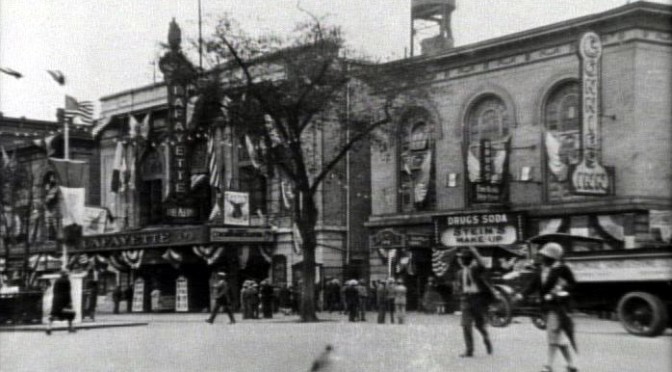
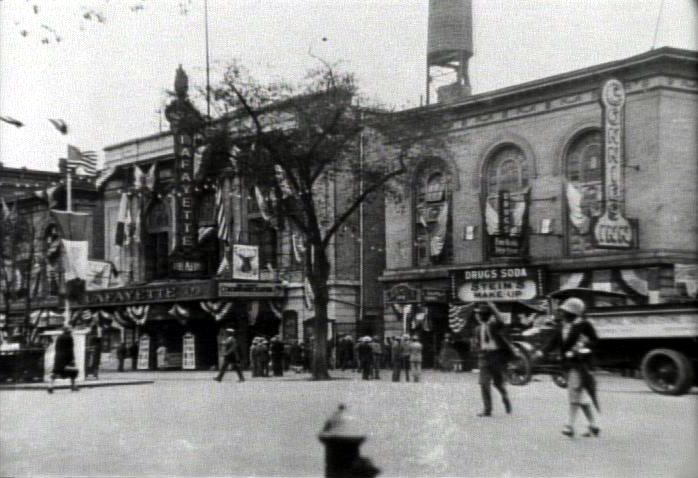
Concentrated on 133rd Street between Lenox and Seventh avenues, Jungle Alley was a place for downtown white Manhattanites to dabble in the saucy, ‘dangerous’ sounds of jazz as performed by some of the most talented people in the world. Elegant, new Pontiac and Franklin sedans lined the street delivering partygoers to the likes of The Cotton Club and Small’s Paradise, the two biggest names among virtually dozens of establishments on Jungle Alley. And of course a couple blocks away at 131st and 7th Ave, in a basement near the Lafayette Theatre — there was Connie’s Inn, in no way as plain as its name suggested.

Cotton, Small’s and Connie’s — these were the big three of Jungle Alley.

The Connie in question is Conrad Immerman, a German immigrant who, with his brother George, moved to the neighborhood and opened a chain of delicatessens. (According to lore, a delivery boy at one of those delis was none other than a young Fats Waller.) However, with prohibition, it became far more profitable to alter their business plan to include speakeasies. By 1923, the brothers had opened Connie’s at one of the most prominent corners in Harlem. Right next to it sat the famous Tree of Hope, a large chestnut who the alleged powers of good fortune for those who rubbed it. (A remnant remains on the stage of the Apollo Theatre.)

It certainly worked for Connie. His establishment soon rivaled the Cotton Club as the hotspot for New York’s trendier white crowd.

Why would Immerman exclude blacks? One source suggests this wasn’t Connie’s natural inclination: “Connie was not a bigoted man. Connie’s reason for exclusivity policy is a matter of profit; he assumed his white downtown clientele did not wish to sit, cheek in jowl, with African Americans.” Faint justification today. Connie’s success spawned a virtual industry of whites-only clubs in the neighborhood. He bolstered the segregation by giving in to it passively. Eventually, though, Connie’s would open for black audiences — after hours, when the downtowners had returned to their homes.

Connie’s attracted the best and the worst of the underworld, “a shady clientele of gangsters and molls, rumrunners, and bathtub bootleggers” according to one source. A black newspaper the New York Age says, “Immerman’s is opened to Slummers; Sports; “coke” addicts, and high rollers of the White race who come to Harlem to indulge in illicit and illegal recreations.”

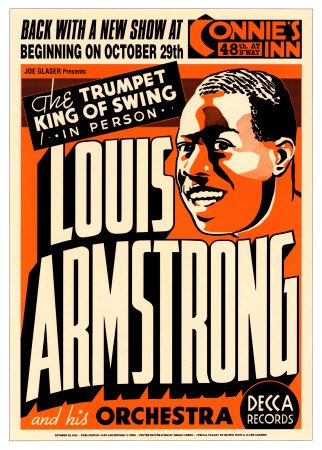
Slummers and sports alike packed into Connie’s 500 seat club, elegantly ornamented, one of the classier looking establishments of Jungle Alley. The stage could fit a couple dozen dancers, a rollicking jazz orchestra and a few prime performers sewn together into a variety of spirited production numbers. Winding across Connie’s stage were artists like Moms Mabley, Fletcher Henderson and Louis Armstrong.

One stage show by Fats Waller, eventually titled Hot Chocolate, was successful enough that it transplanted for a successful run on Broadway. Armstrong would recall racing between the Broadway stage — where he would perform ‘Ain’t Misbehavin’ every night — and Connie’s, where he was a contract performer.

Armstrong was uncomfortable with the mob-controlled world of New York nightlife, and Connie’s place was no exception. One night during a performance in Chicago, he was compelled to return to New York to perform for Connie.

According to an Armstrong bio, Louis claims that a gangster Frankie Foster “was sent over to my place to see that I catch the first train out of New York…I said ‘New York? Why that’s news to me.’ Foster said, Oh yes, you’re leaving tomorrow morning.’ Then he flashed his big ol’ pistol and aimed it straight at me. With my eyes big as saucers and frightened too, I said, ‘Well, maybe I am going to New York.”

Connie’s was a haven for mob activity; Connie’s brother George was even kidnapped for a time during a ‘disagreement’. But then, everybody was acting funny in those desperate final days of Prohibition. By 1933, Connie’s had closed its door, not fit for a world of legal entertainment.

Eliminating the Third Avenue Elevated

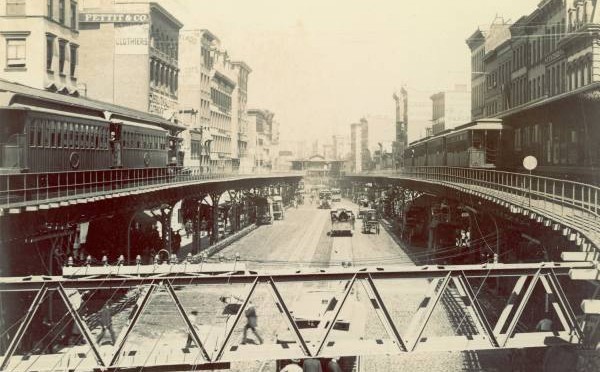
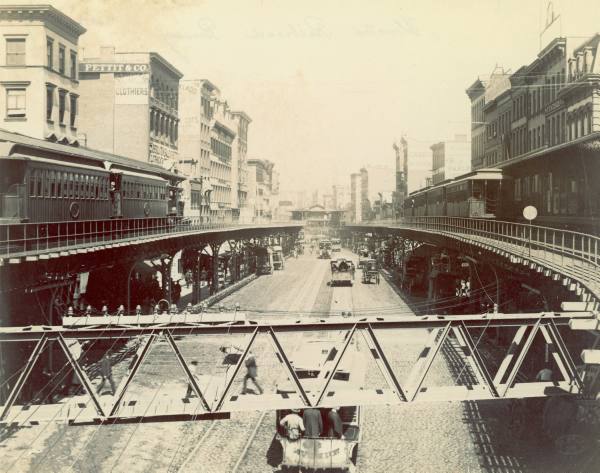
Looking up the Bowery in 1920 (from LIFE images)

Fifty-four years ago today, Manhattan passengers said goodbye a true vestige of 19th century New York — the elevated railroad.

The last ride on the Third Avenue El was taken on May 12, 1955. The line stretched up almost the entire length of Manhattan (from Chatham Square, just below Canal Street) all the way up to East 149th Street in the Bronx. 
How did Manhattan look from the vantage point of an elevated train system in the 1950s? Check out this vintage short from 1950, letting the camera roll through a typical ride on the Third Avenue during a sunny day: 

Categories
Podcasts

Roosevelt Island: New York’s former ‘city of asylums’

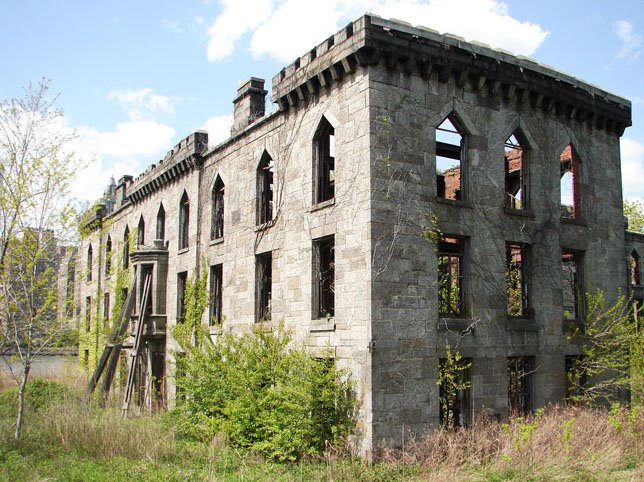
The original Smallpox Hospital, designed by James Renwick, still stands today thanks to diligent restoration. (Click pic for detailed view)

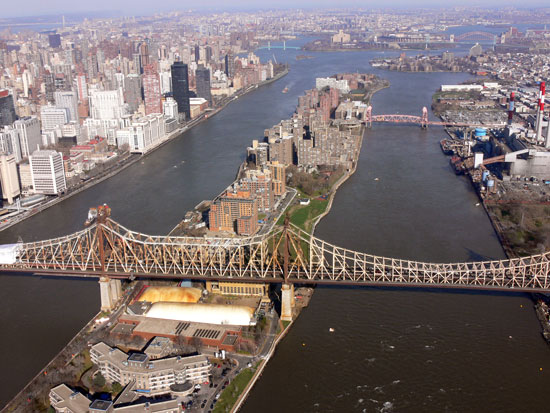
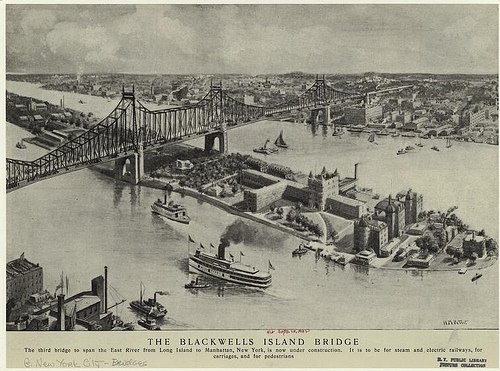
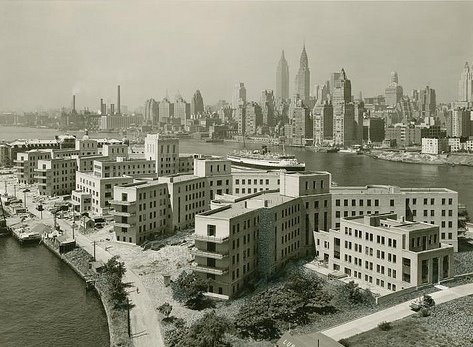
Looking north over Roosevelt Island, which cleanly splits the East River. Picture the buildings gone, the bridges wiped away, replaced with fruit trees and a small farm. The island has adopted several names over the years, including Minnahanonck (‘It’s Nice To Be Here’), Varkens Island (aka Hog’s Island), and Manning’s Island.

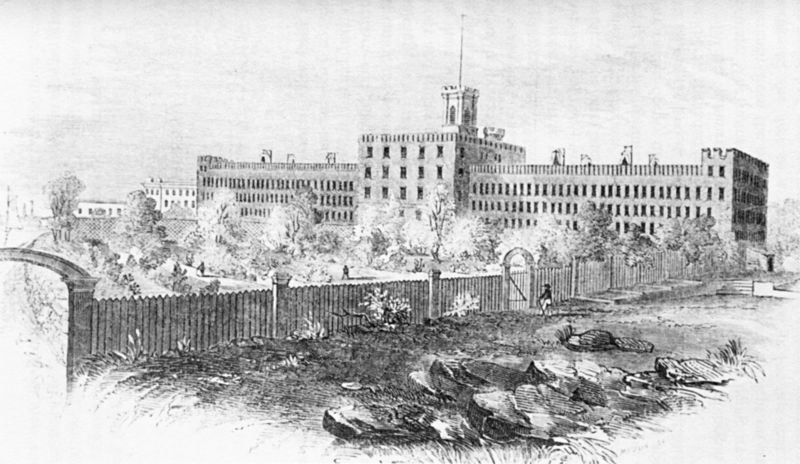
The penitentiary, opening on the now-named Blackwell’s Island in 1832, defined the next 100 years on the island — overcrowded, chaotic, inadequate facilities, grim and corrupted

Another illustration of the prison, this from 1853, showing a rather unusual feature to its side: a garden, which would be kept by inmates to feed themselves

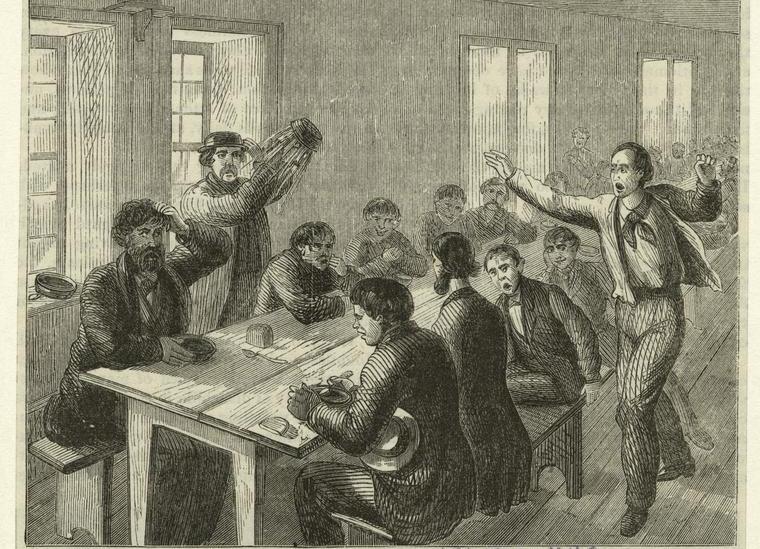
Food fight! Conditions inside the prison — as in most places on the island — were guided by mischief and chaos. Harpers Magazine 1860 (courtesy NY Public Library)

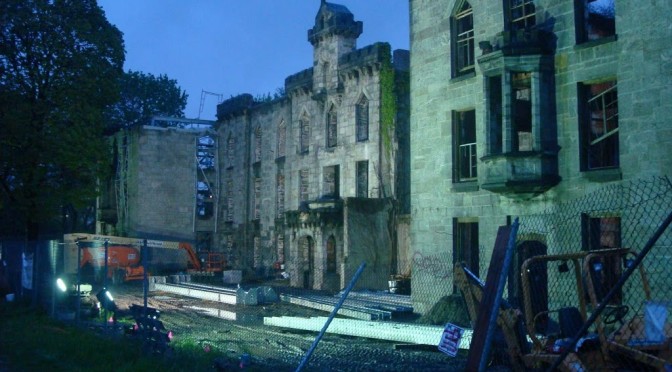
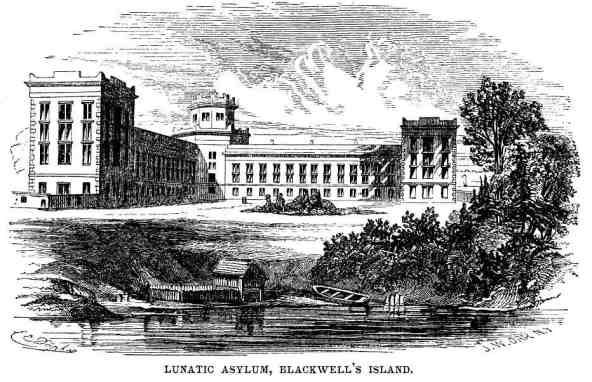
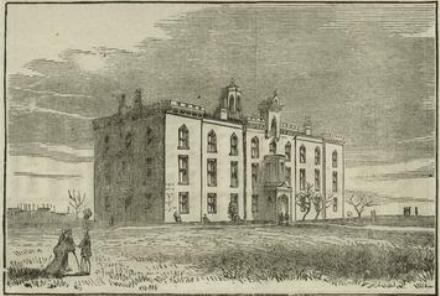
The Lunatic Asylum, aka ‘the Octagon’, became as overcrowded as the island’s prisons, often with people who would not have been considered ‘crazy’ today. Only two wings of the asylum were ever completed. Today, the Octagon is a luxury apartment complex.

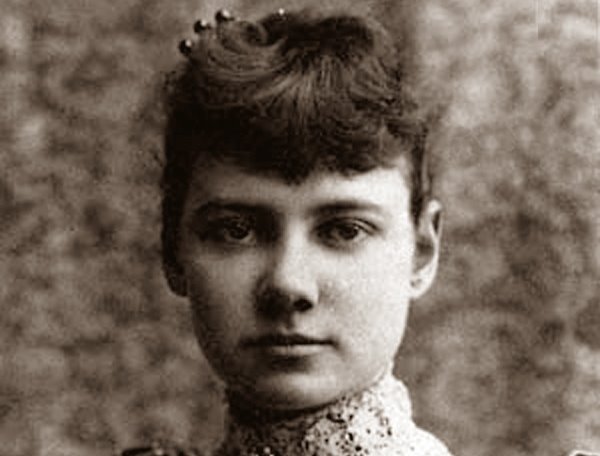
Intrepid reporter Nellie Bly exposed the wretched conditions within the asylum when she went undercover there in 1887.

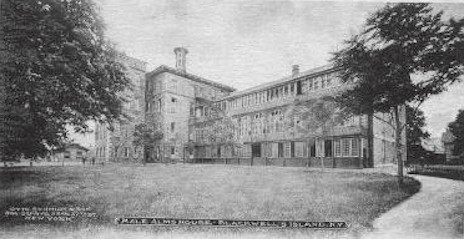
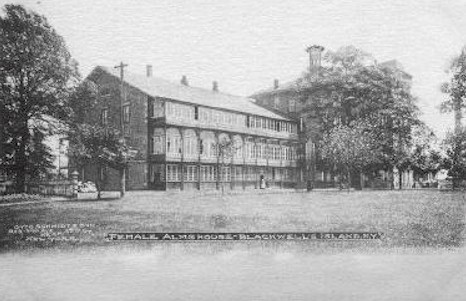
Male and female almshouses, catering to the homeless, the desperately poor and the elderly. Some residents would spend time at the penitentiary or work house, check out, and check back in here. (Images from here)

The Smallpox Hospital came to the island in 1856, a Gothic structure by James Renwick that saw thousands of diseased patients a year.

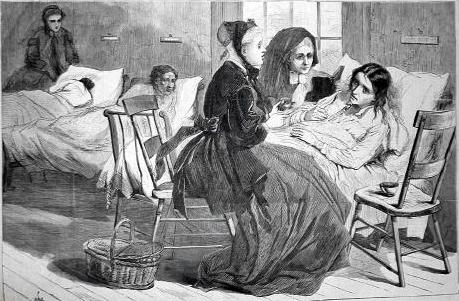
An illustration from 1868 expresses the dire scene at one of the island’s many hospitals. Confining all manner of sick and injured to one island might have been good for the general population, but was often a dangerous proximity for the sufferers, especially during epidemic time.

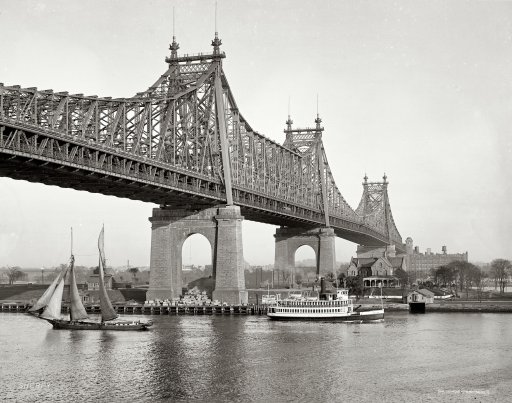
A dramatic change came in 1909 with the construction of the ‘Blackwell’s Island Bridge’, better known today as the Queensboro or 59th Street Bridge. A trolly stopped at the middle of the bridge, letting passengers off who then took an elevator down to the island. The elevator was dismantled by 1970.
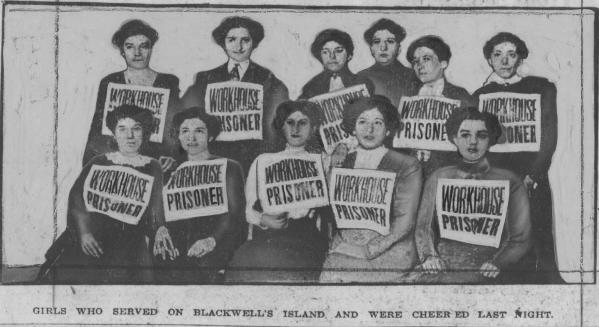
The workhouse, home to prostitutes and drunks, was also a popular place to dump protesters and labor reformers, as evidenced by this group of brave looking women.

As Welfare Island, many of the major institutions would soon leave (to other New York islands) leaving on chronic care hospitals and a whole lot of abandoned property.

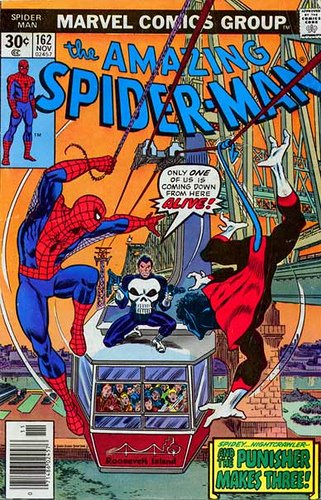
The Roosevelt Islamd Tram was an instant hit when it debuted in 1976, inspiring romantics and comic book writers alike.

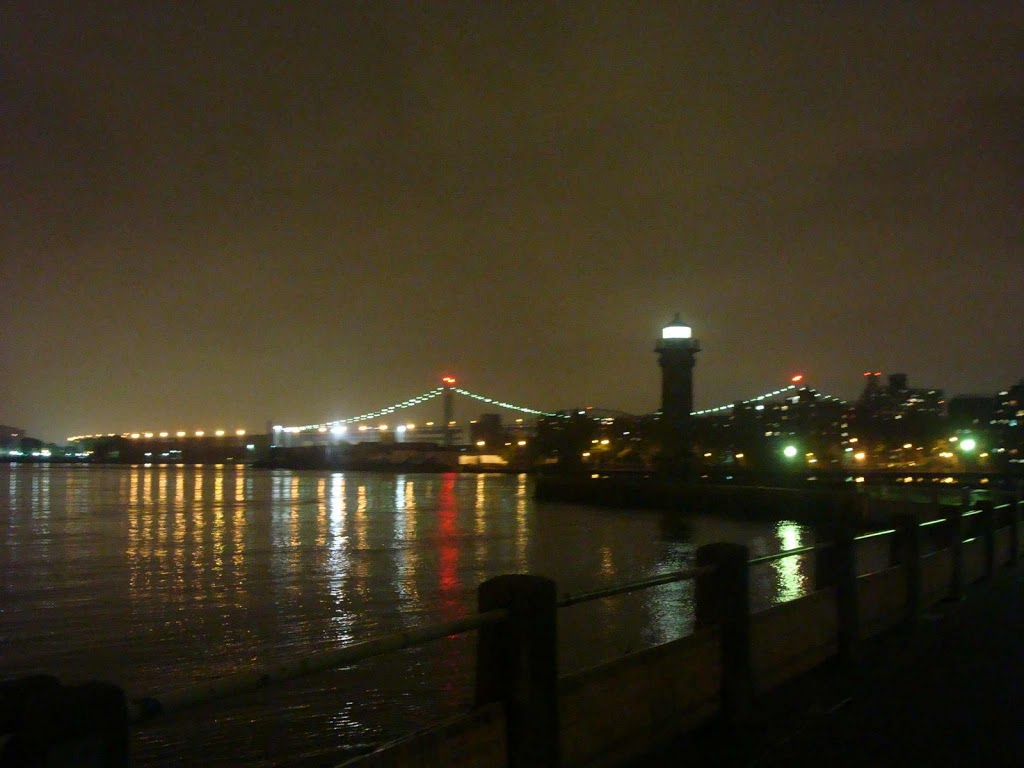
The haunting lighthouse at night, built by island inmates and still illuminating the East River, though the dangers of ships smashing against the rocks of Hell Gate are long gone.

The Renwick Ruins still stand at the south end of the island, the former smallpox hospital still managing to give people a bit of a chill when seen close up (and preferably at night).

An extraordinary look at the island: in 1903, Thomas Edison made a short film using the island as a backdrop. The views include the lighthouse, the Octagon, the penitentiary and the construction work of what would become the 59th Street Bridge

You can find anything you want to know about Roosevelt Island at two excellent blogs, Roosevelt Islander and Roosevelt Island 360. The Main Street Wire, the RI community newspaper, has a great website with an exhaustive history timeline. And naturally, the always reliable Correction History, for all you prison history buffs, has some great info as well.

Click here for some prior articles we’ve written on this blog about Roosevelt here, include Charles Dickens’ visit to the island and an article about the late godfather of RI, ‘Grampa Munster’ Al Lewis.

Paging Dr. La Montagne, Manhattan’s first physician


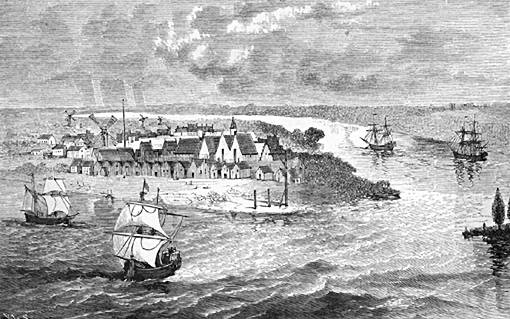
Nothing underscores the harshness of early New Amsterdam more than the notion that the Dutch settlement, which first settled at the tip of Manhattan in 1625, didn’t actually have a real trained physician for almost twelve years.

Most likely, in these earliest years, medical emergencies were handled by ship surgeons and non-professionals skilled in a set of rudimentary practices. More practiced professionals eventually came, such as the man who can lay claim to be Manhattan’s first practicing physician Johannes La Montagne, a Huguenot who arrived in 1637, settling outside the colony in Haarlem.

Johannes soon became “the only doctor in Manhattan in whom the settlers had any confidence,” practicing surprisingly sophisticated (for the day) innovations in Dutch medicine. Like the millions of doctors who would follow in his footsteps, Johannes would soon benefit handsomely from his expertise, gaining a vote in the first official voting council of the new colony under director-general William Kieft. Johannes was also the first of many Manhattan physicians who was also versed in the art networking; within a year he became Kieft’s right hand man and an extension of of the director-general’s wishes, however misguided.

Unfortunately, this devotion to Kieft and the desires of the Dutch West India Company over the needs of the colonists proved to help undermine the new colony, eventually leading to Kieft’s ouster and replacement by Peter Stuyvesant. To his credit, La Montague then won over the steadfast Stuyvesant, who kept him on as a member of his council.

Shockingly, before La Montagne, if one needed actual surgery, one went to the barber. According to one old history, “it might be remarked that a that time barbers were commonly looked upon as surgeons. Any skilled barber was likely to be applied to for surgical procedures.”

These ‘barber-surgeons’, adroit in “performing minor operations“, mostly worked on ships and were hardly skilled in the modern advances of 17th century medicine. Eventually La Montagne was able to regulate these barber-surgeons himself, issuing permits to those practicing in the colony and even those who sailed out of New Amsterdam ports.

Club 57 and the sweet, sweet smell of St. Mark’s Place


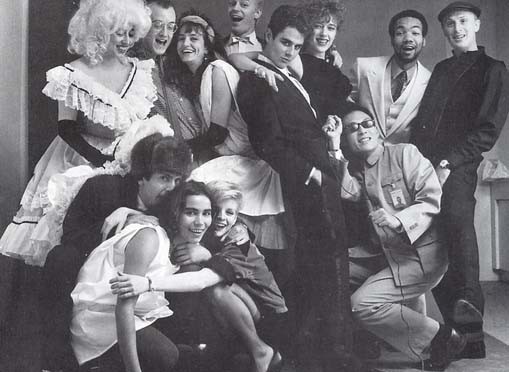
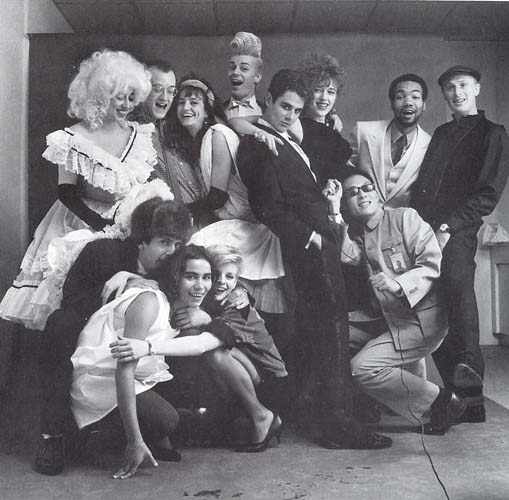
Those crazy kids! The revelers of Club 57 (featuring, among others, Keith Haring), circa 1980

FRIDAY NIGHT FEVER To get you in the mood for the weekend, every other Friday we’ll be featuring an old New York nightlife haunt, from the dance halls of 19th Century Bowery, to the massive warehouse clubs of the mid-1990s. Past entries can be found HERE.

I try not to editorialize too much about the places I write about, because like people, the beauty of a neighborhood is in the eye of the beholder. But these young whippersnappers today just do not understand how profoundly awesome St. Mark’s Place used to be. *waves fist* There’s a Pinkberry there now. Kim’s Video is gone. Where’s the edge?

Yes, yes, things change. And not everyone would agree anyway; in fact, a traditional New York history buff might look upon anything that happened on this East Village street after 1960 as being pure deterioration. Formerly a part of Peter Stuyvesant’s farm, the street transformed from luxury mansions to the heart of German immigrant culture at the turn of the 20th Century. You could say St. Mark’s suffers from a ghost limb. The street used to officially extend one block west before dignified Cooper Union moved into the neighborhood. It now starts at Third Avenue and barrels through to end at the foot of Tompkins Square Park on Avenue A.

The street was also one of New York’s great epicenters for counter-culture, the home to agitators like Emma Goldman and Leon Trotsky, underground jazz clubs and gay bath houses, avant-garde artists and musicians, and finally, by the late 70s, the stomping grounds of punk youth. It’s during this period that our subject, Club 57, enters the story.

Nightlife in the late 70s was epitomized by Studio 54 — high fashion, disco, celebrity and, quite frankly, aristocratic staleness. If disco didn’t appeal to you, it might have been the most loathsome place in the universe. As more and more clubs began aping and distorting the Studio 54 formula, what was your average East Village, pink-haired, multiple pierced, non-traditionally beautiful transgendered girl to do?

We’ve already seen in this column one rebellious strain — the Paradise Garage, which took the big club aesthetic and transformed it into a temple for music worship. When Club 57 opened up in the basement of the Holy Cross Polish National Church at 57 St. Mark’s Place, it had another philosophy: why must celebrities have all the fun?

The strange and the beautiful (Photo by Harvey Wang)

Club 57 was an anti-disco, anti-glitz dingy diamond of the early new wave era, a ‘punk do-it-yourself’ romper room managed by budding performance artist Ann Magnuson. (She’s now an icon of the downtown New York scene. You may remember her from Desperately Seeking Susan.)

According to Ann, she was hired in 1979 by the owner of Irving Plaza whose smaller club here at St. Mark’s needed to be spiced up with “‘alternative’ entertainment” that reflected the clientele of the neighborhood. With some creativity and abandon, Magnuson and her gang of misfits turned the basement into her own “low rent answer to Andy Warhol’s Factory,” “a center for personal exorcism, devising theme parties (or “enviroteques,” as one drug-dealing-conceptual-artist ex-boyfriend liked to call them),” for its outcast, straight, gay, vanguard clientele.

The theme parties would mock serious musical conventions, often requiring silly or even conventional dress done in an ironic fashion — nights like Putt-Putt Reggae night, ‘A Night At the Opry’, and Elvis Memorial night (where everybody dressed as their distorted version of the King). One event featured club goers sitting around making model planes; another emulated the thrill of lady wrestling.

These probably weren’t like the costume parties you’re used to. Kenny Scharf: “There were drugs and promiscuity — it was one big orgy family. Sometimes I’d look around and say ‘Oh my God! I’ve had sex with everybody in this room!”

One of Club 57’s more successful nights was the Monster Movie Club, every Tuesday, showing “the worst monster movie they could find,” according to Drew Straub.

The soundtrack for these absurdist weekly carnival shows were stars of the outer reaches of punk, new wave and rap. The club featured performances by St. Marks resident Klaus Nomi, Fab Five Freddy and John Sex. When it did feature more established names, they were along the lines of the Buzzcocks and the Cramps

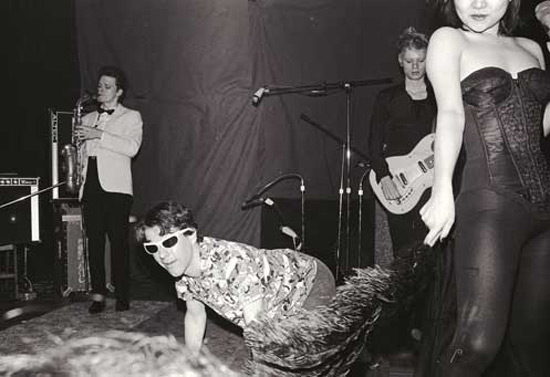
Below: the band Certain General plays at Club 57, April 1981

The club soon gained a rowdy reputation. According to Magnuson, her Elvis Memorial night was disrupted when “local juvenile delinquents” caught the air conditioner on fire, sending bizarre Elvis lookalikes spilling into the street. Its reputation was spirited enough to keep away to more ‘cultured’ avant garde of venues like the Mudd Club. Said Magnuson, “The Mudd Club was more into coolness and being hip and shadowy and mysterious, while Club 57 was about being loud and bright and colorful and kooky and silly — and doing mushrooms.”

However one artist who was not detoured was Keith Haring who frequented the club and credits it for inspiring “the beginning of a whole career as the organizer and curator of some really interesting art shows.”

Club 57’s time was brief; it opened in 1979 and closed four years later. But its influence would spread into many other underground clubs, including the longer lasting Jackie 60. Today’s St. Mark’s Place could definitely benefit from a little infusion of its wild, retro chaos.

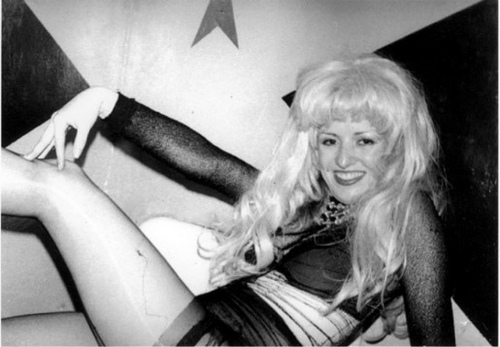
Below: the wonderful Wendy Wild, a fixture of Club 57 (Photo by Ande Whyland)

Mayor Franklin Edson: Bronx man and distillery king

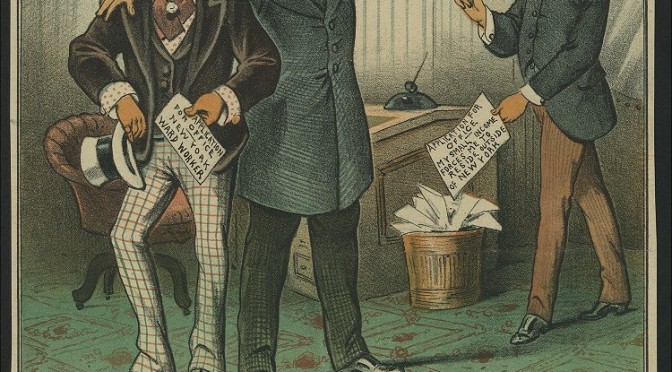
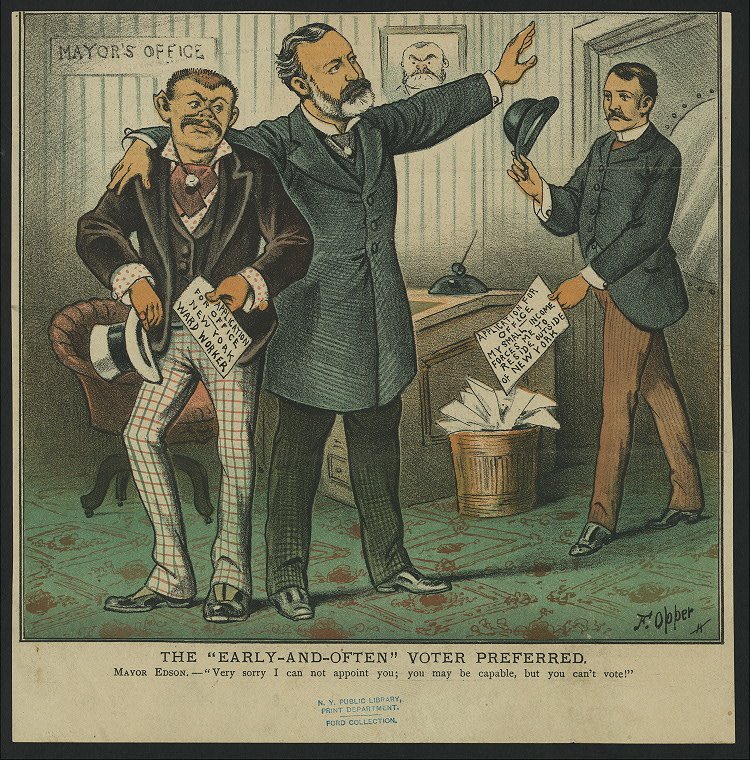
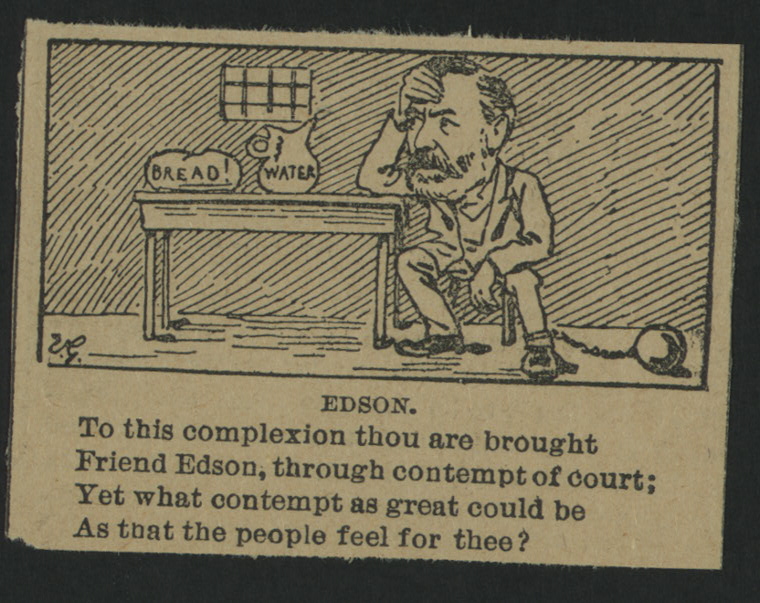
Above: a cartoon mocking Edson’s hiring practices (courtesy New York Public Library Digital Gallery)

KNOW YOUR MAYORS Our modest little series about some of the greatest, notorious, most important, even most useless, mayors of New York City. Other entrants in our mayoral survey can be found here.

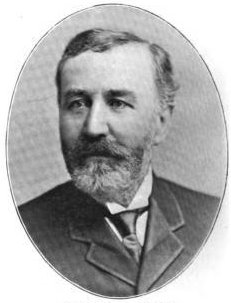
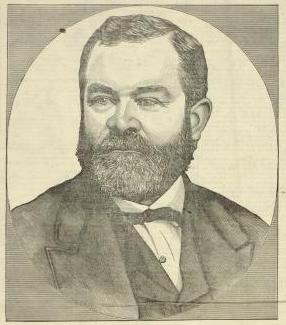
Mayor Franklin Edson

In office: 1883-1884

Although the political career of one-term mayor Franklin Edson was indeed brief, he helped commission both the city’s largest acquisition of park land and one of its biggest improvements in drinking water. And he was present for the opening of one of New York’s greatest landmarks. So how did the city thank him for his service? By nearly throwing him into Ludlow Street Jail — where Boss Tweed had been left to rot just a few years before.

Edson, a transplanted New Yorker, was a farmboy from Chester, Vermont, born in 1832, who distinguished himself in the art of whiskey distillery — distinghished with “precocious tact and sagacity,” in fact.

He worked his way over to Albany, New York, as a successful distiller and grain merchant with his brother. Franklin took full advantage of drink demands during the Civil War; his company soon became so profitable that he moved the entire venture to New York in 1866.

Edson, a burgeoning booze mogul of sorts, immediately became a prominent merchant voice in Manhattan, becoming the president of New York’s Produce Exchange three times, serving his first term in 1866 before he had to time to even unpack his moving boxes.

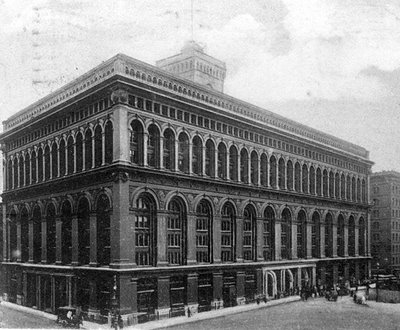
While this naturally afforded Franklin an incredible vantage for commercial power, it would soon place him in the crosshairs of political power as well. In later years he would be most proud of his Exchange days, priding himself in being one of the encouraging voices to tear down the inadequate castle-like Produce Exchange (designed by Leopold Eidlitz) and erecting the larger, more impressive George Post-designed Produce Exchange building near Bowling Green (which itself would be sadly torn down in 1957).

Below: the new Produce Exchange

What sets Edson apart from other future mayors of the time — and what might have potentially hindered his political ambitions — was that he loved the countryside, in this case Old Fordham Village, today a neighborhood in the Bronx.

He would live here for many years and would remain a member of the (now landmarked) Episcopal Saint James Church in Fordham for most of his days. Whether by design or coincidence, this love for what would become New York’s northern borough would soon prove fruitful for the city as a whole.

Franklin was also a practicing anti-Tammany Hall Democrat. And who wouldn’t be anti-Tammany during the 1870s? Edson became politically active in the years following the Boss Tweed scandals, when Tammany was still reeling for the highly publicized affair involving Tweed and then-mayor A. Oakley Hall.


Despite a slow rebounding, Tammany would never fully rinse off the stench of corruption. Naturally, Edson’s prominence among the business class married nicely with mayoral ambitions by the mid 1880s and would eventually include a denunciation of Tammany practices and condemnation of Tammany boss John Kelly (at right). But not at first.

For the election in November 1882, the various Democratic factions, including the still-potent Irving Hall, soon decided on the relatively green Edson, because he was a uncontroversial, neutral choice. To Tammany’s Kelly, Edson must have seemed a fairly agreeable pick indeed compared the previous mayor William Russell Grace, a reform Democrat rebelliously outside the realm of Tammany’s power.

Edson easily swept past his opponent, railroad man Allan Campbell — a sweet victory for John Kelly, as it was Campbell that had replaced Kelly as the city comptroller several years previous under the administration of mayor Edward Cooper. (Check out Edward’s entry for some juicy details of the Kelly/Cooper rivalry.)

How did a political nobody — a “seven day wonder in the political world” — sweep so handily into office? It helps to ride coattails; during that same election, the popular Democrat Grover Cleveland was elected the governor of New York.

At first, Edson gave in readily to political favoritism, paying back some of his Democratic cohorts — including many of the Tammany variety — with lucrative city jobs, a decision which disgruntled many of his former supporters. In fact, he even appointed Richard Croker as fire commissioner; Croker would become the head of Tammany Hall in the 1890s. (Harper’s Weekly has a coy little cartoon chiding the Croker decision.)

Like many before him, however, Edson soon grew tired of Tammany’s corrupting influence and began adopting reform policies which were currently being installed on the state level. And also like many before him, his against-the-wind attempts at reform would essentially spell the end of his political career. Edson would serve but a single term and would almost entirely vanish from politics afterwards.

But not before throwing his weight behind a major expansion of the Croton Aqueduct, which within in a few years would triple the supply of water into the city. (In fact, most of the expansion he pushed for is still in use today.)

Edson is also partially responsible for the huge increase in New York park land, commissioning a citizens group in 1884 to lobby the state to purchase lands in the area of today’s Bronx; accordiing to an old Bronx history, “the ‘new’ parks, as they were called, comprised 3,757 acres, now included in Van Corlandt, Bronx, Pelham Bay, Crotona, St. Mary’s and Claremont parks.”

And most notably, he was the first New York mayor to walk the Brooklyn Bridge, astride president Chester A. Arthur and governor Cleveland on the bridge’s opening day, May 24, 1883. He would be met in the middle by the mayor of Brooklyn — future New York mayor — Seth Low.

He might have crept quietly into obscurity had Edson not been accused of contempt of court shortly after he left office, threatening a man in his early 50s with jail time with a stint at the notorious Ludlow Street Jail. Apparently, despite a court injunction, Edson had quietly made promotions to two posts — the Commissioner of Public Works and the Corporation Council — on his last day in office. However, after a stressful two months in court, Edson was declared not guilty of the crime.

This did not stop people from imagining the ex-Mayor trapped behind bars, as the newspaper illustration below evidences:

Edson died in 1904, at his home on the Upper East Side. 42 West 71st Street, to be exact, a block from the Dakota Apartments, which were completed during his tenure as mayor.

Categories
Podcasts

The Puck Building “What Fools These Mortals Be!”

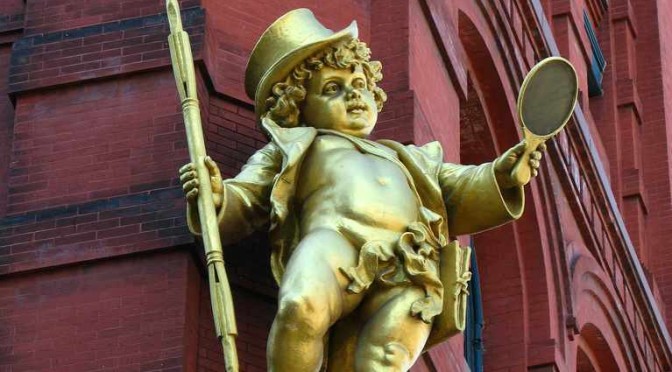
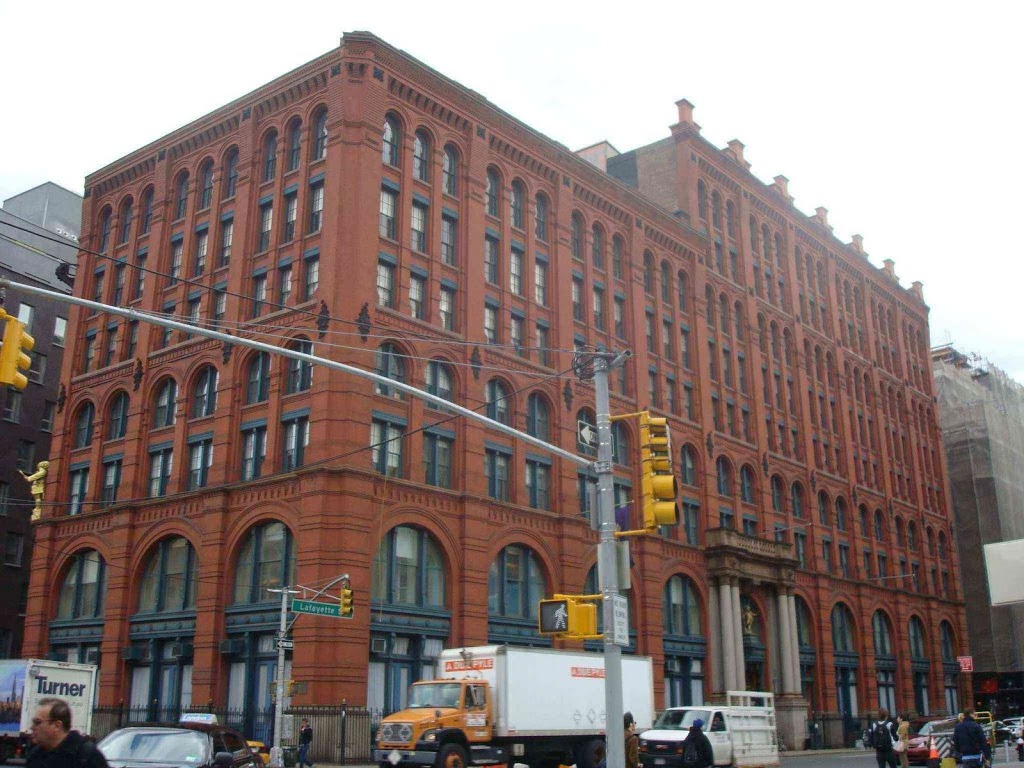
A 6-foot plump gold impish figure stares down as you look up to observe the gorgeous red-brick design of the Puck Building, built for one of the 19th century’s most popular illustrated publications. But this architectural masterpiece was very nearly wiped away by a sudden decision by the city. How did it survive?

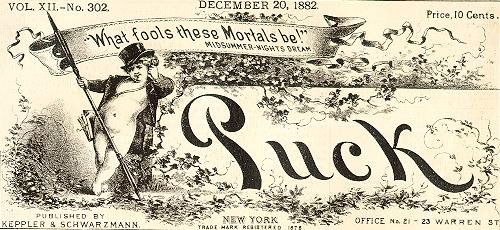
Puck’s utterance “What Fools These Mortals Be!” is the slogan for Puck Magazine and words written by Shakespeare.

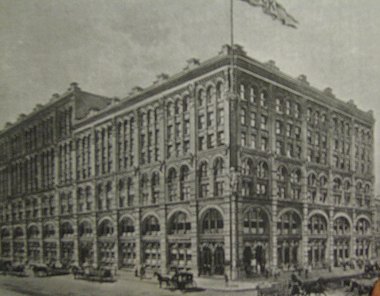
An illustration of what the Puck Building looked like pre-1897….

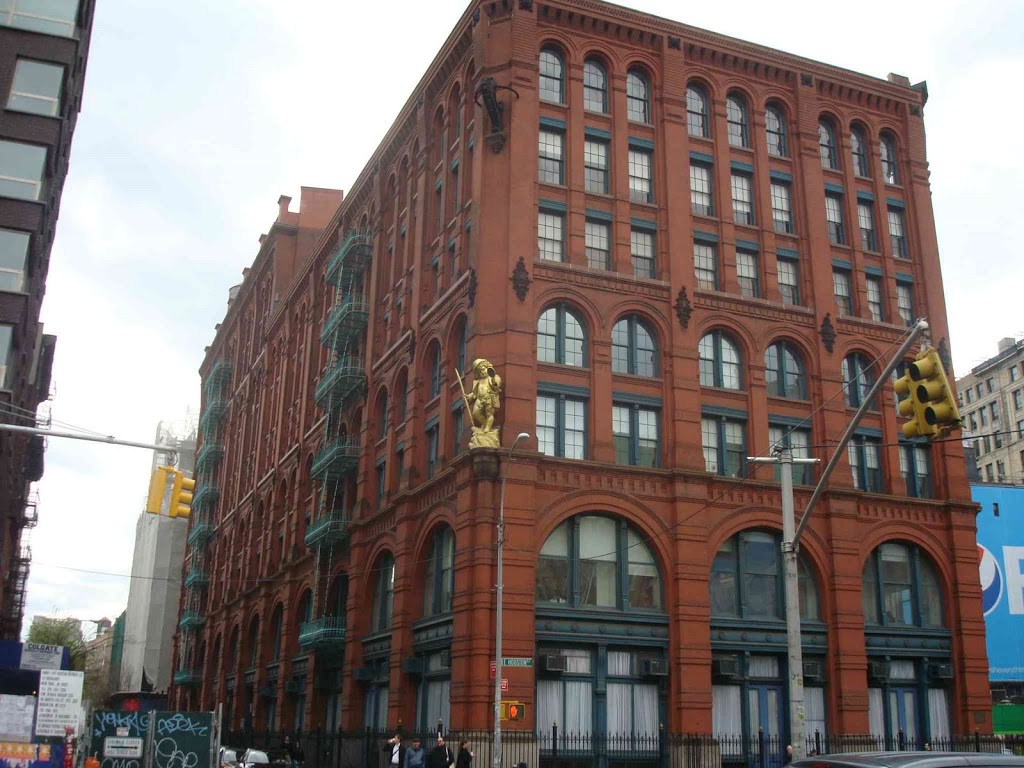
…and how the truncated Puck looks today.

The impish Puck standing at the corner of the building — and above the western doorway — is echoed in Puck’s magazine banner

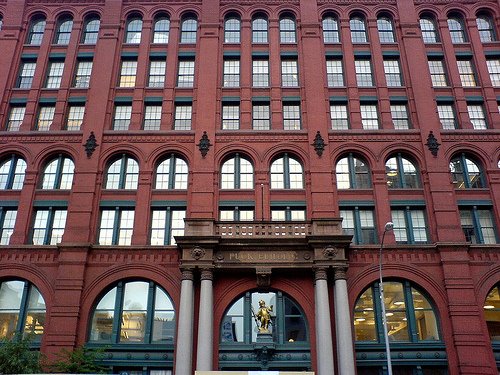
There are, of course, two Pucks at the Puck Building. A smaller, newer Puck stands over the main entrance. Neither this entrance nor the Puck above it existed before 1897.

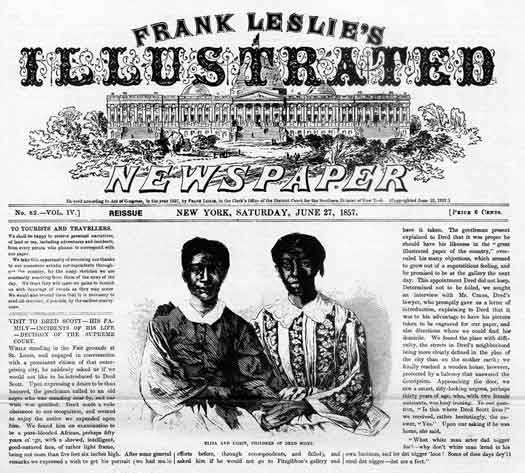
An early issue of Frank Leslie’s Illustrated Newspaper. Keppler went to work for Leslie before striking out on his own with the far more satirical Puck Magazine.

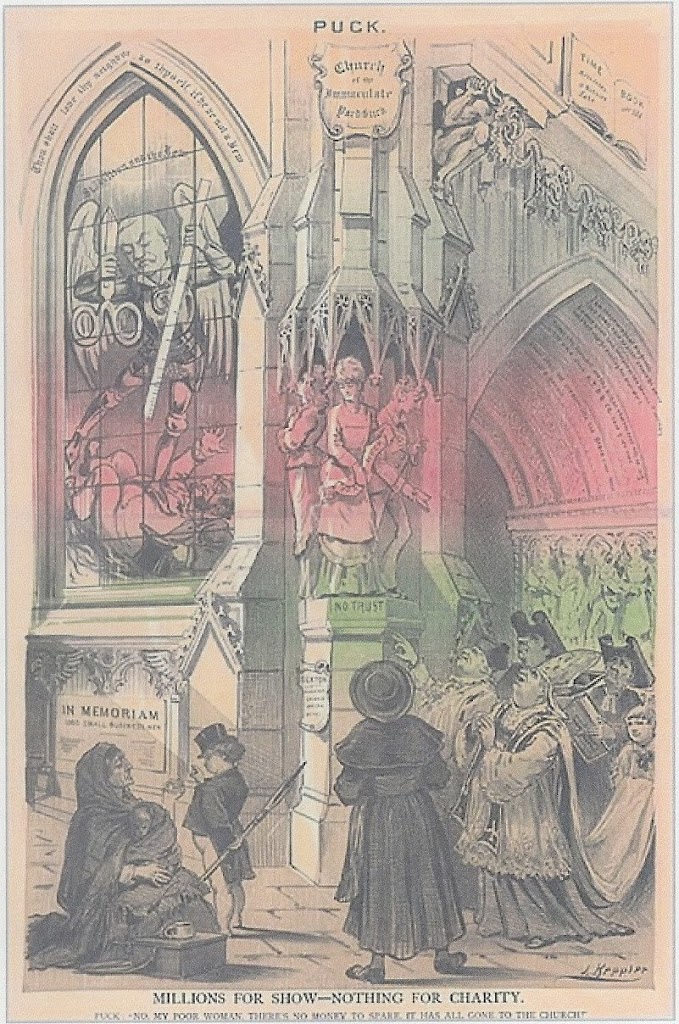
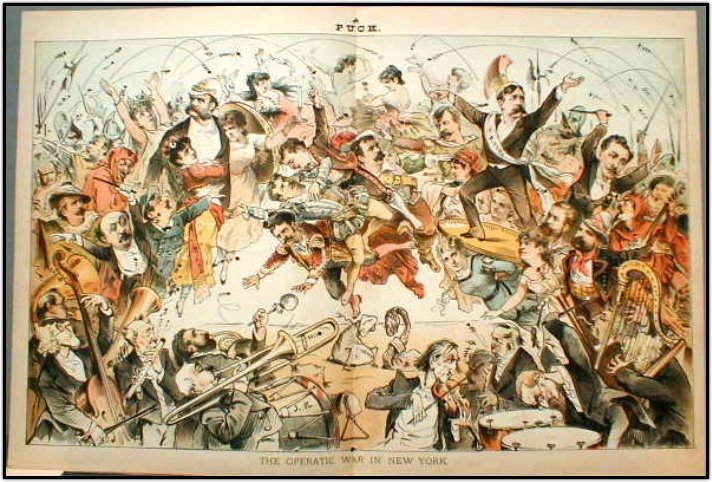
Some images from Puck Magazine. Please click into the images for greater detail.

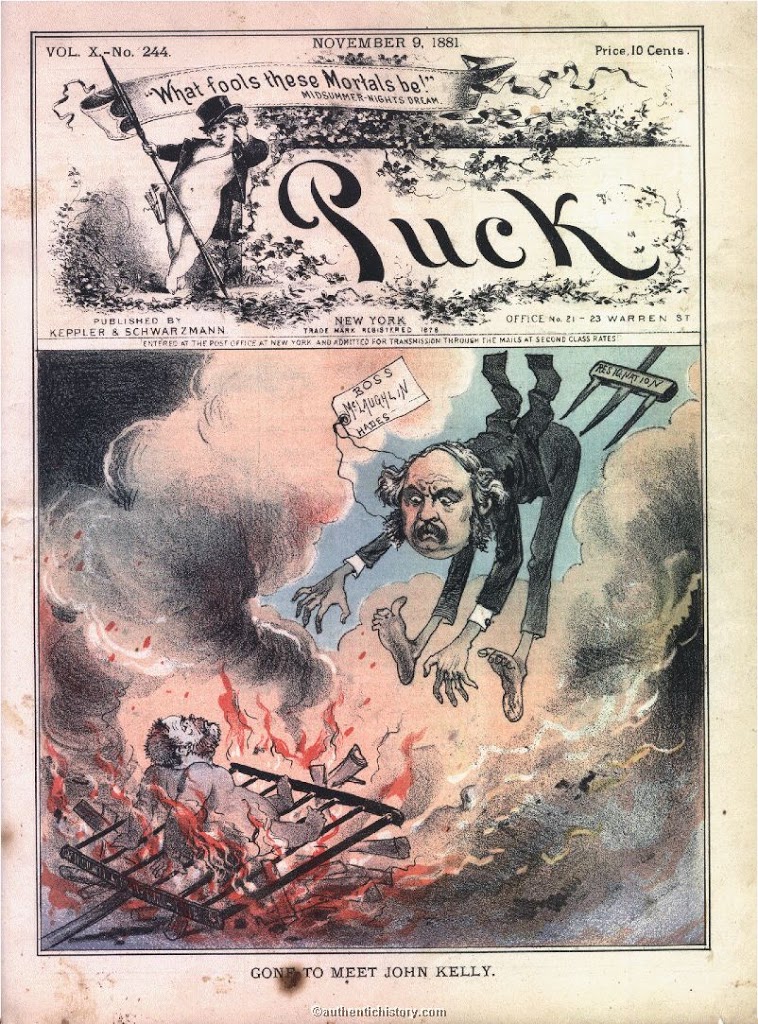
Below is a cover from 1881, satirizing Brooklyn’s most powerful Democrat, Hugh McLaughlin, who frequently butted heads with Tammany Hall.

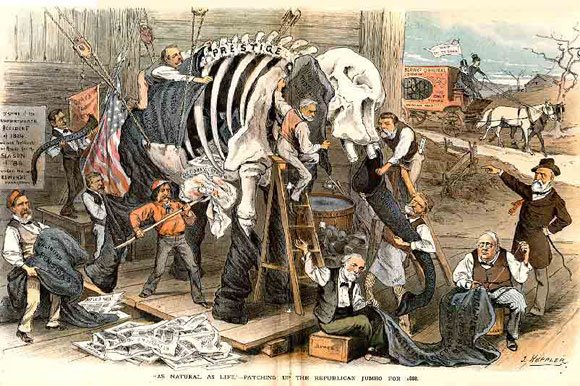
Republicans attempt to stitch together their fractured party, in an illustration by Keppler himself. Keppler was one of the most influential illustrators of his time, second only to the great Thomas Nast of Harper’s Weekly.

Possibly the most powerful image the magazine ever ran was this one, mocking presidential Republican candidate James Blaine. Keppler was a supporter of Democrat Grover Cleveland, and cartoons like this swayed public opinion. Cleveland beat Blaine in the presidential election of 1884.

In the interior illustration below, Keppler displays his obvious anti-Catholic (and, by extension, anti-Irish) bias. Puck himself is inserted in this image at bottom left.

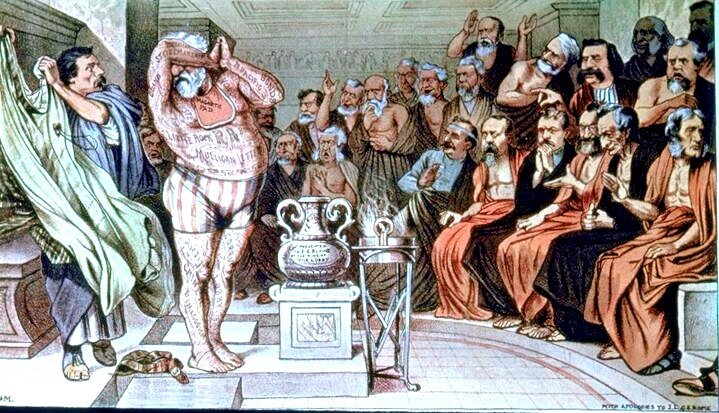
One of my favorite images, and a good example of Puck’s centerfold illustrations, this one expanding on the war in 1883 between the Metropolitan Opera and New York’s Academy of Music.

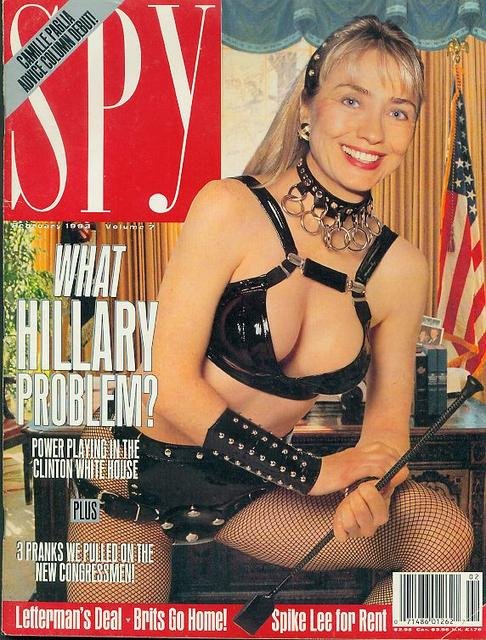
One hundred years after the Puck Building opened, another catty, satirical magazine Spy Magazine moved in, carrying on the tradition of political lampooning.

Categories
Friday Night Fever Music History

Birdland: The Midtown Manhattan playground for classic jazz

FRIDAY NIGHT FEVER To get you in the mood for the weekend, every other Friday we’ll be featuring an old New York nightlife haunt, from the dance halls of 19th Century Bowery, to the massive warehouse clubs of the mid-1990s. Past entries can be found HERE.

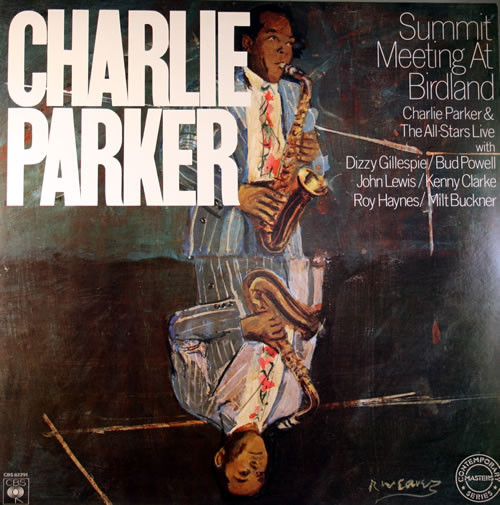
Charlie Parker was the king of the jazz scene, father of bebop, and a figurehead of bohemian New York — the original hipster, before the term moved on to other connotations.

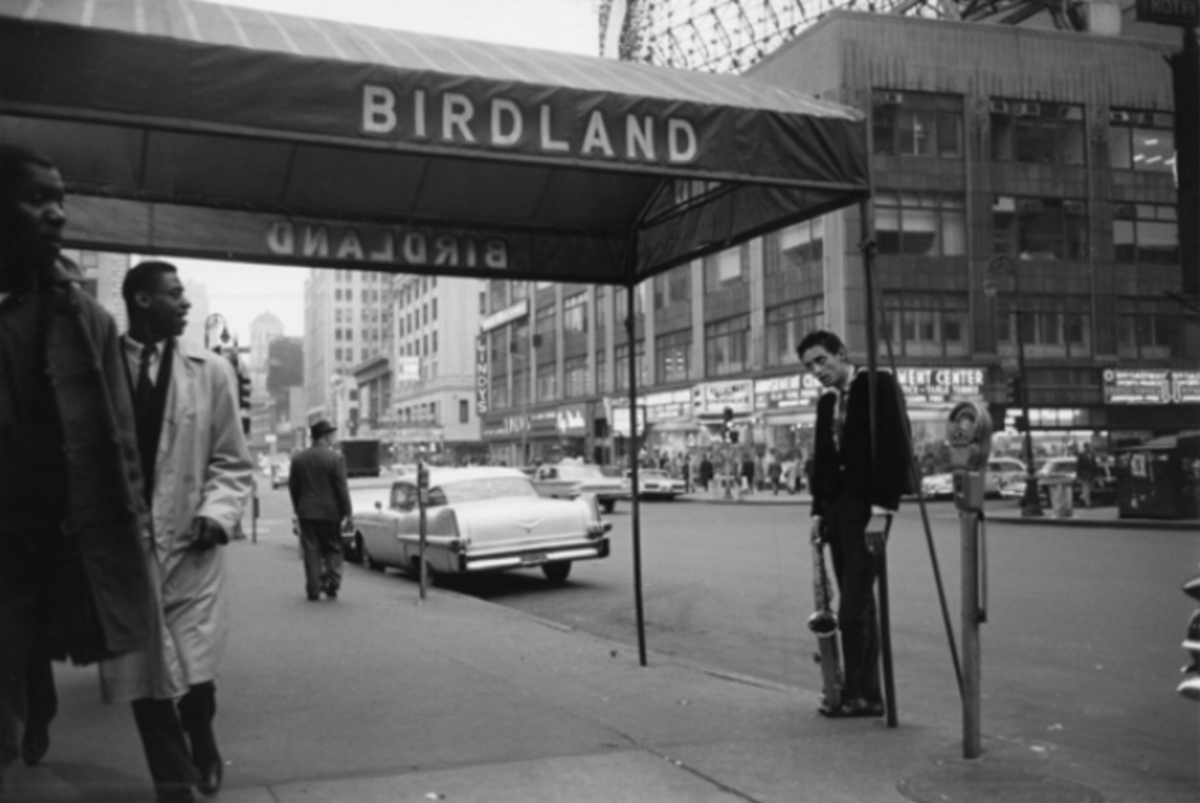
He is also the reason for Birdland, the influential midtown jazz club that’s still with us today.

Parker was born in 1920 in another jazz capital, Kansas City, Mo, and moved to New York at 19 years of age.

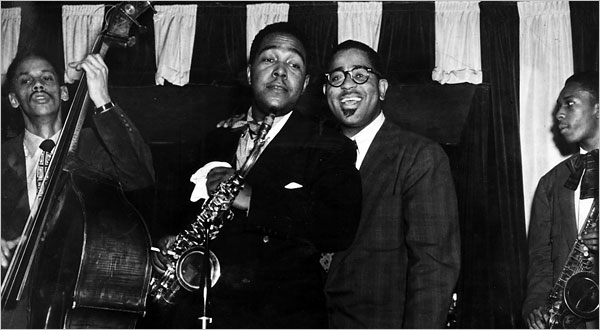
He quickly worked his way into jazz’s inner circle, performing saxophone in Harlem and midtown clubs with names that would soon become legendary in the genre — Art Tatum, Thelonius Monk and especially Dizzy Gillespie, Parker’s frequent duet partner.

Through these collaborations, Parker helped create the style of jazz known as bebop, a frenetic, dirty and liberal type of jazz which required a mastery over their instruments along an uncharted, often improvised melody.

By 1949, he was the biggest star in jazz music, defining the sound through dozens of recordings and spectacularly unpredictable live performances. (He was also severely abusing alcohol and drugs by this time, too.)

He had also acquired the well known nickname, the Yardbird. There are multiple theories as to how he obtained that name; by the 40s, it was most popularly shortened to the Bird.

The fan site Bird Lives has a compendium of back stories of how the name came to be.

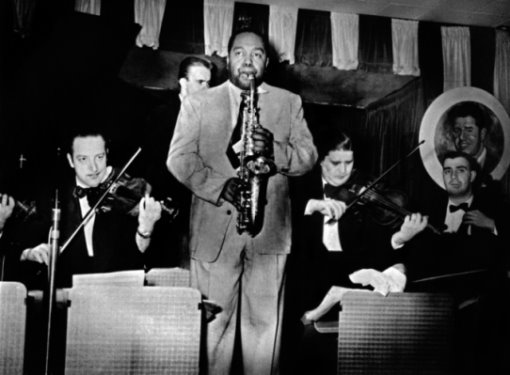
BELOW: Parker performs at Birdland, 1951

Young Bronx-born songwriter Morris Levy, meanwhile, was making his own way through New York’s music scene, most notably in the 40s as manager of Topsy’s Chicken Roost.

Seizing upon the connections he made there, Levy decided to head out on his own, while promising Parker a club of his own to perform in. And so became Birdland, opening near the end of 1949, at 1678 Broadway on 52nd street.

Bird was very excited about that,” recalled renown jazz drummer Earl Haynes. “I remember on opening night there were lines of people outside, waiting in bad weather.”

The club, the self-proclaimed ‘jazz corner of the world’, sat 400 amidst a cabaret space adorned with actual caged birds and a ‘bullpen’ behind the bar “where penniless college kids and struggling musicians” took their place.

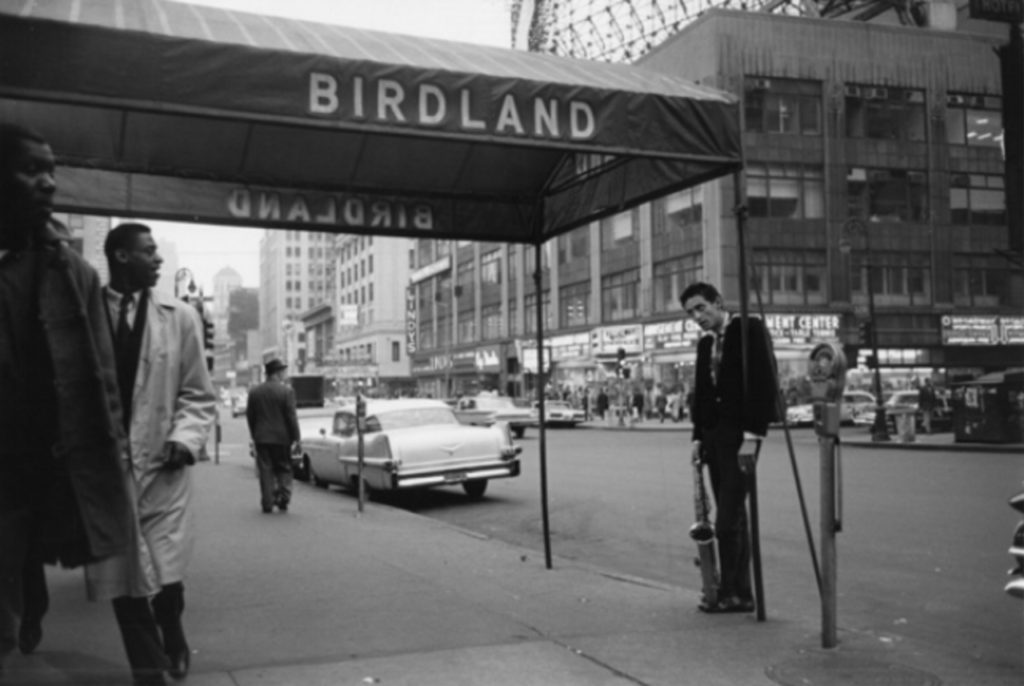
Birdland 4AM, photograph by William Claxton

Birdland quickly took off as New York’s leading jazz club of the 1950s, attracting the genre’s greatest names: Miles Davis, John Coltrane, Lester Young, not to mention Gillespie and Monk.

And of course, Parker would perform there regularly. At one point, he couldn’t acquire a cabaret license because of his substance-abuse problems; as a result, he would actually be barred from performing in any New York club, including his own.

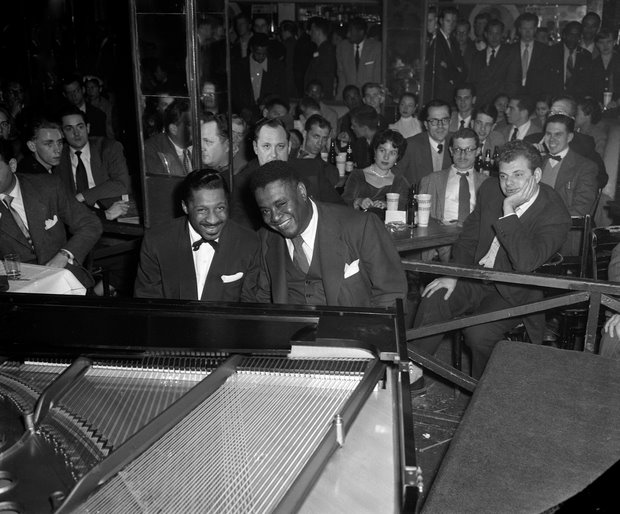
Eroll Garner and Art Tatum perform in 1951. You get a great sense of the room — and the clientele! — in this picture.

As the club became more popular, Birdland’s tables were surrounded by a bevy of glamorous stars on any given night, like Marilyn Monroe, Frank Sinatra, Sammy Davis Jr and Marlene Dietrich.

According to Ebony editor Allan Morrison, “Birdland was both a cultural vantage point and a barometer of trends where all the big names in jazz performed.”

From the successes of Birdland, Levy would go on form Roulette Records and become one of the most unscrupulous music moguls in the rock and R&B era.

He was responsible for some of the biggest R&B hits of the 60s — and also notorious for his mob connections and a penchant for strong-arming recording artists into sharing publishing rights with him. (He also allegedly owned the phrase ‘rock and roll’.) He died in 1990 before he could serve a ten-year jail sentence for extortion.

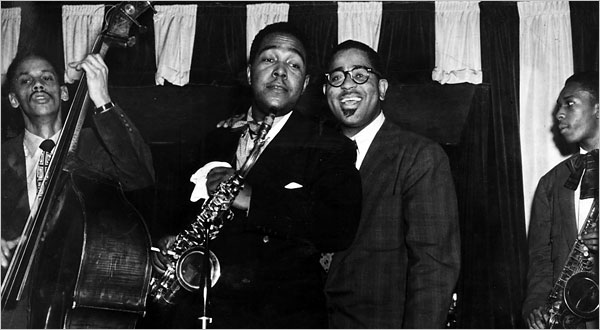
How’s this for a lineup in 1951? From left to right: Tommy Potter, Charlie Parker, Dizzy Gillespie and John Coltrane

Parker meanwhile, had met his tragic end many, many years previous, a victim of rampant substance abuse. His last performance at Birdland was on March 5, 1955, dying in New York one week later.

The Birdland club drifted against the headwinds of the 1960s, where rock clubs like the Peppermint Lounge ruled midtown. “Birdland has gone off the cool,” lamented Oscar Goodstein to Time Magazine. By 1965, the club on 52nd street closed its doors.

With the consent of Parker’s widow Doris, John Valenti reopened Birdland in 1986 on the Upper West Side, 2745 Broadway at 106th Street, in a more intimate, triangular shaped space.

Watching the rebirth of midtown in the 1990s, Valenti decided to move the club back downtown in 1996 to its present location at 315 W. 44th Street, between 8th and 9th avenues.

They get fewer celebrities, but a lot more tourists, sampling the newest crop of jazz stars.

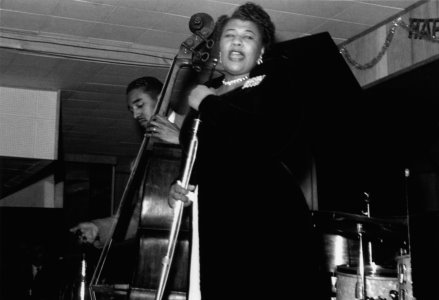
BELOW: Ella Fitzgerald electrifies the room


Yankee Stadium Opening Day: April 18, 1923


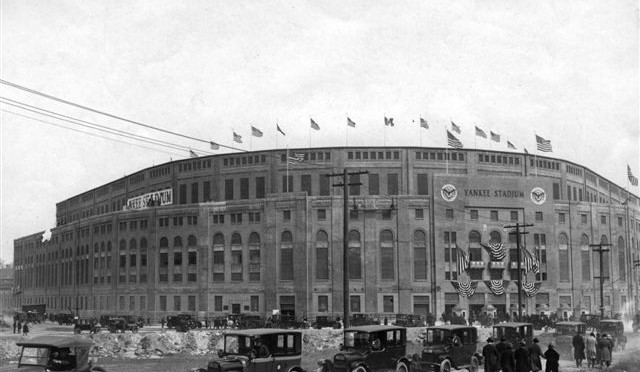
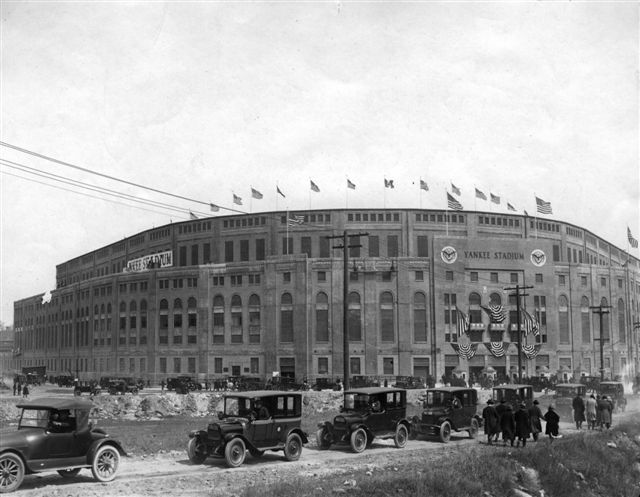
The first Yankee Stadium, all shiny and new in 1923

Today is opening day at the new high-tech Yankees Stadium as Derek Jeter and crew get used to that new stadium smell while fending off the Cleveland Indians. And legendary Yankees catcher and manager Yogi Berra, who turns 84 this year, will be there to throw out the first pitch.

Just two years before Berra was even born, however, came Yankee Stadium’s first opening day, on April 18, 1923. Back then, the Yankees were Babe Ruth, baseball’s magnetic star whose popularity caused Yankees owners Jacob Ruppert and
Tillinghast L’Hommedieu Huston to built the new stadium in the first place.

But despite the stadium being ‘the House that Ruth Built’, he didn’t throw the first pitch. That honor went to governor Alfred E. Smith, hurling the ball at catcher Wally Schang. The Yankees went on the crush the Boston Red Sox that day 4-2, thanks to an effortless three-run homer from Ruth.

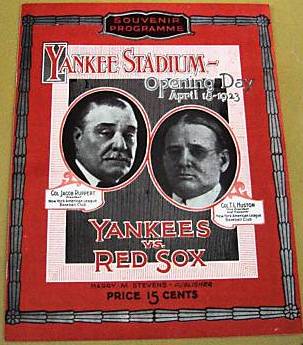
Above: an original opening-day program, curiously with Yankees owners Ruppert and Huston — not Ruth — on the cover

Click here to hear our podcast on the history of the Yankees.

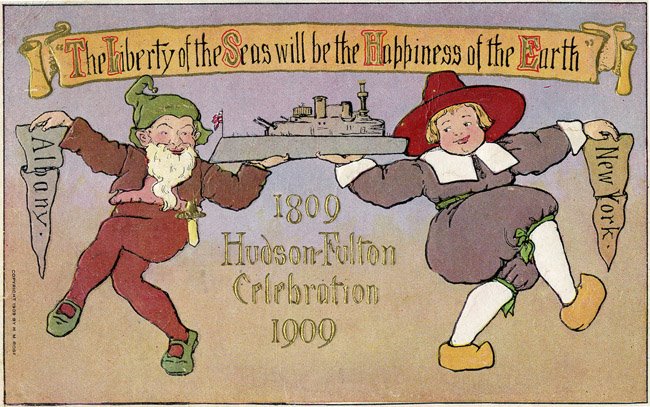
The Hudson-Fulton Celebration: not just another party

Four hundred years ago, on September 12, Henry Hudson sailed into New York harbor and casually discovered the island of Mannahatta, the future home of New Amsterdam, Wall Street, and the New York Yankees.

Two hundred years later, ferry mogul Robert Fulton patented the steamboat, an engineering marvel he perfected, but did not invent. Fulton, a Pennsylvanian who originally tested his ship in Paris, became associated with New York with the development of the successful Clermont North River steamboat service in 1807.

Reason to party, right?

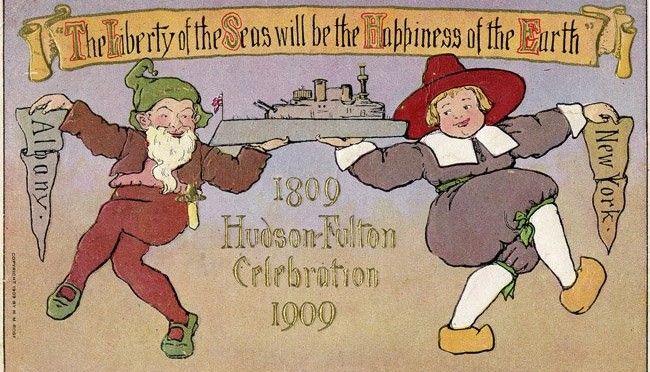
New Yorkers thought so 100 years ago, planning the official Hudson-Fulton Celebration in the fall of 1909, as a grand, showy pat on the back to America’s industrial might. A state-wide soiree, it was New York’s own unofficial world’s fair, a chance to trumpet its innovations and riches via a celebration of its history and the central role of the Hudson River.

Make no mistake: as much as this was a celebration of New York, it was also a celebration of New York’s wealthy. This was the height of the Gilded Age, after all. The original plan was forged by Theodore Roosevelt’s uncle Robert, and the planning committee included Andrew Carnegie, J.P. Morgan, former vice president Levi Morton, Macys co-owner Oscar Straus, and members of the Rockefeller and Van Rensselaer families. They were celebrating New York; by extension, they were celebrating themselves.

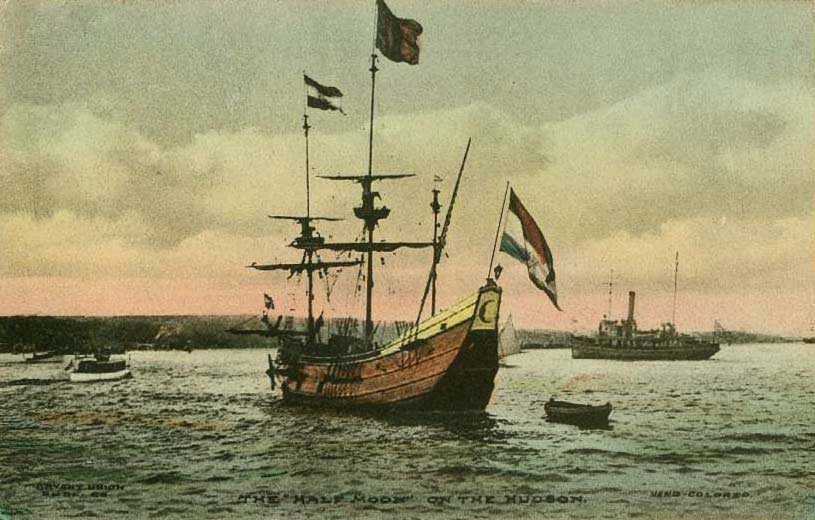
From September 25 to October 11, the river was clogged with shipping and military vessels festooned with electric lights, while overhead the skies were filled with nightly firework displays. Inaugeral nautical displays were capped with the ceremonial entry into the harbor of both Hudson’s ship the Half-Moone and Fulton’s Clermont, both re-created for the event. (The Half-Moone and Clermont unceremoniously collided into each other during the ceremony!)

Below: a postcard of the Half-Moone on its ‘revisit’ to New York harbor

On land. it was a veritable history geek’s dream, with festivals and parades devoted to New York City’s past. Each day featured a different ‘historical pageant’ in each borough, culminating in two far livelier ‘carnival pageants’, one in Manhattan on October 2, and in Brooklyn one week later.

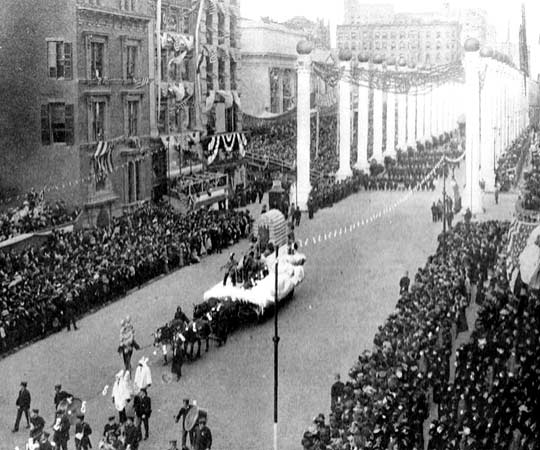
The historical pageant would be a six-mile, papier-mache Beaux-Arts extravaganza, striding from Central Park to Washington Square Park, displaying the political correctness of the day. The parade was led by a series of floats referred to as ‘the Red Man Band’, with such dioramas as ‘the Legend of Hiawatha’ and ‘the War Dance’, escorted by members of Tammany Hall.

Dutch-themed floats depicted Jonas Bronck, Peter Minuit’s purchase of Manhattan island, and a friendly game of bowling at Bowling Green. British and Revolutionary War floats followed, featuring the death of Nathan Hale and the legend of Rip Van Winkle. Peter Stuyvesant, Alexander Hamilton, the Statue of Liberty, the Marquis de Lafayette — they were all represented.

Below: part of the Hudson-Fulton history parade, 1909

Of course, that was nothing compared to the absolutely bizarre Carnival Pageant. Rather than represent anything relating to the celebration at hand, organizers chose to, according to official history, “recall the poetry of myth, legend, allegory and in a few cases of historic fact, which, while foreign in local origin, is an heritage of universal possession and belongs to all nation.”

Bafflingly, this led to a highly flamboyant parade with such European folklore themed floats as the “Crowning of Beethoven,” “Lohengrin,” “Walkure”, “Frost King”, “Orpheus Before Pluto” and “Elves of the Spring” — almost 30 in all. A couple sample descriptions:

Frost King — “This float represented the mythical Frost King, who has control over the snows and other elements of the winter. Around him were grouped his fairies, who have charge of the winds, the snows, the frost and the thaw. The Frost King was represented in his own directing the elements.”

Elves of the Spring — “This float represented the opening of the flowers and the fairies issuing therefrom, suggesting the magical change which comes over the face of nature with the retreat of winter.”

Keep in mind that many of the myths depicted in the carnival may have been quite familiar to New York’s new populations of European immigrants. Had such a procession sprouted up on the streets today, it might be mistaken for the Halloween parade.

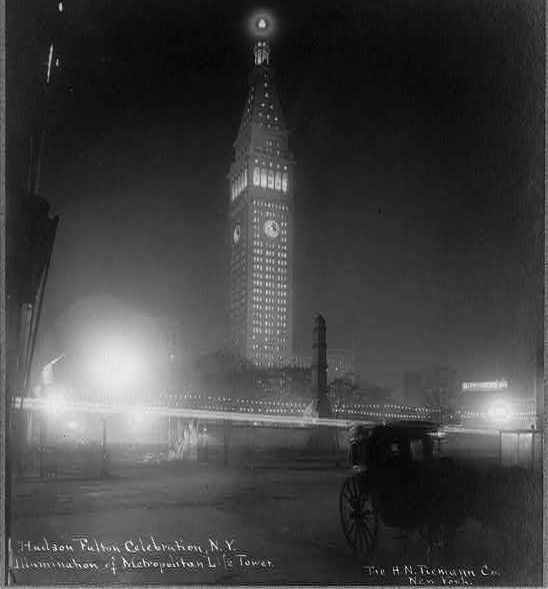
The Metropolitan Life Tower, the tallest building in New York, lights up the night sky during the 1909 Hudson-Fulton celebration

Meanwhile, mayor George McClellan Jr. and other city officials were busy elsewhere, as a flurry of monuments and plaques were dedicated that day. In fact, if you’re walking around the city and find any dedication related to the days of Dutch Manhattan, most likely it’s from the Celebration — from the marking of the old Dutch wall on Wall Street to the marker dedication to Dutch school teachers in Washington Square.

Strings of electric lights were hung from every available landmark and structure, in a sense creating the modern New York skyline that very day, as New Yorkers could now admire their city for the first time at night. Not just incidental illumination, but a decorative show that could be seen from miles away.

Thousands of lights were hung from the bridges and official buildings in all boroughs, paired with “elaborate private illuminations by the owners of large office buildings, stores and dwelling houses,” the lighted vessels in the harbor and the various pyrotechnics throughout the city to create “a veritable City of Light.”

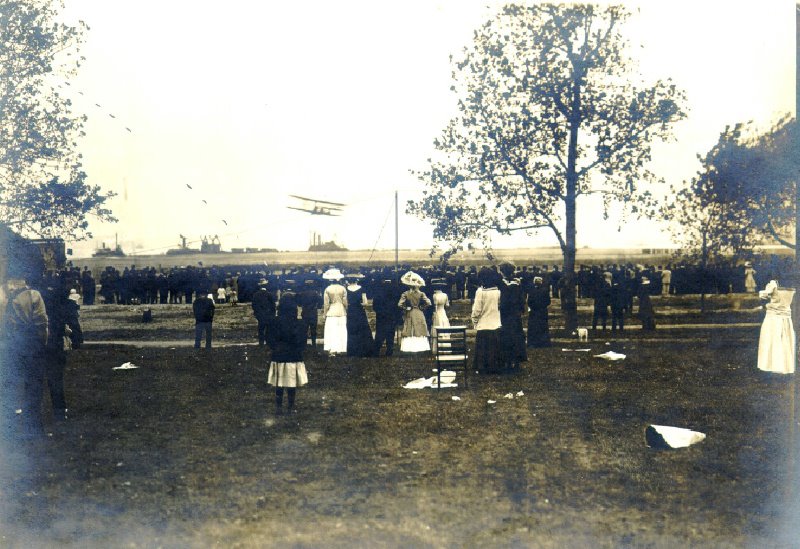
Of course, the most well-known — and most historically significant — event from the Hudson-Fulton Celebration was Wilbur Wright’s flight from Governor’s Island circling the Statue of Liberty, the very first flight over New York waters. (Check out our podcast on LaGuardia Airport and the history of flight for more information.)

Below: Amazed New Yorkers stare as Wilbur takes a second trip through New York skies, up the Hudson River to Grant’s Tomb, then back to Governor’s Island

This year we should be celebrating Hudson, Fulton and Wright, I guess. There are celebrations planned throughout the state, and we’ll hear more about them starting in June and continuing through the fall. Manhattan has already received a new commemorative flag in honor of the event.

And naturally, we’ll be alerting you to some of these events on this blog. Maybe we’ll even have our own. Anybody got a elf costume?

By the way, the official history of the Hudson-Fulton Celebration is worth a look, especially for its descriptions of regular events.

Hallelujah! Billy Sunday comes to town

ANATOMY OF A PHOTOGRAPH An occasional feature where we take a closer look at an old photo of New York City, to give the image some historical context and piece together the situations that led up to it.

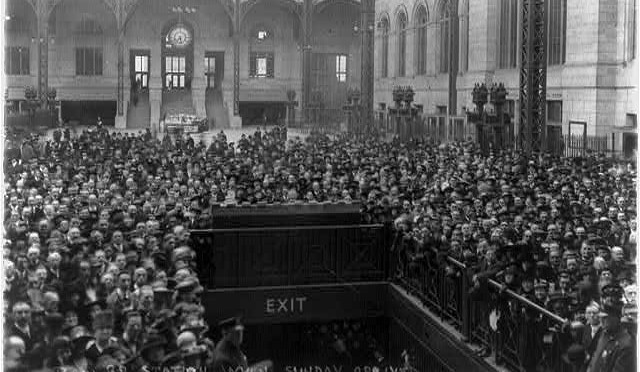
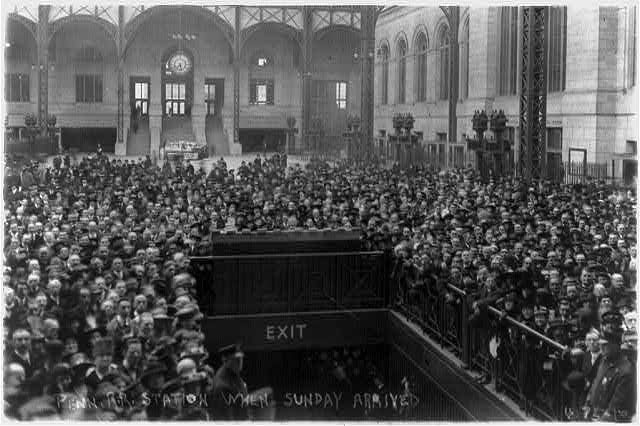
I ran the photograph above on Friday in reference to the early days of Pennsylvania Station. But the people cramming onto Penn Station’s platforms aren’t waiting for a train. They’re waiting for Sunday.

Billy Sunday, that is, America’s preeminent evangelical preacher in the 1910s.

Sunday was an outsized gospel celebrity, a former baseball star turned preacher who gloried in proselytizing to large audiences, a perfect spiritual fit to the Gilded Age.

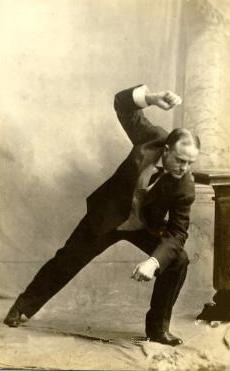
By 1917, Sunday was 65 years old and the most popular religious voice in America. He traveled with his wife Helen — and a staff of over 35 people — to many major cities in the United States in high profile spiritual ‘campaigns’. In an era without microphones and sound systems, Sunday electrified audiences with hyperactive body movements, violent eruptions of fire and brimstone, and elaborate presentations featuring ecstatic choirs and even chair smashing.

Chair smashing? Of course New Yorkers were excited. Sunday pulled into Penn Station on April 1917, for a series of highly publicized revivals that would run ten weeks. His arrival in a private Pullman car was greeted by almost five thousand people.

Sunday at first didn’t care for New York — calling it a ‘graveyard for evangelism’ — but New Yorkers certainly loved their Billy, as evidenced in the photo above. Eventually Sunday came to appreciate the New Yorker as well: “I think New Yorkers are keener than country folk. They are more used to seeing and hearing new things; they catch on quicker. I couldn’t give them any Class B stuff; not even when I was tired or wanted to.”

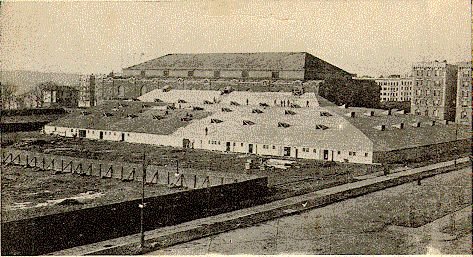
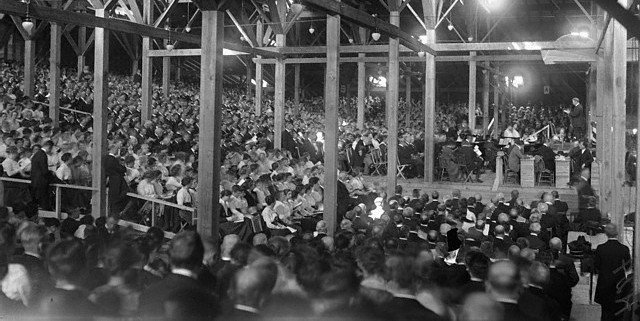
Sunday actually had his very own temporary tabernacle built for him, on Broadway and 168th Street (See below), on the site of Hilltop Park, former home of the New York Highlanders (later to become the New York Yankees). Sunday’s wife had spent the months before her husband’s arrival rallying the attentions of New York’s wealthiest businessmen, including John D. Rockefeller Jr., to assist in building the 16,000-seat arena.

The Sunday tabernacle was specially built “to fit his voice,” according to the New York Times, and also included a private bath for the preacher, “as the physical exertion of his speaking compel him to make an entire change of clothing after each service.”

From April 8 until June 19, 1917, Sunday engaged thousands with his messages and wild, half crazed performances. Naturally one of his pet causes was temperance; within two years, Congress would prohibit the sale of alcohol with the Eighteenth Amendment, something Sunday was instrumental in promoting.

Also factoring into Sunday’s success: America entered World War I that April, fueling attendance records. “If Hell could be turned upside down, you would find stamped on the bottom ‘Made in Germany,” he famously cried from the pulpit.

Sunday’s final assessment of the city: “New York has shown me that its Great White Way is not the pathway to hell that many believe. I know that many who walk the pavements of Broadway are as close to God as I am.”

New York was the culmination of Sunday’s success. America would swiftly outgrow Sunday’s hammy style by the 1920s and he would soon return to small town chapels and backwoods revival tents.

Of course, New Yorkers haven’t lost their interest in high-profile religious figures. Ninety-two years after Sunday took to a former Yankees playing field, pastor and author Joel Osteen comes to town on April 25th … rallying his flock at the new Yankees Stadium.

BELOW: Billy in his New York tabernacle on Palm Sunday