With a new mayoral race on the horizon in New York City we think its time that you Know Your Mayors! Become familiar with other men who’ve held the job, from the ultra-powerful to the political puppets, the most effective to the most useless leaders in New York City history.
This longtime feature of this website is being rebooted with new articles and newly researched and refreshed earlier entries in this series. Check back each week for a new installment.
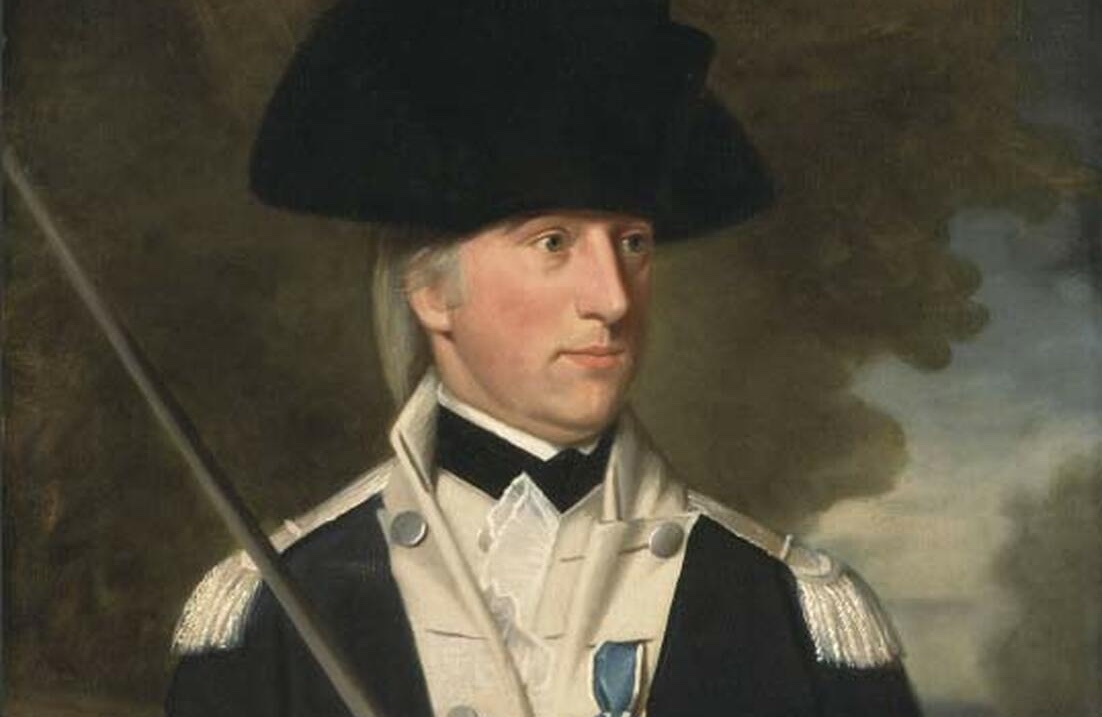
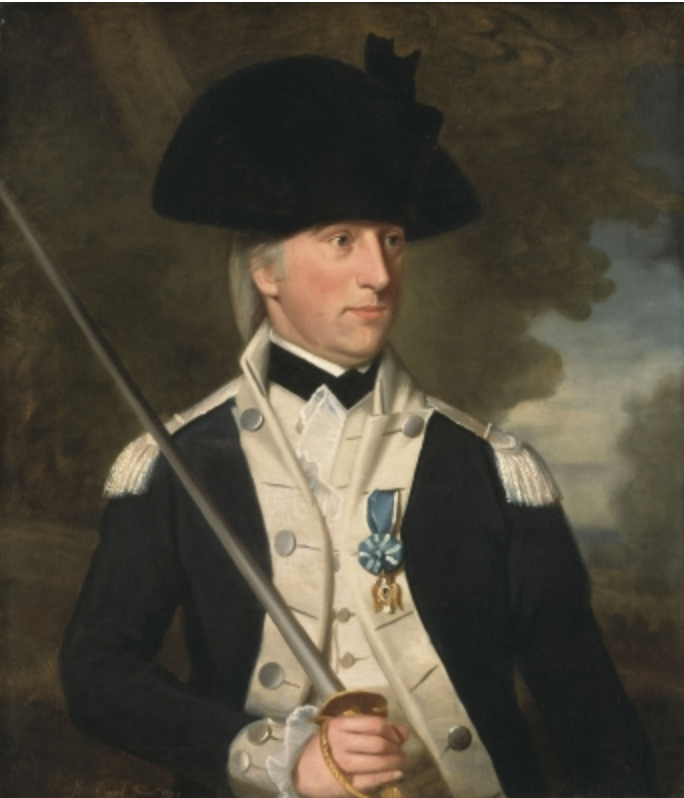
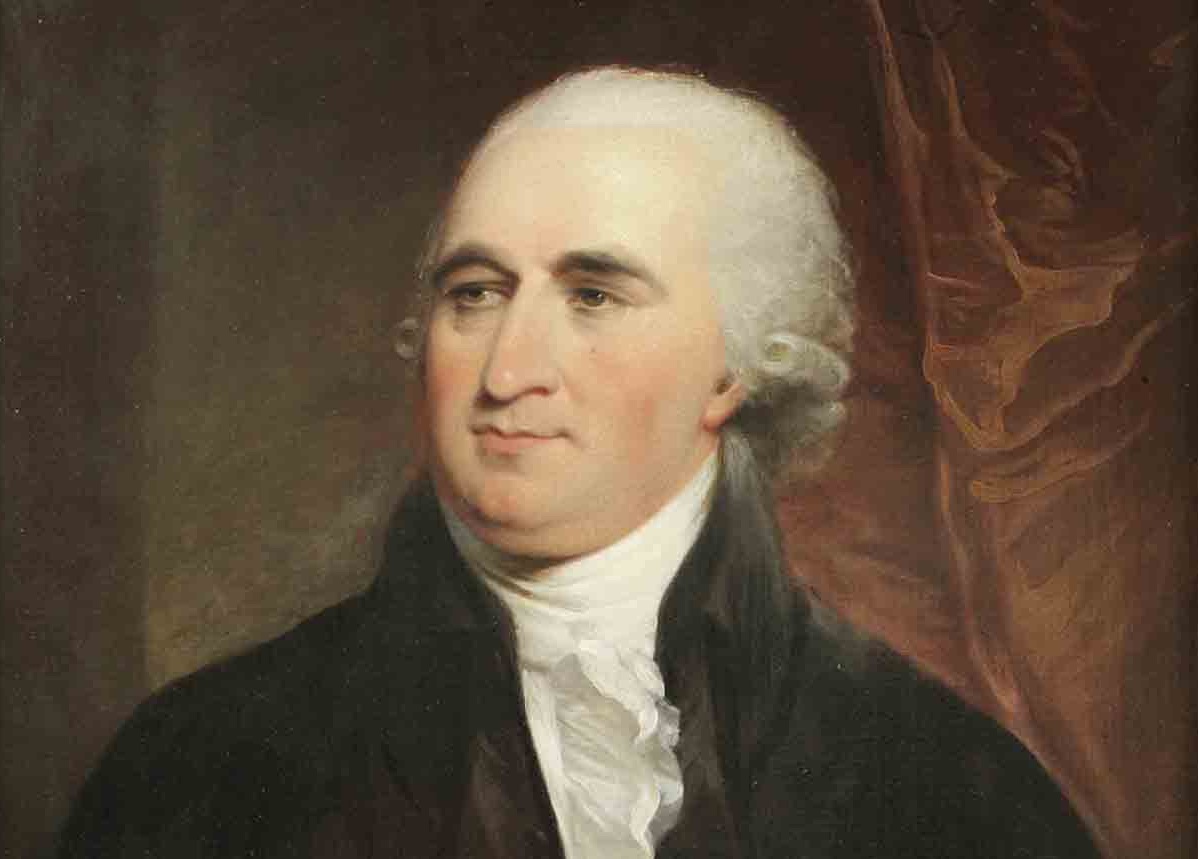
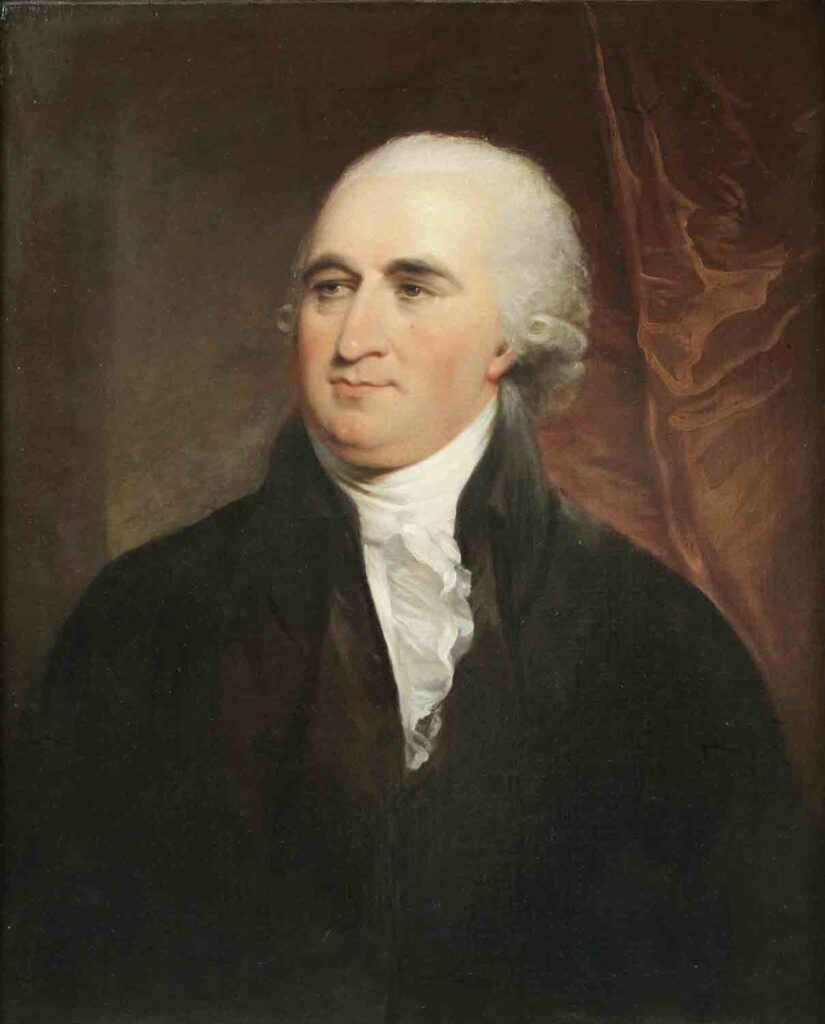
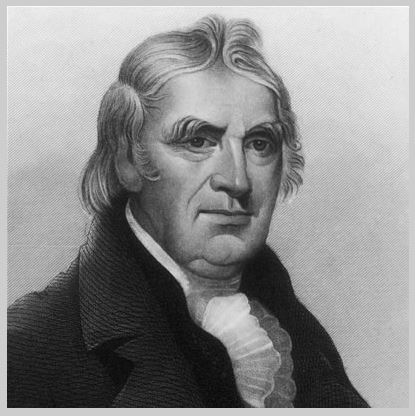
Richard Varick Term: 1789-1801 The Federalist Mayor
La Guardia Airport. Van Wyck Expressway.The Ed Koch Queensboro Bridge. Duane Street.
While most old mayors of New York City fade into obscurity, a few leave their legacies on landmarks and street names.
In Lower Manhattan lies little Varick Street, linking the West Village to Tribeca. Drivers entering the Holland Tunnel are very familiar with Varick Street. It’s named for the man who once owned property here — Richard Varick.
He served as mayor of New York City for eleven consecutive terms — one year terms, from the fall of 1789 to 1801, making him the first New York mayor of the 19th century.
Biographer Paul Cushman calls Varick a “forgotten Founding Father” of the United States, an officer in the Continental Army and confidante of George Washington.
But perhaps his legacy had been slightly tarnished by another close association — with Benedict Arnold.
Richard Varick, born in Hackensack, NJ, on March 15, 1753, was the descendent of Dutch settlers, and his family history is deeply intertwined with that of early colonial New Jersey.
Richard’s fate would lie in New York where he would get his law degree in 1774 at King’s College (Columbia University), naturally becoming compatriots with those who would become revolutionaries against the British Crown.
Varick had a virtually unblemished military record during the Revolutionary War but for one unfortunate association.
During the early days of battle he served as secretary to General Philip Schuyler, later father-in-law to Varick’s friend Alexander Hamilton. He swiftly moved on as inspector-general of the newly formed military base at West Point (it wouldn’t become a military academy until 1802) where he would become entangled with a potential political albatross — Benedict Arnold.
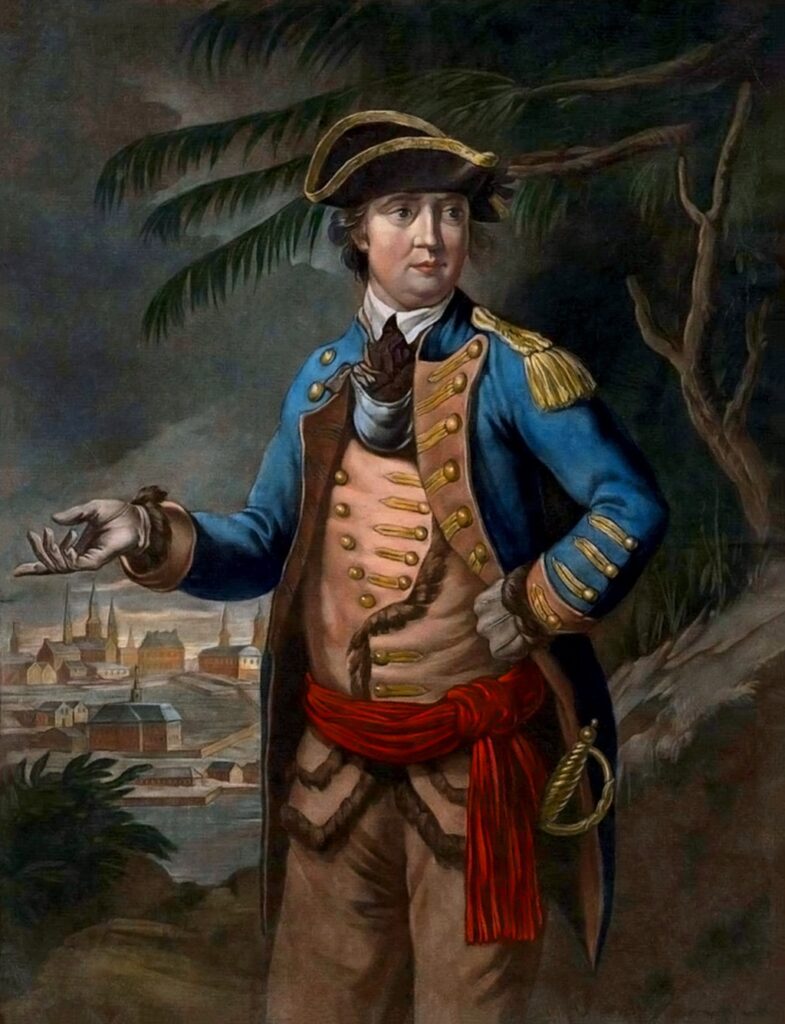
Arnold in a 1776 painting by Thomas Hart
Serving as Arnold’s loyal aide-de-camp, he was unaware that his friend was selling West Point — and the American cause — down the river, plotting to trade the base’s secrets to the British.
Arnold’s treachery was found out, and it comes as no surprise that Varick too was suspected of treason, but was later exonerated. The stench of rumored betrayal was alleviated when Varick was appointed Washington’s personal secretary in the later days of the Revolutionary War.
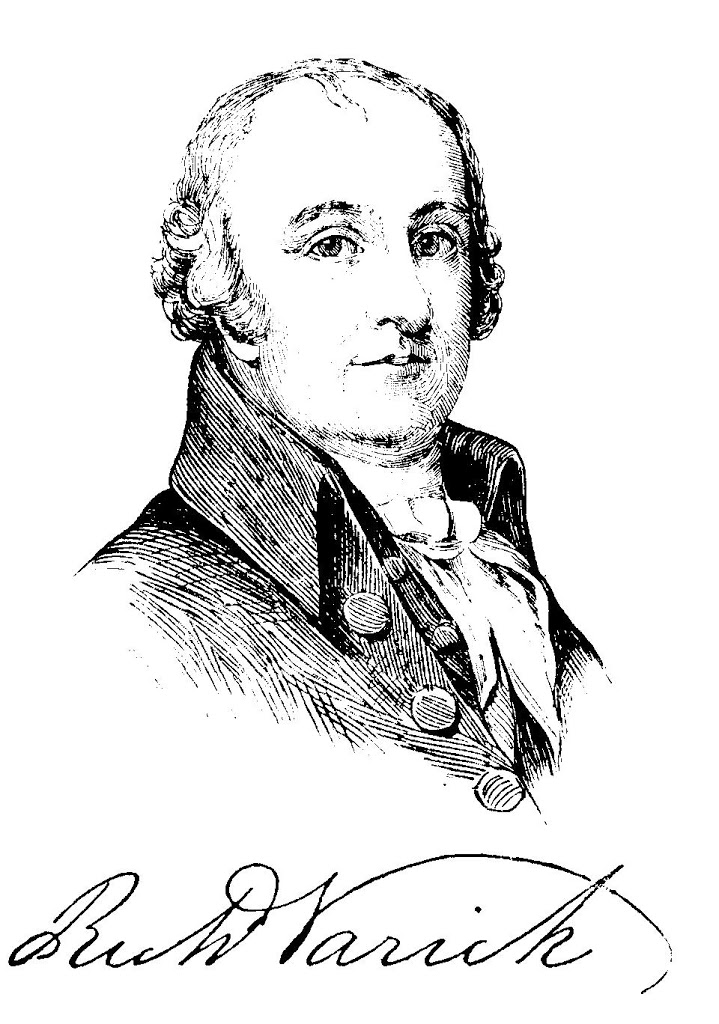
Varick and his signature
The Ultimate Multi-tasker
Not one to let one sticky political association bog him down, Varick was appointed a recorder of New York City once the British were swept out of town. But that’s not all.
In those days, with so many positions in the newly formed government and so few men with experience, Varick soon held other jobs concurrently — including speaker of the New York State assembly and even the state attorney general!
“A simple explanation of the prevalence of a few public-spirited civic servants holding multiple offices in these times,” writes Paul Cushman, “might relate to the fact that these were unusual and non-recurring moments in the development of government. The offices in the evolving government were still quite malleable. “
The amount of ink and parchment used by Varick in these various jobs — not to mention his wartime correspondence — must have been astounding. Indeed forty-four folio volumes known as the Varick Transcripts, collecting his various papers from 1775 to 1785 (including his correspondence with Washington), are housed at the Library of Congress.
But in 1789 came his most intriguing government appointment — mayor of New York, a role in which he was appointed eleven consecutive times by the Council of Appointment. (Previous mayor James Duane stepped down to become a judge. See the previous article of Duane for a breakdown on the appointment process.)
How could one man with so many jobs take on this responsibility as well? Cushman explains: “A part-time occupant as mayor, not yet burdened with a host of defined civic duties or a subordinate staff to manage, could carry out several tasks simultaneously, with the mayoral duties being just one of many.“
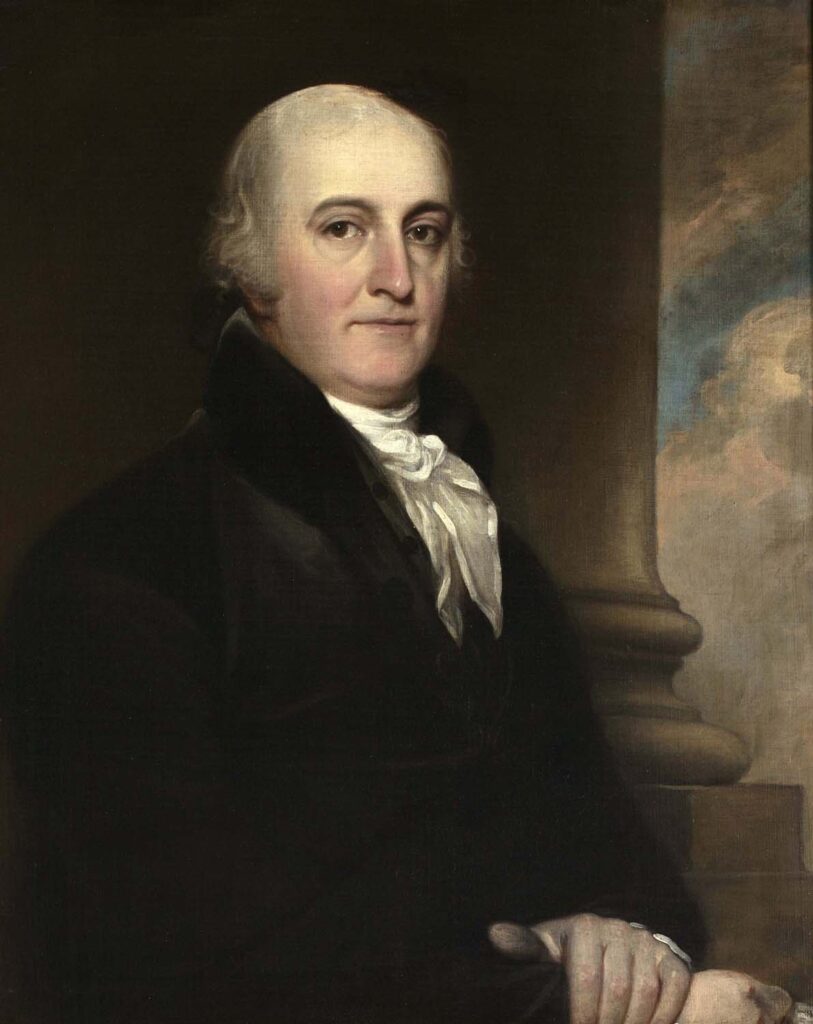
Richard Varick, in an 1805 painting by John Trumbull
A City In Crisis
The city population doubled under his administration, so naturally basic civic neccessities like water and disease control became the focus of his attentions. So what were his governing views?
Like Hamilton and John Jay, Varick was a staunch Federalist, believing in a strong centralized government and a robust national banking system. Federalists were also aristocratic and often elitist, and Varick was frequently at odds with the city’s rising artisan class who favored the more democratic leanings of national politicians like Thomas Jefferson and James Madison.
Varick used his position to punish anti-Federalist New Yorkers. In 1791 he threatened to revoke the licenses of any cartmen who voted against Federalist candidates in future elections.
In fact, due to his support of the quite unpopular Jay Treaty in 1794, the “arrogant and elitist” Varick was almost literally driven out of City Hall by a mad riot.
His political posturing insured that New Yorkers would never really like Varick. Still he continued to be appointed to the job year after year — by both Republican governors (George Clinton) and Federal ones (John Jay), most likely based on his reputation during the war.
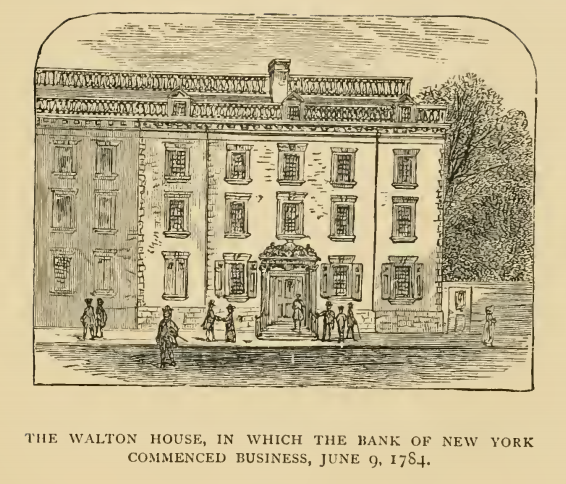
The political bickering between factions failed to stunt the growth of the city, both in terms of its physical size and its prominence as the financial center of the new nation, of which Varick played no small part. (He was the director of a few small fledgling banks, including Alexander Hamilton’s special project the Bank of New York.)
Another change during Varick’s term would alter the course of New York politics forever.
In 1797, New York state government responsibilities moved out of the city to Albany, allowing the city bureaucracy to grow but setting the stage for future animosities between state and local leaders. In other words, the roots of Andrew Cuomo vs. Bill De Blasio begin here.
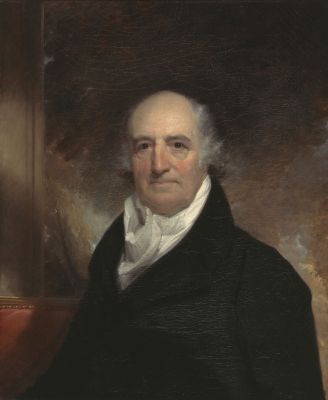
Painting by Henry Inman
Founding Father of Jersey City
With the ascent of the Democratic-Republican Thomas Jefferson to nationwide office, Federalists were on the wane, and Varick was replaced by the more amenable Edward Livingston.
Varick, on the outs in New York, returned to New Jersey where he helped found Jersey City. Varick died there on July 30, 1831. For the residents of NJ’s second-largest city, Varick is most certainly not forgotten.
And thousands everyday take lower Manhattan’s Varick Street to the Holland Tunnel which arrives on its New Jersey side into the city which Varick founded.
This article is newly written and expanded from an earlier version published in 2007.
With a new mayoral race on the horizon in New York City we think its time that you Know Your Mayors! Become familiar with other men who’ve held the job, from the ultra-powerful to the political puppets, the most effective to the most useless leaders in New York City history.
This longtime feature of this website is being rebooted with new articles and newly researched and refreshed earlier entries in this series. Check back each week for a new installment.
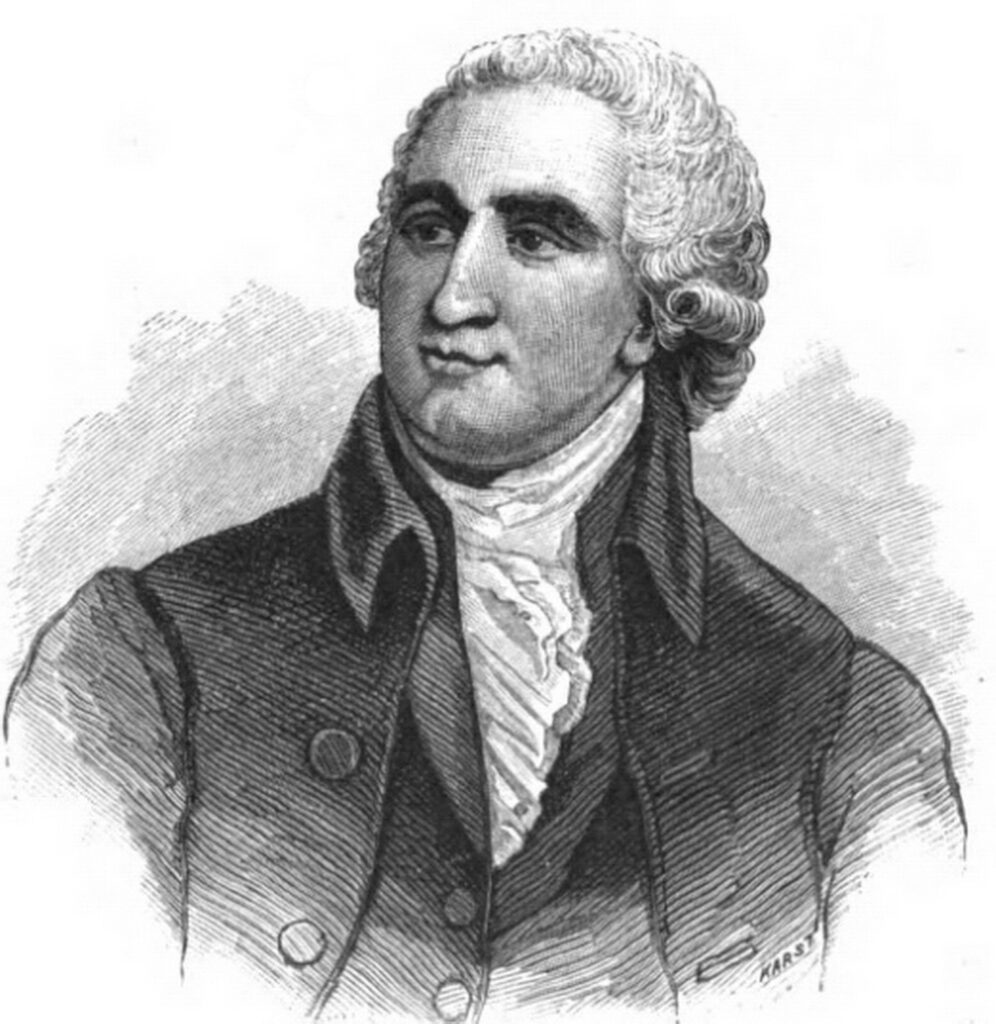
James Duane Term: 1784-1789 The First Post-War Mayor
New York officially had 44 men prior to James Duane filling the seat of city mayor in 1784. So why do I consider Duane New York City’s official first mayor?
Although America declared its independence from England in 1776, England did not declare its independence from New York City until 1783, when they were driven out at the end of the Revolutionary War.
British appointed mayor David Mathews governed Manhattan throughout the entire war until he and other Loyalists fled to Canada in the conflict’s waning days. Which is probably a good thing since he was implicated in a specific attempt to kidnap and murder the commander of the Continental Army George Washington.
Duane is the first American New York mayor, the first to lead the city newly broken from its colonial shackles.
However, it should be noted that he is not New York’s first elected mayor. Like the many mayors of the Colonial era before him — and the many men who would hold this office well into the 19th century — James Duane was appointed to the job.
James Duane, born in New York in 1733, was destined for great things, a respected attorney and statesman who would become what we might call a minor Founding Father.
Orphaned as a teen, young Duane became the charge of Robert Livingston, a prominent lawyer in a socially important New York family. Naturally he pursued a career in law as well, his natural skills bolstered by his social privilege.
In 1759 Duane married Robert’s daughter Mary Livingston and would grow up alongside Robert Jr. who would go on to draft the Declaration of Independence. Through tenacity, family wealth and de facto family influence through the Livingstons, Duane became New York state attorney general at age 34.
Duane was also part of New York’s delegation to the First Congressional Congress in 1774, alongside John Jay and another Livingston, Philip, who would eventually sign the Declaration of Independence. (Duane, alas, was serving in New York’s Provincial Congress in the summer of 1776 or else he too would have John Hancock’d the founding document.)
Duane had originally agreed with general notions of appeasement with the British, not favoring a separation from England.
In fact author Edward P. Alexander calls him a ‘moderate rebel‘. “Duane strove with common sense and moderation to cling to the golden mean which would protect gentlemen of his station from both British taxation and domestic social upheaval.”
In other words he was for the cause of American liberty but not all that rabblerousing.
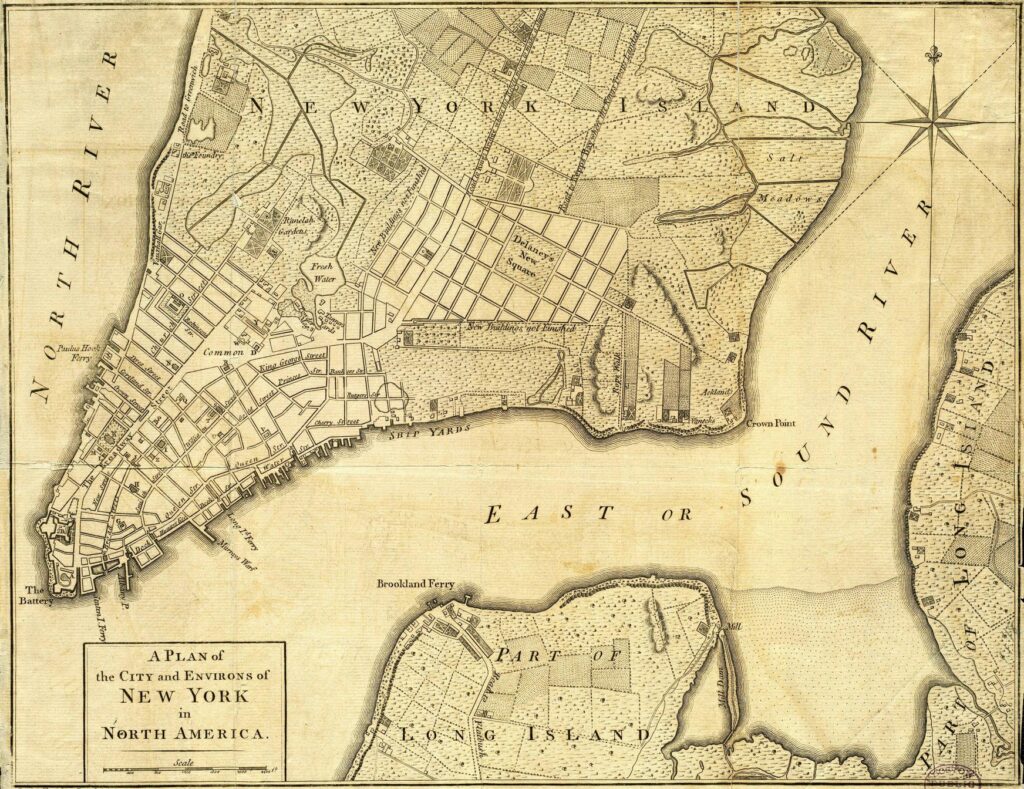
James Duane’s New York City, 1776
Regardless, he would be a member of Second Continental Congress all the way through the end of the war and on behalf of New York would even be a signer of the Articles of Confederation, precursor to the Constitution.
During the British occupation of New York, Duane lived at Livingston Manor, a vast estate which today includes modern-day Livingston, New York.
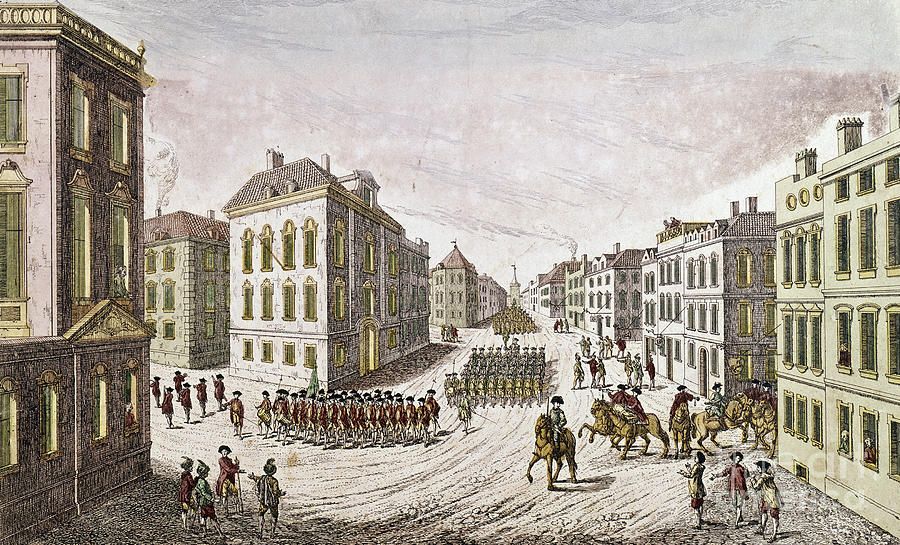
New York during British occupation 1776
Its Loyalists freshly evacuated, the city needed a new leader.
In 1784 Duane was appointed Mayor of New York by a slate of state officials called the Council of Appointment, led by Governor George Clinton.
This council didn’t just select the city’s mayors; it selected every office in the state. It would be decades before mayors were actually elected into office by the people.
Duane moved his family to a family estate right outside the city — a farm that would become Gramercy Park thirty years after his death.
“In a letter of James Duane to his wife, after the Revolution, he alludes to this farm and the beautiful grounds with the fish pond and fountains. The house having been occupied by British officers during the War the letter says ‘you will find the cellars in most excellent condition and the wine bins in good repair, the house has suffered but little.’“
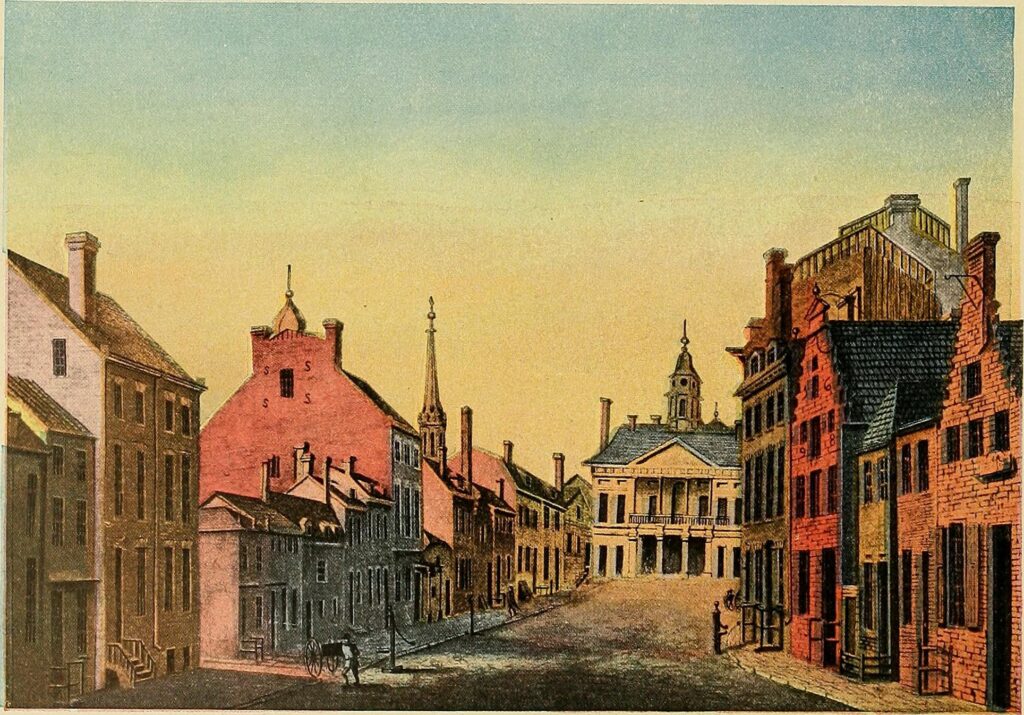
City Hall became Federal Hall.
The new mayor oversaw a massive shift in Manhattan’s well-being; while the evacuation of the British and their sympathizers left a serious economic vacuum, the city also took its first steps win defining its urban character.
In fact Duane’s legacy as mayor would be largely overshadowed as the foundations of the United States were built around him.
City Hall would become Federal Hall in these years and the overcrowded government building — over 75 years old already by the time Duane took office — was hastily enlarged in 1788 to accommodate these extra politicians.
Angry New Yorkers storm the hospital. Wood engraving by William Allen Rogers
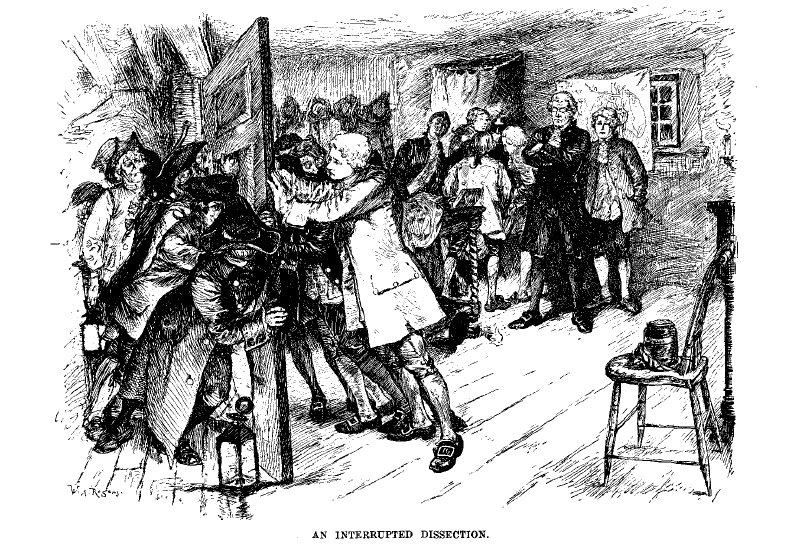
Meanwhile in the spring of that year, Duane intervened in one chilling incident involving grave robbers and medical students at New York Hospital, an incident today known as the Doctor’s Riot.
An angry mob, enraged that the local cemetery had been pillaged for cadavers, stormed the hospital and, eventually, Columbia College. Several officials, including Duane, urged restraint. When the mob attacked the officials — injuring John Jay in the process — Duane took action.
According to Gotham by Edwin G. Burrows and Mike Wallace, “Duane summoned a troop of militia to disperse the crowd and was met with another shower of missiles. Baron von Steuben, also struck in the head and bleeding profusely, shouted, ‘Fire, Duane! Fire!’ Duane, or perhaps [Governor] Clinton, gave the order. The first volley killed three rioters outright and wounded many others. Before a second could be fired, the crowd had scattered.“
Governor George Clinton who possessed most of the power in post-Colonial New York.
While Duane threw himself into the job — he was praised by his critics for his charity and “good judgement” — his power was limited. Governor Clinton and his Common Council (an early version of City Council) controlled his salary and could veto his decisions on a whim.
In 1785 he was also a founding member of the New-York Manumission Society, an abolition organization headed by John Jay that eventually included Alexander Hamilton and Governor Clinton.
This despite the fact that Duane would own at least one enslaved person after this date:
“His 1790 census record, in New York City, shows his family consisting of 2 Free White Males aged 16 and older, 2 FWM under 16, 6 Free White Females, and 1 slave.” [wiki]
(Most of the members were slaveholders including Jay and Clinton. In 1799, Jay, as governor of New York, would sign the Act for the Gradual Abolition of Slavery into law.)
James Duane — February 6, 1773 – February 1, 1797
By the end of administration in 1789, Duane was governing over a city of 25,000 citizens. After the wounds of war, New York was at last recovering.
After Duane’s five one-year terms, the mayor’s seat went to another attorney with even greater ties to the Revolutionary War — Richard Varick.
Duane’s next appointment was more prestigious — one of the nation’s first federal judges on US Circuit Court in New York, nominated for the position by President George Washington himself. (It helped to rub elbows with the new president in the cramped quarters of Federal Hall.)
Duane died on February 1, 1797, on an inherited land grant in upstate New York that he had developed into a township and where he spent his final years. Its name, appropriately, is Duanesburg.
Most New Yorkers are familiar with James Duane today — not for his accomplishments but for the street named after him. Duane Street runs through lower Manhattan today just a couple blocks north of today’s City Hall.
The drug store Duane Reade takes its name from Duane Street.
This article is based on an original post from December 2007.
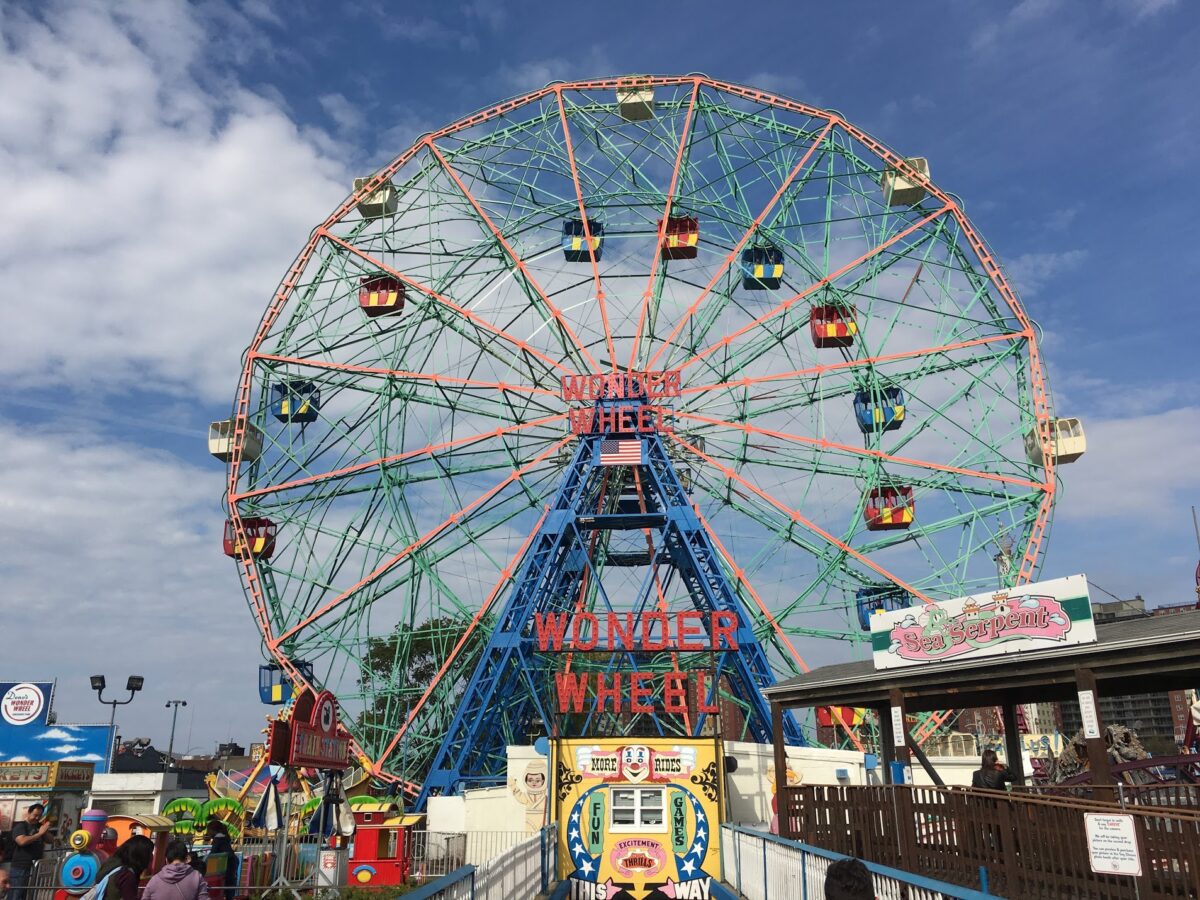
PODCAST Coney Island is back! After being closed for 2020 due to the pandemic, the unusual attractions, the thrilling rides and stands selling beer and hot dog have finally reopened.
So we are releasing a very special version of our 2018 show called Landmarks of Coney Island — special, because this is an extended version of that show — an extended remix, if you will — featuring the tales of two more Coney Island landmarks which were left out of the original show.
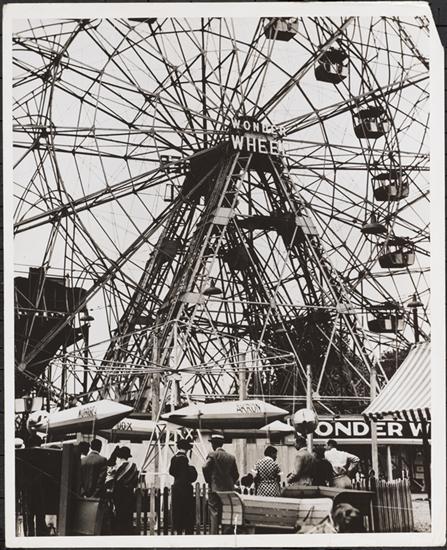
And this episode is dedicated to the Wonder Wheel which was to celebrate its 100th year of operation last year. So go show them some love this year!
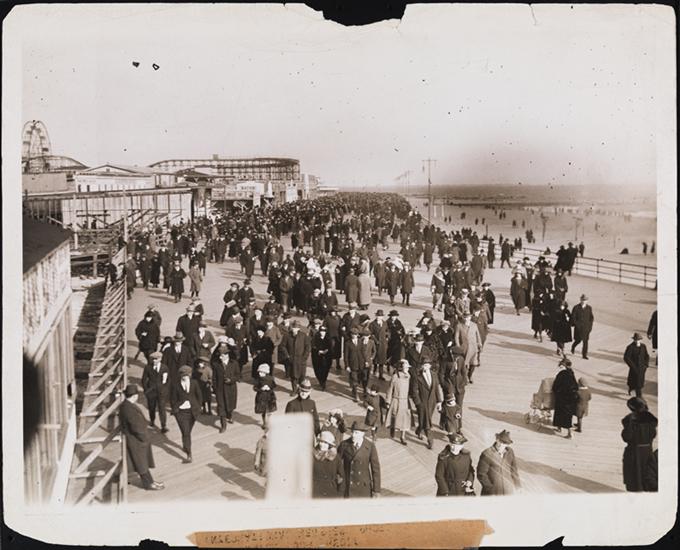
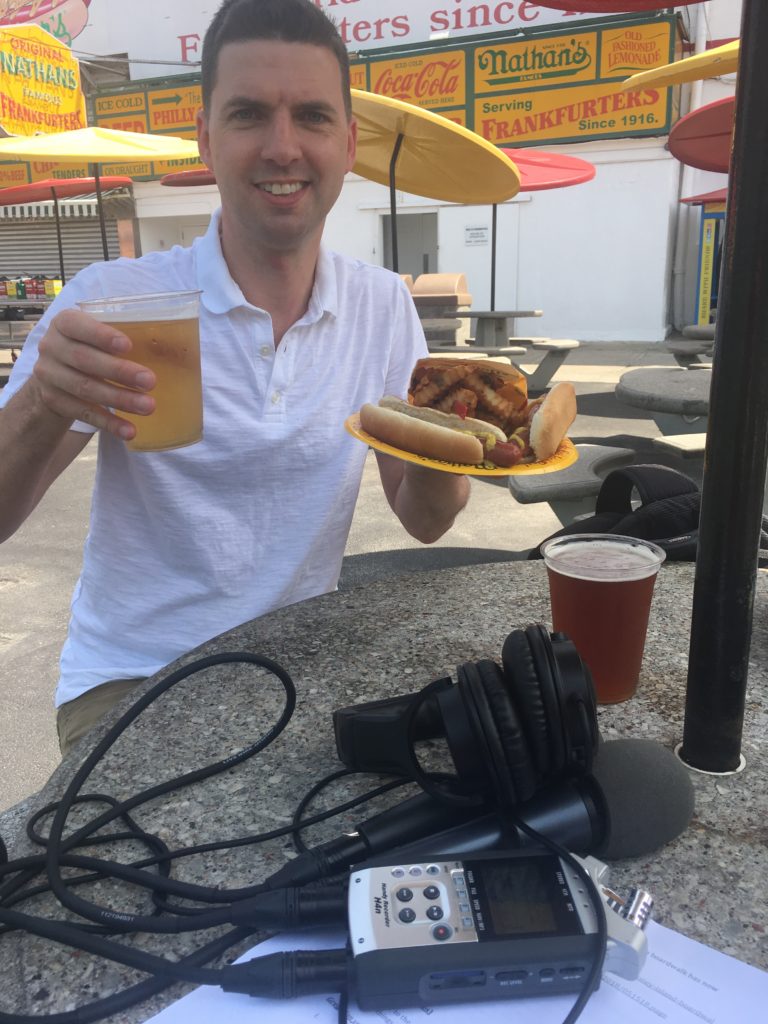
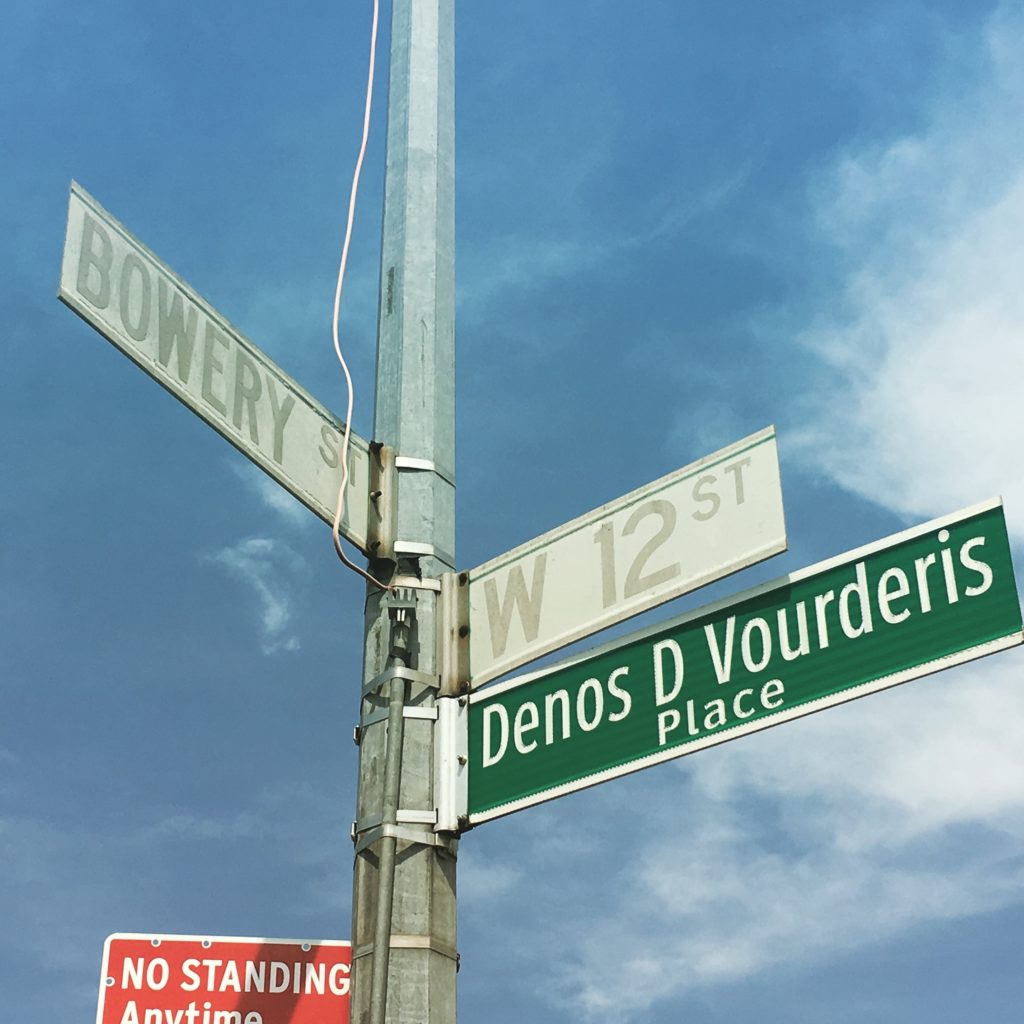
The Coney Island Boardwalk — officially the Riegelmann Boardwalk — became an official New York City scenic landmark in 2018, and to celebrate, the Bowery Boys are headed to Brooklyn’s amusement capital to toast its most famous and long-lasting icons.
Recorded live on location, this week’s show features the backstories of these Coney Island classics:
— The Wonder Wheel, the graceful, eccentric Ferris wheel preparing to celebrate for its 100th year of operation;
— The Spook-o-Rama, a dark ride full of old-school thrills;
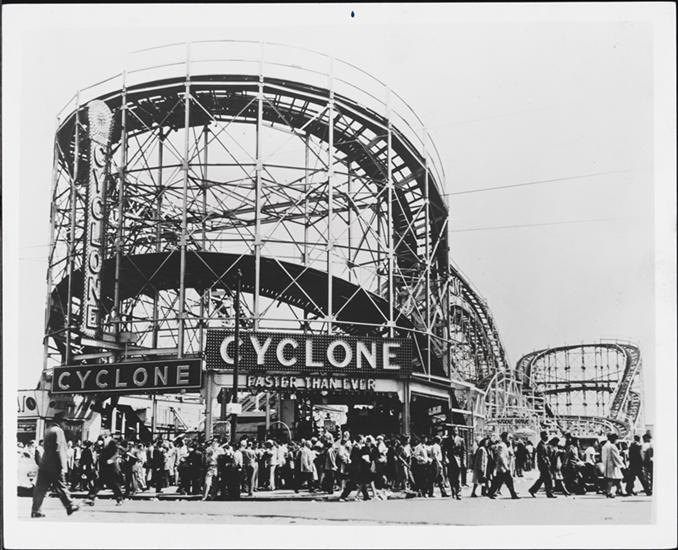
— The Cyclone, perhaps America’s most famous roller-coaster with a history that harkens back to Coney Island’s wild coaster craze;
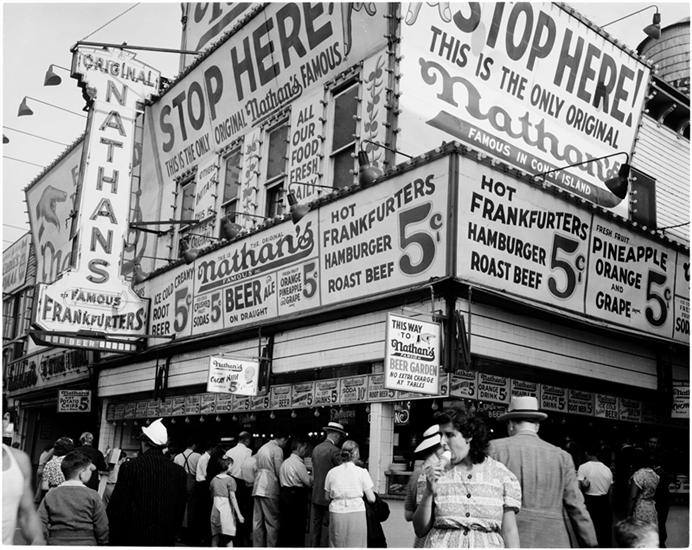
— Nathan’s Famous, the king of hot dogs which has fed millions from the same corner for over a century;
— Coney Island Terminal, a critical transportation hub that ushered in the amusement area’s famous nickname — the Nickel Empire
PLUS: An interview with Dick Zigun, the unofficial mayor of Coney Island and founder of Coney Island USA, who recounts the origin of the Mermaid Parade and the Sideshow by the Seashore
Listen Now: Landmarks of Coney Island (Extended Funhouse Mix)
Here are the seven official landmarks within the old Coney Island amusement area.
1) Coney Island Boardwalk
Museum of the City of New York
2) Wonder Wheel
1944, Museum of the City of New York
3) The Cyclone
1935, Courtesy Museum of the City of New York
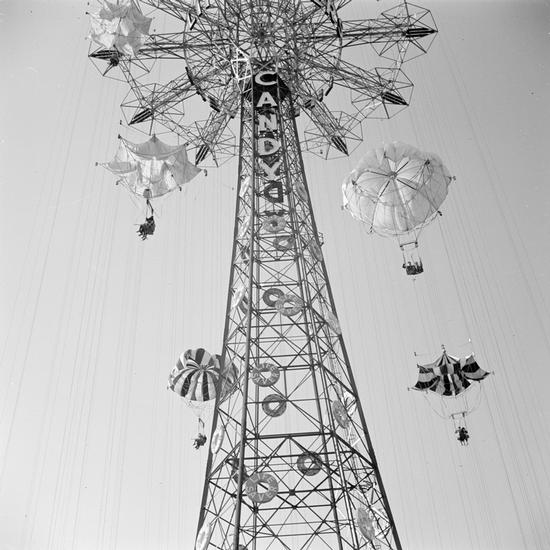
4) Parachute Jump — pictured here at its original home at the 1939 New York World’s Fair at Flushing Meadows
Wurts Brothers, courtesy Museum of the City of New York
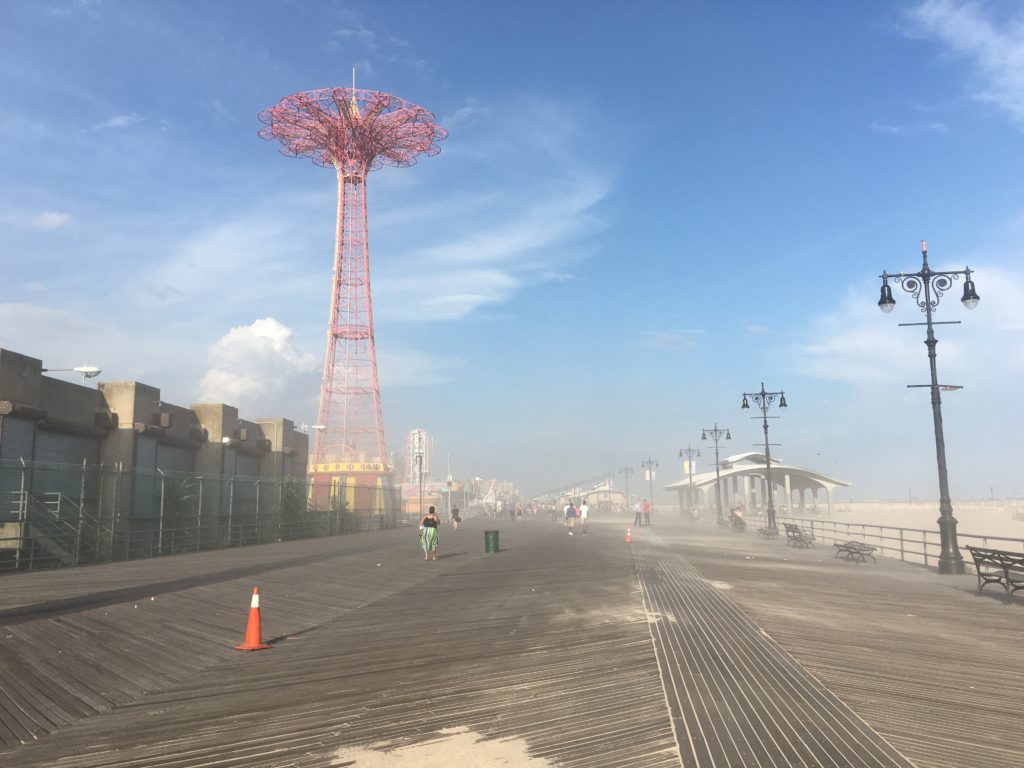
The Parachute Jump and the boardwalk on a windy summer’s day in 2017.
Greg Young
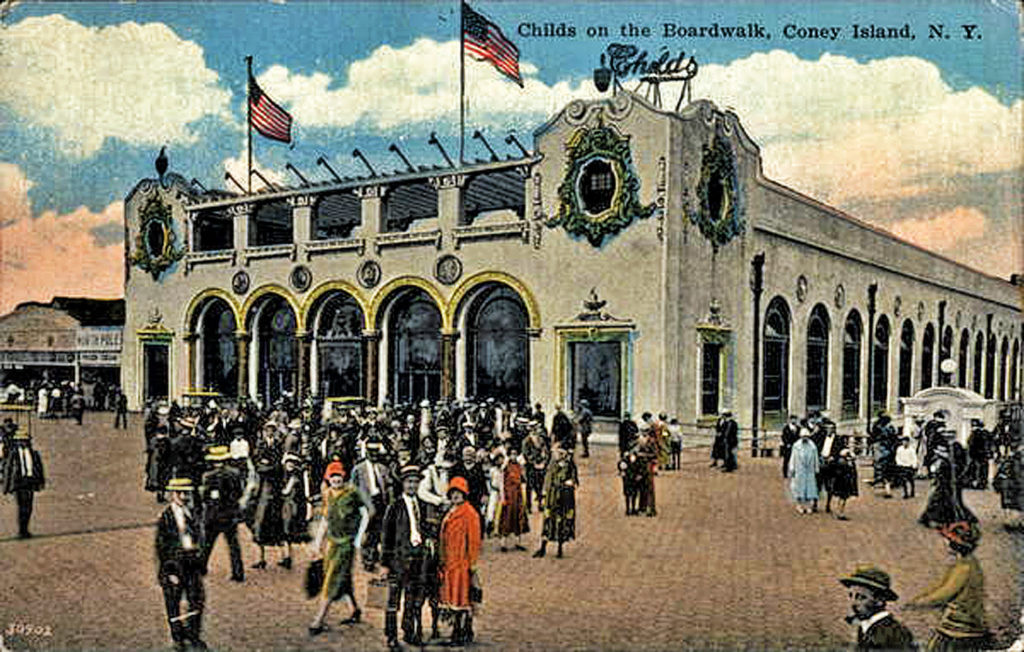
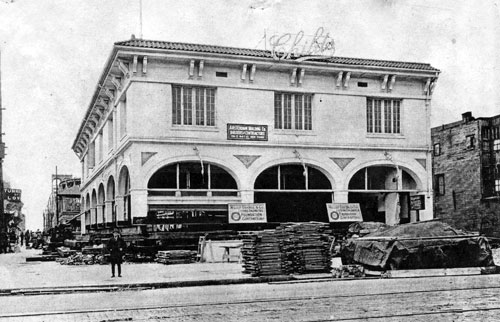
5) Childs Restaurant on the Boardwalk
Forgotten NY
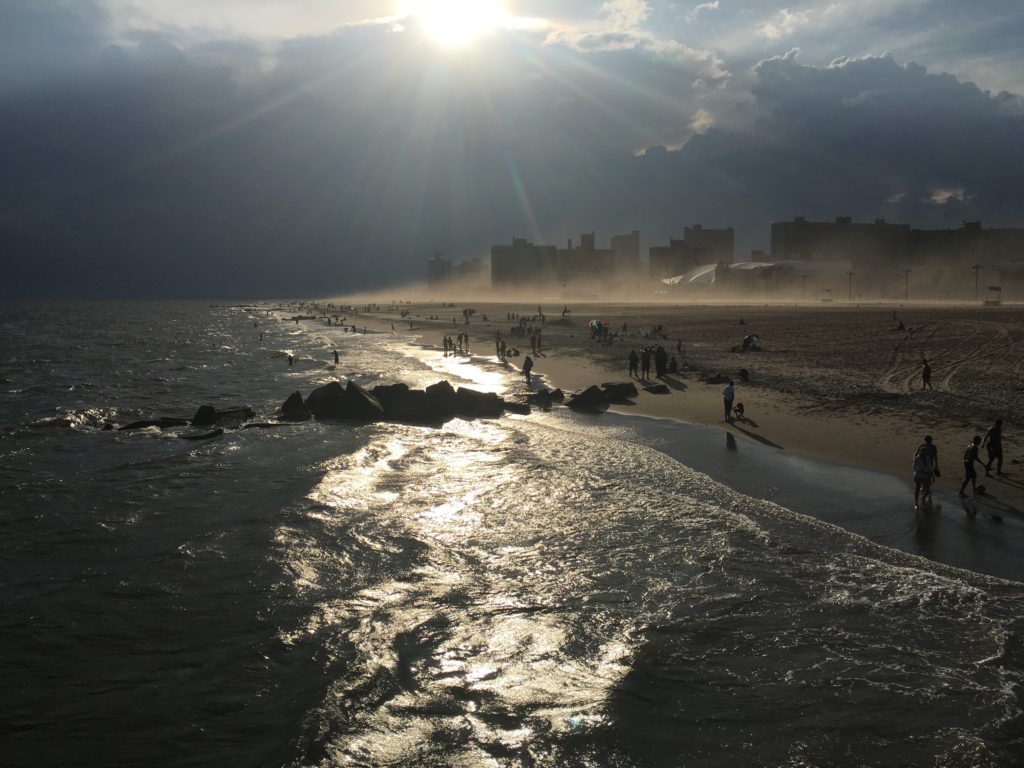
A nice hazy day in 2017. The former Childs Restaurant can be seen in the distance. This image was taken from the Steeplechase Pier.
Greg Young
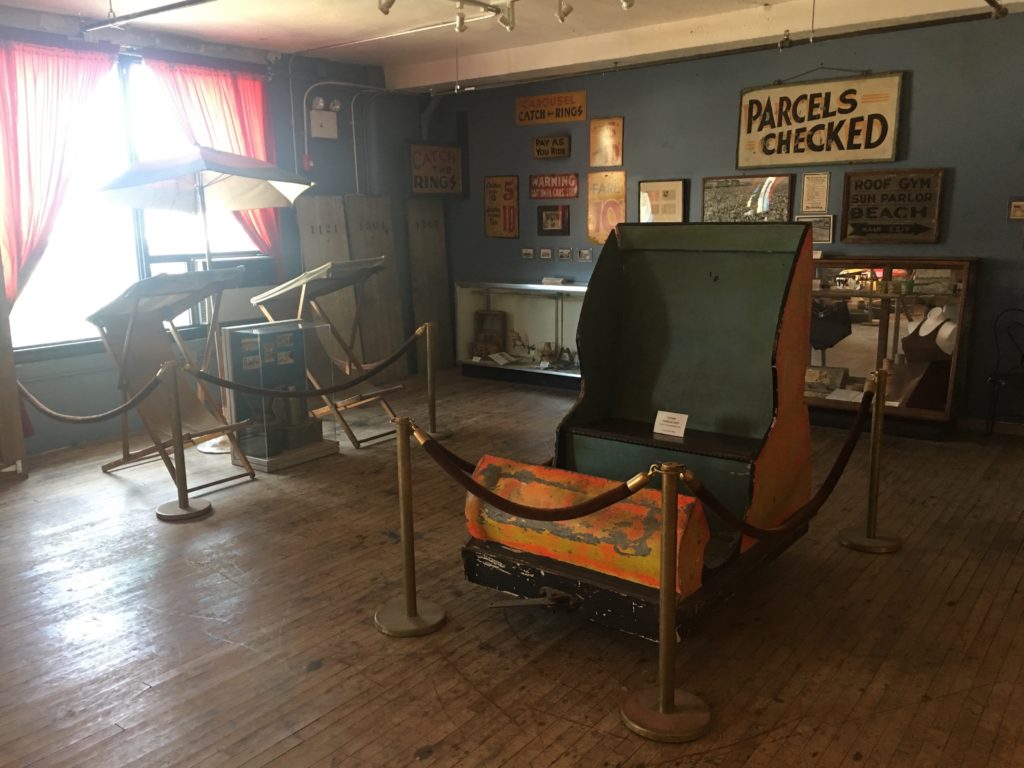
6) Childs Restaurant on Surf Avenue (now the home of the Coney Island Museum)
Courtesy Alex Rush
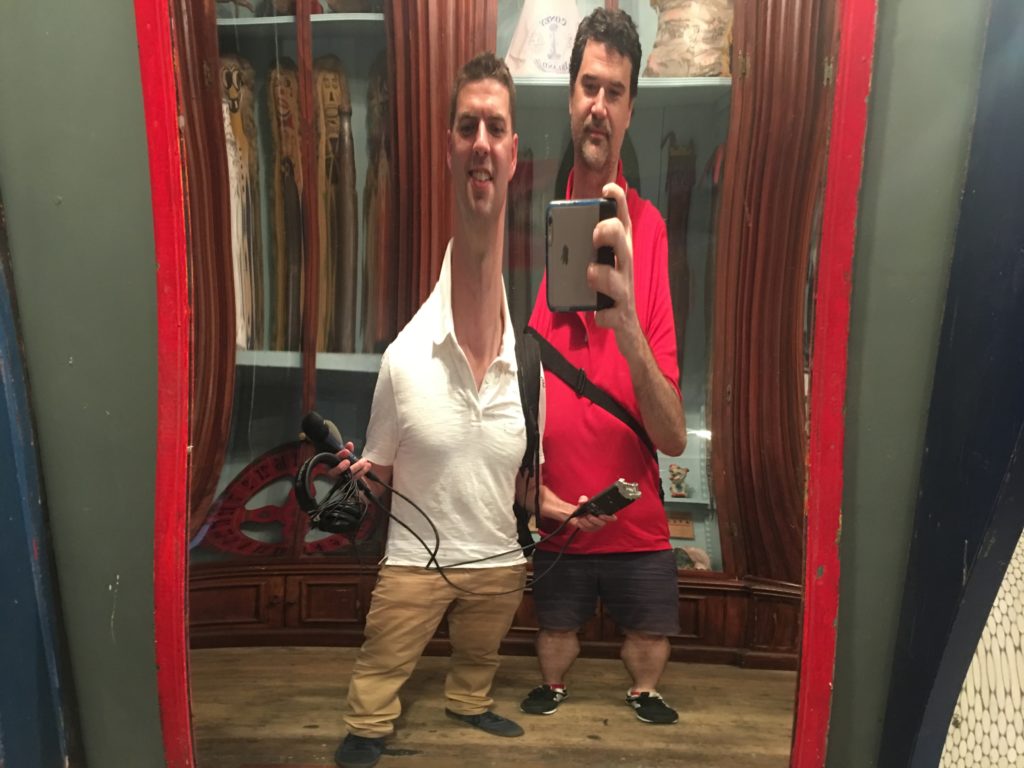
Inside the museum:
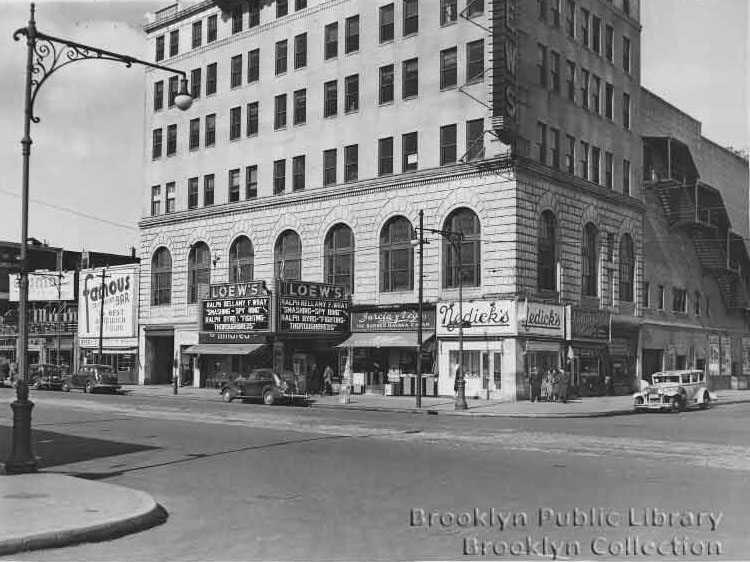
7) Shore Theatre on Surf Avenue
Brooklyn Public Library
And while Nathan’s Famous may not be a landmark, nobody can argue with the fact that its a genuine Coney Island classic.
1939, Andrew Herman Federal Art Project, Museum of the City of New YorkFrom our 2018 adventure through Coney Island
The Bowery Boys: New York City History podcast is brought to you …. by you!
We are now producing a new Bowery Boys podcast every other week. We’re also looking to improve and expand the show in other ways — publishing, social media, live events and other forms of media. But we can only do this with your help!
We are now a creator on Patreon, a patronage platform where you can support your favorite content creators.
Please visit our page on Patreon and watch a short video of us recording the show and talking about our expansion plans. If you’d like to help out, there are six different pledge levels. Check them out and consider being a sponsor.
We greatly appreciate our listeners and readers and thank you for joining us on this journey so far.
PODCAST: Dr. David Hosack was no ordinary doctor in early 19th-century New York.
His patients included some of the city’s most notable citizens, including Alexander Hamilton and Aaron Burr, both of whom he counted as close friends — and both of whom decided to bring him along to their fateful duel.
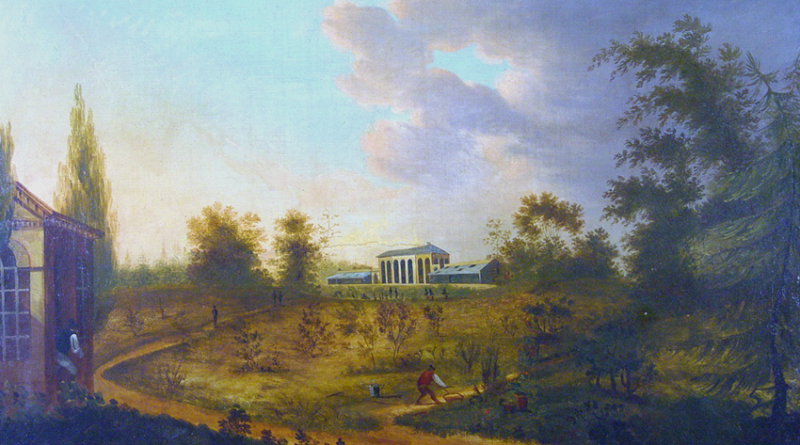
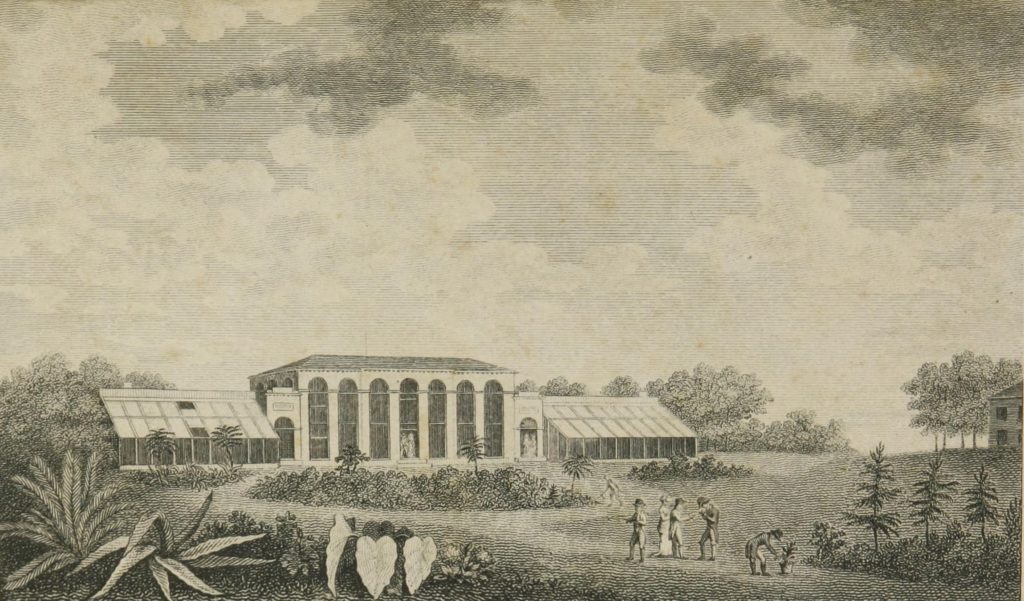
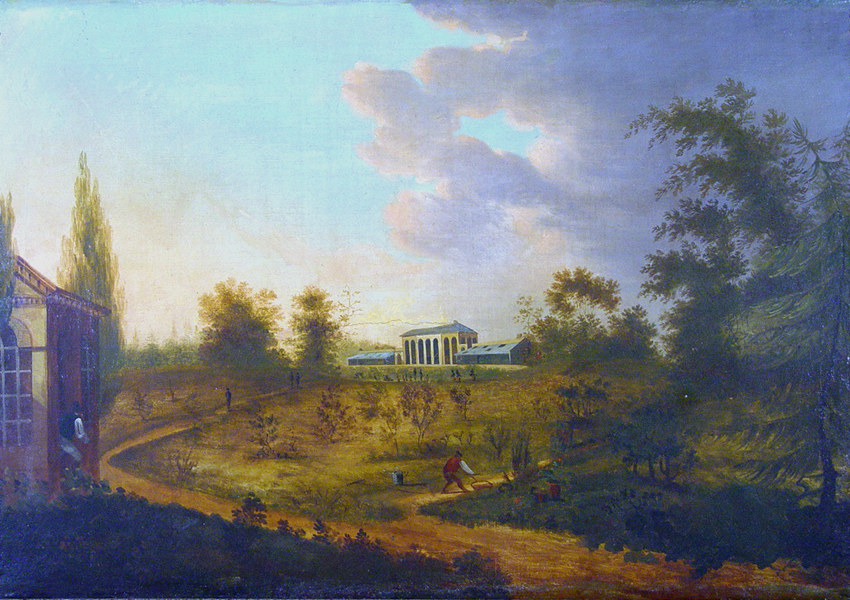
But it was Dr. Hosack’s love and appreciation for the field of botany that would eventually make him famous in his time. In 1801 he opened his Elgin Botanic Garden on 20 acres of land located three miles north of the city on Manhattan Island.
Engraving circa 1802 of a drawing by L. Simond, titled View of the Botanic Garden at Elgin in the vicinity of the City of New York, frontispiece of a pamphlet by David Hosack
In this first public botanical garden in the country, Hosack would spend a decade planting one of the most extraordinary collections of medicinal plants, along with native and exotic plants that could further the young nation’s agriculture and manufacturing industries.
And yet, he also spent a decade looking for funding for this important project, and for validation that this kind of work was even important.
Elgin Botanic Garden, painted in 1910, artist unknown
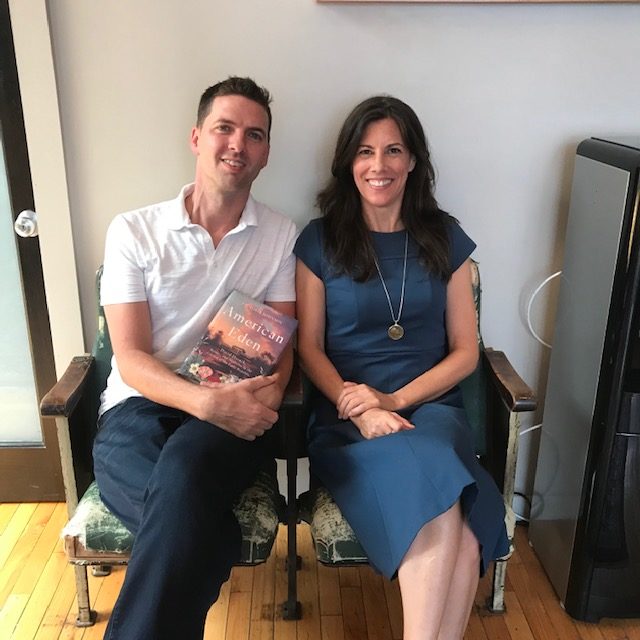
Tom and special guest Victoria Johnson with a copy of her book American Eden
PLACES TO VISIT
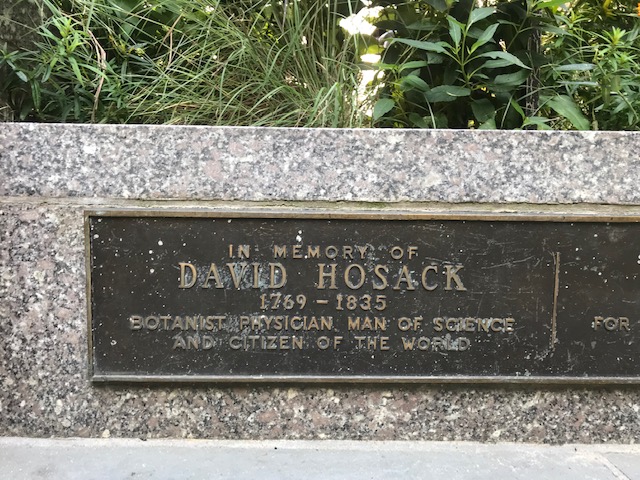
Rockefeller Center — See if you can find the plaque in honor of David Hosack and the Elgin Botanic Garden. It’s located along the way in the Channel Gardens.
FURTHER LISTENING:
Listen to these shows in our back catalog for more information on subjects mentioned in this show —
Our DeWitt Clinton and the Erie Canal show from many years ago gives further insight into the man much admired by Hosack, so much so that he wrote the man’s memoir
What was medical care like in the early 19th century? Look no further than our show on one of the most prominent medical institutions of the day — Bellevue Hospital:
The Bowery Boys: New York City History podcast is brought to you …. by you!
We are now producing a new Bowery Boys podcast every other week. We’re also looking to improve and expand the show in other ways — publishing, social media, live events and other forms of media. But we can only do this with your help!
We are now a member of Patreon, a patronage platform where you can support your favorite content creators.
Please visit our page on Patreon and watch a short video of us recording the show and talking about our expansion plans. If you’d like to help out, there are six different pledge levels. Check them out and consider being a sponsor.
And join us for the next episode of the Bowery Boys Movie Club, an exclusive podcast provided to our supporters on Patreon.
We greatly appreciate our listeners and readers and thank you for joining us on this journey so far.
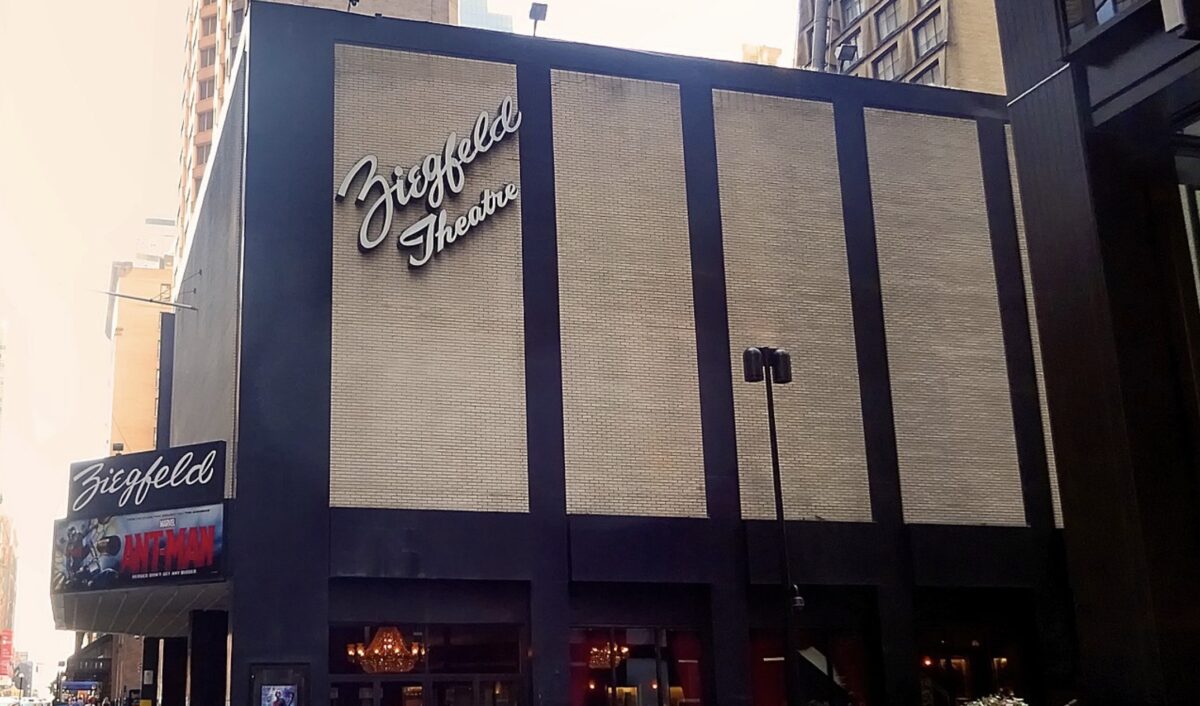
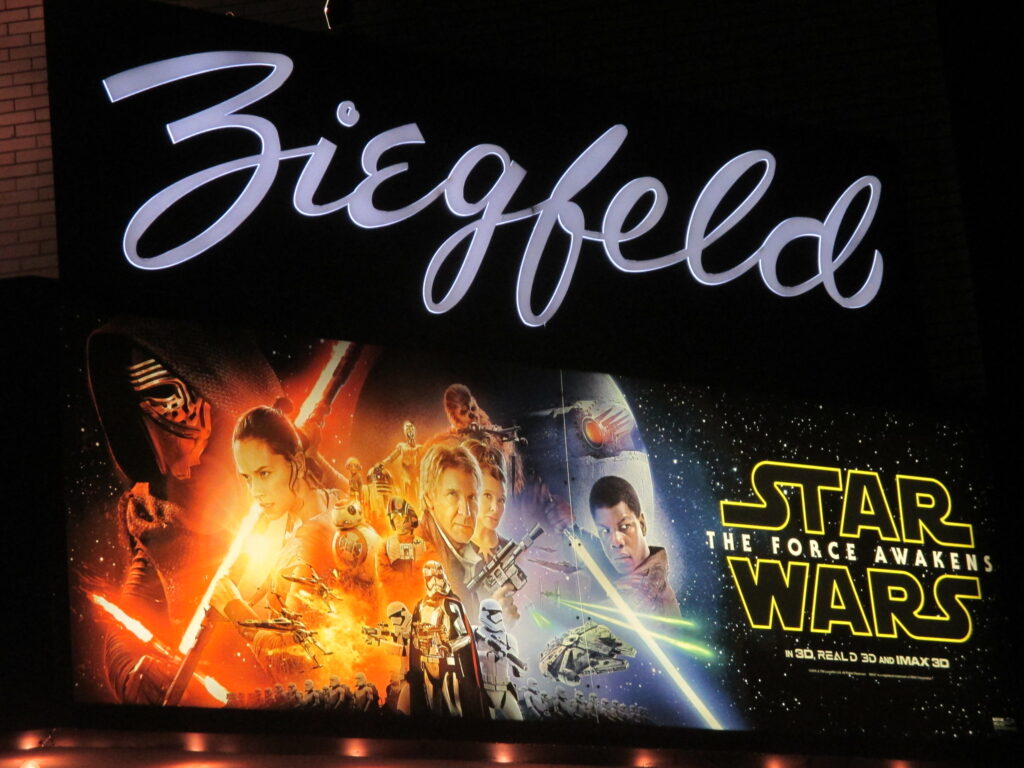
The Ziegfeld Theater, one of Manhattan’s last single-screen movie theaters, closed for regular film exhibition in 2016.* Its final film was Star Wars: The Force Awakens, an appropriate choice as tens of thousands of movie lovers had gone to the Ziegfeld to see previous films in the series — including the 1977 original.
I think the real story here is how — in a landscape of multiplexes and state-of-the-art home theaters — this respected dinosaur, sitting amidst the most valuable real estate in the world, managed to stay open as long as it did, playing a single film at a time.
(The Paris Theater is the only Manhattan theater remaining with just one screen.)
Losing the Ziegfeld means that New York lost a valuable link to one of the city’s greatest theatrical icons, Florenz Ziegfeld. Although, to be fair, that link was already indirect.
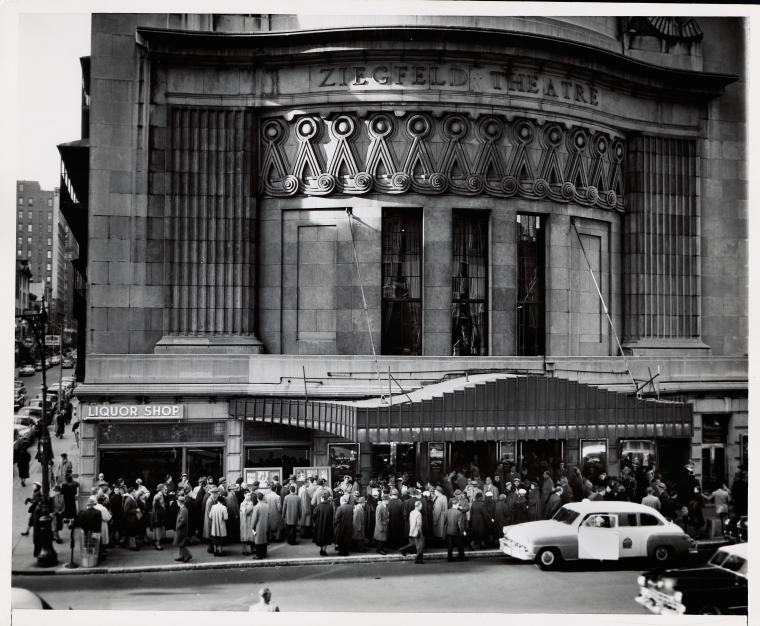
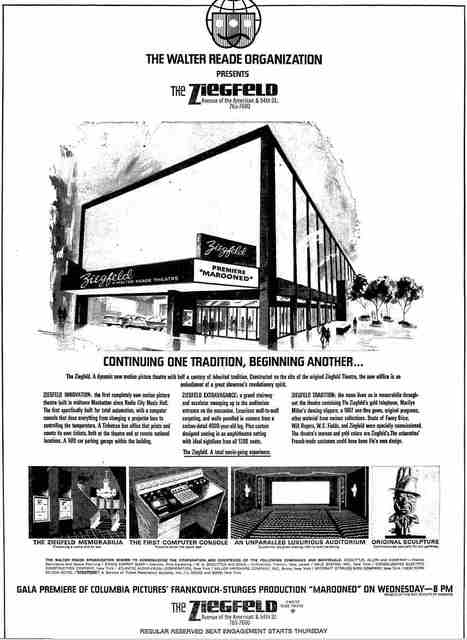
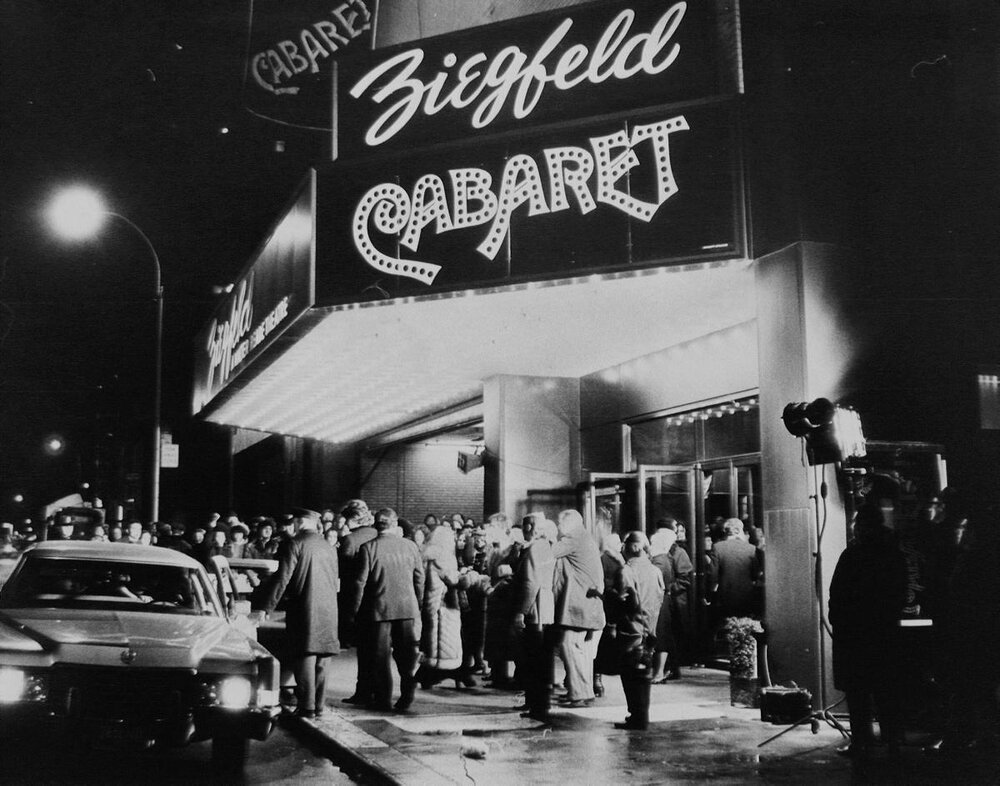
The original Ziegfeld Theater (at top), built especially for the showman by William Randolph Hearst, sat on Sixth Avenue close by the present movie theater. It was demolished in 1966, and a new Ziegfeld — devoted solely to film — was built nearby by Emory Roth & Sons. It opened in December 1969.
At 1,131 seats, the Ziegfeld movie house was hardly the biggest theater in New York. And it doesn’t even have the biggest movie screen (that title belonged to the IMAX at Lincoln Center).
But the grandiosity of design, the traditional show-palace style, and the dramatic trappings of its lobby make for a movie experience of special import. Even its bathrooms were extraordinary.
The Ziegfeld was a throwback to New York’s early single-screen theaters of yore like the Roxy, the Rivoli and the Capitol. It’s also much smaller than all of those. (The Capitol, for instance, sat 4,000 people!)
The Ziegfeld catered to films of a remarkable scope, and it built its reputation upon ‘serious’ films of pedigree.
Some of the most successful films to ever play the Ziegfeld include Gandhi (1982, playing 31 weeks), Cabaret (1972, 26 weeks), and Close Encounters of the Third Kind (1977, 23 weeks, plus an additional month in its 1980 reissue).
Courtesy Ziegfeld Ballroom
But screen longevity doesn’t necessary auger quality. For instance, Raiders Of The Lost Ark played here for three weeks. Grease 2 played for five.
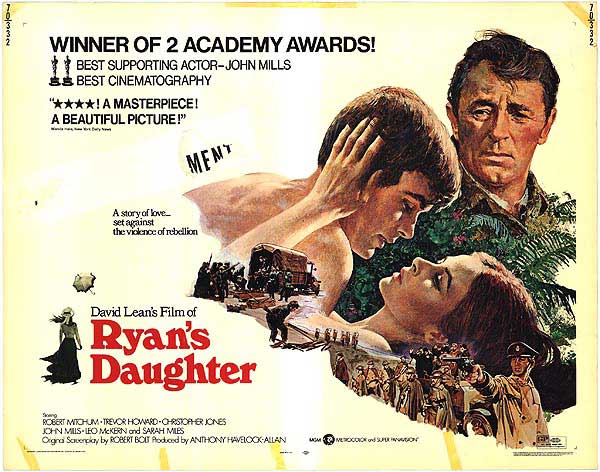
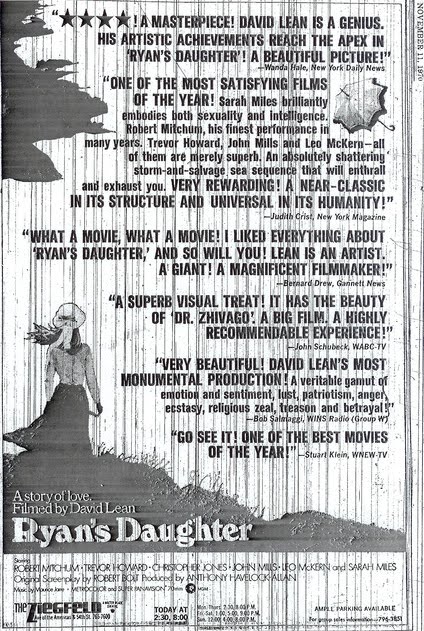
Less than a year after the theater’s opening, on November 9, 1970, came the film that currently holds the record for the longest-running film in Ziegfeld’s history — Ryan’s Daughter.
Perhaps not the traditional classic you might expect to hold such a record.
This blown-out, histrionic World War I drama by legendary filmmaker David Lean, loosely based on the book Madame Bovary, recounts an illicit love affair set along the Irish seashore, with crashing waves serenading the passionate kisses between a married pub owner’s daughter (played by Sarah Miles) and a maimed war veteran (Christoper Jones) who is intermittently tormented by battle flashbacks.
Star wattage was provided by Robert Mitchum as the jilted husband.
Lean’s previous film was Doctor Zhivago, a box office triumph that set international records and proved movie audiences would gratefully sit through lengthy costume dramas if they were any good.
Ryan’s Daughter, sadly, was no Doctor Zhivago.
New York Times critic Vincent Canby completely dismisses it — a film full of ‘soapy gestures’ — but adds a telling postscript to his review:
“I first saw ‘Ryan’s Daughter’ at a press preview at the Ziegfeld Theater, where the audience reaction tended toward rudeness. Five days later, I returned to see it with a paying audience that stood patiently in line around the block before getting into the theater. The members of that audience loved the movie even before they entered the lobby, and, from the reverence with which they greeted the movie itself, they also loved it while seeing it.“
The New Yorker’s Pauline Kael pulled no punches, calling it a “gush made respectable by millions of dollars ‘tastefully’ wasted”.
Afterwards, a brave Lean showed up for a function by the National Society of Film Critics held at the Algonquin Hotel, where he was mercilessly lambasted by the New York critics.
Lean recalls, “One of the most leading questions was, ‘Can you please explain how the man who directed Brief Encounter can have directed this load of sh*t you call Ryan’s Daughter?’ It really cut me to the heart, and that was Richard Schickel.”
The experience was so scarring that Lean later claimed it caused him to withdraw from film making for over a decade
Yet still, New Yorkers flocked to Ryan’s Daughter, from its premiere that November and for thirty-three weeks afterwards.
The film, initially presented in the old ‘roadshow’ format including its overture and intermission, lasted three and a half hours, so the Ziegfeld could only schedule two or three shows a day.
Ryan’s Daughter — all of Lean’s pictures, actually — seemed ready-made for the Ziegfeld.
By 1970, many of New York’s grandest movie screens were already torn down. Those that remained were in Times Square, and it’s doubtful that the Upper East Side crowd — older, wealthier New Yorkers — felt comfortable settling down in those theaters by this time.
The Ziegfeld, right off Sixth Avenue, was also nearby midtown’s swankiest restaurants (as Mad Men, which once mentioned the old Ziegfeld Theater, regularly demonstrates.)
The film was also presented in Super Panavision 70, a film process using ‘spherical optic’ lenses that had only been used by a few films. (2001: A Space Odyssey, another Ziegfeld success, used the same process.)
Such visual scope blasted out from the Ziegfeld’s immense screen, beguiling and even numbing audiences as the IMAX of its day.
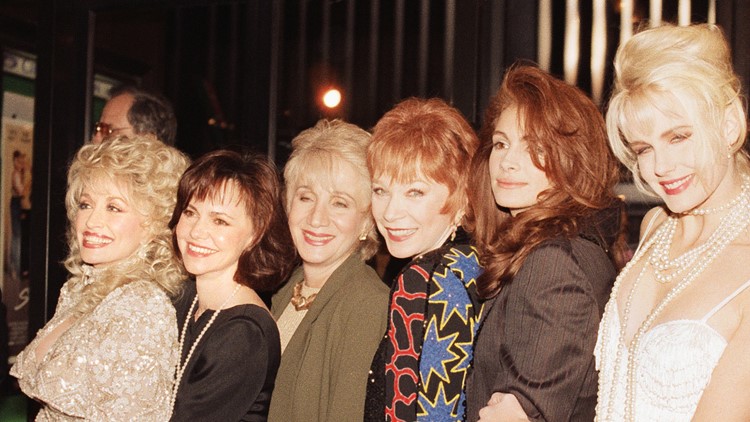
The theater was known for very splashy premieres — especially in the 1980s. Stars of the film Steel Magnolias pose backstage at the Ziegfeld Theater in New York Nov. 5, 1989 at the movie’s premiere. Shown from left: Dolly Parton, Sally Field, Olympia Dukakis, Shirley MacLaine, Julia Roberts and Daryl Hannah. (AP Photo/Ed Bailey)
Which is why Lean would always find a welcome audience at the Ziegfeld — his movies were too monumental in scale to be ignored.
His return to filmmaking A Passage To India would play for over three months at the Ziegfeld in 1984. And a reissue of his greatest masterpiece, Lawrence of Arabia, played to sold-out crowds here in 1989.
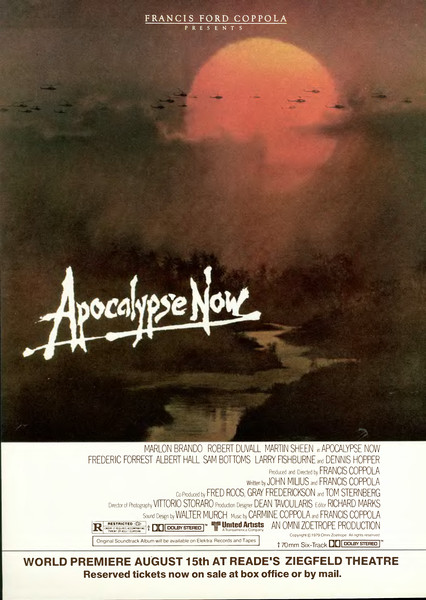
Personally, if I could go back in time, I’d probably want to attend the Ziegfeld premieres of The Last Temptation of Christ (met with offended protesters) or perhaps Apocalypse Now, which made its debut there in 1979 and played for twelve weeks.
Data courtesy the amazing Cinema Treasures / Michael Coate, with verification using old New York magazines.
*Today the old theater is the luxurious event space Ziegfeld Ballroom. Looks swanky!
The Paris Theater, as glamorous and as eccentric as any film it’s ever played, has the benefit of having the Plaza Hotel and Central Park to ensure it never goes out of style.
But the history of this romantic and occasionally radical movie house, the longest running single-screen movie theater in New York, is as cinematic as its photo-friendly neighbors.
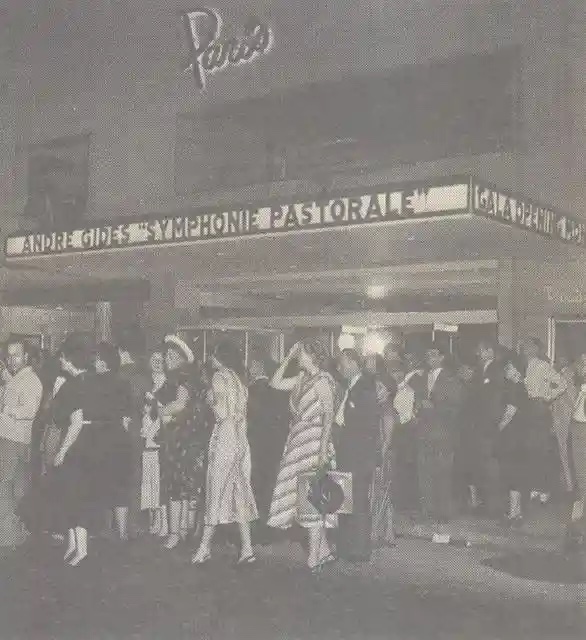
No less than Marlene Dietrich cut the ribbon on opening day of the Paris in September 13, 1948.
Gerald A. DeLuca
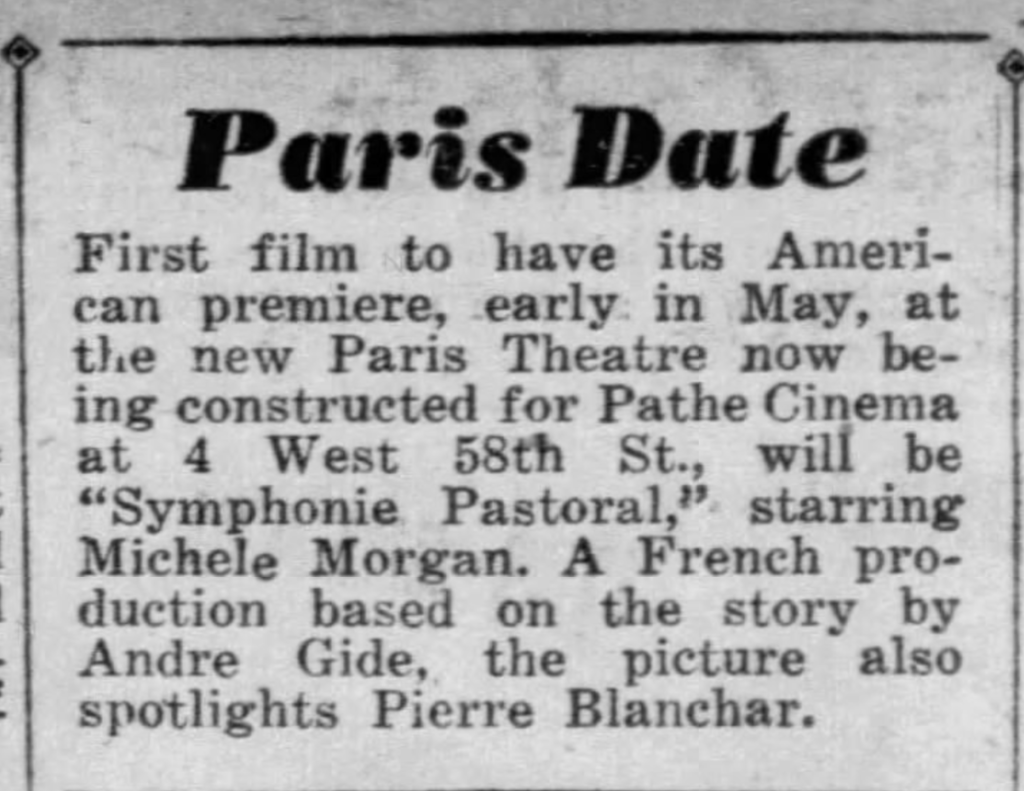
Opened by the French film distributor Pathè Cinema, the old-style 586 seat theatre with balcony — billed as “the first new moving picture theater to be built in New York since before the war” — was intended to debut significant achievements in foreign film, an ambition it still mostly retains today, along with re-issues of classic movies.
New York Daily News, April 11, 1948 (courtesy Newspapers.com)
Its first film was Symphonie Pastoraleby the almost-forgotten French director Jean Delannoy. And the cinema might have continued to enjoy quiet renown among foreign film aficionados if it wasn’t for Roberto Rossellini and Federico Fellini.
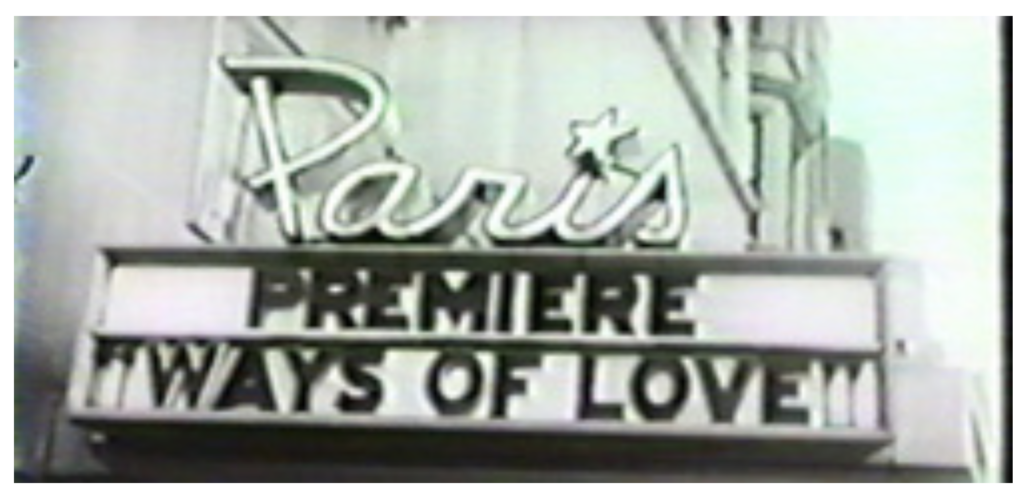
In December 1951, the Paris decided to show three films under an umbrella title Ways of Love.
One of these was a forty-minute piece entitled The Miracle, directed by Rossellini and starring Anna Magnani as a pregnant woman who’s convinced she’s carrying the Christ child after meeting a shepherd (played by Fellini) whom she believes is St. Joseph.
Its subject matter enraged the Catholic Church, and the theatre was assaulted with hundreds of protesters for weeks, orchestrated by Cardinal Spellman from his pulpit at St. Patrick’s Cathedral.
Eventually the Paris was ordered to stop showing the film, a decision Paris manager Lillian Gerard, along with the film’s distributor, appealed in court.
The case eventually went all the way to the U.S. Supreme Court who ruled the banning a violation of free speech.
No other film at the Paris would draw as much international attention, but the theater would affect cinema history in other ways, helping build the reputations of foreign directors on American soil.
Courtesy the Paris Theatre
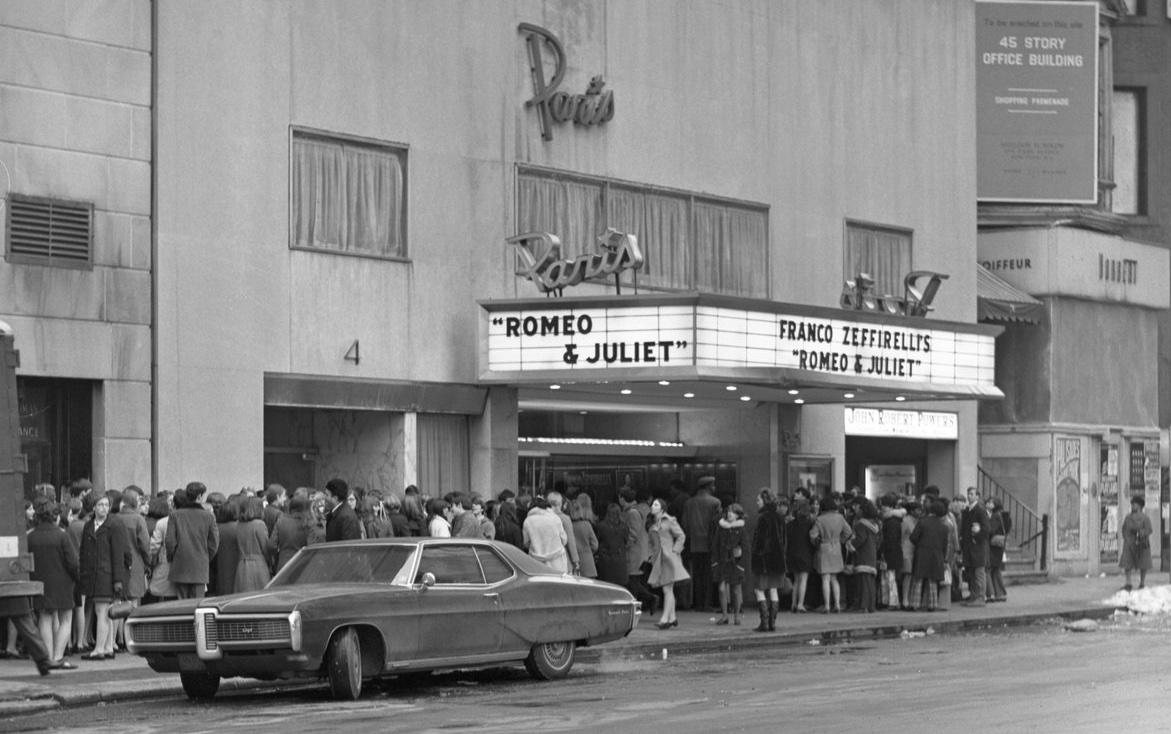
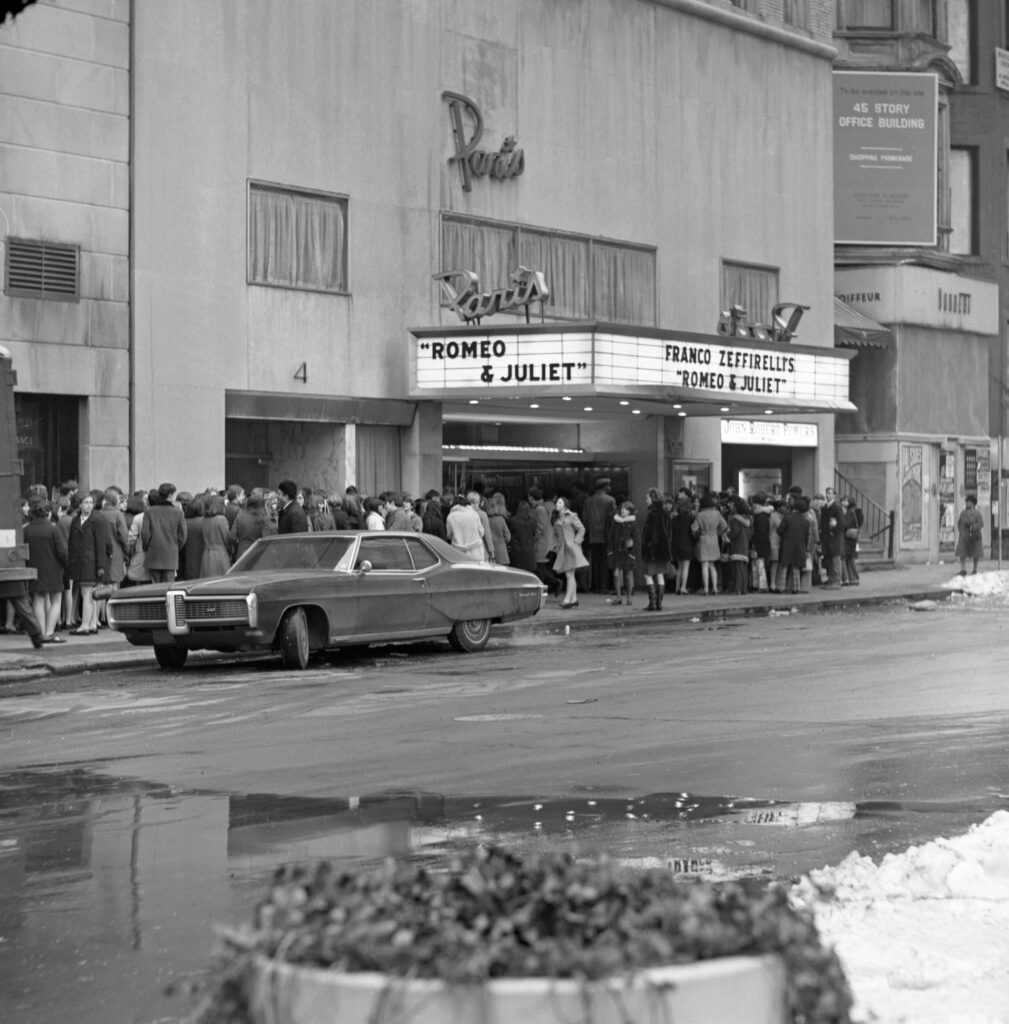
Franco Zeffirelli’s Romeo and Juliet ran for almost an entire year from 1968-69. Director Claude Lelouch’s A Man And A Woman and the Marcello Mastroianni comedy Divorce Italian Style would play for over a year.
Merchant and Ivory preferred to debut all their films here; A Room With A View played almost nine months, Howard’s End seven.
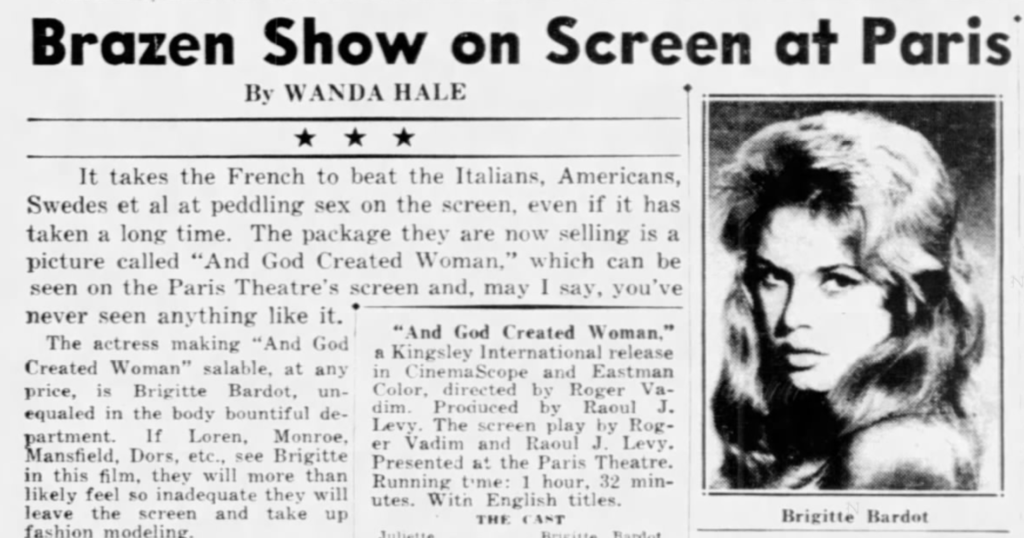
Below: The Paris, no stranger to sex and scandalous screenings
It’s had equally grand success with revival screenings as well, most notably Luis Buñuel’s 1968 drama Belle De Jour starring Catherine Deneuve which re-debuted in theaters in 1995 with the highest single-screen gross for a foreign film ever.
(I saw Lawrence of Arabia for the very first time here in 1997. Anytime the Paris shows a great film like that, I highly recommend you cancel all your plans and go.)
Pathe pulled out of the Paris Theatre in 1990 with intentions of opening another screen in New York. (It never did, but Pathe is still in business, and you can find their film on most art-house screens in New York.)
Loews operated the theater as the Fine Arts Theatre before the landlord bought them out and renamed it back to the Paris.
Courtesy Wikimedia Commons/DavidSchwartzNetflix
Cut to modern day and the threat movie theaters face from at-home streaming services.
Hundreds of theaters across the country have closed in the past ten years, and many have had upgrade interiors and food and drink offerings in order to survive.
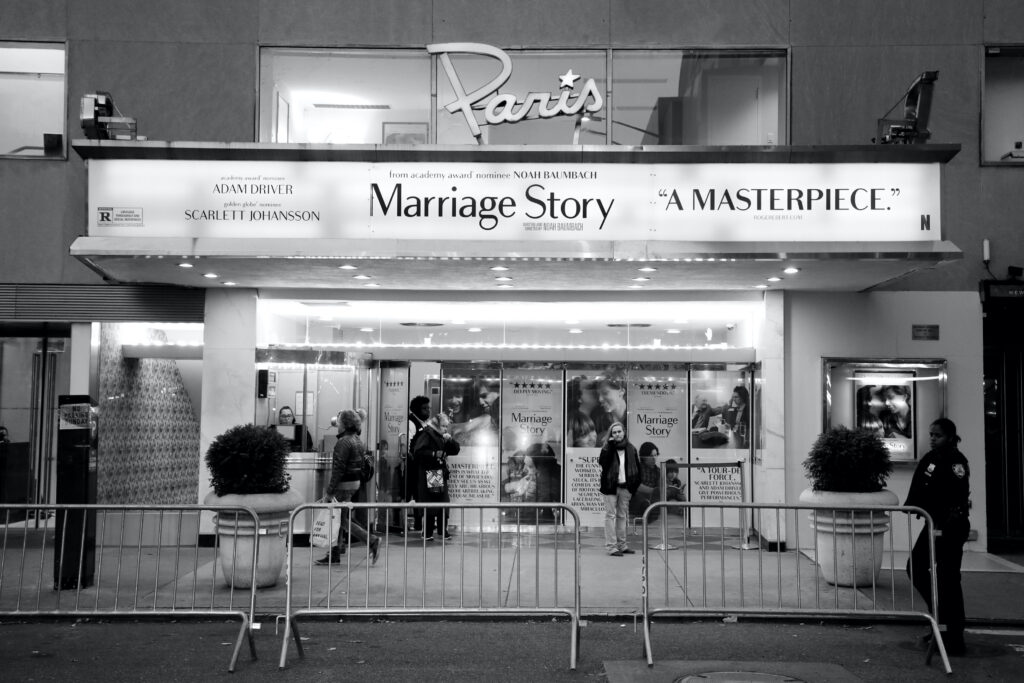
The Paris, however, was actually saved by a streaming service — Netflix. The popular streaming service purchased the theater in 2019 and began launching some of its films there — most with awards-season potential.
From the Paris’ website: “Since opening an engagement of Marriage Story on November 6, 2019, Netflix operates the theater, giving new life to a landmark of New York moviegoing. The Paris is New York’s movie palace, and Netflix will honor the theater’s history while offering the finest in contemporary cinema, introducing the theater to a new generation of film lovers.”
You can find a lot of fun personal recollections by former ushers and managers at Cinema Treasures.
People have been enjoying movies and alcohol well before anybody first thought to make popcorn for hungry audiences.
Believe it or not, this carefree pleasure — one most people do not take for granted anymore — has its roots in a small but significant decision that was made almost 110 years ago.
In May of 1912, people were still reeling from the Titanic disaster and sorting through a messy presidential election between four viable presidential candidates (Woodrow Wilson, William Howard Taft, Theodore Roosevelt and Eugene V Debs).
But most people left their worries behind once they stepped off the train at Coney Island, where the amusement parks were just opening their doors that month, making way for the summer crowds with an even wilder array of rides and shows.
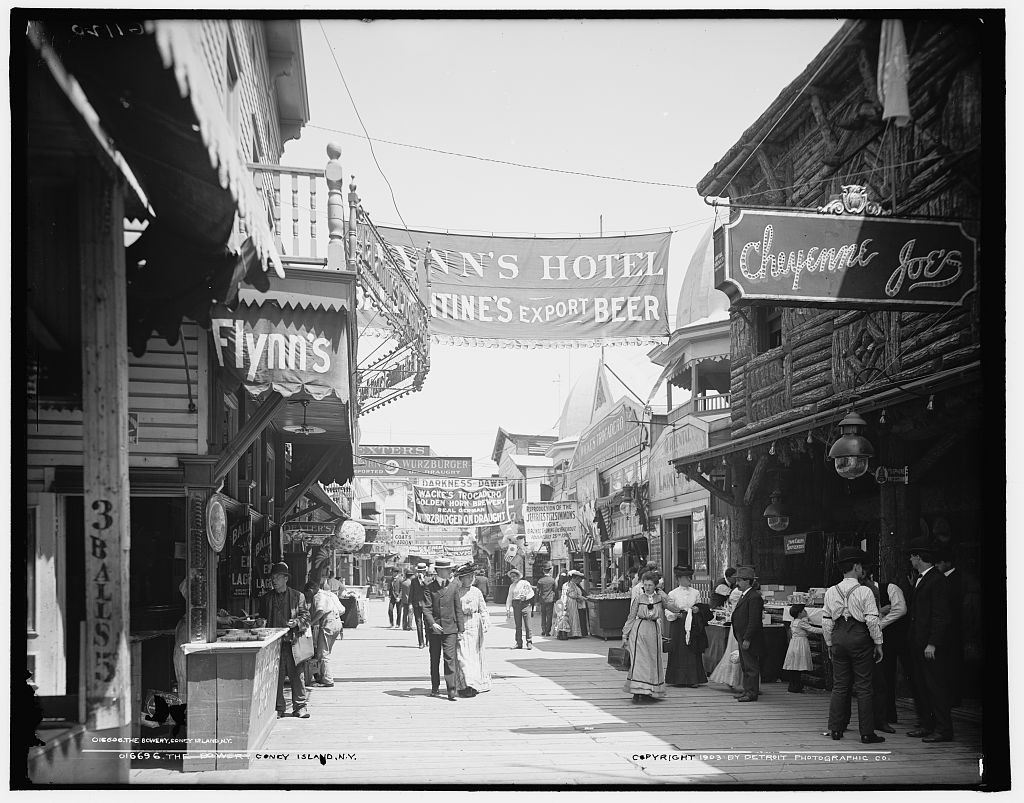
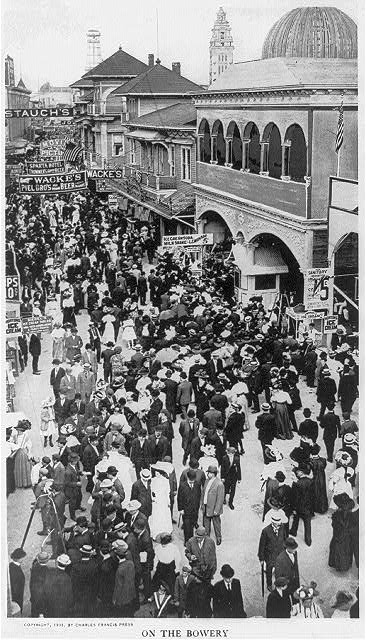
The Bowery, one of the more adventurous sections of Coney Island, 1903
Most of the amusements at Steeplechase Park were totally new, as a fire in 1907 had decimated most of the park.
Nearby sat the ruins of Dreamland, destroyed in a fire in 1911 and never rebuilt. Luna Park also expanded in 1912 with many new rides, including one that seemed to mock the misfortunes of its rival parks — the Great Fire Show, which presented a Western town ravaged in flame.
But a brand new entertainment was making itself known in Coney Island — moving pictures.
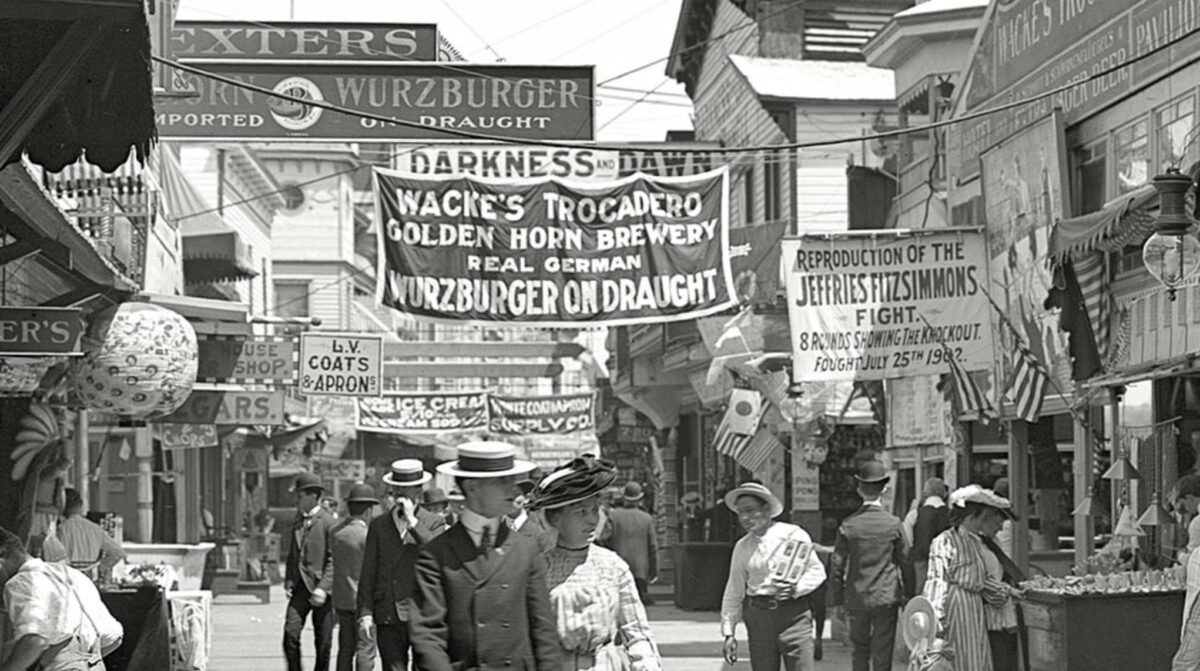
Coney Island’s Bowery. You can see signs for Wacke’s establishment here. (Library of Congress)
For instance, when Luna Park threw open its doors on May 25, 1912, the park contained a theater which presented some of the world’s first color short films in the British-invented Kinemacolor process. (Here’s an example of one of the films that may have exhibited here.)
The popularity of motion pictures, which were often exhibited between vaudeville acts or in continuous runs in theaters called nickelodeons, soon exposed the fallacy of one particular New York law.
For operators had to have a theater license in order to present a free show, even though, technically, a film could be easily displayed in a non-theatrical environment — namely, a saloon.
The Bowery, one of the more adventurous sections of Coney Island, 1903
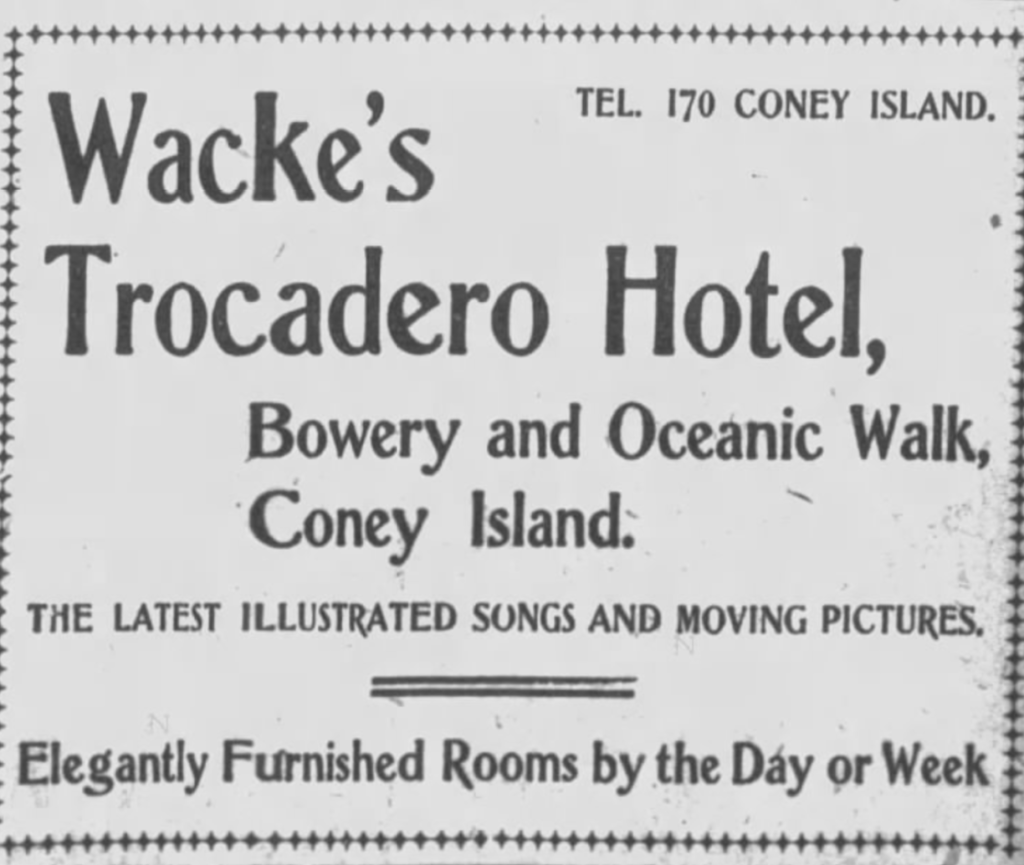
Coney Island theater proprietor Herman Wacke, no stranger to the moving image, is touted by some as the first commercial exhibitor of a motion picture at his Trocadero Hotel in 1893.
Wacke’s hotel, a stalwart from Coney’s early years located along a strip of cabarets and beerhalls affectionately called the Bowery, was nearly destroyed in the fire that consumed Steeplechase in 1907.
In 1912, Wacke fanned a few new flames.
He began showing films for free in the saloon as a way to entice people to come in and purchase food and beer. Wacke’s was probably the best known of many along the Bowery to exhibit films in this fashion.
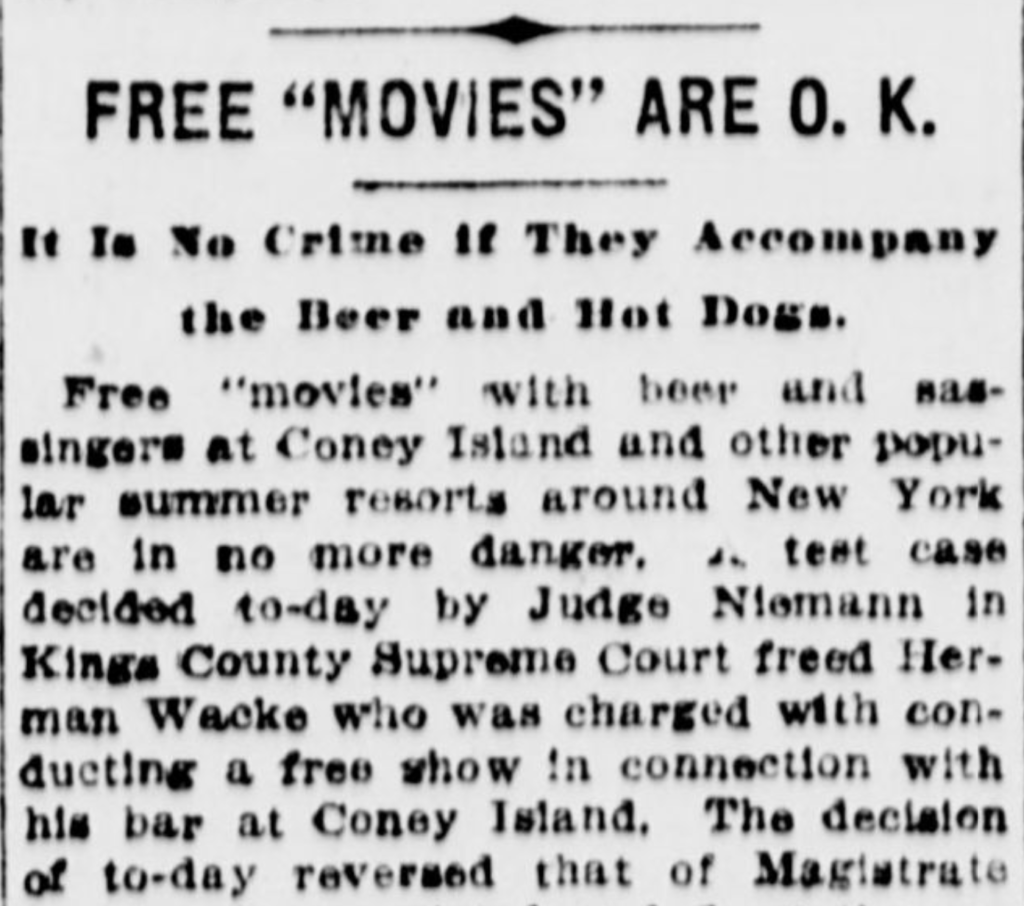
But the proprietor didn’t have a license to do so, and during one particular sting, Wacke was arrested — “charged with conducting a free show in connection with his bar” — and fined $5.
Not a huge sum of money for a successful saloon owner, and Wacke went willingly, becoming a test case for a law that many certainly thought was rigid and overly meddling.
The charge was eventually overturned by a Kings Country Supreme Court judge who announced that such incidental performances were not subject to the law.
“Wacke was arrested for a test of the law and its relation to the free shows given that people may be induced to buy drinks while sitting at the tables. Judge Niemann held that a show must be conducted as a business of exhibition for a price of admission in order to come under the law. “
The law would be challenged again a few years later by the owners of posh Manhattan cabaret Maxim’s, who also presented so-called ‘free’ performances.
By the 1920s, of course, saloons could technically show movies — but they couldn’t serve alcohol! By the time Prohibition was repealed, films were much longer and people preferred the comfort of lavish movie palaces.
Free movies (and broadcast sports) of course returned to bars with the advent of television.
Today theaters like Alamo Drafthouse and Nitehawk Cinema elegantly mix the pleasure of cinema and fine cocktails. The ghost of Herman Wacke looks down approvingly.
As one of America’s premier leisure destinations, Coney Island was so closely associated with films of this period that it even starred in a few of them, including Mack Sennett’s ‘At Coney Island‘ in 1912.
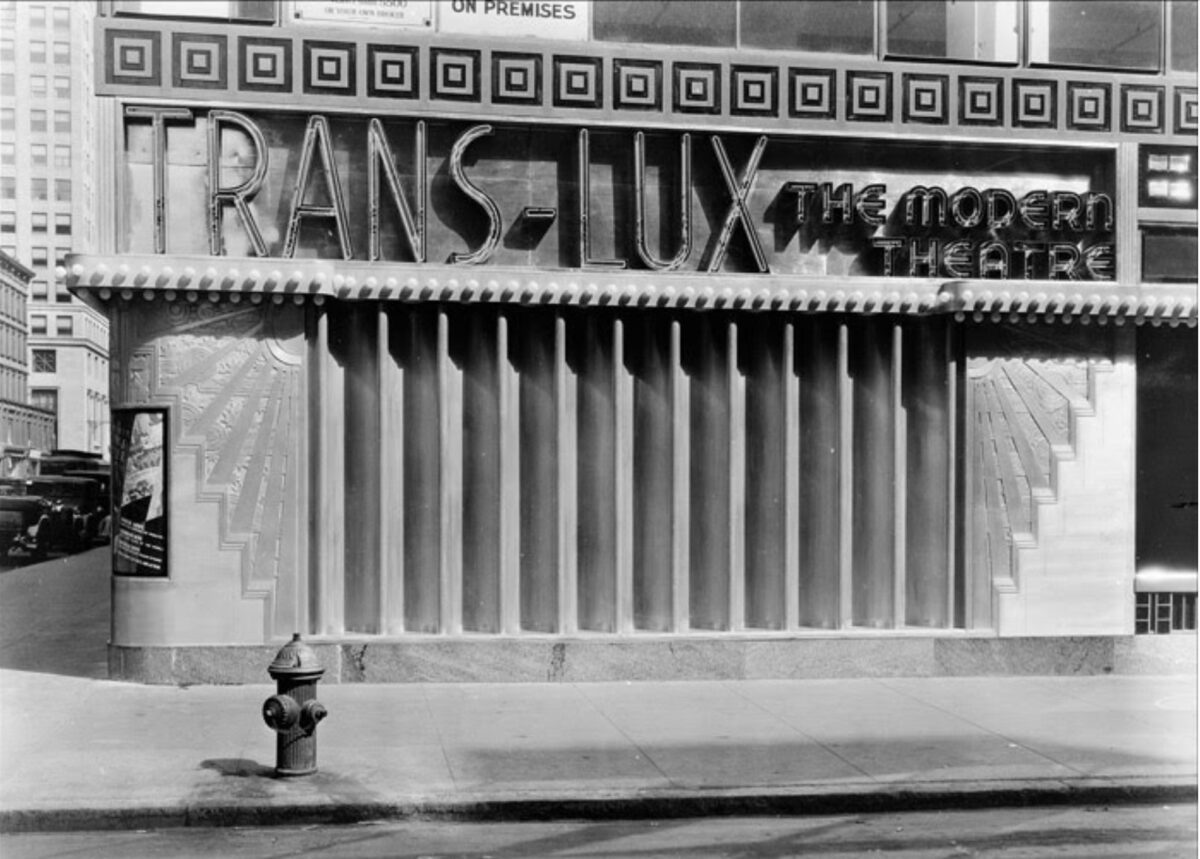
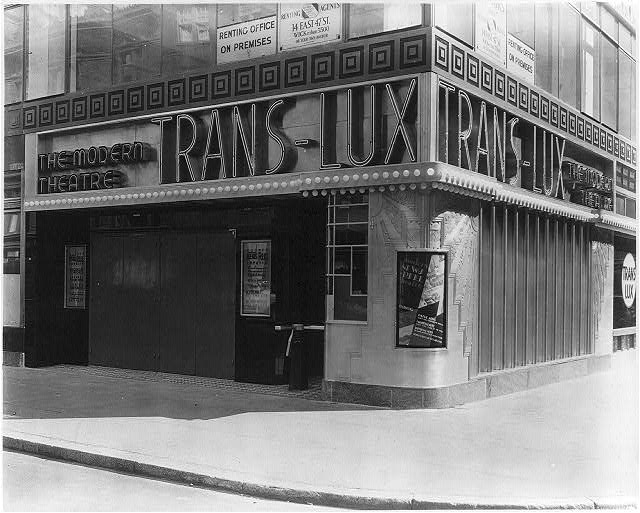
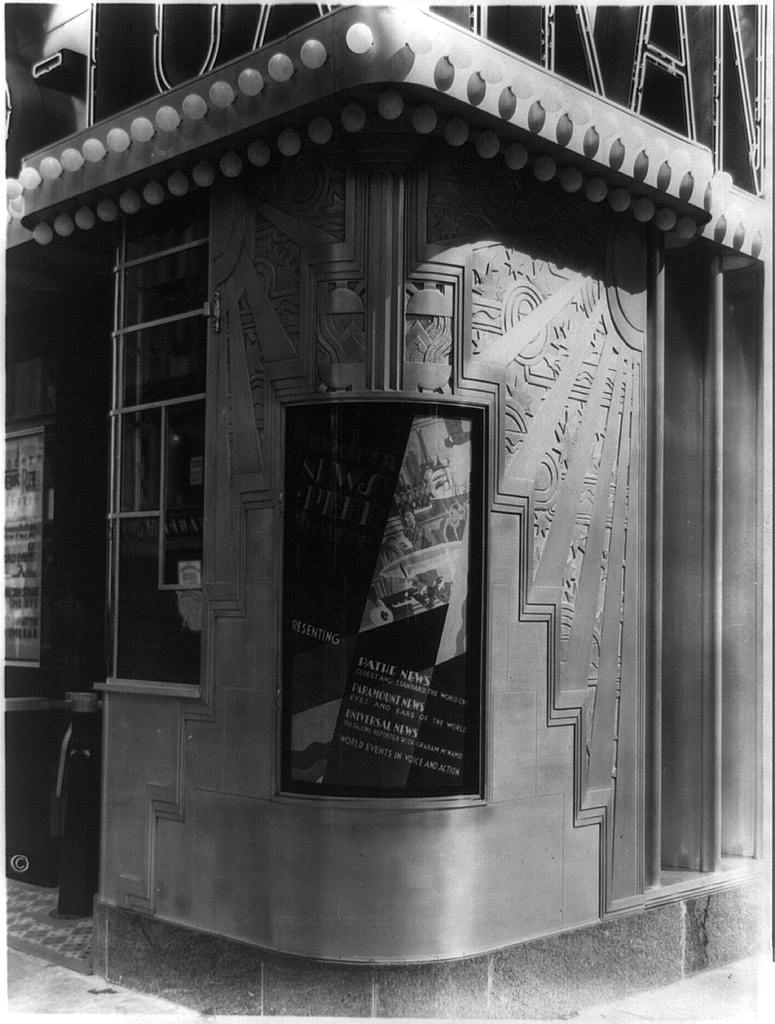
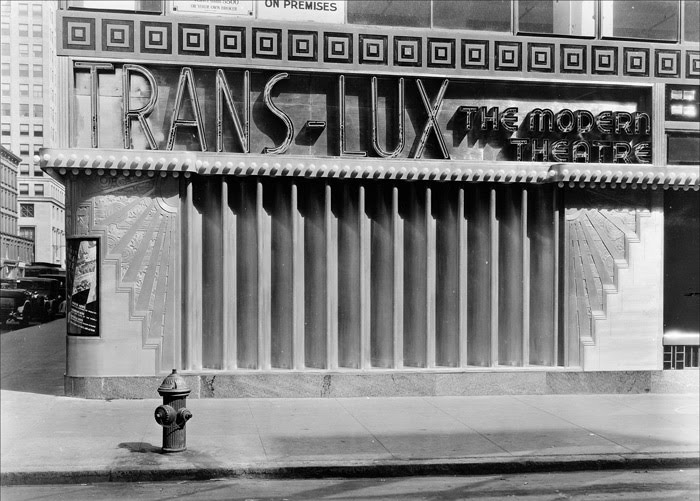
I’m a sucker for severe electric-laden art-deco theaters like the Trans-Lux Modern Theater which was once located in Midtown Manhattan on the corner of 58th Street and Madison Avenue.
Most every Midtown movie theater by the 1920s dabbled into electric signage to grab attention. But Trans-Lux worked in the opposite direction.
To underscore the importance of illuminated billboards in New York, Trans-Lux was actually a sign company who then dabbled into theater ownership.
Their separate film branch, Trans-Lux Movies Corporation, was a collaboration with RKO Pictures. This screen at 58th and Madison, opening in March 1931 as the first of Trans-Lux’s theater ventures, was a unique venue that played newsreels and shorts.
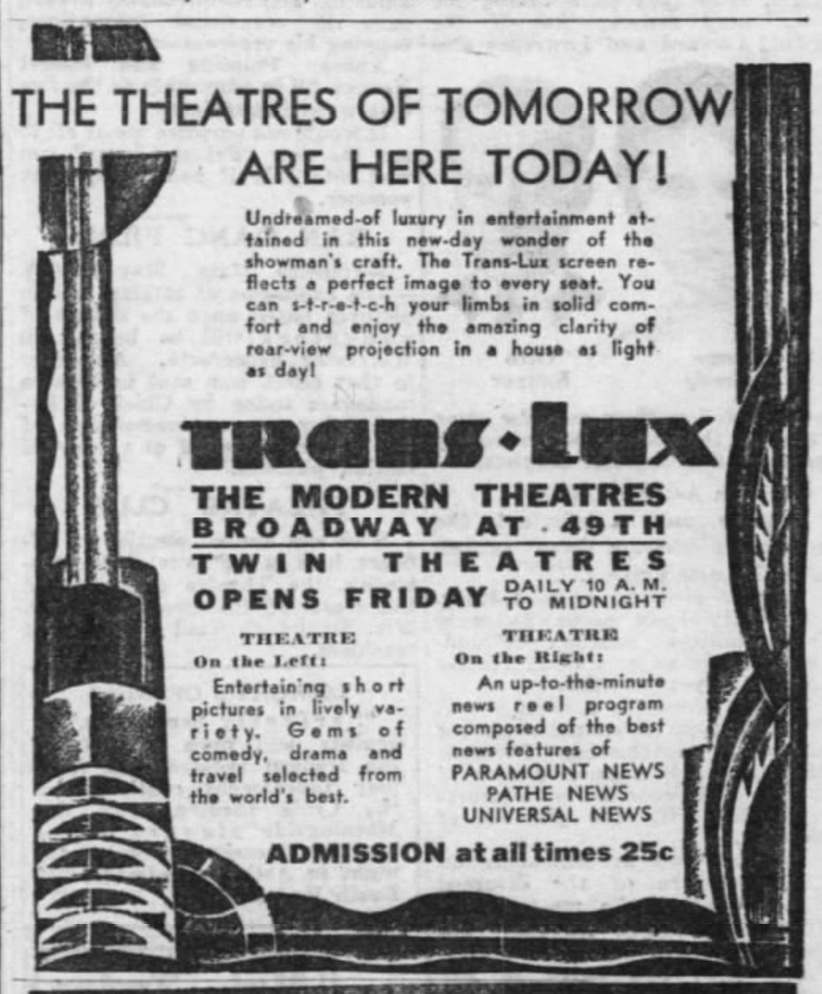
An advertisement for an additional location at Broadway and 49th Street, via the New York Daily News, May 13, 1911
It was an ‘upgraded’ film-going experience, in a miniature theatrical environment.
According to a Time Magazine article from 1931, “[t]his theatre, about the size of a small drugstore, has 158 comfortable arm-seats, a turnstile in front and a svelte modernistic interior in which newsreels now flicker from 10 a. m. till midnight. There are no ushers; a ticket girl, two operators (union requirement) and a manager run the house.”
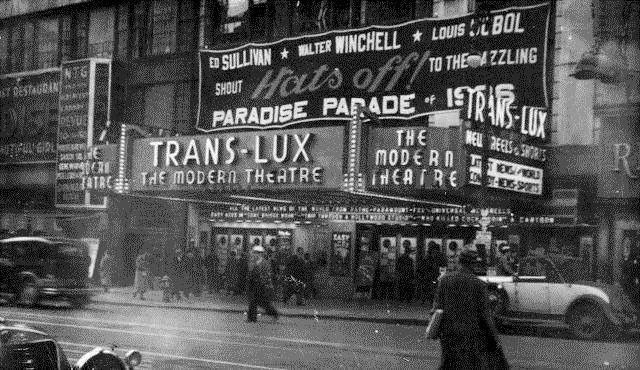
Below: The Broadway and 49th Street location with a more traditional marquee
Customers would pay a quarter to see about an hour of newsreel and short films, in a brightened environment to allow them to read their programs and newspapers without squinting.
Trans-Lux opened several ‘newsreel’ theaters throughout the city, although by the late 1930s, those that survived the Great Depression switched to conventional feature films.
This Library of Congress image from April 1931 shows the building from the corner. That glorious neon lettering would have brightened a bustling Manhattan corner.
Library of Congress
Their theaters may be gone today but the company lives on in its original capacity as electric sign makers, most notably for providing stock-exchange ticker displays.
It’s spring in New York City and time for some frivolity! So we’ve just released an unusually whimsical episode of Bowery Boys Movie Club to the general Bowery Boys Podcast audience, exploring the 1984 comedy treat The Muppets Take Manhattan.
And that’s not all! Sticking to the theme of 1980s New York City, the latest episode of theBoweryBoysMovieClub explores the film Coming To America and its rich historical details. An exclusive podcast for those who support us on Patreon.
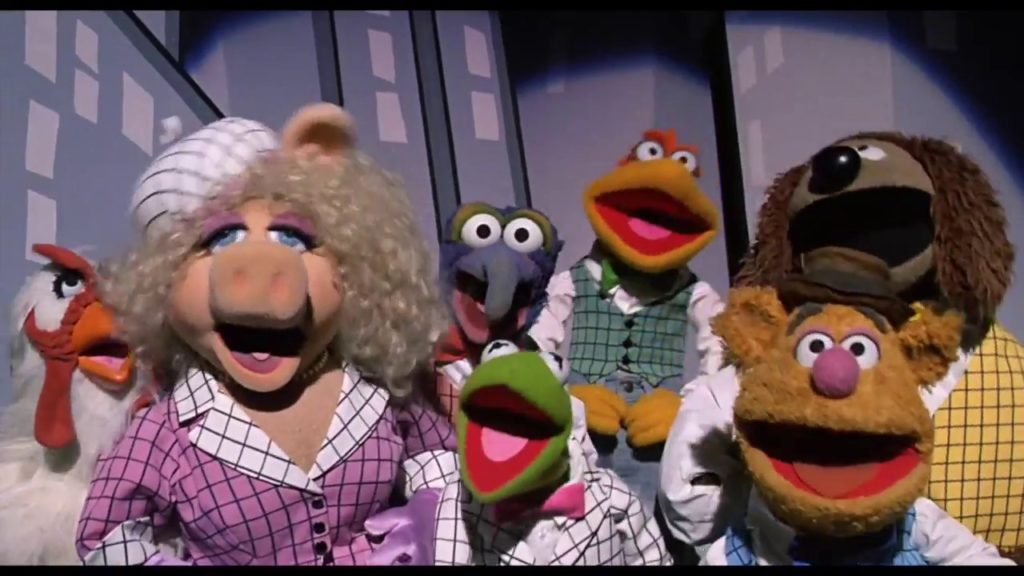
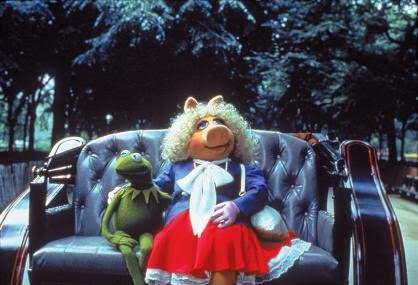
TOGETHER AGAIN! In 1984, Jim Henson brought his world-famous Muppets to New York for a wacky musical comedy that satirized the gritty, jaded environment of 1980s Manhattan while providing fascinating views of some of its most glamorous landmarks.
Listen in as Greg and Tom recap the story and explore the many real New York City settings of the film — from the Empire State Building and Central Park to the corner booth at Sardi’s Restaurant and certain luncheonette in the area of today’s Hudson Square.
The Muppets Take Manhattan expresses an unfiltered enthusiasm for the promise of New York City at a time when national headlines were filled with tales of the city’s high crime and budget problems.
Can Kermit and Miss Piggy (and their roster of guest stars like Art Carney and Joan Rivers) bring magic back to the Big Apple?
HowdoIlistento all episodes of theBoweryBoysMovieClub? Once you’re signed in on Patreon, you’ll see a private RSS link that can be put directly into your favorite podcast player. Even easier, it can also be played directly from the Patreonapp if you’re signed in.
Your support on Patreon assists us in producing our podcast and website and it helps as we endeavor to share our love of New York City history with the world.
Shouldyouwatchthemoviebeforeyoulistentothisepisode? This podcast can be enjoyed both by those who have seen the film and those who’ve never even heard of it.
We think our take on The Muppets Take Manhattan might inspire you to look for the film’s many fascinating (but easy to overlook) historical details, so if you don’t mind being spoiled on the plot, give it a listen first, then watch the movie! Otherwise, come back to the show after you’ve watched it.
This episode was inspired by an ‘obsessive guide’ post that Greg wrote a few years ago. That article is presented here in its entirety, featuring many additional New York City details from the film.
“We did our first film in Los Angeles and our second in London. I thought it would be nice to do the next one in our hometown.” — Jim Henson
In The Muppets Take Manhattan, our friendly assortment of animal and animal-esque protagonists arrive in New York City to put on a variety show. But, of course, Jim Henson and his creations had been here for over a decade already, the critical ingredient of PBS’s Sesame Street, which originally filmed on the Upper West Side.
By 1982, production on the children’s show had moved to 55th Street and Ninth Avenue, but the Muppets had gone global — with a successful syndicated variety show (The Muppet Show, from 1976 to 1981, produced in England) and two box office hits, The Muppet Movie and The Great Muppet Caper.
Given the theatrical nature of their own weekly show — set in a theater, after all — it made sense to return the Muppets to New York, to finally bring the beloved characters to a cinematic Broadway stage.
Below are 21 often trivial, mostly historical points of interest from Henson’s zany, most exuberant homecoming:
NOTE ON TIME AND SETTING: The Muppets Take Manhattan, directed by Frank Oz, was released in the summer of 1984 and filmed the previous summer in a variety of New York and New Jersey locations, with interior shots at Empire Stages in Long Island City (today Paris Film Productions). However it’s set sometime in the summer of 1982, judging from flying calendar pages that set September 1 on a Wednesday.
“Broadway? But this show isn’t good enough for Broooadway!”
1. The film opens with some terrific overhead shots of Manhattan, before taking us over bridges to Poughkeepsie, NY, the home of the fictional Danhurst College (as played by Vassar College). The Muppets are on stage, delighting an over-enthusiastic crowd with their new variety show ‘Manhattan Melodies’. With charming naivety, they decide to bring the show to New York City.
‘Manhattan Melodies‘ was actually the name of a successful New York radio show in 1932, broadcast by WOR from Times Square.
History was made with a unique multi-location broadcast featuring The Do Re Mi Trio, three voices recorded from three different skyscrapers. “‘Do’ was on the Empire State [Building], eighty-six stories in the air, ‘Re’ was on the seventy-first floor of the Chrysler Building, and ‘Mi’ was on the roof of the Manhattan Bank Building [aka 40 Wall Street].” [source]
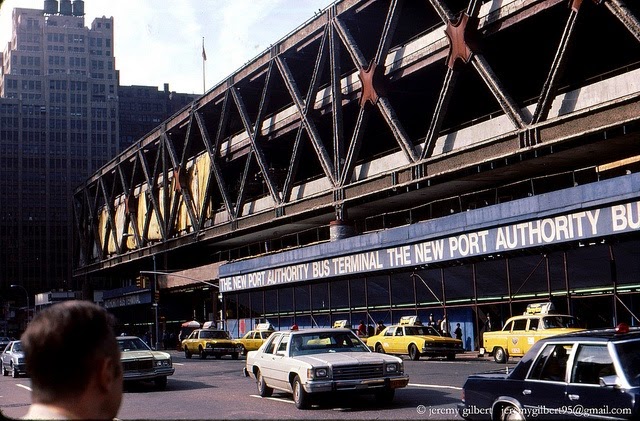
2. The Muppets arrive through the unglamorous hallways of the Port Authority Bus Terminal. In the early 1980s, this was considered one of the most crime infested areas of Midtown, a marketplace for prostitution and crack dealers. The bus terminal was “an ideal place for these illegal activities” during this period due to a recent expansion that left many corridors unguarded at night. Crime here “escalated to an uncontrollable level.”
Despite this, the Muppets decide to move into a wall of lockers. “I’ll trade with anybody who has a Jacuzzi!” says the free-spirited Janice.
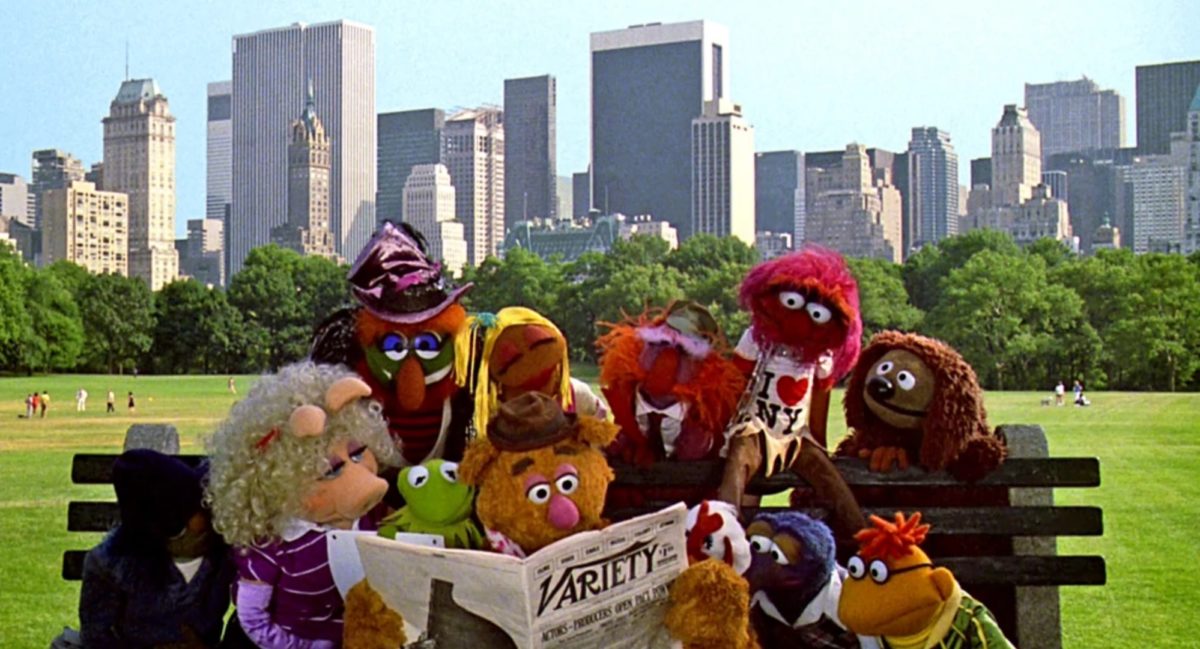
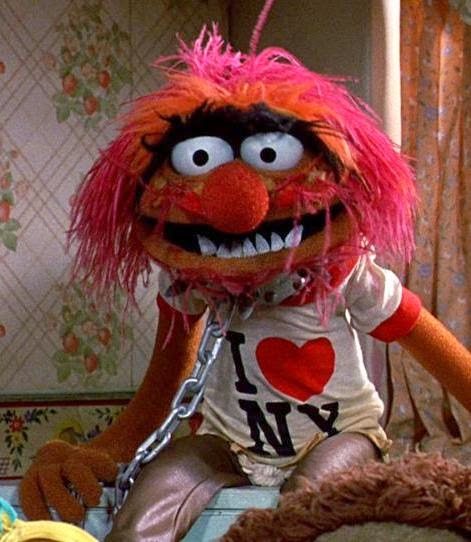
3. Animal wears an I HEART NEW YORK T-shirt throughout the film. This was a rather new emblem then, created in 1977 by graphic designer Milton Glaser. The irony of loving a particular city that was in a serious social and financial crisis was not lost on the designer.
“It was the mid-seventies, a terrible moment in the city. Morale was at the bottom of the pit,” Glaser said in an interview with The Believer. “….[T]hen suddenly the city simultaneously got fed up and said, ‘It’s our city, we’re going to take it back, we’re not going to allow this stuff to happen.” And part of that was this campaign.”
He gave away the rights to the design, so he gets paid nothing for the use — in the film, on tourist T-shirts, or anyplace else.
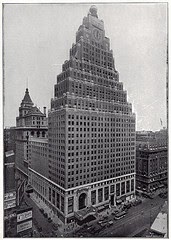
4. With Variety Magazine in hand, the Muppets venture off to pitch the show to big Broadway producers. The first, disreputable Martin Price (Dabney Coleman), has offices at the Paramount Building (1501 Broadway) in Times Square.
Originally built for the film company Paramount Famous Lasky Corporation in 1926, it rapidly became a key center for Broadway theater wheeling-and-dealing, “a hive of suites where ideas are hatched, partnerships forged, contracts signed, legends born,” according the New York Times.
Between 1979 and 1982, there were over 7,000 reported murders in New York City. (In comparison, there were less than 2,000 between 2009-2012.). This partially explains the dialogue exchange between Kermit and Price: “Well, it’s all about life in the big city.” “The big city? Cops, shootings, car chases — that kind of stuff?“
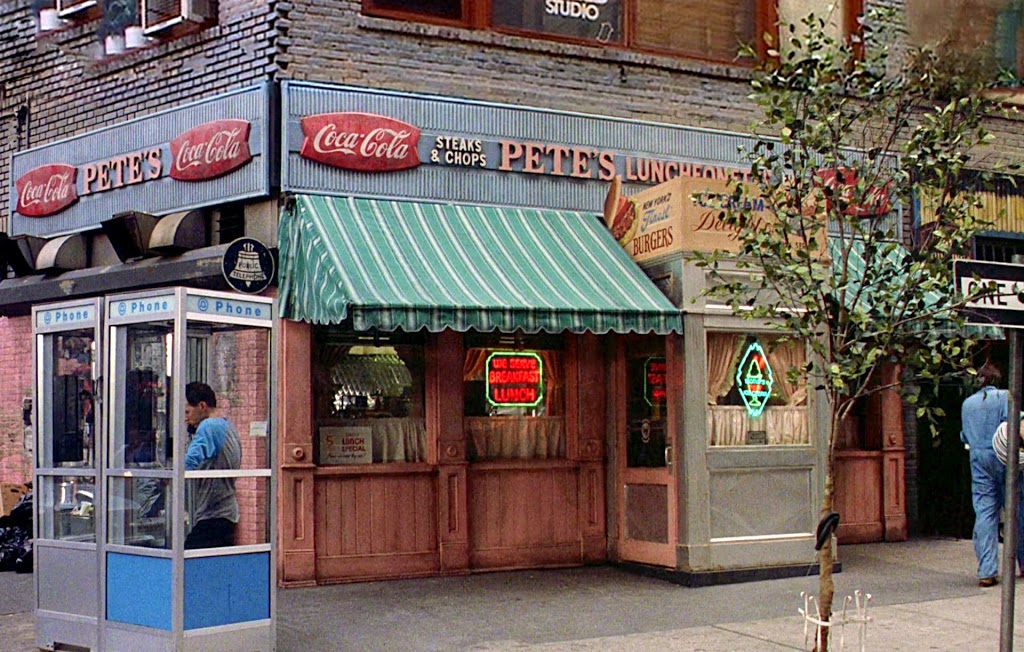
6. Rizzo the Rat delivers a hamburger with no patty to a customer. He turns and shouts to Pete: “Hey Pete. Where’s the beef?” The first Wendy’s commercial featuring the ‘Where’s The Beef’ lady Clara Pellerdebuted in January 1984 — after principal filming was completed — so this is most likely a weird coincidence.
7. Hopeless that their musical will ever be produced, everyone decides to leave town except Kermit. Scooter bikes away through New Jersey, Fozzie hops a train hobo-style, and Dr. Teeth and the Electric Mayhem hitch a ride to the Pennsylvania Turnpike. But, no surprise, Miss Piggy’s departure is the most glamorous, taking one ofThomas Edison’s original 1930 electric traincars from Hoboken Terminal.
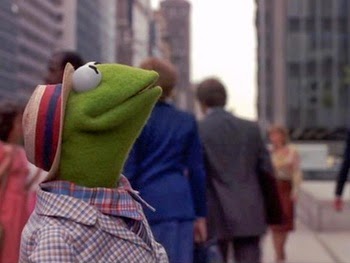
“You hear me, New York? We’re going to be on Broadway. You hear that, New York? I’m staying here! The Frog is staying!” 8. A dejected Kermit the Frog finds some renewed encouragement when he visits the Empire State Building‘s observation deck, looking north over the darkened city. To the right is the Pan Am Building which would remain branded with the airline’s logo until 1992, when it would become the Met Life Building.
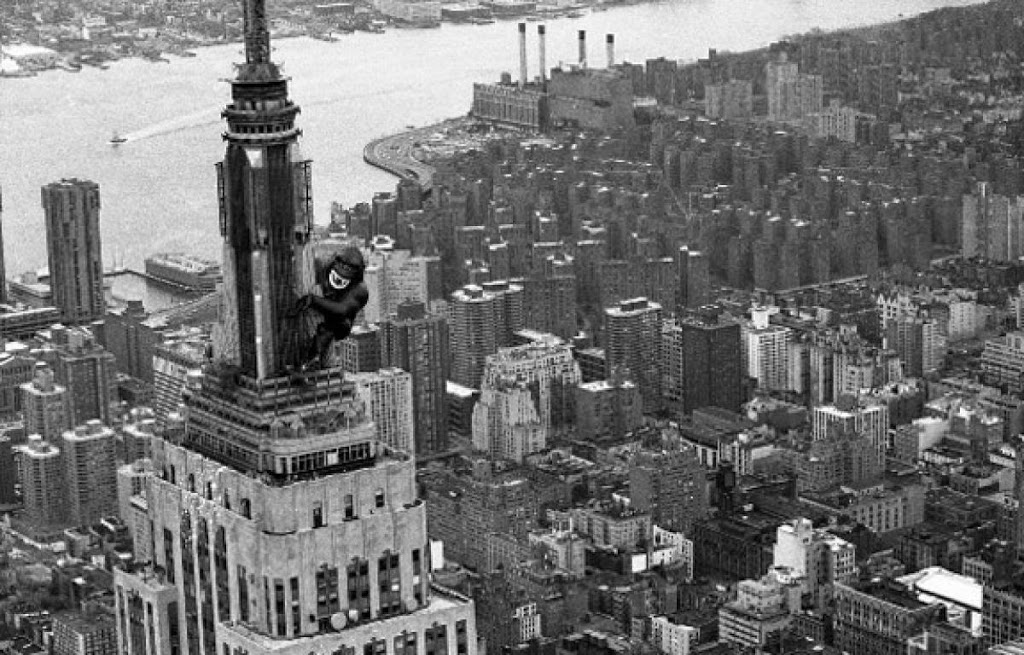
However, presuming this scene was filmed in 1983, Kermit would not have been the only animal superstar on the Empire State Building. In celebration of the 50th anniversary of the movie King Kong, a 3,000 lb nylon King Kong balloon was attached to the top of the building. (Photo courtesy Hamburg News/New York Daily News)
9. Kermit meets up with Pete’s daughter Jenny, a wanna-be fashion designer, in front of the Plaza Hotel, with everything inGrand Army Plazalooking almost the same as it does today.
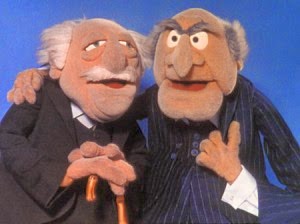
For some reason, those grumpy curmudgeons Statler and Waldorf are sitting on a bench, sunning themselves. The duo has a rather profound link to New York City history; they’re both named for classic New York hotels — the Statler (today’s Hotel Pennsylvania) and the Waldorf Astoria. And, yes, Waldorf’s wife is actually named Astoria. She appeared in this 1979 episode of The Muppet Show starring Dizzy Gillespie.
10. Miss Piggy is spying on Kermit from under a scaffolding in front of Bergdorf Goodman. (Just as we missed out on a shot of the Film Forum earlier, so too is Bergdorf’s neighbor The Paris Theater cut from view.) It’s later revealed she’s working at a perfume and makeup counter with Joan Rivers. This was not far-fetched casting; before making it big as a comic, Rivers worked as a fashion consultant for Bond Clothing Stores and even designed window displays for Saks Fifth Avenue and Lord and Taylor.
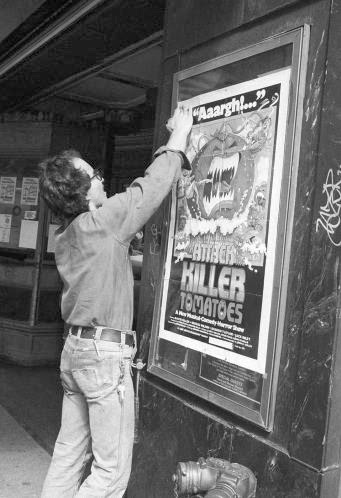
11. What are the rest of the Muppets up to? Scooter works at a Cleveland movie theater, with the Swedish Chef manning concessions. The film playing there is Attack of the Killer Fish in 3D, an obvious parody of 1978’s Attack of the Killer Tomatoes.
Believe it or not, Killer Tomatoes owes a small New York film festival for some of its cult cred. Two years after it was produced, the film piqued the curiosity of the media when it screened at the World’s Worst Film Festival at the Beacon Theatre in 1980, co-hosted by movie critic Michael Medved.
The film festival was a de facto Woodstock for schlock cinema, with Killer Tomatoes a star attraction. Said co-writer John DeBello, “The Wall Street Journal had the poster on its front page, the CBS Evening News used the song to close their credits. When people heard the title, just like when I heard the title, people loved it.” At right: Killer Tomatoes at the Beacon Theatre.
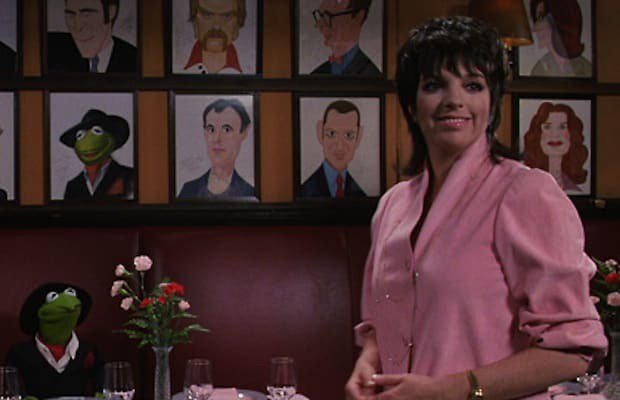
12.Sardi’s Restaurant takes center stage of perhaps the film’s most famous scene, as Kermit, disguised as an elegant producer, sends Rizzo’s rat friends in to create a ‘whisper campaign’ about his new musical.
Sardi’s has been inextricably linked to the Broadway industry since its opening in 1927, hosting hundreds of cast parties, business meetings and probably a few professional break-ups. It even gave birth to the Tony Awards. (You can listen to the whole fabulous tale of Sardi’s in our 2011 podcast.)
Vincent Sardi Jr., who appears in the film (see below), hosted the glittering greats of Broadway for over a half-century. He was considered the unofficial “Mayor of Broadway.“
Kermit also squeezes his own likeness onto Sardi’s famous wall of caricatures. To do so, he must take down that of Liza Minelli, which does not please her.
In fact, not only does Liza’s caricature still appear at Sardi’s, Kermit’s is still there too. (At least last time I checked!) Liza’s is by Brooklyn artist Richard Baratz. Look for his other likeness of Robert De Niro, Dustin Hoffman, Al Pacino, Whoopi Goldberg and dozens more. Kermit’s? No one knows who drew that.
13. Jenny consoles Kermit in Central Park, somewhere on Cherry Hill, next to Bethesda Fountain. Near this spot was the site of New York City’s first-ever frog jumping competition in 1935, inspired by Mark Twain’s short story “The Notorious Jumping Frog of Calavaras County.”
Local children’s organizations could sponsor one of 175 frogs shipped in from Louisiana. But this was not a trivial event. Ten thousand people took part, with former governor Al Smith presiding over the event and boxer Jack Dempsey serving as referee. The winner was a female frog named Abbie Villaret. (You can see a picture here.)
14.Central Park is depicted as a destination for people in exercise clothes and a place to ride through in carriages. Oh, and the place you get mugged. While Piggy is spying on Kermit, a mugger grabs her purse. (The mugger is played by Gary Tacon. Today he’s an accomplished stuntman and was recently in The Wolf of Wall Street.)
Crime was a factor people assumed was a regular component of New York’s most famous park. In 1982, the year it set an attendance record of 14.2 million, there were 22 reported rapes and over 700 robberies. [source] Although it would take several years to meaningfully reduce crime, the park’s infrastructure steadily improved, thanks to the efforts of the Central Park Conservancy.
Oh, by the way, Piggy borrows roller-skates from Gregory Hines, chases down her assailant and retrieves her purse. Here’s a video of some fine roller-skating style exhibited in the park during the 1980s:
15. Of the many special guests who appear in the film, the hottest star of the moment was perhaps Brooke Shields. The Blue Lagoon star filmed this cameo at Pete’s Luncheonette a few months before entering Princeton:
Masterson the Rat: Do you believe in interspecies dating? Brooke: Well, I’ve gone out with a few rats if that’s what you mean. In 1982, Shields briefly dated John F. Kennedy Jr. and took Ted McGinley to her prom.
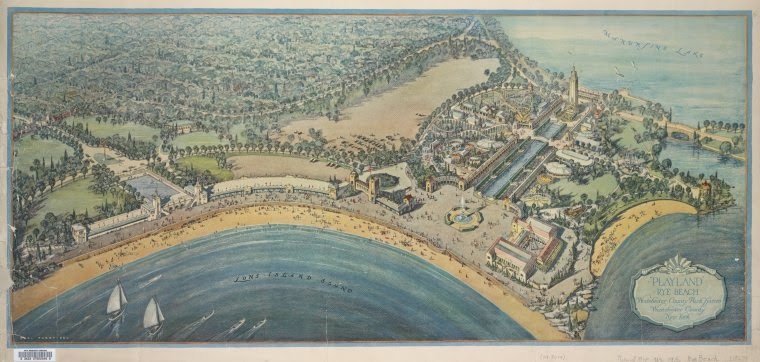
16. Meanwhile where’s Gonzo? He’s trying to make a living on the road, performing in an aquacade in Michigan. But these acrobatic scenes were actually filmed closer to home — Rye Playland, the historic amusement park overlooking the Long Island Sound. Gonzo’s fiery derring-do takes place by the Playland Lake (in the top right corner of the 1927 picture below, courtesy NYPL).
Four years after Gonzo conquers the park, a young boy consults an arcade fortune teller here at Rye Playland and becomes Tom Hanks in the movie Big.
“Just because the whole thing is crazy doesn’t mean it won’t make it on Broadway!”
17. Finally, somebody’s interested in ‘Manhattan Melodies’! Playing esteemed producer Bernard Crawford is Art Carney, who had acted on Broadway for almost thirty years by this time, not to mention, of course, his performance as Ed Norton on The Honeymooners.
But it’s Bernard’s son Ronnie who takes on Kermit’s script to produce and direct. He’s played by Lonny Price in a role that would almost precisely predict his future.
Price was an in-demand theater actor (best known for Broadway’s “Master Harold”…and the Boys) before Muppets. Afterwards, he became an in-demand theater director, recently helming 110 in the Shade with Audra McDonald and a new variation of Camelot with the New York Philharmonic.
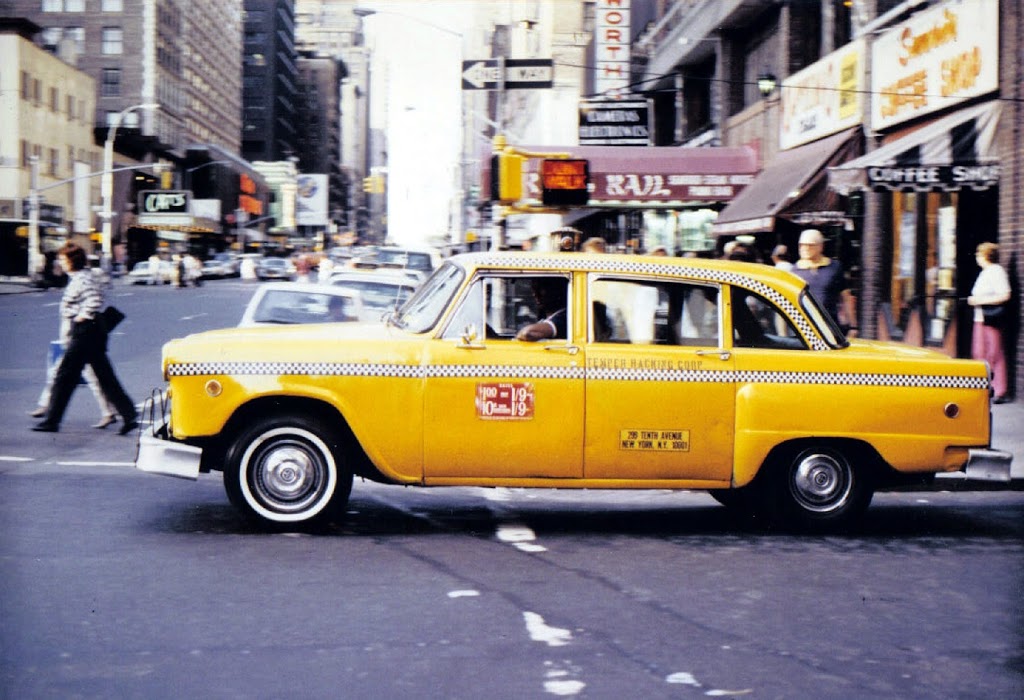
18. Things are looking up for Kermit when he is suddenly hit by a cab in front of Madison Square Garden. And not just any cab, but a Checker Taxi, which had actually ceased manufacturing in 1982. They stayed on city streets for several years after. According to the New York Times, there were ten left in 1993. The final one left service in 1999. Photo above courtesy Inside New York.
19.Kermit’s accident gave him amnesia, and confused about his identity, he gets a job at Mad Ave Advertising, a Madison Avenue advertising firm. Decades before Mad Men, Kermit is immediately thrown into pitch meetings, displaying a Don Draper-like salesmanship. Unlike the offices of Sterling Cooper, female frogs seem to be treated equally. (At least in name — Bill, Gil and Jill.)
1982 was a turbulent year for New York advertising firms with dozens of buyouts and mergers, including one between Madison Avenue’s two largest firms — Saatchi and Saatchi and Compton Advertising — worth over a billion and a half dollars. Given that Mad Ave Advertising is seeking the assistance of an amnesia patient, it doesn’t seem like this firm will be long for this world.
20. The Muppets tear through Manhattan, looking for Kermit. Scooter races his bike by the Shubert Theater and its smash hit A Chorus Line. In September 1983, the show became Broadway’s longest-running show of its day. By the time The Muppets Take Manhattan opened in movie theaters, a movie version of Chorus was already begun filming in New York.
Other Muppets search the New York Public Library, Central Park, even the sewer.
But it’s Gonzo that gets the privilege of interrupting Mayor Ed Koch during a press conference at Gracie Mansion.
Gonzo: I’m looking for a frog that can sing and dance! Koch: If he can also balance the budget, then I’ll hire him.
Koch had a special affection for Gracie Mansion, throwing weekly dinner parties there and organizing press conferences on the porch. Having the mayor of New York live elsewhere, said Koch, would be “like asking the president not to live at the White House.” [source]
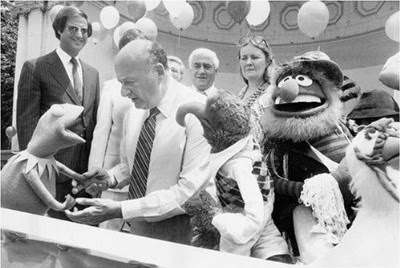
The mayor made several appearances with the Muppets throughout his tenure. The mayor’s itinerary from June 28, 1984 reads as follows: “Courtesy call with Yasushi Oshima, Mayor of Osaka, Japan; views new uniforms for Taxi and Limousine Commission inspectors; accepts check for $500,000 donated by Mobil Corporation for the Summer Youth Employment Program’s Clean Team; attends Financial Control Board meeting; drops in at reception celebrating the opening of The Muppets Take Manhattan.”
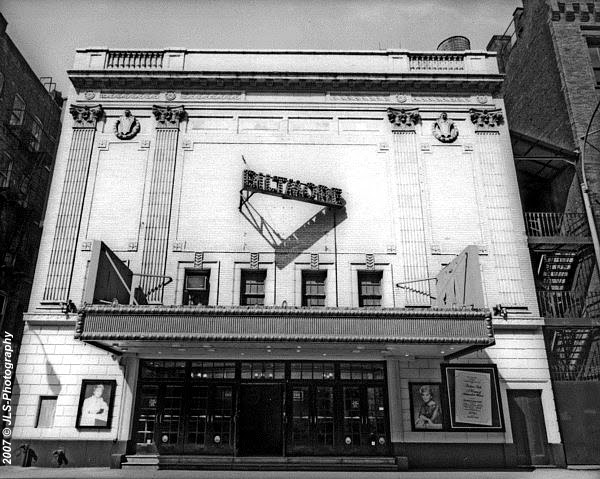
The Biltmore Theater in 1944
21. Finally, Manhattan Melodies opens! And on a swanky stage too — the Biltmore Theater. A stage that unfortunately is on its last legs in the film.
The Biltmore opened in 1925 and hosted dozens of shows in Broadway’s golden years. After briefly becoming a CBS television studio, it reverted back to live theater and was most notably the home for the Broadway transfer of Hairin 1968. The line-up of shows that appeared here in the early 1980s include Deathtrap with Victor Garber and the Garry Trudeau-written musical Doonesbury.
However, in 1987, the theater was ravaged by fire, most likely arson. According to the New York Times report, “Hypodermic needles were found inside the theater, indicating that drug users may have been using it as a shooting gallery, and storage lockers had been rifled.”
The theater finally reopened in 2008 — under the ownership of the Manhattan Theatre Club — as the Samuel J. Friedman Theatre, named for the renown Broadway publicist.
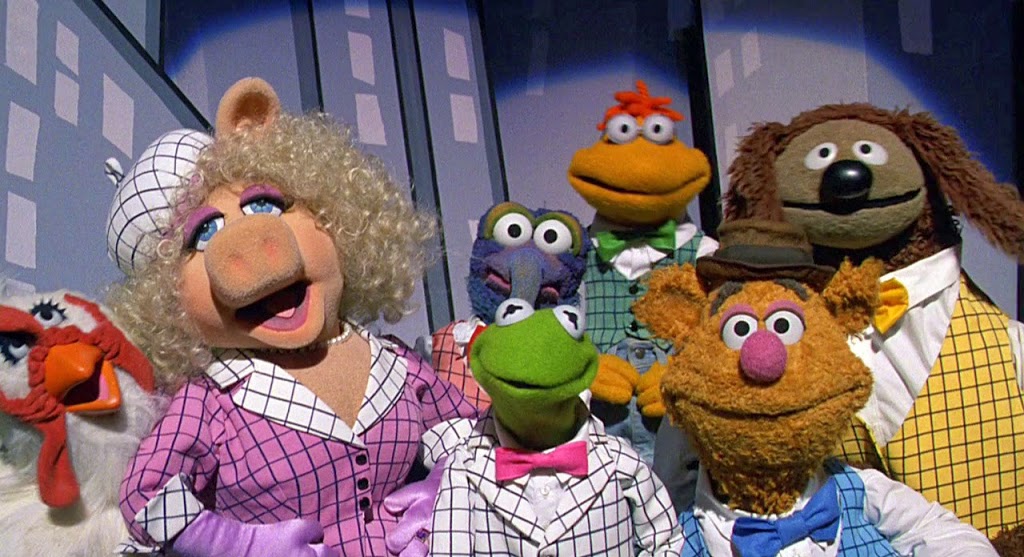
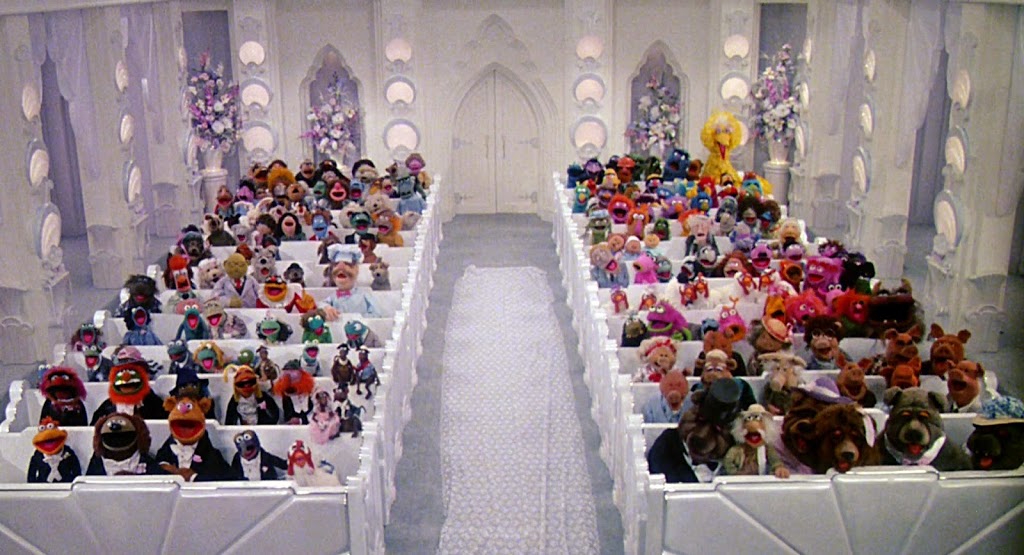
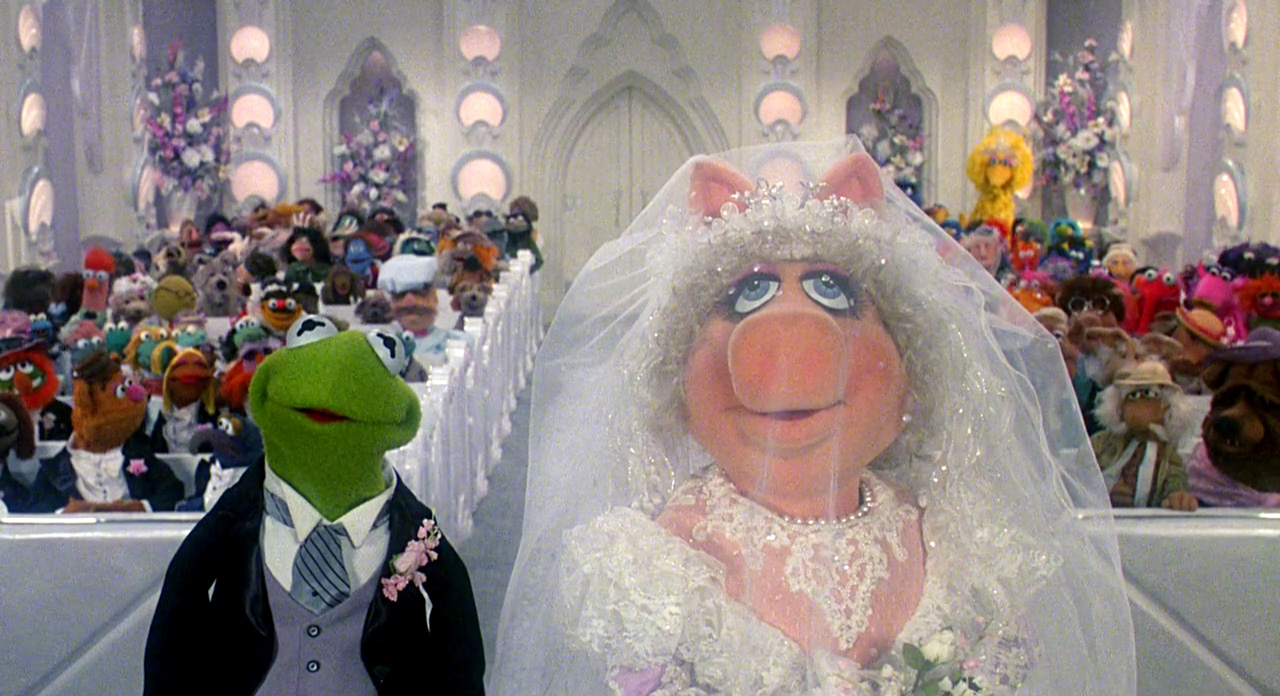
As quickly as the show begins, however we cut to a shot of a wedding chapel for the nuptials of Kermit and Piggy. Nearly all the existing Muppets appear in this scene. (Muppets Wiki actually has a complete seating chart.) Piggy’s gown gives a subtle nod to that of Princess Diana’s when she wed Charles in 1981.
AFTERWORD: The Muppets Take Manhattan was a modest box office success when it opened in July 1984. The film was up for the Academy Award for Best Music, Original Song Score. But the film lost the award to Prince for Purple Rain.
The artist took to the stage wearing a garment which Miss Piggy would have desperately coveted:
My thanks to the Muppets Wiki for the inspiration for this article.. All images are courtesy Tri-Star Pictures/Jim Henson
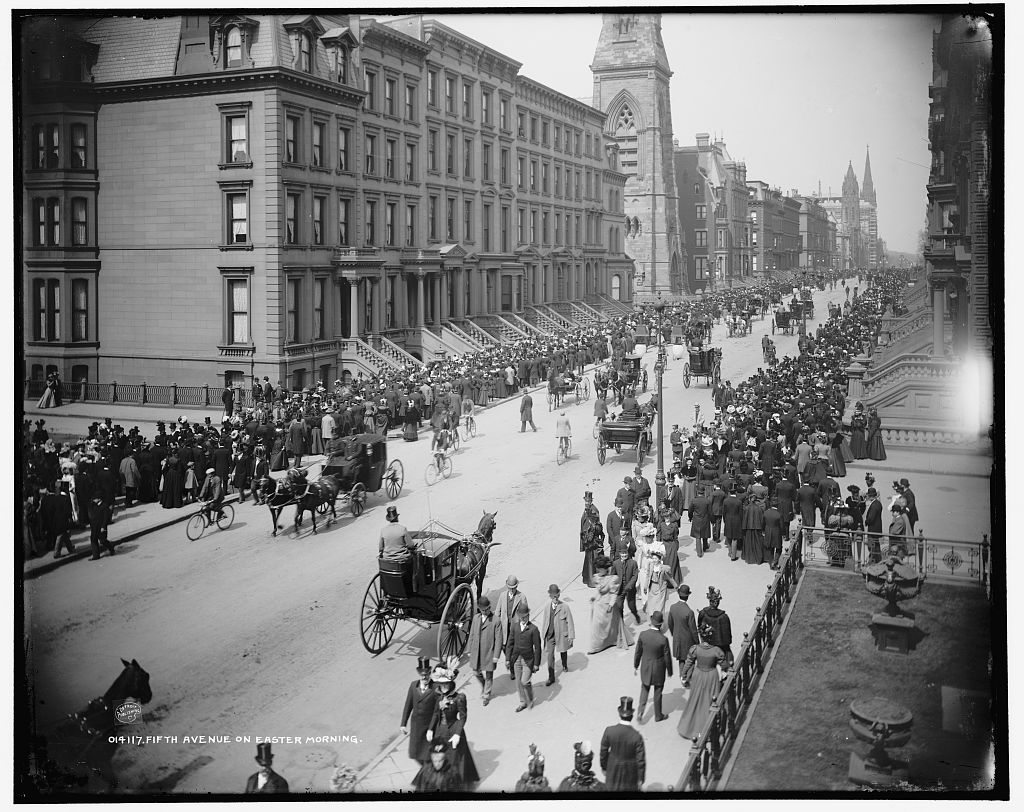
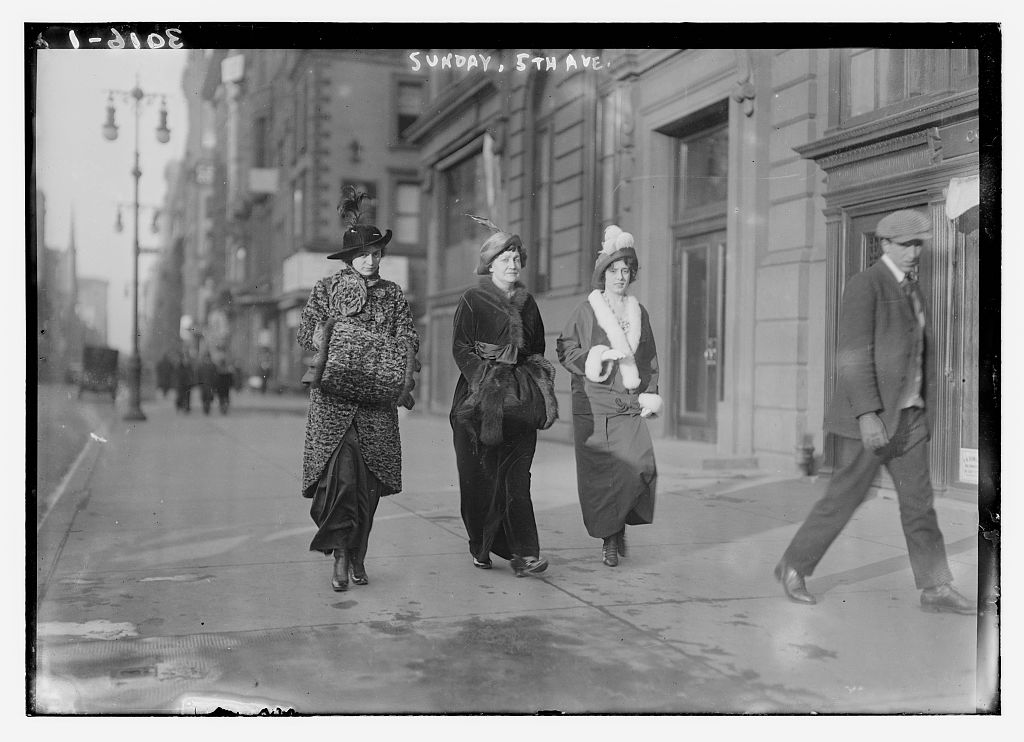
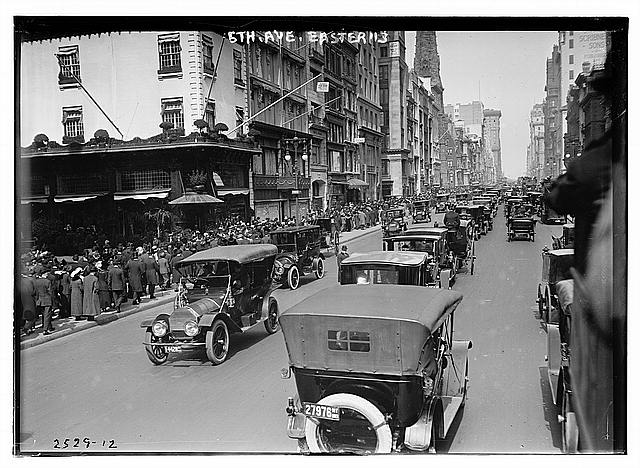
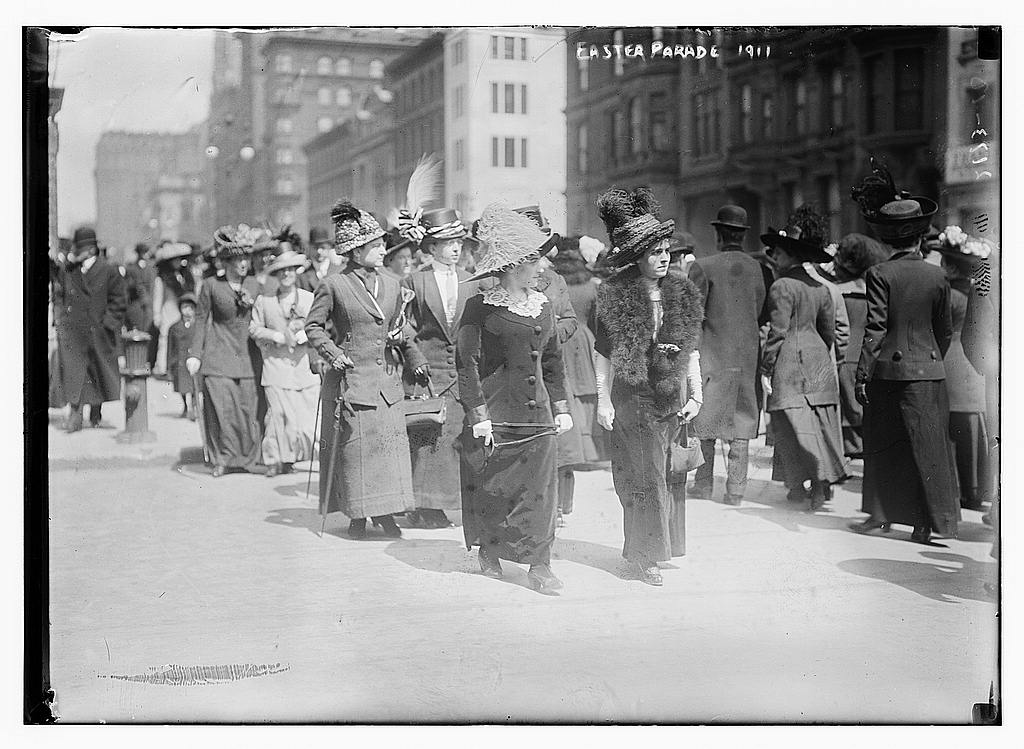
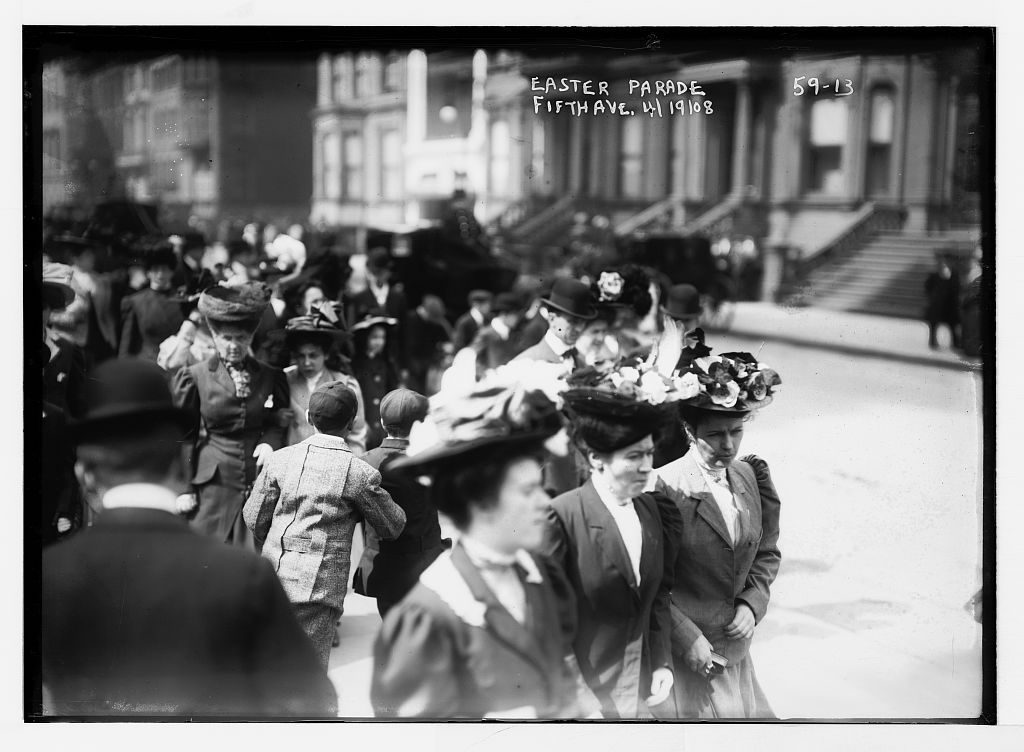
For almost 150 years, budding fashionistas have been prancing up and down Fifth Avenue on Easter Sunday, displaying elaborate bonnets, hairdos and colorful outfits.
Library of Congress
Given that modern holiday celebrations are often relatively new (for instance, trick-or-treating has only been a common activity on Halloween since the 1950s), this decorative practice located at this particular spot in Manhattan enjoys a commendable longevity.
In fact, this indulgent fashion parade is far older than most of the buildings in midtown. After all, people have been dressing up and going to church — and doing so with vanity — since the city was born.
Old Fashioned Trends
According to this 1905 article in Harper’s Weekly, the display of Easter finery may have begun as early as the Dutch days along the streets of the most fashionable churches. When the British came along, that tradition continued along Broadway around Trinity Church in lower Manhattan.
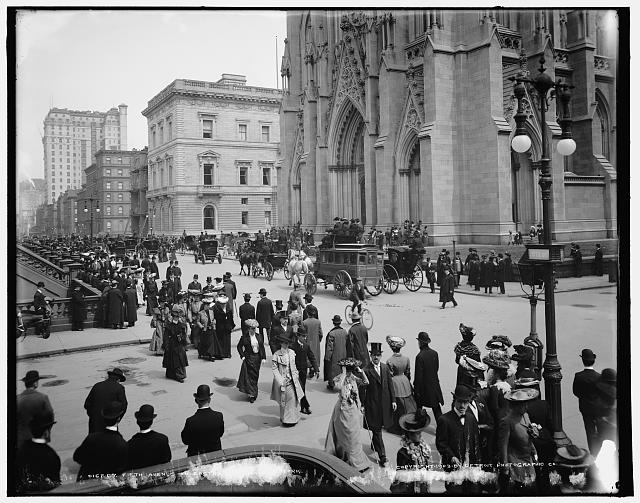
By the time St. Patrick’s Cathedral was finally opened in 1879, the wealthiest New Yorkers were already on Fifth Avenue in their lavish townhouses. The cavalcade naturally migrated here, whether the costumed were congregants there or not.
With the addition of Saint Thomas Church on 53rd Street (built in 1914), Fifth Avenue became even further inundated with Easter elegance.
Flocking in fashion
Even by 1905, the Easter bonnet parade had become an overwhelmingly popular and even cumbersome affair, equatable to weekday rush hour:
“Such a vast number of people come on Easter to see the Fifth Avenue churchgoers walk home from the church that the Avenue, in the Fifties, begins at noon to feel like Park Row at 5 o’clock, when the Brooklynites begin to feel for the Brooklyn entrance.”
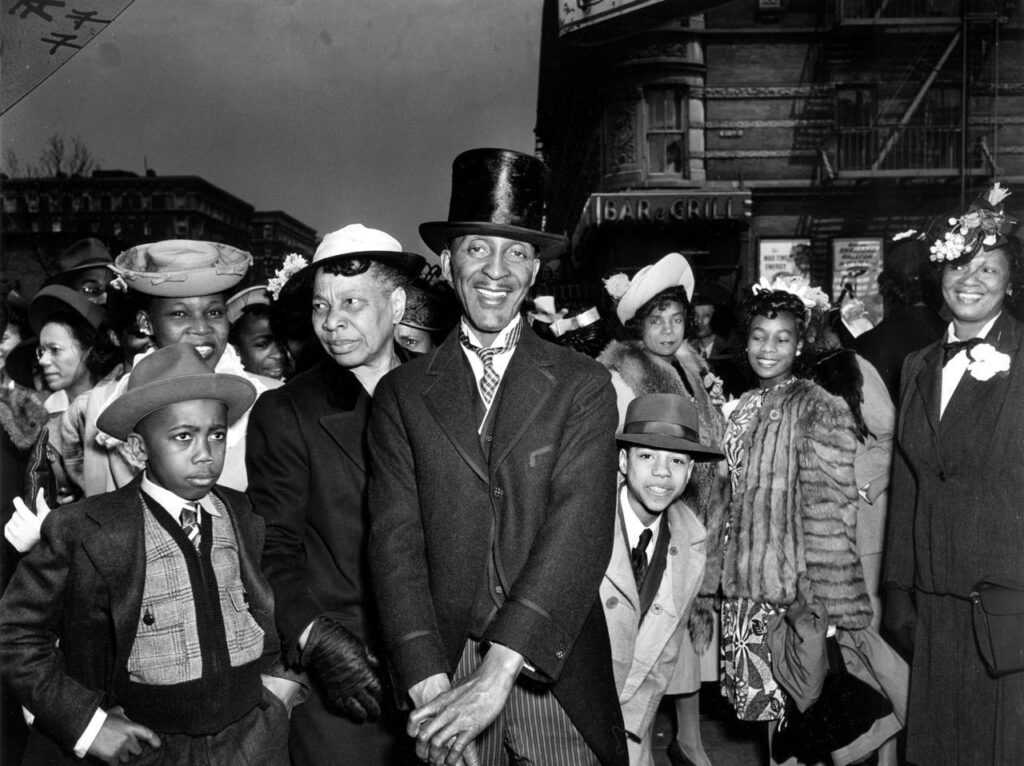
A similar Easter tradition was developing in Harlem by the 1910s. Legendary photographer Weegee captured this moment in 1943.
Parading Influence
The annual Fifth Avenue hat show existed before Saks Fifth Avenue department store, before Rockefeller Center, before any tony Fifth Avenue shops. The affair even influenced fashion for the rest of the year.
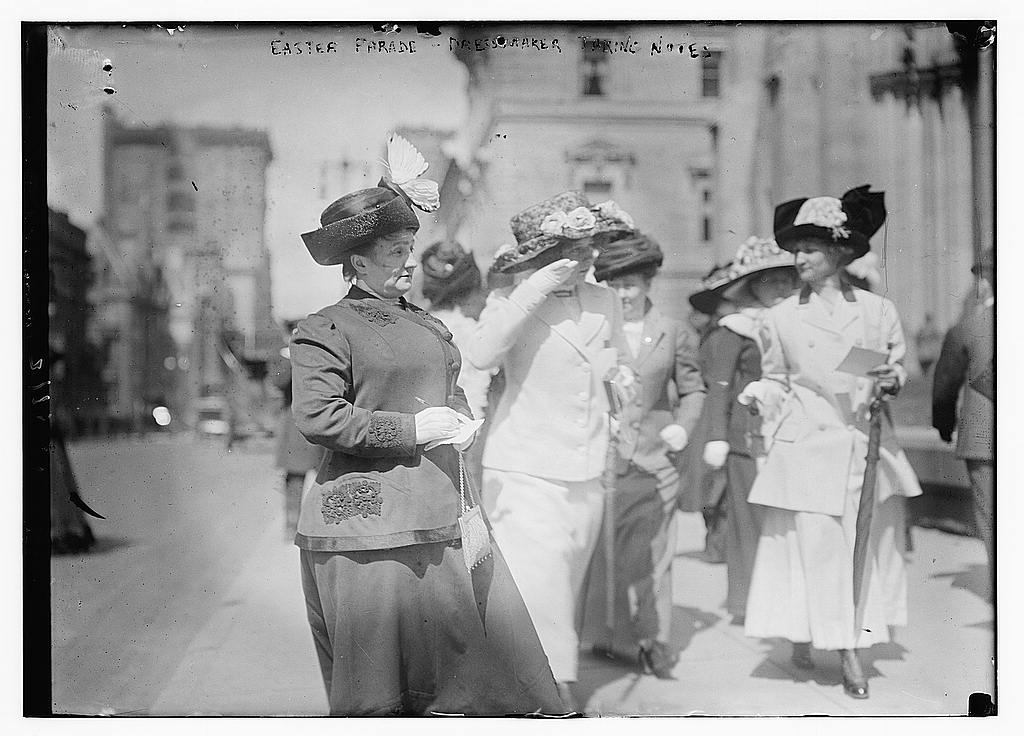
According to author Nathan Silver, designers and illustrators would flock to the bonnet show for inspiration. “Sketches were copied by garment makers on the Lower East Side and photos were circulated to newspapers all over the country.”
Taking arduous notes at the 1900 Easter Parade. Library of Congress.
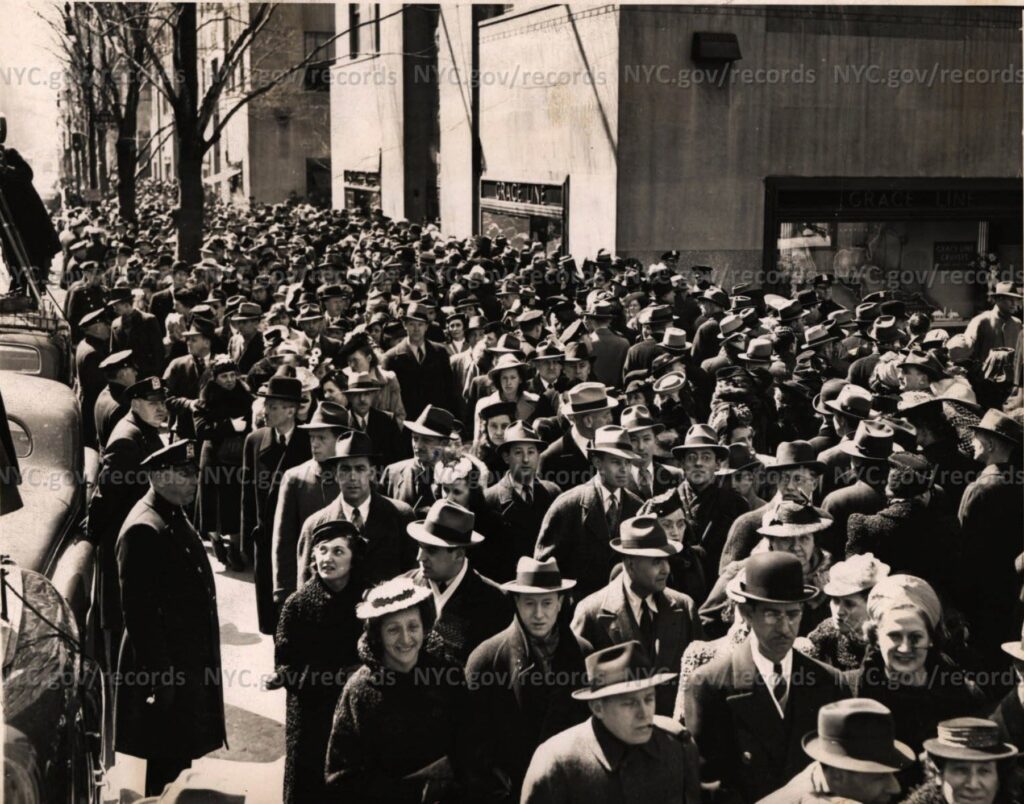
In the 20th century, as the midtown Fifth Avenue mansions were torn down and their wealthy residents moved uptown, the Easter Parade became more tourist-friendly. Not many bonnets here in this New York City Department of Records photo from the mid 1930s!
The Sunday procession was such an ingrained tradition that it’s referenced in one of Irving Berlin’s most famous songs — “Easter Parade” — when later became a colorful Hollywood musical of the same name.
Parading During a Pandemic
This year’s Easter Parade will be online only — but you can win a prize (if you post yourself in a fabulous frock on Instagram and use hashtag #EasteronFifth). Follow @fifthavenue there and visit their website for more information.
OR just sit back in your commons clothes and enjoy these images of Easter Parades gone by, courtesy the Bain Collection/Library of Congress:
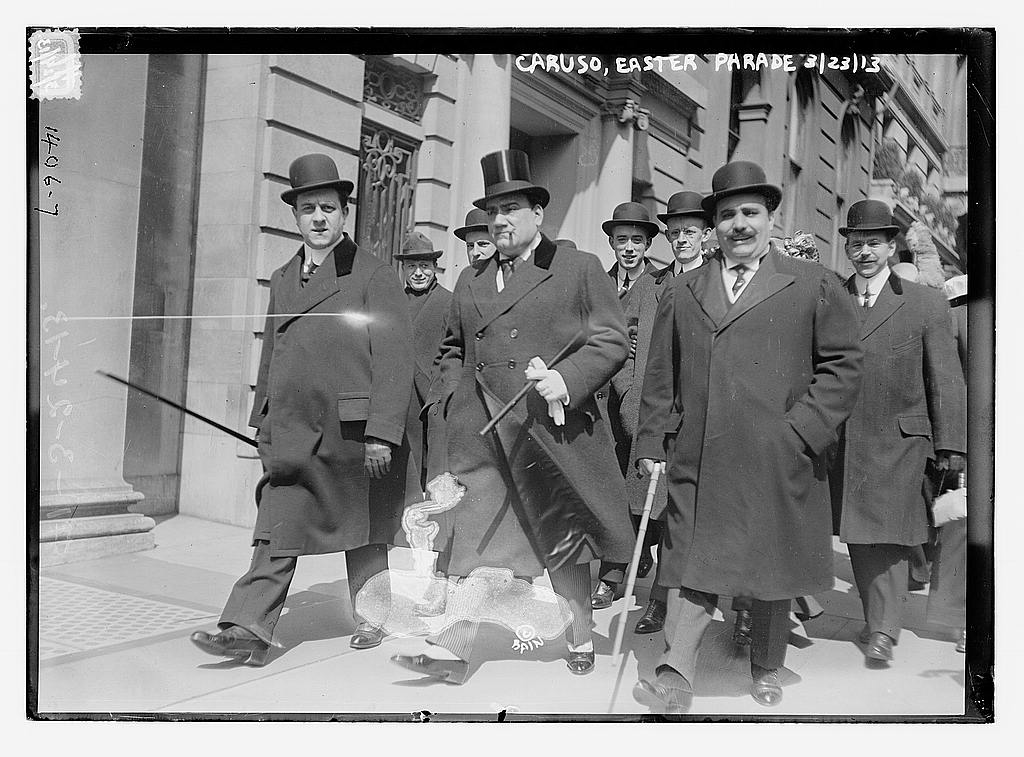
Even famous folks got in the act! Here’s Enrico Caruso on Easter 1913. Library of CongressI love this ‘action shot’ of the Easter Parade with a couple boys going against the tide. (LOC)
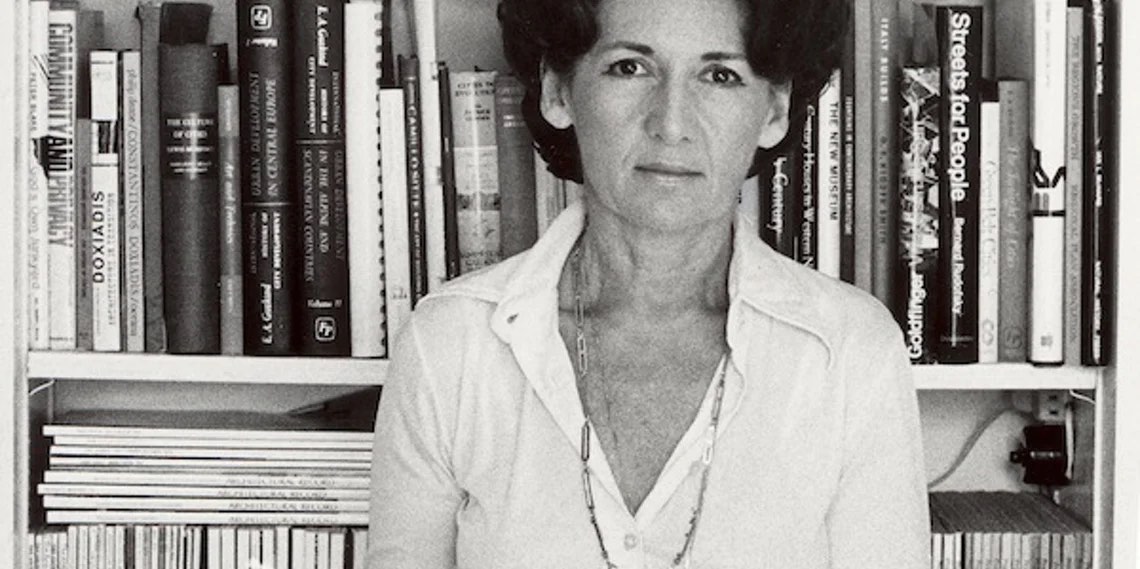
Ada Louise Huxtable, born 100 years ago today, redefined the field of architecture writing, first for the New York Times and then for the Wall Street Journal until her death in 2013.
We really can’t do a podcast an any building in the 20th century without first checking in with Ada to see what she has to say on the matter.
Her writing is elegant, persnickety, direct and affectionate to architectural aesthetic as a whole, and New York City in specific.
Here’s what she’s said over the years regarding a few Manhattan projects:
On her favorites:
“I like old buildings that are intriguing and quite wonderful but don’t make the history books. What you discover is there’s a little group of people that have been admiring them quietly by themselves all along.” [Metropolis Magazine]
On Rockefeller Center:
“If you look at Rockefeller Center in detail, it’s a very elegant plan: higher and lower levels that lead you from one to the other, streets cut through to keep the human scale. You always feel you’re going around a corner, not around a wind-swept plaza, into some other area that has an inviting activity.
First of all, Rockefeller Center was privately planned. It was planned for profit; it was a hard-nosed thing, and of course during the Depression it had to be rejiggered completely because it lost its anchor tenant, the Metropolitan Opera.
But while Rockefeller insisted on a certain return of profit, he did hire the best architects and let them alone, and they combined Beaux-Arts and modernist principles into a really complex, humanistic urban plan.” [New York Times]
“This was an example of how you had to balance good against bad, past against future, reuse against what would happen to the building. The preservationists proved not only incapable of discussing it, but went into paranoia mode. I think the whole movement seems to be doing that.
Of course it was a complex issue but they should have been able to sort it out. And then to compare — you always get one crazy directing these things who has the quality of leadership — [Edward Durell] Stone’s poor little lollipop building to the loss of Penn Station! They were really doing this!” [Metropolis Magazine]
On 1001 Fifth Ave:
“The ‘honest,’ or tongue-in-cheek, gesture of stopping the moldings short of the sides of the building may be amusing for those in the know, but their use just seems unresolved. It does not help that the moldings look like sliced-off Tootsie Rolls.” [Her 1985 book, Architecture Anyone?]
On the original plan for Moynihan Station:
“It is hard to believe that teams with this much financial heft and assembled star power could come up with something so awesomely bad.” [New Penn Station]
On Trump International Hotel and Tower:
“The reasoning here seems to be that if a ship-shaped glass structure is a success in Hartford (the Phoenix Mutual Life Insurance Building by Wallace Harrison) and circular apartment towers made history in Chicago (Marina City by Bertrand Goldberg), New York can go two cities one better by building both, one on top of the other.” [ New York City Architecture]
On the Jacob K. Javits Federal Office Building:
“One of the most monumentally mediocre Federal buildings in history” [New York Architecture]
On the Pan Am Building:
“The Pan Am is a colossal collection of minimums. Its exterior and public spaces used a minimum of good materials of minimum acceptable quality executed with a minimum of imagination (always an expensive commodity), or distinction (which comes high) or finesse (which costs more). Pan Am is gigantically second-rate….a lesson in how to be mediocre without really trying. A monumental deal does not make it monumental. [from the Pan Am Building and the Shattering of the Modernist Dream]
On the South Street Seaport:
“I know what a fiasco that South Street Seaport plan turned out. I remember when they actually tore down the most important part of the seaport, Peck Slip, which had the oldest and most wonderful buildings. And those were demolished to make way for some Con Edison industrial addition.
Then they decided the heart of the seaport was Schermerhorn Row. Then they brought in the Rouse corporation to tie the place together with a shopping center. And Rouse said you have to have so many contiguous feet of shopping or it doesn’t work. So that meant that things had to be moved, torn down, adjusted, and look what we ended up with. I am exceptionally grateful for every inch that got saved. My basic preservation philosophy is: Change it but don’t destroy it.” [New York Times]
On the original World Trade Center:
“Port Authority has built the ultimate Disneyland fairytale blockbuster….the world’s daintiest architecture for the world’s biggest buildings.”
On the elimination of elements from the re-designed Freedom Tower:
“Because the entitlements of loss and grief are the third rail of the rebuilding effort, no one has challenged the subversion of the aims and intent of the plan. The parts that speak of hope and the future have not been able to survive the pressure for a singleminded commitment to the tragic past.
“Even at Ground Zero, not all the bereaved share the sentiments of the most politically active survivors. Some quietly want to get on with their lives, and there are those who would like to see a more constructive renewal as an antidote to grief.” [Wall Street Journal]
On Grand Central Terminal:
“To sit at the one small restaurant on the west balcony is to long for more. Rising into those vast heights is the buzz of all the voices of travelers and transients mingling in the upper air. Shafts of sunlight pierce long shadows, spotlighting the moving figures on the floor. The soft, susurring sound transforms activity and motion into a shared experience; it contains the timeless promise of the city’s, and the world’s, pleasures and adventures. This is the essence of urbanity.” [New York Times, November 28, 1994]
On the most beautiful architectural view in Manhattan in 1968:
“For a demonstration of New York at its physical best, go to Broadway between Cedar and Liberty Streets and face east. This small segment of New York compares in effect and elegance with any celebrated Renaissance plaza or Baroque vista” [New York Sun]
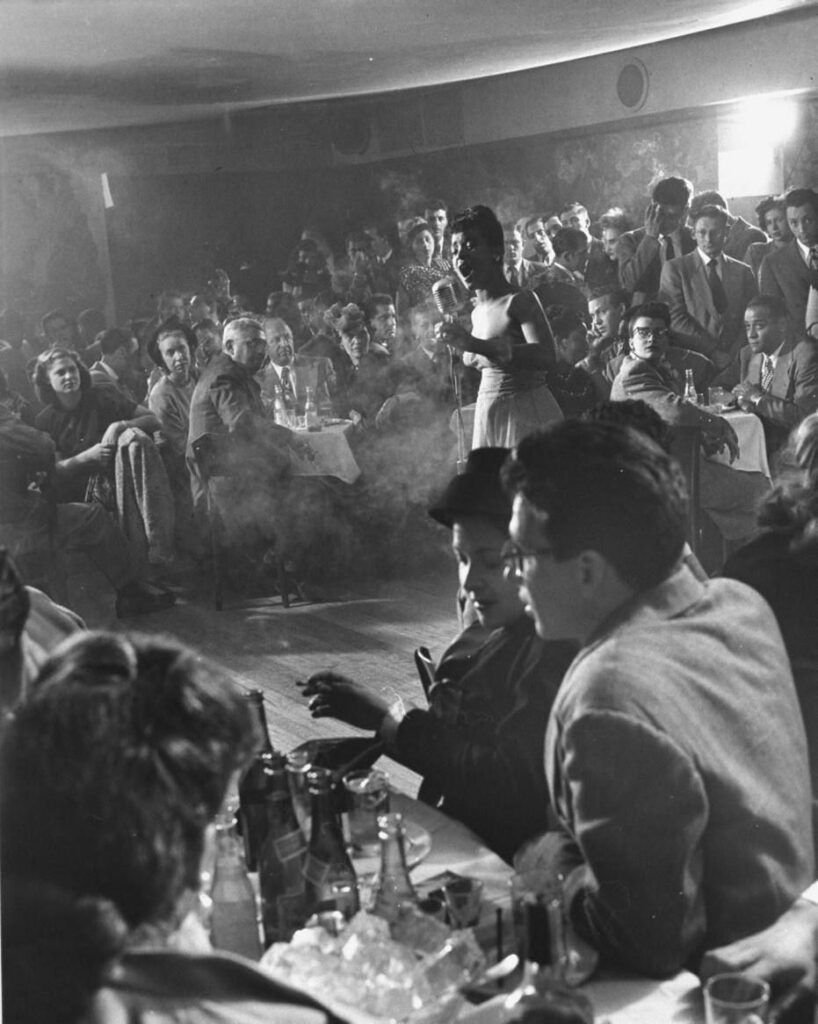
There once was a modest basement nightclub in an old West Village building which opened the door to a revolutionary (and now obvious) idea in New York City music and delivered one of the most significant moments in all of music history.
In the 30s Midtown Manhattan clubs were alight with the bourgeoisie, tuxes and evening gowns, tables and banquettes of rich white people drinking champagne, and often entertained by Black performers borrowed from the Harlem music scene.
It was putting on the ritz, it was dancing cheek to cheek.
It was embodied within the phrase ‘cafésociety‘, coined by the one of the scene’s wittier celebrities Claire Booth Luce, playwright of The Women and a darling toast of Broadway.
But there was also something saccharine and square — and segregated — about those Midtown haunts. Things were wound too tightly.
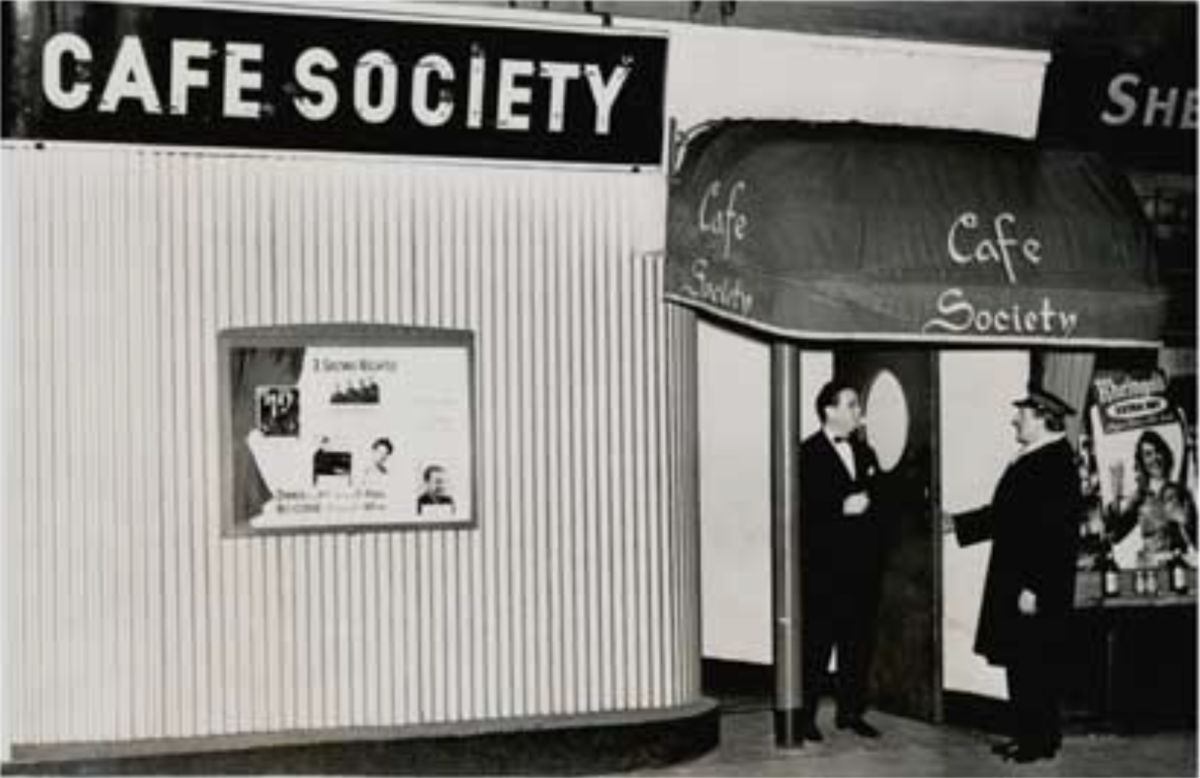
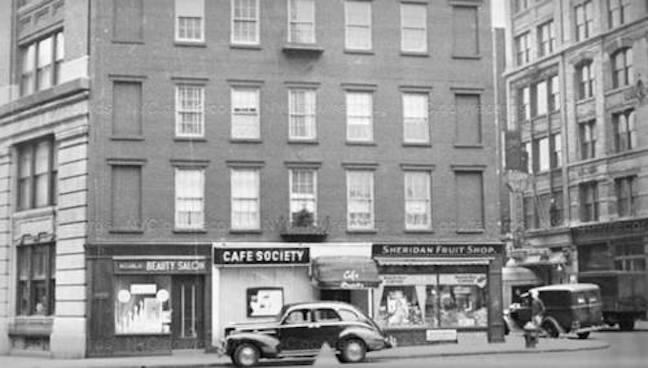
What would become one of the New York music world’s most fertile spots for musical innovation was far, far downtown from the ‘real’ nightlife — at 1 Sheridan Square in the West Village.
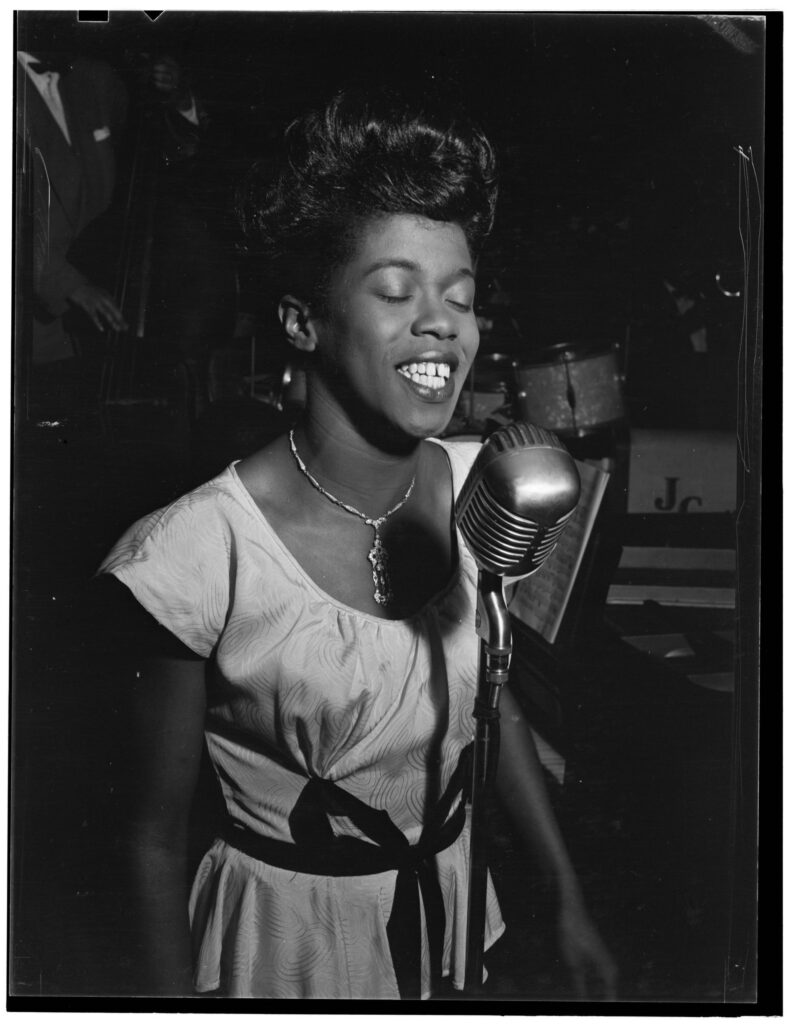
Portrait of Sarah Vaughan, Café Society (Downtown), ca. Aug. 1946], photo by William Gottlieb, courtesy Library of Congress
Café Counter Culture
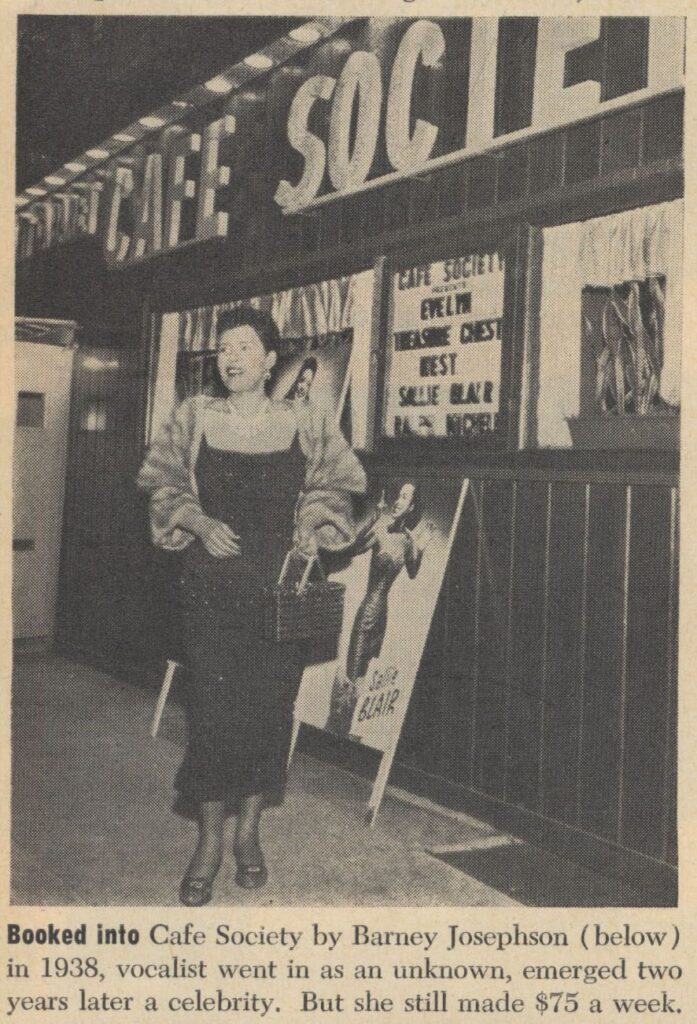
New Jersey shoe salesman Barney Josephson had an affinity for jazz music — partially grown from visiting the bawdy clubs of underground Berlin — but grew irritated at the race segregation, which even occurred in Harlem, at places like The Cotton Club.
Josephson envisioned a venue where musicians of any color could perform — and audiences of any color could enjoy it — but such a notion seemed to fly in the face of modern ‘café society’ culture.
“I wanted a club where blacks and whites worked together behind the footlights and sat together out front. There wasn’t, so far as I know, a place like that in New York or in the whole country.”
So, acquiring his Greenwich Village location, what a better name to call this rather kooky experiment than Café Society?
Luce, knowing good irony when she saw it, even encouraged the bar’s lusty slogan: The wrong place for the right people.
Jon Mili/The LIFE Picture Collection/Getty Images
Open (To All) For Business
Opening on December 18, 1938,Café Society was festooned in wacky caricatures of music stars, comedians and personalities of the age. Walls were muralled by creations from local artists.
The club doorman played with the notion of informal glamour, wearing a tattered top hat and white gloves with the fingertips ripped off.
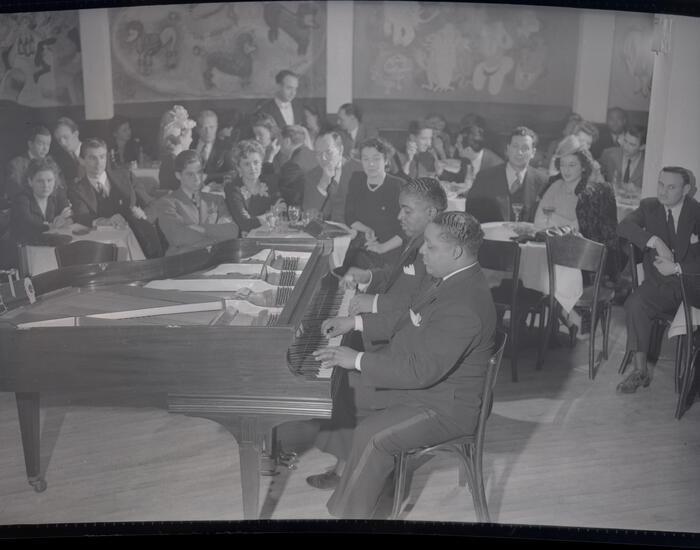
Below: The Boogie Woogie pianists, Cafe Society, 1941. Take note of the murals on the walls.
Frank Bauman/Look Magazine — Courtesy Museum of the City of New York
Josephson began hosting performers of all stripes, many taking to a mixed stage for the first time in their careers.
Over the course of its ten-year run — and that of a second location, coyly placed at 58th and Park — Josephson and his partners would host dozens of soon-to-be jazz stars, in many cases paving the way to their success.
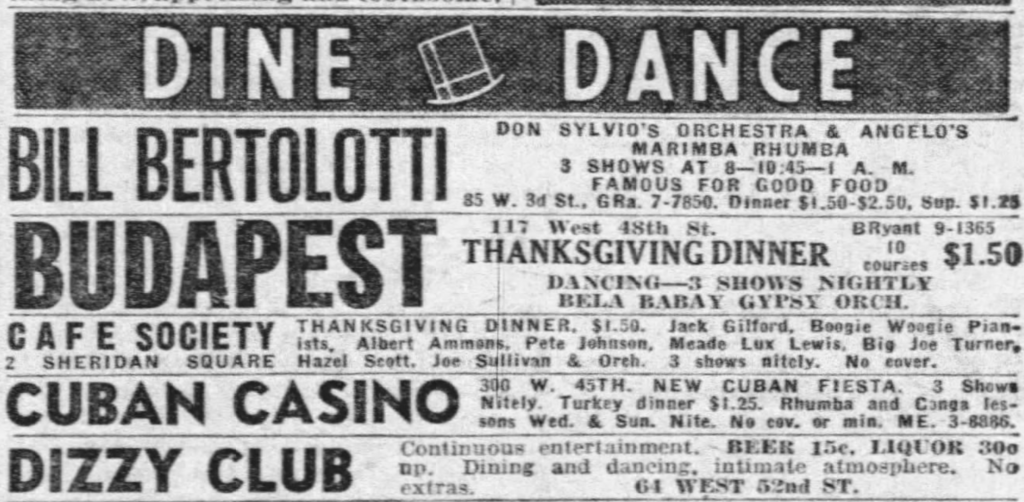
New York Daily News, November 22, 1939 (courtesy Newspapers.com
Art Tatum, Lena Horne, Sarah Vaughn, Mary Lou Williams, Lester Young, Burl Ives, the Golden Gate Quartet, Ella Fitzgerald — in fact its easier to make a list of jazz and pop music icons who didn’t perform there.
But Café Society’s biggest claim was there from the beginning.
On opening night, a young woman took to the microphone. She achieved some success on the New York stage by this point and had even snagged a recording contact with Columbia Records.
But the legend of Billie Holiday would begin here — on opening night.
A Song For Lady Day
To have Holiday as your in-house singer (for nine months!) would have been an honor enough.
To give her — and the world — a defining musical moment, well, that’s New York.
Café Society naturally took on a liberal, left-leaning clientele and with that, a political edge.
Josephson presented a song to Holiday that he had heard at political gatherings, a piercing tune about lynching, one that forcefully reminding listeners that violence and discrimination still very much existed outside the doors of his club.
Billie was originally indifferent to the song, written first as a poem “Bitter Fruit,” by a white Jewish schoolteacher Abel Meeropol; then after contemplating it, considered it too bold.
But she was eventually convinced to sing it, and on three consecutive nights early in 1939, Holliday ended her sets with the song — “Strange Fruit.”
A spotlight tightly focused on her face, she stunned the audience with its searing intensity.
Southern trees bear a strange fruit Blood on the leaves and blood at the root Black bodies swingin’ in the Southern breeze Strange fruit hangin’ from the poplar trees….
And then she left the stage, not returning to hear the thundering applause.
It was theater at its finest; thousands of less talented chanteuses would search to recapture the drama in dozens of Village clubs and cabarets, from then to today.
The Café Society ‘revolution’ would not last long.
Josephson’s brother Leon was being investigated for communist ties, and Barney soon felt the heat of J. Edgar Hoover and his House Un-American Activities Committee.
The FBI even staked out the clubs, photographing patrons, and Hoover soon ‘opened a file’ on Barney himself. Both locations of Café Society were closed by 1950.
But Josephson managed to pick himself up and soon opened another influential downtown jazz club, the Cookery, which stayed opened into the 1980s.
But for a moment, that gritty nightclub became the center of the musical universe.
Most music critics agree that Holiday’s original performances of ‘Strange Fruit’ at Café Society are among the most influential musical moments of 20th century and basically constitute the birth of political activism in popular music.
You can visit the location of the former Café Society simply by taking the subway to Sheridan Square (actually a triangle) and going to its eastern side.
PODCAST One of America’s most important books was published 225 years ago this year.
You won’t find it on a shelf of great American literature. It was not written by a great man of letters, but somebody who described herself simply as ‘an American orphan.’
EPISODE 354 In 1796 a mysterious woman named Amelia Simmons published American Cookery, the first compilation of recipes (or receipts) using such previously unknown items as corn, pumpkins and “pearl ash” (similar to baking powder).
This book changed the direction of fine eating in the newly established United States of America.
But Amelia herself remains an elusive creator. Who was this person who would have so much influence over the American diet?
Join Greg through a tour of 70 years of early American eating, identifying the true melting pot of delicious flavors — Dutch, Native American, Spanish, Caribbean and African — that transformed early English colonial cooking into something uniquely American.
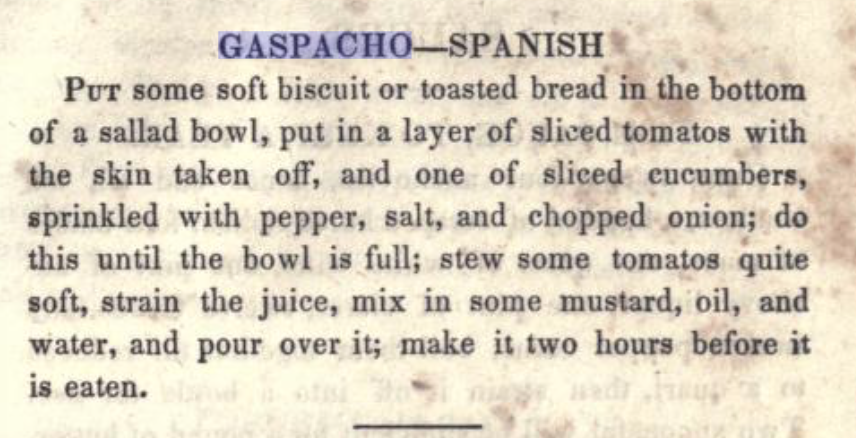
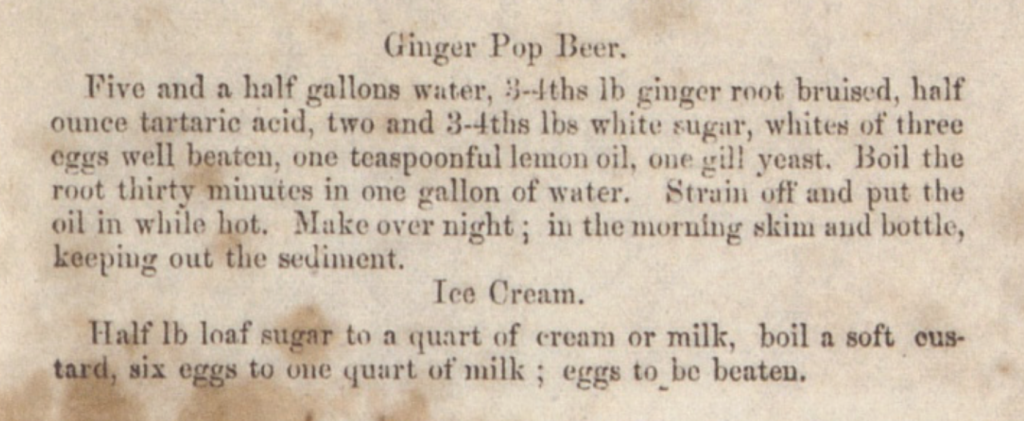
FEATURING early American recipes for johnnycakes, slapjacks and gazpacho!
Listen to WHO WROTE THE FIRST AMERICAN COOKBOOK? on your favorite podcast player or from the player below:
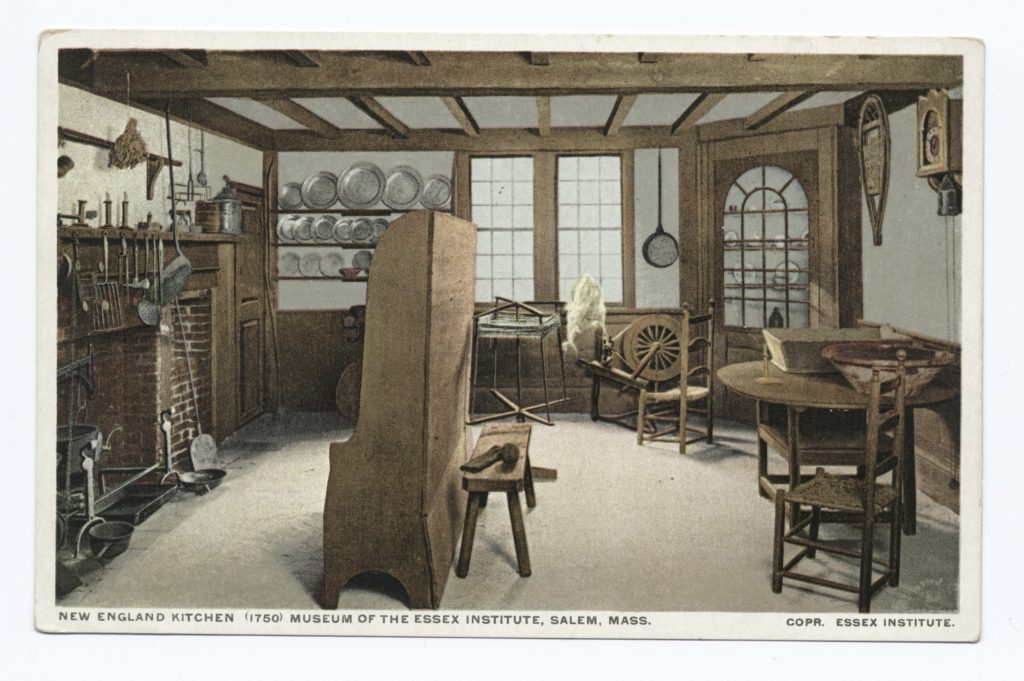
Pictured below: A postcard of a New England kitchen (1750), from the Museum of the Essex Institute, Salem, Massachusetts (and courtesy the New York Public Library)
To check out the recipes from all the cookbooks mentioned on this show, just click on the link below —
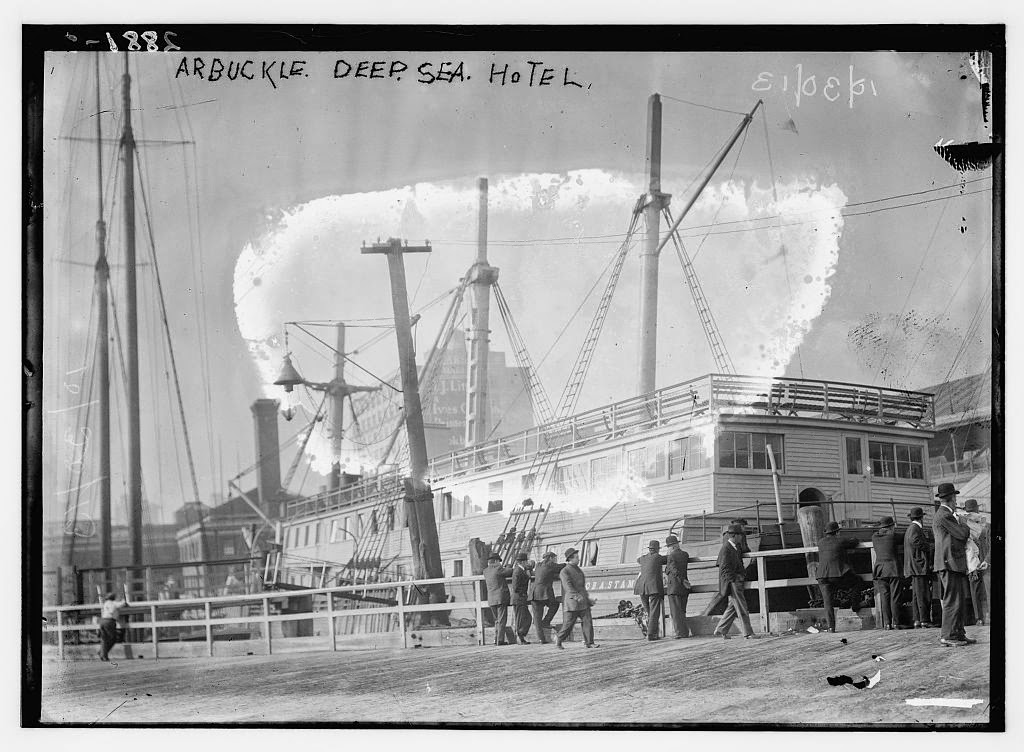
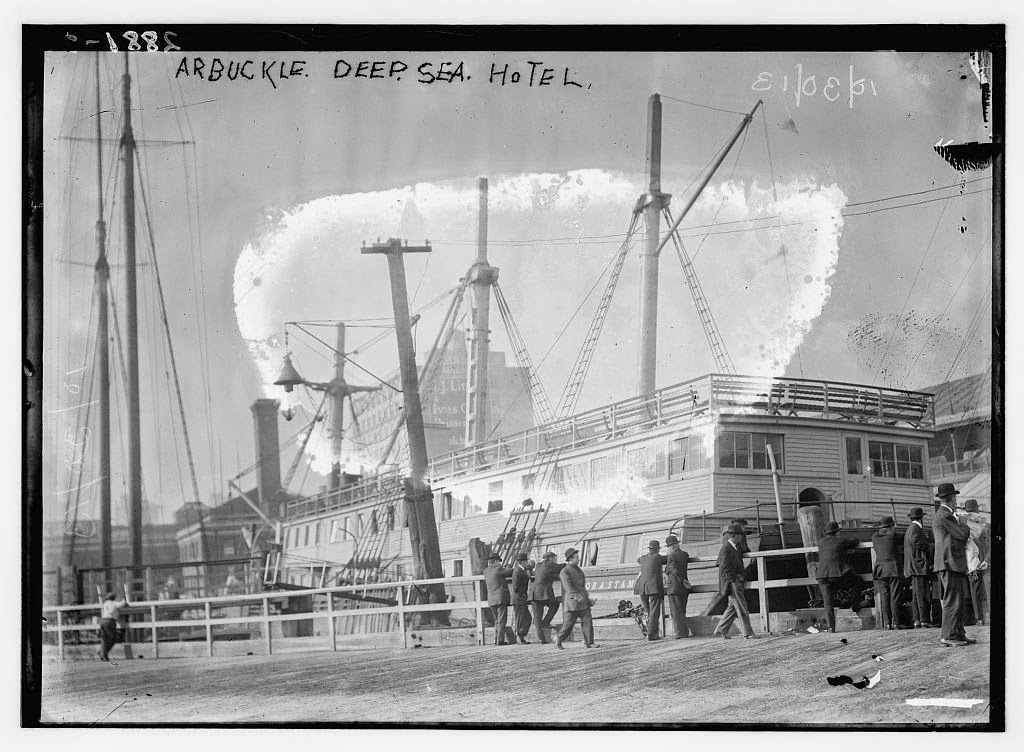
Arbuckle’s Deep Sea Hotel was neither in the deep sea, nor was it a hotel. But for hundreds of young, single women at the end of the Gilded Age, it was home.
The boat hotel built by a coffee manufacturer, photo from January 1913 (Library of Congress)
The Challenges of Living Single
Accommodations were indeed limited for the thousands of young single women who arrived in New York City at the start of the 20th century.
Wealthier single ladies could enjoy a degree of independence by indulging in fashionable apartment living. Affordable options like boarding houses were often socially binding.
For instance, the morality-minded YWCA housed hundreds of New York women by the 1890s. It was often too expensive to rent on your own place, even with roommates, and the neighborhoods where such housing was available would not have been too desirable.
Enter Brooklyn coffee millionaire John Arbuckle.
A Caffeine Jolt
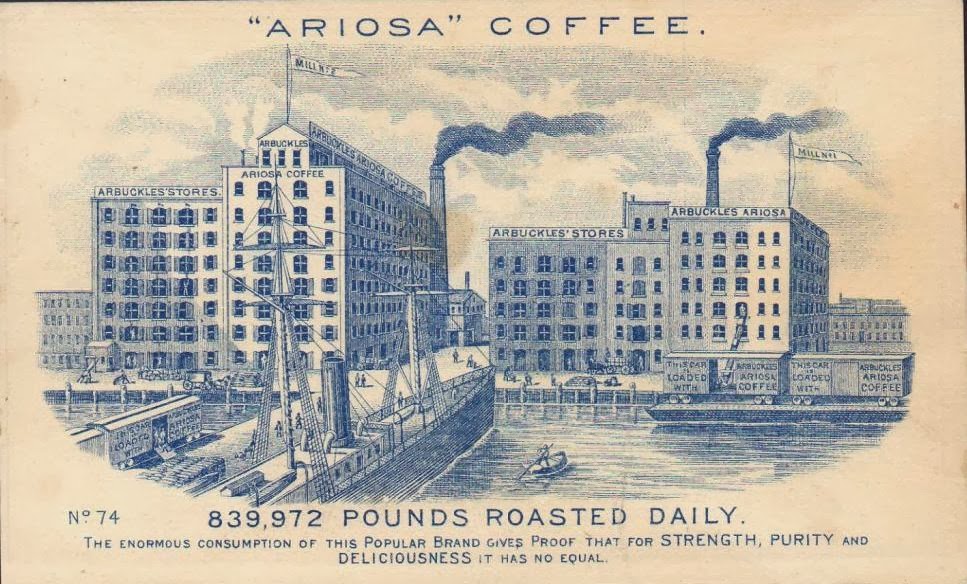
The sugar manufacturer, already a chief competitor of William Havemayer, innovated the mass production of coffee by the 1890s, making himself extremely wealthy and jumpstarting America’s love affair with coffee in the process.
In emulation of other progressive-minded New York philanthropists, Arbuckle commissioned free water-bound excursions for the overcrowded poor of the Lower East Side.
However, when a steamboat owned by another company — thePS General Slocum— exploded during one such excursion in 1904, killing over 1,000 people, such trips quickly went out of fashion.
Arbuckle then decided to use one of his ships in a more unconventional way — a long-term hotel for single women.
The Floating Hotel
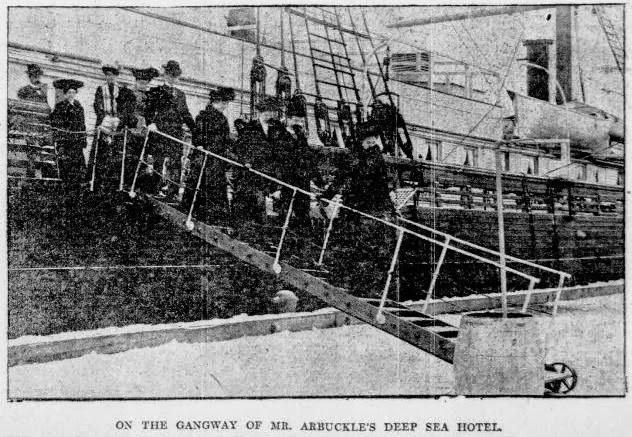
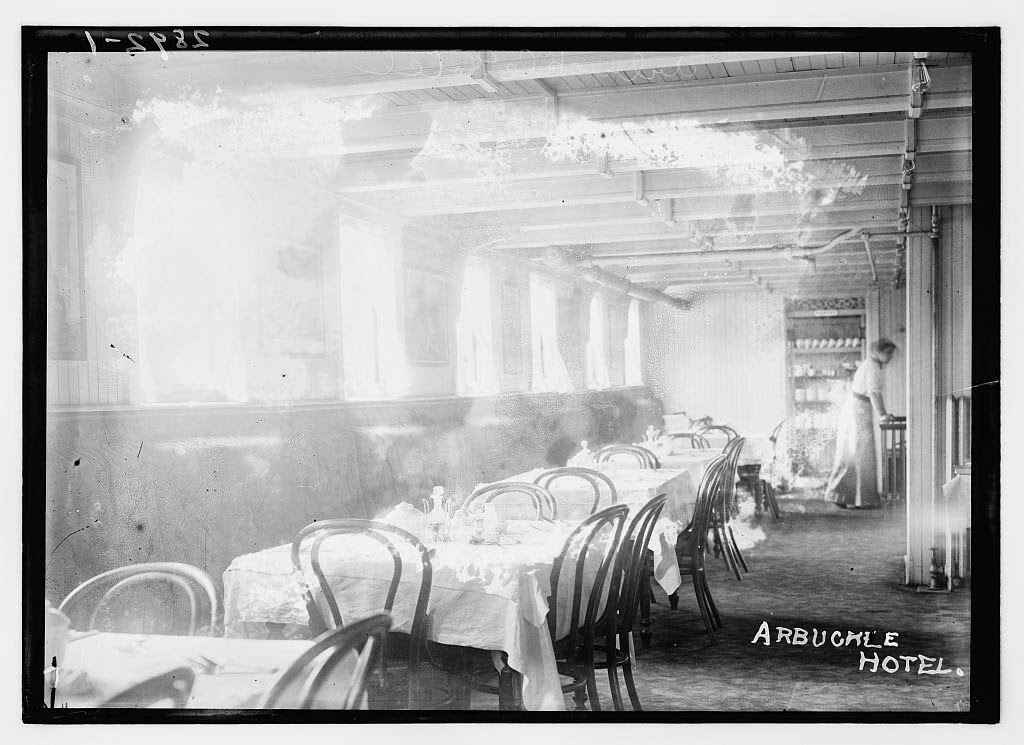
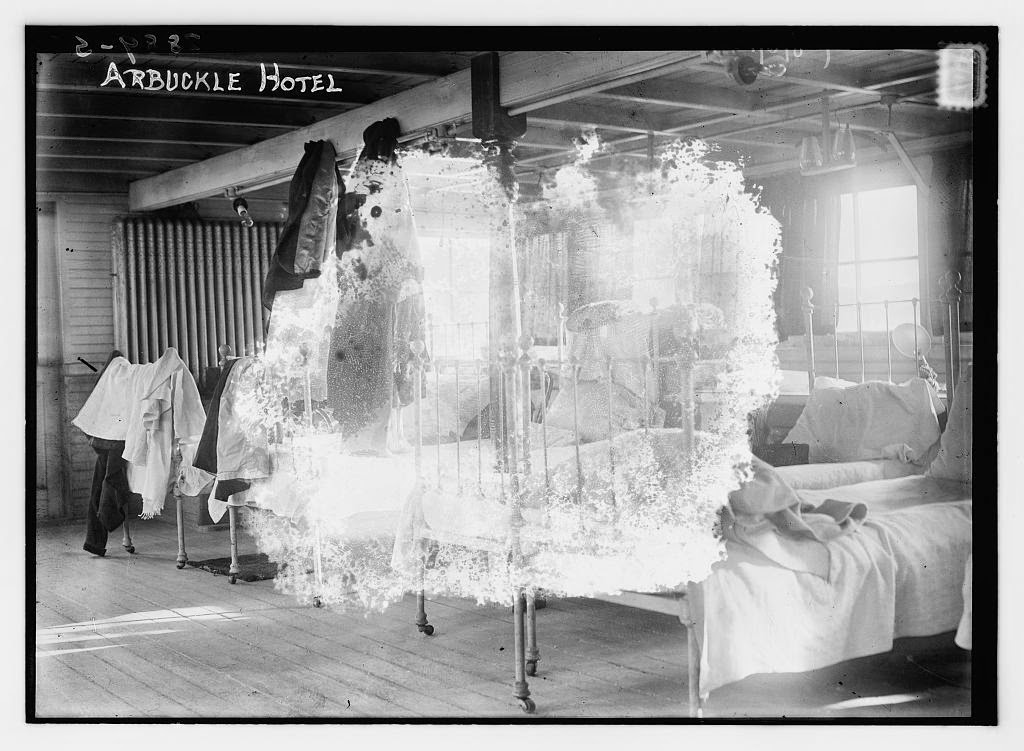
His ship the Jacob A. Stampler was turned into a floating hotel for one hundred women, with a smaller ship nearby for young working men. It was docked at West 21 Street on the Hudson River, near the massive piers for passengers liners.
“The fundamental idea of this hotel scheme,” according the New York Tribune in 1905, “is to benefit young men and young women who are receiving low wages and are striving to live respectable lives.”
In 1905, its first year of operation, women paid “40 cents a day, or $2.80 a week, while the young men pay 50 cents a day or $3.50 a week.” [source]
While both genders benefited from the unusual hotel idea, Arbuckle’s focus was in the assistance of women.
“A young fellow can fight for himself and get along his own way,” said the millionaire, “but it is different with a woman or girl confronted with problem of keeping herself respectable while working for low wages.”
The women were fed well and provided a selection of magazines and newspapers, not to mention a piano for Sunday evening sing-alongs. They were also given sewing machines and laundry facilities.
The rocking of the boat and the relative bustle of a busy pier seems not to have bothered Arbuckle’s early tenants.
“It’s so quiet here. No rattle and roar from the streets,” said one young woman. [source] Ladies could receive gentlemen callers, but men had to vacate by 10 pm. As many women worked quite late in the day, this probably didn’t amount to much socializing.
A House and a Vacation Home
During the summer, the boat actually did take regular trips to various places in the region, from Coney Island to the shore of Staten Island.
At some point, perhaps due to overwhelming traffic at the Chelsea piers, the Stampler made the east side its home, regularly docking at East 23rd Street.
The floating hotel never really made a profit, and after Arbuckle died in 1912, his inheritors attempted to shut it down.
I should also note that the Stampler was a very, very old boat.
“[The] ship was beginning to rot and soon would be unsafe,” said theNew York Sun. The women who lived there, however, fought successfully to keep it open until 1915, when they were finally told to permanently disembark.
Interesting fact to note about its final days — both single men and women lived aboard the boat by 1915.
Its last documented population was 50 girls and 16 boys, according to the Sun. (Most likely teenagers or adults in their early twenties.) The ship rarely sailed to Coney Island in the summer, but had become a destination in itself.
“One of the five decks is fitted up as a dance hall,” “crowded every night with dancers” when music from a nearby pier begins to play.
The price of rent these days!
The last tenants finally left on September 1, 1915, with many unable to find further housing. “There isn’t a girl on this boat that makes $9 a week,” said one mournful tenant, “and you know how far that goes in this city.” [source]
By 1917, the Stampler was a rotted breakwater off of Bayville Beach in Oyster Bay. To this day, perhaps, some remnant of the ship still sits in the water off the coast of Long Island.
By the way, Arbuckle may no longer sponsor floating housing accommodations for working people, but they still make coffee.
For more information on Arbuckle and the New York coffee scene, check out our podcast on the history of DUMBO:
Ozone Park, a quiet residential Queens neighborhood near Woodhaven, is one of those places created by real estate developers in the 1880s.
It happens to have one of the best neighborhood names in all of New York City. So where did it come from?
Ozone is a gas that exists as part of the Earth’s atmosphere and, more dangerously, as a component of ground-level pollutants like smog and industrial waste.
By all accounts, the word should sit nowhere near the word ‘Park’ where the foul-smelling gas would kill everything.
The First Ozone
But when ozone gas was first identified in 1840, its harmful effects were not widely understood. It was associated with fresh air, filled with refreshing recuperative properties.
One dictionary in particular describes ozone as “clean bracing air as found at the sea side.”
By the 1860s and 70s, beach resorts and hotels were advertising their properties are paradises full of tonic air with all the ozone you could want!
Below: This cigarette card was labeled ‘Ozone is present in the air at the sea-side.” So you have cigarettes and ozone…..
New York Public Library
Lands to Develop
There was no borough of Queens in the 1860s, only the counties of Kings and Queens sitting near each other on the western end of Long Island.
The county of Queens was sparsely populated outside of a few towns further north, including Flushing, Jamaica, Astoria and Newtown (later Elmhurst).
The vast population rise and the improving financial fortunes of the cities of New York and Brooklyn in the 1860s inspired some developers to sweep into under-populated areas with the hopes of developing new communities.
It was in the decades following the Civil War that many new Queens communities sprouted up in this way.
Starts With A Fire
In the 1870s, the cooking and houseware manufacturers Florian Grosjean and Charles Lalance built a large factory near the site of the old Union Course racetrack, long since closed. The company town which sprouted up around the factory became the basis for the Woodhaven neighborhood.
In 1876, the factory was destroyed in a devastating fire, so complete in its destruction that Grosjean, upon seeing his life’s work in flames, fainted to the ground.
But Grosjean rebuilt his massive factory just a bit south of the original site, constructing more new cottages for his workers.
I bring up the origins of Woodhaven because the southern factory opened up new opportunities for some undeveloped land. New employees of Grosjean’s factory would eventually venture into this area needing housing,
In 1880, the Long Island Railroad built a station south of Woodhaven as part of its line from Long Island City to Howard Beach.
Two years later, two speculators Benjamin W. Hitchcock and Charles C. Denton bought up most of the plots of land around the station and began marketing the area as a visionary new neighborhood called Ozone Park!
Hitchcock had made his moneyin the music publishing business, one of several enterprising Manhattan businessmen who looked to the vast undeveloped spaces of Long Island to make money. He coined the name Ozone Park to promote the area’s proximity to fresh tonic ocean air.
Below: Postcard of an Ozone Park filling station circa 1930s
Courtesy Boston Public Library
The “Harlem of Brooklyn”?
Here’s a few examples of advertisements used to lure prospective customers to the area:
From the Brooklyn Daily Eagle (7/9/1882):
“A FREE invitation to visit Ozone Park, on the New York, Woodhaven and Rockaway Railroad, adjoining Woodhaven and Brooklyn, with a view of affording homes to persons of moderate means on easy payments.”
From the New York Sun (8/27/1882):
“OWN YOUR HOME at OZONE PARK, And enjoy the pure, life-giving air of the ATLANTIC OCEAN……”
From the New York Sun (4/21/1883):
“Save your children! Save your money! Invest and get rich! OZONE PARK is ‘the Harlem of Brooklyn.’ Come and investigate!”
Wait — ‘the Harlem of Brooklyn‘? Ozone Park isn’t even in Brooklyn, although it’s near the modern border of the borough.
In the 1880s Harlem was a thriving and newly developed Jewish and Italian neighborhood, a new rowhouses were being built along the routes of elevated rail lines. This is certainly the comparison the developers had in mind with this particular advertisements.
Courtesy Museum of the City of New York
Park Life
By 1884, the developers carved streets to connect the properties. Far from relaxing and ‘tonic’, the area was a fury of building construction.
Five years later there were at least 600 residents living in Ozone Park, enough to merit its very own post office.
The development of South Ozone Park was bolstered with the construction in 1894 of the Aqueduct Racetrack (pictured below in 1941).
When Idlewild Airport (later JFK Airport)was completed in 1948, anything positively “ozone” about the the air quickly evaporated.